Epidemiologic Study on Kawasaki Disease in Korea, 2007-2014:
Based on Health Insurance Review & Assessment Service Claims
The aim of this study is to assess the actual epidemiologic features of Kawasaki disease (KD) in Korea using the data from Health Insurance Review & Assessment Service (HIRA) claims from 2007 to 2014. We investigated HIRA claims of patients who had KD (International Classification of Diseases-10, M30.3) as a major diagnosis and were given intravenous immunoglobulin (IVIG) from 2007 to 2014. A total of 39,082 patients were reported during the period. The male-to-female ratio was 1.42 and the median age was 28 months. The incidence rates were 168.3 per 100,000 population aged 0 to 4 years in 2007, 159.1 in 2008, 167.3 in 2009, 190.4 in 2010, 188.2 in 2011, 190.2 in 2012, 210.4 in 2013, and 217.2 in 2014. These rates were much higher than those in the previous studies in Korea.
KD occurred more often in early summer (May, June and July) and winter (December and January). The annual incidence rate of KD had been increasing every year, reaching 217.2 per 100,000 population aged 0 to 4 years in 2014. It is the second highest incidence rate of KD in the world after Japan.
Keywords: Kawasaki Disease; Epidemiology; Annual Incidence; Korea Sangmi Ha,1 Gi Hyeon Seo,1
Kyu Yeun Kim,2 and Dong Soo Kim2
1Healthcare Review and Assessment Committee, Health Insurance Review & Assessment Service, Seoul, Korea; 2Department of Pediatrics, Severance Children’s Hospital, Yonsei University, Seoul, Korea Received: 21 March 2016
Accepted: 19 May 2016 Address for Correspondence:
Sangmi Ha, MD
Healthcare Review and Assessment Committee, Health Insurance Review & Assessment Service, 267 Hyoryeong-ro, Seocho-gu, Seoul 06653, Korea
E-mail: [email protected], [email protected]
http://dx.doi.org/10.3346/jkms.2016.31.9.1445 • J Korean Med Sci 2016; 31: 1445-1449
INTRODUCTION
Kawasaki disease (KD) is well known as the disease causing acute systemic vasculitis that predominantly affects children younger than 5 years of age (1). KD has become a leading cause of acquired heart diseases among children in developed coun- tries, replacing rheumatic heart disease (2). After Dr. Tomisaku Kawasaki described KD first in 1967, KD has been reported all over the world, while its incidence rates varied among coun- tries. High incidence rates were noted in Northeast Asia, espe- cially Japan and Korea, and the incidence rate of KD has been increasing continually in both countries (3-11). The incidence rate of KD in Japan was 264.8 per 100,000 population aged 0 to 4 years in 2012, which was the highest incidence rate in the world (3).
In Korea, the first nationwide survey for KD was conducted from 1991 to 1993. Since then, surveys have been conducted at an interval of 3 years to investigate the incidence rates and epi- demiologic features of KD (6-11). According to the latest survey conducted from 2009 to 2011, the incidence rates were 115.4 per 100,000 population aged 0 to 4 years in 2009, 132.9 in 2010 and 134.4 in 2011 (6). These results were obtained from a retro- spective survey collecting data through questionnaires for pa- tients with KD who were admitted to the hospitals with the pe- diatric residency program (6-11). The results might not repre- sent the actual incidence rate of KD.
In this study, we attempted to get close to the actual epide- miologic features of KD in Korea by using Health Insurance Re- view & Assessment Service (HIRA) claims from 2007 to 2014.
MATERIALS AND METHODS
We investigated HIRA claims of the patients who received IVIG under the diagnosis of KD (ICD-10, M30.3) from January 2007 through December 2014. The annual-incidence rate of KD was calculated by dividing the number of newly diagnosed KD pa- tients who were younger than 5 years old by the total number of children at the same range of age in each year, and it was describ- ed as the number of patients with KD per 100,000 children youn- ger than 5 years old. The data on the Korean population were acquired from the database of the Statistics Korea.
For descriptive analyses, frequencies and percentages were calculated for categorical variables, and means and standard deviations were calculated for continuous variables. All statisti- cal analyses were performed using the R program.
Ethics statement
This study was approved by the institutional review board of Severance Hospital, Yonsei University Health System on Sep- tember 1, 2015 (IRB approval number: 4-2015-0643). Informed consent was waived by the board.
Pediatrics
RESULTS
Age and gender distributions
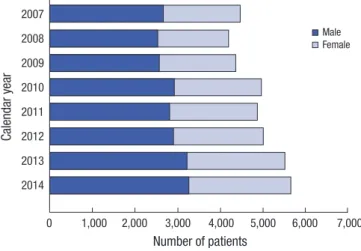
The sum of patients with KD during the study period was 39,082 (4,477 in 2007, 4,208 in 2008, 4,364 in 2009, 4,970 in 2010, 4,869 in 2011, 5,013 in 2012, 5,519 in 2013, and 5,662 in 2014). There were 22,907 male and 16,175 female patients. The male-to-fe- male ratio was 1.42, and the ratio was relatively constant during the period (1.47 in 2007, 1.52 in 2008, 1.44 in 2009, 1.43 in 2010, 1.38 in 2011, 1.37 in 2012, 1.40 in 2013, and 1.37 in 2014) (Fig. 1).
The mean age at the diagnosis of KD was 32.6 ± 24.4 months, and the median age was 28 months with a range of 1 month and 17 years. Most patients were young children: the number of the patients younger than 5 years old were 34,346 and the aver- age proportion of them was 87.9% during the period (87.1% in 2007, 87.1% in 2008, 87.3% in 2009, 87.4% in 2010, 89.4% in 2011, 88.2% in 2012, 88.1% in 2013, and 88.1% in 2014) (Table 1).
Annual incidence rate
The annual incidence rate of KD had been markedly increasing every year from 168.3 per 100,000 population aged 0 to 4 years
in 2007 to 217.2 in 2014, with two small peaks in 2007 and 2010 (168.3 in 2007 and 190.4 in 2010) (Table 1). The annual incidence rates of KD in male were 195.5 per 100,000 population aged 0 to 4 years in 2007, 185.4 in 2008, 190.1 in 2009, 217.4 in 2010, 211.4 in 2011, 215.1 in 2012, 240.3 in 2013, and 244.5 in 2014. The an- nual incidence rates of KD in female were 139.1 per 100,000 pop- ulation aged 0 to 4 years in 2007, 131.0 in 2008, 143.0 in 2009, 161.7 in 2010, 163.6 in 2011, 163.9 in 2012, 178.8 in 2013, and 188.4 in 2014.
Age-specific incidence rate
The age-specific incidence rate was the highest in children un- der 1 year of age, and gradually decreased with age, becoming below 100.0 per 100,000 population after 5 years (Fig. 2). The age-specific incidence rates were 245.7 per 100,000 population under 1 year, 222.8 in age 1, 198.3 in age 2, 160.0 in age 3, 108.7 in age 4, 59.8 in age 5, 29.6 in age 6, 12.6 in age 7, 7.5 in age 8, 4.1 in age 9, and 2.4 in age 10. The age-specific incidence rates in male were 292.9 per 100,000 population under 1 year, 256.4 in age 1, 221.8 in age 2, 175.6 in age 3, 120.3 in age 4, 64.8 in age 5, 32.8 in age 6, 13.9 in age 7, 8.2 in age 8, 5.0 in age 9, and 2.8 in
Table 1. Incidence rate of KD in children younger than 5 years of age by calendar year, 2007-2014 Year No. of total patients Population
< 5 yr Patients
< 5 yr
Incidence per 100,000
Total Male Female
2007 4,477 2,316,155 3,899 168.3 195.5 139.1
2008 4,208 2,302,912 3,665 159.1 185.4 131.0
2009 4,364 2,276,742 3,810 167.3 190.1 143.0
2010 4,970 2,281,200 4,343 190.4 217.4 161.7
2011 4,869 2,313,461 4,355 188.2 211.4 163.6
2012 5,013 2,324,347 4,422 190.2 215.1 163.9
2013 5,519 2,310,731 4,862 210.4 240.3 178.8
2014 5,662 2,297,244 4,990 217.2 244.5 188.4
Fig. 1. Total number of patients with KD by calendar year, 2007-2014. The sum of patients with KD during the study period was 39,082 (4,477 in 2007, 4,208 in 2008, 4,364 in 2009, 4,970 in 2010, 4,869 in 2011, 5,013 in 2012, 5,519 in 2013, and 5,662 in 2014). There were 22,907 male and 16,175 female patients.
Calendar year
Number of patients
0 1,000 2,000 3,000 4,000 5,000 6,000 7,000 2007
2008 2009 2010 2011 2012 2013 2014
Male Female
Fig. 2. Age-specific incidence rate of KD. The age-specific incidence rate was the highest in children under 1 year of age, and gradually decreased with age, becoming below 100.0 per 100,000 population after 5 years.
Incidence rate (per 100,000 patient-year)
Age in year
0 2 4 6 8 10 300
250 200 150 100 50 0
Male Total Female
age 10. The age-specific incidence rates in female were 195.7 per 100,000 population under 1 year, 187.1 in age 1, 173.3 in age 2, 143.3 in age 3, 96.2 in age 4, 54.5 in age 5, 26.1 in age 6, 11.1 in age 7, 6.8 in age 8, 3.1 in age 9, and 2.0 in age 10.
Monthly distribution
KD occurred more often in early summer (May, June and July) and winter (December and January), and occurred less often in spring and fall. The incidence of KD was high in December (9.95%
of total patients with KD) and July (9.08%), and was low in Oc- tober (7.06%) and February (7.13%) (Fig. 3).
We observed similar seasonal variations every year. The inci- dence of KD was relatively high in January, May, July, and De- cember in 2007, June and December in 2008, July and Decem- ber in 2009, July, August, and December in 2010, May and De- cember in 2011, May, June, November, and December in 2012, January and July in 2013, and January, July, and December in 2014. The incidence of KD was the lowest in September 2007 and the highest in December 2014 during the period (Fig. 4).
DISCUSSION
The nationwide epidemiologic surveys for KD had been con- ducted almost every 2 years since 1970 in Japan (2-5). In the surveys, questionnaires and diagnostic guidelines for KD were mailed to all specialized pediatric hospitals and general hospi- tals having pediatric departments with 100 or more beds (3-5).
The incidence rate of KD had been increasing rapidly since mid- 1990s, and approximately 300,000 patients with KD were regis- tered in Japan (3). The latest incidence rates in Japan were 243.1 per 100,000 population aged 0 to 4 years in 2011 and 264.8 in 2012 (3). Those were the highest incidence rates in the world (3).
In Korea, 5 patients with KD were first reported in 1973 and 2,224 patients with KD had been reported until 1986 (12,13).
The Korean Pediatric Heart Society had been conducting na- tionwide epidemiologic surveys every 3 years since 1991 (6-11).
They reported 1,709 patients with KD in 1991-1993, 2,680 in 1994- 1996, 3,862 in 1997-1999, 9,150 in 2000-2002, 9,662 in 2003-2005, 9,039 in 2006-2008, and 13,031 in 2009-2011 (6-11). The results were obtained from retrospective surveys that collected data using questionnaires for the patients with KD who were admit- ted to the hospitals with the pediatric residency program (6-11).
The results didn’t include the data of the patients with KD who were admitted to the hospitals without the pediatric residency program. Therefore, the results could underestimate the actual incidence rate of KD.
In this study, we used HIRA claims of the patients who re- ceived IVIG under the diagnosis of KD (ICD-10, M30.3) from January 2007 through December 2014. The entrance into the National Health Insurance is mandatory for everyone in Korea, so we could collect the entire data of the patients with KD who received IVIG. We thought that almost all patients with KD were included in our data, although we did not include the data of some patients with KD who did not receive IVIG (93.6% of pa- tients with KD were given IVIG between 2009 and 2011 accord- ing to the survey by the Korean Pediatric Heart Society) (6). We counted as a case when a patient received IVIG several times, and 1,142 patients (2.92% of total patients of KD) received IVIG twice or more during the period. We could not confirm the di- agnosis of KD, and the presence of cardiac complications, be- cause we just investigated HIRA claims for the use of IVIG. So the actual incidence rate of KD may be a little different with those of our study. Although our study has some limitations, it is the first attempt using the national database of patients with KD in Korea.
This study revealed again that KD occurred more often in male and the male-to-female ratio was 1.42. KD occurred mainly in children younger than 5 years and infants, and the average pro-
Number of patients
Month
1 2 3 4 5 6 7 8 9 10 11 12 4,000
3,000
2,000
1,000
0
Fig. 3. Number of patients with KD by month, 2007-2014. KD occurred more often in early summer and winter. The incidence of KD was high in December (9.95% of total patients with KD) and July (9.08%), and was low in October (7.06%) and Febru- ary (7.13%).
Fig. 4. Number of patients with KD by month in every year, 2007-2014. We observed similar seasonal variations every year. The incidence of KD was the lowest in Septem- ber 2007 and the highest in December 2014 during the period.
Number of patients
Calendar year
2007 2008 2009 2010 2011 2012 2013 2014 700
600 500 400 300 200 100
Male Total Female
portion of them was 87.9%. The incidence rate decreased mark- edly below 100 per 100,000 population after 5 years, and below 1 per 100,000 population after 11 years. The results were consis- tent with those of the previous studies in Korea and Japan (3-11).
The incidence rate of KD was much higher in this study com- pared to those of the former surveys conducted by the Korean Pediatric Heart Society during the same period (6-11). The lat- est incidence rate was 217.2 per 100,000 population aged 0 to 4 years in 2014 in this study. However, both studies showed an increasing trend of the incidence rate of KD every year, and it was consistent with the results of the studies by the Japan Ka- wasaki Disease Research Committee (3-11). Because the cause of KD is still unknown, the reason for the increase in the inci- dence rate is also unknown. If the cause of KD is infection, chan- ges in the toxicity of causative microorganisms may be the rea- son for the increasing incidence rate (5). The increased aware- ness of KD among physicians and the general population in Korea may be another reason (6). Anyway, the incidence rate of KD in Korea is the second highest in the world after Japan (Ta- ble 2) (3). We also observed that there were two small peaks of incidences of KD in 2007 and 2010 in Korea (Table 2). It may im- ply that infectious agents might be the cause of KD.
Taiwan reported that the incidence rate of KD was 66 per 100,000 population aged 0 to 4 years from 1996 to 2002, and 69 from 2003 to 2006 (14,15). Taiwan has the third highest incidence rate of KD in the world. China reported that the incidence rate of KD was 18.2-27.8 per 100,000 population aged 0 to 4 years from 1995 to 1999 and 40.9-55.1 from 2000 to 2004 in Beijing (16, 17). In addition, the incidence rate was 16.79-36.76 per 100,000 population aged 0 to 4 years from 1998 to 2002 and 46.3 from 2003 to 2007 in Shanghai, and 26 from 1994 to 1997 and 39 from 1997 to 2000 in Hong Kong (18-20). An increasing trend of the incidence rate of KD was also distinctive in China, as in Japan and Korea. However, the incidence rate of KD was much lower in other continents. The incidence rate of KD was reported be-
low 10 per 100,000 population aged 0 to 4 years in several coun- tries in Europe (England, Denmark, Sweden, Finland, France, and Netherlands) (21-25). In Australia, the average annual inci- dence rate was 2.82 per 100,000 population aged 0 to 4 years from 1980 to 1989, 7.96 from 1990 to 1999, and 9.34 from 2000 to 2009 (26). In Canada, the average annual incidence rate was 14.4 per 100,000 population aged 0 to 4 years from 1995 to 1997 and 26.2 from 2004 to 2006 (27). In the United States, the hospi- talization rate for KD was 17.5 per 100,000 population aged 0 to 4 years in 1997, 17.1 in 2000, 19.6 in 2003, and 20.8 in 2006 (28,29).
The increasing trend of the incidence rate of KD was disdinctive in Northeast Asia, but was not in other continents (29). We pos- tulated that some genetic or environmental factors might in- volve the difference.
This study revealed relatively high incidence rates of KD in winter and summer with small variations in each year. It was similar to the results of former studies in Korea and Japan, but was different from those of studies in Beijing, Shanghai, and Taiwan, in which they observed relatively high incidence rates in spring and summer (3-11,14-19). We postulated that Korea and Japan showed similar seasonal variations, because the two countries are very close geographically to each other and have similar climates, in contrast to China and Taiwan. Such season- al variations in the incidence rate of KD were noted across the non-tropical Northern hemisphere, and were not in the tropics and the Southern hemisphere (30). It may imply that possible causative agents of KD may be mainly spread in the non-tropi- cal Northern hemisphere and be predominant in some seasons in the regions (30). Therefore we could postulate that KD might be caused by infectious agents, and some genetic or environ- mental factors might influence the occurrence of KD.
In conclusion, this study was the first attempt using the na- tional database including the patients with KD who were given IVIG, and showed that the incidence rates of KD in Korea were much higher than those of the former surveys by the Korean Pediatric Heart Society during the same period. In addition, the incidence rates had been increasing every year, reaching 217.2 per 100,000 population aged 0 to 4 years in 2014. It was the sec- ond highest incidence rate in the world after Japan.
DISCLOSURE
The authors have no potential conflicts of interest to disclose.
AUTHOR CONTRIBUTION
Conception and design of this study: Ha S, Seo GH, Kim DS.
Acquisition, analysis and interpretation of data: Seo GH. Writ- ing manuscript: Ha S. Critical review: Kim KY, Kim DS. Approv- al of final draft: all authors.
Table 2. Comparison of incidence rates of KD in children younger than 5 years of age (No./100,000)
Year
Incidence rate in the surveys by the
Korean Pediatric Heart Society (6-8)
Incidence rate in this study
Incidence rate in the surveys by the Japan Kawasaki Disease Research Committee (3-5)
2004 106.4 174.0
2005 104.6 181.1
2006 108.7 188.1
2007 118.3 168.3 215.3
2008 112.5 159.1 218.6
2009 115.4 167.3 206.2
2010 132.9 190.4 239.6
2011 134.4 188.2 243.1
2012 190.2 264.8
2013 210.4
2014 217.2
ORCID
Sangmi Ha http://orcid.org/0000-0002-6069-5946 Gi Hyeon Seo http://orcid.org/0000-0001-7414-0258 Kyu Yeun Kim http://orcid.org/0000-0002-8035-4436 Dong Soo Kim http://orcid.org/0000-0002-3270-506X REFERENCES
1. Kawasaki T. Acute febrile mucocutaneous syndrome with lymphoid in- volvement with specific desquamation of the fingers and toes in children.
Arerugi 1967; 16: 178-222.
2. Taubert KA. Epidemiology of Kawasaki disease in the United States and worldwide. Prog Pediatr Cardiol 1997; 6: 181-5.
3. Makino N, Nakamura Y, Yashiro M, Ae R, Tsuboi S, Aoyama Y, Kojo T, Ue- hara R, Kotani K, Yanagawa H. Descriptive epidemiology of Kawasaki dis- ease in Japan, 2011-2012: from the results of the 22nd nationwide survey.
J Epidemiol 2015; 25: 239-45.
4. Nakamura Y, Yashiro M, Uehara R, Sadakane A, Tsuboi S, Aoyama Y, Ko- tani K, Tsogzolbaatar EO, Yanagawa H. Epidemiologic features of Kawa- saki disease in Japan: results of the 2009-2010 nationwide survey. J Epi- demiol 2012; 22: 216-21.
5. Nakamura Y, Yashiro M, Uehara R, Oki I, Watanabe M, Yanagawa H. Epi- demiologic features of Kawasaki disease in Japan: results from the nation- wide survey in 2005-2006. J Epidemiol 2008; 18: 167-72.
6. Kim GB, Han JW, Park YW, Song MS, Hong YM, Cha SH, Kim DS, Park S.
Epidemiologic features of Kawasaki disease in South Korea: data from nationwide survey, 2009-2011. Pediatr Infect Dis J 2014; 33: 24-7.
7. Park YW, Han JW, Hong YM, Ma JS, Cha SH, Kwon TC, Lee SB, Kim CH, Lee JS, Kim CH. Epidemiological features of Kawasaki disease in Korea, 2006-2008. Pediatr Int 2011; 53: 36-9.
8. Park YW, Han JW, Park IS, Kim CH, Cha SH, Ma JS, Lee JS, Kwon TC, Lee SB, Kim CH, et al. Kawasaki disease in Korea, 2003-2005. Pediatr Infect Dis J 2007; 26: 821-3.
9. Park YW, Han JW, Park IS, Kim CH, Yun YS, Cha SH, Ma JS, Lee SB, Kim CH, Lee HJ, et al. Epidemiologic picture of Kawasaki disease in Korea, 2000-2002. Pediatr Int 2005; 47: 382-7.
10. Park YW, Park IS, Kim CH, Ma JS, Lee SB, Kim CH, Yun YS, Lee HJ, Lee SK, Tockgo YC. Epidemiologic study of Kawasaki disease in Korea, 1997- 1999: comparison with previous studies during 1991-1996. J Korean Med Sci 2002; 17: 453-6.
11. Park YW, Kim CH, Park IS, Ma JS, Lee SB, Kim CH, Yun YS, Lee KS, Lee SK, Tockgo YC. Epidemiologic study of Kawasaki disease in Korea, 1994- 1996: comparison of previous study in 1991-1993. J Korean Pediatr Soc 1999; 42: 1255-60.
12. Park JS, Seo CJ, Cho SH, Lee DB. Clinical observation of mucocutaneous lymph node syndrome: 5 cases. J Korean Pediatr Soc 1973; 16: 61-7.
13. Lee DB. Epidemiologic study of Kawasaki disease in Korea. Prog Clin Biol Res 1987; 250: 55-60.
14. Huang WC, Huang LM, Chang IS, Chang LY, Chiang BL, Chen PJ, Wu MH,
Lue HC, Lee CY; Kawasaki Disease Research Group. Epidemiologic fea- tures of Kawasaki disease in Taiwan, 2003-2006. Pediatrics 2009; 123: e401-5.
15. Chang LY, Chang IS, Lu CY, Chiang BL, Lee CY, Chen PJ, Wang JT, Ho HN, Chen DS, Huang LM; Kawasaki Disease Research Group. Epidemiologic features of Kawasaki disease in Taiwan, 1996-2002. Pediatrics 2004; 114:
e678-82.
16. Du ZD, Zhao D, Du J, Zhang YL, Lin Y, Liu C, Zhang T; Beijing Kawasaki Research Group. Epidemiologic study on Kawasaki disease in Beijing from 2000 through 2004. Pediatr Infect Dis J 2007; 26: 449-51.
17. Du ZD, Zhang T, Liang L, Meng X, Li T, Kawasaki T, Nakamura Y, Yanaga- wa H. Epidemiologic picture of Kawasaki disease in Beijing from 1995 through 1999. Pediatr Infect Dis J 2002; 21: 103-7.
18. Ma XJ, Yu CY, Huang M, Chen SB, Huang MR, Huang GY; Shanghai Ka- wasaki Research Group. Epidemiologic features of Kawasaki disease in Shanghai from 2003 through 2007. Chin Med J (Engl) 2010; 123: 2629-34.
19. Huang GY, Ma XJ, Huang M, Chen SB, Huang MR, Gui YH, Ning SB, Zhang TH, Du ZD, Yanagawa H, et al. Epidemiologic pictures of Kawasaki dis- ease in Shanghai from 1998 through 2002. J Epidemiol 2006; 16: 9-14.
20. Ng YM, Sung RY, So LY, Fong NC, Ho MH, Cheng YW, Lee SH, Mak WC, Wong DM, Yam MC, et al. Kawasaki disease in Hong Kong, 1994 to 2000.
Hong Kong Med J 2005; 11: 331-5.
21. Harnden A, Alves B, Sheikh A. Rising incidence of Kawasaki disease in England: analysis of hospital admission data. BMJ 2002; 324: 1424-5.
22. Harnden A, Mayon-White R, Perera R, Yeates D, Goldacre M, Burgner D.
Kawasaki disease in England: ethnicity, deprivation, and respiratory patho- gens. Pediatr Infect Dis J 2009; 28: 21-4.
23. Fischer TK, Holman RC, Yorita KL, Belay ED, Melbye M, Koch A. Kawa- saki syndrome in Denmark. Pediatr Infect Dis J 2007; 26: 411-5.
24. Schiller B, Fasth A, Björkhem G, Elinder G. Kawasaki disease in Sweden:
incidence and clinical features. Acta Paediatr 1995; 84: 769-74.
25. Heuclin T, Dubos F, Hue V, Godart F, Francart C, Vincent P, Martinot A;
Hospital Network for Evaluating the Management of Common Childhood Diseases. Increased detection rate of Kawasaki disease using new diag- nostic algorithm, including early use of echocardiography. J Pediatr 2009;
155: 695-699.e1.
26. Saundankar J, Yim D, Itotoh B, Payne R, Maslin K, Jape G, Ramsay J, Ko- thari D, Cheng A, Burgner D. The epidemiology and clinical features of Kawasaki disease in Australia. Pediatrics 2014; 133: e1009-14.
27. Lin YT, Manlhiot C, Ching JC, Han RK, Nield LE, Dillenburg R, Pepelassis D, Lai LS, Smythe JF, Chahal N, et al. Repeated systematic surveillance of Kawasaki disease in Ontario from 1995 to 2006. Pediatr Int 2010; 52: 699- 706.
28. Holman RC, Belay ED, Christensen KY, Folkema AM, Steiner CA, Schon- berger LB. Hospitalizations for Kawasaki syndrome among children in the United States, 1997-2007. Pediatr Infect Dis J 2010; 29: 483-8.
29. Uehara R, Belay ED. Epidemiology of Kawasaki disease in Asia, Europe, and the United States. J Epidemiol 2012; 22: 79-85.
30. Burns JC, Herzog L, Fabri O, Tremoulet AH, Rodó X, Uehara R, Burgner D, Bainto E, Pierce D, Tyree M, et al. Seasonality of Kawasaki disease: a glob- al perspective. PLoS One 2013; 8: e74529.