81
Open Access
Effectiveness of Medium-Dose Intravenous Immunoglobulin (1 g/kg) in the Treatment of Kawasaki Disease
Joong-Seok Yeo, MD and Jong-Woon Choi, MD
Department of Pediatrics, Bundang Jesaeng General Hospital, Daejin Medical Center, Seongnam, Korea ABSTRACT
Background and Objectives: High-dose intravenous immunoglobulin (IVIG) (2 g/kg) is usually given in the treatment of Kawasaki disease (KD). According to the authors’ experience, however, medium-dose immuno- globulin (1 g/kg) was also effective in the majority of patients. We performed a retrospective clinical study to validate effectiveness of the medium-dose regimen in treatment of KD. Subjects and Methods: A total of 274 pa- tients with KD who were treated with medium-dose immunoglobulin at Bundang Jesaeng General Hospital from July 1998 to October 2007 were enrolled. Results: Medium-dose immunoglobulin was given once in 220 patients (group A; 80.3%) and twice or more in 54 patients (group B; 19.7%). Age and gender distributions, duration of fever before treatment, hemoglobin concentrations, and white blood cell and platelet counts did not differ significantly between the two groups (p>0.05). Concentrations of C-reactive protein, aspartate aminotrans- ferase, alanine aminotransferase, and bilirubin were significantly higher in group B (p<0.005). Coronary arterial lesions (CAL) were found in 51 patients (23.2%) in group A and in 26 patients (48.1%) in group B during the acute stage, and in 14 patients (6.4%) in group A and in 11 patients (20.4%) in group B during the convalescent stage (p<0.005, respectively). A giant aneurysm was found in one patient in each group (0.5% in group A and 1.9% in group B; p<0.005) during the follow-up period. Conclusion: A single infusion of medium-dose im- munoglobulin was effective in 80% of patients with KD. About 20% of patients required two or more infusions of medium-dose immunoglobulin, who had higher concentrations of C-reactive protein, aspartate aminotransferase, alanine aminotransferase and bilirubin. The authors think that the medium-dose regimen proffers an advantage over the high-dose regimen in view of cost-effectiveness. (Korean Circ J 2010;40:81-85)
KEY WORDS: Kawasaki disease; Immunoglobulin; Intravenous infusions.
Introduction
Kawasaki disease (KD) is an acute febrile exanth- ematous illness involving development of vasculitis in various tissue and organs, and frequently affects coro- nary arteries and cardiac tissue, causing coronary ectasia or aneurysm, myocarditis, valvulitis, and pericarditis.1)
KD is now the most important cause of acquired heart disease in infants and children.2) These days, treatment of KD consists of intravenous immunoglobulin (IVIG) and oral aspirin, and IVIG is usually administered as a single infusion of 2 g/kg (high-dose IVIG).1) However, some clinical studies have shown that a single infusion of IVIG 1 g/kg (medium-dose IVIG) was also effec- tive.3-7) Since the 1990s, Han et al.8) has administered medium-dose IVIG as the initial treatment for patients with KD, giving one more infusion after 48 hours if fever persisted, and results that such a mediumdose regimen have been good.
The cost of IVIG is high (about 40,000-45,000 won/
2.5 g). For a patient weighing 20 kg and receiving high- dose IVIG, the cost of IVIG is about 640,000-720,000 won. If the patient receives medium-dose IVIG, the cost will be reduced to 320,000-360,000 won. Therefore, the authors think that the medium-dose regimen proffers an
Received: May 25, 2009 Revision Received: July 29, 2009 Accepted: August 14, 2009
Correspondence: Jong-Woon Choi, MD,Department of Pediatrics, Bun- dang Jesaeng General Hospital, Daejin Medical Center, 255-2 Seo- hyeon-dong, Bundang-gu, Seongnam 463-774, Korea
Tel: 82-31-779-0274, Fax: 82-31-779-0894 E-mail: [email protected]
○ cc This is an Open Access article distributed under the terms of the Creative Commons Attribution Non-Commercial License (http://creativecommons.
org/licenses/by-nc/3.0) which permits unrestricted non-commercial use, distribution, and reproduction in any medium, provided the original work is properly cited.
advantage over the high-dose regimen in view of cost- effectiveness, if the two regimens are equally effective.
We therefore performed a retrospective clinical study to validate effectiveness of the medium-dose regimen in treatment of KD.
Subjects and Methods
Two hundred seventy four patients (162 males and 112 females; M:F=1.45:1) with KD were admitted to Bundang Jesaeng General Hospital from July 1998 to October 2007. The proportion of patients with KD was 1.57% of all patients admitted to the pediatric ward (with the exception of the neonatal unit) of the hospi- tal during the study period. Diagnosis of KD was based on the presence of fever for 5 days or more and presen- tation with 4 or more of 5 principal clinical features (bilateral bulbar conjunctival injection; changes in lips, tongue, or oral mucosa; cervical lymphadenopathy gr- eater than 1.5 cm in diameter; polymorphous skin rash;
changes in extremities).9) In cases where a patient had fever for 7 days or more, and 3 or less of 5 principal cli- nical features, and other diseases were excluded, echo- cardiography was performed. If findings on echocar- diography were abnormal {coronary arterial lesions (CAL), decreased ventricular systolic function, significant val- vular regurgitation, and pericardial effusion}, the patient was diagnosed as having KD.1) CAL included ectasia and aneurysm. Normal internal diameters of coronary arteries were defined as 2.5 mm or less in infants less than 1 year old, 3 mm or less in children from 1 to 4 years old, and 4 mm or less in children 5 years or older.
Significant valvular regurgitation was defined as mitral or aortic valvular regurgitation of grade 1 or more and tricuspid or pulmonary valvular regurgitation of grade 2 or more, according to the previous study.10)
Medium-dose IVIG (1 g/kg) was infused over 8-10 hours as the initial treatment as soon as the diagnosis of KD was made. If fever did not subside within 48
hours, one more infusion of medium-dose IVIG was given. If fever persisted or relapsed thereafter, one or more infusions of medium-dose IVIG was given again.
Aspirin (30-50 mg/kg/day) was given orally in 3 di- vided doses from the time of diagnosis until one week after defervescence; the dosage was then reduced to 3- 5 mg/kg/day in a single dose.
Patients treated with a single infusion of mediumdose IVIG were defined as group A, and patients treated with two or more infusions were defined as group B. Patient characteristics in both groups were compared; these in- cluded demographic features, duration of fever before and after treatment, laboratory findings, and rates of CAL. Continuous variables were described as mean±
standard deviation. Statistical analyses were performed by means of the Student t-test for continuous variables and the Chi-square test for rates and proportions. P of less than 0.05 was considered statistically significant.
Results
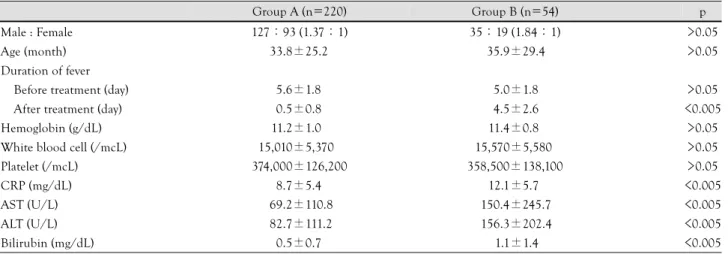
Among 274 patients, 220 of them showed improve- ment with a single infusion of medium-dose IVIG (group A; n=220; 80.3%). Forty one patients showed improvement with two infusions, 11 patients showed improvement with three infusions, and two patients showed improvement with four and five infusions each (group B; n=54; 19.7%). Male-to-female ratios (1.37:
1 in group A vs. 1.84:1 in group B), age distributions (33.8±25.2 vs. 35.9±29.4 months), duration of fever before treatment (5.6±1.8 vs. 5.0±1.8 days), hemo- globin concentrations (11.2±1.0 vs. 11.4±0.8 g/dL), white blood cell counts (15,010±5,370 vs. 15,570±
5,580/mcL), and platelet counts (374,000±126,200 vs.
358,500±138,100/mcL) did not differ significantly be- tween the two groups (p>0.05) (Table 1).
Duration of fever after treatment was significantly longer in group B than in group A (0.5±0.8 days in group A vs. 4.5±2.6 days in group B), and concen-
Table 1. Comparison of demographic features and laboratory findings in each group
Group A (n=220) Group B (n=54) p
Male : Female 127:93 (1.37:1) 35:19 (1.84:1) >0.05
Age (month) 33.8±25.2 35.9±29.4 >0.05
Duration of fever
Before treatment (day) 5.6±1.8 5.0±1.8 >0.05
After treatment (day) 0.5±0.8 4.5±2.6 <0.005
Hemoglobin (g/dL) 11.2±1.0 11.4±0.8 >0.05
White blood cell (/mcL) 15,010±5,370 15,570±5,580 >0.05
Platelet (/mcL) 374,000±126,200 358,500±138,100 >0.05
CRP (mg/dL) 8.7±5.4 12.1±5.7 <0.005
AST (U/L) 69.2±110.8 150.4±245.7 <0.005
ALT (U/L) 82.7±111.2 156.3±202.4 <0.005
Bilirubin (mg/dL) 0.5±0.7 1.1±1.4 <0.005
CRP: C-reactive protein, AST: aspartate aminotransferase, ALT: alanine aminotransferase
trations of C-reactive protein (8.7±5.4 vs. 12.1±5.7 mg/dL), aspartate aminotransferase (69.2±110.8 vs.
150.4±245.7 U/L), alanine aminotransferase (82.7±
111.2 vs. 156.3±202.4 U/L), and total bilirubin (0.5
±0.7 vs. 1.1±1.4 mg/dL) were significantly higher in group B than in group A (p<0.005, respectively) (Table 1).
CAL were found in 51 patients (23.2%) in group A and 26 patients (48.1%) in group B who were in the acute stage (p<0.005). CAL were found in 14 patients (6.4%) in group A and 11 patients (20.4%) in group B who were in the convalescent stage (p<0.005). During the follow-up period, CAL disappeared in 13 of 14 pa- tients in group A and in 7 of 11 patients in group B. A giant aneurysm of 8 mm or more in diameter was found in one patient in each group (0.5% in group A and 1.9%
in group B; p<0.005) (Table 2). Three patients in group B were lost to follow-up.
Discussion
Suppression of acute inflammatory reactions and pre- vention or reduction of cardiac complications, such as coronary aneurysm are the goals of treatment in KD.
Efficacy of IVIG in treatment of KD was first reported in 1984.11) IVIG was given at the dosage of 400 mg/kg/
day for 3-5 consecutive days during the earlier period.
It was reported years later that a single infusion of IVIG 2 g/kg suppressed acute symptoms of KD more rapidly, decreased duration of both intravenous injection and hospitalization, and effectively prevented coronary an- eurysm.12-14) Thereafter, a single infusion of high-dose IVIG became the standard regimen in treatment of KD (the high-dose regimen).
Opinions have differed, however, on the effective dosage of IVIG in treatment of KD. Engle et al.3) re- ported that a single infusion of IVIG 1 g/kg was ef- fective in treatment of KD, and Furusho et al.4) sug- gested that the dosage of IVIG should be 1 g/kg or more for effective prevention of CAL. Barron et al.5) com- pared effectiveness of a single infusion of IVIG 1 g/kg and infusions of 400 mg/kg/day for 4 days and re- ported that a single infusion of 1 g/kg suppressed fever more rapidly and prevented coronary aneurysm with equal effectiveness. Ihn et al.6) and Qin et al.7) com- pared effectiveness of IVIG 1 g/kg and 2 g/kg and re- ported that the two regimens were equally effective. Han et al.8) performed a clinical study to evaluate effectiveness
of medium-dose IVIG during the 1990s. Results from that study showed improvement in 86% of patients with a single infusion of IVIG 1 g/kg and 14% showed im- provement with two infusions of IVIG 1 g/kg. Rates of coronary aneurysm showed no significant difference from each other or from patients treated with a single infusion of IVIG 2 g/kg. Therefore, Han et al.8) thoug- ht that medium-dose IVIG was effective in the ma- jority of patients with KD and that the mediumdose regimen was more advantageous than the highdose re- gimen in view of cost-effectiveness.
KD shows various degrees of severity and ranges from a mild illness that subsides quickly without complica- tions to a very severe illness that is complicated by se- rious complications and can be fatal. Several scoring systems have been developed to identify patients at hi- gher risk for coronary aneurysm so that they can be tr- eated more aggressively. However, the scoring systems are not accurate, and their application in clinical prac- tice is somewhat cumbersome. Therefore, the authors recommend the medium-dose regimen in which a sin- gle infusion of IVIG 1 g/kg is given as the initial treat- ment. A single infusion of medium-dose IVIG will be sufficient for the majority of patients suffering mildto- moderate KD, and one or more additional infusions can be given to the minority of patients who suffer se- vere KD and do not respond to a single infusion of me- dium-dose IVIG.
In this study, 80% of patients showed improvement with a single infusion of IVIG 1 g/kg (group A) and 20% showed improvement with two or more infusions of IVIG 1 g/kg (group B). These results were similar to those of the previous study by Han et al.8) Demogra- phic features, duration of fever before treatment, hemo- globin concentrations, and white blood cell and plate- let counts did not differ significantly between two groups.
However, concentrations of C-reactive protein, aspartate aminotransferase, alanine aminotransferase, bilirubin, and rates of CAL were significantly higher in group B than in group A. It can be postulated that patients in group A suffered mild-to-moderate illness and patients in group B suffered severe illness. So the latter might require greater amounts of IVIG for suppression of more severe inflammatory reactions, and therefore develop CAL more frequently than the former. Therefore, the authors insist that even a single infusion of medium- dose IVIG is effective in the majority (about 80%) of patients, and one or more additional infusions are needed only in a minority (about 20%) of patients who do not respond to a single infusion of medium-dose IVIG. Use of the medium-dose regimen will reduce the cost of treatment by 40% roughly, compared with use of the high-dose regimen.
Some may have questions regarding the accuracy of diagnosis of KD in patients enrolled in this study. The
Table 2. Rates of coronary arterial lesions in each group Group A
(n=220) (%)
Group B
(n=54)(%) p Acute stage 51 (23.2) 26 (48.1) <0.005 Convalescent stage 14 (6.4)0 11 (20.4) <0.005 Follow-up period 1 (0.5)* 1 (1.9)* <0.005
*giant aneurysm
authors made their diagnoses based on currently ap- proved diagnostic criteria.1)9) The proportion of patients with KD was 1.57% of all patients admitted to the pe- diatric ward (with the exception of the neonatal unit) of Bundang Jesaeng General Hospital during the study period. This proportion was similar to the mean pro- portion of patients with KD (1.48%) in a recent na- tionwide survey.15) Therefore, the authors think that the diagnosis of KD in patients enrolled in this study was accurate.
In this study, the authors defined normal internal diameters of coronary arteries as 2.5 mm or less in in- fants less than 1 year old, 3 mm or less in children from 1 year to 4 years old, and 4 mm or less in children 5 years or older. The Japanese Ministry of Health de- fines normal internal diameters of coronary arteries as 3 mm or less in children 4 years or younger and 4 mm or less in children 5 years or older.16) In the opinion of the authors, however, the criteria of the Japanese Mi- nistry of Health are too simple and may underestimate of rates CAL in small infants. Nakano et al.17) and de Zorzi et al.18) proposed that normal internal diameters of coronary arteries be 2.5 mm or less if body surface area (BSA) is less than 0.5 m2, 2.5-3 mm if BSA is 0.5- 1 m2, and 3 mm or more if BSA is 1 m2 or more. Other criteria define normal internal diameters of coronary arteries as 2.5 mm or less in children weighing less than 12.5 kg, 2.5-3 mm in children weighing between 12.5 kg and 27.5 kg, and 3-5 mm in children weighing 27.5 kg or more.19) Therefore, the authors classified infants less than 1 year old separately, and, within this context, defined the normal internal diameter of coronary ar- teries as 2.5 mm or less. Rates of CAL in this study were higher than those in other studies. The reasons for these results could be explained by the following: The authors included mild coronary ectasia into CAL, and more in- fants may have been diagnosed with CAL by use of our detailed criteria on the normal diameter of coronary arteries in infants.
The limitations of this study are that it is a retro- spective study, and we evaluated treatment outcomes in patients treated with medium-dose IVIG, instead of comparing them with those in patients treated with high-dose IVIG. However, in the previous study by Han et al.8) treatment outcomes in patients treated with medium-dose IVIG were similar to those in patients treated with high-dose IVIG.8) Therefore, the authors think that effectiveness of medium-dose IVIG is con- sistent and comparable with that of high-dose IVIG in the majority of patients with KD. In the minority of patients with severe KD, however, two or more infu- sions of medium-dose IVIG will be required. In con- clusion, the authors think that the regimen with me- dium-dose IVIG (1 g/kg) is effective in the majority of patients with KD and proffers an advantage over the
regimen with high-dose IVIG (2 g/kg) in view of cost- effectiveness.
Acknowledgments
The abstract of this article was presented at the 2nd Asia-Pacific Congress of Pediatric Cardiology and Cardiac Surgery in May 2008 in Jeju, Korea.
REFERENCES
1) Newburger JW, Takahashi M, Gerber MA, et al. Diagnosis, tr- eatment, and long-term management of Kawasaki disease: a st- atement for health professionals from the Committee on Rheu- matic Fever, Endocarditis, and Kawasaki Disease, Council on Cardiovascular Disease in the Young, American Heart Associa- tion. Pediatrics 2004;114:1708-33.
2) Taubert KA, Rowley AH, Shulman ST. Nationwide survey of Kawasaki disease and acute rheumatic fever. J Pediatr 1991;
119:279-82.
3) Engle MA, Fatica NS, Bussel JB, O’Loughlin JE, Snyder MS, Lesser ML. Clinical trial of single-dose intravenous gamma glo- bulin in acute Kawasaki disease: preliminary report. Am J Dis Child 1989;143:1300-4.
4) Furusho K, Kamiya T, Nakano H, et al. Intravenous gammaglo- bulin for Kawasaki disease. Acta Paediatr Jpn 1991;33:799-804.
5) Barron KS, Murphy DJ, Silverman ED, et al. Treatment of Ka- wasaki syndrome: a comparison of two dosage regimens of in- travenously administered immune globulin. J Pediatr 1990;117:
638-44.
6) Ihn SM, Ann RZ, Kil HR, Chung YH. Selective gamma globulin treatment in Kawasaki disease: the comparison between single 1 g/kg and 2 g/kg. J Korean Pediatr Soc 2000;43:920-5.
7) Qin LJ, Wang HW, Hu XF, et al. Therapeutic effectiveness of intravenous immunoglobulin at 1 g/kg and 2 g/kg on Kawasaki disease: a comparative and follow-up study. Zhonghua Er Ke Za Zhi 2006;44:891-5.
8) Han SB, Choi JW, Kim SK, Chung SW, Kim JG, Son BK. The optimal dosages of gammaglobulin and aspirin in treating Ka- wasaki disease. J Korean Pediatr Soc 1996;39:703-11.
9) Dajani AS, Taubert KA, Gerber MA, et al. Diagnosis and ther- apy of Kawasaki disease in children. Circulation 1993;87:1776- 80.
10) Choi CH, Byun SH, Jeon JD, Choi JW. Usefulness of echocar- diographic findings in the early diagnosis of Kawasaki disease. J Korean Pediatr Soc 2007;50:47-51.
11) Furusho K, Nakano H, Shinomiya K, et al. High-dose intraven- ous gammaglobulin for Kawasaki disease. Lancet 1984;2:1055-8.
12) Newburger JW, Takahashi M, Beiser AS, et al. A single intra- venous infusion of gamma globulin as compared with four infu- sions in the treatment of acute Kawasaki syndrome. N Engl J Med 1991;324:1633-9.
13) Kang MK, Cho EY, Kim YH, et al. Treatment of Kawasaki dise- ase with single high-dose intravenous gammaglobulin. J Korean Pediatr Soc 1992;35:342-8.
14) Moon SY, Kim NS, Lee HB, Lee H. Comparative study about the therapeutic effect between single and five-day administration of gammaglobulin in Kawasaki disease. Korean Circ J 1994;24:
77-85.
15) Park YW, Han JW, Park IS, et al. Kawasaki disease in Korea, 2003-2005. Pediatr Infect Dis J 2007;26:821-3.
16) Research Committee on Kawasaki Disease. Reports of Subcom- mittee on Standardization of Diagnostic Criteria and Reporting of Coronary Artery Lesions in Kawasaki Disease. Tokyo: Mini- stry of Health and Welfare; 1983. p.48-54.
17) Nakano H, Ueda K, Saito A, Nojima K. Repeated quantitative angiograms in coronary arterial aneurysms in Kawasaki disease.
Am J Cardiol 1985;56:846-51.
18) de Zorzi A, Colan SD, Gauvreau K, Baker AL, Sundel RP, New- burger JW. Coronary artery dimensions may be misclassified as normal in Kawasaki disease. J Pediatr 1998;133:254-8.
19) Takahashi M. Kawasaki syndrome (mucocutaneous lymph node syndrome). In: Allen HD, Gutgesell HD, Clark EB, Driscoll DJ editors. Moss and Adams Heart Disease in Infants, Children, and Adolescents: Including the Fetus and Young Adult. 6th ed. Phila- delphia: Lippincott Williams & Wilkins; 2000. p.1216-25.