• 검색 결과가 없습니다.

Alternative Therapies with Tacrolimus and Low-Dose Doxycycline for Oral Chronic Graft-versus-Host Disease That Is Resistant to Topical Corticosteroid Medication: Case Report JOMP

N/A
N/A
Protected

Academic year: 2021

Share "Alternative Therapies with Tacrolimus and Low-Dose Doxycycline for Oral Chronic Graft-versus-Host Disease That Is Resistant to Topical Corticosteroid Medication: Case Report JOMP"

Copied!
5
0
0

로드 중.... (전체 텍스트 보기)

전체 글

(1)

pISSN 2288-9272 eISSN 2383-8493 J Oral Med Pain 2018;43(1):16-20 https://doi.org/10.14476/jomp.2018.43.1.16

Alternative Therapies with Tacrolimus and Low-Dose Doxycycline for Oral Chronic Graft-versus-Host Disease That Is Resistant to Topical Corticosteroid Medication: Case Report

Hye-Min Ju 1,2 , Yong-Woo Ahn 2,3 , Soo-Min Ok 2,3 , Sung-Hee Jeong 2,3

1

Department of Oral Medicine, Pusan National University Dental Hospital, Yangsan, Korea

2

Dental Research Institute, Pusan National University Dental Hospital, Yangsan, Korea

3

Department of Oral Medicine, School of Dentistry, Pusan National University, Yangsan, Korea

Received February 6, 2018 Revised February 27, 2018 Accepted March 2, 2018

Graft-versus-host disease (GVHD) is frequent complications of hematopoietic stem cell trans- plantation. In the chronic GVHD (cGVHD), the oral cavity is the most commonly affected re- gion. The clinical manifestations include erythema, ulceration, lichenoid-hyperkeratotic change in oral mucosa, dry mouth, and limitation of mouth opening. The initial treatment strategy of oral cGVHD patients is topical corticosteroid therapy in various formulation. However, corti- costeroid resistance appears in some patients. We report a case of a 25-year-old male patient with oral cGVHD, who has resistance to topical corticosteroid medication, treated with 0.03%

tacrolimus ointment and low-dose doxycycline. The patient showed subjective and objective improvement without side effect.

Key Words: Low-dose doxycycline; Oral chronic graft-versus-host disease; Resistance to ste- roid; Tacrolimus

Correspondence to:

Sung-Hee Jeong

Department of Oral Medicine, School of Dentistry, Pusan National University, 49 Busandaehak-ro, Mulgeum-eup, Yangsan 50612, Korea

Tel: +82-55-360-5242 Fax: +82-55-360-5238 E-mail: [email protected]

Report

JOMP Journal of Oral Medicine and Pain

Copyright Ⓒ 2018 Korean Academy of Orofacial Pain and Oral Medicine. All rights reserved.

CC

This is an open-access article distributed under the terms of the Creative Commons Attribution Non-Commercial License (http://creativecommons.org/licenses/by-nc/4.0/), which permits unrestricted non-commercial use, distribution, and reproduction in any medium, provided the original work is properly cited.

INTRODUCTION

Graft-versus-host disease (GVHD) is frequent and seri- ous complications of hematopoietic stem cell transplanta- tion (HSCT). The major cause of GVHD is incompatibility between the Human leukocyte antigen (HLA) system anti- gens of the donor and recipient. It has been a convention that GVHD is supposed to be subdivided into either acute GVHD (aGVHD) or chronic GVHD (cGVHD), which depends on the timing of GVHD manifestations—aGVHD (before day +100 after transplantation), or cGVHD (after day +100).

Recently; however, aGVHD and cGVHD are thought to be differentiated by mutually different processes and mecha- nisms, not by the time of clinical onset.

1)

Among poten- tial regions cGVHD may affect, the oral cavity is the most

commonly affected region. Typical clinical manifestations of oral cGVHD include lichen-type features, hyperkeratotic plaques, and restriction of mouth opening from sclerosis.

1,2)

Clinical changes like erythema, ulceration, and lichenoid- hyperkeratotic change occur in oral mucosa. They can oc- cur anywhere in oral cavity, but are most commonly seen in tongue and buccal mucosa. The oral condition can range from mild, moderate to severe and it cause pain and limited functional ability.

1,3,4)

The first-line treatment of oral cGVHD patients is topical

corticosteroid therapy in various formulations. Topical ste-

roid gargle solutions are used for a wide range of oral ap-

plications, and high-efficacy corticosteroid gels and intrale-

sional injection of triamcinolone acetonide are effective for

limited area management.

1)

However, to date, the definition

(2)

of steroid-refractory cGVHD has not been uniformly ex- plained, but half of the patients require secondary treat- ment.

5,6)

There are several options for the second-line treat- ment for patients with resistance to steroids, but the most preferred is the calcineurin inhibitor tacrolimus ointment.

1,4)

This case report describes a case of alternative therapies including tacrolimus in a 25-year-old male oral cGVHD who is resistant to steroids.

CASE REPORT

A 25-year-old male patient visited the Department of Oral Medicine at the Pusan National University Dental Hospital for the address as follows his mouth was dry and his buccal mucosa were sore. He had been diagnosed with acute myeloid leukemia 5 years ago and received HSCT 3 months later from HLA-matched elder sister, after being re- ceived conditioning regimen with total body irradiation.

After HSCT, cGVHD developed in skin, liver, eyes and oral mucosa. One tablet of prednisolone and tacrolimus were taken for 3 years as systemic immuno-suppressants. When the patient visited the clinic, all of the immunosuppressive medications had been stopped.

At intraoral clinical examination, the lesion was local- ized on the right buccal mucosa and presented with ery- thematous and ulceration lesion. Also, lichenoid hyper- keratosis was observed in 25%-50% of oral cavity. Saliva was not secreted at all and the mouth opening was limited to 30 mm. Oral cGVHD manifestation was scored using 15-point National Institutes of Health Oral Mucosal Score (NIH OMS) (Table 1).

7)

The total score was 7 at the first visit:

erythema–moderate (2), lichenoid hyperkeratosis–moderate (2), ulcers–moderate (3), and mucoceles (0).

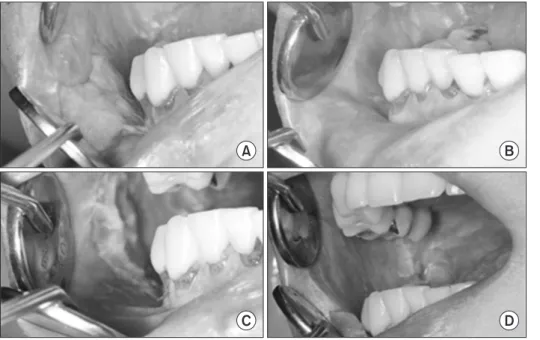
A recall exam was performed every 2 weeks. For one month, the patient was treated with topical agents such as steroid gargle solutions and fluocinonide 0.05% ointments, but there was no response (Fig. 1A). The patient also used topical antifungal agent (Diflucan; Pfizer, Paris, France) to prevent candida infection. After 2 months, intra-lesional injection was done with triamcinolone acetonide (40 mg/1 mL) 0.5 mg/site at twice and as a result subjective symp- tom was a little bit improved, while objective sign was not changed.

Four months after the treatment, tacrolimus was added to the topical agent. One month later, the size of right buccal mucosa lesion was reduced (Fig. 1B). Patient was instruct- ed to apply 0.03% tacrolimus ointment (Protopic; Fujisawa GmbH Deutschland, Munich, Germany) on right buccal mu- cosa lesion two times per day for 3 months and not to eat or rinse mouth for at least 30 minutes after application. The use of tacrolimus discontinued and a new lesion developed, continuing to change size and position without response for 6 months (Fig. 1C).

One year after the treatment, a low dose of doxycycline (20 mg, twice a day) was prescribed. The size of the lesion was reduced after 1 month of treatment and showed significant difference in lesion size at 2 months (Fig. 1D). Doxycycline was taken for a total of 7 months in combination with con- ventional topical corticosteroids agents. Since then, it has remained improved without any new lesions. The total score of NIH OMS was 2 at the last visit.

Table 1. The National Institutes of Health Oral Mucosal Score for cGVHD, scored 0-15: erythema, lichenoid, mucoceles (scored 0-3) and ulcers (scored 0-6)

Mucosal change

No evidence

of cGVHD Mild Moderate Severe

Erythema None 0 Mild erythema or morderate erythema (<25%)

1 Moderate (≥25%) or severe erythema (<25%)

2 Severe erythema (≥25%) 3

Lichenoid None 0 Hyperkeratotic changes (<25%)

1 Hyperkeratotic changes (25%-50%)

2 Hyperkeratotic changes (>50%) 3

Ulcers None 0 None 0 Ulcers involving ≤20% 3 Severe ulcers >20% 6

Mucoceles None 0 1-5 mucoceles 1 5-10 mucoceles 2 Over 10 mucoceles 3

cGVHD, chronic graft-versus-host disease.

Data from the article of Bassim CW, et al. Bone Marrow Transplant 2014;49:116-121.

7)

(3)

DISCUSSION

GVHD is a disease caused by HLA incompatibility be- tween receptor and donor, and immunopathogenic mecha- nism that causes GVHD has not been completely clarified, but it is known that donor T cell alloreactivity against re- ceptor tissue is the major cause. Conditioning after HSCT causes tissue damage, releases pro-inflammatory cytokines, and activates antigen-presenting cells (APCs). APCs pres- ent antigens to T cells, which activate donor T cells. This leads to apoptosis of keratinocyte. In the past, cGVHD was thought to be a continuous process that progressed from acute to chronic, but the causes of aGVHD and cGVHD are now different and each GVHD is being studied separately.

3,5)

cGVHD occurs when there’s immune deviation by decreased negative selection of alloreactive CD4

+

T cells, which is caused by damage to the thymus resulting from prior oc- currence of aGVHD or conditioning regimen. This induces the release of fibrogenic cytokines from type 2 T helper cells, which activates macrophage and thus produces trans- forming growth factor- β 1 and platelet-derived growth fac- tor. These molecules induce the proliferation and activity of fibroblasts in tissues. In addition, regulatory T cell reduction leads to autoreactive B cell appearance and autoreactive an- tibody induced by chronic stimulation of donor CD4

+

T cell.

All of these processes can cause systemic autoimmune re- actions due to fibroblast proliferation and activity.

1,2,8)

These

changes may occur in all organs, but predominantly in the mucosal surface of the eyes and oral cavity.

1,3,5)

Complications of oral cGVHD can be divided into oral mucosa, salivary gland, and sclerotic disease. Oral mucosa disease is characterized by hyperkeratotic lesions, which re- semble Wickham striae of oral lichen planus (OLP), erythe- ma, and pseudomembranous ulceration and it causes pain during swallowing and brushing. Salivary gland disease de- velops when lymphocytes infiltrate intralobular around the salivary gland duct and are released lymphocytes into the intralobular ducts and acini, and as a result fibrosis of sali- vary glands occurs, which leads to quantitative and qualita- tive changes of saliva. This causes xerostomia, and cervical and interproximal surface of the tooth are affected by car- ies. The patient in this case report complained of severe dry mouth. In both stimulation and non-stimulation, no saliva was secreted at all (0 mL/min), and most of the teeth had cervical caries. Plirocarpine (Salagen; Patheon Inc., Toronto, ON, Canada) was taken for 1 month, but there was no re- sponse. Finally, there is a sclerotic disease, which is charac- terized by manifestations of scleroderma. Sclerotic disease include limited mouth opening, restriction of food intake and difficulties in maintaining oral hygiene.

1,3,5,9)

The National Institutes of Health (NIH) scored four items:

erythema, lichenoid, ulcers, and mucoceles to determine objective criteria for severity of oral mucosa in cGVHD pa- tients, ranging from 0 to 15 of the score system. Using the

Fig. 1. Medical intervention that hugely changes the lesion. (A) After 1-month follow up (after 1 month from the begin- ning of the treatment with topical cor- ticosteroid agents). (B) After 5-months follow up (after 1 month from the be- ginning of the treatment with 0.03%

tacrolimus). The size of right buccal mucosa lesion at (B) was reduced than (A). (C) After 1-year follow up (after 6 months from the stop of tacrolimus). (D) After 1 year & 2 months follow up (after 2 months from the beginning of the treatment with low dose doxycycline).

The size of right buccal mucosa lesion at (D) was reduced than (C).

A B

C D

(4)

score system, the progress and response of the disease were evaluated objectively.

7,10)

The patient in this case had a total score of 7 at initial visit when presented with NIH score.

As with systemic GVHD, the first treatment of oral cGVHD is corticosteroids in various formulations, and in patients with resistance to it, tacrolimus and cyclosporine A, both of which are calcineurin inhibitors, are used.

1,3)

Tacrolimus is macrolide immunosuppressant produced by solid fungus Streptomyces tsukubaensis. Tacrolimus (FK- 506) acts directly by penetrating T cell to inhibit calcineu- rin and block the dephosphorylation of Nuclear factor of activated T-cells, cytoplasmic protein. Cyclosporine A also has a similar action, but tacrolimus has more high-potency.

The action of tacrolimus is independent of the glucocorti- coid receptor, so it can be expected to have a positive ef- fect on steroid-resistant atopic dermatitis and erosive OLP patients, and ointment and gargle solution of tacrolimus are also used in oral GVHD patients. In this case, tacrolimus was used to confirm the objective improvement of the le- sion as well as the subjective improvement of symptom of the patient. However, tacrolimus has high viscosity and hy- drophobic properties, so intraoral use is not preferred, and when tacrolimus is applied to the skin or oral cavity with a wall defect, it may increase the blood concentration by in- creasing the amount of systemic absorption. Furthermore, the risk of increased blood concentration depends on the duration and intensity of use; therefore, there is a difficulty

in long-term use.

4,11,12)

In this case report, doxycycline was prescribed as treat- ment added to topical steroids. Subantimicrobial-dose tet- racycline drugs (TCs) can inhibit the collagenase like as ma- trix metalloproteinase (MMP). Among them, doxycycline has been widely used for periodontal treatment in the den- tal field because it inhibits the degradation of various col- lagen types. Also, it has more MMP inhibition potent than other TCs and is safer than minocycline.

13)

Recently, low doses of doxycycline have been used for bullous and ulcer- ative disorders such as mucous membrane pemphigoid and OLP. Particularly, in bullous pemphigoid, doxycycline is in the spotlight as a first-line treatment with corticosteroids.

14)

Both OLP and GVHD are T cell mediated diseases and are clinically similar. Although there had been no direct ap- plication of doxycycline to oral cGVHD, in this case, low doses of doxycycline were taken for a total of 7 months. No abnormal findings were observed during periodic laborato- ry screening. After 2 months from the medication, a signifi- cant reduction of the lesion size was observed (Fig. 1D).

13)

Antibiotic resistance may occur due to long-term use of antibiotics such as doxycycline, so FDA investigated anti- biotic susceptibility and resistance at low dose doxycycline in a double-blind clinical trials to determine the safety of long-term use. There were not changes in antibiotic suscep- tibility and resistance in long-term use.

13)

Our patient has stopped doxycycline and remained in an improved state for 3 months without the occurrence of new lesions. During the one-and-a half year treatment period, we were able to ob- serve large lesion changes two times, the first with the use

Fig. 2. The patient’ s visual analogue scale (VAS), and National Insti- tutes of Health Oral Mucosal Score (NIH OMS). Horizontal axis rep- resents the order of recall exam (every two weeks), which amounts to one and a half year of follow-up period.

10

8

6

4

2

0 1

The order of recall exam (wk)

3 5 7 9 11 13 15 17 19 21 23 25 27 29 31 33 35 37 39 41 VAS NIH OMS

Fig. 3. (A) Conventional protocol for oral chronic graft-versus-host disease (cGVHD) treatment. (B) Suggested protocol for oral cGVHD treatment is use a combination of corticosteroids and doxycycline for patient resistant to steroids, and additional use tacrolimus if needed.

Suggested protocol Conventional protocol B

A

Corticosteroid topical agent

or Corticosteroid

topical agent

add

Tacrolimus topical agent

Calcineurin inhibitor Tacrolimus topical agent

Low dose doxycycline

20 mg, twice a day

(5)

of tacrolimus, and the second with doxycycline.

When the change of oral mucosa lesion was expressed as NIH score, it decreased from the initial NIH score 7 to the final 2 (Fig. 2, dotted line). However, the visual analogue scale (VAS) remained almost unchanged (Fig. 2, full line).

This is because although the lesion was healed and the pain was reduced but the inconvenience shifted to the limitation of the mouth opening, xerostomia, and difficulty of dental treatment. In the past three months, the oral lesion has not recurred, and as the mouth opening has slightly increased, the patient’s VAS has been decreasing. Treatment of the le- sion is also important, but we believe that efforts to im- prove the quality of life of the patient are necessary.

In conclusion, the conventional treatment protocol for oral cGVHD is topical corticosteroid use and for patients with resistance, tacrolimus is used. However, this case re- port suggests a protocol that a combination of corticoste- roids and doxycycline for patient resistant to steroids, and tacrolimus if needed (Fig. 3). In addition, overall oral care is recommended to improve quality of life.

CONFLICT OF INTEREST

No potential conflict of interest relevant to this article was reported.

REFERENCES

1. Kuten-Shorrer M, Woo SB, Treister NS. Oral graft-versus-host disease. Dent Clin North Am 2014;58:351-368.

2. Mays JW, Fassil H, Edwards DA, Pavletic SZ, Bassim CW. Oral chronic graft-versus-host disease: current pathogenesis, therapy, and research. Oral Dis 2013;19:327-346.

3. Margaix-Muñoz M, Bagán JV, Jiménez Y, Sarrión MG, Poveda- Roda R. Graft-versus-host disease affecting oral cavity. A review.

J Clin Exp Dent 2015;7:e138-e145.

4. Eckardt A, Starke O, Stadler M, Reuter C, Hertenstein B. Severe oral chronic graft-versus-host disease following allogeneic bone marrow transplantation: highly effective treatment with topical tacrolimus. Oral Oncol 2004;40:811-814.

5. Jaglowski SM, Devine SM. Graft-versus-host disease: why have we not made more progress? Curr Opin Hematol 2014;21:141- 147.

6. Wolff D, Schleuning M, von Harsdorf S, et al. Consensus confer- ence on clinical practice in chronic GVHD: second-line treatment of chronic graft-versus-host disease. Biol Blood Marrow Trans- plant 2011;17:1-17.

7. Bassim CW, Fassil H, Mays JW, et al. Validation of the national institutes of health chronic GVHD oral mucosal score using com- ponent-specific measures. Bone Marrow Transplant 2014;49:116- 121.

8. Blazar BR, Murphy WJ, Abedi M. Advances in graft-versus-host disease biology and therapy. Nat Rev Immunol 2012;12:443-458.

9. Dhir S, Slatter M, Skinner R. Recent advances in the management of graft-versus-host disease. Arch Dis Child 2014;99:1150-1157.

10. Jagasia MH, Greinix HT, Arora M, et al. National institutes of health consensus development project on criteria for clinical tri- als in chronic graft-versus-host disease: I. the 2014 diagnosis and staging working group report. Biol Blood Marrow Transplant 2015;21:389-401.e1.

11. Albert MH, Becker B, Schuster FR, et al. Oral graft vs. host disease in children--treatment with topical tacrolimus ointment. Pediatr Transplant 2007;11:306-311.

12. Mawardi H, Stevenson K, Gokani B, Soiffer R, Treister N. Com- bined topical dexamethasone/tacrolimus therapy for management of oral chronic GVHD. Bone Marrow Transplant 2010;45:1062- 1067.

13. Gu Y, Walker C, Ryan ME, Payne JB, Golub LM. Non-antibacteri- al tetracycline formulations: clinical applications in dentistry and medicine. J Oral Microbiol 2012;4:19227.

14. Williams HC, Wojnarowska F, Kirtschig G, et al. Doxycycline

versus prednisolone as an initial treatment strategy for bullous

pemphigoid: a pragmatic, non-inferiority, randomised controlled

trial. Lancet 2017;389:1630-1638.

수치

Table 1. The National Institutes of Health Oral Mucosal Score for cGVHD, scored 0-15: erythema, lichenoid, mucoceles (scored 0-3) and ulcers  (scored 0-6)
Fig. 1. Medical intervention that hugely  changes the lesion. (A) After 1-month  follow up (after 1 month from the  begin-ning of the treatment with topical  cor-ticosteroid agents)
Fig. 2. The patient’ s visual analogue scale (VAS), and National Insti- Insti-tutes of Health Oral Mucosal Score (NIH OMS)

참조

관련 문서

Sandberg D, Lavyne M (1999) Symptomatic spinal epidural lipomatosis after local epidural corticosteroid injections:

W hen self-medication is attempted, this study suggests that knowledge on medicine and drugs should be properly given, and pharmacists sh ould

Therefore, we suggested that clear aligner is effective apparatus for relatively simple teeth movement of pathologic tooth migration with chronic periodontitis,

Korean Aspects to Scenario 4, LG HC with decelerating TPER This case requires Korean government to maintain nuclear energy and pursue alternative

Chronic kidney disease (partial update): Early identification and management of chronic kidney disease in adults in primary and secondary care (Clinical

1) Global Initiative for Chronic Obstructive Lung Disease (GOLD). Global strategy for the diagnosis, management and prevention of COPD. Yates, B.S., Jørgen Vestbo, M.D.,

Tenofovir alafenamide versus tenofovir disoproxil fumarate for the treatment of patients with HBeAg-negative chronic hepatitis B virus infection: a randomised, double-blind,

Mice were subjected to saline injected group (Control, A), tacrolimus injected group (TAC, B), tacrolimus plus green tea extract group (TAC+G, C),