http://www.medicinalcrop.org http://dx.doi.org/10.7783/KJMCS.2013.21.4.282
재배조건과 수확시기에 따른 천마의 기능성 물질함량 변화
김현태·박응준† 국립산림과학원 산림생명공학과
Change of Major Functional Components of Gastrodia elata Blume with Cultivation Conditions and Harvest Times
Hyun Tae Kim and Eung Jun Park†
Division of Forest Biotechnology, Korea Forest Research Institute, Suwon 441-847, Korea.
ABSTRACTS : Gastrodia elata Blume is a achlorophyllous orchid plant that has been used in traditional medicine to treat many human illnesses, such as vertigo, hemiplegia, and epilepsy. It contains three major pharmacological substances; gas- trodin, ergothioneine, and vanillyl alcohol. Here we investigated the quantitative changes in those functional components by cultivation conditions and harvest times. The content of ergothioneine was different with cultivation areas, while gastrodin accumulated the higher levels than vanillyl alcohol regardless of cultivation areas. The smaller tubers contained the higher concentrations of gastrodin and the lower concentrations of ergothioneine than did the larger tubers. The cultivation under sun shade screen increased the concentrations of both gastrodin and vanillyl alcohol but decreased the levels of ergothion- eine. We also determined the contents of functional substances depending on the harvest times. The concentration of gastro- din was higher in October than in April, while the level of ergothioneine was higher in April than in October. Interestingly, the use of sexually propagated seed tubers produced 1.9 times higher levels of gastrodin compared to vegetatively propa- gated seed tubers. In this study, we found that three major functional substances in G. elata tubers altered depending on var- ious cultivation practices, which might be important to increase the economic values of G. elata tubers.
Key Words : Gastrodia elata Blume, Gastrodin, Vanillyl Alcohol, Ergothioneine, Seed Tuber
서 언
천마 (Gastrodia eleta Blume)는 고등식물의 다년생 난과 식물이지만 잎과 뿌리가 퇴화되어 독립적인 생육이 불가능한 식물이다. 광합성을 통한 탄소동화 작용이 불가능하고 담자균 류인 뽕나무 버섯균 (Armillaria sp.)과 공생하여 영양을 공급 받아 생장하는 기생식물이다. 생리적인 특성으로 종자 발아 시 담자류인 Mycena species, 생장에는 Amillaria species와 공생 하는 것으로 알려져 있다 (Kim et al., 2013). 주로 한국, 중 국, 일본 등 북아시아 지역의 고산지대 계곡의 숲속이나 부식 질이 많고 경사면이 있는 참나무 군락 속에서 자생하며, 줄기 와 잎은 15 ~ 18℃ 정도의 봄철에 일시적으로 지상으로의 생 장하며 줄기는 붉은 밤색이고 비늘잎이 드물게 붙어 있으며,
지상부의 형성된 줄기의 색깔에 따라서 홍천마 (Gastrodia elata for. elata), 청천마 (Gastrodia elata Blume for. glauca) 및 녹천마 (Gastrodia elata for. viridis)로 구별하기도 한다.
천마는 봄과 가을에 수확을 하며 괴경과 줄기는 약용으로 이 용이 되고 있다. 주요 성분으로는 gastrodin (GA), ergothionine (ERG), vanillyl alcohol (VA), lkaloid, phenolglycoside, β- sitosterol, citric acid, palmitic acid 등이 있는 것으로 알려져 있다 (Bin and Chen, 2004; Hayashi et al., 2002; Lee et al., 2002). 최근 천마의 기능성 물질들이 뛰어난 약리효과를 나타내며 관심을 받고 있는데, 특히 천마 추출물이 1,1- diphenyl-2-picryhydrazyl (DPPH)/Ferric ion reducing antioxidant power (FRAP) 실험에서 높은 free radical 소거능을 보이는 항산화활성을 보여주었으며, 항암효과로 암세포의 운동성을 억
†
Corresponding author: (Phone) +82-31-290-1167 (E-mail) [email protected]
Received 2013 June 15 / 1st Revised 2013 July 9 / 2nd Revised 2013 July 22 / 3rd Revised 2013 July 29 / Accepted 2013 Revised July 29
This is an open access article distributed under the terms of the Creative Commons Attribution Non-Commercial License (http://creativecom-
mons.org/licenses/by-nc/3.0/) which permits unrestricted non-commercial use, distribution, and reproduction in any medium, provided the original
work is properly cited.
제하는 효과가 매우 높은 것으로 나타났다 (Heo et al., 2006). 또한 중추신경계의 중요한 억제성 신경전달체인 γ- amino-butyric acid (GABA) 의 함량이 높아 신경세포 손상을 방지하고, 기억증진효능이 있으며 신경세포사를 억제한다는 연 구결과가 있다 (Kang et al., 2002). GA의 경우 항산화작용, 항경련작용, 항염증작용, 항간질작용, 항비만, 항불안증 등 신 경계 질환에 매우 효과있는 것으로 알려져 있으며, VA은 항 염증성 및 항혈관생성 억제 물질로서의 기능을 하며, 간질, 심 장발작, 폐암 등에 효과가 있는 것으로 보고되었다 (Kim et al., 2012) (Fig. 1. A, B). ERG 은 수용성 아미노산의 일종으 로 버섯과 같은 곰팡이에서 주로 합성이 되며 천마의 경우 공 생관계인 뽕나무버섯에 의해 합성된 ERG이 천마로 전달되어 축적된다는 보고가 있으며 천마는 식물 중 가장 많은 ERG을 함유한 것으로 알려져 있다 (Park et al., 2010) (Fig. 1. C).
ERG 는 직접적으로 활성산소를 제거하거나 항산화 효소의 활 성을 촉진시키는 역할을 하며, 신진대사 에너지의 증대와 폐 에서 항염증 메커니즘의 분자 조절과 백내장의 형성에 대한 보호 작용을 하는 것으로 보고되고 있다 (Shukla et al., 1981; Kawano et al., 1982; Rahman et al., 2003).
천마의 재배법은 매우 다양하나 근본적으로 천마의 생활사 를 모방하여 뽕나무버섯균, 원목, 자마를 함께 식재해 공생관 계를 형성시켜 주는 것이다. 재배포장은 배수가 잘 되어야하 며, 토양의 산도는 pH 5 ~ 6의 약산성이 좋다. 재배용 원목의 수종은 참나무류가 좋으며 원목은 수피가 부착되어 있어야 하 고 직경과 크기는 재배방법에 따라 다르다. 종균 접종 방법은 구멍 접종법, 종균 접착법, 골목을 이용하는 방법이 있다 (Lee, 2007). 천마의 재배 유형은 크게 인공적 재배법, 시설재 배법으로 나눌 수 있다. 인공재배법은 뽕나무 버섯균을 원목 에 접종하여 토양에 묻은 후 자마를 접종시키는 방법으로 노 지 또는 야외재배라 하며 현재 대부분의 농가가 이용하는 방 법이다. 시설재배법은, 재배 방법은 노지 재배와 같으나 재배 사를 설치하고 재배사 내의 온도 및 습도 등 환경을 인위적으 로 조절하여 천마를 단기간 내에 생육시켜 수확하는 방법으로 속성 재배법이라고도 한다. 시설재배에는 일반 하우스 설치와 간이형 하우스설치 두 가지 방법이 있다. 일반 하우스의 경우 측면 개폐형과 천장 개폐형 두가지 형태가 있는데 일반적으로 측면 개폐형을 선택한다. 간이형 하우스의 차광망을 설치 제 거함으로 폭우, 폭설이나 바람 등의 피해를 예방할 수 있으며
수확 후 철거 및 이동이 간편한 장점이 있다 (Lee, 2007).
자마의 품질은 천마의 수량과 품질에 직접적인 영향을 미치 는 중요한 요소이다. 자마는 크게 영양번식을 통한 무성증식 자마와 종자를 이용한 유성증식 자마가 있다. 무성증식 자마 의 경우 수확 후 크기가 2 ㎝ 이상인 미성숙 천마를 종자의 개념으로 자마라 부르며 모마의 유전형질을 그대로 이어 받음 으로 오랜 기간 재배되어 퇴화되거나 병원균에 오염되어 있을 경우 품질이나 생산량 저하에 크게 영향을 미친다. 이러한 퇴 화를 극복하기 위해 종자를 이용한 유성증식 자마에 대한 연 구가 활발하게 진행되고 있다 (Park et al., 2012; Park and Lee, 2013). 천마의 수확은 가을 (11 ~ 12월) 이나 봄 (3 ~ 4월) 에 이루어진다. 가을에 수확하는 천마는 건조 수율이 20 ~ 25%
정도로 높으나 봄에 꽃대가 나온 후에 수확하면 건조 수율이 10 ~ 15% 로 크게 떨어지고 상품성도 낮아 대부분 가을에 수확 을 한다 (Lee, 2007). 봄 늦게 수확하면 꽃대가 성장하면서 천마의 저장 영양분이 괴경에서 소모되어 영양이 소실되어 무 게가 감소하고 품질 저하가 되므로 꽃대가 발달 생육하기 전 에 수확을 해야 한다. 천마의 기능성 물질에 대한 연구는 많 이 되어있으나 인삼과 같은 다른 작물에 비해 수확시기나 재 배 방법에 따른 기능성 물질의 함량 변화에 대한 연구는 아직 미흡하다. 최근 재배지별 유전적 변이 분석 결과 재배지역에 따라 유전형질 차이가 보고되었으며, 기능성 물질인 GA과 ERG 를 비롯하여 아마노산의 함량 또한 다르게 나타남이 보고 된바 있다 (Kim et al., 2012).
따라서 본 연구는 천마의 각 재배지역별 유전적인 차이와 재배 조건에 따른 기능성 물질의 함량의 변화를 비교하며, 같 은 시기에 수확된 천마의 크기별, 수확시기별, 자마의 특성 따 라 천마의 기능성 물질함량의 변화를 알기 위하여 본 연구를 수행하였다.
재료 및 방법
1. 천마 재배 방법
본 연구를 위하여 천마 재배지 중 임의적으로 3개 지역 (포 천, 상주, 영양)에서 자마를 수집한 무성증식자마와 종자를 이 용하여 기내 발아 및 무균 자마생산방법을 통하여 생산된 유 성증식자마를 이용하여 식재하였다 (Park et al., 2012). 원목 으로 참나무를 사용하였으며, 종균접종 방법으로는 뽕나무 버 섯균을 이용한 종균 접착법을 사용하였다 (Jang, 2009). 재배 토양은 모래를 이용하였으며, 재배 방법으로는 노지재배와 차 광막을 이용한 해가림 시설로 나누어 재배하였다. 재배 기간 은 4월에 식재하여 2년 동안 재배하였다.
2. 실험재료
본 연구에 사용된 시료는 3개 지역 (포천, 상주, 영양)으로
Fig. 1. Chemical structure of major functional components.부터 확보된 무성증식자마를 이용하여 일반노지재배와 해가림 시설재배로 나누어 재배한 천마를 가을에 수확하여 이용하였 으며, 수확한 천마를 생육단계에 따라 Group I (50 g 이하), Group II (50 g ~ 100 g), Group III (100 g 이상)로 나누어 기 능성 물질을 분석하였다. 수확 시기별 기능성물질 함량 변화 를 관찰하기 위해 유전적으로 동일한 천마를 봄 (4월)과 가을 (10 월)에 수확하였다. 노지에서 재배된 무성증식자마와 유성증 식자마를 가을에 수확하여 기능성 물질의 함량을 조사하였다.
3. 물질분석
1) Gastrodin 과 Vanillyl alcohol 함량측정
동결 건조된 천마 분말시료 50 ㎎ 시료를 50% methanol 2.5 ㎖ 첨가하여 10분 동안 상온에 정치한 후 5분 동안 sonication 한 후 상온에 하루를 정치한 후, 4500 rpm에 20분 동안 원심분리를 하였다. 상등액을 0.22 ㎛ Nylon filter를 이 용하여 filtering 한 후 HPLC를 이용하여 분석하였다. 이동상 은 0.5% formic acid water와 0.5% formic acid methanol 두 가지 용매를 사용하였으며, 유속은 0.7 ㎖/min, 흡광도는 270 ㎚이며, HPLC column은 Luna C
18(250 × 21.2 ㎜, 5 M) 를 사용하였으며 분석시간은 시료 당 45분으로 소요되었다 (Liu et al., 2005; Ong et al., 2007). 표준시료 제조는 gastrodin (Tauto Biotech, Catalog No. E-0206) 과 vanillyl alcohol (TCI laboratories, Catalog No. V0018) 을 각각 물에 녹여 단계적으로 희석하여 표준 용액으로 사용하였다. 각 표 준액의 4가지 농도 (30, 60, 125 ,250 ng/㎕)를 이용하여 확 립된 HPLC 조건으로 시험을 실시하여 검량선을 작성하였다 (Fig. 2. A, B).
2) Ergothionine 함량측정
동결 건조된 천마 분말시료 0.2 g에 10 ㎖ cold ethanolic extraction buffer (10 mM DTT, 100 M betain, 100 M MMI in 70% ethanol) 를 첨가 후 vortex 한 후 3분 동안 sonication 하고 1% ethanolic solution 2 ㎖을 첨가 후 1분 동안 상온에 정치한 후 4500 rpm에 20분 동안 원심분리를 하였다. 상등액 3 ㎖ 을 유리관에 담아 농축하여 HPLC 분석 용액 (50 mM sodium phosphate, 3% acetonitrile) 에 녹여서 분석하였다.
Mobile phase 로 50 mM sodium phosphate에 3% acetonitrile 를 첨가하여 0.1% triethylamine를 이용하여 pH를 7.3으로 조 절하여 사용하였으며, 유속은 1 ㎖/min이며, 흡광도는 254 ㎚ 를 이용하였다. HPLC column은 Ecomosphere C
18(4.6 × 250 ㎜, 5 ㎛)를 사용하였으며 분석시간은 시료 당 30분으로 소요되었다 (Lee et al., 2009). 표준시료 제조는 ergothionine (SIGMA, Catalog No. E1521) 을 물에 녹여 단계적으로 희석 하여 표준 용액으로 사용하였다. 각 표준액의 4가지 농도 (6, 12, 25, 50 ng/ ㎕)를 이용하여 확립된 HPLC 조건으로 시험을
실시하여 검량선을 작성하였다 (Fig. 2. C, D).
4. 통계처리
모든 측정값은 5회 반복하여 측정한 평균값과 표준편차 (mean ± SD)로 표시하였고 통계학적 분석은 window용 SPSS 12.0 (SPSS Inc., Chicago, USA) 을 이용하여 Duncan’s Multiple Range Test (DMRT) 과 t-test로 유의성 검정을 하였다.
결과 및 고찰
1. 재배지에 따른 자마의 기능성 물질함량
본 연구는 포천, 상주, 영양의 세 지역에서 수집된 자마를
동일한 환경에서 재배하고 가을에 수확하여 그 기능성 물질의
함량을 조사해본 결과 각 지역별 자마들 간 기능성 물질함량
이 차이가 남을 확인할 수 있었다. GA의 경우 상주에서 가장
많이 함유하고 있었으며, VA은 영양이, ERG은 포천이 가장
많이 함유하고 있는 것을 확인하였다 (Fig. 3). 앞서 보고된
Fig. 2. HPLC chromatogram of major functional components in G. elata. (A); Standard of gastrodin(GA) and vanillyl alcohol(VA), (B) and (D); Extract of G. elata, (C); Standard of ergothioneine (ERG).천마의 재배지별 유전 다양성 분석 결과에 따르면, 천마의 경 우 유전적 다양성 지수가 다른 나무나 식물에 비해 매우 낮은 것으로 나타났으며, 집단 간의 유전변이보다 집단 내 개체 변 이가 큰 것으로 나타났다 (Kim et al., 2012). 특히 UPGMA 법을 이용한 유전적 거리분석 결과를 보면 포천과 영양의 경 우 유전적 거리가 매우 가까우며 상주의 경우 유전적 거리가 먼 것으로 각 지역 천마의 유전형이 다르게 나타났으며, 기능 성 물질 또한 재배지별로 서로 차이를 보였다 (Kim et al., 2012). 인삼의 경우 유전적인 차이에 의하여 ginsenoside의 함 량이 차이가 남이 보고된 바 있다 (Ahn et al., 2008). 따라 서 이러한 결과는 환경적인 영향 보다는 지역별 자마가 가진 유전적 차이에 의해 비롯된 것이라고 판단이 된다.
2. 천마의 생육단계별 기능성 물질함량
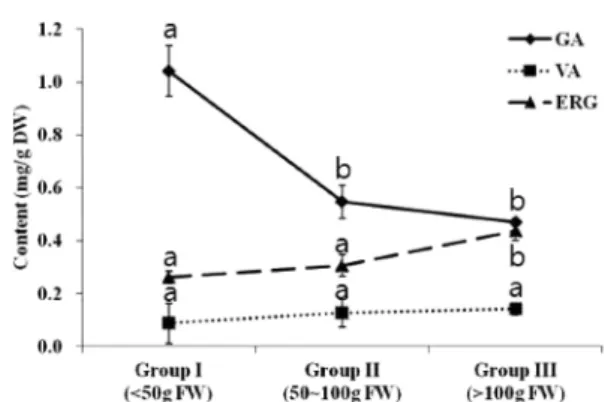
재배된 천마를 생육단계별 Group I (50 g 이하), Group II (50 g ~ 100 g), Group III (100 g 이상)로 나누어 기능성 물질 인 GA, VA, ERG을 분석하였다. 천마의 생육단계를 보면 종 자가 발아하여 원구경이 되며, 원구경이 뽕나무 버섯균에 감 염되어 크기가 커지기 시작하는데 그 크기에 따라 미마 백마 로 성장하게 된다 (Lee, 2009). 본 연구 결과에서 크기가 작 을수록 단위 건중량 (g DW) 당 GA의 함량은 증가하고 ERG 의 함량은 감소하는 것으로 나타났으며, VA의 함량은 큰 차이를 보이지 않은 것으로 나타났다 (Fig. 4). 일반적으로 초 기 발달단계인 Group I에 속하는 천마는 생장속도가 상대적 으로 느리고, 이후 성숙되는 시기인 Group II와 Group III단 계에서는 생장속도가 빠른 것을 감안할 때, 초기 발달단계인 Group I 에 속하는 천마에서 GA 축적이 상대적으로 많아진 것
으로 판단된다. GA와 같은 항산화성이 강한 페놀화합물의 경 우 생장이 왕성할 때보다 스트레스 상황에 더 많이 생합성하 여 식물을 보호하는 역할로 알려져 있다 (Piyada et al., 2004). GA 와는 상이하게 ERG의 경우 생장이 왕성한 시기인 Group III 에서 함량이 많은 것으로 관찰되었다 (Fig. 4). ERG 는 뽕나무 버섯이 나무로부터 분해한 영양분을 천마로 전달할 때 함께 전달되는 물질로 알려져 있다 (Park et al., 2010).
따라서 생장이 가장 왕성한 시기인 Group III에 뽕나무버섯으 로부터 영양분과 함께 전달되었을 것으로 판단된다. 인삼의 경 우 생육연수에 따라 근중이 급격하게 증하며, 46년생 인삼의 경우 그 연수에 따라 기능성 물질의 함량이 달라짐이 보고되 어 있으며, 16년생 인삼에 함유된 무기영양성분 또한 연수에 따라 다양하게 차이가 남이 보고되어 있다 (Lee et al., 2004;
Park et al., 2012).
3. 재배 방법에 따른 기능성 물질함량
일반노지 재배와 해가림 시설재배를 통해 수확된 천마 중 생중량이 약 100 g인 천마를 대상으로 기능성 물질의 함량을 조사해본 결과 GA와 VA의 경우 시설재배에서 그 함량이 증 가됨을 확인할 수 있었으며, ERG 함량은 변화가 없는 것으로 확인할 수 있었다 (Fig. 5). 이는 해가림을 해줌으로 인하여 한여름의 급격한 토양 온도의 상승과 직사광선을 막아 줌으로 인해 GA와 VA의 생합성이 원활하게 유지됨으로 기능성 물질 의 함량이 증가된 것으로 추측이 된다. 인삼의 경우 직사광선 에 의한 토양의 급격한 온도 상승 및 장마철의 과습으로 인한 피해를 줄이기 위하여 여러 종류의 해가림 시설에 관한 연구 가 진행되고 있으며, 해가림 시설에 따라 인삼의 생육상태와
Fig. 3. Contents of three major functional components in G.elata depending on the genetic origin of seed tubers.
Seed tubers originated from three different places, such as Pocheon, Sangju, and Youngyang, were used for the production of mature tubers. Three major functional components including gastrodin (GA), vanillyl alcohol (VA), and ergothioneine (ERG) were measured from mature tubers of G. elata. The data represent mean value ± SD (n = 5). The same superscript letters indicate the corresponding components that do not differ statistically (p < 0.05;
Duncan’s test).
Fig. 4. Differences in the contents of the major functional components depending on tuber weight. Three major functional components including gastrodin (GA), vanillyl alcohol (VA), and ergothioneine (ERG) were measured from three different sizes of tubers; Group I (< 50 g fresh weight/tuber), Group II (50100 g fresh weight/tuber), and Group III (> 100 g fresh weight/tuber). The data represent mean value± SD (n = 5). The same superscript letters indicate the corresponding components that do not differ statistically (p < 0.05; Duncan’s test).
품질의 변화를 있었으며, saponin 함량 또한 차이가 있다는 보 고가 있다 (Lee, 2007; Song et al., 2011). ERG의 경우 버 섯의 균사를 통하여 얻어지는 기능성 물질로서, 버섯의 경우 균사가 지속적으로 생장할 때에는 물질을 축척하기 보다는 생 장에 많은 에너지를 소모함으로 인하여 균사에 많은 물질을 함유하고 있지 않다 (Sung et al., 1998). 그러므로 버섯으로 부터 전달되는 ERG 의 경우 버섯의 균사 생장이 활발한 시 설보다 그렇지 못한 노지에서 그 함량이 증가되었을 것으로 추측이 된다.
4. 수확시기에 따른 기능성 물질함량
같은 재배지에 식재된 천마 중 유전적으로 동일한 천마를 분석에 이용하기 위해 동일한 덩이줄기로부터 비롯된 천마를 가을 (10월)에 수확한 것과 그 다음 해 봄 (4월)에 수확하여 천마의 기능성 물질을 살펴 본 결과 GA의 경우 가을 천마가 봄 천마보다 1.6배 많았으며, ERG의 경우 봄 천마가 가을 천 마 보다 1.7배 많이 함유된 것으로 나타났다 (Fig. 6). VA 경 우는 차이가 수확 시기에 따른 차이가 없음을 알 수 있었다 (Fig. 6). 이러한 결과는 앞에서도 살펴봤듯이 천마의 생활사와 버섯의 생활사를 같이 고려해서 판단해야 할 것이다. 천마의 생활사를 살펴보면 식재 후 뽕나무 버섯과 자마가 공생관계가 형성되는 5월경부터 시작하여 10월까지 성장을 하게 되고, 겨 울이 되면 성장이 억제되어 그 다음해 봄이 되어 생육적온에 이르게 될 때 다시 성장을 시작한다. 이것으로 미루어 볼 때 천마가 봄과 여름을 거쳐 가을까지 생장이 왕성해지고 생리 작용 또한 활발해 짐으로 인하여 GA 함량이 증가된 것으로 판단이 된다. 반면 겨울동안 생장이 억제되었던 천마에서는 함 량이 감소된 것으로 판단이 된다. 버섯의 생활사를 살펴봤을
때 생육적온이 되면 균사의 발달이 왕성하게 되고, 온도가 떨 어지게 되면 균사의 생장이 멈춰지면서 균사에 영양분이 축척 된다 (Cho et al., 1994; Sung et al., 1998). ERG의 경우 버섯의 균사체로부터 얻어지는 물질임으로 균사의 생장이 왕 성한 여름과 가을에는 버섯으로부터 ERG의 공급이 저조하다 가 균사의 생장이 멈추는 겨울 동안 균사에 저장된 물질이 천 마로 이동하여 ERG이 봄에 수확한 천마에 더 많이 축척된 것으로 판단된다. 다른 식물의 경우를 살펴보면, 차나무의 경 우 채취 시기가 늦어질수록 총 카테킨 함량, 탄닌, 엽록소, 비 타민 C의 함량이 증가되는 반면 총 질소, 유리아미노산 데아 닌, 카페인 등은 감소하는 경향이 있으며 무기질 함량 또한 다소 차이가 남이 보고되었다 (Yang et al., 2012). 수수의 경
Fig. 5. Changes in the contents of the major functionalcomponents in G. elata tubers cultivated under sun shade screen. G. elata was cultivated under sun shade screen or no screen. Approximately 100 g fresh weight tubers were collected and used to measure three functional components, such as gastrodin (GA), vanillyl alcohol (VA), and ergothioneine (ERG). The data represent mean value± SD (n = 5). The same superscript letters indicate the corresponding components that do not differ statistically (p < 0.05; t-test).
Fig. 6. Contents of the major functional components in G.
elata tubers harvested from April or October. Tubers (approximately 100 g fresh weight per tuber) originated from the same vegetative stem were collected from April and October, respectively, and then used to measure three major functional components including gastrodin (GA), vanillyl alcohol (VA), and ergothioneine (ERG). The data represent mean value± SD (n = 5). The same superscript letters indicate the corresponding components that do not differ statistically (p < 0.05; t-test).
Fig. 7. Contents of the major functional components in asexully or sexully propagated tubers of G. elata. Tubers of G.
elata were produced in the field by using either asexully or sexually propagated seed tubers, which were then used for measuring three major functional components, including gastrodin (GA), vanillyl alcohol (VA), and ergothioneine (ERG). The data represent mean value± SD (n = 5). The same superscript letters indicate the corresponding components that do not differ statistically (p < 0.05; t-test).
우 재배시기에 따라 총 폴리페놀, 플라보노이드, 탄닌 등의 항 산화성분의 함량의 차이를 보였다 (Lee et al., 2012). 오미자 의 경우 수확 시기에 따라 과육과 종자 내의 성분 함량 또한 변하는 것으로 나타났다 (Choi et al., 2011). 약초는 특정 약 리성분이나 생리 활성성분이 가장 많이 생산되는 시기를 규명 하여 약초 생산에 이용하고자 하는 노력들이 있다. 인삼 잎의 총 사포닌함량은 4월보다 5월이 9배 더 증가한다는 보고가 있 으며, 선학초 전초의 항산화 활성은 4월과 7월에 채취한 시료 의 항산화 활성이 다름이 보고되었으며, 산초열매 또한 채집 시기별 지방산화 정유 성분이 많이 차이 남을 보고된 바 있다 (Bae et al., 2011; Choi et al., 2009; Jang et al., 2008).
5. 자마에 따른 기능성 물질함량
종자를 이용하여 기내에서 무균상태에서 생산된 유성 증식 자마와 일반무성증식 자마를 동일한 재배지에 식재하여 재배 후 가을에 수확하여 천마의 기능성 물질을 분석한 결과 유성 증식 자마에서 GA 함량이 무성증식 자마보다 1.9배 증가하였 으며 VA과 ERG 함량에는 차이가 없는 것으로 나타났다 (Fig. 7). 무성번식의 경우 식물의 우량 형질을 다음 세대에 이어갈 수 있다는 장점이 있으나 장기적으로 무성번식을 계속 하게 되면 품종의 퇴화 현상이 일어난다. 천마의 경우 5 ~ 6대 후가 되면 종마의 노화 또는 퇴화로 인하여 병에 쉽게 감염되 어 품종의 퇴화 현상이 일어나게 되며 이로 인해 천마의 생산 량 또한 감소하게 된다 (Lee, 2007). 유성증식 자마의 경우 다른 병원균들의 오염이 없는 무병주이지만, 무성증식 자마의 경우 토양, 골목 등으로부터 유래된 병원균 오염으로 인하여 생장이 저해되며 이에 따라 GA 생합성 또한 저하된 것으로 판단이 된다. ERG은 천마 생장보다는 버섯의 균사에 의한 것 임으로 비슷한 크기의 천마의 경우 같은 양의 균사의 영향으 로 인해 비슷한 함량이 나온 것으로 추측된다.
본 연구는 재배지의 기후와 토양의 영향이 아닌 천마의 유전 적인 차이로 인하여서 기능성 물질이 서로 상이하게 나타날 수 있음을 확인할 수 있었으며, GA의 경우 크기가 작을수록, ERG 의 경우 크기가 클수록 단위 무게 당 함량이 높음을 확인 하였다. GA 함량이 높은 천마 생산을 위해서는 무병의 유성 증식 자마를 이용하여 해가림 시설을 설치하여 가을에 수확하 는 것이 가장 좋은 것으로 나타났으며, ERG의 경우 무병의 유성증식 자마를 이용하여 봄에 수확하는 것이 가장 좋은 것 으로 나타났다. 반면 VA의 경우 해가림 시설을 해줌으로서 함 량을 높일 수 있음을 확인하였다. 천마의 경우 아직 품종으로 등록되어 있는 천마가 없으며 각 지역별 천마의 기능성 물질 들이 상이하게 나타나기는 하였으나 특정 지역의 천마가 더 많은 기능성 물질을 가졌다고 판단하기는 어려울 것으로 판단 이 된다. 따라서 본 연구를 기초로 하여 천마의 유전적인 특
성과 기능성 물질이 계속적으로 유지되는지를 확인해야 할 것 이며 이를 통한 천마의 품종을 개발과 유전적 마커를 개발이 필요할 것으로 판단이 된다.
LITERATURE CITED
Ahn IO, Lee SS, Lee JH, Lee MJ and Jo BG. (2008).
Comparison of ginsenoside contents and pattern similarity between root parts of new cultivars in Panax ginseng C. A.
Meyer. Journal of Ginseng Research. 32:15-18.
Bae SM, Jin YM, Jeong EH, Kim MB, Shin HY, Ro CW and Lee SC. (2011). Studies on proximate composition, fatty acids and volatile compounds of Zanthoxylum schinifolium fruit according to harvesting time. Korean Journal of Medicinal Crop Science. 19:1-8.
Bin H and Chen F. (2004). Preparative isolation and purification of gastrodin from the Chinese medicinal plant Gastrodia elata by high-speed counter current chromatography. Journal of Chromatography A. 1052:229-232.
Cho JT. (1985). Physiological and ecological studies on the Chinese bellflower, Platycodon grandiflorum DC. -Ⅲ. Effects of soil texture, fertilizer and cultural environments on the growth and crude saponin content of Chinese bellflower.
Horticulture Environment and Biotechnology. 26:22-28.
Cho SM, Seo GS, Yoo ID and Shin GC. (1994). Physiological response of a white mutant of Ganoderma lucidum induced by light and temperature. Korean Journal of Microbiology and Biotechnology. 22:115-119.
Choi JE, Li X, Han YH and Lee KT. (2009). Changes of saponin contents of leaves, stems and flower-buds of Panax ginseng C. A. Meyer by harvesting days. Korean Journal of Medicinal Crop Science. 17:251-256.
Choi SR, Kim CS, Kim JY, You DH, Kim JM, Kim YS, Song EJ, Kim YG, Ahn YS and Choi DG. (2011). Changes of antioxidant activity and lignan contents in Schisandra chinensis by harvesting times. Korean Journal of Medicinal Crop Science. 19:414-420.
Cohen SA, Meys M and Tarvin TL. (1989). The pico-tag method: A manual of advanced techniques for amino acid analysis. Millipore Corporation. Milford. Massachusetts, USA.
p.11-52.
Hayashi J, Sekine T, Deguchi S, Lin Q, Horie S, Tsuchiya S, Yano S, Watanabe K and Ikegami F. (2002). Phenolic compounds from Gastrodia rhizome and relaxant effects of related compounds on isolated smooth muscle preparation.
Phytochemistry. 59:513-519.
Heo JC, Park JY, An SM, Lee JM, Yun CY, Shin HM, Kwon TK and Lee SH. (2006). Anti-oxidant and anti-tumor activities of crude extracts by Gastrodia elata Blume. Korean Journal of Food Preservation. 13:83-87.
Jang HY. (1999). Cultivation technology of Gastrodia elata Blume using Armillaria. Mycobiology. 11:116-140.
Jang SH, Yu EA, Han KS, Shin SC, Kim HK and Lee SG.
(2008). Changes in total polyphenol contents and DPPH radical scavenging activity of Agrimonia pilosa according to harvest time and various part. Korean Journal of Medicinal Crop
Science. 16:397-401.
Kang TS, Kong YJ, Kwon HJ, Choi BK, Hong JG and Park YK. (2002). A studies on the chemical composition and in vitro biological activities of a hot water extracts of Gastrodia elata. The Korean Journal of Mycology. 30:136-141.
Kawano H, Higuichi F, Mayumi T and Hama T. (1982). Studies on ergothioneine. VII. Some effects of ergothioneine on glycolytic metabolism in red blood cells from rats. Chemical &
Pharmaceutical Bulletin. 30:2611-2613.
Kim DH, Kim HY, Jang EY, Yang CH and Roh SS. (2012).
The study on chemical components and korean medical effects of Gastrodiae Rhizoma. The Journal of East-West Medicine.
37:41-55.
Kim HT, Kim JA and Park EJ. (2012). Genetic diversity and metabolite analysis of Gastrodia elata by Inter-Simple Sequence Repeats(ISSR) markers. Korean Journal of Medicinal Crop Science. 20:440-446.
Kim HT, Kim ST, Lee WY and Park EJ. (2013). Induction and growth of vegetative stems through in vitro culture of Gastrodia elata. Korean Journal of Medicinal Crop Science.
21:142-147.
Lee BY, Choi HS and Hwang JB. (2002). Analysis of food components of Gastrodiae rhizoma and changes in several characteristics at the various drying conditions. Korean Journal of Food Science and Technology. 34:37-42.
Lee CY. (2007). Effects of shading material of rain shelter on growth and quality in Panax ginseng C. A. Meyer. Korean Journal of Medicinal Crop Science. 15:291-295.
Lee MY. (2007). Important medicinal crop characteristics and cultivation technologies. Dongguk University. Korea. p.64-287.
Lee JS, Oh BG, Ko JY, Song SB, Kim JI, Kim HY, Seo HI, Kwak DY, Jung TW, Kim KY, Jeong HS and Woo KS.
(2012). Change of antioxidant compounds and antioxidant capacity by cultivar and cultivated time in sorghum. Journal of Agricultural Science Chungbuk National University. 28:68-73.
Lee SW, Kang SW, Seong NS, Hyun GS, Hyun SY, Kim YC and Cha SW. (2004). Seasonal changes of growth and extract content of roots in Panax ginseng C. A. Meyer. Korean Journal of Medicinal Crop Science. 12:483-489.
Lee WY, Park EJ and Ahn JK. (2009). Supplementation of methionine enhanced the ergothioneine accumulation in the Ganoderma neojaponicum Mycelia. Applied Biochemistry and Biotechnology. 158:213-221.
Liu ZH, Hu HT, Feng GF, Zhao ZY and Mao NY. (2005).
Protective effects of gastrodine on the cellular model of Alzheimer’s disease induced by Abeta 25-35. Sichuan Da Xue Xue Bao. 36:537-540.
Ong ES, Heng MY, Tan SN, Yong JWH, Koh H, Teo CC and Hew CS. (2007). Determination of gastrodin and vanillyl alcohol in Gastrodia elata Blume by pressurized liquid extraction at room temperature. Journal of Separation Science.
30:2130-2137.
Park EJ, Lee WY, Kim ST, Ahn JK and Bae EK. (2010).
Ergothioneine accumulation in a medicinal plant Gastrodia elata. Journal of Medicinal Plants Research. 4:1141-1147.
Park EJ, Lee WY and Ahn JK. (2012). In vitro propagation of myco-heterotrophic Gastrodia elata. Horticulture, Environment, and Biotechnology. 53:415-420.
Park EJ and Lee WY. (2013). In vitro symbiotic germination of myco-heterotrophic Gastrodia elata by Mycena species. Plant Biotechnology Reports. 7:185-191.
Park SY, Lee GA, Heo SJ, Jeong HN and Song BH. (2012).
Comparative analysis on concentration and uptake amount of major mineral nutrients in plat tissues and years old of Panax ginseng C. A. Meyer. Korean Journal of Medicinal Crop Science.
20:195-201.
Piyada T, Jeffrey M, David WW and John CS. (2004).
Suppression of polyphenol oxidases increases stress tolerance in tomato. Plant Science. 167:693-703.
Rahman I, Gilmour PS, Jimenez LA, Biswas SK, Antonicelli F and Aruoma OI. (2003). Ergothioneine inhibits oxidative stress- and TNF-α-induced NF-KB activation and interleukin-8 release in alveolar epithelial cells. Biochemical and Biophysical Research Communications. 302:860-864.
Shukla Y, Kulshrestha OP and Khuteta KP. (1981).
Ergothioneine content in normal and senile human cataractous lenses. Indian Journal of Medical Research. 73:472-473.
Song HB, Chang YG, Lee KA, Lee SW, Kang SW and Cha SW. (2011). Studies on analysis of growth characteristics, ability of dry matter production, and yield of Panax ginseng C. A.
Meyer at different growth stages with different cultivars and shading nets in paddy field. Korean Journal of Medicinal Crop Science. 19:90-96.
Sung JM, Yoo YB and Cha DY. (1998). Mushroom Science.
Kyo-Hak Publishing Company. Seoul, Korea. p.95-106.
Yang JK, Kim JC, Lee JG and Jo JS. (2012). The changes of chemical composition of green tea by picking periods. Journal of Agriculture & Life Science. 46:49-61.