†
These authors contributed equally to this work
H. C. Park
†( ) ・ S. C. Koo
†・ H. Kim ・ W. Choi ・ D.-J. Yun ( ) 경상대학교 대학원 응용생명과학부, 식물생명공학연구소
(Division of Applied Life Science (BK21 program) and Plant Molecular Biology and Biotechnology Research Center, Gyeongsang National University, Jinju, 660-701, Korea) e-mail: [email protected], [email protected]
벼의 small ubiquitin-like modifier E3 ligase, OsSIZ1 돌연변이체의 특성 분석
박형철 ・ 구성철 ・ 김 훈 ・ 최원균 ・ 윤대진
Characterization of small ubiquitin-like modifier E3 ligase, OsSIZ1, mutant in rice
Hyeong Cheol Park ・ Sung Cheol Koo ・ Hun Kim ・ Wonkyun Choi ・ Dae-Jin Yun
Received: 28 September 2012 / Accepted: 12 October 2012
ⓒ Korean Society for Plant Biotechnology
Abstract Sumoylation is a reversible conjugation process that attaches the small ubiquitin modifier (SUMO) peptide to target proteins and regulates a wide variety of cellular functions in eucaryotes. As final step of the sumoylation, SUMO E3 ligases facilitate conjugation of SUMO to target proteins. To characterize the functions of the SUMO E3 ligases in Oryza sativa, we isolated a single recessive rice SUMO E3 ligase, Ossiz1-2 mutant. In addition, we also confirmed the interaction between OsSIZ1/-2 and OsSUMO1, respectively, by using an Agrobacterium-based tobacco luciferase transient expression system. Ossiz1-2 mutant exhibited approximately 20% reduction in growth and developmental units compared with wild type. Especially, number of filled seeds and total seed weight were dramati- cally decreased in the Ossiz1-2 mutant rice. Thus, these results suggest that sumoylation by the OsSIZ1 as SUMO E3 ligase plays an important role in regulating growth and development in rice.
Keywords Agronomic traits, Rice, SIZ/PIAS-type SUMO E3 ligase, SUMO, sumoylation
서 론
지구상에 존재하는 모든 생명체는 성장, 발달, 및 항상성
의 유지를 위하여 많은 유형의 단백질 번역후 modification 과정을 이용하여 세포신호를 전달 및 조절하고 있다. 그 과정에는 methane, acetate, fatty acids, sugars, nucleosides 그 리고 phosphate와 같은 작은 분자가 관여 할 뿐만 아니라, ubiquitin(Ub) 그리고, 그와 유사체인 SUMO(small ubiquitin- like modifier)와 같은 작은 polypeptide에 의해서도 단백질의 번역후 modification 과정이 작용된다(Downes and Vierstra 2005). 이와 같은 단백질의 번역후 modification 과정은 세 포내의 위치 및 목적 단백질의 안정화와 같은 생물학적 활성에 결정적인 변화를 부여한다(Dohmen 2004). 특히, 단백질의 Ub에 의한 modification 과정은 DNA repair, protein kinase activation, 그리고 endocytosis와 같은 세포내 신호전 달에 관여하는 mono-ubiquitination 과정과 26S proteosome complex가 관여하여 목적 단백질을 polyubiquitination하여 그 단백질을 분해하는 과정으로 동물 , 효모, 그리고 곰팡이 에서 알려져 있다(Welchman et al. 2005). 식물에서 mono- ubiquitination에 의한 단백질의 조절 기작에 관한 연구는 보고 되어있지 않고, polyubiquitination에 의한 단백질의 분해 기작에 관한 연구가 보고 되고 있다. 또한, 애기장 대에서 전체 유전자의 5%에 해당하는 1400개 이상의 유 전자가 ubiquitin/26S proteasome pathway에 관여 할 것으로 예측되며, 그 중에서 약 90%의 유전자는 ubiquitin E3 ligases 의 소단위체를 구성하는 단백질을 암호화한다고 보고되 었다(Moon et al. 2004; Smalle and Vierstra 2004).
SUMO 단백질은 3차원 구조적으로 Ub와 높은 유사성을 보이지만, 아미노산의 1차 서열을 비교해 보면 오직 20%
정도의 유사성을 보이고 있으며 N-말단의 15개의 아미노 산 잔기를 추가적으로 포함하고 있다(Hay 2005). SUMO 단백질은 ubiquitin-like proteins(ULPs)이며, 약 12 KDa 크 기의 작은 단백질이다. 이 단백질은 1996년 GTPase 활성 단백질인 RanGAP1에 공유결합하여 세포내 위치를 조절 DOI:http://dx.doi.org/10.5010/JPB.2012.39.4.235
Research Article
하는 단백질로 확인되었다(Matunis et al. 1996). 이와 같이 SUMO 단백질이 목적 단백질에 공유결합하는 과정을 sumoylation이라고 하며, 동물과 효모에서 전사조절, 세포 주기에서 신호전달, DNA repair, 세포핵내의 위치조절, 그 리고 ubiquitination에 대한 길항작용 등과 같은 다양한 세 포내에서 역할을 수행할 것으로 보고되고 있다(Jonson 2004; Hay 2005). SUMO 단백질은 모든 진핵생물에 존재 하고 있으며, 애기장대에서 SUMO 유전자는 오직 4개 (SUM1~3, 그리고 5)가 발현되고 있다. 또한, 모두 8개의 유 전자를 가지고 있다는 것이 확인되었다(Colby et al. 2006;
Budhiraja et al. 2009). SUMO1/2 conjugates는 heat shock, H
2O
2, ethanol, 그리고 canavanin과 같은 세포내 다양한 스트 레스에 의해서 증가되는 것으로 보여진다. 하지만, SUMO3 conjugates는 그와 같은 스트레스에 변화가 없는 것으로 보고되었다(Kurepa et al. 2003). 최근에 AtSUMO3는 살리 실산(Salicylic acid; SA) 축적의 하위단계에서 기능을 수행 하고, AtSUMO1/-2는 살리실산 축적의 상위단계에서 그 조절을 억제하는 기능을 수행할 것이라고 예측 하였다.
(van den Burg et al. 2010). 이와 같이 SUMO 단백질에 의 한 sumoylation 과정은 다양한 환경조건에서 목적 단백질 의 modification을 구별하여 조절한다는 것을 시사한다.
애기장대의 유전자에서 sumoylation 과정을 위하여 필 요한 구성요소에 관한 생화학적 및 유전학적인 연구가 잘 되어있다(Colby et al. 2006). 또한, 다양한 연구방법을 통하 여 생물학적 또는 비생물학적 스트레스에 대한 저항성과 식물의 발달 및 적응에 매우 중요한 요소인 것으로 밝혀 졌다(Miura et al. 2007a; Saracco et al. 2007). Sumoylation 과 정은 ubiquitination 과정과 유사하게 목적 단백질에 E1 (SUMO-activation enzyme) (activation), E2(SUMO-conjugation enzyme) (conjugation), 그리고 E3(SUMO ligase) (ligation)와 같 이 크게 세가지의 순차적인 효소반응을 통하여 SUMO 단백 질을 conjugation하게 된다. 그리고, 목적 단백질에 결합된 SUMO 단백질을 다시 이용할 수 있도록 SUMO proteases라 고 하는 단백질이 작용하여 SUMO를 분리하는 기능을 수행 하게 된다(Johnson 2004). Sumoylation 과정은 ubiquitination 과정과 달리 목적 단백질에 짧은 공통서열, ψ-K-X-E/D (ψ, large hydrophobic amino acid; K, the acceptor lysine; X, any amino acid; E/D, glutamate or aspartate)의 위치에 SUMO conjugation이 발생하게 된다(Schmidt and Müller 2003; Seeler and Dejean 2003). 일반적으로, SUMO E1은 효모, 동물 그 리고 애기장대에서 Aos1(SAE1, Sua1)과 Uba2(SAE2, hUbs2) 로 구성되어 heterodimer를 형성하며, SUMO E2는 동물과 효 모에서 Ubc9, 그리고 애기장대에서 SCE1의 단일 유전자로 구성되어 있다(Dohmen 2004). 애기장대에서 AtSUMO1/2의 돌연변이체에서 식물체가 치사되는 양상과 같이 E1과 E2 즉, SAE2와 SCE1의 유전자가 돌연변이가 되면 동일한 치 사형을 보여주게 된다. 이와 같은 현상은 sumoylation에
관여하는 유전자가 식물의 분화 및 발달에 중요한 역할 을 수행할 것으로 보여진다(Saracco et al. 2007).
SUMO E3 ligase는 SUMO를 E2 conjugation enzyme으로 부터 목적 단백질로 특이적으로 전달하는데 역할을 수행 한다. 그러므로, 이것은 생체내의 sumoylation 과정에 매 우 중요한 구성성분이다(Johnson 2004). 동물과 효모에서 SIZ/PIAS, RanBP2, Pc2 그리고 HDAC4와 같이 몇 종류의 SUMO E3 ligase가 보고되고 있으며, 애기장대에서는 SIZ1 과 MMS21/HPY2의 두 종류가 알려지고 있다(Huang et al.
2009; Ishida et al. 2009). 특히, 다양한 환경 스트레스 반응 은 SIZ1, SUMO E3 ligase에 의해서 주로 매개됨이 유전학 적이고 생화학적인 방법으로 확인되었다. SIZ1이 관여하 는 환경 스트레스 반응에 의한 sumoylation 과정은 phosphate starvation, abscisic acid(ABA), SA-dependent defense response, flowering regulation, basal thermotolerance, drought 그리고 cold 등과 같은 기작에 관여할 것으로 확인되었다(Yoo et al.
2006; Catala et al. 2007; Lee et al. 2007; Saracco et al. 2007;
Miura et al. 2005; 2007b; 2009; Jin et al. 2008). 그리고, MMS21/HPY2, SUMO E3 ligase는 주로 식물의 분화 및 발 달과정에 관여할 것으로 보고 되었다(Huang et al. 2009;
Ishida et al. 2009).
애기장대에서 sumoylation에 관여하는 구성요소들이 잘 연구되어 있고 또한, SUMO의 목적단백질에 관한 보고가 증가하고 있다. 이전까지 보고된 목적단백질로는 MYB30, GTE3/5, PHR1, ICE1, ABI5, 그리고 FLD와 같이 몇 가지 정도만 보고 되었다(Garcia-Dominguez et al. 2008; Jin et al.
2008; Miura et al. 2005; 2007b; 2009; Okada et al. 2009). 하 지만, 두 그룹에 의해서 방대한 양의 목적 단백질의 분석 을 수행하였다. 첫번째 그룹은 SUMO E2 activating enzyme, SCE와 SUMO specific protease, ESD4를 이용하여 yeast two- hybrid screening 방법으로 238개의 추정의 목적 단백질을 분리하고, 그 중에 124개를 가지고 sumoylation 분석을 수 행하였다(Elrouby and Coupland 2010). 두번째 그룹은 His- H89R SUMO1 sum1-1sum2-1 형질전환 식물 추출물로부터 SUMO 항체를 이용하여 357개의 목적 단백질을 분리하 였다(Miller et al. 2010). 본 연구 그룹은 AtSUMO1에 6His- 3Flag tag을 결합하여 애기장대 형질전환 식물체를 만들 고 그 식물 추출물로부터 sumoylation을 수행하는 목적 단 백질의 분석을 보고하였다(Park et al. 2011a). 이와 같이, 동 물과 효모를 비롯하여 애기장대에서 sumoylation 기작의 연구가 활발히 되어있는 반면, 주곡작물인 벼에서는 생화 학적 및 분자생물학적인 연구가 아직 미비한 상태이다.
최근 벼에서는 환경스트레스 처리후에 일어나는 sumoylation
유형에 관한 연구가 보고 되었으며, SUMO E3 ligase 돌연
변이체의 연구로부터 OsSIZ1 단백질이 성장, 발달 그리
고, spikelet fertility에 관여함을 보여 주었다(Chaikam and
Karlson 2010; Thangasamy et al. 2011; Wang et al. 2011). 본
연구그룹은 벼에서 SUMO E3 ligases, OsSIZ1과 OsSIZ2 유 전자들을 분리하고 그 단백질들이 SUMO E3 ligase의 특징 을 수행하는지에 관한 연구를 수행하였으며, 그 유전자들 을 애기장대의 atsiz1-2 돌연변이체에 형질전환을 수행하 여 형태학적인 관찰을 비교 했을 뿐만 아니라, ABA와 고 온 스트레스에서 OsSIZ1과 OsSIZ2의 기능을 보고하였다 (Park et al. 2010). 본 연구에서는 Ossiz1-2 돌연변이체를 분 리하였고, OsSIZ1과 OsSIZ2 단백질들이 OsSUMO1과의 상 호작용을 형성한다는 것을 담배에서 luciferase expression system을 이용하여 확인하였다. 또한, Ossiz1-2 돌연변이 체가 대조군과 비교하여 다양한 형태학적으로 결함이 있 음을 보였다. 특히, 등숙율에서 약 50% 정도 감소함을 보 여줌으로써 벼에서 SUMO E3 ligase, OsSIZ1 단백질이 벼 의 성장, 발달 및 수확량에 중요한 역할을 수행할 것으로 예측된다.
재료 및 방법
식물재료 및 생육조건
동진벼(Oryza sativa L. cv. Dongjin) 품종과 T-DNA tagging mutant line(Ossiz1-2, PFG_3A-02154)은 안진흥 교수님으로 부터 분양 받았다(Jeong et al. 2005). 벼는 온실에서 낮에는 30℃ 그리고 밤에는 20℃, 14 h 광/10 h 암 조건에서 생육 하였다. 벼의 기내배양을 위하여 종자는 96% 에탄올을 사 용하여 5분씩 세번 멸균한 후, 3% sodium hypochlorite 용액 을 사용하여 2 시간 동안 소독하였다. 또한, 멸균수를 이 용하여 종자의 표면에 sodium hypochlorite 용액이 묻어있 지 않도록 5회 반복 세척하였다(Park et al. 2011b). 그 종자 는 1/2 MS를 포함하는 고체배지를 가지고 있는 plastic boxes(25 x 18 x 9 cm
3)에서 25℃의 16/8 h 광/암의 조건에 서 발아되었다. 유전자의 cloning을 위하여 E. coli XL1-Blue
MRF’와 DH5α(Stratagene, La Jolla, CA, USA)를 사용하였다.벼의
Ossiz1-2 유전자의 분리 및 확인분양받은 T-DNA tagging mutant line(Ossiz1-2, PFG_3A-02154) 으로부터 동질의 돌연변이체를 분리하기 위하여 기내배 양된 벼로부터 cetyl trimethyl-ammonium bromide(CTAB) 방법을 이용하여 genomic DNA를 분리하였다(Murray and Thompson 1980). 순수분리된 genomic DNA를 주형으로 사 용하여 OsSIZ1 primers(P1 and P2)와 T-DNA의 LB primer로 genomic PCR을 수행하여 순수한 Ossiz1-2 돌연변이체를 확인하였다. 그 돌연변이체는 기내배양된 후, 온실 및 포 장에서 성장되어 수확되었다. 세대를 거친 후, T
2세대에 서 Ossiz1-2 돌연변이체의 특징들을 관찰하였고 최종적으
로 분석을 수행하였다.
담배에서
Agrobacterium-mediated luciferase transient expression의 확인
담배에서 OsSIZ1과 OsSIZ2 단백질들이 OsSUMO1 또는 AtSUMO1과의 상호작용을 확인하기 위하여 약 7 주된 담배 식물체를 Agrobacterium-mediated luciferase transient expression 실험을 위하여 사용하였다 . OsSIZ1/-2 유전자는 pCambia1300-
nLUC vector에 각각 삽입하였고, OsSUMO1과 AtSUMO1 유전자는 pCambia1300-cLUC vector에 삽입하여 형질전환 실 험을 위하여 준비하였다(Chen et al. 2008). 각 쌍들의 vector 들은 Agrobacterium tumefaciens GV3101 종에 도입하였다.
또한, 28℃에서 10 mM MES buffer, 20 μM acetosyringone, 그리고 적당한 항생제가 함유된 Luria-Bertani 배지에서 성 장한 bacteria는 10 mM MgCl
2, 10 mM MES buffer, 그리고 100 μM acetosyringone를 함유하는 infiltration solution에서 항생제의 독성을 없애기 위하여 두번 세척하였다. Gene silencing의 suppressor인 p19가 형질전환된 Agrobacterium 도 같이 준비하였다. 각각 배양된 Agrobacterium 배양액은 OD
600=0.5로 맞추고, 동일한 부피로 혼합하였다. 그 배양 액은 담배의 잎에 무바늘 주사기를 사용하여 침윤시켰 고, 23℃에서 36 시간 동안 plastic bag으로 덮어두었다. 그 담배잎은 1 mM luciferin 용액으로 세번 분사하였으며, EM CCD camera(iXon, Andor Technology plc, Ireland)를 이용하 여 사진을 찍었다. Bioluminescence는 암상태에서 5분 동 안 둔 후에 기록하였다.
Ossiz1-2 돌연변이체의 성장율 조사
Ossiz1-2 돌연변이체의 성장과 관련된 농업형질을 조사하기 위
하여 동진벼(wild type) (Oryza sativa L. cv. Dongjin)와 Ossiz1-2 돌연변이체의 벼를 포장에서 생육시켰으며, 최종적으로 수 확기에 각각의 식물체를 수확하였다. T
2세대의 개체로부터 수확된 벼는 초장, 수장, 주당수수, 수당립수, 총립수, 등숙 률, 완전립, 정조, 천립중으로 구분하여 각각의 통계치를 동 진벼와 비교하여 농업형질의 분석을 수행하였다. 또한, 등 숙율은 야생형인 동진벼를 비롯하여
Ossiz1-2 돌연변이체에서 Hetero와 Homo lines으로 나누어 분석하여 통계화하였다.
결과 및 고찰
벼의 Sumoylation 기작 관련 유전자 및 Ossiz1-2 돌연변이체 의
T-DNA 삽입위치 확인애기장대에서 sumoylation에 관여하는 유전자들은 잘 보
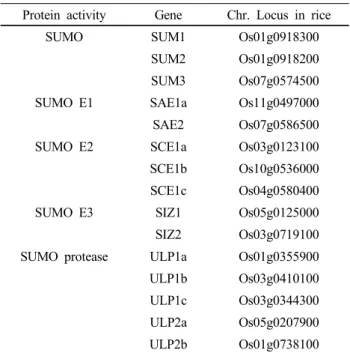
Table 1 The components of SUMO conjugation and SUMO deconjugation in rice
Protein activity Gene Chr. Locus in rice
SUMO SUM1 Os01g0918300
SUM2 Os01g0918200
SUM3 Os07g0574500
SUMO E1 SAE1a Os11g0497000
SAE2 Os07g0586500
SUMO E2 SCE1a Os03g0123100
SCE1b Os10g0536000
SCE1c Os04g0580400
SUMO E3 SIZ1 Os05g0125000
SIZ2 Os03g0719100
SUMO protease ULP1a Os01g0355900
ULP1b Os03g0410100
ULP1c Os03g0344300
ULP2a Os05g0207900
ULP2b Os01g0738100
SUMO: small ubiquitin-related modifier; E1: SUMO activation enzyme; E2: SUMO conjugating enzyme; E3: SUMO ligation enzyme; protease: ubiquitin-like SUMO protease.
Fig. 1 Identification of T-DNA insertion mutant of OsSIZ1.
(A) Schematic diagram indicating genomic structure and the site of the T-DNA insertion of OsSIZ1. Genomic OsSIZ1 DNA is represented by exons (black boxes) and introns. T-DNA insertion is indicated by the open inverted-triangle and located into 15
thexon of OsSIZ1 gene. P1 and P2 are primers used for the genotyping.
RB, right border; LB, left border. (B) Genotyping of Ossiz1-2 mutant. Genomic DNA was isolated from WT and 19 independent Ossiz1-2 mutant plants. PCR was performed with gene specific primers (P1 and P2) and T-DNA border primer sets, respectively.
Lanes 2, 5, 9, 10, 14, 15, and 19 indicate homozygote lines (-/-). Wild type and heterozygote lines are indicated by (+/+) and (+/-), respectively.
고 되어 있다(Miura and Hasegawa 2010). 그러나, 벼에서는 이러한 유전자들의 연구가 미비하여 sumoylation 기작에 관여하는 유전자들을 분석해 보았다(Table 1). 벼에서도 애기장대와 같이 모든 구성요소가 잘 보존되어 있었다.
그러나, SUMO 단백질은 애기장대에서 8개 존재하지만, 벼에서는 3개가 존재함이 밝혀졌다. 또한, 흥미로운 것은 SUMO E3 ligase, SIZ 유전자가 애기장대와 다르게 두개가 존재함이 확인되었다(Table 1). 이것은 벼에서 SUMO 단 백질에 의해서 sumoylation의 다양성을 보여주는 것 보다 는 SIZ 형태의 SUMO E3 ligase에 의해서 다양한 신호전 달에 관여 할 것으로 사려된다. 그러므로, 본 연구그룹은 벼에서 OsSIZ1과 OsSIZ2 유전자를 분리하고 그 단백질들 의 특징을 애기장대의 AtSIZ1과 비교하여 분석함과 동시 에 SUMO E3 ligase로써 기능을 확인하였다. 또한, 애기장 대의 atsiz1-2 돌연변이체에 그 유전자를 이용하여 형질전 환 식물체를 만들었다. 그런 후에 형질전환 식물체들의 형태학적인 비교뿐만 아니라, ABA, 그리고 열 스트레스 에 의한 OsSIZ1/-2 단백질의 기능을 연구하였다(Park et al. 2010).
위와 같은 연구를 수행하면서 벼의 OsSIZ1 돌연변이체 를 동정하는 연구를 함께 수행하게 되었다. OsSIZ1은 벼 의 genome상에서 16개의 exon으로 구성되어 있었으며, 애 기장대의 AtSIZ1 단백질과 같이 SAP, PHD, PINIT, SP-RING, 그리고 SXS domain들이 잘 보존 되어있었다(Fig. 1A; Park et al. 2010). 특히, 오직 식물체의 SIZ1 단백질이 가지고
있는 plant homeodomain-finger(PHD) domain이 잘 보존되 어 있었다. 분양받은 Ossiz1-2 돌연변이체를 확인한 결과
T-DNA가 15번째 exon부위에 존재한다는 것을 확인하였다(Fig. 1A). 또한, 야생형인 동진벼와 돌연변이체를 이용하 여 genomic PCR을 수행하여 19개의 개체로부터 7개의 순 수한 Ossiz1-2 돌연변이체를 확인하였다(Fig. 1B). 그리고,
Ossiz1-2(#2)과 Ossiz1-2(#10)의 T2세대의 개체를 이용하여 돌연변이체의 형태학적인 분석을 수행하였다.
OsSIZ1/-2 단백질과 SUMO1 단백질의 상호작용 분석
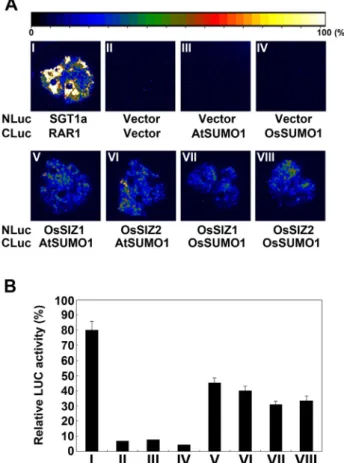
지금까지 알려진 SUMO E3 ligase의 기능은 목적 단백질 에 SUMO를 특이적으로 전달하는 기능을 수행한다. 그러 므로, SUMO E3 ligase가 SUMO와 상호작용하여 목적단백 질에 SUMO를 전달할 것이다. OsSIZ1/-2 단백질이 벼에서 SUMO E3 ligase로써 기능을 수행할 수 있는지를 분석하 기 위하여 OsSIZ1/-2 단백질과 애기장대와 벼의 SUMO1 단백질과의 상호작용을 담배 luciferase transient expression system을 이용하여 확인하였다(Fig. 2A). 양성 대조군인 CLuc-RAR1과 NLuc-SGT1a가 형질전환된 담배 식물체에 서 강한 형광을 보였다(Fig. 2A-I; Chen et al. 2008). 또한, 음성대조군들은 firefly luciferase의 기질인 luciferin을 처리 했을 때 형광을 확인할 수 없었다(Fig. 2A-II, III, and IV).
그러나, NLuc-OsSIZ1/-2와 CLuc-OsSUMO1 혹은 CLuc-AtSUMO1
의 각각의 조합에서는 서로가 상호작용한다는 것을 형광
으로 보여 주었다(Fig. 2A-V, VI, VII, and VIII). 담배
luciferase transient expression으로부터 확인한 luciferase 활
성을 정량적으로 분석해보면, 양성 대조군에 비해서
NLuc-OsSIZ1/-2와 CLuc-OsSUMO1 혹은 CLuc-AtSUMO1의 각
Fig. 2 Identification of the interaction between SUMO1 and OsSIZ1/-2 in planta.
(A) Interaction between SUMO1 and OsSIZ1/-2 in tobacco expression system. Tobacco leaves were transformed by Agrobacterium infiltration using a needleless syringe. The indicated NLuc and CLuc construct pairs were used for transformation. Luciferase (LUC) image was taken by an EM CCD camera. (B) Quantification of LUC activity in tobacco leaves expressing the NLuc and CLuc construct pairs.
The data were collected at 36 h after infiltration and presented as mean ± SE of three independent samples.
Fig. 3 Phenotypes of wild type and Ossiz1-2 mutant rice plants.
(A) Morphological phenotypes of wild type and Ossiz1-2 mutant in pot-soil condition. (B) Comparison of the ripened grains between wild type and Ossiz1-2 mutant. Shown are the pictures of each grain in the wild type, Ossiz1-2 (hetero line) and Ossiz1-2 (homo line) mutants, respectively. Arrow heads indicate the sterilized grains. (C) Statistical data of the ripened grains in (B). Data represent mean ± SE of three independent experiments (n = 30).
각의 조합들에서 luciferase 활성이 약 50% 정도임을 보였 다. 이와 같이 OsSIZ1/-2 단백질은 벼에서 SUMO E3 ligase 의 기능을 수행하기 위하여 SUMO 단백질과 상호작용한 다는 것을 보였다.
Ossiz1-2 돌연변이체의 성장 및 등숙율 조사
벼에서 sumoylation 기작에 관여하는 SUMO E3 ligase, OsSIZ1 단백질의 기능을 상실한 돌연변이체가 실질적으로 sumoylation 기작에서 결점을 야기하는지를 확인하는 것이 중요할 것 이다. 그러므로, 야생형 벼와 Ossiz1-2(#2)과 Ossiz1-2(#10) 돌연변이체들을 이용하여 열 처리후에 sumoylation 양상 을 비교해 보았다. 두개의 돌연변이체는 야생형과 비교 하여 sumoylation 양상이 줄어듬을 확인하였다(Park et al.
2010). 이 결과는 OsSIZ1 단백질이 열 스트레스에 의한 sumoylation 기작에 관여함을 알 수 있으며, 돌연변이체가
잘 구축되었다는 것을 시사한다. 이전 보고에서 애기장 대의 atsiz1-2 돌연변이체는 난쟁이 표현형 및 높은 농도 의 살리실산을 함유하고 있는 것으로 보고되었다(Lee et al. 2007). 그러므로, 야생형 벼와 분리된 Ossiz1-2(#2) 개체 를 화분에서 생육시킨 후에 수확기에 초장을 비교하여 보았을 때, Ossiz1-2(#2) 돌연변이체는 야생형과 비교하여 작은 초장을 보였다(Fig. 3A). 또한, 실제 포장에서도
Ossiz1-2(#2) 돌연변이체가 전체적으로 야생형과 비교하여 작은 초장을 보여 주었다(data not shown). 수확기의 벼 는 등숙율이 수량에 가장 중요한 요소이다. 그러므로,
Ossiz1-2(#2) 돌연변이체의 전체적인 등숙율을 야생형과비교하여 살펴보면, homo line의 돌연변이체가 등숙율이 가장 떨어짐을 확인할 수 있었다(Fig. 3B). 그와 같이 등 숙율의 결과를 수치화 해보면, 야생형은 약 93.7%, hetero line은 약 92%, 그리고 homo line은 약 56.7% 정도로 Ossiz1-2 의 돌연변이체가 야생형과 비교하여 약 절반 정도로 등 숙율이 떨어짐을 확인하였다(Fig. 3C).
Ossiz1-2 돌연변이체의 형태학적인 특징 분석
Ossiz1-2 돌연변이체를 관찰해보면, 벼의 성숙 및 발달의
중요한 과정에서 sumoylation 기작에 관여 할 것으로 예측
된다. Ossiz1-2 돌연변이체를 형태학적인 측면에서 분석
을 수행하기 위하여 야생형 벼를 대조군으로 사용하여
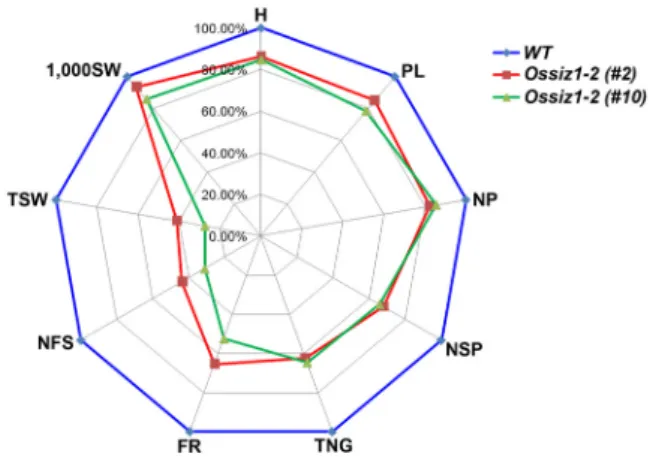
Ossiz1-2 돌연변이체들의 발달 및 성숙의 분류기준들을Fig. 4 Agronomic traits for wild type and Ossiz1-2 mutant rice plants grown in the field.
Spider plots of agronomic traits of two independent homozygous lines [Ossiz1-2 (#2) and Ossiz1-2 (#10)], respectively, were drawn using Microsoft Excel software. Each data represent mean ± SE of three independent experiments (n = 30). Mean values from wild type plant were set at 100% as a reference. H, Height; PL, Panicle Length; NP, Number of Panicles per plant; NSP, Number of Spikelets per panicle; TNG, Total Number of Grains; FR, Filling Rate; NFS, Number of Filled Seeds; TSW, Total Seed Weight; 1,000 SW, 1,000 Seed Weight.
가지고 농업형질을 조사하였다. 조사항목을 살펴보면, 초장(plant height, PH), 수장(panicle length, PL), 주당수수 (panicles per plant, PPP), 수당립수(spikelets per panicle, SSP), 총립수(total number of grains, TNG), 등숙률(ripened grain ratio, RGR), 완전립(number of filled grains, NFG), 정조(total seed weight, TSW), 그리고, 천립중(1,000 grain weight, 1,000-GW)과 같이 9개의 분류기준으로 농업형질을 조사 하였다 (Fig. 4). 초장을 비롯하여 대부분의 분류기준에서 야생형 동진벼와 비교해보면, Ossiz1-2 돌연변이체(#2 and
#10)에서 약 20% 정도의 감소된 성장을 보였다. 또한,
Ossiz1-2 돌연변이체(#2 and #10)에서 전체적인 등숙율과정조에서 50% 이상의 감소율을 확인 할 수 있었다. 결론 적으로, Ossiz1-2 돌연변이체에서 정조와 등숙율이 상당 히 떨어짐으로써, OsSIZ1 단백질은 벼의 성숙과 발달에 중요한 기능을 수행할 것으로 사려된다.
적 요
식물체에서 sumoylation 기작은 성장 및 발달에 중요한 기 능을 수행할 것이다. 특히, SUMO E3 ligase는 SUMO 단백 질을 목적 단백질로 전달해주는 마지막 단계의 sumoylation 기작 구성요소이며, 다양한 신호전달에 특이성을 나타내 는 것으로 보고되고 있다. 본 연구에서는 벼에서 SUMO E3 ligase, SIZ1 유전자에 T-DNA가 삽입된 Ossiz1-2 돌연변이 식 물체를 분석하였다. 그리고, OsSIZ1 단백질이 OsSUMO1 단 백질과 상호작용함으로써 OsSIZ1이 SUMO E3 ligase의 기
능을 수행할 것으로 예측하였다. Ossiz1-2 돌연변이 식물 체는 형태학적으로 발달과 성장의 다양한 부분에서 미성 숙상태로 유지됨이 보였다. 특히, 야생형인 동진벼와 비 교하여 초장의 성장 및 등숙율에서 상당히 낮은 정도를 보여 주었다. 이와 같이, 벼에서 SUMO E3 ligase로써 OsSIZ1 단백질의 생리학적인 기능은 성장과 발달 그리 고, 수확량에 관여하는 단백질을 sumoylation 시키는 기작 에서 역할을 수행할 것으로 사려된다.
사 사
본 연구는 교육과학 기술부의 재원으로 World Class University (WCU) Program 연구비(R32-10148)와 한국연구재단의 지 원 연구비(NRF-2010-359-F00006), 그리고 농촌진흥청의 차세대 바이오그린21 사업(Next-Generation BioGreen 21 program; grant no. PJ008025) 연구비로 수행하였음.
인용문헌
Budhiraja R, Hermkes R, Müller S, Schmidt J, Colby T, Panigrahi K, Coupland G, Bachmair A (2009) Substrates related to chromatin and to RNA-dependent processes are modified by
Arabidopsis SUMO isoforms that differ in a conserved
residue with influence on desumoylation. Plant Physiol 149:1529-1540Catala R, Ouyang J, Abreu IA, Hu Y, Seo H, Zhang X, Chua N-H (2007) The Arabidopsis E3 SUMO ligase SIZ1 regulates plant growth and drought responses. Plant Cell 19:2952-2966 Chaikam V, Karlson DT (2010) Response and transcriptional
regulation of rice SUMOylation system during development and stress conditions. BMB rep 43:103-109
Chen H, Zou Y, Shang Y, Lin H, Wang Y, Cai R, Tang X, Zhou J-M (2008) Firefly luciferase complementation imaging assay for protein-protein interactions in plants. Plant Physiol 146:
368-376
Colby T, Matthai A, Boeckelmann A, Stuible HP (2006) SUMO- conjugating and SUMO-deconjugating enzymes from Arabidopsis.
Plant Physiol 142:318-332
Dohmen RJ (2004) SUMO protein modification. Biochim Biophys Acta 1695:113-131
Downes B, Vierstra RD (2005) Post-translational regulation in plants employing a diverse set of polypeptide tags. Biochem Soc Trans 33:393-399
Elrouby N, Coupland G (2010) Proteome-wide screens for small ubiquitin-like modifier (SUMO) substrates identify Arabidopsis proteins implicated in diverse biological processes. Proc Natl Acad Sci USA 107:17415-17420
Garcia-Dominguez M, March-Diaz R, Reyes JC (2008) The PHD domain of plant PIAS proteins mediates sumoylation of bromodomain GTE proteins. J Biol Chem 283:21469-21477
Hay RT (2005) Sumo: a history of modification. Mol Cell 18:1-12 Huang L, Yang S, Zhang S, Liu M, Lai J, Qi Y, Shi S, Wang J,
Wang Y, Xie Q, Yang C (2009) The Arabidopsis SUMO E3 ligase AtMMS21, a homologue of NSE2/MMS21, regulates cell proliferation in the root. Plant J 60:666-678
Ishida T, Fujiwara S, Miura K, Stacey N, Yoshimura M, Schneider K, Adachi S, Minamisawa K, Umeda M, Sugimoto K (2009) SUMO E3 ligase HIGH PLOIDY2 regulates endocycle onset and meristem maintenance in Arabidopsis. Plant Cell 21:
2284-2297
Jeong DH, An S, Park S, Kang HG, Park GG, Kim SR, Sim J, Kim YO, Kim MK, Kim SR, Kim J, Shin M, Jung M, An G (2005) Generation of a flanking sequence-tag database for activation- tagging lines in japonica rice. Plant J 45:123-132
Jin JB, Jin YH, Lee J, Miura K, Yoo CY, Kim W-Y, Van Oosten M, Hyun Y, Somers DE, Lee I, Yun D-J, Bressan RA, Hasegawa PM (2008) The SUMO E3 ligase, AtSIZ1, regulates flowering by controlling a salicylic acid-mediated floral promotion pathway and through affects on FLC chromatin structure.
Plant J 53:530-540
Jonson ES (2004) Protein modification by SUMO. Annu Rev Biochem 73:355-382
Kurepa J, Walker JM, Smalle J, Gosink MM, Davis SJ, Durham TL, Sung D-Y, Vierstra RD (2003) The small ubiquitin-like modifier (SUMO) protein modification system in Arabidopsis:
Accumulation of SUMO1 and -2 conjugates is increased by stress. J Biol Chem 278:6862-6872
Lee J, Nam J, Park HC, Na G, Miura K, Jin JB, Yoo CY, Baek D, Kim DH, Jeong JC, Kim D, Lee SY, Salt DE, Mengiste T, Gong Q, Ma S, Bohnert HJ, Kwak SS, Bressan RA, Hasegawa PM, Yun DJ (2007) Salicylic acid-mediated innate immunity in Arabidopsis is regulated by SIZ1 SUMO E3 ligase. Plant J 49:79-90
Matunis MJ, Coutavas E, Blobel G (1996) A novel ubiquitin-like modification modulates the partitioning of the Ran-GTPase- activating protein RanGAP1 between the cytosol and the nuclear pore complex. J Cell Biol 135:1457-1470
Miller MJ, Barrett-Wilt GA, Hua Z, Vierstra RD (2010) Proteomic analyses identify a diverse array of nuclear processes affected by small ubiquitin-like modifier conjugation in Arabidopsis.
Proc Natl Acad Sci USA 107:16512-16517
Miura K, Hasegawa PM (2010) Sumoylation and other ubiquitin- like post-translational modifications in plants. Trends Cell Biol 20:223-232
Miura K, Jin JB, Hasegawa PM (2007a) Sumoylation, a post- translational regulatory process in plants. Curr Opin Plant Biol 10:495-502
Miura K, Jin JB, Lee J, Yoo CY, Stirm V, Miura T, Ashworth EN, Bressan RA, Yun DJ, Hasegawa PM (2007b) SIZ1-mediated sumoylation of ICE1 controls CBF3/DREB1A expression and freezing tolerance in Arabidopsis. Plant Cell 19:1403-1414 Miura K, Lee J, Jin JB, Yoo CY, Miura T, Hasegawa PM (2009)
Sumoylation of ABI5 by the Arabidopsis SUMO E3 ligase SIZ1 negatively regulates abscisic acid signaling. Proc Natl Acad Sci USA 106:5418-5423
Miura K, Rus A, Sharkhuu A, Yokoi S, karthikeyan AS, Raghothama KG, Baek D, Koo YD, Jin JB, Bressan RA, Yun DJ, Hasegawa PM (2005) The Arabidopsis SUMO E3 ligase SIZ1 controls phosphate deficiency responses. Proc Natl Acad Sci USA 102:7760-7765
Moon J, Parry G, Estelle M (2004) The ubiquitin-proteasome pathway and plant development. Plant Cell 16:3181-3195 Murray MG, Thompson WF (1980) Rapid isolation of high
molecular weight plant DNA. Nucl Acids Res 8:4321-4325 Okada S, Nagabuchi M, Takamura Y, Nakagawa T, Shinmyozu K,
Nakayama J-I, Tanaka K (2009) Reconstitution of Arabidopsis
thaliana SUMO pathways in E. coli: functional evaluation of
SUMO machinery proteins and mapping of SUMOylation sites by mass spectrometry. Plant Cell Physiol 50:1049-1061 Park HC, Choi W, Park HJ, Cheong MS, Koo YD, Shin G, Chung WS, Kim W-Y, Kim MG, Bressan RA, Bohnert HJ, Lee SY, Yun D-J (2011a) Identification and molecular properties of SUMO-binding proteins in Arabidopsis. Mol Cells 32:143-151 Park HC, Park J, Baek D, Yun D-J (2011b) Functional charac- terization of Arabidopsis thaliana BLH8, BEL1-like homeodo- main 8 involved in environmental stresses. Korean J Plant Biotechnol 38:162-168Park HC, Kim H, Koo SC, Park HJ, Cheong MS, Hong H, Baek D, Chung WS, Kim DH, Bressan RA, Lee SY, Bohnert HJ, Yun D-J (2010) Functional characterization of the SIZ/PIAS-type SUMO E3 ligases, OsSIZ1 and OsSIZ2 in rice. Plant Cell Environ 33:1923-1934
Saracco SA, Miller MJ, Kurepa J, Vierstra RD (2007) Genetic analysis of sumoylation in Arabidopsis: heat-induced conjugation of SUMO1 and SUMO2 is essential. Plant Physiol 145:119-134 Schmidt D, Müller S (2003) PIAS/SUMO: new partners in
transcriptional regulation. Cell Mol Life Sci 60:2561-2574 Seeler JS, Dejean A (2003) Nuclear and unclear functions of
SUMO. Nat Rev Mol Cell Biol 4:690-699
Smalle J, Vierstra RD (2004) The ubiquitin 26s proteasome proteolytic pathway. Annu Rev Plant Physiol Plant Mol Biol 55:555-590
Thangasamy S, Guo C-L, Chuang M-H, Lai M-H, Chen J, Jauh G-Y (2011) Rice SIZ1, a SUMO E3 ligase, controls spikelet fertility through regulation of anther dehiscence. New Phytol 189:869-882
van den Burg HA, Kini RK, Schuurink RC, Takken FLW (2010)
Arabidopsis small ubiquitin-like modifier paralogs have distinct
functions in development and defense. Plant Cell 22:1998-2016 Wang H, Makeen K, Yan Y, Cao Y, Sun S, Xu G (2011) OsSIZ1regulates the vegetative growth and reproductive development in rice. Plant Mol Biol Rep 29:411-417
Welchman RL, Gordon D, Mayer RJ (2005) Ubiquitin and ubiquitination-like proteins as multifunctional signals. Nat Rev Mol Cell Biol 6:599-609
Yoo CY, Miura K, Jin JB, Lee J, Park HC, Salt DE, Yun D-J, Bressan RA, Hasegawa PM (2006) SIZ1 small ubiquitin-like modifier E3 ligase facilitates basal thermotolerance in