• 검색 결과가 없습니다.

A Case of Septic Azygos Vein Embolism Caused by Staphylococcus aureus Bacteremia

N/A
N/A
Protected

Academic year: 2021

Share "A Case of Septic Azygos Vein Embolism Caused by Staphylococcus aureus Bacteremia"

Copied!
4
0
0

로드 중.... (전체 텍스트 보기)

전체 글

(1)

328

http://dx.doi.org/10.4046/trd.2012.72.3.328 ISSN: 1738-3536(Print)/2005-6184(Online) Tuberc Respir Dis 2012;72:328-331

CopyrightⒸ2012. The Korean Academy of Tuberculosis and Respiratory Diseases. All rights reserved.

A Case of Septic Azygos Vein Embolism Caused by Staphylococcus aureus Bacteremia

Won Sik Kang, M.D.

1

, Joo-Won Min, M.D.

1

, Sang Joon Park, M.D.

1

, Min Kyung Lee, M.D.

1

, Chan Sup Park, M.D.

2

, Jae Ho Chung, M.D.

1

Departments of

1

Internal Medicine and

2

Diagnostic Radiology, Myoungji Hospital, Kwandong University College of Medicine, Goyang, Korea

A Septic embolism is a type of embolism infected with bacteria containing pus. These may become dangerous if dislodged from their original location. Embolisms of this type in the azygos vein are potentially fatal. The diagnosis of septic azygos vein embolism is difficult, so rapid diagnosis and treatment is important to avoid complications. Generally, treatment is enough for appropriate antibiotic therapy without anticoagulant therapy. We report a case of staphylococcal septic embolism in the azygos vein, which was discovered in a 51-year-old man exhibiting chest pain, dyspnea and fever. The patient was treated with antibiotic therapy alone without the use of anticoagulants.

Key Words: Pulmonary Embolism; Sepsis; Azygos Vein; Staphylococcus aureus

Address for correspondence: Jae Ho Chung, M.D.

Department of Internal Medicine, Myoungji Hospital, Kwan- dong University College of Medicine, 697-24, Hwajeong- dong, Deokyang-gu, Goyang 412-270, Korea

Phone: 82-31-810-5424, Fax: 82-31-969-0500 E-mail: [email protected]

Received: Dec. 7, 2011 Revised: Dec. 30, 2011 Accepted: Jan. 27, 2012

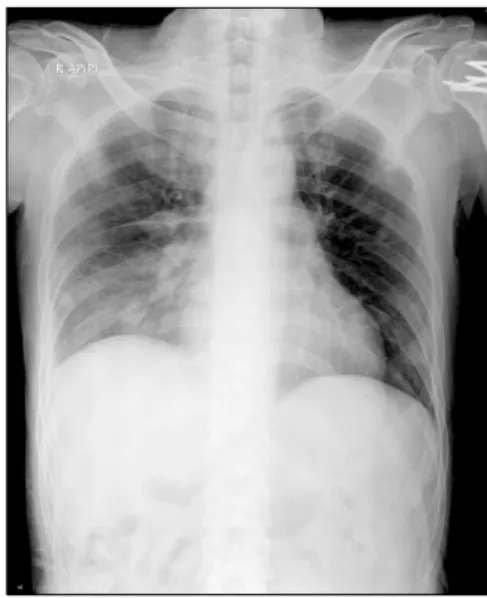
Figure 1. Chest X-ray showed right lower zone con- solidation with pleural effusion and peripherally multiple nodular opacities.

Introduction

Septic embolism is a rare disorder that is associated with bone infections, infective endocarditis, sinusitis, or- bital cellulitis, femoral thrombophlebitis, urinary tract in- fections, central venous catheter infections, prosthetic cardiac valve infections and pacemaker infections. The most common causative organism is Staphylococcus aureus . Predisposing factors include diabetes mellitus, immunosuppression and intravenous drug use. Septic embolism can be difficult to diagnose and can present with a variety of features.

We report a case of staphylococcal septic embolism in the azygos vein, which was discovered in a 51- year-old man with chest pain, dyspnea and fever. The patient was treated with antibiotic therapy alone without

anticoagulant therapy.

Case Report

A 51-year-old male was admitted to our hospital with high grade fever, severe right-sided chest pain and

Case Report

(2)

Tuberculosis and Respiratory Diseases Vol. 72. No. 3, Mar. 2012

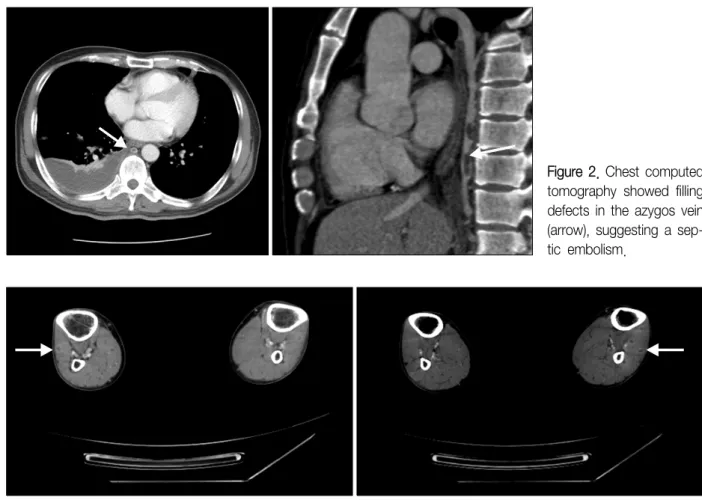
329 Figure 2. Chest computed tomography showed filling defects in the azygos vein (arrow), suggesting a sep- tic embolism.

Figure 3. Long vascular computed tomography showed lower leg intramuscular abscess.

dyspnea for five days. He had a history of poorly con- trolled type 2 diabetes mellitus. The patient appeared severely ill. On admission, his body temperature was 38.2

o

C, pulse rate was 93 per minute, respiration rate was 18 per minute and blood pressure was 120/90 mm Hg. Auscultation of the chest revealed decreased breath sound and inspiratory crackle at the right lower lung field. There was tenderness on palpation and percus- sion of his right lower chest wall. Initial laboratory eval- uation showed white blood cell count of 22,300/μL with 88% segmented neutrophils, hemoglobin of 11.9 g/dL, platelets of 317,000/μL and C-reactive protein of 37.8 mg/dL. His plasma glucose was 438 mg/dL and hemoglobin A1C was 11%. He was negative human im- munodeficiency virus. Chest X-ray showed right lower zone consolidation with pleural effusion and periph- erally multiple nodular opacities (Figure 1). Further imaging with contrast enhanced helical computed to-

mography of the chest showed embolic occlusion of the

azygos vein (Figure 2). Long vascular computed tomog-

raphy did not show lower extremity deep vein thrombo-

sis but showed intramuscular abscess on both lower

legs (Figure 3). Initial empiric antibiotic therapy was

started on ceftriaxone 2.0 g intravenously every twelve

hours. The patient underwent a diagnostic thoracentesis

with removal of serosanguinous fluid that was an exu-

dative pleural effusion, negative bacterial and acid-fast

stains and cytology. The pleural fluid cell count demon-

strated a red blood cell count of 140/μL (per cubic mil-

limeter), a white blood cell of 1,520/μL with 95% neu-

trophil and adenosine deaminase was normal. The pa-

tient's blood, sputum and pleural fluid cultures yielded

oxacillin-sensitive S. aureus . Ceftriaxone was dis-

continued on day 3 of the admission. Nafcillin at 500

mg intravenously every four hours and isepamicin at

200 mg intravenously every twelve hours was begun.

(3)

WS Kang et al: Septic azygos vein embolism

330

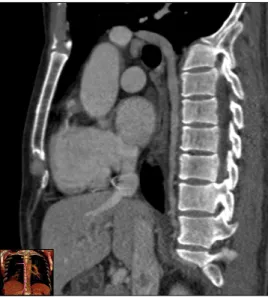
Figure 4. Follow-up of chest computed tomography re- vealed complete resolution of the septic embolism in the azygos vein.

Transthoracic echocardiography revealed normal left ventricular function with no vegetation, valvular regur- gitation and other signs of endocarditis.

With appropriate antibiotic therapy, the patient's clin- ical condition had been improved and subsequent chest X-ray showed gradual resolution of pneumonia and par- apneumonic effusion. His diabetes was controlled well starting insulin therapy. After taking one month of anti- biotics, a repeat chest computed tomography revealed complete resolution of septic embolism in the azygos vein without anticoagulant therapy (Figure 4).

Discussion

Septic embolism is a type of embolism infected with bacteria, resulting in pus formation. The embolic blood clot that leads to an infarction in the pulmonary vascula- ture also contains microorganisms that incite a focal abscess. The bacterial insult to endothelium in vessel is postulated in regard to the pathogenesis of septic embolism. These may become dangerous if dislodged from their original location. Septic embolism in the azy- gos vein is potentially fatal because it may result in pul- monary embolism and sudden death. The most com- mon causative organism is S. aureus . Predisposing fac-

tors include diabetes mellitus, immunosuppression and intravenous drug use

1

.

In this case, the patient presented sepsis with pneu- monia and had signs of septic embolism with chest imaging such as poorly defined nodules in the lung periphery. Contrast enhanced helical computed tomog- raphy of the chest showed embolic occlusion of the azy- gos vein and long vascular computed tomography did not show lower extremity deep vein thrombosis (His Wells score for pulmonary embolism was 0 point, sug- gestive of low probability). In conclusion, the patient was diagnosed with septic azygos vein embolism caused by S. aureus bacteremia, parapneumonic effu- sion and lower leg intramuscular abscess. The patient was treated with antibiotics (nafcillin and isepamicin) without anticoagulant therapy and discharged after one month.

The diagnosis of septic embolism can be suspected from antecedents and symptoms, but imaging tests (especially, CT of the chest, and echocardiography) to- gether with isolating cultures of microorganism play a key role in the diagnosis of septic embolism

2

. With ear- ly diagnosis, appropriate antimicrobial therapy and con- trol of the infectious source, resolution of the illness can be expected for most patients with avoidance of poten- tial complications. Other reports described that S. aur- eus was the predominant infective agent

3,4

. Therefore, initial empiric antibiotic therapy should include beta-lac- tamase-resistant penicillin by the intravenous route.

There are no data available on whether an aminoglyco- side should be added.

It may be difficult to the adequate management of

septic patients with major deep venous thrombosis be-

cause septic embolism is the high risk for complications

such as worsening sepsis, metastatic infection and pul-

monary embolism by itself. However early admin-

istration of intravenous heparin followed by oral anti-

coagulant therapy in patients with septic embolism re-

mains controversial. The presumed dangers include

provocation of septic embolism from the infected

thrombus itself or from concomitant infective endocardi-

tis and complications of hemorrhage from unrecognized

(4)

Tuberculosis and Respiratory Diseases Vol. 72. No. 3, Mar. 2012

331 mycotic arterial aneurysms. Indeed, patient with septic

embolism belong to a population at particularly high risk for development of infective endocarditis, and some authors have stated that anticoagulant therapy should be instituted only after infective endocarditis has been ruled out.

Patients with complications from septic vein embo- lism who fail to respond to antibiotic therapy alone may require anticoagulant therapy or inferior vana cava filter use. Greenfield and Proctor

5

reviewed 175 septic pa- tients who received inferior vena cava filters and found no reports of patients with recurrent sepsis episodes or any significant adverse events. On the other hand, an inferior vena cava filter has been shown to become in- fected during active sepsis

6

.

The diagnosis of septic azygos vein embolism is diffi- cult, so rapid diagnosis and treatment is important to avoid complications. Radiologic imaging, especially CT of the chest, is valuable in the evaluation of patients with suspected azygos vein embolism

7

. Generally, ap- propriate antibiotic therapy without anticoagulant ther- apy may be a sufficient treatment of septic azygos vein embolism depending on the clinical situation.

References

1. Ptaszynski AE, Hooten WM, Huntoon MA. The inci- dence of spontaneous epidural abscess in Olmsted County from 1990 through 2000: a rare cause of spinal pain. Pain Med 2007;8:338-43.

2. Cook RJ, Ashton RW, Aughenbaugh GL, Ryu JH. Septic pulmonary embolism: presenting features and clinical course of 14 patients. Chest 2005;128:162-6.

3. Ang AK, Brown OW. Septic deep vein thrombosis. J Vasc Surg 1986;4:563-6.

4. Andes DR, Urban AW, Acher CW, Maki DG. Septic thrombosis of the basilic, axillary, and subclavian veins caused by a peripherally inserted central venous catheter. Am J Med 1998;105:446-50.

5. Greenfield LJ, Proctor MC. Vena caval filter use in pa- tients with sepsis: results in 175 patients. Arch Surg 2003;138:1245-8.

6. Meda MS, Lopez AJ, Guyot A. Candida inferior vena cava filter infection and septic thrombophlebitis. Br J Radiol 2007;80:e48-9.

7. Huang RM, Naidich DP, Lubat E, Schinella R, Garay SM, McCauley DI. Septic pulmonary emboli: CT-radio- graphic correlation. AJR Am J Roentgenol 1989;153:

41-5.

수치

Figure  1.  Chest  X-ray  showed  right  lower  zone  con- con-solidation  with  pleural  effusion  and  peripherally  multiple  nodular  opacities.
Figure  3.  Long  vascular  computed  tomography  showed  lower  leg  intramuscular  abscess.
Figure  4.  Follow-up  of  chest  computed  tomography  re- re-vealed complete resolution of the septic embolism in the azygos  vein.

참조

관련 문서

Forces exerted by a flowing fluid on a pipe bend, enlargement, or contraction in a pipeline may be computed by a application of the impulse-momentum principle...

Percutaneous polymethylmethacrylate vertebroplasty in the treatment of osteoporotic vertebral body compression fractures: technical aspects. Pulmonary embolism caused

 In the present study, as a preliminary study, a LACC-based Compton CT was developed to estimate the activity of the spot inside the radioactive waste drum. To

"ESKAPE" pathogens, consist of Enterococcus faecium, Staphylococcus aureus, Klebsiella pneumoniae, Acinetobacter baumannii, Pseudomonas aeruginosa,

(1) Infuse fluid through a large vein: subclavian vein (high osmolarity) (2) Ensure proper placement of the line (chest X-ray after line insertion) (3) Precisely regulate

It considers the energy use of the different components that are involved in the distribution and viewing of video content: data centres and content delivery networks

After first field tests, we expect electric passenger drones or eVTOL aircraft (short for electric vertical take-off and landing) to start providing commercial mobility

1 John Owen, Justification by Faith Alone, in The Works of John Owen, ed. John Bolt, trans. Scott Clark, "Do This and Live: Christ's Active Obedience as the