INTRODUCTION
Adolescent smokers are likely to become smokers and are at increased risk of smoking-related diseases such as asthma, lung cancer, emphyse- ma, and peripheral vascular disease.1,2) Notably, smoking promotes the
adoption of other health risk behaviors such as the use of alcohol or ille- gal drugs.3) In this context, smoking during adolescence may have harm- ful consequences on the current, as well as on the future, population’s health.
To reduce adolescent smoking prevalence, the Korean government has
Received August 22, 2017 Accepted October 7, 2017
Corresponding author Dong Ryul Lee Tel: +82-31-390-2965, Fax: +82-31-390-2266 E-mail: [email protected]
ORCID: http://orcid.org/0000-0001-7255-4561
Copyright © 2018 The Korean Academy of Family Medicine
This is an open-access article distributed under the terms of the Creative Commons At- tribution Non-Commercial License (http://creativecommons.org/licenses/by-nc/4.0) which permits unrestricted noncommercial use, distribution, and reproduction in any medium, provided the original work is properly cited.
Original Article
https://doi.org/10.21215/kjfp.2018.8.6.826 eISSN 2233-9116
Korean J Fam Pract. 2018;8(6):826-833
Korean Journal of Family Practice
KJFP
한국 청소년에서 담배 가격 인상 후 흡연 지속과 관련된 요인:
성별에 따른 차이를 중심으로
박수경, 김경환, 이정운, 이동률*
원광대학교 의과대학 산본병원 가정의학교실
Factors Related to Persistent Smoking after Cigarette Price Increase among Korean Adolescents:
Focusing on Sex Differences
Soo Kyoung Park, Kyung Hwan Kim, Jungun Lee, Dong Ryul Lee*
Department of Family Medicine, Wonkwang University Sanbon Hospital, Wonkwang University School of Medicine, Gunpo, Korea
Background: Epidemiological studies have reported sex differences in adolescents’ responsiveness to cigarette prices; however, few studies have suggested factors related to this. We investigated factors related to persistent smoking in Korean adolescents following the cigarette price increase of 2015 (by approximately 80% or 2.0 dollars per pack), focusing on sex differences.
Methods: This study used data from adolescent smokers from the 2015 Korea Youth Risk Behavior Web-based Survey. A self-administered questionnaire was completed by middle and high school students (aged 13–18 years) following the cigarette price increase. Persistent smokers were defined as those who maintained their smoking level after the increase. Weighted logistic regression analyses based on a multi-stage complex sample design were conducted to assess factors related to persistent smoking despite the cigarette price increase.
Results: The persistent smoking rate in females was significantly higher than in males (78.7% vs. 75.4%, respectively; P<0.001). Factors related to persistent smoking in males were stress, suicidal thoughts, smoking duration, and no exposure to anti-smoking publicity (odds ratios [OR]=1.21, 1.32, 1.04, and 1.44, respectively); factors related to persistent smoking in females were stress, self-recognized obesity, and no exposure to anti- smoking publicity (OR=1.62, 2.28, and 1.43, respectively).
Conclusion: Sex differences were found in factors related to changes in smoking habits following the cigarette price increase among Korean adolescents. Of these, psychological factors played an important role, particularly in females. Besides the pricing policy, individualized adolescent anti-smoking programs considering various factors should be developed in Korea.
Keywords: Persistent Smoker; Persistent Smoking; Cigarette Price; Sex Differences; Adolescent
박수경 외. 담배 가격 인상 후 청소년 흡연 지속과 관련된 요인 Korean Journal of Family Practice
KJFP
promoted anti-smoking measures such as expanding smoke-free areas and restricting advertisements; furthermore, even stronger policies, such as implementing image-based cigarette package warnings and increasing cigarette prices are in progress.4) Of these policies, the most effective ap- proach for reducing the prevalence of smoking has been to increase the price of cigarettes.5-7)
Importantly, responsiveness to an increase in cigarette price varies de- pending on the characteristics of the adolescents, such as race, smoking level, and allowance.8-10) Several studies have also reported sex differences in changes in smoking habits following a cigarette price increase; howev- er, these studies did not present detailed factors that explain these differ- ences.11,12) On January 1, 2015, the Korean Ministry of Health and Wel- fare raised the average retail price of cigarettes by 80% (approximately 2.0 dollars per pack). This high increase may clarify the factors related to sex differences in adolescent smoking. Although a study reported the factors related to continued smoking after the cigarette price increase in 2015, it did not suggest differentiated results according to sex.13) Given the preva- lence of the adolescent smoking rate in Korea (6.3% in 2015),12) the devel- opment of non-price-based anti-smoking programs based on detailed
information is still important.
Therefore, the objective of this study was to examine factors related to persistent smoking following the cigarette price increase among Korean adolescents, focusing on sex differences.
METHODS
1. Study subjects
This study used cross-sectional data from the baseline survey of the Korea Youth Risk Behavior Web-based Survey (KYRBS) 2015, which was conducted by the Korea Centers for Disease Control and Prevention. The KYRBS is an anonymous, self-administered, web-based survey using a stratified, multistage, cluster-sampling design to monitor health risk be- haviors among Korean adolescents. The 2015 KYRBS consisted of 125 indicators in 14 domains. Nineteen indicators of 6 domains (demograph- ic factors, smoking, drinking, obesity and weight control, mental health, and subjective health) were included in this study. The KYRBS was ap- proved by the institutional review board of the Korea Centers for Disease Control and Prevention (2014-06EXP-02-P-A). A total of 70,362 students
Original Article
Korean Journal of Family Practice
Randomly selected for KYRBS 2015
(n=70,362)
Participated in a web-based survey
(n=68,043)
Participated who have ever smoked a cigarette
(n=11,628)
Current smokers at the time of the cigarette price increase
(n=7,118)
Male (n=5,516) Persistent smoking* (n=3,870) Decreased smoking (n=1,646)
Female (n=1,602) Persistent smoking* (n=1,261)
Decreased smoking (n=341)
Excluded due to the following reasons (n=4,510):
Quit before the increase in cigarette price (n=2,957) Did not provide smoking status (n=1,553)
Did not smoke cigarettes at all (n=56,415)
Did not participate in KYRBS 2015 (n=2,319)
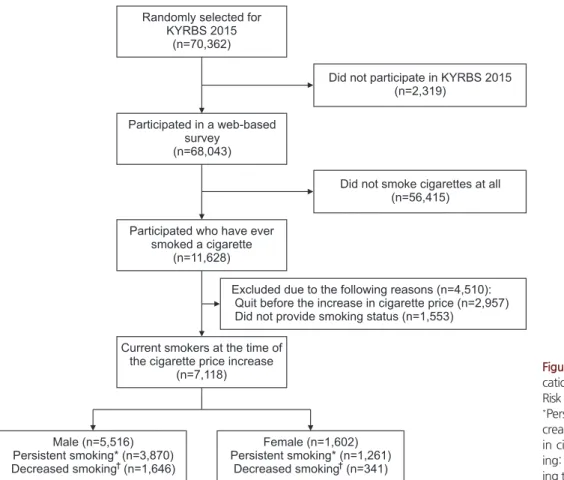
Figure 1. Flow diagram for the identifi- cation of study population Korea Youth Risk Behavior web-based Survey (KYRBS).
*Persistent smoking: maintained or in- creased smoking following the increase in cigarette prices. †Decreased smok- ing: decreased or quit smoking follow- ing the increase in cigarette prices.
Soo Kyoung Park, et al. Factors Related to Persistent Adolescent Smoking after Cigarette Price Increase
Korean Journal of Family Practice
KJFP
from 400 middle schools and 400 high schools were selected for the sur- vey. Among them, 68,043 students from 797 schools participated in the survey (response rate, 96.7%). Of the 11,628 participants who had ever had a puff of cigarette, those who had quit smoking before the cigarette price increase (n=2,957) or who did not provide their current smoking status (n=1,553) were excluded. Thus, our analysis included 7,118 current smokers at the time of the cigarette price increase (5,516 males and 1,602 females) (Figure 1).
2. Measurements
The participants were asked, “‘How did you change your smoking habits following the increase in cigarette price (since January 1, 2015)?,”
with a choice of four possible answers: “There was no change,” “I quit smoking,” “I smoked fewer cigarettes,” or “I smoked more cigarettes.” In this study, smoking status following the increase in cigarette price was re- categorized as persistent smoking (maintained or increased smoking fol- lowing the increase in cigarette price) or decreased smoking (decreased or no smoking following the increase in cigarette price). Variables were largely divided into socio-demographic, psychological, and smoking-re- lated factors. Socio-demographic factors included sex, type of school (middle school or high school) and residential area (urban, suburban, or rural), school record (high, middle, or low), weekly allowance (classified as less than 50,000 Korean won [KRW], corresponding to approximately 50 dollars), 50,000–100,000 KRW, or more than 100,000 KRW). Psycho- logical factors addressed self-reported stress levels in general (high, mid- dle, or low), depressive mood during the past 12 months (yes or no), sui- cidal thoughts during the past 12 months (yes or no), self-recognized body image (thin, normal, or obese), and self-reported health (healthy, moderate health, or poor health). Smoking-related factors included smoking duration (less than 2 years, 2–4 years, more than 4 years), hav- ing a good friend who smokes (yes or no), receiving smoking cessation education at school during the previous 12 months (yes or no), exposure to anti-smoking publicity during the previous 12 months (yes or no), and exposure to cigarette advertisements during the previous 30 days (yes or no).
3. Statistical analysis
Statistical analysis was performed considering a multistage complex sample design. We compared baseline characteristics between persistent smoking and decreased smoking using a chi-square test for categorical
variables and t-test for continuous variables. Multivariate logistic regres- sion analysis was used to estimate the odds ratios (ORs) and 95% confi- dence intervals (CIs) between persistent smoking and influence factors (socio-demographic, psychological, and smoking-related factors). “Smok- ing amount” was not included in the logistic regression model because it was the resultant value of the increase in cigarette price and did not rep- resent the degree of nicotine dependence before the increase in cigarette price. All data were analyzed using SAS version 9.4 (SAS Institute, Cary, NC, USA). A P-value < 0.05 was considered statistically significant.
RESULTS
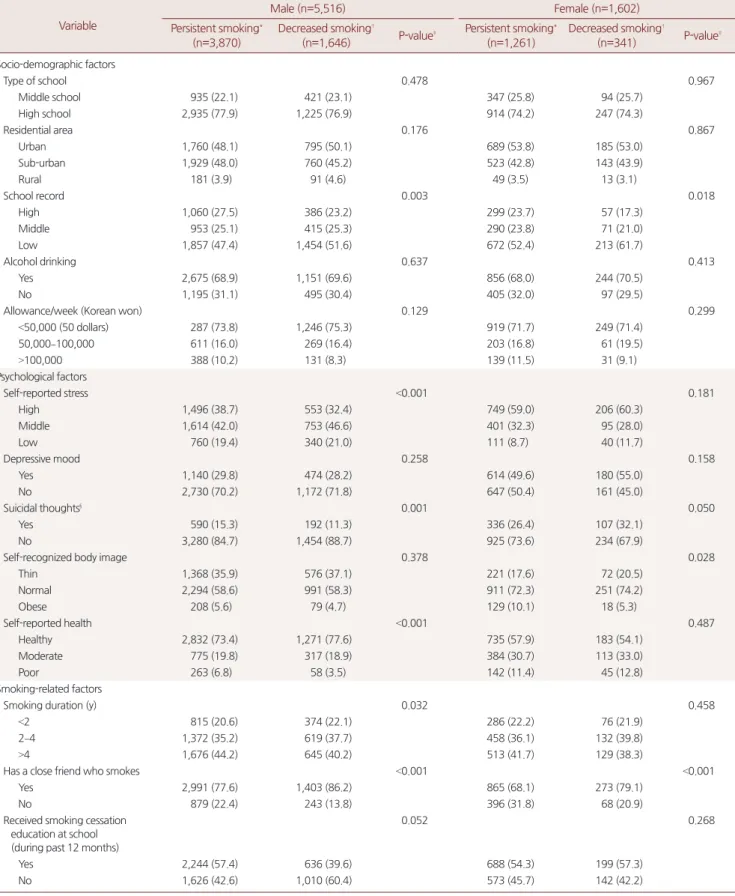
The general characteristics of the study subjects by persistent or de- creased smoking status are presented in Table 1. A total of 7,118 adoles- cents were included; the mean age was 17.6±0.1 years for males and 17.4±0.1 years for females. Of the participants, 72.1% reported being per- sistent smokers following the cigarette price increase. The persistent smoking rate in females was higher than that in males (78.7% vs. 75.4%, respectively; P < 0.001).
The daily smoking levels of persistent and decreased-level smokers in males were 7.2±0.2 and 4.3±0.2, respectively (P=0.010); whereas the val- ues for females were 6.5±0.4 and 5.9±0.5, respectively (P=0.929).
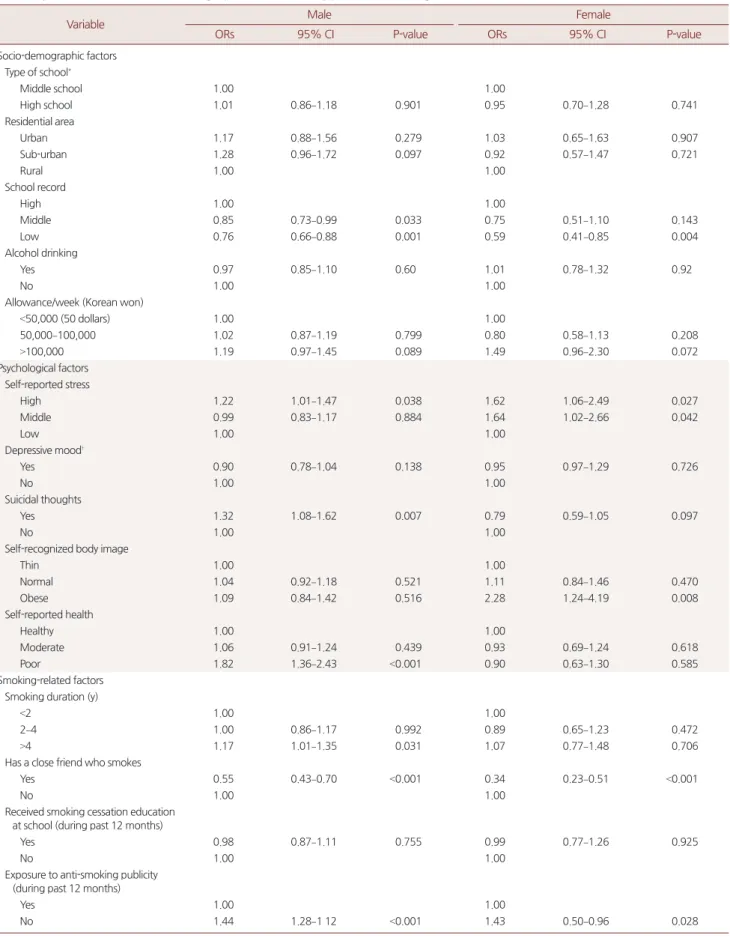
The adjusted OR for being a persistent smoker by possible influencing factors are presented in Table 2. Factors related to persistent smoking in males were self-reported stress (OR=1.22 for high levels of stress com- pared with low levels), suicidal thoughts (OR=1.32 for yes compared with no), self-reported health (OR=1.82 and 1.06 for healthy and moderate, re- spectively, compared with poor), and exposure to anti-smoking publicity (OR=1.44 for no compared with yes); factors in females were self-reported stress (OR=1.22 for high levels of stress compared with low levels), self- recognized body image (OR=1.11 and 2.28 for normal and obese, respec- tively, compared with thin), and exposure to anti-smoking publicity (OR=1.43 for no compared with yes). The odds ratio of persistent smok- ing associated with self-reported stress was higher in females than in males (1.62 vs. 1.22, respectively; P=0.040).
Factors related to decreased smoking in males were school record (OR=0.85 and 0.76 for middle and low, respectively, compared with high), and having a good friend who smokes (OR=0.55 for yes compared with no); factors in females were school record (OR=0.75 and 0.59 for middle and low, respectively, compared with high) and having a close friend who
박수경 외. 담배 가격 인상 후 청소년 흡연 지속과 관련된 요인 Korean Journal of Family Practice
KJFP
Table 1. General characteristics of participants’ smoking status following the cigarette price increase in 2015 Variable
Male (n=5,516) Female (n=1,602)
Persistent smoking* (n=3,870)
Decreased smoking†
(n=1,646) P-value‡ Persistent smoking* (n=1,261)
Decreased smoking†
(n=341) P-value‡ Socio-demographic factors
Type of school 0.478 0.967
Middle school 935 (22.1) 421 (23.1) 347 (25.8) 94 (25.7)
High school 2,935 (77.9) 1,225 (76.9) 914 (74.2) 247 (74.3)
Residential area 0.176 0.867
Urban 1,760 (48.1) 795 (50.1) 689 (53.8) 185 (53.0)
Sub-urban 1,929 (48.0) 760 (45.2) 523 (42.8) 143 (43.9)
Rural 181 (3.9) 91 (4.6) 49 (3.5) 13 (3.1)
School record 0.003 0.018
High 1,060 (27.5) 386 (23.2) 299 (23.7) 57 (17.3)
Middle 953 (25.1) 415 (25.3) 290 (23.8) 71 (21.0)
Low 1,857 (47.4) 1,454 (51.6) 672 (52.4) 213 (61.7)
Alcohol drinking 0.637 0.413
Yes 2,675 (68.9) 1,151 (69.6) 856 (68.0) 244 (70.5)
No 1,195 (31.1) 495 (30.4) 405 (32.0) 97 (29.5)
Allowance/week (Korean won) 0.129 0.299
<50,000 (50 dollars) 287 (73.8) 1,246 (75.3) 919 (71.7) 249 (71.4)
50,000–100,000 611 (16.0) 269 (16.4) 203 (16.8) 61 (19.5)
>100,000 388 (10.2) 131 (8.3) 139 (11.5) 31 (9.1)
Psychological factors
Self-reported stress <0.001 0.181
High 1,496 (38.7) 553 (32.4) 749 (59.0) 206 (60.3)
Middle 1,614 (42.0) 753 (46.6) 401 (32.3) 95 (28.0)
Low 760 (19.4) 340 (21.0) 111 (8.7) 40 (11.7)
Depressive mood 0.258 0.158
Yes 1,140 (29.8) 474 (28.2) 614 (49.6) 180 (55.0)
No 2,730 (70.2) 1,172 (71.8) 647 (50.4) 161 (45.0)
Suicidal thoughts§ 0.001 0.050
Yes 590 (15.3) 192 (11.3) 336 (26.4) 107 (32.1)
No 3,280 (84.7) 1,454 (88.7) 925 (73.6) 234 (67.9)
Self-recognized body image 0.378 0.028
Thin 1,368 (35.9) 576 (37.1) 221 (17.6) 72 (20.5)
Normal 2,294 (58.6) 991 (58.3) 911 (72.3) 251 (74.2)
Obese 208 (5.6) 79 (4.7) 129 (10.1) 18 (5.3)
Self-reported health <0.001 0.487
Healthy 2,832 (73.4) 1,271 (77.6) 735 (57.9) 183 (54.1)
Moderate 775 (19.8) 317 (18.9) 384 (30.7) 113 (33.0)
Poor 263 (6.8) 58 (3.5) 142 (11.4) 45 (12.8)
Smoking-related factors
Smoking duration (y) 0.032 0.458
<2 815 (20.6) 374 (22.1) 286 (22.2) 76 (21.9)
2–4 1,372 (35.2) 619 (37.7) 458 (36.1) 132 (39.8)
>4 1,676 (44.2) 645 (40.2) 513 (41.7) 129 (38.3)
Has a close friend who smokes <0.001 <0.001
Yes 2,991 (77.6) 1,403 (86.2) 865 (68.1) 273 (79.1)
No 879 (22.4) 243 (13.8) 396 (31.8) 68 (20.9)
Received smoking cessation education at school (during past 12 months)
0.052 0.268
Yes 2,244 (57.4) 636 (39.6) 688 (54.3) 199 (57.3)
No 1,626 (42.6) 1,010 (60.4) 573 (45.7) 142 (42.2)
Soo Kyoung Park, et al. Factors Related to Persistent Adolescent Smoking after Cigarette Price Increase
Korean Journal of Family Practice
KJFP
smokes (OR=0.34 for yes compared with no).
Of the socio-demographic factors, no variable, including allowance, was related to persistent smoking in either male or female adolescents.
However, when the population was merged, and sex was not taken into account, the subgroup with an allowance of over 100,000 KRW/week demonstrated an elevated likelihood of persistent smoking (OR=1.25 for more than 100,000 KRW compared with less than 50,000 KRW). Of the smoking-related factors, the OR of persistent smoking increased in male adolescents who had been smoking for more than four years (OR=1.17 for more than 4 years compared with less than 2 years).
DISCUSSION
Our results demonstrate that among the 7,118 adolescent smokers, 72.1% reported as persistent smokers following the cigarette price in- crease on January 1, 2015. The persistent smoking rate was similar but significantly higher in females than in males (78.7% vs. 75.4%). Persistent smoking in males was associated with self-reported stress, suicidal thoughts, self-reported poor health, smoking duration, and no exposure to anti-smoking publicity. For female students, persistent smoking was related to stress, self-recognized body image, and no exposure to anti- smoking publicity.
Evidence has suggested that female adolescents are less sensitive to cig- arette price increases than males.8,11,14,15) A study performed in the United States among ninth-grade students (aged 13–16) suggested that the smoking rate for boys decreased considerably more than for girls (elastici- ties of -1.51 and -0.32, respectively).14) Similarly, a recent survey in Korea (2013 KYRBS) also found that smokers who would continue smoking
despite any future price increases were more commonly female (with a difference of approximately 5.1% between males and females).8) In our re- sults for the 2015 KYRBS, the difference was relatively small (approxi- mately 3.3%). The difference between these two recent Korean surveys may be explained by the timing of the surveys performed (before and af- ter the price increase) and different definitions of the outcome variable.
Notably, in spite of the different responsiveness by sex, previous stud- ies did not pay attention to related factors. In this study, we performed detailed analyses, considering various factors and found that psychologi- cal factors played an important role in the persistence of cigarette smok- ing. Of these, stress affected both male and female adolescents. Stress was particularly more important in females (aOR=1.22 vs. 1.62; P<0.001).
These results are in line with a recent report on African-American ado- lescents in the United States.16) In addition to its effect on persistent smoking, stress is a principal factor that promotes the initiation of ciga- rette use.17) To evaluate whether stress was also related with initiation of smoking in adolescents after the increase in cigarette price, another study should be considered.
Interestingly, suicidal thoughts had a significant association with per- sistent smoking only in male students. This may possibly be explained by nicotine dependence. Namely, a recent study on smoking level and sui- cidal thoughts in Korean youth found that smoking levels and suicidal thoughts had a meaningful relationship.18) In our study, the smoking lev- els of persistent and decreased-level smokers were different only in males;
hence, suicidal thoughts may be a significant factor only in males. Several studies have suggested that smoking may be a risk factor for suicidal thoughts.19) The causal relationship between them should therefore be elucidated.
Table 1. Continued Variable
Male (n=5,516) Female (n=1,602)
Persistent smoking* (n=3,870)
Decreased smoking†
(n=1,646) P-value‡ Persistent smoking* (n=1,261)
Decreased smoking†
(n=341) P-value‡ Exposure to anti-smoking publicity
(during past 12 months)
<0.001 0.008
Yes 2,544 (66.0) 1,216 (74.4) 850 (67.8) 258 (76.7)
No 1,326 (34.0) 430 (25.6) 411 (32.2) 83 (23.3)
Exposure to tobacco advertisement (during past 30 days)
0.024 0.039
Yes 2,548 (66.4) 1,145 (69.9) 797 (63.6) 237 (70.8)
No 1,322 (33.6) 501 (30.1) 464 (36.4) 104 (29.3)
Values are presented as number (%).
*Persistent smoking: maintained or increased smoking following the cigarette price increase. †Decreased smoking: decreased or quit smoking following the cigarette price increase. ‡Rao-Scott chi-square test was conducted considering a multistage complex sample design. §Sadness enough to interrupt daily life.
박수경 외. 담배 가격 인상 후 청소년 흡연 지속과 관련된 요인 Korean Journal of Family Practice
KJFP
Table 2. Adjusted odds ratios (ORs) for being a persistent smoker by possible influencing factors
Variable Male Female
ORs 95% CI P-value ORs 95% CI P-value
Socio-demographic factors Type of school*
Middle school 1.00 1.00
High school 1.01 0.86–1.18 0.901 0.95 0.70–1.28 0.741
Residential area
Urban 1.17 0.88–1.56 0.279 1.03 0.65–1.63 0.907
Sub-urban 1.28 0.96–1.72 0.097 0.92 0.57–1.47 0.721
Rural 1.00 1.00
School record
High 1.00 1.00
Middle 0.85 0.73–0.99 0.033 0.75 0.51–1.10 0.143
Low 0.76 0.66–0.88 0.001 0.59 0.41–0.85 0.004
Alcohol drinking
Yes 0.97 0.85–1.10 0.60 1.01 0.78–1.32 0.92
No 1.00 1.00
Allowance/week (Korean won)
<50,000 (50 dollars) 1.00 1.00
50,000–100,000 1.02 0.87–1.19 0.799 0.80 0.58–1.13 0.208
>100,000 1.19 0.97–1.45 0.089 1.49 0.96–2.30 0.072
Psychological factors Self-reported stress
High 1.22 1.01–1.47 0.038 1.62 1.06–2.49 0.027
Middle 0.99 0.83–1.17 0.884 1.64 1.02–2.66 0.042
Low 1.00 1.00
Depressive mood†
Yes 0.90 0.78–1.04 0.138 0.95 0.97–1.29 0.726
No 1.00 1.00
Suicidal thoughts
Yes 1.32 1.08–1.62 0.007 0.79 0.59–1.05 0.097
No 1.00 1.00
Self-recognized body image
Thin 1.00 1.00
Normal 1.04 0.92–1.18 0.521 1.11 0.84–1.46 0.470
Obese 1.09 0.84–1.42 0.516 2.28 1.24–4.19 0.008
Self-reported health
Healthy 1.00 1.00
Moderate 1.06 0.91–1.24 0.439 0.93 0.69–1.24 0.618
Poor 1.82 1.36–2.43 <0.001 0.90 0.63–1.30 0.585
Smoking-related factors Smoking duration (y)
<2 1.00 1.00
2–4 1.00 0.86–1.17 0.992 0.89 0.65–1.23 0.472
>4 1.17 1.01–1.35 0.031 1.07 0.77–1.48 0.706
Has a close friend who smokes
Yes 0.55 0.43–0.70 <0.001 0.34 0.23–0.51 <0.001
No 1.00 1.00
Received smoking cessation education at school (during past 12 months)
Yes 0.98 0.87–1.11 0.755 0.99 0.77–1.26 0.925
No 1.00 1.00
Exposure to anti-smoking publicity (during past 12 months)
Yes 1.00 1.00
No 1.44 1.28–1 12 <0.001 1.43 0.50–0.96 0.028
Soo Kyoung Park, et al. Factors Related to Persistent Adolescent Smoking after Cigarette Price Increase
Korean Journal of Family Practice
KJFP
In addition, male students who reported their health to be poor tend to continue smoking. It is common sense to believe that individuals who report having poor health would be more likely to be persistent smokers than those who report having good health. This phenomenon seems to be related to the perception that their health is bad due to smoking, and was also noted in a previous study.8) This could be a characteristic of ado- lescent smokers.
Self-recognized body image as obese increased the likelihood of per- sistence in smoking only in females. A positive relationship between per- sistent smoking and self-recognized body image may indicate that some female adolescents use smoking as a weight control method. This rela- tionship has already been reported by previous studies and was stronger for girls than for boys.20) In addition, adolescent smoking experts should pay attention to the fact that a self-image as obese was the strongest factor in persistent smoking in females.
Unexpectedly, the persistent smoking rate was lower among adoles- cents who had a close friend who smoked and a poor school record. This result was similar to a Korean youth smoking study, which investigated smoking behavioral changes following the cigarette price increase in 2004 (500 KRW per pack).15) The reduction of smoking in adolescents with smoker friends may be attributable to cigarette sharing among teen- agers. In reality, based on our data, adolescents whose close friends smoked were more likely to seek cigarettes from friends than those whose close friends did not smoke (33.5% vs. 26.8%, respectively; P=0.029). This was also true for adolescents with a low school ranking because they had more close friends who smoked (data not shown).
To explore the relationship between nicotine dependence and smok- ing behavior, smoking level is commonly used. However, the smoking level included in our data was the resultant value of the increase in ciga- rette price. Therefore, we used smoking duration (i.e., time since smoking initiation) instead. This also reflects the nicotine dependence of adoles-
cent smokers.21) Interestingly, we found that persistent smoking was asso- ciated with smoking duration only in males. As mentioned previously, psychological factors played a more important role among female adoles- cents. Therefore, smoking dependence might play a minor role in fe- males. This observation warrants further investigation.
As non-price-related anti-smoking programs, school smoking cessa- tion programs have been adopted in many countries. However, these have not been particularly effective in Korea.22) In addition, based on present and prior studies, smoking behavior was not affected by school anti-smoking programs following the cigarette price increases in 2004 and 2015 in Korea.13,15) This may be because smoking cessation programs in schools have focused on video-based mass education.22) Reevaluation and improvement of school anti-smoking programs is therefore needed.
Some limitations of the present study must be acknowledged. First, there was no objective indicator to confirm the current smoking status or changes in smoking habits. Second, social desirability bias may result in under-reporting of smoking status or duration. Third, psychological fac- tors were measured using single-item questions, rather than standardized multi-item measures. This may limit the validity of the measurements of psychological factors. Fourth, smoking level before the cigarette price in- crease was not considered in the analysis; however, the smoking duration variable may have compensated for this shortcoming to some degree. Fi- nally, the survey was school based. Thus, our data did not represent the entire population of adolescents aged 13–18 years.
Despite these limitations, the present study used nationally representa- tive samples of Korean adolescents; this improves the external validity of the study results. Most importantly, this is one of just a few studies that have examined sex differences in the factors related to persistent smoking among adolescents.
In conclusion, sex differences were found in factors related to changes in smoking habits following the cigarette price increase among Korean Table 2. Continued
Variable Male Female
ORs 95% CI P-value ORs 95% CI P-value
Exposure to tobacco advertisement (during past 30 days)
Yes 0.99 0.86–1.14 0.876 0.820 0.62–1.08 0.161
No 1.00 1.00
CI, confidence interval.
*Adjusted for type of school, residential area, school record, allowance/week, self-reported stress, suicidal thoughts, self-recognized body image, self-reported health, smoking duration, has a close friend who smokes, received smoking cessation education at school (during past 12 months), exposure to anti-smoking publicity (during past 12 months), and exposure to tobacco advertisement (during past 30 days). †Sadness enough to interrupt daily life.
박수경 외. 담배 가격 인상 후 청소년 흡연 지속과 관련된 요인 Korean Journal of Family Practice
KJFP
adolescents. Of these, psychological factors played an important role, particularly in females. Besides pricing policy, individualized adolescent anti-smoking programs considering various factors should be developed in Korea. Future studies should examine whether price policy has de- creased the initiation of adolescent smoking. The long-term change in smoking patterns of decreased-level smokers following the price increase should be investigated by future studies.
ACKNOWLEDGEMENTS
This study was supported by Wonkwang University in 2017.
REFERENCES
1. Greening L, Dollinger SJ. Adolescent smoking and perceived vulnerability to smoking-related causes of death. J Pediatr Psychol 1991; 16: 687-99.
2. Eder W, Ege MJ, von Mutius E. The asthma epidemic. N Engl J Med 2006;
355: 2226-35.
3. Faeh D, Viswanathan B, Chiolero A, Warren W, Bovet P. Clustering of smok- ing, alcohol drinking and cannabis use in adolescents in a rapidly develop- ing country. BMC Public Health 2006; 6: 169.
4. Cho HJ. The status and future challenges of tobacco control policy in Korea.
J Prev Med Public Health 2014; 47: 129-35.
5. Lee MJ, Lee SW, Cho HJ. Analyzing issues and a status investigation of stud- ies on tobacco control policies in South Korea. Korea Inst Health Soc Aff 2014; 34: 165-91.
6. Chaloupka FJ, Yurekli A, Fong GT. Tobacco taxes as a tobacco control strate- gy. Tob Control 2012; 21: 172-80.
7. Nikaj S, Chaloupka FJ. The effect of prices on cigarette use among youths in the global youth tobacco survey. Nicotine Tob Res 2014; 16 Suppl 1: S16-23.
8. Lee YS, Kim HS, Kim HD, Yoo KB, Jang SI, Park EC. Is a price increase policy enough for adolescent smokers?: factors affecting the effectiveness of in- creasing cigarette prices among Korean adolescent smokers. Nicotine Tob Res 2016; 18: 2013-9.
9. Liang L, Chaloupka FJ. Differential effects of cigarette price on youth smok- ing intensity. Nicotine Tob Res 2002; 4: 109-14.
10. Do YK, Farooqui MA. Differential subjective responsiveness to a future cig- arette price increase among South Korean youth smokers. Nicotine Tob Res 2012; 14: 209-16.
11. Chaloupka FJ, Pacula RL. Sex and race differences in young people’s respon- siveness to price and tobacco control policies. Tob Control 1999; 8: 373-7.
12. van Hasselt M, Kruger J, Han B, Caraballo RS, Penne MA, Loomis B, et al.
The relation between tobacco taxes and youth and young adult smoking:
what happened following the 2009 U.S. federal tax increase on cigarettes?
Addict Behav 2015; 45: 104-9.
13. Kim JW, Lee SH, Bae H, Park ES, Lee S. Smoking behavior change after a to- bacco price increased in Korean adolescence. Korean J Fam Pract 2016; 6:
281-7.
14. Lewit EM, Hyland A, Kerrebrock N, Cummings KM. Price, public policy, and smoking in young people. Tob Control 1997; 6 Suppl 2: S17-24.
15. Cho KS, Yoon J. Changes in smoking behavior following an increase in ciga- rette price among Korean adolescents. Health Soc Welf Rev 2014; 34: 500- 22.
16. Belgrave FZ, Johnson J, Nguyen A, Hood K, Tademy R, Clark T, et al. Stress and tobacco use among African-American adolescents: the buffering effect of cultural factors. J Drug Educ 2010; 40: 173-88.
17. Torres OV, O’Dell LE. Stress is a principal factor that promotes tobacco use in females. Prog Neuropsychopharmacol Biol Psychiatry 2016; 65: 260-8.
18. Hong MS, Jung HS. Relationship between the current smoking level and suicidal ideation of youth. J Korean Soc Sch Health 2014; 27: 50-7.
19. Strandheim A, Bjerkeset O, Gunnell D3 Bjørnelv S, Holmen TL, Bentzen N.
Risk factors for suicidal thoughts in adolescence--a prospective cohort study: the Young-HUNT study. BMJ Open 2014; 4: e005867.
20. Rhee D, Yun SC, Khang YH. Co-occurrence of problem behaviors in South Korean adolescents: findings from Korea Youth Panel Survey. J Adolesc Health 2007; 40: 195-7.
21. Hwang JH, Park SW. Age at smoking initiation and subsequent smoking among Korean adolescent smokers. J Prev Med Public Health 2014; 47: 266- 72.
22. Jang HS, Kim HC, Shim KS, Jeon SN, Kim EK. Smoking prevention and an- ti-smoking education in school. J Korean Acad Fam Med 2006; 27: 561-70.