INTRODUCTION
Gastric or esophageal variceal bleeding has been a major cause of deaths in liver cirrhosis (1). Among the treatment modalities for gastric and esophageal variceal bleeding, medical treatment such as glypressin etc. or other palliative treatment using the S-B tube, whose hemostatic effect is not persistent (2, 3), sclerotherapy, and band ligation by endoscopy show a high rebleeding rate primarily because the portal pressure is not decreased (4, 5). Surgical porto-systemic shunt can decrease the portal venous pressure, however, is limited by its high surgical mortality (6-8).
Since percutaneous decompression of portal hypertension was reported by Rosch et al. in 1969, transjugular intrahepatic portosystemic shunt (TIPSS) has been known as an effective treatment method (9).
Therefore, we performed this study to determine the factors contributing to the survival time and rebleeding rate after TIPSS.
MATERIALS AND METHODS Subject
One hundred and fifty-five patients who had undergone TIPSS between September 1991 to March 2001 were selected retrospectively. Endoscopic treatment was ineffective or tech- nically very difficult in all cases. One hundred and twenty-six cases among them had gastric variceal bleeding and 29 cases had esophageal variceal bleeding. Endoscopic examination showed that 23 cases had only esophageal varices, 24 cases only gastric varices, and the other 108 cases had both esophageal and gastric varices. Twenty-seven cases had active bleeding, 21 cases from gastric varices and 6 cases from esophageal varices.
The mean age of the patients was 53 yr (18-78 yr), and 123 cases were male and 32 cases were female. Thirty-one cases were the Child-Pugh classification A, 88 cases were B, and 36 cases were C.
The causes of liver cirrhosis were alcohol in 60 cases, HBV in 75 cases, HCV in 9 cases, mixed type of HBV and HCV
Young Tak Kim, Min Kyu Jung, Chang Min Cho, Won Young Tak, Young Oh Kweon, Sung Kook Kim, Yong Hwan Choi, Joon Mo Chung
Department of Internal Medicine, Kyungpook National University, College of Medicine, Daegu, Korea
Address for correspondence Young Oh Kweon, M.D.
Department of Internal Medicine, Kyungpook National University, College of Medicine, 50 Sam-duck 2 ga, Jung-gu, Daegu 700-721, Korea
Tel : +82-53-420-5518, Fax : +82-53-426-8773 E-mail: [email protected].
772
Prognostic Factors of the Long-Term Survival after Transjugular Intrahepatic Portosystemic Shunt in the Treatment of Gastric and Esophageal Variceal Bleeding
Transjugular intrahepatic portosystemic shunt (TIPSS) is a promising method of treatment for gastric or esophageal variceal bleeding. This study was performed to determine the prognostic factors contributing to the survival of patients after TIPSS for gastric or esophageal variceal bleeding. One hundred and fifty-five patients who underwent TIPSS between September 1991 and March 2001 were followed up by clinical examination, upper gastrointestinal endoscopy, and Duplex sonography.
The mean portohepatic pressure gradient prior to TIPSS was 20.5±9.93 mmHg and dropped to 10.7±6.62 mmHg after TIPSS (p<0.001). The cumulative survival rate was 75.1% at 6 months, 66.6% at 1 yr, 58.4% at 2 yr, and 38.1% at 5 yr. Sur- vival after TIPSS was inversely related to the Child-Pugh classification (p<0.05).
The rebleeding rate was 18.3% at 6 months, 21.0% at 1 yr, 32.8% at 2 yr, and 53.1% at 5 yr. The causes of deaths were hepatic failure (53.5%), recurrent variceal bleeding (11.6%), pneumonia (4.6%), sepsis (3.5%), hepatic encephalopathy (2.3%), and unknown (17.4%). Multivariate analysis (Cox proportional hazard model) revealed that the Child-Pugh classification and age were statistically significant independent prognostic factors. In conclusion, TIPSS is an effective method of treatment for variceal bleeding in cases where other treatment modalities including endoscopic therapy are unsuccessful and the most important prognostic factors are preprocedural hepatic reserve (Child-Pugh class) and age.
Key Words : Portosystemic Shunt; Transjugular Intrahepatic; Esophageal and Gastric Varices
Received : 30 April 2002 Accepted : 29 August 2002
in 1 case, cholestatic liver disease in 2 cases, glycogen storage disease in 1 case, and idiopathic in 7 cases.
Seventy-five cases (48.4%) had a previous history of gastric or esophageal variceal bleeding. Thirty-eight cases among them had a history of endoscopic sclerotherapy or band ligation or percutaneous esophageal variceal embolization and the others received conservative treatment for bleeding. The mean hos- pitalization duration of the cases was 19 days and the mean post-TIPSS follow-up time was 116±106.2 weeks.
Diagnostic studies before TIPSS and follow-up
We confirmed the site of bleeding and the severity of varices by endoscopy. The patients’ general status was evaluated by blood tests including liver function test, Hb, platelet count, prothrombin time, ammonia, Na+, K+, BUN, and creatinine, and ultrasonogram was done before procedure to detect hep- atocellular carcinoma or portal vein thrombosis.
After procedure, we repeated endoscopy to evaluate the state of hemostasis, rebleeding, and the size of varices, and we repeat- ed blood tests including liver function test, blood ammonia to check side effects or complication, especially concerning the development of hepatic encephalopathy.
After discharge, we followed up clinical progress and per- formed blood tests and upper gastrointestinal endoscopy every three to six months.
TIPSS
After puncture and catheterization to the internal jugular vein at the right supraclavicular site, we took a hepatic venous angiogram to decide the shunt site from hepatic vein to portal vein. After puncture of portal vein, we checked the portal pressure, compared with the hepatic venous pressure, and performed a portal venous angiogram. We detected the varices by portal angiogram, dilated the puncture site of portal vein
by a balloon catheter, put a metal stent, and formed a porto- hepatic shunt. After shunt formation, we checked the decrease of the portal pressure and confirmed disappearance of the varices and shunt flow by portal angiogram.
Statistics
Reliablility of each clinical value was checked by Student’s t-test, one-way ANOVA and chi-square test. The survival rate was analysed by the survival curves by the Kaplan-Meier method (10), and the difference between each group’s survival rate was proved by log-rank test and Wilcoxon test.
To determine the factors affecting the life expectancy and the time of rebleeding, we performed the log-rank test and Cox-proportional hazard model.
RESULTS Effects of TIPSS
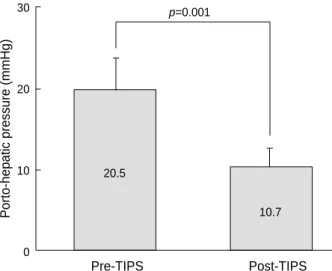
Establishment of the shunt was successful in all cases, and the porto-hepatic pressure gradient was decreased by average 9.8±5.54 mmHg, from 20.5±9.93 mmHg before TIPSS to 10.7±6.62 mmHg after the procedure (p<0.001) (Fig. 1).
In 108 cases for which follow-up endoscopy was performed within 14 days after TIPSS, 19 cases (17.6%) had no varices, 79 cases (73.1%) showed a decreased size of the esophageal and gastric varices, and 10 cases (9.3%) had no change.
Survival rate and factors affecting the survival rate
According to the analysis of survival rate by the Kaplan- Meier method, the mean survival time after TIPSS was 186.7
±14.9 weeks. The cumulative survival rate was 75.1% at 6 months after TIPSS, 66.6% at 1 yr, 58.4% at 2 yr, and 38.1%
30
20
10
0
Pre-TIPS Post-TIPS
p=0.001
Porto-hepatic pressure (mmHg)
20.5
10.7
Fig. 1. Decreased porto-hepatic pressure gradient after TIPSS.
100
50
0 3 6 9
Years
Survival rate (%)
Fig. 2. Cumulative survival rate after TIPSS.
20.5
10.7
at 5 yr (Fig. 2).
The univariate analysis showed that the male sex, older age, the Child-Pugh class C, and the less decrease of portal venous pressure after TIPSS were associated with a significantly lower survival rate. However, in the multivariate analysis, the Child- Pugh classification was the only significant factor affecting the survival rate.
The mean survival rates by the Child-Pugh classification were 225.0±27.6 weeks in A, 192.5±19.8 weeks in B, and 53.6±95 weeks in C; there were statistically significant dif- ferences between the groups (p<0.05) (Fig. 3).
The age of patients at the time of procedure was classified into 5 groups ; 39 yr or less, 40-49 yr, 50-59 yr, 60-69 yr, and 70 yr or more. The mean survival times of the age groups were 147.0±16.1 weeks, 127.5±14.1 weeks, 208.9±24.5 weeks, 84.9±10.6 weeks, and 21.2±9.9 weeks, respectively. There were significant differences between the groups (p<0.0001) (Fig. 4 and Table 2).
Rebleeding rate and factors related with rebleeding
Fifty cases (32.2%) experienced rebleeding after TIPSS. The mean time of rebleeding after TIPSS was 167.9±10.7 weeks.
The cumulative rebleeding rates were 18.3% at 6 months, 21.0% at 1 yr, 32.8% at 2 yr, and 53.1% at 5 yr after TIPSS.
The result of univariate analysis showed a significantly higher rebleeding rate in male patients and in cases with a history of more frequent bleeding before TIPSS. But in the multivariate analysis, there was no significant factor affecting the rebleeding rate. In 43 out of 50 cases of rebleeding, Doppler ultrasonogram was done and the state of shunt flow was checked. Twenty cases (46.5%) had shunt obstruction and 12 cases (27.9%) had shunt stenosis. The shunt flow was kept well in 11 cases.
Among 50 cases of rebleeding, 24 cases underwent a second TIPSS and 8 patients expired during resuscitation. In 2 cases, bleeding was controlled by band ligation and 6 patients expired due to rebleeding after control of the first rebleeding episode.
100
50
0 3 6 9
40-49
50-59 60-69
>60
Survival rate (%)
<40
Fig. 4. Cumulative survival rates after TIPSS by age (yr) (p<0.0001).
100
50
0 3 6 9
Follow-up years Follow-up years
B
Survival rate (%)
A
C
Fig. 3. Cumulative survival rates after TIPSS by Child-Pugh class A, B, and C (p=0.0118).
Mean age (range) (yr) 53 (18-78)
Sex (Male/Female) 123/32
Etiology of cirrhosis (No.)
Alcoholic 60
Viral 85
Others 10
Child-Pugh class A/B/C 31/88/36
No. (%) of patients with
a previous bleeding episode 75 (48.4)
No. (%) with spurting varices 27 (17.4)
Bilirubin (mg/dL) 3.1±4.4
Albumin (g/dL) 2.7±0.6
Prothrombin time (sec) 14.8±3.0
Characteristics Value
Table 1. Clinical characteristics of patients treated with trans- jugular intrahepatic portosystemic shunt (TIPSS)
Survival
All (No.; 155) 66.6 58.4 38.1
Child-Pugh class
A 76.7 72.8 51.9
B 73.0 60.6 35.9
C 42.7 42.7 35.6
Age (yr)
≤39 92.3 83.1 72.7
40-49 65.2 59.0 34.2
50-59 71.3 64.4 46.7
60-69 63.0 52.0 22.5
≥70 23.3 11.7 11.7
Rebleeding 21.0 32.8 53.1
1 yr (%) 2 yr (%) 5 yr (%) Table 2.Summary of Kaplan-Meier analysis
Complications
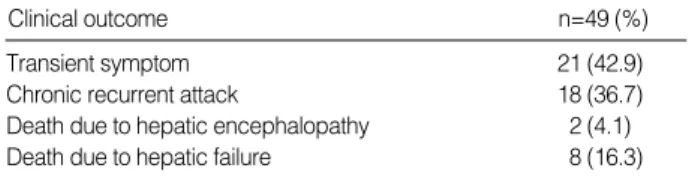
Hepatic encephalopathy was the most common compli- cations related to the TIPSS procedure. It developed as a complication of TIPSS in 49 cases; it was newly developed within 2 months after TIPSS or aggravated compared with before TIPSS. Eighteen (36.7%) among 49 cases of hepatic encephalopathy had chronic recurrent attacks; they experienced the acute episode of hepatic encephalopathy more than twice during hospitalization or over 3 times as out patients. 21 cases (42.9%) among them showed the pattern of transient hepatic encephalopathy.
In two cases (4.1%), hepatic encephalopathy was the major cause of death. Eight patients expired due to hepatic failure (Table 3).
Puncture of the bile duct developed during procedure in 19 cases, puncture to intraperitoneal space in 13 cases, infections in 10 cases, distortions of the stent in 3 cases, and hemolysis in 1 case. In 1 case of bile duct puncture, vascular embolization was done due to hemobilia.
Causes of deaths
Among 86 patients who expired during follow-up after TIPSS, hepatic failure was the most common cause of death (46 patients, 53.5%). Rebleeding occurred in 14 cases (16.3%), pneumonia in 4 cases (4.6%), hepatic encephalopathy in 2 cases (2.3%), sepsis in 3 cases (3.5%), renal failure in 1 case (1.2%) and the cause of death was unknown in 16 cases (18.6%) (Table 4).
DISCUSSION
About 30% of patients with liver cirrhosis have esophageal
varices, and about 30% of them are expected to experience bleeding afterwards (11). The mortality rate of patients with variceal bleeding due to liver cirrhosis is 30-50% (12). The main therapeutic modalities include aggressive resuscitation, continuous infusion of vasopressin, nitrate (13) or somatostatin (14), endoscopic sclerotherapy, and band ligation (13, 15), which are generally used for gastric or esophageal variceal bleeding. In spite of this therapies, however, the 30-day survival rate of the Child-Pugh classification C patients was no more than 50% (13, 16). Surgical shunt operation could decrease the portal pressure and treat the esophageal variceal bleeding, however, the 30-day survival rate was no more than 50% in emergent situations for controlling variceal bleeding in advanced liver cirrhosis (16-18).
In 1969, TIPSS, which could decrease the portal pressure nonsurgically, was introduced after animal test results by Rosch et al. (9), and then in 1988, it proved effective in humans by using a metal stent (19). The purpose of TIPSS is to increase survival of patients with liver cirrhosis through reducing the portal pressure for stopping gastric or esophageal variceal bleeding and preventing rebleeding. TIPSS is indi- cated for cases where pharmacologic or endoscopic manage- ment failed and the risk for surgical shunt operation is high.
Especially patients with variceal bleeding who are scheduled for liver transplantation can be treated by TIPSS without intraabdominal anatomical changes. In fact, by Ring et al. (20), more than 50% of patients received liver transplantation within 1 month after TIPSS. Recently, many studies showed the effectiveness of TIPSS for pharmacologically nonrespon- sive ascites of liver cirrhosis (21). TIPSS can be used for treat- ment of Budd-Chiari syndrome or portal hypertension due to portal vein thrombosis (22, 23).
In previous studies (24-27), the technical success rate and bleeding control rate of TIPSS were reported as 93-100% and 96-100%, respectively. The shunt was successfully established in all 155 cases in this study. Several studies have shown that gastric or esophageal varices recur or bleeding develop common- ly when the portal pressure is higher than the inferior vena caval (IVC) pressure by 12 mmHg (11, 28). In our study, the portocaval pressure gradient was 20.5±9.93 mmHg before TIPSS, 10.7±6.62 mmHg after TIPSS, showing on average decrease of 9.8±5.54 mmHg. The results are consistent with those from other studies (27, 29, 30).
In a follow-up study of 90 variceal bleeding patients for 2.2 yr, the 1-yr survival rate was 60% and 2-yr survival rate was 51% (30). The present study showed that the 6-month survival rate after TIPSS was 75.1%, 1-yr survival rate was 66.6%, 2-yr survival rate was 58.4%, and 5-yr survival rate was 38.1%.
Several studies have shown that the residual liver function by the Child-Pugh classification was a more important factor than the decrease in the portal pressure or portocaval venous pressure gradient affecting the survival rate after TIPSS (29, 30). The present study showed that the survival time in the group A according to the Child-Pugh classification was 225.0
Transient symptom 21 (42.9)
Chronic recurrent attack 18 (36.7)
Death due to hepatic encephalopathy 2 (4.1)
Death due to hepatic failure 8 (16.3)
Clinical outcome n=49 (%)
Table 3. Clinical outcome of the patients who developed hep- atic encephalopathy after TIPSS
Hepatic failure 46 (53.5)
Rebleeding 14 (16.3)
Pneumonia 4 (4.6)
Sepsis 3 (3.5)
Hepatic encephalopathy 2 (2.3)
Renal failure 1 (1.2)
Unknown 16 (18.6)
Causes of death n=86 (%)
Table 4.Causes of death after TIPSS
±27.6 weeks, the group B was 192.5±19.8 weeks and the group C was 53.6±9.5 weeks (p<0.05). The age of patient at the time of TIPSS was a statistically significant factor affect- ing the survival time (p<0.0001). However, the etiology of liver cirrhosis, sex, variceal grade, and the magnitude of decrease in the portal vein pressure had no effect on survival.
One study showed that the rebleeding rate after TIPSS in the first year was 26%, second year was 32%, and the aver- age interval between TIPSS procedure and rebleeding was 6.8±6.2 months (30). The present study showed that the aver- age interval between TIPSS procedure and rebleeding was 167.9±10.7 weeks. And the rebleeding rate after TIPSS was 18.3% in 6 months, 21% in the first year, 32.8% in the sec- ond year and 53.1% in the fifth year. The Child-Pugh classifi- cation did not affect the rebleeding rate significantly.
In the present study, 50 cases experienced rebleeding. Twen- ty-four among them underwent a second TIPSS, 8 patients expired during resuscitation, 12 were treated by conservative medical therapy, 4 received coil embolization and 2 received band ligation. Six patients, after control of the first rebleeding episode, eventually expired due to subsequent rebleeding.
In a follow-up study of 90 variceal bleeding patients by La Berge et al. (30), 22 patients received a total of 30 procedures of new stent insertion or angioplasty for shunt recanalization.
In the present study, 36 patients received a total of 50 proce- dures for shunt stenosis, obstruction, or rebleeding. It was suggested that the control of shunt stenosis is very helpful for the improvement of survival. Williams et al. showed that all rebleeding cases had shunt stenosis or obstruction (31). In the present study, 43 out of 50 rebleeding cases underwent duplex ultrasonography to check for the shunt patency, and 32 cases (74.4%) were shown to have shunt obstruction or stenosis and 11 cases (25.6%) had an intact shunt. Rebleed- ing after TIPSS was closely related with shunt obstruction.
Some researchers suggested that surgical shunt operation would be better than TIPSS as a long term treatment modality for gastric or esophageal variceal bleeding considering the high rate of shunt obstruction (32). However, with careful follow- up for shunt patency and timely correction of shunt stenosis or obstruction, TIPSS was effective for the long-term bleed- ing control.
Complications after TIPSS were encephalopathy, obstruction of the shunt, rebleeding, transposition of the stent, hematoma at the puncture site, rupture of liver capsule (33, 34), and rarely intraabdominal bleeding (27) or hepatic infarction (35). In this study, the most common complication after procedure was hepatic encephalopathy. Hepatic encephalopathy that developed newly or aggravated within 2 months after TIPSS compared with before TIPSS was considered as a complication of TIPSS. This was the case in 49 patients (31.6%). This obser- vation was similar to the frequency of hepatic encephalopathy after surgical shunt operation (20-50%) (36, 37). Eighteen (36.7%) out of 49 cases were treated for hepatic encephalopathy more than twice during hospitalization, or more than 3 times
in outpatient clinic. This was considered as a pattern of chronic recurrent hepatic encephalopathy. Twenty-one (42.9%) showed a transient hepatic encephalopathy pattern.
Hepatic encephalopathy was considered to be a direct cause of death in 2 cases (4.1%) and 8 patients died of concurrent hepatic failure. A previous study reported that the group C by the Child-Pugh classification showed a higher frequency of hepatic encephalopathy (38). In the present study, however, the Child-Pugh classification was not significantly related with the development of hepatic encephalopathy. Other complications were biliary puncture in 19 cases and abdominal puncture in 13 cases. Conservative management was successful in all these cases. Infection occurred in 10 cases, transposition of stent in 3 cases and hemolysis in 1 case.
In summary, TIPSS is an effective method of treatment for variceal bleeding in cases where other treatment modalities including endoscopic therapy are unsuccessful and the most important prognostic factors are the preprocedural hepatic reserve (Child-Pugh class) and age. TIPSS by itself is not a definite therapy, but in combination with careful follow-up surveillance and shunt revision TIPSS is a very effective ther- apeutic strategy for the control of variceal bleeding.
REFERENCES
1. Conn HO. The prognosis and management of bleeding esophageal varices. Ann NY Acad Sci 1970; 170: 345-8.
2. Johnson W, Widrich W, Ansell J, Robbins AH, Nabseth DC. Control of bleeding varices by vasopressin: a prospective randomized study.
Ann Surg 1977; 186: 369-76.
3. Teres J, Cecilia A, Bordas JM, Rimola A, Bru C, Rodes J. Esophageal tamponade for bleeding varices. Controlled trial between the Sen- gstaken-Blakemore tube and the Linton-Nachlas tube. Gastroenterol- ogy 1978; 75: 566-9.
4. Cello JP, Grendell JH, Crass RA, Weber TE, Trunkey DD. Endoscopic sclerotherapy versus portocaval shunt in patients with severe cirrho- sis and acute variceal hemorrhage. N Engl J Med 1987; 316: 11-5.
5. Benner KG, Keeffe EB, Keller FS, Rosch J. Clinical outcome after percutaneous transhepatic obliteration of esophageal varices. Gas- troenterology 1983; 85: 146-53.
6. Cello JP, Deveney KE, Trunkey DD, Heilbron DC, Stoney RJ, Ehren- feld WK, Way LW. Factors influencing survival after therapeutic shunts: results of a discriminant function and linear logistic regression analysis. Am J Surg 1981; 141: 257-65.
7. Grendell JH, Cello JP, Margaretten W, Heilbron DC. Impact of pre- shunt liver histology on survival following portosystemic shunt surgery for bleeding esophageal varices. Dig Dis Sci 1983; 28: 44-55.
8. Cello JP, Crass R, Trunkey DD. Endoscopic sclerotherapy versus esophageal transection in Child’s class C patients with variceal hemorrhage. Comparison with results of portocaval shunt: prelimi- nary report. Surgery 1982; 91: 333-8.
9. Rosch J, Hanafee WN, Snow H. Transjugular portal venography and radiologic portocaval shunt. Radiology 1969; 92: 1112-4.
10. Kaplan E, Meier P. Non-parametric estimation from incomplete obser- vation. J Am Stat Assoc 1958; 53: 457-60.
11. Garcia-Tsao G, Groszmann RJ, Fisher RL, Conn HO, Atterbury CE, Glickman M. Portal pressure, presence of gastroesophageal varices and variceal bleeding. Hepatology 1985; 5: 419-24.
12. Graham DY, Smith JL. The course of patients after variceal hemor- rhage. Gastroenterology 1981; 80: 800-9.
13. Terblanche J, Burroughs AK, Hobbs KE. Controversies in the man- agement of bleeding esophageal varices. N Engl J Med 1989; 320:
1393-8.
14. Burroughs AK, McCormick PA, Hughes MD, Sprengers D, D’Heygere F, McIntyre N. Randomized, double-blind, placebo controlled trial of somatostatin for variceal bleeding. Emergency control and prevention of early variceal rebleeding. Gastroenterology 1990; 99: 1388-95.
15. Stiegmann GV, Goff JS, Michaletz-Onody PA, Korula J, Lieberman D, Saeed ZA, Reveille RM, Sun JH, Lowenstein SR. Endoscopic sclerotherapy as compared with endoscopic ligation for bleeding esophageal varices. N Engl J Med 1992; 326: 1527-32.
16. Cello JP, Grendell JH, Crass RA, Trunkey DD, Cobb EE, Heilbron DC. Endoscopic sclerotherapy versus portocaval shunt in patients with severe cirrhosis and variceal hemorrhage. N Engl J Med 1984;
311: 1589-94.
17. Sarfeh IJ, Carter JA, Welch HF. Analysis of operative mortality after portal decompressive procedures in cirrhotic patients. Med J Surg 1981; 140: 306-11.
18. Jacobs S, Chang RW, Lee B, al Rawaf A, Pace NC, Salam I. Predic- tion of outcome in patients with acute variceal hemorrhage. Br J Surg 1989; 76: 123-6.
19. Richter GM, Palmaz JC, Noldge G, Rossle M, Siegerstetter V, Franke M, Wenz W. The transjugular intrahepatic portosystemic stent-shunt.
A new nonsurgical percutaneous method. Radiology 1989; 29: 406-11.
20. Ring EJ, Lake JR, Roberts JP, Gordon RL, LaBerge JM, Read AE, Sterneck MR, Ascher NL. Using transjugular intrahepatic portosys- temic shunts to control variceal bleeding before liver transplantation.
Ann Intern Med 1992; 116: 304-9.
21. Ochs A, Rossle M, Haag K, Hauenstein KH, Deibert P, Siegerstetter V, Huonker M, Langer M, Blum HE. The transjugular intrahepatic portosystemic stent-shunt procedure for refractory ascites. N Engl J Med 1995; 332: 1192-7.
22. Ochs A, Sellinger M, Haag K, Noldge G, Herbst EW, Walter E, Gerok W, Rossle M. Transjugular intrahepatic portosystemic stent-shunt (TIPS) in the treatment of Budd-Chiari syndrome. J Hepatol 1993;
18: 217-25.
23. Radosevich PM, Ring EJ, LaBerge JM, Peltzer MY, Haskal ZJ, Doherty MM, Gordon RL. Transjugular intrahepatic portosystemic shunts in patients with portal vein occlusion. Radiology 1993; 186:
523-7.
24. LaBerge JM, Ring EJ, Gordon RL, Lake JR, Doherty MM, Somberg KA, Roberts JP, Ascher NL. Creation of transjugular intrahepatic portosystemic shunts with the Wallstent endoprosthesis: results in 100 patients. Radiology 1993; 187: 413-20
25. Rossle M, Haag K, Ochs A, Sellinger M, Noldge G, Perarnau JM, Berger E, Blum U, Gabelmann A, Hauenstein K, Langer M, Gerok W. The transjugular intrahepatic portosystemic stent-shunt proce- dure for variceal bleeding. N Engl J Med 1994; 330: 165-71.
26. Martin M, Zajko AB, Orons PD, Dodd G, Wright H, Colangelo J, Tartar R. Transjugular intrahepatic portosystemic shunt in the man- agement of variceal bleeding: indication and clinical results. Surgery 1993; 114: 719-26.
27. Helton WS, Belshaw A, Althaus S, Park S, Coldwell D, Johansen K. Critical appraisal of the angiographic portocaval shunt (TIPS).
Am J Surg 1993; 165: 566-71.
28. Viallet A, Marleau D, Huet M, Martin F, Farley A, Villeneuve JP, Lavoie P. Hemodynamic evaluation of patients with intrahepatic portal hypertension. Gastroenterology 1975; 69: 1297-300.
29. Rubin RA, Haskal ZJ, O’Brien CB, Cope C, Brass CA. Transjugular intrahepatic portosystemic shunting: decreased survival for patients with high APACHE II scores. Am J Gastroenterol 1995; 90: 556-63.
30. LaBerge JM, Somberg KA, Lake JR, Gordon RL, Kerlan RK Jr, Ascher NL, Roberts JP, Simor MM, Doherty CA, Hahn J. Two-year outcome following transjugular intrahepatic portosystemic shunt for variceal bleeding: results in 90 patients. Gastroenterology 1995;
108: 1143-51.
31. Williams D, Waugh R, Gallagher N, Perkins K, Dilworth P, Duggan A, Selby W. Mortality and rebleeding following Transjugular Intra- hepatic Portosystemic Stent Shunt for variceal haemorrhage. J Gas- troenterol Hepatol 1998; 13: 163-9.
32. Khaitiyar JS, Luthra SK, Prasad N, Ratnakar N, Daruwala DK. Tran- sjugular intrahepatic portosystemic shunt versus distal splenorenal shunt: a comparative study. Hepatogastroenterology 2000; 47: 492-7.
33. Park JH, Han JK, Jung JW, Han MC. Transjugular intrahepatic portosystemic shunt. J Korean Radiol Soc 1992; 28: 393-8.
34. Noeldge G, Richter GM, Roessle M, Haag K, Katzen BT, Becker GJ, Palmaz JC. Morphologic and clinical results of the transjugular intrahepatic portosystemic stent-shunt (TIPSS). Cardiovasc Intervent Radiol 1992; 15: 342-8.
35. Lim HL, Abbitt PL, Kniffen JC, Myers BM. Hepatic infarction complicating a transjugular intrahepatic portosystemic shunt. Am J Gastroenterol 1993; 88: 2095-7.
36. Grace ND, Conn HO, Resnick RH, Groszmann RJ, Atterbury CE, Wright SC, Gusberg RJ, Vollman R, Garcia-Tsao G, Fisher RL. Distal splenorenal vs. portal-systemic shunts after hemorrhage from varices:
a randomized controlled trial. Hepatology 1988; 8: 1475-81.
37. Millikan WJ Jr, Warren WD, Henderson JM, Smith RB 3rd, Salam AA, Galambos JT, Kutner MH, Keen JH. The Emory prospective randomized trial: selective versus nonselective shunt to control variceal bleeding. Ten year follow-up. Ann Surg 1985; 201: 712-22.
38. Kim YT, Kweon HM, Kim DH, Kum MS, Kweon YO, Kim SK, Choi YH, Chung JM, Kim YJ. The results of long-term follow-up after tran- sjugular intrahepatic portosystemic shunt for gastric and esophageal bleeding. Korean J Hepatol 1996; 2: 37-46.