원적외선 처리가 포도씨의 기능성분에 미치는 영향
이지현․백지영․윤성란․권중호* 경북대학교 식품공학과
The Effect of Far-Infrared Irradiation on Functional Components of Grape Seed
Jihyun Lee, Jiyoung Baek, Sung-Ran Yoon, Joong-Ho Kwon*
Department of Food Science & Technology, Kyungpook National University, Daegu 702-701, Korea
Abstract
The effect of far-infrared (FIR) irradiation on the functional compounds of grape seeds extract were evaluated.
Grape seed was dried on different heating power (0, 900, 1800 W) and heating time (0, 20, 40 min) with far-infrared drier. Contents of soluble solids, catechins, total phenolics and total flavonoids along with Hunter's color value, electron donating ability (EDA) and nitrite scavenging activity were analyzed. The soluble solids, Hunter's L value and a value were not significantly different from control samples. Cathechin, procyanidin B2 and epicatechin contents changed with heating time. In the treated sample, total cathechins content was found maximum at 900 W of heating power and 20 min of heating time with a high level of total phenolics, total flavonids and EDA.
These results indicated that FIR irradiation of grape seed could enhance antioxidant activities of its extracts by increasing the amounts of functional compounds. Moreover, response surface methodology(RSM) was applied to predict optimum conditions for heating by FIR rays of grape seeds. Based on superimposition of contour map with respect to total phenolics, total catechin and EDA, optimum ranges of heating conditions were heating power of 621.82~818.18 W and heating time of 16.3~19.83 min
Key words:far-infrared (FIR) irradiation, grape seed, total phenolics, electron donating ability, catechin, response surface methodology
서 론
1)
포도는 갈대나무목 (Rhamnales) 포도과 (Vitaceae)
*Corresponding author. E-mail : [email protected], Phone : 82-53-950-5775, Fax : 82-53-950-6772
(Received October 12, 2010; Examined November 11, 2010;
Accepted November 20, 2010)
에 속하며, 포도과에는 11속, 700여종의 포도가 있다.
국내에서 재배되고 있는 포도의 약 85~90% 정도는 생식용을 소비되고 나머지 10~15% 정도가 포도 주 스, 포도주, 포도즙과 같은 포도 가공식품의 제조에 사용되고 있다. 일반적으로 포도를 가공 식품으로 제 조하는 과정에서는 포도 중량의 약 3~5% 정도의 포
도씨가 부산물로 배출되고 있다(Yoo et al., 2004).
포도씨에는 (+)-catechins, (-)-epicatechin, (-)-epicatechin- 3-o-gallate 등의 monomer 페놀화합물, polyhydroxy flavan-3-ol 단위의 oligomer, 그리고 polymer인 proanthocyanidin이라고 하는 폴리페놀 화합물이 함유 되어 있는데(Jorge et al., 1991), 이들 폴리페놀 화합물 의 항산화 활성과 라디칼 소거능이 보고되어 있다 (Ricardo da Silva et al., 1991; Ariga et al., 1998). 또한 포도씨에 함유한 유용물질들은 동맥경화 억제, 노인 성치매, 당뇨병, 대장암예방 등에 효과가 있는 것으로 보고되고 있다(Castillo et al., 2000; Ariga, 2004). 이러 한 기능성분이 풍부한 포도씨는 기름 또는 생식, 기능 성 화장품 성분으로 제한적으로 이용되고 있으나 포 도가공과정에서 대부분 식품폐기물로 버려지는 실정 이다. 그러므로 이러한 폐자원을 이용하여 항산화 및 생리활성을 갖는 기능성 성분을 효과적으로 추출하여 식품소재로 사용한다면 식품폐기물을 줄일 수 있을 뿐만 아니라 기능성 식품소재로서 부가가치를 높이는 일이 될 것이다(Lee et al., 2008).
포도씨의 볶음 처리에 이용한 원적외선은 3~1000
㎛ 파장의 적외선으로 우리나라에서는 식품의 건조, 자숙, 살균처리와 선도유지 등 일상생활에 활용하였 으며, 현대에서는 이를 응용한 다양한 제품들이 생산, 판매되고 있으므로 고부가가치 첨단기술로서 가능성 이 기대되고 있다. 또한 열전달을 위한 매체가 필요 없는 복사방식으로 열을 전달하기 때문에 전열 속도 가 매우 빠른 특징을 가지고 있어 식품의 내외에 균일 하게 열을 전달 할 수 있는 특징이 있다(Inoue and Kabaya, 1989). 이러한 특성으로 인해 가열시간을 단 축시킴으로서 에너지 절감 등의 효과를 가져 올 수 있으며, 또한 열분해에 의한 영양물질 또는 생리활성 물질의 손실을 최적화할 수 있다. 천연 항산화 물질들 은 중합체인 polyphenol, tocopherol, flavonid 등의 고 분자를 가지고 있는데 원적외선 처리가 이들을 저분 자로 유리시킨다는 보고가 있으며(Niwa and Miyachi, 1986), 또한 원적외선 처리에 의하여 왕겨의 고분자 polyphenol들이 유리되어 항산화능이 증가되었다는 보고(Lee et al., 2003)도 있다. 특히 최근에는 원적외선 처리가 천연물 식품소재의 기능성을 증대시킬 수 있
다는 보고가 있어 이에 대한 체계적인 연구와 이해가 요구되고 있다(Park et al., 2005; Kim et al., 2006).
따라서 본 연구에서는 국내에서 발생되는 폐자원인 포도씨로부터 건강기능성 성분을 활용할 목적으로, 원적외선 처리에 따른 포도씨 추출물의 기능성분 함 량 변화를 연구하였다.
재료 및 방법
1. 실험재료
실험에 사용된 포도(Vitis vinifera)는 경북대학교 포 도마을(주)에서 제공받은 2007년 경북 영천산 Campbell Early품종으로서, 분리된 포도씨는 흐르는 물에 세척하여 35~45℃ 열풍 건조하고 진공 포장한 다음 4℃에 냉장 보관하면서 실험에 사용하였다.
2. 원적외선 가열처리
본 실험에 사용된 원적외선 건조기(4~24 μm, 200 W/450 W, 400 mm L, AS-FD05, A-Sung Test Machine, Busan, Korea)는 가열출력(W)과 가열시간(min)을 조 절할 수 있도록 제작하였다. 시료의 원적외선 가열 처리는 시료 일정량을 페트리 접시(직경 120 mm)에 담아 가열출력 (0, 900, 1,800 W) 및 가열시간(0, 20, 40 min)을 달리하여 실험하였다.
3. 마이크로웨이브를 이용한 추출
원적외선 처리된 포도씨의 기능성분 추출에는 마이 크로웨이브추출법(Lee et al., 2008)을 적용하였다. 마 이크로웨이브 추출장치는 2,450 MHz 주파수의 실험 실 규모의 환류냉각관이 장착된 상압형 추출장치 (Open vessel type : Microdigest unit, Prolabo, France)이 었다. 추출은 extraction vessel에 18 mesh로 분쇄한 시료 일정량(2.5 g) 시료 대 용매비를 1:20의 비율로 용매 50 mL를 가한 후 110 W, 4 min의 조건에 맞추어 실행하였다. 추출 후 여과지(Whatman No. 1)를 사용 하여 흡입여과 후 일정량의 부피로 맞추어 이화학적 및 기능성분 측정 실험에 사용하였다.
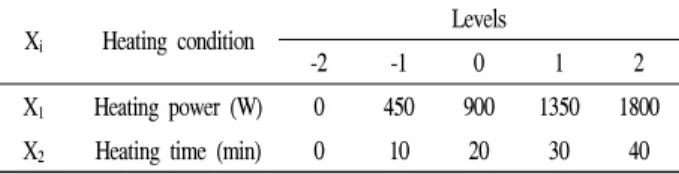
4. 가열조건 최적화를 위한 중심합성실험계획 본 실험에서는 반응표면분석법(response surface methodology, RSM)(Lee et al., 2000)을 이용하여 최적 가열조건의 예측 및 시료 추출물의 품질 특성을 모니 터링 하였다. 가열조건의 최적화를 위한 실험계획은 중심합성계획법(Lee et al., 2000)에 의하여 설계하였 으며 독립변수(Xi)는 가열출력(X1: 0~1,800 W)과 가 열시간(X2: 0~40 min)으로 정하였으며 예비 실험을 통하여 임의 조건 범위를 -2, -1, 0, 1, 2의 5단계 부호로 나타내었다(Table 1). 그리고 이들 독립변수를 중심합 성실험계획에 따라 10개의 구간으로 나누어 원적외 선 처리하였다.
Table 1. Levels of FIR-heating power and time for grape seed based upon central composite design.
Xi Heating condition Levels
-2 -1 0 1 2
X1 Heating power (W) 0 450 900 1350 1800
X2 Heating time (min) 0 10 20 30 40
5. 이화학적 및 기능적 특성 분석 1) 가용성 고형분 함량 측정
시료의 가용성 고형분 함량 측정은 미리 항량을 구한 알루미늄 수기에 추출물 2 mL를 취하여 105℃
dry oven에 6시간 가열 후 데시케이터에서 30분간 방 냉시켜 항량이 구해질 때까지 무게를 반복 측정하였 다(Kwon et al., 2003).
2) 기계적 색도
분말 시료(18 mesh)의 기계적 색도는 색차계(Color and color difference meter, Chromameter CR-200, Minolta, Tokyo, Japan)를 이용하여 Hunter color parameter(L, a, b)를 측정하였다. 이 때 표준백판의 L, a, b 값은 각각 49.57, 7.05, 6.78이었다.
3) 총 페놀 함량 측정
총 페놀 함량 측정은 Folin-Denis법(Amerine and Ough, 1980)에 따라 실시하였다. 추출액 2 mL에 Folin 시약 2 mL를 가하여 혼합하고 3분간 정치시킨 뒤
10% Na2CO3 용액을 2 mL를 넣어 진탕하고 1시간 실온에서 방치한 다음 700 nm에서 흡광도를 측정하 였다. 이 때 표준물질로는 gallic acid를 적정 농도로 조제하여 표준곡선의 작성에 사용하였다.
4) 총 플라보노이드 함량 측정
총 플라보노이드 함량 측정은 Park and Kim (1995) 의 방법에 준하여 측정하였다. 추출액 0.5 mL에 ethanol 1.5 mL와 10% aluminium nitrate 용액 0.1 mL 및 증류수 2.8 mL를 넣어 진탕하여 30 분간 방치시킨 후 흡광도를 측정하였다. 이 때 표준물질로 hesperidin 을 적정농도로 조제하여 표준곡선의 작성에 사용하 였다.
5) 카테킨 함량 측정
추출물의 catechin 분석은 Ricardo da Silva 등의 방 법(Ricardo da Silva, 2002)을 변형하여 Choi의 방법 (Choi, 2002)에 따라 HPLC에 의해 분석하였다. 각 추 출물 1 mL를 80% methanol 2 mL에 용해하여 얻은 시험용액 3 mL를 0.45 ㎛ membrane filter에 통과시킨 후 10 μL를 HPLC 분석에 사용하였다. 여기에 내부표 분물질로서 catechol(catechol 0.2 mg을 methanol 1 mL 에 녹인 용액) 1 mL를 시험용액 1 mL에 가하여 0.45 μm membrane filter에 통과시킨 후 HPLC용 시료용액 으로 하였다. 이때의 분석조건은 170 UV-vis detector 와 231XL autosampler가 부착된 Gilson 506B HPLC system, column은 YMC-Pack Pro C18(5 μm, 4.6 I.D.×
250 mm, YMC Inc., Merdian, Idaho, USA), mobile phase는 solvent A(4.5% formic acid in H2O)와 solvent B(90% CH3CN containing 10% solvent A)를 사용하였 다. Detector는 UV 280 nm, flow rate는 1.0 mL/min, sensitivity는 0.01 AUFS 등이었다. 또한 표준물질로는 (+)-catechin, procyanidin B2, (-)-epicatechin, (-)- epicatechinn gallate를 각각 methanol에 용해시켜 mg/mL의 용액으로 조제하여 사용하였다.
6) 항산화성 측정
시료 추출물의 항산화성(electron donating ability, EDA) 측정은 Blois의 방법(Blois, 1958)에 준하여 α,α
-diphenyl-β-picrylhydrazyl (DPPH) 12 mg을 100% 에 탄올 100 mL에 녹인 뒤 517 nm에서 흡광도 값이 0.9 5~0.99가 되도록 50% 에탄올로 희석하여 용액을 제 조하였다. 이 용액 5 mL을 추출액 0.5 mL에 가하여 교반한 후 517 nm에서 흡광도를 측정하였다.
Electron donating ability(%) = (1-SAbs/BAbs)×100 SAbs : Absorbance at 520 nm determined with test
sample
BAbs: Absorbance at 520 nm determined with solvent instead of test sample
7) 아질산염 소거능 측정
아질산염 소거능 측정은 Kato 등의 방법(Kato, 1987)에 준하여 실행하였다. 특히 산성영역에서 높은 값을 나타내므로 pH 1.2와 pH 3.0에서 각각 측정하였 다. 각 시료 추출물에 1 mM NaNO2 용액 1 mL을 가하고, 0.1 N HCl(pH 1.2)과 0.1 M 구연산 완충용액 (pH 3.0)을 사용하여 반응용액의 pH를 각각 1.2와 3.0 으로 조정한 후 반응용액의 부피를 10 mL로 하였다.
그 뒤 37℃에서 1시간 동안 반응시켜 용액 1 mL에 2% 아세트산 용액 5 mL를 첨가한 다음 Griess 시약 (1% sulfanilic acid : 1% naphthylamine = 1:1) 0.4 mL를 가하여 혼합하였다. 그리고 실온에서 15분간 방치시 킨 후 520 nm에서 흡광도를 측정하여 잔존하는 아질 산염의 백분율(%)로 나타내었다.
Nitrite scavenging ability(%) = [1-(SAbs-BAbs)/CAbs]×100 SAbs : Absorbance at 520 nm determined with test
sample
BAbs: Absorbance at 520 nm determined with distilled water instead of Griess reagent
CAbs: Absorbance at 520 nm determined with solvent instead of test sample
6. 통계처리
본 실험에서 3회 반복으로 실험결과를 얻었으며 SAS program(ver. 8.12)을 이용하여 분산분석 (Analysis of variance, ANOVA)과 시료간의 차이는
Duncan's multiple range test에 따라 p<0.05 수준에서 유의차를 검정하였고, 결과는 평균값과 표준편차 (mean±S.D.)로 나타내었다. 원적외선 가열처리 최적 화를 위해서는 중심합성계획에 의한 원적외선 가열 조건에 따른 품질특성에 대한 결과는 추출물의 품질 특성을 반복 측정하여 그 평균값을 종속변수(Y)로 하 여 회귀분석을 실시하였다. 이 때 두 개의 독립변수와 종속변수에 대한 2차 회귀 모형식은 다음과 같다.
Y = b0+ b1X1+ b2X2+ b12X1X2 + b11X12 + b22X22
여기서 Y는 종속변수, X1, X2는 독립변수, b0는 절 편, bn은 회귀계수이고, 반응 표면 회귀분석을 위해서 SAS(Statistical Analysis System) program(SAS Institiute) 을 이용하였다.
결과 및 고찰
1. 가용성 고형분 함량 및 기계적 색도 변화
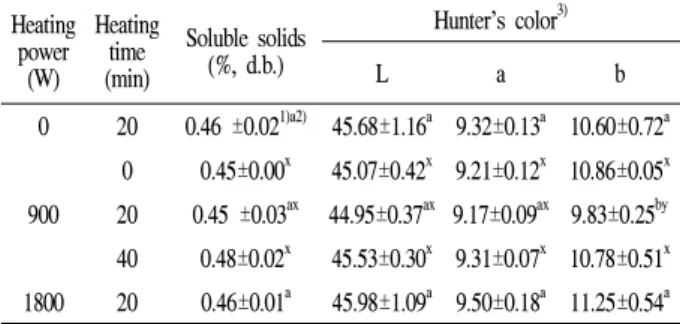
포도씨에 원적외선을 가열출력(0, 900, 1800 W)과 가열시간(0, 20, 40 min)을 달리하여 처리한 다음, 그 추출물의 가용성 고형분 및 기계적 색도를 측정한 결과는 Table 2와 같다. 처리 조건에 따른 시료들의 가용성 고형분 함량은 0.45~0.48% 범위로 나타났으
Table 2. Soluble solids content and Hunter's color value of grape seeds under far-infrared irradiation with different heating power and time.
Heating power
(W) Heating
(min)time
Soluble solids (%, d.b.)
Hunter's color3)
L a b
0 20 0.46 ±0.021)a2) 45.68±1.16a 9.32±0.13a 10.60±0.72a
900
0 0.45±0.00x 45.07±0.42x 9.21±0.12x 10.86±0.05x 20 0.45 ±0.03ax 44.95±0.37ax 9.17±0.09ax 9.83±0.25by 40 0.48±0.02x 45.53±0.30x 9.31±0.07x 10.78±0.51x 1800 20 0.46±0.01a 45.98±1.09a 9.50±0.18a 11.25±0.54a
1)Values are means ± S.D. (n=3).
2)Values with different letters within a heating power (a-b) and a heating time (x-y) differ significantly(p<0.05).
3)L: Degree of whiteness (white + 100 ↔ 0 black).
a: Degree of redness (red + 100 ↔ -80 green).
b: Degree of yellowness (yellow + 70 ↔ -80 blue).
며, 가열시간 20분에서 가열출력에 따른 유의적인 차 이는 없는 것으로 나타났다. 기계적 색도에 있어서는 명도(L)와 적색도(a)는 각각 44.95~45.68 및 9.17~
9.50의 범위로 가열출력에 따른 유의적인 차이는 없었 으나, 시료의 황색도(b)는 가열출력 900 W에서 다소 낮은 값을 보여주었으나 큰 차이는 아닌 것으로 나타 났다.
2. 카테킨 함량 변화
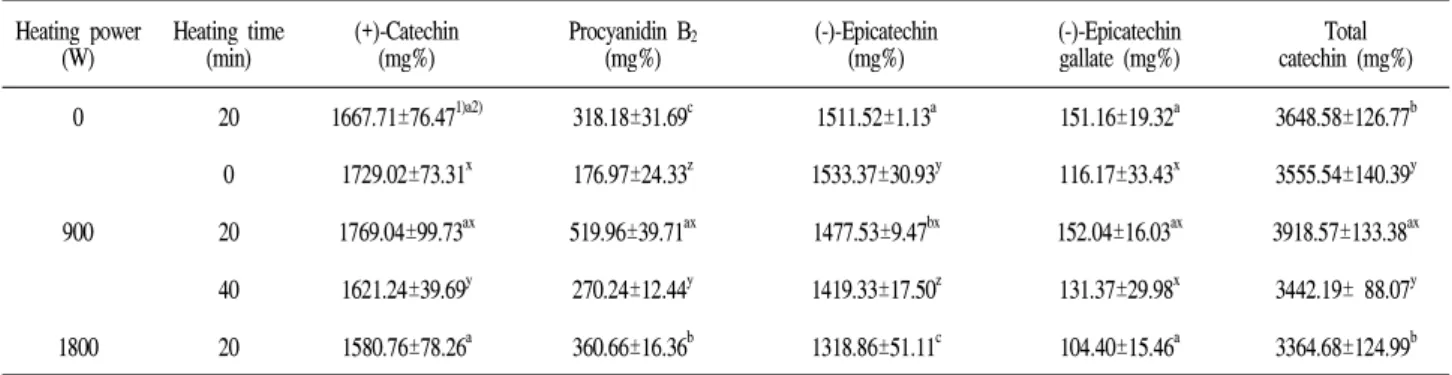
원적외선 처리조건을 달리하여 열처리한 포도씨 추출물의 카테킨 함량 즉, catechin, procyanidin B2, epicatechin, epicatechin gallate 및 총 catechin 함량을 측정한 결과는 Table 3과 같다. 원적외선 가열출력을 달리하였을 때 catechin 및 epicatechin gallate 함량은 통계적으로 유의적인 차이가 없는 것으로 나타났다.
반면에 procyanidin B2 함량은 900 W에서 519. 96 mg%
로 높게 가장 높게 나타났다. Epicatechin 함량은 가열 출력이 높을수록 그 함량이 유의적으로 감소하는 것 으로 나타났다. 그리고 총 catechin 함량은 900 W 처리 시 가장 높게 나타났다. 원적외선 가열시간에 따른 포도씨의 catechin류 함량은 Table 3과 같이 epicatechin gallate 함량은 가열시간에 따라 유의적인 차이가 없는 것으로 나타났다. 그러나 catechin, procyanidin B2및 epicatechin 함량은 원적외선 20분 처리 시 그 함량이 높은 것으로 나타났다. 전반적으로 catechin류 함량은 원적외선 20분 처리 시 3918.57 mg%로 가장 높게 나타났다.
Table 3. Cathechin content of grape seeds under far-infrared irradiation with different heating power and time.
Heating power
(W) Heating time
(min) (+)-Catechin
(mg%) Procyanidin B2
(mg%) (-)-Epicatechin
(mg%) (-)-Epicatechin
gallate (mg%) Total
catechin (mg%)
0 20 1667.71±76.471)a2) 318.18±31.69c 1511.52±1.13a 151.16±19.32a 3648.58±126.77b
900
0 1729.02±73.31x 176.97±24.33z 1533.37±30.93y 116.17±33.43x 3555.54±140.39y
20 1769.04±99.73ax 519.96±39.71ax 1477.53±9.47bx 152.04±16.03ax 3918.57±133.38ax
40 1621.24±39.69y 270.24±12.44y 1419.33±17.50z 131.37±29.98x 3442.19± 88.07y
1800 20 1580.76±78.26a 360.66±16.36b 1318.86±51.11c 104.40±15.46a 3364.68±124.99b
1)Values are means± S.D. (n=3).
2)Values with different letters within a heating power (a-c) and a heating time (x-z) differ significantly(p<0.05).
3. 관련 기능성분 변화
원적외선 처리조건을 달리하여 열처리한 포도씨 추출물의 기능성분 즉, 총 페놀성 화합물과 총 플라보 노이드 함량은 Table 4에 나타내었다. 총 페놀 함량은 가열출력이 900 W일 때 2419.81 mg%로 가장 높게 나타났으며, 다음으로 1,800 W에서 높게 나타났다.
또한 가열시간에 따른 총 페놀 함량은 20분 처리 시 가장 높은 것으로 나타났다. 식물체에는 많은 종류의 페놀 화합물이 존재하며, hydroxycinnamic acid를 비 롯한 대부분의 페놀 화합물은 세포벽 다당류, 리그닌 등과 ester 결합되어 있거나 중합체로 존재한다 (Herrmann 1989). 따라서 상기 결과는 식물에 존재하 는 페놀성 화합물은 다양한 결합상태로 존재하고, 이 들은 이화학적 처리 조건에 따라 유리될 수 있음을 의미한다. 총 플라보노이드 함량은 가열출력이 증가 할수록 1261.55, 1372.05 및 1375.71 mg%로 증가하여 으며, 가열시간 20분 처리 시에 높은 것으로 나타났다.
원적외선 처리에 따른 포도씨 추출물의 전자공여능은 가열출력 900 W일 때 66.50%, 1,800 W 처리 시 64.87%로 나타나 900 W 처리 시 전자공여능이 높은 것을 알 수 있었다. 또한 가열출력을 900 W로 고정하 고 가열시간에 따른 전자공여능은 무처리 시 58.60%, 20분 처리 시 66.50%, 40분 처리 시 61.38%로 각각 나타나 20분 처리 시에 전자공여능이 높음을 알 수 있었다. 즉, 전자공여능은 총 페놀성 화합물 함량의 변화와 유사한 경향이었다. 이는 원적외선 조사한 가 래나무잎 추출액에서 페놀성 화합물 증가로 항산화성 이 높아졌다는 결과와 유사한 경향이었다(Eom et al.,
2007). 또한 탈지대두박에 원적외선을 처리하였을 시 항산화능이 증가되었다는 보고도 있다(Rim et al., 2005). 한편 원적외선 가열에 따른 포도씨 추출물의 아질산염 소거능은 pH 1.2 및 pH 3.0에서 90% 이상의 높은 활성을 나타내었다. 이는 Chung 등(1999)의 결과 Kato 등(1987)의 여러 가지 pH 조건에서 nondialylzable melanoidin을 첨가하여 니크로사민 형성 억제효과를 측정한 결과 pH가 낮은 곳에서 활성이 더 높게 나타남 을 볼 수 있었다. 또한 Lee 등(1997)의 연구에서 pH 3.0에서 영지 추출물의 아질산염 소거능은 약 40%, 표고버섯의 경우는 70%의 소거능을 보인 결과와 비 교할 때 포도씨 추출물의 경우 상대적으로 아질산염 소거능이 높음을 알 수 있었다.
Table 4. Total phenolics, total flavonoid, electron donating ability and nitrite scavenging activity of grape seeds under far-infrared irradiation with different heating power and time.
Heating power
(W) Heating time
(min) Total phenolics
(mg%, d.b.) Total Flavonoid
(mg%) Electron donating ability (%)
Nitrite scavenging activity (%)
pH 1.2 pH 3.0
0 20 2309.24±3.361)c2) 1261.55±17.61b 57.44±0.69c 94.14±1.53a 95.58±1.06a
900
0 2343.98±26.11y 1370.23±18.24x 58.60±0.15z 92.46±3.69x 95.58±1.16x
20 2419.81±10.78ax 1372.05± 2.73ax 66.50±0.54ax 96.09±1.32ax 95.12±0.27ax
40 2248.71± 5.11z 1296.55± 6.87y 61.38±0.08y 96.65±0.88x 96.34±0.45x
1800 20 2326.05± 6.72b 1375.71±11.07a 64.87±0.40b 96.37±0.53a 94.66±0.72a
1)Values are means± S.D. (n=3).
2)Values with different letters within a heating power (a-c) and a heating time (x-z) differ significantly(p<0.05).
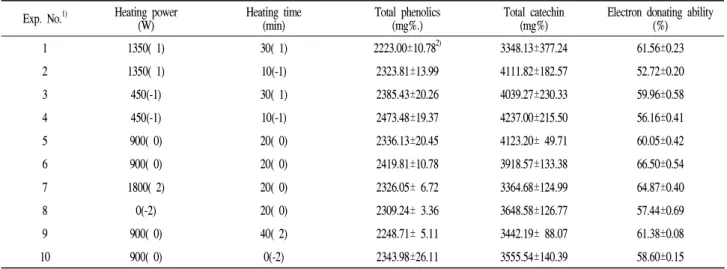
Table 5. Experimental data on total phenolics, total catechin and electron donating ability of FIR-heated grape seed based upon central composite design by response surface analysis.
Exp. No.1) Heating power
(W) Heating time
(min) Total phenolics
(mg%.) Total catechin
(mg%) Electron donating ability (%)
1 1350( 1) 30( 1) 2223.00±10.782) 3348.13±377.24 61.56±0.23
2 1350( 1) 10(-1) 2323.81±13.99 4111.82±182.57 52.72±0.20
3 450(-1) 30( 1) 2385.43±20.26 4039.27±230.33 59.96±0.58
4 450(-1) 10(-1) 2473.48±19.37 4237.00±215.50 56.16±0.41
5 900( 0) 20( 0) 2336.13±20.45 4123.20± 49.71 60.05±0.42
6 900( 0) 20( 0) 2419.81±10.78 3918.57±133.38 66.50±0.54
7 1800( 2) 20( 0) 2326.05± 6.72 3364.68±124.99 64.87±0.40
8 0(-2) 20( 0) 2309.24± 3.36 3648.58±126.77 57.44±0.69
9 900( 0) 40( 2) 2248.71± 5.11 3442.19± 88.07 61.38±0.08
10 900( 0) 0(-2) 2343.98±26.11 3555.54±140.39 58.60±0.15
1)The number of experimental conditions based upon central composite design.
2)Values are means± S.D. (n=3).
4. 원적외선 처리 최적 조건 설정
앞선 연구에서 포도씨 원적외선 처리에 따른 가열 출력 및 가열시간의 변화에 총 catechin 함량, 총 페놀 성 화합물 함량 및 전자공여능이 영향을 많이 받는 것으로 나타났다. 따라서 원적외선 가열처리 최적 조 건을 설정하고자 가열출력 900 W 및 가열시간 20 분을 중심점으로 하여 가열출력은 0, 450, 900, 1350, 1800 W, 가열시간은 0, 10, 20, 30, 40 분으로 하여 중심합성실험계획에 따라 실험한 결과 Table 5와 같 은 결과를 얻을 수 있었다. 즉 총 페놀성 화합물 함량 은 가열조건에 따라 2223.00~2473.48 mg%로 나타났 으며, 총 catechin 함량은 3348.13~4237.00 mg%로 나 타났다. 이에 따른 전자공여능은 52.72~64.87 %로 나타났다.
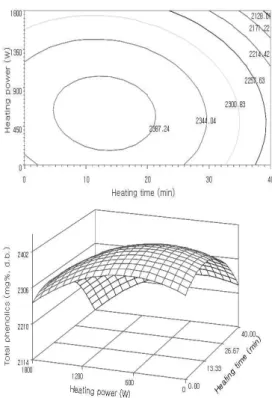
1) 반응표면분석에 의한 총 페놀성 화합물 함량 변화 가열출력 및 가열시간에 따른 포도씨의 총 페놀성 화합물의 결과인 Table 5를 바탕으로 하여 반응표면 분석을 한 결과 다음과 같은 회귀식을 얻을 수 있었다.
Y=2332.906667+0.102344X1+5.894476X2-0.000709 X1X2-0.000077631X12-0.210454X22
위와 같은 회귀식을 바탕으로 contour map 및 반응 표면은 Fig. 1에 나타내었다. 즉 가열출력 588 W 및 가열온도 13 min 최대로 나타났으며, 그 이후로는 가 열출력 및 가열 시간이 증가할수록 총 페놀성 화합물 함량이 감소하는 것으로 나타났다.
Fig. 1. Contour map (left) and response surface (right) for the effect of IR-heating power and time on total phenolics of FIR rays heated grape seeds.
2) 반응표면분석에 의한 총 카테킨 함량 변화 가열 조건별 포도씨의 총 카테킨 함량인 Table 5의 결과를 바탕으로 반응표면분석한 결과 다음과 같은 회귀식을 구할 수 있었다.
Y=2847.356667+1.624673X1+75.520107X2-0.03144 2X1X-0.000696X2-1.428078X2
회귀식을 바탕으로 contour map 및 반응표면을 Fig.
2에 나타내었다. 즉 가열출력 및 가열시간이 증가할수 록 증가하다가, 가열출력 750 W 및 가열시간 18 min 부근에서 최대를 나타내었으며, 그보다 높은 가열출 력 및 가열시간에서는 감소됨을 볼 수 있었다.
Fig. 2. Contour map (left) and response surface (right) for the effect of IR-heating power and time on total catechin content of FIR rays heated grape seeds.
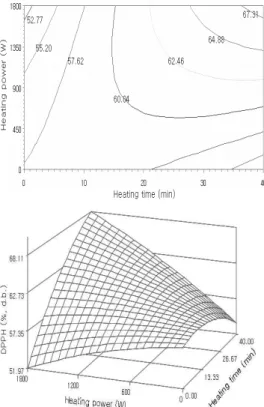
3) 반응표면분석에 의한 전자공여능 변화 가열출력 및 가열시간에 따른 포도씨의 전자공여능 의 결과인 Table 5를 바탕으로 하여 반응표면분석을 한 결과 다음과 같은 회귀식을 얻을 수 있었다.
Ye=57.706667-0.001223X1+0.104631X2+0.000280X1
X2-0.000001092X12-0.005124X22
회귀식을 바탕으로 contour map 및 반응표면을 Fig.
3에 나타내었다. 즉 가열시간이 20 min 보다 짧으면 가열 출력이 증가할수록 전자공여능이 낮게 나타났으며, 가 열시간이 20 min보다 길 경우에는 가열출력이 증가할수 록 증가하는 것으로 나타났다. 전자공여능은 가열시간 및 가열출력이 증가할수록 높은 것으로 나타났다.
Fig. 3. Contour map (left) and response surface (right) for the effect of FIR-heating power and time on electron donating ability of FIR rays heated grape seeds.
4) 최적조건 설정
포도씨의 기능성분 함량을 최대화 할 수 있는 원적 외선 가열처리의 최적조건을 찾기 위해 가열출력 및 가열시간에 영향을 많이 받는 총 페놀성 화합물
Fig. 4. Superimposed response surface for the optimized conditions of total phenolics, total catechin content and electron donating ability of FIR rays heated grape seeds.
함량, 총 catechin 함량 및 전자공여능에 대한 contour map을 superimposing 하였다(Fig. 4). 그 결과 가열출 력 621.82~818.18 W 및 가열시간 16.3~19.83 min의 범위가 최적 가열조건범위로 설정되었다. 이 범위 중 최적 범위로 임의의 점인 가열출력 720 W 및 가열시 간 18 min으로 설정하여 반응표면분석에 의한 예측치 와 실측치를 비교한 결과 Table 6과 같이, 80% 이상으 로 유사하게 나타남을 볼 수 있었다.
Table 6. Comparison between predicted and experimental values of response variable of grape seed extracts at the given condition1)within the range of optimum conditions.
Response variables Predicted
values(A) Experimental
values(B) B/A×100 Total phenolics 2,395.08 1,995.242) 83.31
Catechin content 4145.49 3852.18 92.94
Electron donating ability 60.11 50.20 83.51
1)Heating power 720 W, heating time 18 min.
2)Mean of triplicates.
요 약
원적외선 조사가 포도씨 기능성분의 변화에 미치는 영향을 알아보고자 가열출력(0, 900, 1800 W) 및 가열 시간(0, 20, 40 min)을 달리하여 원적외선 조사 후 마이 크로파를 이용하여 포도씨 추출물을 제조하고 기능성 분으로서 가용성 고형분, 기계적 색도, 카테킨, 총 페 놀, 총 플라보노이드 함량 및 전자공여능과 아질산염 소거능을 각각 측정하였다. 가용성 고형분 함량 및 백색도 및 적색도는 유의적인 차이가 없는 것으로 나타났다. Cathechin류는 가열시간에 따라 catechin, procyanidin B2, epicatechin 함량의 변화가 있음을 확 인하였으며, 총 catechin 함량은 총 카테킨 함량은 900 W 및 20분 처리 시 가장 높게 나타났다. 총 페놀성 화합물 및 플라보노이드 함량 또한 가열출력 900W 및 가열시간 20 분 일 때 가장 높게 나타났다. 그에 따라 전자공여능도 가열출력 900 W 및 가열시간 20 분 일 때 가장 높은 것으로 나타났다. 이상의 결과는 원적외선 처리에 의해 총 페놀성 화합물 함량, 총 플라 보노이드 함량이 증가됨을 볼 수 있었으며, 특히
cathechin류의 변화가 있음을 확인할 수 있었다. 또한 이로 인해 항산화능도 증가됨을 알 수 있었다. 또한 포도씨의 원적외선 가열처리 최적조건을 설정하고자 가열출력 및 가열시간을 달리하여 중심합성실험계획 으로 반응표면분석한 결과 가열출력 621.82~818.18 W, 가열시간 16.3~19.83 min의 범위가 최적 가열조 건범위로 설정되었다.
인용문헌
1. Amerine, M.A., Ough, C.S. 1980. Method for analysis of musts and wine. Wiely & Sons, Nes York. pp. 176-180
2. Argia, T. 2004. Antioxidants functions, preventive action toward disease and utilization of proanthocyanidins. BioFactors 21(1-4) : 197-201.
3. Ariga, T., Koshiyama, I., Fukushima, D. 1998.
Antioxidative properties of procyanidins B-1 and B-3 from azuki beans in aqueous systems.
Agricutural Biology and Chemistry 52(11) : 2717-2722.
4. Blois, M.S. 1958. Antioxidant determinations by the use of a stable free radical. Nature, 181 : 1199-1203.
5. Castillo, J., Benavente-Garefa, O., Lorente, J., Alcaraz, M., Redondo, A., Ortuno, A., Del Rio, J. 2000. Antioxidant activity and radioprotective effect against chromosal damage induce in vivo by X-rays of flavan-3-ols(procyanidins) from grape seeds (Vitis vinifera): Comparative study versus other phenolic and organic compounds. Journal of Agricultural and Food Chemistry 48(5) : 1738-1745.
6. Choi, S.W. 2002. Studies on an improved methodology for analysis of catechin derivatives in processed foods containing grape seed oils, Korea Food & Drug Administration, Final report.
7. Chung, S.Y., Kim, N.K., Yoon, S. 1999. Nitrite
scavenging effects of methanol fraction obtained from green yellow vegetable juices. Journal of the Korean Society of Food Science and Nutrition 28(2) : 342-347.
8. Eom, S.H., Park, H.J., Jin, C.W., Park, S.M., Kim, M.J., Yu, C.Y., Cho, D.H. 2007. Changes of antioxidant activitiy inJuglans mandshrica maxim.
leaves by far infrared ray irradiation. Korean Journal of Medicinal Crop Science 15(4) : 266-270.
9. Herrmann, K. 1989. Occurance and content of hydroxycinnamic and hydroxybenzoic acid compounds in foods. Critical Reviews in Food Science and Nutrition 28(4) : 315-347.
10. Inoue, S., Kabaya, M. 1989. Biological activities caused by far-infrared radiation. International Journal of Biometeorology 33(3) : 145-150.
11. Jorge, M., Ricardo, D.S., Jacques, R., Veronique, C., Annie, C., Michel, M. 1991. Procyanidin dimers and trimers from grape seeds. Phytochemistry 30(4) : 1259-1264.
12. Kato, H., Lee, I.E., Chuyen, N.V., Kim, S.B., Hayase, F. 1987. Inhibition of nitrosamine formation by nondialyzable melanoidins.
Agricultural Biology and Chemistry 51 : 1333-1338.
13. Kim, J.W., Jeon, Y.J., Lee, J.H., Lee, S.C. 2006.
Effect of Far-Infrared irradiation and heat treatment on antioxidant activity of extracts from citrus pamaces. Journal of the Korean Society for Applied Biological Chemistry 49(1) : 60-64.
14. Kwon, J.H., Belanger, J.M.R., Pare, J.R.J. 2003.
Optimization of microwave assisted extraction (MAP) for ginseng components by response surface methodology. Journal of Agricultural and Food Chemistry 51(7) : 1807-1810.
15. Lee, E.J., Choi, S.W., Kim, H.K., Kwon, J.H. 2008.
Characteristics of microwave-assisted extraction for catechins from grape seed. Korean Journal of food science and technology 40(5) : 510-515.
16. Lee, K.D., Chang, H.K., Kim, H.K. 1997.
Antioxidative and nitrite scavenging activities of edible mushrooms. Korean Journal of Food Science and Technology 29(3) : 432-436.
17. Lee, S.C., Kim, J.H., Jeong, S.M., Kim, D.R. 2003.
Effect of far-infrared radiation on the antioxidant activity of rice hulls. Journal of Agricultural and Food Chemistry 51(15) : 4400-4403.
18. Lee, G.D., Lee, J.E., Kwon, J.H. 2000. Application of response surface methodology for food industry.
Food Science and Industry 33(1): 33-45
19. Niwa, Y., Miyachi, Y. 1986. Antioxidant action of natural health products and Chinese herbs.
Inflammation 10(1) : 79-91.
20. Park, J.C., Kim, S.H. 1995. Flavonoid analysis from the leaves of Eucommia ulmoides. Journal of the Korean Society of Food Science and Nutrition 24(6) : 901-905.
21. Park, J.H., Jin, J.H., Kim, H.J., Park, H.R., Lee, S.C. 2005. Effect of Far-Infrared irradiation on the antioxidant activity of extracts from rice hulls.
Journal of the Korean Society of Food Science and Nutrition 34(1) : 131-134.
22. Ricardo da Silva, J.M., Rigaud, J., Cheynier, V., Cheminat, A. Moutounet, M. 2002. Procyanidin dimers and trimers from grape seeds.
Phytochemistry 30(4) : 1259-1264.
23. Ricardo da Silva, J.M., Darmon, N., Fenandez, Y., Mitjavila, S. 1991. Oxygen free radical scavenger capacity in aqueous models of deferent procyanidins from grape seeds. Journal of Agricultural and Food Chemistry 39(9) : 1549-1552.
24. Rim, A.R., Jung, E.S., Kim, S.Y., Lee, S.C. 2005.
Effect of far-infrared irradiation and heat treatment on the antioxidant activity of extracts from defatted soybean meal. Journal of the Korean Society for Applied Biological Chemistry 48(4) : 400-403.
25. SAS Institute Inc. 1982. SAS user’s guide:
Statistics, 1982 Edition. Cary, North Carolina, SAS Institute Inc., pp. 91-100.
26. Yoo, M.A., Chung, H.K., Kang, M.H. 2004.
Evaluation of physicochemical properties in different cultivar grape seed waste. Food Science and Biotechnology 13(1) : 26-29.