A Study on Leaching and Solvent Extraction for the Recovery of Copper Ore for Small-Scale Mining in Tanzania
Soon-Young Soh
1*, Yong-Jin Chun
2, Ambrose J. M. Itika
31Department of Cosmetic Science, Chungwoon University
2Department of Integrated Materials Engineering, Chungwoon University
3Department of Chemical and Mining Engineering, University of Dar es Salaam
탄자니아의 소규모 광산에서 구리광석 정제를 위한 침출 및 용매 추출에 관한 연구
소순영1*, 전용진2, 암브로즈 이티카3
1청운대학교 화장품과학과, 2청운대학교 융합소재공학과, 3다르대학교 화학광산공학과
Abstract Tanzania has abundant copper deposits, but copper-metal extraction remains low there, owing to the lack of suitable copper recovery processes and insufficient funds for developing mining technologies. Accordingly, leaching and solvent extraction methods for the extraction of copper from copper ore were studied with a particular emphasis on developing a simple processing method for small-scale copper mining. Chrysocolla ore was used as the copper-bearing mineral and sulfuric acid was used as the leaching reagent. A maximum copper recovery of 95.1%
was obtained when the particles in the sample were smaller than 53μm, the concentration of 98%(w/w) sulfuric acid in the leaching solution was 5.0 g/L and the stirring rate was between 60 and 80 rpm. The highest selectivity of Cu2+ in the solvent extraction was obtained using 15% LIX-70 in kerosene. In the pH range from 0.5 to 3.0, the efficiency of Cu2+ extraction increased with increasing pH. However, at pH values higher than 3.0, other metal ions were extracted into the organic phase more readily than Cu2+. The highest solvent extraction rate obtained was 96.5% at pH values of 2.0 and 3.0 using 15% LIX-70.
요 약 탄자니아에는 풍부한 구리 매장량이 있으나, 적절한 구리 회수 공정의 결핍과 광산 기술 개발을 위한 자금 부족으로 구리 금속의 추출량은 여전히 낮은 상태이다. 이에 따라 소규모 구리 채굴을 위한 간단한 처리공정 개발에 중점을 두어 구리 광석에서 구리를 추출하기 위한 침출법과 용매 추출법을 연구하였다. 사용된 구리광석은 규공작석이었으며, 침출 시약으로 황산을 사용하였다. 침출 공정에서 시료의 입경이 53μm보다 작고, 98%(w/w) 황산 농도가 5.0 g/L, 교반 속도가 60에서 80 rpm일 때 최대 구리 회수율이 95.1% 이었다. 용매 추출에서 구리 2가 양이온의 최고의 선택 비율은 등유에 녹인 15 % LIX-70을 이용하여 얻어졌다. pH가 0.5에서 3.0까지, 구리 2가 양이온 추출 효율은 pH가 증가함에 따라 증가했다. 그러나 3.0이상의 pH에서는 다른 금속 이온이 구리 2가 양이온보다 유기물층으로 더 많이 추출되었다. 최고의 용매 추출율은 15%
LIX-70를 사용하여 각각 pH 2.0 및 3.0에서 96.5% 이었다.
Keywords : chrysocolla, copper recovery, hydrometallurgy, leaching, solvent extraction
*Corresponding Author : Soon-Young Soh(Chungwoon Univ.) Tel: +82-41-630-3298 email: [email protected] Received January 4, 2017
Accepted April 7, 2017
Revised February 22, 2017 Published April 30, 2017
1. Introduction
Copper has been important to human civilization for over 5,000 years. Over the past few decades, significant improvements have been made in the continuous processing of copper-bearing concentrates into blister copper. Copper is currently used in electrical and electronic products, building construction, industrial machinery and equipment, transportation, as well as consumer and general products[1].
Currently, two main processes, pyrometallurgical and hydrometallurgical, are used in the industrial processing of copper ore for metal production. The pyrometallurgical process is economically viable for copper-rich feeds and large-scale operations[2,3].
However, this process has several drawbacks, including high energy consumption and the production of hazardous gases[2].
The increasing worldwide demand for copper has spurred the development of more environmentally friendly processes for copper extraction from low-grade ores. Correspondingly, significant research and development has been conducted on hydrometallurgical methods[4-8]. The hydrometallurgical process consists of crushing, leaching, solvent extraction(SX) and electrowinning (EW). Leaching/SX/EW has been used commercially for processing oxide ores and mixed oxide_sulfide ores since 1968 and the mid-1970s, respectively. This process is one of the most important methods used to obtain copper from low-grade oxidized ores. Leaching followed by SX is a convenient method for the extraction and separation of copper. This combination can be efficiently applied to the recovery of copper from leach liquors and waste solutions, using variety of reagents[9-12].
Tanzania has abundant copper deposits, but copper-metal extraction remains low there, owing to the lack of suitable copper recovery processes, and the insufficient funds for developing mining technologies.
Therefore, the development of a simple copper recovery processing method is essential for small-scale
miners in Tanzania. Correspondingly, the goal of this study was to develop technology for the extraction of copper in a small-scale pilot plant in Tanzania.
The influences of pH and the type of extracting agents used were examined, in addition to major factors affecting the copper leaching from copper ore.
This study is aimed primarily at developing a hydrometallurgical process that uses a combination of leaching and SX, which is easily performed, inexpensive, and highly efficient.
2. Experimentals
2.1 Copper-bearing ore analysis
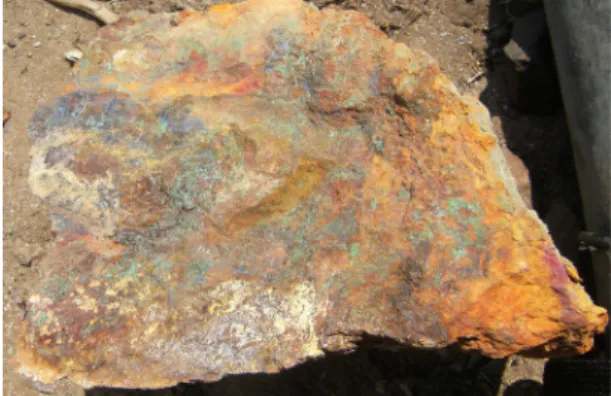
A chrysocolla(Cu22H22Si22O55(OH)4·n4·nH22O) ore, obtained from opencast copper mining in the Shingida region of Tanzania, was used as a model ore sample(Fig. 1).
Fig. 1. Copper-bearing ore(chrysocolla) used in this study.
The copper content of the head sample was 30.6%, as determined by X-Ray fluorescence spectrometer(XRF).
2.2 Reagents
LIX-70 (supplied by Cognis Inc.) and Kelex-100 (supplied by Yurui(Shanghai) Chemical Co.) were used without further purification. Kerosene (supplied by Total) was used as organic solvent. 98 % H2SO4, 36%
HCl and 72% HNO3 were of reagent grade quality.
2.3 Sample preparation
The copper-bearing ore sample, with a mass of around 2 kg, was crushed by a primary jaw crusher, a secondary jaw crusher and passed through a roller crusher. The crushed sample was collected, then ground for about an hour in a laboratory dry ball mill.
To avoid bias, the sample was thoroughly mixed, then split into representative samples using the rotary rifle splitter(Fig. 2).
Fig. 2. Photograph of a rotary rifle splitter.
A representative sample was taken for sieve analysis to determine the particle size distribution in the ground sample. A further sample was taken for laboratory analysis to determine its mineralogical and chemical properties using XRF.
2.4 Leaching experiments 2.4.1 Leaching procedure
Three separate 100 g samples of finely ground chrysocolla ore were weighed and placed into 2L bottles. Each sample was sieved for 1 h through 53µm, 75µm, 106µm, 150µm and 212µm sieve, and the 80%
pass rate determined for each sieve size. A 500 mL solution was prepared in each 2 L bottle by mixing 8 mL of 98%(w/w) H2SO4, 15mL of 98 %(w/w) H2SO4, 23mL of 98%(w/w) H2SO4 adding each 492 mL, 485 mL, 477 mL of distilled water respectively.
These bottles were then agitated for 2 h, by bottle rolling to dissolve the ore samples. The resulting solutions were filtered into a 250 mL volumetric flask,
using a funnel and filter paper to obtain a clear solution and a residue. All experiments were carried out at room temperature.
2.4.2 Residue digestion
The sample residues were dried in an oven and labeled. For each sample, 0.5 g of the dried residues was placed into a labeled 10 mL test tube. Then 3 mL HCl and 1 mL HNO3 were added each tube, and mixed. After the reaction has ceased, the tubes were placed in a water bath and heated to near boiling for 1 h. The test tubes were allowed to cool, water was added to the 10 mL mark, and mixed well. Sample mixtures were centrifuged, then analyzed with flame atomic absorption spectrophotometry(AAS).
2.5 Extraction experiments
Leaching solutions (1.5 M, 3.0 M, and 4.5 M) were prepared by diluting 98%(w/w) H2SO4 in distilled water. The pregnant leach solution(PLS), containing copper sulfate, was prepared by dissolving 100g of finely ground chrysocolla ore in 500 mL of leaching solution in three 1000 mL glass bottles. The resulting mixtures were agitated by bottle rolling for 1 h at a constant speed of 40 rpm. The resulting slurry was filtered, yielding PLSs and residues. Extractions were performed by equilibrating 100 mL organic reagent (15% LIX-70 or 10% Kelex-100 in kerosene) and 100 mL of PLS in a 500 mL separating funnel. All experiments were carried out at room temperature. The
% recovery of copper from the extract solution was determined by AAS analysis.
3. Results and Discussion
3.1 Chemical analysis of copper-bearing ore(chrysocolla)
The chemical composition (Table 1) of ground copper ore, 2.5 mm particle size was determined by XRF analysis.
Mineral Al Si S Ca Ti V Mn Fe Cu Zn Rb Sr Y Ru Cr Amount, % 6.9 24.5 1.73 1.99 0.47 0.05 0.14 27.8 30.6 4.8 0.04 0.2 0.04 0.42 0.05 Table 1. Chemical composition of chrysocolla ore
As expected, the ore consisted mainly of copper, with large fractions of iron, silicon, aluminum, and zinc, also present.
3.2 Leaching
3.2.1 Determination of the optimum concentration of H2SO4
The crushed ore had an 80% pass rate through 53 µm sieve. As Fig. 3 shows, the ore was leached using five different concentrations,(3.0 g/L, 4.0 g/L, 5.0 g/L, 7.0 g/L and 9.0 g/L) of H2SO4.
The % recovery of copper increases from 58.6% to 88.7% when the concentration of H2SO4 was increased from 3.0 g/L to 5.0 g/L and decreased to 54.1% at a H2SO4 concentration of 9.0 g/L. Therefore, the ore exhibited the highest recovery at a concentration of 5.0 g/L and an agitation rate of 20 rpm.
Fig. 3. Dependence of recovery on H2SO4 concentration.
It has been shown that adding and maintaining the appropriate amount of reagents throughout the leaching process is critical to a successful operation[7]. The use of acids is prevalent in industrial copper leaching process. Sulfates are commonly used to extract metals from the solid phase.
In this experiment, the % recovery of copper increased with increases in sulfuric acid concentration.
This can be explained as greater amounts of copper are dissolved at higher sulfuric acid concentrations.
However, it is not clear why the % recovery of copper decreased as the increase in sulfuric acid concentration from 5.0 g/L to 9.0 g/L.
We hypothesized that this increase in the concentration of sulfuric acid, caused other metals to be dissolved, reducing the recovery % of copper.
Leaching recovery ratios were calculated as follow with respect to the tailings and feed grades at each H2SO4 concentration. The grade of the copper ore (feed) was 30.6%. Table 2 shows tailing (residue) and recovery % for copper at each H2SO4 concentration.
×
In case of the recovery of copper with 3.0 g/L H2SO4, the leaching recovery(%) was calculated as
×
Table 2. Tailing residue and recovery of copper at each H2SO4 concentration tested
H2SO4 concentration
(g/L)
Tailing residue (% copper)
Recovery (% copper)
3.0 12.66 58.6
4.0 8.24 73.1
5.0 3.46 88.7
7.0 10.74 64.9
9.0 14.04 54.1
Therefore, leaching recovery with 3.0g/L of H2SO4
was 58.6%. The recovery % of copper at other H2SO4
was calculated using the same equation.
3.2.2 Determination of the optimum particle size
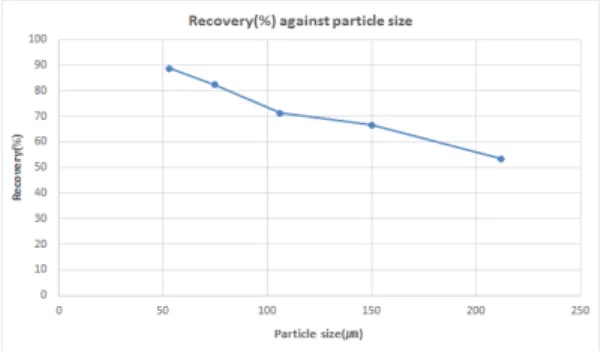
As Fig. 4 shows, the % recovery of copper from its ore decrease with increasing particle size. The highest (88.7%) and lowest (53.4%) recovery rates (obtained with 5.0 g/L H2SO4) occurred with particles smaller than 53µm, and larger than 212µm, respectively. This is because the contact areas between the leaching solution and copper-bearing particles was greater with smaller particles.
Fig. 4. Dependence of recovery on particle size.
The recovery rate increased significantly with respect to smaller particle size. Therefore, we attempted to extend the treatment to 38 µm particles, even after grinding for more than 2 h in a dry ball mill. Considering the high cost of electricity in Tanzania, we determined that 80% pass rate of 53µm particles is the optimum size for use in small-scale copper mining.
3.2.3 Determination of the optimum agitation rate at various H2SO4 concentration Fig. 5 shows recovery rate for the 80% pass at 53µm samples at different agitation rates. With a H2SO4 concentration of 5.0 g/L, the % recovery of copper increased to 94.9% with increasing agitation rate up to 60 rpm. Beyond 60 rpm, the recovery stabilized at 95.1%.
Fig. 5. Dependence of the % recovery on the agitation rate at various H2SO4 concentrations.
Significantly lower levels of recovery occurred with 4.0 g/L H2SO4, than with 5.0 g/L H2SO4. In this case, the % recovery increased to 78.9% with increasing agitation rates up to 60 rpm and remained approximately constant thereafter. Similarly, at a H2SO4 concentration of 7.0 g/L, the % recovery increased linearly to 60 rpm and remained approximately constant thereafter.
Results indicate that agitation facilitates the contact between sulfuric acid and particles of copper-bearing ore, and has a noticeable effect on copper recovery.
However, increasing the stirring speed beyond 60 rpm, had little effect on the recovery rate.
3.3 Solvent extraction
Solvent extraction was performed to recover copper from the PLS[13-15]. LIX-70 and Kelex-100 (Fig. 6), are commercially available chelates used for copper extraction. They were selected as extraction agents because they are relatively easy to obtain in Tanzania.
Chelating extraction reactions of this type have the following stoichiometry :
Cu2+(aq) + 2RH(org) CuR2(org) + 2H+(aq) (1)
Fig. 6. Structures of LIX-70(left) and Kelex-100 (right).
The equilibrium of the extraction reaction is controlled by the hydrogen ion concentration.
Consequently, the acidity of the reacting hydroxyl group is a very important parameter [16].
LIX-70 has a chlorinated aryl hydroxyoxime structure. Hence, in LIX-70 the electrons associated with the hydroxyl group are delocalized with the aromatic ring structure, Further delocalization occurs if the aromatic ring is chlorinated. Kelex-100 has a 7-alkyl 8-hydroxy quinoline structure, with around 10 carbon atoms and at least one double bond.
8-hydroxyquinoline(oxine) itself is a mono- protic bidentate chelating agent.
Experimentally measuring pH50 plots is a standard technique for determining pH dependency. The pH50 values of LIX-70 and Kelex-100 were 2.6 and 1.8 respectively, in an extractant-xylene solution loaded with 100 ppm copper[17].
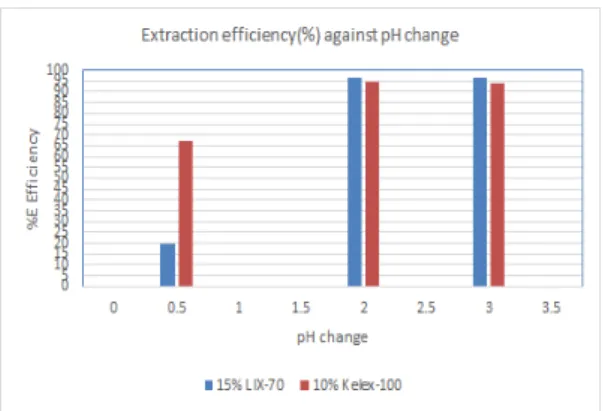
This experiment was performed by varying the pH of the aqueous solution of each copper extractant, as shown in Fig. 7.
Fig. 7 shows that 15% LIX-70 in kerosine was effective in preferentially extracting Cu2+ as evidenced by the extraction efficiency (%E) of 96.5 % at pH values of 2.0 and 3.0, other metal ions were not extracted at these pH values. The efficiency of Cu2+
extraction increased with increasing pH from pH 0.5 to 3.0.
Fig. 7. Extraction efficiency against pH value for 15%
LIX-70 and 10% Kelex-100 solutions.
However, at pH values higher than 3.0, other metal ions were readily extracted into the organic phase.
That indicated that the organic extractant formed complex copper ions at pH values less than 2 and others metal ion complexes at pH values higher than 3.0. In order to avoid complexation of other metals in the PLS, the optimum pH values were determined to be pH 2 and 3 using 15% LIX-70.
Additionally, the extraction of copper using 10%
Kelex-100 in kerosine was more effective at pH 2 than at pH 3, as shown in Fig. 7, because other metal ions were also extracted in the organic phase at pH 3. This indicates that higher pH values decrease copper extraction by producing stable species of Cu2+ ions in the aqueous phaseas in case of Kelex-100, and the ion pair complex containing the hydroxyl anion is more stable in the aqueous phase.
4. Conclusions
Leaching and solvent extraction methods were studied for the extraction of copper from copper ores.
A chrysocolla ore was used as a model copper-bearing mineral and sulfuric acid was used as the leaching reagent. A maximum copper recovery of 95.1% was obtained when the particles in the sample were smaller than 53µm, the concentration of the 98% (w/w) sulfuric acid in the leaching reagent was 5.0 g/L and stirring rate varied from 60 rpm to 80 rpm.
The highest selectivity for Cu2+ in the solvent extraction in the PLS was obtained using 15% LIX-70 in kerosine. From pH 0.5 to pH 3.0, the efficiency of Cu2+ extraction increased with increasing pH. However, at pH values higher than 3.0, other metal ions were extracted into the organic phase more readily than Cu2+. To avoid the complexation of other metals in the PLS, pH values of 2 and 3 were used with 15%
LIX-70. Under these conditions, the highest extraction rate of 96.5% was achieved.
References
[1] Ayman Elshkaki, T.E. Graedel, Luca Ciacci, and Barbara K. Reck, “Copper demand, supply, and associated energy use to 2050”, Global Environmental Change, vol.
39, pp. 305-315, July, 2016.
DOI: https://doi.org/10.1016/j.gloenvcha.2016.06.006 [2] R. R. Moskalyk, and A. M. Alfantazi, "Review of
copper pyrometallurgical practice : today and tomorrow", Minerals Engineering, vol. 16, no. 10, pp. 893-919, Oct.
2003.
DOI: https://doi.org/10.1016/j.mineng.2003.08.002 [3] D. Villarroel, "Process for refining copper in solid state",
Minerals Engineering, vol. 12, no. 4, pp. 405-414, April, 1999.
DOI: https://doi.org/10.1016/S0892-6875(99)00020-5 [4] M. E. Schlesinger, M. J. King, K. C. Sole, and W. G.
Davenport, Extractive metallurgy of copper, 5th ed., pp.
281-322, Oxford, Elsevier, 2011.
DOI: https://doi.org/10.1016/B978-0-08-096789-9.10015-0 [5] Yan Xu, Jinhui Li, and Lili Liu, "Current Status and
Future Perspective of Recycling Copper by Hydrometallurgy from Waste Printed Circuit Boards", Procedia Environmental Sciences, vol. 31, pp. 162-170, 2016.
DOI: https://doi.org/10.1016/j.proenv.2016.02.022 [6] H. R. Watling, “Chalcopyrite hydrometallurgy at
atmospheric pressure: 2. Review of acidic chloride process options”, Hydrometallurgy, vol. 146, pp. 96-110, May, 2014.
DOI: https://doi.org/10.1016/j.hydromet.2014.03.013 [7] Yahui Zhang, Qi Liu, and Li Li, “Removal of iron from
sythetic copper leach solution using a hydroxy-oxime chelating resin”, Hydrometallurgy, vol. 164, pp. 154-158, Sep. 2016.
DOI: https://doi.org/10.1016/j.hydromet.2016.06.004 [8] K. C. Sole, A. M. Feather, and P. M. Cole, "Solvent
extraction in Southern Africa : An update of some recent hydrometallurgical developments", Hydrometallurgy, vol.
78, no. 1-2, pp. 52-78, July 2005.
DOI: https://doi.org/10.1016/j.hydromet.2004.11.012 [9] A. G. Chmielewski, Y. S. Urbanski, and W. Migdal,
"Separation technologies for metal recovery from industrial waste", Hydrometallurgy, vol. 45, no. 3, pp.
333-344, July, 1997.
DOI: https://doi.org/10.1016/S0304-386X(96)00090-4 [10] S. Agarwel, A. E. Ferreira, S. M. C. Santos, M. T. A.
Reis, M. R. C. Ismael, M. N. N. Correia, and J. M. R.
Carvalho, "Separation and recovery of copper from zinc leach liquor by solvent extraction using Acorga M5640", International. Journal of Mineral Processing, vol. 97, no. 1-4, pp. 85-91, Nov. 2010.
DOI: https://doi.org/10.1016/j.minpro.2010.08.009 [11] S. Mishra, and N. Devi, "Extraction of copper(II) from
hydrochloric acid solution by Cyanex 921", Hydrometallurgy, vol. 107, no. 1-2, pp. 29-33, Apr.
2011.
DOI: https://doi.org/10.1016/j.hydromet.2010.12.016 [12] C. M. Moreno, J. R. Perez-Correa, and A.Otero,
"Dynamic modeling of copper solvent extraction
mixer-settler units", Minerals Engineering, vol. 22, no.
15, pp. 1350-1358, Dec. 2009.
DOI: https://doi.org/10.1016/j.mineng.2009.09.003 [13] K. C. Sole, and J. B. Hiskey, "Solvent extraction of
copper by Cyanex 272, Cyanex 302 and Cyanex 301", Hydrometallurgy, vol. 37, no. 2, pp. 129-147, Feb. 1995.
DOI: https://doi.org/10.1016/0304-386X(94)00023-V [14] D. S. Flett, "Solvent extraction in hydrometallurgy : the
role of organophosphorus extractants", Journal of Organometallic Chemistry, vol. 690, no. 10, pp.
2426-2438, May, 2005.
DOI: https://doi.org/10.1016/j.jorganchem.2004.11.037 [15] L. R. Lemos, I. J. B. Santos, G. D. Rodrigues, L. H. M.
Silva, and M. C. H. Silva, "Copper recovery from ore by liquid-liquid extraction using aqueous two-phase system", Journal of Hazardous Materials, vol. 237-238, pp. 209-214, Oct. 2012.
DOI: https://doi.org/10.1016/j.jhazmat.2012.08.028 [16] Baba, Yoshinari, Iwakuma, Minako, and Nagami Hideto,
"Extraction Mechanism for Copper(II) with 2-Hydroxy-4-n-octyloxybenzophenone Oxime", Industrial
& Engineering Chemistry Research. vol. 41, no. 23, pp.
5835–5841, 2002.
Available from: https://en.wikipedia.org/wiki/
Liquid-liquidextraction(accessed Nov. 1, 2016)
[17] R. L. Atwood, and J. D. Miller, "Structure and composition of commercial copper chelate extractant", AIME Transactions, vol. 254, pp. 319-323, 1973.
Soon-Young Soh [Regular member]
•Feb. 1999 : Choongnam National Univ., Industrial Organic Chemistry, PhD
•May. 1995 ∼ Mar. 2012 : Research Director, Hanwha Chemical Corp.
•Dec. 2012 ∼ Dec. 2014 : KOICA Advisor, Dept. of CME, UDSM(Tanzania)
•Apr. 2015 ∼ current : Chungwoon Univ., Dept. of Cosmetic Science, Associate professor
<Research Interests>
Organic Industrial Chemistry, Chemical Process Renewable Energy, Specialty Chemicals
Yong-Jin Chun [Lifetime member]
•Feb. 1994 : Korea Univ., Chemical engineering, PhD
•Jul. 1987 ∼ Feb. 1994 : Researcher, KIST
•Mar. 1997 ∼ current :
Chungwoon Univ., Dept. of Integrated Materials Engineering, Professor
<Research Interests>
Organic synthesis, Cosmetics, Environment-friendly materials, Fragrance
Ambrose J. M. Itika [Regular member]
•Sep. 2000 : Technical University Clausthal, Germany, PhD
•Sep. 2009 ~ Jul. 2010 : : Research Fellow, University of Alberta
•Oct. 2001 ∼ current : Univ. of Dar es Salaam (UDSM_Tanzania), Dept. of Chemical and Mining Engineering, Senior Lecturer
<Research Interests>
Particle size reduction, Process development for small scale mineral processing, Coal processing