• 검색 결과가 없습니다.

Intercoronary Communication between the Circumflex and Right Coronary Arteries Coexisted with Coronary Vasospasm

N/A
N/A
Protected

Academic year: 2022

Share "Intercoronary Communication between the Circumflex and Right Coronary Arteries Coexisted with Coronary Vasospasm"

Copied!
3
0
0

로드 중.... (전체 텍스트 보기)

전체 글

(1)

488 Copyright © 2013 The Korean Society of Cardiology Korean Circulation Journal

Introduction

The incidence of coronary artery anomalies in a routine coronary angiography series is between 0.5% and 1.0%.

1)2)

Intercoronary communication is a rare coronary artery anomaly with unidirection- al or bidirectional blood flow between two coronary arteries. Yama- naka and Hobbs

2)

reported the incidence of intercoronary connec- tions to be 0.002% in a study comprising 126595 patients. It is suggested that a defective embryological development allowed the existing intercoronary channel to remain prominent.

3-5)

Case

A 45-year-old male presented with chest pain that was aggra- vated in early morning. He was a current smoker with 20 pack-years

Case Report

http://dx.doi.org/10.4070/kcj.2013.43.7.488 Print ISSN 1738-5520 • On-line ISSN 1738-5555

Intercoronary Communication between the Circumflex and Right Coronary Arteries Coexisted with Coronary Vasospasm

Soo Hyun Kim, MD 1 , Dae-Hyeok Kim, MD 2 , Woong Gil Choi, MD 1 , Seoung Il Woo, MD 2 , In Suk Choi, MD 3 , Jun Kwan, MD 2 , Keum Soo Park, MD 2 , and Sung-Hee Shin, MD 2

1

Division of Cardiology, Department of Internal Medicine, Konkuk University College of Medicine, Chungju,

2

Division of Cardiology, Department of Internal Medicine, Inha University College of Medicine, Incheon,

3
Division of Cardiology, Department of Internal Medicine, Gachon University, Incheon, Korea

Intercoronary arterial connection between normal coronary arteries is a rare variant of coronary anatomy in which there is open-ended circulation. It is distinguished from collaterals seen in the occlusive coronary artery disease. We report a case of bidirectional intercoro- nary communication between the left circumflex artery and the right coronary artery without occlusive coronary artery disease, but with left anterior descending artery spasm. (Korean Circ J 2013;43:488-490)

KEY WORDS: Coronary vessel anomalies; Coronary vasospasm.

Received: October 11, 2012

Revision Received: December 13, 2012 Accepted: December 24, 2012

Correspondence: Sung-Hee Shin, MD, Division of Cardiology, Department of Internal Medicine, Inha University College of Medicine, 27 Inhang-ro, Jung- gu, Incheon 400-711, Korea

Tel: 82-32-890-2440, Fax: 82-32-890-2447 E-mail: [email protected]

• The authors have no financial conflicts of interest.

This is an Open Access article distributed under the terms of the Creative Commons Attribution Non-Commercial License (http://creativecommons.

org/licenses/by-nc/3.0) which permits unrestricted non-commercial use, distribution, and reproduction in any medium, provided the original work is properly cited.

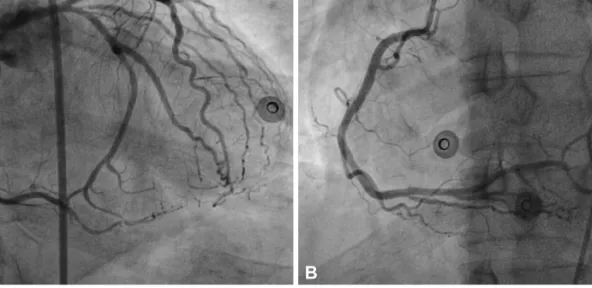
and used to have chest pain on exertion intermittently. Electrocar- diogram showed ST elevation on leads from V 1-3, and chest X-ray was normal. Laboratory findings revealed mildly elevated cardiac enzyme; creatine kinase-MB and troponin I level were 6.9 ng/mL (0.0-5.0) and 0.3 ng/mL (0.00-0.16), respectively. Transthoracic echo- cardiography demonstrated hypokinetic mid anteroseptum with preserved left ventricular global systolic function. Coronary angio- graphy was performed and revealed no significant luminal narrow- ing or occlusion of coronary arteries. However, selective injection of left coronary artery showed retrograde filling of the distal right coronary artery (RCA) from distal left circumflex artery (LCX), and right coronary injection visualized RCA and distal and mid portion of LCX simultaneously visualized (Fig. 1). Retrograde filling was not related to collaterals, but to a bidirectional intercoronary commu- nication.

When ergonovine was administered intravenously in a dose of 50 ug, the significant spasm of proximal left anterior descending artery (LAD) was provoked with chest pain (Fig. 2A). The spasm and chest pain subsided promptly after intracoronary injection of 200 ug of nitroglycerin (Fig. 2B).

Discussion

Intercoronary communications are rarely seen during coronary

angiography in patients with and without coronary artery narrow-

ing. They are distinguished from coronary collaterals that are seen in

the patients with occlusive coronary artery disease by angiographic

(2)

489 Soo Hyun Kim, et al.

http://dx.doi.org/10.4070/kcj.2013.43.7.488 www.e-kcj.org

features and histological structure. Intercoronary arterial commu- nications are single, extramural, straight and larger in diameter (>1 mm) compared to collaterals. The histological structure of the con- necting vessel has the characteristics of a normal arterial wall, with a well defined muscular layer.

6)

Two types have been reported, which are a communication between LAD and posterior descending artery in the distal interventricular groove, and a communication between LCX and RCA in the posterior atrioventricular groove, as shown in our case.

4)

The predominant symptom at presentation is chest pain, which is usually atypical, and non-invasive diagnostic procedures have of- ten doubtful results.

4)7)

There are controversies regarding functional significance of intercoronary connections. Sometimes, these con-

nections may play a protective role for myocardium, if the coronary artery obstruction has developed in one of the two connecting ves- sels.

4)8)

On the other hand, myocardial ischemia can be resulted from a coronary steal by the unidirectional intercoronary communica- tion.

5)9)

Our case presented bidirectional intercoronary communication having coronary spasm on provocation test without significant cor- onary narrowing. Takatsu et al.

10)

reported similar cases of intercoro- nary communications with vasospastic angina. They proposed the intercoronary communications were useful in at least partially pro- tecting myocardium from ischemia during spasm. Whereas spastic coronary artery was related to the intercoronary connections in their report, it was not directly related to intercoronary communication

A   B  

Fig. 1. A: left selective coronary angiogram shows no significant obstructive disease of left coronary artery and retrograde filling of the right coronary ar- tery (RCA). B: right selective coronary angiogram shows direct connection between the distal part of RCA and the left circumflex artery (LCX), without a critical lesion involving RCA and LCX.

A   B  

Fig. 2. A: the significant stenosis of proximal LAD develops when ergonovine is administered intravenously in a dose of 50 ug. B: LAD spasm resolves with

the injection of intracoronary nitroglycerine. LAD: left anterior descending artery.

(3)

490 Intercoronary Communication and Coronary Vasospasm

http://dx.doi.org/10.4070/kcj.2013.43.7.488 www.e-kcj.org

in our case. Although the relation between intercoronary connection and coronary artery spasm is not clear, consideration of provocation for coronary vasospasm can be useful if intercoronary communica- tion without significant coronary obstruction is found in patients with chest pain.

References

1. Chung SK, Lee SJ, Park SH, Lee SW, Shin WY, Jin DK. An extremely rare variety of anomalous coronary artery: right coronary artery originat- ing from the distal left circumflex artery. Korean Circ J 2010;40:465-7.

2. Yamanaka O, Hobbs RE. Coronary artery anomalies in 126,595 patients undergoing coronary arteriography. Cathet Cardiovasc Diagn 1990;

21:28-40.

3. Atak R, Güray U, Akin Y. Images in cardiology: intercoronary communi- cation between the circumflex and right coronary arteries: distinct from coronary collaterals. Heart 2002;88:29.

4. Gavrielatos G, Letsas KP, Pappas LK, et al. Open ended circulation pat- tern: a rare case of a protective coronary artery variation and review of

the literature. Int J Cardiol 2006;112:e63-5.

5. Sengül C, Ozveren O, Oduncu V, Deg˘ertekin M. Unidirectional intercor- onary communication: a very rare coronary anomaly and cause of ischemia. Turk Kardiyol Dern Ars 2011;39:344.

6. Reig J, Jornet A, Petit M. Direct connection between the coronary ar- teries in the human heart. Intercoronary arterial continuity. Angiology 1995;46:235-42.

7. Fournier JA, Cortacero JA, Díaz de la Llera L, Sánchez A, Arana E, Morán JE. [Distal intercoronary communication. A case report and medical lit- erature review]. Rev Esp Cardiol 2003;56:1026-8.

8. Ozlü MF, Ozcan F, Sen N, Cag˘lı K. An intercoronary connection serving as a safety valve for the left ventricle. Turk Kardiyol Dern Ars 2010;38:

416-8.

9. Gur M, Yilmaz R, Demirbag R. Unidirectional communication between the circumflex and right coronary arteries: a very rare coronary anom- aly and cause of ischemia. Int J Cardiovasc Imaging 2006;22:339-42.

10. Takatsu F, Osugi J, Sugiishi M, Suzuki A, Nagaya T. Intercoronary and intracoronary communications in four cases of vasospastic angina.

Cathet Cardiovasc Diagn 1989;16:103-8.

수치

Fig. 1. A: left selective coronary angiogram shows no significant obstructive disease of left coronary artery and retrograde filling of the right coronary ar- ar-tery (RCA)

참조

관련 문서

Cerebral Cerebral Cerebral angiography Cerebral angiography angiography angiography shows shows shows shows feeding feeding feeding artery feeding artery

In other words the mother's scholarship who have a lot of conversation time with child in home also influences the father's open communication type and

캐나다정부간행물목록(Weekly checklist of Canadian government publications) 에 수록된 자료 중 Folder자료, 인구센서스, 전화번호 자료 등을 제외한

Therefore, cTnT is a recommended biomarker for use in the detection of myocardial infarction (MI) and in acute coronary syndromes.[8] Indeed, several authors

for a future of work that does not yet exist, careers that have not yet been invented, an economy that prizes things not yet created, and that puts STEAM into the

• EDI is a communication standard that enables the electronic transfer of routine documents, such as purchasing orders, between business partners. • Traditional EDI has

Long-term outcome after an early invasive versus selective invasive treatment strategy in patients with non.ST-elevation acute coronary syndrome and elevated

Prevention of coronary and stroke events with atorvastatin in hypertensive patients who have average or lower-than-average cholesterol concentrations, in