ABSTRACT
Dual antiplatelet therapy (DAPT) — a combination of a P2Y
12receptor inhibitor and aspirin
— has revolutionized antithrombotic treatment. Potent P2Y
12inhibitors such as prasugrel and ticagrelor exhibit a strong and more consistent platelet inhibition when compared to clopidogrel. Therefore, ticagrelor and prasugrel significantly reduce ischemic events, but at an expense of an increased bleeding risk in acute coronary syndrome (ACS) patients undergoing percutaneous coronary intervention (PCI). These observations have engaged intensive clinical research in alternative DAPT regimens to achieve sufficient platelet inhibition with an acceptable bleeding risk. Our review focusses on P2Y
12receptor therapy de-escalation defined as a switch from a potent antiplatelet agent (ticagrelor or prasugrel) to clopidogrel. Recently, both unguided (platelet function testing independent) and guided (platelet function testing dependent) DAPT de-escalation strategies have been investigated in different clinical studies and both switching strategies could be possible options to prevent bleeding complications without increasing ischemic risk. In light of the still limited data currently available, future large-scale trials should accumulate more data on various DAPT de-escalation regimens with both ticagrelor and prasugrel in unguided and guided de-escalation approaches. In the current review we aim at summarizing and discussing the current evidence on this still emerging topic in the field of antiplatelet treatment.
Keywords: Acute coronary syndrome; P2Y
12Inhibitors; DAPT de-escalation
INTRODUCTION
Dual antiplatelet therapy (DAPT) — a combination of a P2Y
12receptor inhibitor and aspirin
— has revolutionized antithrombotic treatment options in an acute coronary syndrome (ACS) patients with and without invasive management.
1)2)The accessibility of a variety of P2Y
12inhibitors enabled physicians to switch these drugs in reflection of individual patient features including their bleeding and thrombotic risk after stent implantation. The potent P2Y
12inhibitors prasugrel and ticagrelor exhibit a strong and more consistent platelet inhibition when compared to clopidogrel. These pharmacologic properties resulted in a significant reduction in ischemic events, albeit at the expense of an increased bleeding risk in ACS
Review Article
Received: Jul 31, 2018 Accepted: Aug 12, 2018 Correspondence to Dirk Sibbing, MD
Department of Cardiology, Ludwig-Maximilians University München, Marchioninistraße 15, München 81377, Germany.
E-mail: [email protected] [email protected]
Danny Kupka, MD
Department of Cardiology, Ludwig-Maximilians University München, Marchioninistraße 15, München 81377, Germany.
E-mail: [email protected] Copyright © 2018. The Korean Society of Cardiology
This is an Open Access article distributed under the terms of the Creative Commons Attribution Non-Commercial License (https://
creativecommons.org/licenses/by-nc/4.0) which permits unrestricted noncommercial use, distribution, and reproduction in any medium, provided the original work is properly cited.
ORCID iDs Danny Kupka
https://orcid.org/0000-0002-6125-4114 Conflict of Interest
Dr. Sibbing reports personal fees from Eli Lilly, personal fees from Pfizer, personal fees from Roche Diagnostics, personal fees from Daiichi Sankyo, personal fees from Astra Zeneca, personal fees from Bayer, personal fees from MSD, personal fees from Sanofi, outside the submitted work.
Danny Kupka , MD
1,2and Dirk Sibbing, MD
1,21
Department of Cardiology, LMU Munich, Marchioninistraße 15, München, Germany
2
DZHK (German Centre for Cardiovascular Research), Munich Heart Alliance, München, Germany
De-Escalation of P2Y 12 Receptor
Inhibitor Therapy after Acute
Coronary Syndromes in Patients
Undergoing Percutaneous Coronary
Intervention
Author Contributions
Conceptualization: Kupka D, Sibbing D;
Visualization: Kupka D, Sibbing D; Writing - original draft: Kupka D, Sibbing D.
patients undergoing percutaneous coronary intervention (PCI).
3-5)The challenge of preventing ischemic events with an acceptable bleeding risk of ACS patients by adapting P2Y
12receptor inhibitor therapy is a field of intensive research.
2)6)Switching between oral P2Y
12inhibitors can either result in a stronger P2Y
12receptor inhibition (e.g. clopidogrel to prasugrel or ticagrelor) or reduced P2Y
12receptor inhibition (e.g. ticagrelor or prasugrel to clopidogrel). Those strategies are defined as DAPT escalation and de-escalation, respectively.
7)In the pivotal phase III trials (PLATO, TRITON-TIMI 38) ticagrelor and prasugrel significantly reduced ischemic events especially in the early period after PCI when compared to clopidogrel.
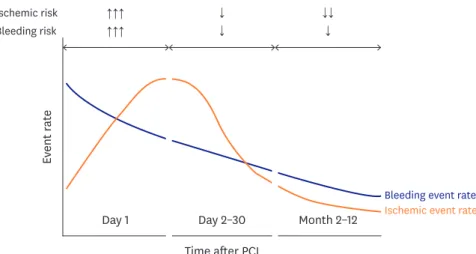
3)4)8)However, bleeding complications are an omnipresent issue during the entire maintenance phase of DAPT (Figure 1). In addition, switching to clopidogrel may have an economic advantage given the high treatment costs of ticagrelor and prasugrel.
7)An unguided DAPT de-escalation approach is already adopted by many physicians when treating ACS patients after PCI
9)but the limited data that is available is still conflicting.
9)10)Moreover, the current clinical practice guidelines offer no clear recommendations on de-escalation of P2Y
12inhibitors, leaving clinicians uninformed on how to manage these patients.
11)12)Our review summarizes and explains the rationale as well as the current evidence on de-escalating P2Y
12receptor inhibitor treatment, including both un-guided and guided treatment approaches.
GENERAL ASPECTS OF P2Y 12 RECEPTOR THERAPY DE-ESCALATION
Oral P2Y
12receptor inhibitor treatment is a key element for secondary prevention of thrombotic events in ACS patients and especially for those patients with invasive management by means of PCI.
2)For ACS patients the current clinical practice guidelines recommend a one-year treatment period with a potent P2Y
12inhibitors combined with aspirin.
12-14)Prasugrel and ticagrelor are superior to clopidogrel in preventing ischemic events
3)4)due to a more immediate and intense platelet inhibition. In general, escalated DAPT is accompanied by a higher risk for bleeding events and those bleeds are very prominent during the maintenance phase of treatment (Figure 1).
3)4)15-18)Therefore, identification of appropriate patients for DAPT de-escalation may prove useful for an optimized and more
Ev ent r at e
Time after PCI
Day 1 Day 2–30 Month 2–12 Ischemic event rate Bleeding event rate Ischemic risk
Bleeding risk ↑↑↑
↑↑↑ ↑
↑
↑↑
↑
Figure 1. Timing of ischemic versus bleeding events after PCI. Ischemic and bleeding rates after PCI are displayed dependent on time. Whereas ischemic rates reach a plateau during the first month, bleeding rates steadily decline. In the second month, ischemic events substantially decrease resulting in an exuberant bleeding risk in the later phase post-PCI.
PCI = percutaneous coronary intervention.
personalized P2Y
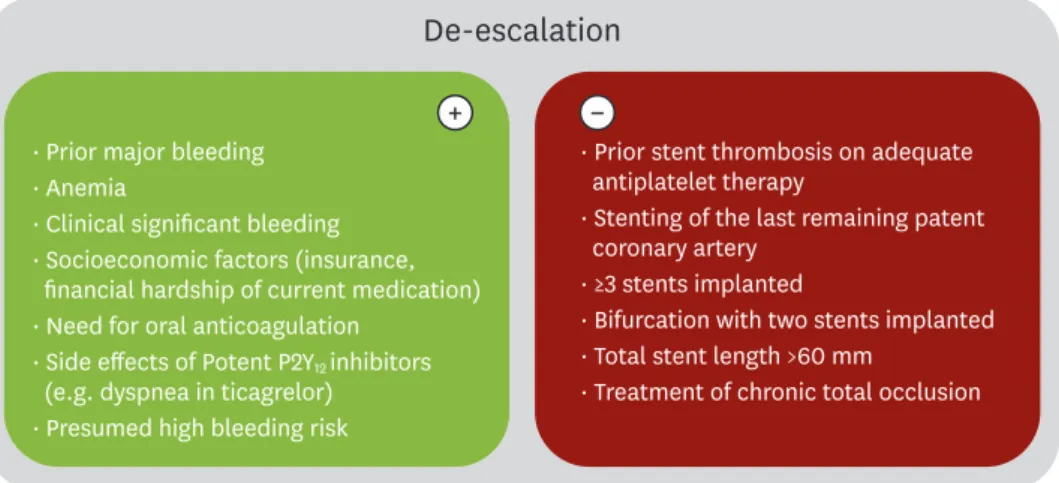
12receptor treatment after PCI. As outlined in Figure 2 there are factors that favor and there are factors against a DAPT de-escalation approach. In clinical practice, there is a variety of possibilities to downgrade the potency of antiplatelet treatment over time and this may include a dose reduction of potent P2Y
12receptor blockers,
19)a discontinuation of aspirin
12)20)and a possible shortening of the DAPT duration. Our review focuses on a true DAPT de-escalation defined as a switch from a potent P2Y
12blocker such as prasugrel or ticagrelor to clopidogrel.
7)Indeed, many physicians already shorten the treatment duration with the potent drugs to the early weeks or months after the ACS event.
9)21-23)The main reasons for de-escalation in this setting are reduced costs and concerns of bleeding during prasugrel and ticagrelor treatment, respectively. In case of ticagrelor, side effects such as dyspnea represent an additional possibility for modifying the ongoing treatment.
3)24-26)Although there is general paucity of randomized data on de-escalating P2Y
12blocker therapy (Table 1), 2 randomized controlled trials have provided first and promising results on the efficacy and safety of such a biologically plausible treatment regimen. Whereas the timing of optimal platelet inhibition after acute coronary syndrome (TOPIC)
27)trial investigated an unguided DAPT strategy that included both ticagrelor and prasugrel, Testing Responsiveness to Platelet Inhibition on Chronic Antiplatelet Treatment for Acute Coronary Syndrome (TROPICAL-ACS)
28)29)used platelet function testing to guide DAPT de-escalation from the potent P2Y
12inhibitor prasugrel to clopidogrel.
UNGUIDED DUAL ANTIPLATELET THERAPY DE-ESCALATION
Observational data suggests an in-hospital de-escalation rate of 5–14% and a post-hospital switching rate of 5–8%.
30)For instance, Treatment With Adenosine Diphosphate (ADP) Receptor Inhibitors: Longitudinal Assessment of Treatment Patterns and Events After Acute Coronary Syndrome (TRANSLATE ACS), a large multicenter, longitudinal registry in 12,365 ACS patients captured data on post discharge switching in patients with acute myocardial infarction.
30)Among patients discharged on prasugrel or ticagrelor a switch to clopidogrel was very common and strongly associated with having a government medication insurance
De-escalation
· Prior major bleeding
· Anemia
· Clinical significant bleeding
· Socioeconomic factors (insurance, financial hardship of current medication)
· Need for oral anticoagulation
· Side effects of Potent P2Y
12inhibitors (e.g. dyspnea in ticagrelor)
· Presumed high bleeding risk
+
· Prior stent thrombosis on adequate antiplatelet therapy
· Stenting of the last remaining patent coronary artery
· ≥3 stents implanted
· Bifurcation with two stents implanted
· Total stent length >60 mm
· Treatment of chronic total occlusion
−
Figure 2. The Pros and Cons of DAPT de-escalation. Characteristics marked in red are variables that may favor a DAPT de-escalation approach and variables marked in blue could be considered as factors that argue against DAPT de-escalation as an alternative DAPT strategy after PCI. Part of the figure content and variables are adapted from the ESC 2017 DAPT guidelines
12).
DAPT = dual antiplatelet therapy, PCI = percutaneous coronary intervention.
and financial hardship of medication costs. Bleeding events and increase in creatinine clearance were also associated factors prior to the switching. By contrast, a higher education was correlated with continuation of P2Y
12inhibitors suggesting costs as a main driver of switching. Switching after discharge from prasugrel or ticagrelor to clopidogrel was not associated with a significant increase in thrombotic events and GUSTO moderate/severe bleeding. Comparable results are derived from randomized data of the Comparison of Prasugrel and Ticagrelor in the Treatment of Acute Myocardial Infarction (PRAGUE-18) trial, which compared ticagrelor versus prasugrel in 1,280 ST-elevation myocardial infarction or high-risk non-ST-elevation myocardial infarction patients. After 12 months no significant differences in the composite endpoint (death, cardiovascular death, myocardial infarction, stent thrombosis, stroke and bleeding) were seen for ticagrelor and prasugrel in the intention to treat analysis (5.7% vs. 6.6%; p=0.50).
31)Approximately half of the patients were switched and de-escalated to clopidogrel at the 12-month follow-up. Interestingly, most of the switches were due to economic reasons and 70% of them occurred early and during the 30-day period after the index event. In the PRAGUE-18 trial, an economically driven de-escalation to clopidogrel was associated with a reduction in thrombotic and bleeding events, whereas a Table 1. Studies on P2Y
12receptor inhibitor de-escalation
Study
(acronym) Approach P2Y
12receptor
inhibitors No. of patients
and study design Key results Ref.
TROPICAL-ACS Effect of PFT-guided de-escalation in PCI-treated patients
Prasugrel 2,610 ACS patients Primary endpoint (control vs. PFT-guided de-escalation):
Net clinical benefit of CV death, MI, stroke, BARC bleeding ≥2 (9% vs. 7%; HR, 0.81; 95% CI, 0.62–1.06; p=0.0004)
28)29)42)
Clopidogrel RCT Subgroup analysis (escalation vs. de-escalation) - CV death, MI, stroke (3% vs. 3%; p=0.0115) - BARC bleeding events ≥2
(6% vs. 5%; HR, 0.82; 95% CI, 0.59–1.13; p=0.23) TOPIC Effect of unguided
de-escalation in PCI-treated patients
Ticagrelor 646 ACS patients Primary endpoint: (control vs. unguided de-escalation): CV death, urgent revascularization, stroke, BARC bleeding ≥2 (26.3% vs. 13.7%;
HR, 0.48; 95% CI, 0.34–0.68; p<0.01)
27)33)
Prasugrel RCT
Clopidogrel SCOPE Investigate the
incidence of switching P2Y
12blocker and its safety in ACS patients with PCI
Ticagrelor 1,363 ACS patients Primary endpoint: MACE (1.6%) and NACE (5.6%)
32)Prasugrel Observational study Switching rate: cath lab (2.3%), discharge (3.3%), follow-up (5.2%)
Clopidogrel Subgroup analysis (escalation vs. de-escalation)
- Patients with escalation: no NACE occurred among patients receiving an escalation (escalation vs. de-escalation: OR, 25.2;
95% CI, 1.4–242.9; p=0.02)
- Patients with de-escalation: NACE increased (OR, 5.3; CI, 2.1–18.2; p=0.04)
TRANSLATE ACS Investigation of post-discharge P2Y
12receptor blocker switching
Ticagrelor
Prasugrel 12,365
MI patients Primary endpoint: MACE, factors for ADP receptor inhibitor choice
9)30)Clopidogrel Observational study Switching rate: overall 7.6%
Switch in P2Y
12inhibitor groups: ticagrelor (28.3%), prasugrel (15.4%), clopidogrel (3.6%)
Main reasons for switching: costs (40.3%), physicians decision (60.7%) PRAGUE-18 Evaluate treatment
of ticagrelor versus prasugrel in patients with STEMI undergoing PCI
Prasugrel 1,230
MI patients Primary endpoint (prasugrel vs. ticagrelor): CV death, MI, stroke, all-cause mortality, definite stent thrombosis (HR, 1.167; 95% CI, 0.742–1.835; p=0.503), all bleeding (10.9% vs. 11.1%; p=0.999), TIMI major bleeding (6.6% vs. 5.7%, p=0.754)
10)31)