Taiwanese Female Vegetarians Have Lower Lipoprotein- Associated Phospholipase A2 Compared with Omnivores
Chih-Wei Chen,
1,2Chih-Ta Lin,
1Ying-Lung Lin,
3Tin-Kwang Lin,
1and Chin-Lon Lin
1,21The Division of Cardiology, Department of Internal Medicine, Buddhist Dalin Tzu-Chi General Hospital, Chia-Yi;
2The College of Medicine, Tzu-Chi University, Hualien;
3The Department of Family Medicine, Buddhist Dalin Tzu-Chi General Hospital, Chia-Yi, Taiwan.
Received: October 6, 2008 Revised: January 9, 2010 Accepted: January 13, 2010
Corresponding author: Dr. Chin-Lon Lin, The Division of Cardiology, Department of Internal Medicine, Buddhist Dalin Tzu-Chi General Hospital, Number 2 Min-Sheng Road, Dalin Town, Chia-Yi, Taiwan, R.O.C.
Tel: 886-5-2648000, Fax: 886-5-2648228 E-mail: [email protected]
∙ The authors have no financial conflicts of interest.
© Copyright:
Yonsei University College of Medicine 2011 This is an Open Access article distributed under the terms of the Creative Commons Attribution Non- Commercial License (http://creativecommons.org/
licenses/by-nc/3.0) which permits unrestricted non- commercial use, distribution, and reproduction in any medium, provided the original work is properly cited.
Purpose: Many studies supported that vegetarians have a lower risk of cardiac diseases and mortality, partly due to better blood pressure and serum cholesterol profiles. However, the inflammatory markers, especially lipoprotein-associated phospholipase A2 (Lp-PLA2), have not been well-studied. This study aimed to compare inflammatory markers and conventional risk factors between vegetarians and omnivores. Materials and Methods: One hundred and seventy-three vegetar- ians and 190 omnivores were studied. Fasting blood samples were obtained to compare levels of glucose, total cholesterol, triacylglycerol, high density lipopro- tein (HDL) and low density lipoprotein (LDL) cholesterol, homocysteine, Lp- PLA2 activity, and high-sensitivity C-reactive protein (hs-CRP). Results: Vegetar- ians had higher serum levels of the following markers: hs-CRP (1.8 ± 3.4 vs. 1.2 1.8 mg/L, respectively; p = 0.05), homocysteine (9.39 ± 3.22 vs. 7.62 ± 2.41 μmol/L, respectively; p < 0.01), and triacylglycerol (96.91 ± 59.56 vs. 84.66 ± 43.24 mg/dL, respectively; p < 0.05). Vegetarians also had lower levels of Lp- PLA2 (18.32 ± 7.19 10-3 μmol/min/mL vs. 20.22 8.13 10-3 μmol/min/mL; p <
0.05), total cholesterol (180.62 ± 36.55 mg/dL vs. 192.73 ± 36.57 mg/dL; p <
0.01), LDL cholesterol (118.15 ± 32.8 vs. 126.41 ± 34.28 mg/dL; p < 0.05), and HDL cholesterol (55.59 ± 13.30 vs. 62.09 ± 14.52 mg/dL, p < 0.01). Multivariate analyses demonstrated that a vegetarian diet increases the chances for high serum hs-CRP and low Lp-PLA2 activity. Conclusion: In addition to lower total choles- terol, LDL-cholesterol, and HDL-cholesterol, Taiwanese female vegetarians have lower serum Lp-PLA2 activity but higher levels of hs-CRP, homocysteine, and tri- acylglyerol. It might be due to geographic differences of vegetarian diets, and fur- ther studies are needed.
Key Words: Vegetarian diet, risk factors, lipoprotein associated phospholipase A2, C-reactive protein, inflammation
INTRODUCTION
Many studies have shown that people on vegetarian diets have lower risks of isch- emic heart disease mortality1-4 and even lower overall mortality rates.1,3 A vegetari-
toid arthritis, diagnosis of a coronary artery disease, or a fe- ver or another infectious disease within 3 weeks prior to the start of the study. Those who fit the above criteria but not on a regular vegetarian diet at least one year before inclu- sion were enrolled into the omnivore group. Patients who had been on an ovo-lactovegetarian diet for at least 1 year before inclusion were enrolled into the vegetarian group.
Informed consent forms were obtained from all subjects and the study protocol was approved by the research com- mittee and the institutional review board (IRB) of The Bud- dhist Dalin Tzu-Chi General Hospital (B09404004).
After an overnight fast for at least 12 hours, venous blood samples were obtained from all subjects. Each patient age, weight, height, heart rate, and blood pressure were recorded before blood withdrawal on the day of study inclusion. The fasting blood samples were tested for Lp-PLA2, hs-CRP, glucose, cholesterol, triacylglycerol, high density lipopro- tein (HDL) cholesterol, LDL cholesterol, uric acid and ho- mocysteine levels, and white blood cell (WBC) counts were recorded. Frozen serum samples were used for analyzing Lp- PLA2, hs-CRP, and homocysteine. Serum Lp-PLA2 activi- ty was analyzed by dynamic assay with a platelet-activating factor acetylhydrolase assay kit in a unit of μmol/min/mL (Cayman Chemical Company, Ann Arbor, MI, USA). Sam- ples were centrifuged with a Micron centrifugal filter de- vice (YM-30, Millipore, Billerica, MA, USA) under a cen- trifugal force of 14,000 g and temperature controlled at 4°C, to reach a cut-off molecular weight of 30,000 Daltons.
hs-CRP was measured with an enzyme-linked immunosor- bent assay (ELISA) based on purified protein and poly- clonal anti-C-reactive protein antibodies with a unit of mg/
L (Cobas Integra 800 system, Roche Diagnostics GmbH, Mannheim, Germany). Homocysteine levels were mea- sured using an immunoassay method in a unit of μmol/L (FPIA assay, AXSYM system, Abbott Laboratories, Chica- go, IL, USA).
Statistical analysis
For basic comparisons, the two groups characteristics were primarily examined by independent t-tests. Furthermore, based on the two hypotheses specified for the effects of a vegetarian diet on the inflammation factors of Lp-PLA2 and CRP, we applied linear regressions to the influencing factors for exposure to a vegetarian diet. B values with 95%
confidence intervals were estimated for the effects of pre- dicting factors. Separately, Lp-PLA2 and CRP were treated as dependent variables in univariate and multivariate analy- an diet lowers blood pressure, serum total, and low density
lipoprotein (LDL) cholesterol levels, and also improves en- dothelial function and insulin sensitivity, and thus reduces the risk of atherosclerosis.5-11
There are still some conflicting facts about the benefits of a vegetarian diet. For example, serum homocysteine has been reported to be higher in vegetarians than in omni- vores.7,12 Homocysteine stimulates vascular smooth muscle cells to proliferate and synthesize collagen; it also affects endothelial cell function and adversely affects anticoagula- tion, which may result in atherosclerosis.13
Chronic inflammation is an essential feature of the ath- erosclerotic process. High-sensitivity C-reactive protein (hs-CRP), a very important inflammatory marker, has been reported to be a strong independent risk factor for athero- sclerosis and a cardiovascular prognosis.14,15 Some studies16 showed lower hs-CRP in vegetarians than omnivores. Oth- er studies7,17 failed to demonstrate that.
Lipoprotein-associated phospholipase A2 (Lp-PLA2), an enzyme mainly produced by monocytes/macrophages, gen- erates potent proinflammatory products. In one study, ele- vated levels of Lp-PLA2 appeared to predict future coro- nary events in apparently healthy middle-aged men with moderately elevated total cholesterol levels, independent of hs-CRP.18 This suggests that the cardiovascular outcome predictive effect of Lp-PLA2 and CRP may be additive.18
The status of Lp-PLA2-associated inflammation in vege- tarians has not been studied. Thus, we designed a cross-sec- tion study enrolling a larger number of subjects, to compare the differences in inflammation markers in addition to con- ventional risk factors between vegetarians and omnivores by examining hs-CRP and Lp-PLA2 levels. To eliminate any gender bias on inflammation status, we enrolled only females in this study.
MATERIALS AND METHODS
All of the subjects were adult females (more than 20 years old) who had undergone a general health examination at the Buddhist Dalin Tzu-Chi General Hospital, Chia-Yi, Tai- wan, from Jan 1, 2006 to Dec 31, 2006. All of the subjects filled out questionnaires regarding their dietary preferences and past medical history. Exclusion criteria include a histo- ry of smoking, diabetes, dyslipidemia, hypertension, cere- brovascular disease, chronic gingivitis, connective tissue disease such as systemic lupus erythematosus or rheuma-
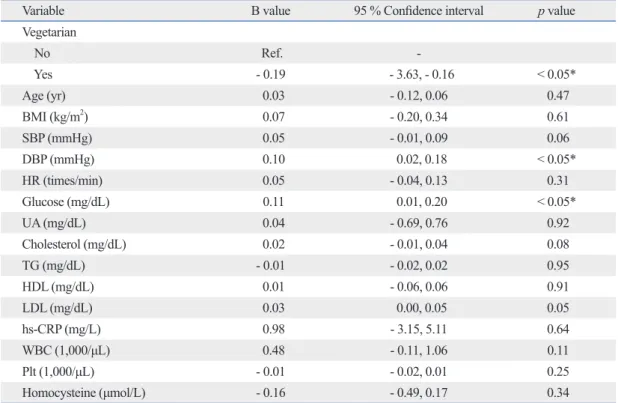
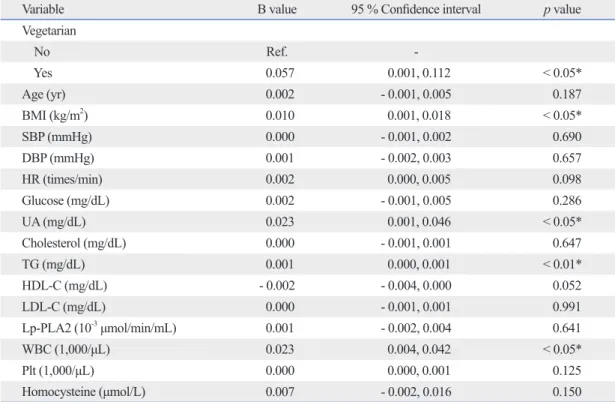
counts. It was noteworthy that the level of CRP reached bor- derline statistical significance between these two groups (p = 0.05). As to the results of linear regressions on Lp-PLA2, vegetarianism had significant effects on changes on Lp- PLA2 levels on univariate analyses (Table 2). In multivariate analyses, after adjusting for age and BMI as potential con- founders, vegetarianism remained a significant factor influ- encing the Lp-PLA2 level [B value: - 1.79, 95% confidence interval (CI): - 3.58, - 0.01; p < 0.05]. A vegetarian diet de- creased Lp-PLA2 levels remarkably (Table 3). Meanwhile, because of the overall low levels of CRP among healthy sub- jects, the estimated changes influenced by predicting factors were tiny. Thus, we applied three digits after the decimal point. In univariate (Table 4) or multivariate (Table 5) analy- ses, significant positive correlation to CRP levels with vege- tarianism and BMI were detected (B values for vegetarian- ism and BMI, separately: 0.058 and 0.010, 95% CIs: 0.001, 0.114 and 0.001, 0.018; both p values < 0.05).
DISCUSSION
Our current study demonstrated that as a new inflammation marker, serum Lp-PLA2 activity is lower in apparently ses. In multivariate analyses, age and body mass index
(BMI) were considered as potential confounders. However, in the case of secondary or intermediate associations within the causal relationship between dietary habit and these two inflammation markers, variables of basic characteristics that were not clearly independent influencing factors were excluded from the final model of multivariate analyses.
SPSS 13.0 for Windows (SPSS Inc, Chicago, IL, USA) was utilized to perform all the statistical analyses and the significance level (a value) was set at 0.05.
RESULTS
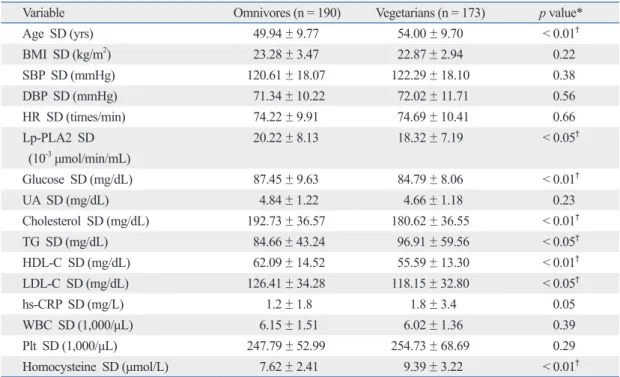
A total of 363 subjects (190 omnivores, 173 vegetarians) were involved in the analysis. Their average age was 51.9 years old (SD: 9.9 years old), and all were female. Table 1 presents the basic characteristics of each group by indepen- dent t-tests. Remarkable discrepancies for age, levels of Lp- PLA2, glucose, cholesterol, triglyceride, HDL cholesterol, LDL cholesterol, and homocysteine were detected between the two groups (p values < 0.05 or 0.01). However, basic comparisons showed no significant differences for BMI, blood pressure, heart rate, uric acid, WBC, and platelet
Table 1. Basic Characteristics of Both Groups
Variable Omnivores (n = 190) Vegetarians (n = 173) p value*
Age SD (yrs) 49.94 ± 9.77 54.00 ± 9.70 < 0.01†
BMI SD (kg/m2) 23.28 ± 3.47 22.87 ± 2.94 0.22
SBP SD (mmHg) 120.61 ± 18.07 122.29 ± 18.10 0.38
DBP SD (mmHg) 71.34 ± 10.22 72.02 ± 11.71 0.56
HR SD (times/min) 74.22 ± 9.91 74.69 ± 10.41 0.66
Lp-PLA2 SD 20.22 ± 8.13 18.32 ± 7.19 < 0.05†
(10-3 μmol/min/mL)
Glucose SD (mg/dL) 87.45 ± 9.63 84.79 ± 8.06 < 0.01†
UA SD (mg/dL) 4.84 ± 1.22 4.66 ± 1.18 0.23
Cholesterol SD (mg/dL) 192.73 ± 36.57 180.62 ± 36.55 < 0.01†
TG SD (mg/dL) 84.66 ± 43.24 96.91 ± 59.56 < 0.05†
HDL-C SD (mg/dL) 62.09 ± 14.52 55.59 ± 13.30 < 0.01†
LDL-C SD (mg/dL) 126.41 ± 34.28 118.15 ± 32.80 < 0.05†
hs-CRP SD (mg/L) 1.2 ± 1.8 1.8 ± 3.4 0.05
WBC SD (1,000/μL) 6.15 ± 1.51 6.02 ± 1.36 0.39
Plt SD (1,000/μL) 247.79 ± 52.99 254.73 ± 68.69 0.29
Homocysteine SD (μmol/L) 7.62 ± 2.41 9.39 ± 3.22 < 0.01†
BMI, body mass index; SBP, systolic blood pressure; DBP, diastolic blood pressure; HR, heart rate; Lp-PLA2, lipoprotein-associated phos- pholipase A2; UA, uric acid; TG, triglyceride, HDL-C, high density lipoprotein cholesterol, LDL-C, low density lipoprotein cholesterol; hs- CRP, high-sensitivity C-reactive protein; WBC, white blood cell; Plt, platelet counts.
*Independent t-tests were performed.
†Statistically significant.
hs-CRP in vegetarians but there are many study limitations in it. As we know, gender and smoking influenced the se- rum hs-CRP level significantly.22,23 In our previous study, there are more males and smokers in the omnivore group that can influence the statistical power of difference of hs- CRP between both groups. Actually, it failed to demon- strate a significant difference if male and female samples were analyzed separately. Also, the case number of our pre- vious study is small. So, we conducted the present study with more subjects and only female nonsmokers were en- rolled. We believe that our present study is better controlled and more reliable than our previous one. There are several possible explanations for lower Lp-PLA2 and higher hs- CRP in Taiwanese female vegetarians. Firstly, there are healthy Taiwanese vegetarians than in omnivores. Elevated
Lp-PLA2 has been proven to be an independent risk factor for inflammation, was additive to hs-CPR as a predictor of cardiovascular events18,19 and a risk factor for a new or re- current ischemic stroke.20,21 This provided the basis that Tai- wanese vegetarian diets might have protective effects on cardiovascular disease and ischemic stroke via the mecha- nism of lower Lp-PLA2 levels in vegetarians.
However, our results also demonstrated a lower serum hs-CRP level in omnivores than in vegetarians. This result is different from Szeto report,16 which showed a lower se- rum hs-CRP in apparently healthy Hong Kong vegetarians than in omnivores. It is different from our previous study, too.7 Our previous study showed a borderline lower serum
Table 2. Univariate Analyses for Influencing Factors on Lp-PLA2 (n = 363)
Variable B value 95 % Confidence interval p value
Vegetarian
No Ref. -
Yes - 0.19 - 3.63, - 0.16 < 0.05*
Age (yr) 0.03 - 0.12, 0.06 0.47
BMI (kg/m2) 0.07 - 0.20, 0.34 0.61
SBP (mmHg) 0.05 - 0.01, 0.09 0.06
DBP (mmHg) 0.10 0.02, 0.18 < 0.05*
HR (times/min) 0.05 - 0.04, 0.13 0.31
Glucose (mg/dL) 0.11 0.01, 0.20 < 0.05*
UA (mg/dL) 0.04 - 0.69, 0.76 0.92
Cholesterol (mg/dL) 0.02 - 0.01, 0.04 0.08
TG (mg/dL) - 0.01 - 0.02, 0.02 0.95
HDL (mg/dL) 0.01 - 0.06, 0.06 0.91
LDL (mg/dL) 0.03 0.00, 0.05 0.05
hs-CRP (mg/L) 0.98 - 3.15, 5.11 0.64
WBC (1,000/μL) 0.48 - 0.11, 1.06 0.11
Plt (1,000/μL) - 0.01 - 0.02, 0.01 0.25
Homocysteine (μmol/L) - 0.16 - 0.49, 0.17 0.34
Lp-PLA2, lipoprotein-associated phospholipase A2; BMI, body mass index; SBP, systolic blood pressure; DBP, diastolic blood pressure;
HR, heart rate; UA, uric acid; TG, triglyceride; HDL, high density lipoprotein; LDL, low density lipoprotein; hs-CRP, high-sensitivity C- reactive protein; WBC, white blood cell; Plt, platelet counts.
*Statistically significant.
Table 3. Multivariate Analyses for Influencing Factors on Lp-PLA2 (n = 363)
Variable B value 95% Confidence interval p value
Vegetarian
No Ref. -
Yes - 1.79 - 3.58, - 0.01 < 0.05*
Age (yr) - 0.02 - 0.11, 0.07 0.68
BMI (kg/m2) 0.06 - 0.21, 0.34 0.65
Lp-PLA2, lipoprotein-associated phospholipase A2; BMI, body mass index.
*Statistically significant.
terns and cooking methods, except that they do not include any meat, fish, or poultry in their meals. The Taiwanese veg- etarian diet includes a large intake of soybean products, which are the major substitute for animal products.27 In comparison to western vegetarians, Taiwanese vegetarians consume fewer fresh vegetables and usually cook their veg- etables in oil. They also consume many deep-fried and re- fined soybean and grain products, which probably contain many more oxidative groups, and more oil and even trans fatty acids since trans fatty acids are mainly produced during oil hardening in food processing.28 Studies have confirmed that a diet and a cooking pattern that includes processed, fried, and refined foods, such as meats, grains, and beans, are associated with an elevation of inflammation markers, large variations of hs-CRP levels which makes statistical
analysis difficult (as evidenced by standard deviation great- er than mean in both our current study and Szeto report).
Secondly, Lp-PLA2 appeared to be a specific marker of vascular inflammation, whereas hs-CRP is a circulating marker influenced by chronic systemic inflammation and obesity.24-26 Thirdly, it might be due to the geographic dif- ferences in vegetarian diets. Most western vegetarians in- clude fresh vegetables and fruits as their main source of nu- trition and energy, based on health benefits of the foods. In contrast, most Taiwanese vegetarians choose a vegetarian diet because of their Buddhist religion, which teaches a poli- cy of “no killing” Buddhists in Taiwan have a dietary pat- tern similar to that of most Taiwanese in terms of meal pat-
Table 4. Univariate Analyses for Influencing Factors on hs-CRP (n = 363)
Variable B value 95 % Confidence interval p value
Vegetarian
No Ref. -
Yes 0.057 0.001, 0.112 < 0.05*
Age (yr) 0.002 - 0.001, 0.005 0.187
BMI (kg/m2) 0.010 0.001, 0.018 < 0.05*
SBP (mmHg) 0.000 - 0.001, 0.002 0.690
DBP (mmHg) 0.001 - 0.002, 0.003 0.657
HR (times/min) 0.002 0.000, 0.005 0.098
Glucose (mg/dL) 0.002 - 0.001, 0.005 0.286
UA (mg/dL) 0.023 0.001, 0.046 < 0.05*
Cholesterol (mg/dL) 0.000 - 0.001, 0.001 0.647
TG (mg/dL) 0.001 0.000, 0.001 < 0.01*
HDL-C (mg/dL) - 0.002 - 0.004, 0.000 0.052
LDL-C (mg/dL) 0.000 - 0.001, 0.001 0.991
Lp-PLA2 (10-3 μmol/min/mL) 0.001 - 0.002, 0.004 0.641
WBC (1,000/μL) 0.023 0.004, 0.042 < 0.05*
Plt (1,000/μL) 0.000 0.000, 0.001 0.125
Homocysteine (μmol/L) 0.007 - 0.002, 0.016 0.150
hs-CRP, high-sensitivity C-reactive protein; BMI, body mass index; SBP, systolic blood pressure; DBP, diastolic blood pressure; HR, heart rate; UA, uric acid; TG, triglyceride; HDL-C, high density lipoprotein cholesterol; LDL-C, low density lipoprotein cholesterol; Lp-PLA2, lipoprotein-associated phospholipase A2; WBC, white blood cell; Plt, platelet counts.
*Statistically significant.
Table 5. Multivariate Analyses for Influencing Factors on hs-CRP (n = 363)
Variable B value 95% Confidence interval p value
Vegetarian
No Ref. -
Yes 0.058 0.001, 0.114 < 0.05*
Age (yr) 0.001 - 0.002, 0.004 0.698
BMI (kg/m2) 0.010 0.001, 0.018 < 0.05*
hs-CRP, high-sensitivity C-reactive protein; BMI, body mass index.
*Statistically significant.
ity. Am J Clin Nutr 1982;36:873-7.
2. Phillips RL, Lemon FR, Beeson WL, Kuzma JW. Coronary heart disease mortality among Seventh-Day Adventists with differing dietary habits: a preliminary report. Am J Clin Nutr 1978;31:
S191-8.
3. Key TJ, Appleby PN, Davey GK, Allen NE, Spencer EA, Travis RC. Mortality in British vegetarians: review and preliminary re- sults from EPIC-Oxford. Am J Clin Nutr 2003;78:533S-8S.
4. Key TJ, Fraser GE, Thorogood M, Appleby PN, Baral V, Reeves G, et al. Mortality in vegetarians and nonvegetarians: detailed findings from a collaborative analysis of 5 prospective studies.
Am J Clin Nutr 1999;70:516S-24S.
5. Fraser GE. Associations between diet and cancer, ischemic heart disease, and all-cause mortality in non-Hispanic white California Seventh-day Adventists. Am J Clin Nutr 1999;70:532S-8S.
6. Knuiman JT, West CE. The concentration of cholesterol in serum and in various serum lipoproteins in macrobiotic, vegetarian and non-vegetarian men and boys. Atherosclerosis 1982;43:71-82.
7. Chen CW, Lin YL, Lin TK, Lin CT, Chen BC, Lin CL. Total car- diovascular risk profile of Taiwanese vegetarians. Eur J Clin Nutr 2008;62:138-44.
8. Ko YC. Blood pressure in Buddhist vegetarians. Nutr Rep Int 1983;28:1375-83.
9. Lin CL, Fang TC, Gueng MK. Vascular dilatory functions of ovo- lactovegetarians compared with omnivores. Atherosclerosis 2001;158:247-51.
10. Kuo CS, Lai NS, Ho LT, Lin CL. Insulin sensitivity in Chinese ovo-lactovegetarians compared with omnivores. Eur J Clin Nutr 2004;58:312-6.
11. Hung CJ, Huang PC, Li YH, Lu SC, Ho LT, Chou HF. Taiwanese vegetarians have higher insulin sensitivity than omnivores. Br J Nutr 2006;95:129-35.
12. Krajcovicová -Kudlácková M, Blazícek P, Kopcová J, Béderová A, Babinská K. Homocysteine levels in vegetarians versus omni- vores. Ann Nutr Metab 2000;44:135-8.
13. Harpel PC. Homocysteine, atherogenesis and thrombosis. Fibri- nolysis & Proteolysis 1997;11:77-80.
14. Ridker PM, Cushman M, Stampfer MJ, Tracy RP, Hennekens CH.
Inflammation, aspirin, and the risk of cardiovascular disease in ap- parently healthy men. N Engl J Med 1997;336:973-9.
15. Ridker PM, Hennekens CH, Buring JE, Rifai N. C-reactive pro- tein and other markers of inflammation in the prediction of cardio- vascular disease in women. N Engl J Med 2000;342:836-43.
16. Szeto YT, Kwok TC, Benzie IF. Effects of a long-term vegetarian diet on biomarkers of antioxidant status and cardiovascular dis- ease risk. Nutrition 2004;20:863-6.
17. Mezzano D, Muñoz X, Martínez C, Cuevas A, Panes O, Aranda E, et al. Vegetarians and cardiovascular risk factors: hemostasis, in- flammatory markers and plasma homocysteine. Thromb Haemost 1999;81:913-7.
18. Koenig W, Khuseyinova N, Löwel H, Trischler G, Meisinger C.
Lipoprotein-associated phospholipase A2 adds to risk prediction of incident coronary events by C-reactive protein in apparently healthy middle-aged men from the general population: results from the 14-year follow-up of a large cohort from southern Ger- many. Circulation 2004;110:1903-8.
19. Ballantyne CM, Hoogeveen RC, Bang H, Coresh J, Folsom AR, Heiss G, et al. Liporotein-associated phospholipase A2, high-sen- sitivity C-reactive protein, and risk for incident coronary heart dis- ease in middle-aged men and women in the Atherosclerosis Risk
such as hs-CRP, adhesion molecules, and impaired endothe- lial function.29,30 Consuming foods containing more trans fatty acids will also result in higher serum inflammation markers, adhesion molecules, and impaired endothelial function.31 Further study with detailed food item question- naires might serve to elucidate the exact mechanism.
As the Atherosclerosis Risk in Communities (ARIC) Study showed, there was no correlation between Lp-PLA2 and hs-CRP.19 According to the comments of Zalewski and Macphee,24 circulating Lp-PLA2 levels are dependent on the level of its carrier, LDL cholesterol, and CRP and Lp- PLA2 do not correlate because they probably reflect dispa- rate inflammatory pathways.
Ridker, et al.15 demonstrated that hs-CRP was the stron- gest univariate predictor of future cardiovascular events (relative risk, 4.4), followed by the ratio of total cholesterol to HDL-C, total cholesterol, LDL cholesterol, and homo- cysteine (relative risk, 2) in a prospective case-control study of 28,263 healthy postmenopausal women followed for more than 3 years. Our study demonstrated that Taiwanese vegetarians have lower Lp-PLA2, total cholesterol, HDL cholesterol, and LDL cholesterol, but higher hs-CRP, ho- mocysteine, and triacylglycerol. Since each of these risk factors carries different relative risk ratios, the net effect on cardiovascular protection is difficult to estimate. Long-term follow-up on this group of subjects is warranted and inter- ventions to modify these risk profiles should be studied.
ACKNOWLEDGEMENTS
The present study was supported by grant DTCRD 95-01 from The Buddhist Dalin Tzu-Chi General Hospital, Chia-Yi, Taiwan. The authors are grateful for the statistical assistance provided by Professor CK Chang of National Chung-Cheng University, Chia-Yi, Taiwan. The authors responsibilities were as follows: C-WC and C-LL provided the initial hypothesis and study design and drafted the manuscript; C-WC reviewed the literature and revised the manuscript; C-TL, Y-LL and T-KL subsequently collected and analyzed the data. All au- thors contributed to the discussion of the results and have seen and approved the final revised version.
REFERENCES
1. Burr ML, Sweetnam PM. Vegetarianism, dietary fiber, and mortal-
26. Packard CJ, O’Reilly DS, Caslake MJ, McMahon AD, Ford I, Coo- ney J, et al. Lipoprotein-associated phospholipase A2 as an indepen- dent predictor of coronary heart disease. West of Scotland Coronary Prevention Study Group. N Engl J Med 2000;343:1148-55.
27. Pan WH, Chin CJ, Sheu CT, Lee MH. Hemostatic factors and blood lipids in young Buddhist vegetarians and omnivores. Am J Clin Nutr 1993;58:354-9.
28. Lee HY, Woo J, Chen ZY, Leung SF, Peng XH. Serum fatty acid, lipid profile and dietary intake of Hong Kong Chinese omnivores and vegetarians. Eur J Clin Nutr 2000;54:768-73.
29. Nettleton JA, Steffen LM, Mayer-Davis EJ, Jenny NS, Jiang R, Herrington DM, et al. Dietary patterns are associated with bio- chemical markers of inflammation and endothelial activation in the Multi-Ethnic Study of Atherosclerosis (MESA). Am J Clin Nutr 2006;83:1369-79.
30. Lopez-Garcia E, Schulze MB, Fung TT, Meigs JB, Rifai N, Man- son JE, et al. Major dietary patterns are related to plasma concen- tration of markers of inflammation and endothelial dysfunction.
Am J Clin Nutr 2004;80:1029-35.
31. Lopez-Garcia E, Schulze MB, Meigs JB, Manson JE, Rifai N, Stampfer MJ, et al. Consumption of trans fatty acid is related to plasma biomarkers of inflammation and endothelial dysfunction. J Nutr 2005;135:562-6.
in Communities (ARIC) study. Circulation 2004;109:837-42.
20. Oei HH, van der Meer IM, Hofman A, Koudstaal PJ, Stijnen T, Breteler MM, et al. Lipoprotein-associated phospholipase A2 ac- tivity is associated with risk of coronary heart disease and isch- emic stroke: the Rotterdam Study. Circulation 2005;111:570-5.
21. Elkind MS, Tai W, Coates K, Paik MC, Sacco RL. High-sensitivi- ty C-reactive protein, lipoprotein-associated phospholipase A2, and outcome after ischemic stroke. Arch Intern Med 2006;166:
2073-80.
22. Zedler BK, Kinser R, Oey J, Nelson B, Roethig HJ, Walk RA, et al. Biomarkers of exposure and potential harm in adult smokers of 3-7 mg tar yield (Federal Trade Commission) cigarettes and in adulted non-smokers. Biomarkers 2006;11:201-20.
23. Lakoski SG, Cushman M, Criqui M, Rundek T, Blumenthal RS, D’Agostino RB Jr, et al. Gender and C-reactive protein: data from the Multiethnic Study of Atherosclerosis (MESA) cohort. Am Heart J 2006;152:593-8.
24. Zalewski A, Macphee C. Role of lipoprotein-associated phospho- lipase A2 in atherosclerosis. Biology, epidemiology, and possible therapeutic target. Arterioscler Thromb Vasc Biol 2005;25:923-31.
25. Garza CA, Montori VM, McConnell JP, Somers VK, Kullo IJ, Lopez-Jimenez F. Association between lipoprotein-associated phospholipase A2 and cardiovascular disease: a systematic review.
Mayo Clin Proc 2007;82:159-65.