https://doi.org/10.5763/kjsm.2020.38.2.78 pISSN 1226-3729 eISSN 2288-6028
세가지 종류의 장거리 달리기에서 포도당과 지질 지표의 변화 비교
신성대학교 임상병리과
1, 성신여자대학교 운동재활복지학과
2신 경 아1
∙
김 영 주2Comparison of Changes in Glucose and Lipid Parameters Associated with Three Types of Long-Distance Running
Kyung-A Shin
1, Young-Joo Kim
21
Department of Clinical Laboratory Science, Shinsung University, Dangjin,
2
Department of Exercise Rehabilitation Welfare, Sungshin Women’s University, Seoul, Korea
Purpose: The purpose of this study was to evaluate biochemical markers of blood glucose and blood lipids associated with extreme long-distance running races (marathon, 100 km, 308 km).
Methods: The participants were 45 middle-aged male runners: 15 corresponding to each distance. All participants performed graded exercise tests before the races. Blood glucose, total cholesterol (TC), triglyceride (TG), high-density lipoprotein cholesterol (HDL-C), and low-density lipoprotein cholesterol (LDL-C) levels were analyzed by blood collection before and after the races to identify differences between the groups and before and after the races.
Results: No differences were found in blood glucose levels before and after all races, as well as between the groups.
TC levels decreased only after the 308-km race, and this decrease was lower than the differences after the marathon and 100-km races. TG levels decreased after all three races and were lower after the 100-km and 308-km races than that after the marathon race. HDL-C levels showed no differences after the marathon race but increased after the 100-km and 308-km races, with higher levels after the 308-km race than those after the marathon and 100-km races. LDL-C levels increased after the marathon race, but decreased after the 308-km race, with lower levels after the 308-km race than those after the marathon and 100-km races.
Conclusion: The 308-km race was associated with decreases in TC, TG, and LDL-C levels and an increase in HDL-C levels, indicating that exercise time may have a positive effect on lipid metabolism rather than exercise intensity.
Keywords: Glucose, Lipid, Running
Received: January 20, 2020 Revised: May 25, 2020 Accepted: May 25, 2020 Correspondence: Young-Joo Kim
Department of Exercise Rehabilitation Welfare, Sungshin Women’s University, Bomun-ro 34da-gil, Seongbuk-gu, Seoul 02844, Korea Tel: +82-2-920-7942, Fax: +82-2-920-7942, E-mail: [email protected]
*This work supported by the Sungshin Women’s University Research Grant of 2018.
Copyright ©2020 The Korean Society of Sports Medicine
CC This is an Open Access article distributed under the terms of the Creative Commons Attribution Non-Commercial License (http://creativecommons.org/
서 론
성인에서 규칙적인 신체활동은 심폐체력의 향상으로 인해 심 혈관 질환에 의한 사망률을 감소시킬 뿐만 아니라 대사성 질환과 일부 암을 예방하고, 암 생존자의 삶의 질 향상에 도움이 된다
1,2. 그러나 반복적인 장시간의 격렬한 운동은 동맥경화 및 심실기능 이상, 심방세동, 과도한 근육 및 연골 손상, 전신 염증반응을 촉진하여 건강에 부정적인 영향을 미칠 수 있다
3,4.
울트라 마라톤에 의한 콜레스테롤과 중성지방 같은 혈중 지질 의 생리적 변화는 동맥경화 및 관상동맥질환 위험요인과 깊이 관련되어 있어 생리학 분야에서 주목 받고 있다
5. 장거리 지구력 운동은 축적된 중성지방을 에너지원으로 사용하기 때문에 경기 중 지속적인 혈중 지질의 변화가 나타나지만, 이러한 변화는 연령, 체중, 식습관, 경기 전 음식섭취, 혈장량의 변화, 운동 종류 등에 의해 다양한 결과를 나타낸다
6,7. Wu 등
8은 24시간 울트라 마라톤 경기 직후 콜레스테롤치는 유의한 변화가 없었으나, 중성 지방과 low-density lipoprotein cholesterol (LDL-C)이 유의하게 감소하였음을 보고하였다. Waskiewicz 등
9도 24시간 울트라 마라 톤 직후 중성지방의 감소를 보고하였으며, 이는 총콜레스테롤과 LDL-C 의 뚜렷한 감소와 high-density lipoprotein cholesterol (HDL-C) 의 유의한 증가에 의한 것으로 보고하였다. 또한 산악 울트라 마라톤에서 HDL-C의 현저한 증가와 중성지방의 감소가 나타나며, 이는 지방산화 속도가 마라톤 달리기 동안에 높아지기 때문으로 보고된다
10. 따라서 장거리 지구력 운동은 지방대사에 영향을 미치며, 혈장 지방산 및 지방 이용률을 현저하게 증가시킨다
11.
장거리 지구력 운동은 신체의 칼로리 수요를 충족시키기 위해 충분한 양의 에너지를 필요로 하는데
12, 탄수화물은 에너지원으로 써 뿐만 아니라 에너지의 급속한 지방대사와 중추신경계의 포도 당 공급에 필수적이다
9. 탄수화물의 충분한 공급은 지구력 운동 선수들에게 중요하다. Waskiewicz 등
9은 24시간 울트라 마라톤 기간 동안 자유로운 음식섭취로 혈당 농도에 큰 변화는 없었다고 보고하였다. 그러나 마라톤 참가자 중 2/5 이상이 탄수화물의 고갈을 경험하고 이로 인해 결승선에 도달하기 전 중도 탈락하게 된다
13. 그럼에도 불구하고 기존의 장거리 지구력 운동에 의한 신체 대사반응의 연구들은 대부분 운동 직후 및 회복기에 일어나 는 변화에 초점을 맞춰 평가하고 있으며
6,8,14, 울트라 마라톤의 운동 거리에 따른 생화학적 지표의 차이를 검증한 연구는 부족하다.
미국의 마라톤 참여자는 1976년 25,000명에서 2008년 470,000 명으로 증가하고 있으나, 매년 6–8명의 마라톤 선수가 사망한다 고 추정하고 있어 그 원인과 안전성에 대한 평가가 중요하다
15. 울트라 마라톤은 일반적 마라톤 거리인 42.195 km 이상을 달리는
경기로 국내 참여자가 매년 증가하고 있으나, 마라톤과 비교하여 최소한의 식사와 수면만 하고 달리는 울트라 마라톤의 생리적 안전성에 대한 임상 자료는 충분하지 않은 실정이다. 이에 본 연구는 장거리 달리기의 거리별(마라톤, 100 km, 308 km) 경기 전후 혈당 및 지질대사와 관련된 생화학적 지표 변화를 비교하여, 운동 강도와 거리가 미치는 영향을 평가하고자 하였다.
연구 방법
1. 연구 대상자 및 절차
이 연구의 대상자는 운동경력이 3년 이상이고 지속적으로 주 2회 이상 운동에 참여한 40세 이상 60세 이하의 건강한 중년 남성을 대상으로 하였다. 모든 대상자는 연구에 대한 목적과 방법에 대해 서면 제시와 함께 충분한 설명 후 동의서를 받고 연구에 자발적으로 참여하였다. 대상자의 평균 연령은 50.5±3.3 세였으며, 설문이나 상담을 통해 과거 병원에서 당뇨, 심혈관질환, 고혈압으로 진단받은 대상자는 연구에서 제외하였다. 연구집단 은 마라톤 참여집단, 100 km 울트라 마라톤 참여집단, 308 km 울트라 마라톤 참여집단으로 각각 15명씩 무작위로 선정하였다.
무작위 할당 방법은 엑셀(Microsoft Excel, Redmond, WA, USA) 에서 집단 별 15개의 셀을 생성하고 1번부터 45번까지 집단 별 난수표를 생성하여 순차적으로 집단에 배정하였다. 연구 대상 자의 개인적 특성과 운동부하검사에 대한 결과는 Tables 1과 2 에 제시한 바와 같다. 마라톤은 5시간 이내로 완주한 대상자로 하였으며, 100 km 울트라 마라톤은 경기 규정상 15시간 이내 완주한자, 308 km 울트라 마라톤은 경기 규정상 64시간 이내로 완주한 대상자로 하였다. 혈액분석은 혈당과 혈중 지질대사의 변화를 보기 위해 각각의 경기 직전과 직후에 채혈하여 분석하였 다. 본 연구는 성신여자대학교 기관생명윤리위원회의 승인을 거쳐 수행하였다(IRB No. SWURB 2019-016).
2. 운동 부하 검사
점진적인 부하 증가와 심폐체력을 측정하기 위해 트레드밀
(treadmill; Medtrack ST 55, Quinton Instrument Co., Boston,
MA, USA) 과 호흡가스 분석기(Quinton metabolic cart, Quinton
Instrument Co.) 를 이용하였다. 트레드밀은 Bruce protocol을 사용
하였으며, 호흡가스분석은 15초 간격으로 측정하는 mixing
chamber mode 를 이용하였다. 심전도 감시를 위해 Q4500
(Quinton Instrument Co.) 를 사용하였으며, 혈압측정은 자동혈압
기인 Me-del 412 (Quinton Instrument Co.)를 사용하였다. 이
Table 1. Subject characteristics
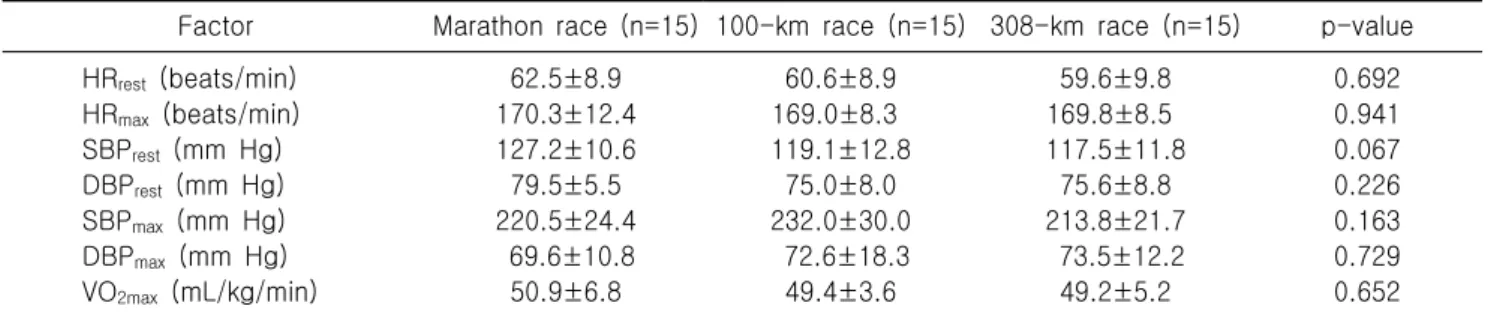
Factor Marathon race (n=15) 100-km race (n=15) 308-km race (n=15) p-value
Age (yr) 50.5±3.3 51.0±3.8 50.0±6.3 0.845
Height (cm) 167.0±4.8 169.3±3.9 167.9±5.7 0.434
Weight (kg) 62.1±3.3 64.9±5.2 65.7±5.5 0.109
BMI (kg/m
2) 22.2±0.9 22.6±1.7 23.3±1.3 0.084
Exercise history (yr) 12.2±0.9 10.3±6.8 10.8±4.6 0.881
Values are presented as mean±standard deviation.
BMI: body mass index.
Table 2. Hemodynamic and cardiorespiratory fitness in graded exercise test
Factor Marathon race (n=15) 100-km race (n=15) 308-km race (n=15) p-value
HR
rest(beats/min) 62.5±8.9 60.6±8.9 59.6±9.8 0.692
HR
max(beats/min) 170.3±12.4 169.0±8.3 169.8±8.5 0.941
SBP
rest(mm Hg) 127.2±10.6 119.1±12.8 117.5±11.8 0.067
DBP
rest(mm Hg) 79.5±5.5 75.0±8.0 75.6±8.8 0.226
SBP
max(mm Hg) 220.5±24.4 232.0±30.0 213.8±21.7 0.163
DBP
max(mm Hg) 69.6±10.8 72.6±18.3 73.5±12.2 0.729
VO
2max(mL/kg/min) 50.9±6.8 49.4±3.6 49.2±5.2 0.652
Values are presented as mean±standard deviation.
HR: heart rate, SBP: systolic blood pressure, DBP: diastolic blood pressure, VO
2max, maximal oxygen consumption.
검사를 통하여 안정 시와 운동 시 심박수, 혈압, 최대산소섭취량을 측정하였다. 체중과 신장은 인바디 720 (Biospace Co., Seoul, Korea) 으로 측정하였고, 체중(kg)을 신장(m)의 제곱으로 나눈 값으로 체질량지수를 계산하였다.
3. 혈액 채혈 및 분석
연구 대상자의 마라톤, 100 km, 308 km 울트라 마라톤에서의 생화학적 혈액성분 변화를 평가하기 위해 전주정맥(antecubital vein) 에서 Clinical and Laboratory Standards Institute (CLSI) 가이 드라인의 지침에 따라 표준화된 방법으로 채혈을 실시하였다.
혈액은 진공 채혈관(BD Vacutainer Serum Separate Tube)에 채혈 하여 3,400 rpm에서 10분간 혈청 분리 후 즉시 분석하였다. 총콜레 스테롤, HDL-C, LDL-C, 중성지방, 혈당을 Toshiba TBA-200FR NEO (Toshiba Medical Systems, Japan) 로 측정하였다. 각각의 분석방법은 총콜레스테롤, HDL-C, 중성지방은 enzymatic method 로, LDL-C는 liquid selective detergent assay로, 혈당은 hexokinase 법으로 측정하였으며, 마라톤, 100 km, 308 km 울트라 마라톤에서의 혈액분석은 동일한 검사자가 동일한 장비와 검사방 법으로 분석하였다. 검사의 정밀도 평가는 CLSI EP5-A2에 준하 여 정도관리물질(BioRad Lyphochek L1, L2)을 매일 하루에 2회씩 매검사마다 측정하였으며, 평균 coefficient of variation 값은 2.0%
(Beckman Coulter) 장비로 분석하였다. 혈장량 변화(plasma volume change) 는 Hematocrit와 Hemoglobin을 이용하여 산출하 였으며, 모든 혈액검사는 혈장량 변화율로 계산하여 보정하였다
16.
4. 자료 분석
자료처리방법은 IBM SPSS ver. 24.0 (IBM Corp., Armonk, NY, USA) 을 이용하여 대상자의 거리별 개인적 특성, 운동부하검 사 및 각각의 거리별 경기 전후의 혈액 변인의 차이 검증은 one-way analysis of variance 를 적용하여 처리하였다. 또한 통계적 으로 차이가 있을 경우 사후검증은 Tukey를 이용하였으며, 각각 의 경기 전후 혈액 변인의 차이 검증은 paired t-test를 실시하였다.
모든 연구결과는 평균과 표준편차로 기술하였으며, 통계적 유의 성 수준은 p<0.05로 설정하였다.
결 과
대상자의 신장, 체중, 체질량지수, 운동경력은 집단간(마라톤, 100 km, 308 km 울트라 마라톤) 비슷한 수준이었다(Table 1).
이들에게서 체력적인 차이를 검증하기 위해 운동부하검사를 실시
하였으며, 대상자 모두에게서 안정 시와 운동 시 심박수, 혈압에서
차이를 보이지 않았다. 또한 심폐체력의 지표인 최대 산소섭취량
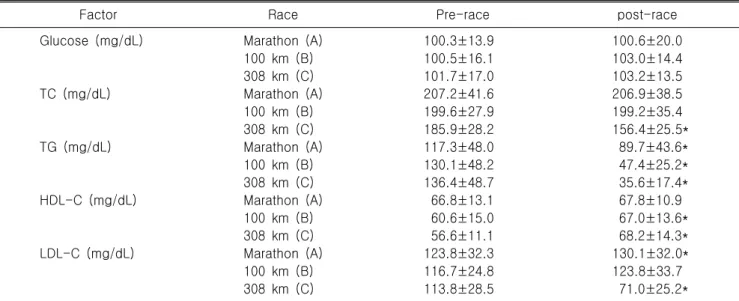
Table 3. Changes in blood glucose and lipid battery according to long distance race
Factor Race Pre-race post-race
Glucose (mg/dL) Marathon (A) 100.3±13.9 100.6±20.0
100 km (B) 100.5±16.1 103.0±14.4
308 km (C) 101.7±17.0 103.2±13.5
TC (mg/dL) Marathon (A) 207.2±41.6 206.9±38.5
100 km (B) 199.6±27.9 199.2±35.4
308 km (C) 185.9±28.2 156.4±25.5*
TG (mg/dL) Marathon (A) 117.3±48.0 89.7±43.6*
100 km (B) 130.1±48.2 47.4±25.2*
308 km (C) 136.4±48.7 35.6±17.4*
HDL-C (mg/dL) Marathon (A) 66.8±13.1 67.8±10.9
100 km (B) 60.6±15.0 67.0±13.6*
308 km (C) 56.6±11.1 68.2±14.3*
LDL-C (mg/dL) Marathon (A) 123.8±32.3 130.1±32.0*
100 km (B) 116.7±24.8 123.8±33.7
308 km (C) 113.8±28.5 71.0±25.2*
Values are presented as mean±standard deviation.
TC: total cholesterol, TG: triglyceride, HDL-C: high-density lipoprotein cholesterol, LDL-C: low-density lipoprotein cholesterol.
*Significantly different from the pre-race at p<0.05.
Fig. 1. Comparison of pre- and post-race glucose level difference by distance.
Fig. 2. Comparison of pre and post total cholesterol (TC) level difference by distance. Long-distance differences for the before and after difference in TC are shown in mar- athon (−0.2±10.2), 100 km (−0.4±1.1), and 308 km (−29.5±14.6). *Significantly different from marathon at p<
0.05;
†Significantly different from 100 km at p<0.05.
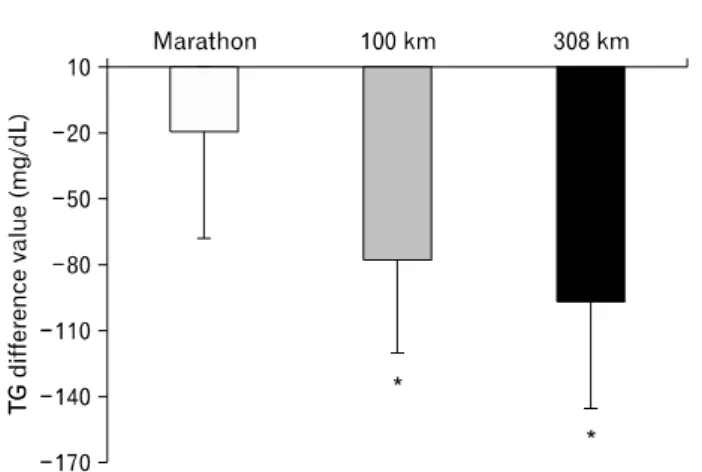
경기에 따른 혈당과 혈중 지질치의 경기 전후 변화는 Table 3에 나타난 바와 같으며, 혈당과 혈중 지질치의 경기 전후 차이에 대한 장거리 거리별 차이는 Figs. 1–5로 제시하였다. 혈당은 각각 의 경기 전후 차이가 없었으며, 전후 차이 값에 대한 거리별 차이도 없었다(marathon, 0.2±26.4; 100 km, 2.5±19.3; 308 km, 1.5±23.0) (Fig. 1). 총콜레스테롤은 마라톤과 100 km에서 전후 차이는 없었지만 308 km에서 유의하게 감소하였고(p<0.05) 전 후 차이 값에 대한 거리별 차이는 마라톤(–0.2±10.2)과 100 km ( –0.4±1.1)보다 308 km (–29.5±14.6)에서 유의하게 낮았다(각각 p <0.05) (Fig. 2). 중성지방은 마라톤, 100 km, 308 km에서 경기 전보다 후에 유의하게 감소하였으며(p<0.05), 전후 차이 값에
대한 거리별 차이는 마라톤(–27.6±46.6)보다 100 km (–82.7±40.2)
와 308 km (–100.8±46.4)에서 유의하게 낮았다(각각 p<0.05)
(Fig. 3). HDL-C 는 마라톤에서 경기 전후 차이는 없었으나 100
km 와 308 km에서 유의하게 증가하였으며(각각 p<0.05), 전후
차이 값에 대한 장거리 거리별 차이는 308 km (11.5±9.4)가 마라톤
(1.0±4.4) 과 100 km (6.3±6.2)보다 유의하게 높았다(각각 p<0.05)
(Fig. 4). LDL-C 는 마라톤에서 경기전보다 후에 유의하게 증가하
였고(p<0.05) 308 km에서는 유의하게 낮았으며(p<0.05), 전후
Fig. 3. Comparison of pre/post triglyceride (TG) level dif- ference by distance. Long-distance differences for the before and after difference in TGs are shown for marathon (−27.6±46.6), 100 km (−82.7±40.2), and 308 km (−100.8±
46.4). *Significantly different from marathon at p<0.05.
Fig. 4. Comparison of pre/post high-density lipoprotein cholesterol (HDL-C) level difference by distance.
Long-distance differences for the before and after differ- ence in HDL-C are shown for marathon (1.0±4.4), 100 km (6.3±6.2), 308 km (11.5±9.4). *Significantly different from marathon at p<0.05;
†Significantly different from 100 km at p<0.05.
Fig. 5. Comparison of pre/post low-density lipoprotein cholesterol (LDL-C) level difference by distance. Long distance differences for the before and after difference in LDL-C are shown for marathon (6.2±7.3), 100 km (7.1±17.3), 308 km (−29.8±10.8). *Significantly different from marathon at p<0.05;
†Significantly different from 100 km at p<0.05.
차이 값에 대한 거리별 차이는 308 km (–29.8±10.8)가 마라톤 (6.2±7.3) 과 100 km (7.1±17.3)보다 유의하게 낮았다(각각 p<
0.05) (Fig. 5).
고 찰
이 연구는 마라톤, 100 km, 308 km 울트라 마라톤 주행 거리별 경기 전후 혈당 및 지질대사의 변화를 평가하고자 하였다. 그 결과 총콜레스테롤, LDL-C는 경기 후 308 km에서 마라톤과 100 km 보다 감소하였으며, 중성지방은 마라톤보다 100 km와
100 km 보다 308 km 경기 직후 증가하였다. 또한 308 km는 마라톤과 100 km보다 총콜레스테롤, 중성지방, LDL-C의 감소폭 이 컸으며, HDL-C는 308 km에서 증가폭이 가장 크게 나타났다.
지구력 운동에 의한 생화학적 혈액변화는 선수의 체력수준, 운동 강도 및 시간, 운동형태에 따른 에너지 대사과정에 영향을 받으며, 운동 시 생화학적 혈액변화를 규명하는 것은 지구력 운동이 신체기관의 생리적 변화에 어떠한 영향을 미치는가를 이해하는데 중요하다
17. 선행연구를 통해 울트라 마라톤에 의해 골격근 손상과 더불어 간 및 신장기능의 손상 가능성이 제시되며, 혈액학적 지표 변화 및 염증반응과 같은 생리적 변화를 유발한다 고 보고된다
17-19. 극단적 지구력 운동에 의한 특징적인 대사반응으 로는 지방산화의 증가와 그와 관련된 혈중 지질지표의 뚜렷한 변화가 제시된다
9,11,20. 또한 트레이닝 기간이 길수록, 운동량이 많을수록 총콜레스테롤, 중성지방, LDL-C는 감소하는 반면 HDL-C 는 증가하는 것으로 보고된다
21.
일반적으로 운동에 의한 혈중 총콜레스테롤치의 변화는 운동
시간과 운동 강도에 비례하여 감소하는 것으로 알려져 있으나
22,
장거리 지구력 운동에서 총콜레스테롤치의 변화는 일관된 결과를
보이지 않는다. 총콜레스테롤은 l00 km와 1,600 km 울트라 마라톤
후 감소하는 반면, 마라톤 경기 후 증가하거나 변화가 없다는
결과가 보고된다
22-24. 본 연구결과에서 총콜레스테롤치는 308
km 울트라 마라톤에서 경기 전보다 경기 후 감소하였으며, 마라톤
과 100 km보다 308 km에서 전후 차이에 대한 유의한 감소폭을
보였다. 이러한 결과는 308 km의 장시간 운동이 체중과 체지방량
감소를 유발하여 부분적으로 혈중 콜레스테롤치 감소에 영향을
대부분의 지방은 근육과 지방세포에 중성지방으로 저장되며
8, 중성지방은 음식물 섭취, 특히 고지방식이에 의해 직접적인 영향 을 받는다
25. 마라톤, 24시간, 48시간 울트라 마라톤 경기 직후 중성지방은 현저한 감소를 보이며
8,20,24, 본 연구에서도 마라톤, 100 km, 308 km 울트라 마라톤 경기 직후 중성지방은 감소하였으 며, 감소폭은 마라톤보다 100 km와 308 km에서 3배 이상의 현저한 감소를 보였다. 이와 같은 결과는 100 km와 308 km 울트라 마라톤에 의해 중성지방이 내장 및 피하지방 조직에서 동원되어 지방분해효소(lipoprotein lipase [LPL])에 의해 유리지 방산(free fatty acid)으로 가수분해가 촉진되었기 때문이다
20,26.
24 시간, 48시간 울트라 마라톤에서 HDL-C는 변화가 없거나 상승하며, LDL-C는 감소하는 것으로 보고된다
8,27. 본 연구결과 HDL-C 는 308 km 울트라 마라톤 후 마라톤과 100 km보다 유의한 증가폭을 보였고, LDL-C는 마라톤과 100 km보다 308 km 울트라 마라톤 직후 유의한 감소폭을 보였다. Friedewald 공식에 의하면 [LDL-C= 중성지방–HDL-C–(중성지방/5)]로 정의하는데, 장거 리 달리기에 의한 LDL-C 감소는 총콜레스테롤과 중성지방의 감소, HDL-C의 유의한 증가에 의한 것을 확인할 수 있다
9. 특히, 장거리 마라톤일수록 LPL의 활성화로 탄수화물보다는 지방세포 내의 중성지방이 에너지원으로 사용되어 총콜레스테롤, 중성지 방, LDL-C는 감소시키고, HDL-C는 증가시켜 혈청지질에 긍정적 인 효과가 있는 것으로 생각된다
28.
또한 울트라 마라톤 후 HDL-C의 증가는 VLDL (very low-density lipoprotein)-C 가 지질단백질 LPL에 의해 HDL-C로 전환되었기 때문으로 추정된다
29. 그러나 운동에 의한 항지질 효과(antilipidemic effects)를 담당하는 메커니즘은 아직까지 뚜렷 하게 밝혀지지 않았으나, 지방산화와 관련된 LPL, PDK4 (pyruvate dehydrogenase kinase-4) 및 FOXO1 (forkhead transcription factor O1) 의 발현 증가와 관련이 있다고 보고된다
12. 향후 울트라 마라톤에서의 지질대사에 대한 기전을 확립하기 위해 단백질 및 유전자 발현에 대한 추가적인 연구가 필요할 것으로 생각된다.
장기간의 격렬한 운동은 근육과 뇌에 에너지를 공급하기 위해 탄수화물을 필요로 한다
21. 신체의 탄수화물 저장량은 제한되어 있기 때문에 탄수화물의 적절한 섭취가 지구력 운동 선수들에게 중요하다
30. 이 연구에서 마라톤, 100 km, 308 km 경기 전후 혈당치는 유의한 변화가 없었으며, 이는 대회 중 탄수화물 공급이 충분하다는 것을 의미한다.
이 연구는 혈당 및 지질지표에 대한 장거리 마라톤(마라톤, 100 km, 308 km) 의 영향을 규명하였으며, 장거리 마라톤 거리별 혈당 및 지질지표의 변화를 확인한 선행연구가 부족하여 연구결
과를 구체적으로 비교하여 논의할 수는 없었다. 결론적으로 마라 톤과 100 km 울트라 마라톤과 비교해 308 km 울트라 마라톤은 총콜레스테롤, 중성지방과 LDL-C의 감소와 HDL-C의 증가에 긍정적인 영향을 미치는 것으로 나타났다. 마라톤은 시속 10 km/hr (5 시간 이내) 고강도, 100 km 울트라 마라톤은 7–8 km/hr (15 시간 이내) 중강도, 308 km 울트라 마라톤은 4.4 km/hr (64시간 이내) 저강도로 달리며, 308 km 울트라 마라톤이 지질대사에 가장 긍정적인 것으로 나타나 운동 강도보다는 운동시간이 지질 대사에 영향을 미치는 것으로 나타났다. 이 연구는 다음과 같은 제한점이 있다. 첫째, 마라톤, 100 km, 308 km 울트라 마라톤에 출전한 대상자들의 개인적 특성은 비슷했지만 제공된 식사와 음료, 대회출발 시간대가 달랐으며, 온도, 습도와 같은 환경요인은 통제하지 못했다. 둘째, 또한 회복기 동안의 생화학적 변인의 변화는 비교하지 못하였다. 그러나 이 연구는 3가지 종류의 장거 리 달리기에서 혈당 및 지질지표를 비교한 최초의 연구라는 데 의의가 있다.
Conflict of Interest
No potential conflict of interest relevant to this article was reported.
ORCID
Kyung-A Shin https://orcid.org/0000-0001-5266-5627 Young-Joo Kim https://orcid.org/0000-0001-9379-656X
References