THE HAND
Hand Injury Patterns Caused by Different Electric Saws in South Korea
Woongkyu Choi, Joonhyon Kim, Youngjoon Kim, Sanghyun Nam, Youngwoong Choi
Department of Plastic and Reconstructive Surgery, Sanggye Paik Hospital, Inje University College of Medicine, Seoul, Korea
Received: December 2, 2015 Revised: [1] March 3, 2016 [2] March 8, 2016 Accepted: March 12, 2016
Correspondence to: Youngjoon Kim Department of Plastic and Reconstructive Surgery, Sanggye Paik Hospital,
Inje University College of Medicine, 1342 Dongil-ro, Nowon-gu, Seoul 01757, Korea TEL: +82-2-950-1048
FAX: +82--932-6373 E-mail: [email protected]
* This article was presented as a free paper at the 71st International Congress of the Korean Society of Plastic and Reconstructive Surgeons on November 1-3, 2013 in Seoul, Korea.
This is an Open Access article distributed under the terms of the Creative Commons Attribution Non-Commercial License (http://creativecommons.org/licenses/bync/
3.0/) which permits unrestricted noncommercial use, distribution, and reproduction in any medium, provided the original work is properly cited.
Purpose: Electric saw is widely used and patients involved with the tool are in- creasing. We made efforts to analyze data of saw-related hand injuries.
Methods: Electric saw-related hand injuries that required operation were ana- lyzed retrospectively by reviewing medical charts, clinical photographs and X- ray films from 2009 through 2013. Additionally, we interviewed patients regard- ing the type of electric saw involved (hand-held/table-mounted) and how the hand was injured.
Results: There were 16 male patients with 19 injured fingers and 22 injured ten- dons. Due to the damaging mechanism of the electric saw, injuries were severe and complex such as tendon, bone defects, fractures and amputations. 4 fingers had open fractures. Separately, 4 were amputated. Non-dominant hands were injured more by hand-held saw, while, dominant hands were damaged more by table-mounted saw. The thumb and index fingers were injured mostly by elec- tric saw. Probability of dominant and non-dominant hand injury depends on the types of electric saw because of the working position when using this tool.
Conclusion: Hand injuries can be classified according to the type of electronic saw used. Complete understanding of a specific trauma mechanism and the resulting injury patterns is important especially for hand surgeons. Surgeons should take into account the type of electric saw when examining patients.
However, the most important step to prevent these types of injuries is to provide all workers with appropriate training and precautions before using the electric saw.
Keywords: Finger injuries, Tendon injuries, Rupture, Electric saw J Korean Soc Surg Hand 2016;21(1):38-44.
http://dx.doi.org/10.12790/jkssh.2016.21.1.38
INTRODUCTION
An electric saw is a machine that uses a toothed metal cutting disc or blade1. It is an instrument used for cutting wood or other materials and can be classified as either hand-held or table-mounted. In the United States, almost 100,000 people per year seek medical care for trauma
from professional and recreational use of electric table- mounted and hand-held saws2. The data available from the Consumer Product Safety Commission’s Hazard Screening Report indicate traumas from electric saws are not uncommon3. As ripping and tearing are the primary mechanisms of injury generated by electric saws3,4, types of injuries due to the tool could differ from other types
of injury, such as cutting. Injuries resulting from contact with an electric saw are usually severe5,6. To the best of our knowledge, there have been no data analysis on elec- tric saw-related hand injuries in the Republic of Korea.
This study describes the injury patterns and features of electric saw-related hand injuries.
MATERIALS AND METHODS
Any case involving a hand injury from an electric saw that required operation was included in this study. Op- erations were needed in cases of tendon, vessel, nerve injuries, fractures, and amputations. Electronic medi- cal records, clinical photographs and X-ray films for the years 2009 through 2013 were reviewed. Exclusion crite- ria included patients with a simple laceration of the hand and minimal skin defects. Detailed information relating to the nature of the activities (e.g., home/professional activities); characteristics of the saws involved (e.g., type of the saw); characteristics of the cutting material; work- ing activities of the patients prior to/at the time of the incident (e.g., position of the hand); and dominant hand of the patients, was gathered. Information on the cutting direction (longitudinal direction from the front, direction at right angles to the finger axis) was reconstructed ac- cording to the patient interviews and the documentation in the medical records, clinical photographs and X-rays.
RESULTS
Nineteen injured fingers of 16 patients were surgically treated for hand injuries due to electric saw during the period from January 2009 to August 2013. Age ranged be- tween 37 and 71 years, with a mean age of 54 years. All of the 16 patients were male and only one was left handed.
All injuries occurred during professional activities, saw- ing wood (Table 1).
Among 19 injured fingers, thumb and index finger ac- counted for almost 70% (n=13) (Fig. 1). Table 2 shows the counts of the injured structures. The 19 affected fingers were composed of 22 damaged tendons. There were 14 (63.6%) extensor tendon injuries and 8 (36.4%) flexor ten-
don injuries. Cases involving injury of both extensor and flexor tendons at the same time were usually caused by amputations, except 1 case. Not uncommonly, patients had complex injuries such as 7 tendon defects, 4 open fractures, 3 bone defects, and 4 amputations (Table 2).
Our patients could be separated into 2 groups accord- ing to type of electric saw - one the portable, hand-held type, and the other the fixed, table-mounted type. Table 3 summarizes the injured structures depending on domi- nant and fingers induced by type of electric saw. Non- dominant hand injuries were significantly more common with hand-held type saw (n=8, 80%) compared to table- mounted type saw (n=1, 17.7%) (Table 3).
10 8 6 4 2 0
Thumb Index Middle Ring Little
Fig. 1. Thumb and index fingers were more injured than other fin- gers. 3 patients injured multiple fingers.
Table 1. Demographical characteristics of the patients Characteristic
Sex Male Female Age Mean Range Injured hand Right Left Injured fingers Right Left Dominant hand Right Left Injury history Occupation Hobby
16 0 54 37–71
6 10 7 12 15 1 16 0
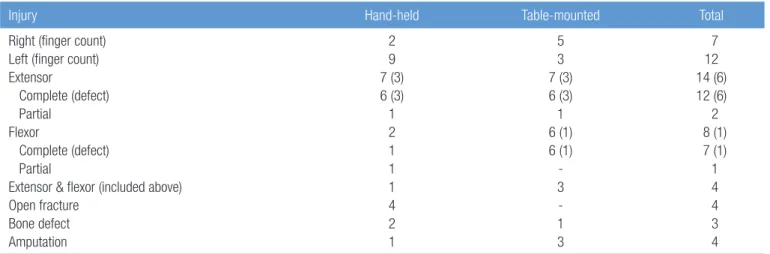
Extensor tendon was the main victim of the hand-held saw compared to the table-mounted type. Relative to the number of injured fingers, the flexor tendon injury rate was higher for the table-mounted type (n=6, 46.2%) than
for the hand-held type (n=2, 22.2%). Besides, amputation occurred 3 times more with the table-mounted saw than the hand-held saw (Table 4).
Table 2. Categorization of injury types
Injury Thumb Index Middle Ring Little Total
Right (finger count) Left (finger count) Tendon
Extensor
Complete (defect) Partial
Flexor
Complete (defect) Partial (defect)
Extensor & flexor (included above) Open fracture
Bone defect Amputation
1 4 6 3 3 (2)
- 3 3 (1) - (3) 1 - - 1
4 4 7 6 4 (2)
2 1 - 1 (2)
1 3 1 -
2 1 1 1 1 (1)
- - - - (1)
- 1 1 1
- 2 4 2 2 (1)
- 2 2 - (1)
1 - 1 1
- 1 4 2 2 - 2 2 - 1 - - 1
7 12 22 14 12 (6)
2 8 7 (1) 1 (7) 4 4 3 4
Table 3. Distribution of injured finger of hand-held and table-mounted electric saw injuries
Thumb Index Middle Ring Little Total Patient count
Hand-held Dominant Non-dominant Total Table-mounted Dominant Non-dominant Total
- 3 3 2 - 2
2 4 6 2 - 2
- 1 1 2 - 2
- 1 1 - 1 1
- - - - 1 1
2 9 11 6 2 8
2 8 10 5 1 6
Table 4. Comparison of hand-held and table-mounted electric saw injuries
Injury Hand-held Table-mounted Total
Right (finger count) Left (finger count) Extensor
Complete (defect) Partial
Flexor
Complete (defect) Partial
Extensor & flexor (included above) Open fracture
Bone defect Amputation
2 9 7 (3) 6 (3) 1 2 1 1 1 4 2 1
5 3 7 (3) 6 (3) 1 6 (1) 6 (1) - 3 - 1 3
7 12 14 (6) 12 (6) 2 8 (1) 7 (1) 1 4 4 3 4
DISCUSSION
Since the electric saw was invented around mid-19th century, it has been widely used in home/professional activities2,7. According to the U.S. Consumer Product Safety Commission, 64,100 injuries involving electric saws were reported in 2001. Half of these injuries were associated with table-mounted type saws, another 10,584 with hand-held type saws5,6. Also in Korea, activities us- ing electric saw are common and increasing, and how- ever, there are no data on injuries caused by electric saw.
Therefore, we analyzed data on hand injuries due to the use of the power tool.
All 16 victims of this study were male and the users of the electric saw, not bystanders. This is owing to the character of the work that it is still thought to be difficult for females to use electronic saws in Korea. In a study by Frank et al.5, 75.4% (n=86) of incidents occurred at home during do-it-yourself activities, while 24.6% (n=28) of in- cidents occurred at work while the victim was on duty or during professional activities. By contrast, in the current study, all victims were injured during professional activi- ties. This condition originates from the dwelling place of people in a city of Korea, as the majority of Korean citizens reside in apartments or row houses which do not have workshops. Even when dwelling in a detached house, residents seldom possess an electric saw.
According to our data, there were about twice as many extensor tendons injuries as flexor tendon injuries, and tendon defect of extensor tendon occurred more often than that of flexor tendons. Considering the anatomy of the hand, the volar side, on which the flexor tendon is situated, has more soft tissues than the dorsal side of the hand. Besides, while grabbing an object, flexor tendons are located in the clenched fist, but extensor tendons are located on the dorsal aspect. Consequently, the extensor tendons are more likely to be injured. Interestingly how- ever, among 22 tendon injuries, only 1 extensor tendon of middle finger was injured. We suppose that the result is due to the location of the middle finger, which is situated third in order and has the inevitable protection from the other fingers. On the other hand, Frank et al.5 reported
that middle fingers were mainly involved in cases of si- multaneous injury to three fingers. In this study, tendon defects accounted for 31.8% of cases with tendon injuries and bone injury cases accounted for 43.8%. The results of hand injuries due to electric saw tend to be more com- plex because of the primary injury mechanism3,4. Thus, the wound margins were irregular and dirty, and the tendons had a tendency to be completely ruptured or de- fected rather than partially ruptured. Fractures and bone defect injuries were not unusual. Therefore, appropri- ate procedures such as tendon or bone grafts should be prepared before the operation. In addition, Frank et al.5 suggested that a thorough understanding of the specific trauma mechanisms and resulting injury patterns is im- perative for surgeons.
Bonte et al.8 reported 15 slight bone lesions (8%) among 188 finger injuries caused by chain saw. However, in our data 37% (7 bone injury cases among 19 fingers) were bone injuries such as bone defect or open fracture. Com- pared to Bonte’s study, our data indicate that bones in- juries are likely to be caused by an electric saw. Hoxie et al.3 also reported that bone damage such as comminuted fractures frequently occurs by rotating power-saw blades.
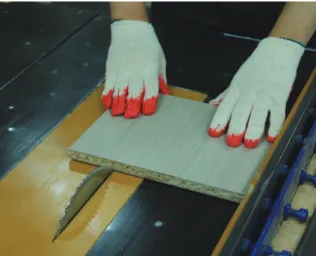
The different results between Bonte’s study and those of our study are due to the type of electric saw. The patients of Bonte et al. used a chain saw, which does not have ro- tating blades like ours. Besides, when operating a chain saw, patients of Bonte need not grab the cutting materials because the chain saw is held by both hands. Whereas in our study, the non-dominant hand is grabbing the cut- ting material while using a hand-held type saw, and both hands are pushing the object into the saw blade when op- erating a table-mounted saw (Figs. 2, 3). Therefore, when encountering severe hand injuries caused by an electric saw, X-ray work up is indispensable and preparation of bone surgery with adequate equipment is required.
In Hoxie’s study, 85% (n=114) of injured hands were the non-dominant3. Data were collected regardless of the saw type. Categorizing the injured hands according to the type of electric saw revealed interesting features. Injuries of flexor tendon and dominant hand tended to occur more frequently by table-mounted electric saw than by
hand-held one. By contrast, compared to table-mounted type, non-dominant hand and extensor tendon injury ra- tios are higher in hand-held type. Frank et al. investigated accidental circular saw (hand-held type) injuries. Of 50 injuries affecting one finger only, the injury location was in descending order as follows: thumb (24 injuries), in- dex finger (14 injuries)5. In the current study, regarding only the hand-held type cases, the injury location was as follows: thumb (3 injuries), index finger (6 injuries). The thumb and index finger represented a majority of the in- juries, with 76% for the former and 82% for the latter5.
This clinical feature is associated with the operating
posture. With hand-held saws, the operator holds the saw with the dominant hand and holds the object with the non-dominant hand (Fig. 2). Frank et al.5 suggested the same reason for the susceptibility to injuries of the non- dominant hand. On that ground, the non-dominant hand has a greater chance of being injured. In addition, be- cause the saw blade approaches the dorsum of the non- dominant hand holding the object, damage to extensor tendons tends to occur.
By contrast, with the table-mounted saw, both un- clenched hands push the object toward the fixed saw blade (Fig. 3). As a result, there are more cases of injured dominant hands, which are used mainly while managing of the saw. Also, flexor tendon injury ratio is higher than that of hand-held saw. Frank et al.5 suggested that both dominant and non-dominant hands are at risk while op- erating a table-mounted saw. However, he did not grant more susceptibility of damage to either hand.
In our study, one patient had two amputated fingers, and the vessels were damaged extensively by a table- mounted saw. The traction-type injury to the nerves and vessels results in longitudinal damage that extends beyond the original area of laceration, making microvas- cular replantation highly challenging for most competent microsurgeons3. Ultimately, replantation was not suc- cessful.
In this study, the patients were injured while grabbing the objects being sawed, grabbing the electric saw han- dle, stopping the blade, and pushing the turn-off button of the electric saw. In 5 cases, the patient’s gloves were caught in the saw. Frank et al.5 also reported those kinds of cases. Some patients were injured due to a defect in protective gear. Considering such injury modes, careless handling was the main reason for injury.
The limitations of this study are the small number of pa- tients and lack of a multicenter study. Further evaluation of hand injuries by electric saws and their consequences will be required, and efforts to establish treatment plans are necessary.
In Korea, the electric saw is mainly used by mid to old aged males. Therefore the majority of victims of electric saw injuries are male. Thumbs and index fingers are eas- Fig. 2. Typical hand position while operating a table-mounted
saw. We can expect the dominant hand, grabbing an object, to be injured.
Fig. 3. Typical hand position while operating a hand-mounted saw. We can expect the non-dominant hand, which is pushing the object, to be injured.
ily injured compared to other fingers. Due to the anatomy of the hand, extensor tendons tend to be damaged rather than flexor tendons. Probability of dominant and non- dominant hand injury depends on two different types of electric saw. Because of the injury mechanism of the tool, complex injuries such as open fractures, bone defects, and amputations are frequent. Therefore, precise preop- erative evaluation and preparation is mandatory.
The most important step to prevent these types of in- juries is to provide all workers with appropriate training and precautions before using the electric saw. Before us- ing hand-held type electric saws, users should be educat- ed and warned of the injury of the non-dominant hand, and especially the dorsal aspect of the thumb or the index finger. Since the material is held in place with the non-dominant hand, and the saw is pushed down during the procedure, direct visualization of the material and the saw should be advised at all times. Likewise, table- mounted saw users should be informed about the injury of the ventral aspect of either hands. Instead of using the worker’s hands, it seems reasonable to use a solid buffer- ing material to push the material into the table-mounted saw to prevent primary injury of the hand. Also, materials should be held firmly bilaterally to prevent any sliding of the material during the process. Most importantly, all workers should be fully rested before any procedure to prevent fatigue from causing injury.
Conclusion
In conclusion, hand injuries can be divided according to the type of electronic saw used by the handler. Hand- held type saw users suffered from non-dominant hand injuries with more frequent extensor tendon injuries than the table-mounted saw users. On the other hand, flexor tendon injury was higher in the table-mounted saw users. Additionally, longitudinal injury or an injury with
gloves can be challenging to repair microscopically. Our study is the first study performed in Korea on electronic saw related hand injuries. Complete understanding of a specific trauma mechanism and the resulting injury pat- terns is important especially for hand surgeons, because of the complex anatomy of the hand and the irregularity of saw-related injuries. We hope our study will prove to be beneficial when treating saw injuries in South Korea.
REFERENCES
1. US Forest Service, Missoula Technology & Development Center. Chain saw and crosscut saw training course: stu- dent’s guidebook 2006 edition. Missoula: USDA; 2006.
2. Shields BJ, Wilkins JR 3rd, Smith GA. Nonoccupational table saw-related injuries treated in US emergency depart- ments, 1990-2007. J Trauma. 2011;71:1902-7.
3. Hoxie SC, Capo JA, Dennison DG, Shin AY. The economic impact of electric saw injuries to the hand. J Hand Surg Am. 2009;34:886-9.
4. Starnes T, Saunders RJ, Means KR Jr. Clinical outcomes of zone II flexor tendon repair depending on mechanism of injury. J Hand Surg Am. 2012;37:2532-40.
5. Frank M, Lange J, Napp M, Hecht J, Ekkernkamp A, Hinz P. Accidental circular saw hand injuries: trauma mecha- nisms, injury patterns, and accident insurance. Forensic Sci Int. 2010;198:74-8.
6. Marcy N, Rutherford G, Mills A. Hazard screening report:
power tools and workshop equipment [Internet]. U.S.
Consumer Product Safety Commission. 2003 [cited 2016 Mar 14]. Aailable from: https://www.cpsc.gov/PageFiles/
106093/2003h054.pdf.
7. US Consumer Product Safety Commission. Briefing pack- age: petition for performance standards for table saws [In- ternet]. Bethesda: US Consumer Product Safety Commis- sion; 2006 [cited 2008 Nov 25]. Available from http://www.
cpsc.gov/LIBRARY/FOIA/FOIA06/brief/tablesaw.pdf.
8. Bonte W, Schroter F, Goldberg R. Injuries caused by acci- dents with chain saws. Z Rechtsmed. 1984;92:215-23.
한국에서의 전기톱으로 인한 수부 손상에 대한 자료 분석
최웅규·김준현·김영준·남상현·최영웅
인제대학교 부속 상계백병원 성형외과
목적: 병원에 내원하는 성형외과 환자 중 전동 톱 작업 중 수상한 자의 수가 증가하는 추세이다. 본 논문에서는 전동 톱 과 관련된 수부 손상에 대한 자료를 조사했다.
방법: 전동 톱 사용 중 발생한 수부 손상 중 수술이 시행되었던 환자들의 의무기록, 임상 사진, 방사선 사진을 2009년부 터 2013년 동안 후향적으로 분석하였다. 또한, 수상 기전 및 사용되었던 전동 톱의 종류에 대하여 환자들에게 설문 조사 를 실시하였다.
결과: 손으로 들고 사용하는 전동 톱으로는 주로 사용하지 않는 손을 수상하였고, 탁자에 고정되어 있는 전동 톱에는 주 로 사용하는 손을 수상하였다. 전동 톱에 의해 엄지손가락과 검지 손가락을 가장 빈번히 수상하였으며, 주로 사용하는 손가락 수상 여부는 사용한 전동 톱의 종류에 의해 결정되었다.
결론: 전동 톱에 의한 수부 손상은 사용한 톱의 종류에 따라 세분화할 수 있다. 수부외과 의사들은 수상기전 및 손상되 는 정도의 차이를 숙지해야 한다. 그러므로, 전동 톱으로 수상한 환자에 대한 신체검진을 시행할 때, 반드시 어떤 종류의 톱을 사용하였는지 확인하는 것이 중요하다. 전동 톱에 의한 수상을 줄이기 위해서는 무엇보다도 작업자의 사용 전 교 육 및 훈련이 필요하며, 사용자가 주의를 하는 게 가장 중요하다.
색인단어: 수부 손상, 인대 손상, 파열, 전동 톱
접수일 2015년 12월 2일 수정일 1차: 2016년 3월 3일, 2차: 2016년 3월 8일 게재확정일 2016년 3월 12일
교신저자 김영준
서울시 노원구 동일로 1342
인제대학교 상계백병원 성형외과 3층 외래 TEL 02-950-1048 FAX 02-932-6373 E-mail [email protected]
*본 논문은 대한성형외과학회 국제학회에서(2013년 11월) 구연 발표하였습니다.