Impact of preoperative management in patients older than 80 years requiring cholecystectomy
Da-Kyum Shin1, Seok-Hwan Kim1,2, Deok-Bog Moon1, Shin Hwang1, Ki-Hum Kim1, Chul-Soo Ahn1, Tae-Yong Ha1, Gi-Won Song1, Dong-Hwan Jung1, Ki-Byung Song3,
Dae-Wook Hwang3, Song-Cheol Kim3, and Young-Joo Lee3
1Division of Hepatobiliary Surgery and Liver Transplantation, Department of Surgery, Asan Medical Center, University of Ulsan College of Medicine, Seoul, 2Division of Hepatobiliary Surgery and Liver Transplantation, Department of Surgery, Chungnam National University Hospital, Chungnam National University of College of
Medicine, Daejeon, 3Division of Hepatobiliary and Pancreatic Surgery, Department of Surgery, Asan Medical Center, University of Ulsan College of Medicine, Seoul, Korea
Backgrounds/Aims: Elderly patients aged >80 yr have high morbidity and mortality rates after biliary surgery, especially in emergency operations. We conducted this study to determine the effect of preoperative management on the outcome of elderly patients undergoing cholecystectomy. Methods: The medical records of 452 elderly (≥80 yr old) patients who underwent cholecystectomy from January 1997 to December 2015 were reviewed retrospectively. We divided the patients into 2 groups: intervention (preoperative biliary drainage) and non-intervention groups. We evaluated the ef- fects of preoperative management on the American Society of Anesthesiology (ASA) score and perioperative outcomes.
Results: Among the preoperative biliary drainage intervention group (n=286), 48 patients (51.7%) were diagnosed as having gallbladder stone combined with common bile duct stone. On admission, the proportion of patients with ASA score ≥3 and WBC counts were significantly higher in the intervention group than in the non-intervention group (p
<0.05). The preoperative hospital stay was longer in the intervention group; however, operation-related factors such as operation type, time, conversion rate, complications, and mortality showed no difference between groups.
Conclusions: With proper preoperative evaluations and preoperative biliary drainage, cholecystectomy can be a safe treatment option for elderly patients with cholelithiasis. (Ann Hepatobiliary Pancreat Surg 2018;22:380-385)
Key Words: Aged; Cholecystectomy; Preoperative care; ASA score
Received: August 18, 2018; Revised: October 22, 2018; Accepted: October 23, 2018 Corresponding author: Seok-Hwan Kim
Division of Hepatobiliary Surgery and Liver Transplantation, Department of Surgery, Chungnam National University Hospital, Chungnam National University of College of Medicine, 282 Munhwa-ro, Jung-gu, Daejeon 35015, Korea
Tel: +82-42-280-7175, Fax: +82-42-280-8024, E-mail: [email protected]
Copyright Ⓒ 2018 by The Korean Association of Hepato-Biliary-Pancreatic Surgery
This is an Open Access article distributed under the terms of the Creative Commons Attribution Non-Commercial License (http://creativecommons.org/
licenses/by-nc/4.0) which permits unrestricted non-commercial use, distribution, and reproduction in any medium, provided the original work is properly cited.
Annals of Hepato-Biliary-Pancreatic Surgery ∙ pISSN: 2508-5778ㆍeISSN: 2508-5859
INTRODUCTION
The prevalence of cholelithiasis increases with age, and among patients aged ≥80 yr, prevalence rates as high as 38% to 53% have been reported.1,2 Biliary tract disease is the single most common cause of acute abdominal com- plaints and accounts for approximately one-third of all ab- dominal operations in the elderly.3 An increased incidence of common bile duct (CBD) stones is also associated with advanced age.4 Elderly patients frequently have significant comorbid diseases and limited functional reserve, which may increase the perioperative mortality rate from 1.5%
in patients with no concomitant diseases to 6.1% in pa-
tients with >3 additional conditions.5 Emergency chol- ecystectomy without proper preoperative management of comorbidities and acute inflammation also significantly increases the mortality rate from 2% to 10%.6,7 At our in- stitution, most elderly patients with gallstones undergo elective cholecystectomy after a thorough preoperative evaluation and management of comorbid disease and CBD stones, as a means of reducing perioperative complication and mortality. We apply the American Society of Anesthesiologists (ASA) score for evaluating the pre- operative health of elderly surgical candidates before the operation. It is known that the ASA score has a strong association with postoperative morbidity and mortality.8
We conducted this study to know how much preoperative management affects the outcome of elderly patients under- going cholecystectomy.
MATERIALS AND METHODS
A total of 452 patients age >80 yr who underwent cholecystectomy for biliary tract disease from January 1997 to December 2015 were included in the study.
Patients who underwent incidental cholecystectomy were excluded.
Information obtained from database and hospital re- cords were used to gather the patients’ demographic details. Preoperative, operative, and postoperative data were collected through a review of case notes. These data included level of urgency on admission, location of biliary stones based on clinical and radiologic assessments, pre- operative comorbidities and managements, changes in ASA score and leukocyte counts between the time of ad- mission and before the operation, type of operation ac- cording to urgency and operation method, need for con- version to an open procedure, and postoperative compli- cations.
Preoperative assessments for biliary stones included ab- dominal ultrasonography (US), CT, and/or magnetic reso- nance cholangiography (MRC) for hypersensitive patients.
Preoperative endoscopic retrograde cholangiopancreatog- raphy (ERCP) and consequent endoscopic nasobiliary drainage (ENBD) were performed in patients suspected to have CBD stones or other bile duct etiologies based on imaging evaluations and liver function tests. Patients with acute cholecystitis but not responding to antibiotics under- went percutaneous cholecystostomy (PTGBD) to reduce inflammation and improve surgical performance. Percu- taneous transhepatic biliary drainage (PTBD) was per- formed in patients who were unable to go through ERCP due to previous operation history such as gastrectomy and unstable vital sign. Cardiopulmonary workups including echocardiography, thallium scan, and pulmonary function test (PFT) were performed before the operation, with echocardiography and PFT being mandatory for all patients. Routine intraoperative cholangiography was not applied. Clinical assessment was performed by the attend- ing surgeon and, when necessary, the attending anesthe- tist. Specific outcomes were assessed in terms of any
change in the patients’ urgency and ASA score between admission and operation day, as well as differences in out- comes according to preoperative biliary drainage.
Statistical analysis was performed using SPSS for Windows release 11.0.0 (SPSS, Chicago, IL, USA).
Differences between groups were determined using 2 and Fisher’s exact test for categorical variables. Continuous variables were expressed as mean±SD, and comparisons between means were done using Student’s t-test. A p-val- ue of <0.05 was considered significant.
This study was approved by the institutional review board in Asan Medical Center (2018-0032).
RESULTS
The demographic characteristics of the patients are shown in Table 1. The mean patient age was 82.81±2.70 yr and 82.60±2.61 yr in the intervention (preoperative biliary drainage) and non-intervention groups, respectively (p=0.431). The proportion of male patients was 47.6%
(n=136) and 42.2% (n=70) each in the 2 groups (p=0.268). There were 228 (79.7%) and 64 (38.6%) pa- tients who were admitted to the hospital via the emer- gency department in the intervention and non-intervention groups, respectively (p=0.000). The diagnostic process of preoperative imaging evaluation and cardiopulmonary workup showed no significant difference between the 2 groups (p=0.453 and p=0.275).
Preoperative diagnosis showed statistical differences between the 2 groups (Table 1). A total of 148 (51.7%) patients in the intervention group had gallbladder and CBD stones combined, and 7 (4.2%) patients in the non-intervention group had gallbladder stone with CBD stone (p=0.000). There were 118 (41.3%) patients in the intervention group and 31 (18.7%) patients the in non-in- tervention group (p=0.007) who had ASA score >3.
WBC counts were significantly higher in the intervention group (11.38×10³) than in the non-intervention group (7.96×10³) on admission (p=0.000). However, there was no statistical difference in WBC count between the 2 groups at the time of the operation.
Within the intervention group, endoscopic nasobiliary drainage tube insertion was performed in 162 patients (57.4%) and percutaneous transhepatic gallbladder drain- age tube insertion in 115 (48.2%) patients preoperatively
Table 2. Types of preoperative interventional approach in the intervention group
No. of patients
(n=286) Percentage
ENBD 140 49.6%
PTGBD 115 40.8%
PTBD 5 1.8%
ENBD+PTGBD 21 7.4%
ENBD+PTBD 1 0.4%
ENBD, endoscopic nasobiliary drainage; PTGBD, percuta- neous transhepatic gallbladder drainage; PTBD, percutaneous transhepatic bile drainage
Table 1. Characteristics of patients
Preoperative intervention
p-value Yes (n=286) No (n=166)
Age (yr) 82.81±2.70 82.60±2.61 0.431 Sex (male) 136 (47.6%) 70 (42.2%) 0.268
Admission 0.000
ER 228 (79.7%) 64 (38.6%)
OPD 58 (20.3%) 102 (61.4%)
Preoperative imaging evaluation 0.453 Ultrasonography 179 (62.6%) 127 (76.5%)
CT 278 (97.2%) 145 (87.3%)
MRCP 56 (19.6%) 48 (28.9%)
Preoperative workup 0.275
Echocardiography 286 (100%) 166 (100%) Normal 176 (61.5%) 103 (62.0%) Pulmonary
function test
273 (95.5%) 155 (93.4%)
Normal 82 (28.7%) 63 (38.0%) Thallium 230 (80.4%) 129 (77.7%)
Normal 212 (74.1%) 116 (69.9%)
Preoperative diagnosis 0.000
GB stone 106 (37.1%) 112 (67.5%) GB+CBD stone 148 (51.7%) 7 (4.2%)
Polyp 1 (0.3%) 4 (2.4%)
Malignancy 13 (4.5%) 34 (20.5%) Acalculous
cholecystitis
18 (6.3%) 9 (5.4%)
Comorbidity 0.727
Yes 238 (83.2%) 136 (81.9%)
No 48 (16.8%) 30 (18.1%)
ASA score (≥3) 0.007
Admission 118 (41.3%) 31 (18.7%) Operation 46 (16.1%) 12 (7.2%) WBC count
Admission 11.38×10³ 7.96×10³ 0.000 Operation 6.92×10³ 6.39×10³ 0.521 ER, emergency room; OPD, outpatient department; MRCP, magnetic resonance cholangiopancreatography; GB, gall- bladder; CBD, common bile duct; ASA, American Society of Anesthesiology
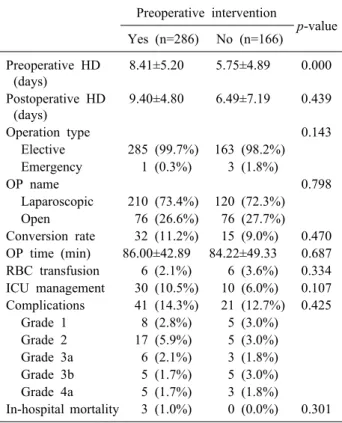
Table 3. Postoperative outcomes
Preoperative intervention
p-value Yes (n=286) No (n=166)
Preoperative HD (days)
8.41±5.20 5.75±4.89 0.000
Postoperative HD (days)
9.40±4.80 6.49±7.19 0.439
Operation type 0.143
Elective 285 (99.7%) 163 (98.2%) Emergency 1 (0.3%) 3 (1.8%)
OP name 0.798
Laparoscopic 210 (73.4%) 120 (72.3%)
Open 76 (26.6%) 76 (27.7%)
Conversion rate 32 (11.2%) 15 (9.0%) 0.470 OP time (min) 86.00±42.89 84.22±49.33 0.687 RBC transfusion 6 (2.1%) 6 (3.6%) 0.334 ICU management 30 (10.5%) 10 (6.0%) 0.107 Complications 41 (14.3%) 21 (12.7%) 0.425
Grade 1 8 (2.8%) 5 (3.0%)
Grade 2 17 (5.9%) 5 (3.0%) Grade 3a 6 (2.1%) 3 (1.8%) Grade 3b 5 (1.7%) 5 (3.0%) Grade 4a 5 (1.7%) 3 (1.8%)
In-hospital mortality 3 (1.0%) 0 (0.0%) 0.301 HD, hospital days; OP, operation; ICU, intensive care unit
(Table 2).
The postoperative outcomes are shown in Table 3. The preoperative hospital stay duration was longer in the inter- vention group than in the non-intervention group (8.41±5.20 vs. 5.75±4.89 days, p=0.000); however, the postoperative hospital stay duration was not statistically different between the 2 groups (9.40±4.80 vs. 6.49±7.19 days, p=0.439). A total of 285 (99.7%) patients in the in- tervention group and 163 (98.2%) patients in the non-in- tervention group underwent elective surgery (p=0.140).
Only 1 (0.3%) patient in the intervention group and 3
(1.8%) patients in the non-intervention group underwent emergency surgery. Laparoscopic cholecystectomy was performed in 210 (73.4%) patients in the intervention group and 120 (72.3%) patients in the non-intervention group (p=0.798). The conversion rate was 11.2% (n=32) in the intervention group and 9.0% (n=15) in the non-in- tervention group, with no statistical significance (p=0.470). Postoperative intensive care unit (ICU) man- agement was needed in 30 (10.5%) patients in the inter- vention group and 10 (6.0%) patients in the non-inter- vention group (p=0.107). There was no statistical differ-
ence in RBC transfusion and operation time between the 2 groups. We classified the surgical complications accord- ing to the Clavien-Dindo classification.9 The number of patients who required interventional treatment was 11 (3.8%) in the intervention group and 8 (4.8%) in the non-intervention group (p=0.425). There were 3 cases of in-hospital mortality involving patients in the intervention group.
DISCUSSION
The population of Korea has increased significantly over the past few generations, mostly as a result of de- creased mortality due to medical and public health inter- ventions accompanied by increased income. According Mathers et al.10 by 2011, the life expectancy of persons aged 80 yr in a high-income country was 8.7 yr for men and 11.0 yr for women, compared with 6.2 yr for men and 7.7 yr for women in 1980.
As the number of geriatric patients increases, it be- comes increasingly important for every surgeon to have a clear understanding of factors that influence the life ex- pectancy of elderly patients.11 Particularly, a hepatobiliary surgeon should know well about such factors because bili- ary tract disease is the single most common cause of acute abdominal complaints and accounts for approximately one-third of all abdominal operations in the elderly population.12 Elderly patients could be challenging to treat because they present with vague symptoms that are diffi- cult to distinguish from other abdominal etiologies, often require open abdominal surgery, and nearly two-thirds of them are admitted to the hospital in an emergency setting.
In these circumstances, the existence of comorbid diseases and the decision to perform emergency operation are closely related to the mortality rate.13 Meanwhile, CBD stones are often accompanied by gallstone diseases and an additional choledocholithotomy procedure during the op- eration significantly increases the incidence of complications. However, nowadays, endoscopic removal of CBD stones can be performed in >90% of relevant cases.14
There are 2 important factors affecting the mortality of elderly patients undergoing cholecystectomy. One is co- morbid disease and the other is limited functional reserve.15 Therefore, we attempted to correct these factors
preoperatively to reduce mortality and complications after cholecystectomy.
At our institute, when managing geriatric patients with gallbladder disease, we first attempt to assess for the pres- ence of CBD stones through imaging evaluations (US, CT scan, ERCP, and MRC), and we also assess the patient’s baseline cardiopulmonary function. If the patient has a CBD stone or severe inflammation, we attempt to perform endoscopic treatment and/or percutaneous drainage first.
After resolving such problems, we perform an elective op- eration rather than an emergency operation.
It is well known that the ASA score, which helps in evaluating the preoperative risk, is an effective method to predict the postoperative morbidity and mortality of geri- atric patients.8,16-18 We used the ASA score to compare a patient’s medical status before and after the interventional treatment. The proportion of patients with ASA score ≥3 in the intervention (preoperative biliary drainage) group was 41.3%. After the preoperative interventional treat- ment, the proportion of those patients declined to 16.1%
at the time of the operation. Although patients in the inter- vention group tended to have higher ASA scores on ad- mission, postoperative outcomes such as complication and mortality rates were not statistically different between the 2 groups. It was notable that the ASA score of the non-in- tervention group decreased before the operation compared with that on admission. This is because even without pre- operative biliary drainage, conservative treatment such as administration of antibiotics and analgesics helped relieve the patients’ symptoms and aided their recovery from physical derangement.
The operation type, conversion rate, and ICU stay did not show statistical differences between the intervention and non-intervention groups. The most common reason for conversion to open cholecystectomy (n=32, 11.2%) was severe adhesion (n=29) after upper abdominal surgery in the intervention group. The rate and main cause of con- version operation were similar between the 2 groups (p=0.470). Postoperative ICU management was needed in 30 (10.5%) and 10 (6.0%) patients in the intervention and non-intervention groups, respectively. A total of 3 patients (1.1%) in the intervention group died within 3 mo after the operation. The causes of death were acute kidney in- jury, aspiration pneumonia, and sepsis combined with mesenteric infarct, respectively. According to Nielsen et
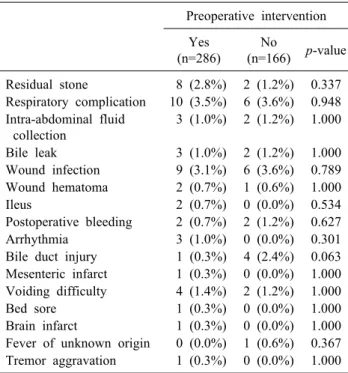
Table 4. Postoperative complications
Preoperative intervention Yes
(n=286)
No
(n=166) p-value Residual stone 8 (2.8%) 2 (1.2%) 0.337 Respiratory complication 10 (3.5%) 6 (3.6%) 0.948 Intra-abdominal fluid
collection
3 (1.0%) 2 (1.2%) 1.000
Bile leak 3 (1.0%) 2 (1.2%) 1.000
Wound infection 9 (3.1%) 6 (3.6%) 0.789 Wound hematoma 2 (0.7%) 1 (0.6%) 1.000
Ileus 2 (0.7%) 0 (0.0%) 0.534
Postoperative bleeding 2 (0.7%) 2 (1.2%) 0.627 Arrhythmia 3 (1.0%) 0 (0.0%) 0.301 Bile duct injury 1 (0.3%) 4 (2.4%) 0.063 Mesenteric infarct 1 (0.3%) 0 (0.0%) 1.000 Voiding difficulty 4 (1.4%) 2 (1.2%) 1.000
Bed sore 1 (0.3%) 0 (0.0%) 1.000
Brain infarct 1 (0.3%) 0 (0.0%) 1.000 Fever of unknown origin 0 (0.0%) 1 (0.6%) 0.367 Tremor aggravation 1 (0.3%) 0 (0.0%) 1.000
al.,19 patients aged ≥80 yr who underwent cholecy- stectomy, mortality rate after surgery was 6.3%. It is nota- ble that our study showed significantly lower rate of mor- tality compared to other studies. In addition, since inter- vention group and non-intervention group’s mortality rate showed no statistical difference (p=0.301), chol- ecystectomy can be considered as a safe treatment option for intervention group patients without additional risk for mortality.
The most common postoperative complications were respiratory complications, wound infection, and residual stone, in that order (Table 4). We compared the complica- tions between the intervention and non-intervention groups, and each of the complications showed no stat- istical difference between the 2 groups. It is noteworthy that the complication rate in patients in the intervention group who underwent surgery was similar to that of the non-intervention group, which is opposite to the common notion that patients who need intervention will have more complications owing to their higher disease severity. This guarantees that the surgery is safe without conferring a higher risk of complications after the intervention.
However, this study has a few limitations. First, this study has a retrospective design. Second, as the results of this study only convey the outcomes of patients who un- derwent surgery, patients with gallbladder disease who
only received conservative treatment without surgery were not included, which confers the possibility of a selection bias.
In conclusion, proper preoperative evaluations and pre- operative biliary drainage allow reductions in the ASA score, making surgery a safe treatment option for elderly patients needing a cholecystectomy.
REFERENCES
1. Festi D, Dormi A, Capodicasa S, Staniscia T, Attili AF, Loria P, et al. Incidence of gallstone disease in Italy: results from a multicenter, population-based Italian study (the MICOL project).
World J Gastroenterol 2008;14:5282-5289.
2. Tambyraja AL, Kumar S, Nixon SJ. Outcome of laparoscopic cholecystectomy in patients 80 years and older. World J Surg 2004;28:745-748.
3. Kauvar DS, Brown BD, Braswell AW, Harnisch M.
Laparoscopic cholecystectomy in the elderly: increased operative complications and conversions to laparotomy. J Laparoendosc Adv Surg Tech A 2005;15:379-382.
4. Borzellino G, de Manzoni G, Ricci F, Castaldini G, Guglielmi A, Cordiano C. Emergency cholecystostomy and subsequent cholecystectomy for acute gallstone cholecystitis in the elderly.
Br J Surg 1999;86:1521-1525.
5. Yetkin G, Uludag M, Oba S, Citgez B, Paksoy I. Laparoscopic cholecystectomy in elderly patients. JSLS 2009;13:587-591.
6. Brunt LM, Quasebarth MA, Dunnegan DL, Soper NJ. Outcomes analysis of laparoscopic cholecystectomy in the extremely elderly. Surg Endosc 2001;15:700-705.
7. Csikesz N, Ricciardi R, Tseng JF, Shah SA. Current status of surgical management of acute cholecystitis in the United States.
World J Surg 2008;32:2230-2236.
8. Hackett NJ, De Oliveira GS, Jain UK, Kim JY. ASA class is a reliable independent predictor of medical complications and mortality following surgery. Int J Surg 2015;18:184-190.
9. Clavien PA, Barkun J, de Oliveira ML, Vauthey JN, Dindo D, Schulick RD, et al. The Clavien-Dindo classification of surgical complications: five-year experience. Ann Surg 2009;250:187- 196.
10. Mathers CD, Stevens GA, Boerma T, White RA, Tobias MI.
Causes of international increases in older age life expectancy.
Lancet 2015;385:540-548.
11. Riall TS, Zhang D, Townsend CM Jr, Kuo YF, Goodwin JS.
Failure to perform cholecystectomy for acute cholecystitis in eld- erly patients is associated with increased morbidity, mortality, and cost. J Am Coll Surg 2010;210:668-677, 677-679.
12. Fuks D, Duhaut P, Mauvais F, Pocard M, Haccart V, Paquet JC, et al. A retrospective comparison of older and younger adults undergoing early laparoscopic cholecystectomy for mild to mod- erate calculous cholecystitis. J Am Geriatr Soc 2015;63:1010- 1016.
13. Strasberg SM. Clinical practice. Acute calculous cholecystitis. N Engl J Med 2008;358:2804-2811.
14. Lee HM, Min SK, Lee HK. Long-term results of laparoscopic common bile duct exploration by choledochotomy for chol- edocholithiasis: 15-year experience from a single center. Ann Surg Treat Res 2014;86:1-6.
15. Tzeng CW, Cooper AB, Vauthey JN, Curley SA, Aloia TA.
Predictors of morbidity and mortality after hepatectomy in eld-
erly patients: analysis of 7621 NSQIP patients. HPB (Oxford) 2014;16:459-468.
16. Shahir MA, Lemmens VE, van de Poll-Franse LV, Voogd AC, Martijn H, Janssen-Heijnen ML. Elderly patients with rectal can- cer have a higher risk of treatment-related complications and a poorer prognosis than younger patients: a population-based study. Eur J Cancer 2006;42:3015-3021.
17. Ranta S, Hynynen M, Tammisto T. A survey of the ASA phys- ical status classification: significant variation in allocation among
Finnish anaesthesiologists. Acta Anaesthesiol Scand 1997;41:
629-632.
18. Haynes SR, Lawler PG. An assessment of the consistency of ASA physical status classification allocation. Anaesthesia 1995;
50:195-199.
19. Nielsen LB, Harboe KM, Bardram L. Cholecystectomy for the elderly: no hesitation for otherwise healthy patients. Surg Endosc 2014;28:171-177.