Address reprint requests to : Aungsuroch, Yupin
Faculty of Nursing, Chulalongkorn University, Borommaratchachonnani Srisataphat, Building, Rama 1 Road, Pathumwan, Bangkok 10330, Thailand Tel: +66-2-218-1131 Fax: +66-2-218-1130 E-mail: [email protected]
Received: April 26, 2021 Revised: June 25, 2021 Accepted: July 23, 2021 Published online August 31, 2021
This is an Open Access article distributed under the terms of the Creative Commons Attribution NoDerivs License. (http://creativecommons.org/licenses/by-nd/4.0) If the original work is properly cited and retained without any modification or reproduction, it can be used and re-distributed in any format and medium.
J Korean Acad Nurs Vol.51 No.4, 430 https://doi.org/10.4040/jkan.21075
A Concept Analysis of Quality Nursing Care
Juanamasta, I Gede1,2 · Aungsuroch, Yupin1 · Gunawan, Joko1
1Faculty of Nursing, Chulalongkorn University, Bangkok, Thailand
2Nursing Program, STIKes Wira Medika Bali, Bali, Indonesia
Purpose: This study aimed to perform a concept analysis of quality nursing care. Methods: Walker and Avant’s concept analysis method was used to carry out this study. Results: The defining attributes identified were as follows: caring, the nurse-patient relationship, and pa- tient needs. Antecedents included patient characteristics, individual factors (age, education, knowledge, competence, and experience), job position, and environmental factors. The consequences of quality nursing care have significant influence on both patients and nurses.
Conclusion: The findings can aid researchers in obtaining a better understanding of quality nursing care, and stakeholders can consider the factors related to quality nursing care and its consequences to improve the nursing process.
Key words: Caring; Hospitals; Nursing Process; Nurse-Patient Relations; Patients
INTRODUCTION
Nursing researchers have described a diversity of concepts related to quality nursing care (QNC). They include, but are not limited to, the quality of care, nursing care quality, nurs- ing care, nursing-sensitive outcomes, nursing outcomes, missed nursing care, and care left undone. However, re- searchers have treated “QNC” as a complex and vague con- cept with many definitions, and the concept has been the subject of many complex discussions. Different environments, different job positions, and the diversity of in-patient and out-patient experiences contribute to the challenge of deter- mining a consistent definition. The existing definitions vary, and there are no specific definitions for QNC. Consequently, a consensus concept may not be naturally feasible because of the different perspectives of nurses and patients and their different understanding of treatment, despite the similar fea- tures found in their experiences. The concept centered on
this commonality would be incomplete and would not con- sider “quality” holistically [1].
QNC in the hospital is related to complex factors, from up- per-level management to patient outcomes. Many studies have tried to explain the predictors and impact of QNC. Prior studies have shown that the nurse’s perspective of QNC can be predicted by hospital management, organizational support, nurse practice environment at the unit level, workload, emo- tional exhaustion, personal accomplishment, and work en- gagement [2-4]. In addition, QNC is a significant factor of not only adverse events and recurrence [5-7], but also pa- tient satisfaction, hospital commitment, and revisit intention [8,9].
Nurses have the social responsibility of promoting health and preventing accidents and diseases. Quality evaluation, including results of nursing education programs, has tradi- tionally been hampered by the lack of accessible data on the nursing process and patient results. Evidence to support
nursing practice this is committed to patient care is deficient due to the lack of critical data on QNC. Distinctions in meth- ods should be made to reinforce successful quality evaluation and measurement of results in nursing. Instead of seeking significance in the available data, resources have to be redi- rected to selecting the relevant data [10].
A better understanding of the concept of QNC in hospitals that is explicitly specified in a potentially useful way is needed, in order for QNC to be recognized in the hospital.
This concept analysis aids in clarifying the operational defi- nition of QNC. Furthermore, the identification of the an- tecedents and implications will shed light on the phenomena associated with QNC.
METHODS
1. Study designThis study explored the characteristics of QNC using Walker and Avant’s concept analysis [11] approach. The main purposes were to define the characteristics of QNC and to present ‘QNC’ with a detailed explanation of the concept.
The study also developed a conceptualized description of QNC.
2. Data collection and analysis
The time period examined was from 1990 to 2020. A lit- erature search was conducted using the PubMed, Blackwell, Science Direct, CINAHL, and Google Scholar databases. The terms “quality nursing care,” “quality of nursing care,”
“nursing care quality,” and “nurse” were searched for in the keywords and titles of articles.
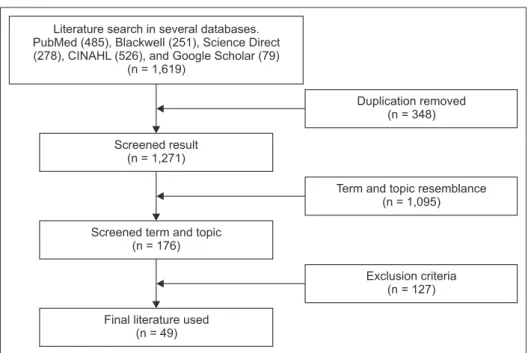
The process of selection started with the inclusion and ex- clusion criteria. The inclusion criteria were: (1) definitions and attributes of QNC, (2) antecedents, consequences, and empirical evidence of QNC, and (3) published articles in En- glish. The exclusion criteria were: (1) books, (2) letters to the editors, (3) non-peer-reviewed articles, and (4) com- mentaries. Forty-nine out of 176 potential articles were se- lected based on the inclusion and exclusion criteria (Figure 1).
All of the authors performed the screening. First, the re- searchers checked for duplicate articles and articles on stud- ies conducted on a different topic. Then the title was screened for its inclusion of at least one of the search terms (“quality” or “nursing” or “care” or “quality nursing care”).
Finally, studies were screened against the exclusion criteria.
Articles on studies that examined other aspects of healthcare quality or were not written in English were also excluded.
Literature search in several databases.
PubMed (485), Blackwell (251), Science Direct (278), CINAHL (526), and Google Scholar (79)
(n = 1,619)
Screened result (n = 1,271)
Screened term and topic (n = 176)
Final literature used (n = 49)
Duplication removed (n = 348)
Term and topic resemblance (n = 1,095)
Exclusion criteria (n = 127)
Figure 1. Flow diagram of the selection of studies.
Afterward, three authors reviewed and analyzed the articles independently. Differences were discussed and re-analyzed to achieve consensus. The review of the articles was carried out from September 2020 to February 2021.
Data were extracted, and analyzed using Walker and Avant’s eight-step approach of concept analysis [11]: First, the concept was selected, as described in the introduction section; Second, the purpose was determined, as described in the methods section; The remaining steps included defin- ing the attributes, constructing a model case and an addi- tional case, and identifying the antecedents and conse- quences, and empirical referents. These steps are described in the results section.
3. Ethical considerations
This study was approved by the Udayana University Ethic Research Committee (IRB No. 1258/UN14.2.2.VII.14/LT/
2020).
RESULTS
1. Identifying all uses of the conceptThe term “quality” is widely used across disciplines.
“Quality of care” is commonly used in healthcare, and can be used for any healthcare discipline, including medical practice, nursing, pharmacy, and nutrition. “Quality nursing care” is a term focused specifically on the nursing discipline.
1) Dictionary definitions of quality nursing care
“QNC” does not appear as one term in any dictionary.
Thus, the terms are divided into three parts to be clearly defined: “quality,” “nursing,” and “care.”
The definitions of “Quality” in the Oxford Learner’s Dic- tionary are (1) “the standard of something when it is com- pared to other things like it,” (2) “how good or bad some- thing is,” (3) “a high standard,” and (4) “a thing that is part of a person’s character, especially something good” [12]. The definitions for the term in the Cambridge Dictionary of American English are (1) “how good or bad something is,”
(2) “a characteristic or feature of someone or something,”
and (3) “the degree of excellence of something, often a high
degree of it” [13]. The Lexico defines “quality” as (1) “the standard of something as measured against other things of a similar kind,” (2) “the degree of excellence of something,”
and (3) “a distinctive attribute or characteristic possessed by someone or something” [14]. Thus, “quality” can be defined as the degree of excellence of something.
The word “nursing” has several definitions. The definition in the Oxford Learner’s Dictionary is (1) “the job or skill of caring for people who are sick or injured” [12]. According to the Cambridge Dictionary of American English, nursing is defined as (1) the job of being a nurse and (2) the act of a woman feeding a baby with milk from her breasts [13]. Lex- ico’s definitions include (1) The profession or practice of providing care for the sick and infirm, and (2) “a mother breastfeeding a baby” [14]. Therefore, nursing can be de- fined as a profession in which a nurse provides care.
“Care” is defined in the Oxford Learner’s Dictionary as (1)
“the process of caring for somebody/something and provid- ing what they need for their health or protection”; (2) “the fact of providing a home in an institution run by the local authority or with another family for children who cannot live with their parents”; (3) “attention or thought that you give to something that you are doing, so that you will do it well and avoid mistakes or damage”; and (4) “a feeling of worry;
something that causes problems or worries” [12]. In the Cambridge dictionary of American English, “care” is defined as (1) “the process of protecting someone or something and providing what that person or thing needs,” (2) “the process of providing for the needs of someone or something,” and (3)
“serious attention, especially to the details of a situation or a piece of work” [13]. The Lexico defines “care” as (1) “the provision of what is necessary for the health, welfare, main- tenance, and protection of someone or something” and (2)
“serious attention or consideration applied to doing something correctly or to avoid damage or risk” [14]. Thus, “care” can be defined as the process of attending to the needs of some- one for their health, welfare, maintenance, and protection.
2) Definitions of quality nursing care in the literature The definition of QNC can be considered from a variety of perspectives, including the patient and family, nurses, nurse
managers, and management [15]. This study focused on the micro-level, specifically how nursing staff in a hospital could make a significant and unique contribution. Past studies sug- gest that a nurse commonly uses two terms/set of terms to explain QNC. The first is “meet” and “need”; these terms are related to meeting the patient’s needs. One study defined QNC as the meeting of human needs through caring, empa- thy, and respectful interactions within which responsibility, intentionality, and advocacy form an essential, integral foun- dation [16]. Another study defined it as meeting the patient’s psychosocial needs [17]. According to Williams [18], provid- ing QNC means meeting the patient’s physical, psychosocial, and extra care needs.
Some studies used the term “standard” to explain the meaning of QNC. QNC engenders patient safety and satis- faction and is conducted by nurses and based on nursing standards [19]. One study conducted in Iran defined QNC as nursing care delivery based on nursing standards with safety, which are important factors in patient satisfaction [20].
2. Determining the defining attributes
An attribute is a term that is repeatedly associated with a concept. The term defines the characteristics that differenti- ate the phenomenon from a similar one [11]. The relevant resources, which are used to identify the attributes of QNC
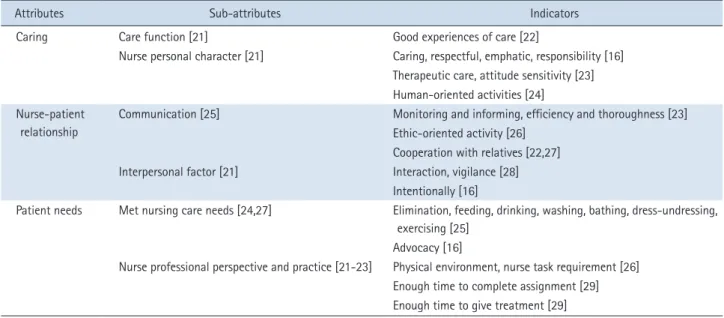
are presented in Table 1 [16,21-29] (The details of the attri- butes on each study can be seen in Appendix 1). “Caring”
was the most supported attribute in the literature, followed by the “nurse-patient relationship” and “patient needs.”
Therefore, the conceptual definition of QNC arrived at in this study was the degree of excellence of caring conducted by nurses to meet their patients’ needs.
1) Caring
Caring is an essential part of nursing. Caring is a part of the attitude that humans need while they interact with one another. According to the literature, the majority of the at- tributes are related to caring. Caring can be divided into two parts: care function and the nurse’s personal character. Care function refers to how a nurse’s feelings can impact his or her caring experiences. Moreover, a nurse’s personal char- acter is obviously a major aspect of the care they provide.
2) Nurse-patient relationship
The QNC process involves nurses and patients. The nurse-patient relationship has evolved. Communication and interpersonal skills are important in constructing the nurse-patient relationship. These skills are used to construct a good relationship between individuals. Specifically, the nurse needs the patient’s trust during the treatment (Table 1).
Table 1. Attributes, Sub-Attributes and Indicators of ‘Quality Nursing Care’
Attributes Sub-attributes Indicators
Caring Care function [21] Good experiences of care [22]
Nurse personal character [21] Caring, respectful, emphatic, responsibility [16]
Therapeutic care, attitude sensitivity [23]
Human-oriented activities [24]
Nurse-patient relationship
Communication [25] Monitoring and informing, efficiency and thoroughness [23]
Ethic-oriented activity [26]
Cooperation with relatives [22,27]
Interpersonal factor [21] Interaction, vigilance [28]
Intentionally [16]
Patient needs Met nursing care needs [24,27] Elimination, feeding, drinking, washing, bathing, dress-undressing, exercising [25]
Advocacy [16]
Nurse professional perspective and practice [21-23] Physical environment, nurse task requirement [26]
Enough time to complete assignment [29]
Enough time to give treatment [29]
3) Patient needs
Patient needs are slightly complex and comprehensive.
They include physical care, psychosocial support, emotional care, and spiritual needs. Meeting patient needs in the con- text of QNC involves providing basic nursing care treatment and having enough time to provide treatment and complete the assignment as well. Patient needs are attended to, in or- der to meet nursing care needs and to achieve QNC.
3. Quality nursing care model case
A model case based on the hospital nurse’s experience was developed to define the concept [11]. The case is presented below.
1) Model case
In the intensive care unit of a tertiary hospital, the ratio of nurses to patients is 1:2 for the morning shift and 1:3 for the afternoon and night shifts. Nurses meet the patients during the handover. They greet the patient and call his or her name even when the patient is in a comatose state. Then the nurse talks to the patient as if he or she were in compos mentis to report on handover. During a patient’s treatment, nurses always ask the patient’s permission to perform an in- tervention. The nurses try to adhere to standard operational procedures, and provide patients with adequate care. They always maintain good communication with the patient and family, educate the patient about his or her problem, and provide positive encouragement. Nurses carry out actions and interventions based on their patient’s condition. They will call other healthcare workers if collaboration is required.
For this case, the nurses provided QNC. They expressed adequate care for all patients in any condition and followed standard procedures during treatment. They consistently maintained a good relationship with the patient and family and encouraged them to deal with the patient’s health prob- lem. Nursing actions to satisfy the patient needs that had an essential role included observing the patient’s condition, pa- tient mobilization, providing information to the patient and family, and advocating for collaboration in the treatment of the patient.
4. Additional cases
Contrary, borderline, and related cases that can support researchers in understanding the vital attributes of QNC were also identified. They can also prevent overlap of the at- tributes of the concept with the analyzed concept.
1) Contrary case
A contrary case is an example of a contradiction or oppo- site of the concept. One case is described below:
One hospital had severe problems during the pandemic.
There was a nursing shortage and a bed occupancy rate of 100%, which caused fatigue and increased nursing care bur- den. Nurses did not have enough time to talk in person with the patient and felt distant from the patient. In addition, the patient complained because of the nurse’s attitude. They did not feel safe and felt that they were being ignored by the nurse. Patients were also unsatisfied because they did not feel that they had a good relationship with the nurse during nurse implementation. Thus, nurses could not meet patient needs.
In the case described above, the high workload prevented the nurses from providing QNC. The nurse could not express care for the patient. They could not meet the patient’s needs due to the work situation. The nurse-patient relationship suffered because of the treatment situation. Thus, in this contrary case, all of the attributes were absent.
2) Borderline case
A similar case, a borderline case (or boundary case), is a case that cannot be regarded as an illustration of the concept because it only includes some of the important attributes of the concept. An example is presented below:
Nurses in the emergency unit need to save the life of a patient. Nurse C gives enough treatment to patient A. Then the family and patient A must wait for the doctor’s diagnosis.
However, the family cannot accept the situation because they are required to wait for a long time. Nurse C tries to explain the situation many times, but the family ignores Nurse C’s explanations. Nurse C is unable to build a trusting nurse-pa- tient relationship because of the family situation. Thus, in
this borderline case, one of the attributes is absent.
3) Related case
A related model case that could aid researchers in under- standing the vital attributes of the concept was also identi- fied. The concept is quite similar to nursing care. An exam- ple is given below:
Nurse A usually provides good care to patients. However, she needs to finish the patient’s documentation, and it takes considerable time. Patient and family can tolerate the condi- tion because the nurse-patient relationship is well-con- structed. However, nurse have not enough time for the pa- tient, that would miss or delay of the nursing intervention.
Thus, the nurse provided good nursing care.
5. Identifying the antecedents and consequences of quality nursing care
According to Walker and Avant [11], antecedents are cer- tain occurrences that have to occur before the concept does.
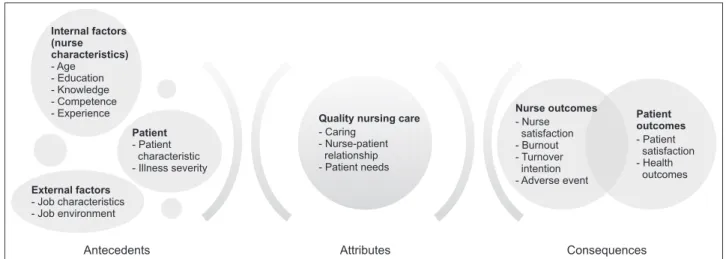
The articles related to the predictors of QNC were reviewed and the antecedents of QNC were considered (Figure 2). The antecedents were grouped into four categories, which in- cluded the patient, individual (nurse) characteristics, job characteristics, and job environment variables. The first im- plied antecedents were patient demographic factors [30], in- cluding patient characteristics and severity of the disease [6].
These were followed by nurse characteristics [30,31], such
as age [32], education [33], experience [34], knowledge [35], and competence [1,36,37], and all of these are related to personal situations. The third category was job variables.
The aspects are typical of nursing work, such as task as- signments [30,36], nurse staffing [22,33,34,36-38], role tension [39], job autonomy [39,40] and workload [1,4,18].
The last antecedent was environmental factors, which is a measurement of whether the nurses are employed in a sup- portive atmosphere. These factors include, but are not lim- ited to, nurses’ work environments [30,34,40-43], empow- erment [44], and engagement [3,4].
The consequences are the events that occur as a result or effects of the concept’s occurrence [11]. After a comprehen- sive analysis, it was determined that the consequences of QNC impact nurses’ outcomes (Figure 2). Prior studies have shown that nursing care quality has an impact on nurse sat- isfaction [18,33,43], burnout [18,33,43,45], turnover intention [46], and adverse event [47]. In terms of patient outcomes, it impacts patient satisfaction [48] and health outcomes [40].
6. Defining the empirical referents of quality nursing care
Empirical referents are the phenomena that explicitly prove the concept’s occurrence [11]. The empirical referents re- quired to make the concept measurable given the concept’s attributes are abstract. The empirical referents of QNC were as follows.
Internal factors (nurse characteristics) - Age
- Education - Knowledge - Competence - Experience
External factors - Job characteristics - Job environment
Patient - Patient
characteristic - Illness severity
Quality nursing care - Caring
- Nurse-patient relationship - Patient needs
Nurse outcomes - Nurse
satisfaction - Burnout - Turnover
intention - Adverse event
Patient outcomes - Patient
satisfaction - Health
outcomes
Antecedents Attributes Consequences
Figure 2. Antecedents, attributes, and consequences of quality nursing care.
1) Caring
This attribute can be assessed by statements consisting of loving, respect, empathy, and responsibility such as “encour- aging the patient to call if there are problems; or allowing the patient to express feelings about his or her disease and treatment; or being empathetic or identifying with the pa- tient, or showing concern for the patient” [49].
2) Nurse-patient relationship
Statements which can measure this attribute consist of presence, trust, and interaction such as “returning to the pa- tient voluntarily; or spending time with the patient” [49].
3) Patient needs
Statements, which can be used to evaluate this attribute, consist of physical, psychosocial, and extra needs like “in- cluding the patient in planning his or her care; or giving the patient’s treatments and medications on time; or helping to reduce the patient’s pain” [49].
However, in several cultures, circumstances, and environ- ments, QNC may have other empirical references. For this purpose, researchers may establish additional empirical sources based on the characteristics of this study by inter- viewing the experts in their contexts.
DISCUSSION
This concept analysis of QNC offers a clearer understand- ing of the nature of nursing care quality. There are two other important terms besides QNC that should be mentioned:
quality of nursing care and nursing care quality. All of the terms are similar in meaning. While it does not appear as a dictionary term, the detailed research findings show more consistency in the sense of QNC by nurses. In the extensive review of the dictionary definitions and published articles, two essential phrases were found: “degree of excellence or stan- dard” and “meet the patient’s needs.” Thus, it was defined as the degree of excellence of caring conducted by the nurse to meet patients’ needs. The study confirmed that the concept does not have any distinction from the general definition even if Walker and Avant’s analysis method was not used.
Despite its slightly similar definitions, the attributes were constructed from nine of sixteen studies. The sixteen studies used different terms. Then the authors performed a compre- hensive review and analyzed several redundant attributes among the literature. This study found three main attributes with two sub-attributes in each part and explained with particular indicators. Caring, nurse-patient relationship, and patient needs were identified as the defining attributes.
In terms of the consequences of QNC, it was confirmed in a prior study that nurses who provide QNC, have more job satisfaction and their level of burnout is reduced. Additionally, this analysis revealed that QNC impacts patient satisfaction and health outcomes as shown in Figure 2. Thus, by devel- oping programs that promote QNC, stakeholders can improve the health of clinical nurses and patients receiving nursing care.
Future studies could construct the instrument based on the indicators of this study that explicitly show the QNC process and measure its validity and reliability in registered nurses.
Likewise, an evaluation of the psychometric properties is needed to generate an authentic and precise instrument.
Moreover, additional research is required to elucidate the at- tributes of QNC in relation to antecedents and their potential effect on outcomes.
In this analysis, the authors reviewed documents published in English after 1990. For 19 studies, the article was written in another language and the study was not included. As a result, the insights and views generated may be limited. The methodological issues are perhaps another limitation of the study. The findings can be subjective, as various researchers may have varying perspectives on the literature and hence report inconsistent conclusions.
CONCLUSION
This study explicitly described the attributes, antecedents, consequences, model case, contrary case and relative, and empirical referents of QNC through an extensive review us- ing Walker and Avant’s eight-step process of concept analy- sis approach. The results of this study will help advance nursing knowledge and practice. They can also improve the
nursing student’s understanding of the concept and how it is different from others.
Furthermore, the antecedents of QNC provided overall ev- idence of the patient, internal (nurse characteristics), and external (job characteristics and environmental) factors, which substantially affect QNC, as illustrated in Figure 2.
Therefore, it is recommended for health policymakers, nurse managers, and registered nurses to conscientiously reflect on modifiable factors, particularly external factors that can im- prove the quality of nursing care.
CONFLICTS OF INTEREST
The authors declared no conflict of interest.
ACKNOWLEDGEMENTS
None.
FUNDING
This study was supported by Second Century Fund (C2F), Chulalongkorn University, Bangkok, Thailand.
DATA SHARING STATEMENT
Please contact the corresponding author for data availability.
AUTHOR CONTRIBUTIONS
Conceptualization or/and Methodology: Juanamasta IG &
Aungsuroch Y.
Data curation or/and Analysis: Juanamasta IG & Aungsur- och Y & Gunawan J.
Funding acquisition: Juanamasta IG.
Investigation: None.
Project administration or/and Supervision: None.
Resources or/and Software: Juanamasta IG.
Validation: Juanamasta IG & Aungsuroch Y & Gunawan J.
Visualization: None.
Writing original draft or/and Review & Editing: Juana-
masta IG & Aungsuroch Y & Gunawan J.
REFERENCES
1. Charalambous A, Papadopoulos R, Beadsmoore A. Quality nursing care: A selective review of the literature of pa- tients’and nurses’ interpretations. The Scientific Journal of the Hellenic Regulatory Body of Nurses. 2008;1(2):75-82.
2. Van Bogaert P, Clarke S, Willems R, Mondelaers M. Nurse practice environment, workload, burnout, job outcomes, and quality of care in psychiatric hospitals: A structur- al equation model approach. Journal of Advanced Nursing.
2013;69(7):1515-1524. https://doi.org/10.1111/jan.12010 3. Van Bogaert P, Peremans L, Van Heusden D, Verspuy M,
Kureckova V, Van de Cruys Z, et al. Predictors of burnout, work engagement and nurse reported job outcomes and qual- ity of care: A mixed method study. BMC Nursing. 2017;16:5.
https://doi.org/10.1186/s12912-016-0200-4
4. Van Bogaert P, van Heusden D, Timmermans O, Franck E.
Nurse work engagement impacts job outcome and nurse-as- sessed quality of care: Model testing with nurse practice environment and nurse work characteristics as predictors.
Frontiers in Psychology. 2014;5:1261.
https://doi.org/10.3389/fpsyg.2014.01261
5. Reed L, Blegen MA, Goode CS. Adverse patient occurrences as a measure of nursing care quality. The Journal of Nursing Administration. 1998;28(5):62-69.
https://doi.org/10.1097/00005110-199805000-00009 6. Lucero RJ, Lake ET, Aiken LH. Nursing care quality and
adverse events in US hospitals. Journal of Clinical Nursing.
2010;19(15-16):2185-2195.
https://doi.org/10.1111/j.1365-2702.2010.03250.x
7. Van Bogaert P, Timmermans O, Weeks SM, van Heusden D, Wouters K, Franck E. Nursing unit teams matter: Impact of unit-level nurse practice environment, nurse work charac- teristics, and burnout on nurse reported job outcomes, and quality of care, and patient adverse events--a cross-sec- tional survey. International Journal of Nursing Studies. 2014;
51(8):1123-1134.
https://doi.org/10.1016/j.ijnurstu.2013.12.009
8. Karaca A, Durna Z. Patient satisfaction with the quality of nursing care. Nursing Open. 2019;6(2):535-545.
https://doi.org/10.1002/nop2.237
9. Jung YA, Sung KM. A comparison of patients’ nursing ser- vice satisfaction, hospital commitment and revisit intention between general care unit and comprehensive nursing care unit. Journal of Korean Academy of Nursing Administration.
2018;24(1):30-39.
https://doi.org/10.11111/jkana.2018.24.1.30
10. Jones TL. Outcome measurement in nursing: Imperatives, ideals, history, and challenges. Online Journal of Issues in Nursing. 2016;21(2):1.
11. Walker LO, Avant KC. Strategies for theory construction in nursing. 6th ed. New York (NY): Pearson; 2019. p. 167-193.
12. Oxford University Press. Oxford advanced learner’s dictio- nary [Internet]. Oxford: Oxford University Press; c2021 [cited 2020 Apr 11]. Available from: https://www.oxford- learnersdictionaries.com/definition/english/.
13. Cambridge University Press. Cambridge dictionary [Internet].
Cambridge: Cambridge University Press; c2021 [cited 2020 Apr 11]. Available from: https://dictionary.cambridge.org/
dictionary/english/.
14. Oxford University Press (OUP). Lexico.com [Internet]. Ox- ford: Lexico.com; c2021 [cited 2020 Apr 4]. Available from:
https://www.lexico.com/definition/.
15. Redfern SJ. In pursuit of quality of nursing care. Journal of Clinical Nursing. 1993;2(3):141-148.
https://doi.org/10.1111/j.1365-2702.1993.tb00153.x
16. Burhans LM, Alligood MR. Quality nursing care in the words of nurses. Journal of Advanced Nursing. 2010;66(8):1689- 1697.
17. Koy V, Yunibhand J, Angsuroch Y, Fisher ML. Relationship between nursing care quality, nurse staffing, nurse job satis- faction, nurse practice environment, and burnout: Literature review. International Journal of Research in Medical Sciences.
2015;3(8):1825-1831.
https://doi.org/10.18203/2320-6012.ijrms20150288.
18. Williams AM. The delivery of quality nursing care: A grounded theory study of the nurse’s perspective. Journal of Advanced Nursing. 1998;27(4):808-816.
https://doi.org/10.1046/j.1365-2648.1998.00590.x
19. Kunaviktikul W, Anders RL, Srisuphan W, Chontawan R, Nuntasupawat R, Pumarporn O. Development of quality of nursing care in Thailand. Journal of Advanced Nursing. 2001;
36(6):776-784.
https://doi.org/10.1046/j.1365-2648.2001.02039.x
20. Tafreshi MZ, Pazargadi M, Abed Saeedi Z. Nurses’ perspec- tives on quality of nursing care: A qualitative study in Iran.
International Journal of Health Care Quality Assurance. 2007;
20(4):320-328.
https://doi.org/10.1108/09526860710754389
21. Attree M. An analysis of the concept “quality” as it relates to contemporary nursing care. International Journal of Nursing Studies. 1993;30(4):355-369.
https://doi.org/10.1016/0020-7489(93)90107-6
22. Koy V, Yunibhand J, Angsuroch Y. Nursing care quality: A concept analysis. International Journal of Research in Medical Sciences. 2015;3(8):1832-1838.
https://doi.org/10.18203/2320-6012.ijrms20150289
23. Redfern S, Norman I. Quality of nursing care perceived by patients and their nurses: An application of the critical in- cident technique. Part 2. Journal of Clinical Nursing. 1999;
8(4):414-421.
https://doi.org/10.1046/j.1365-2702.1999.0288b.x
24. Liu Y, Aungsuroch Y, Gunawan J, Sha L, Shi T. Development and psychometric evaluation of a quality nursing care scale from nurses’ perspective. Nursing Open. 2021;8(4):1741- 1754. https://doi.org/10.1002/nop2.816
25. Kitson AL. Indicators of quality in nursing care--an alterna- tive approach. Journal of Advanced Nursing. 1986;11(2):133- 144. https://doi.org/10.1111/j.1365-2648.1986.tb01231.x 26. Koy V, Yunibhand J, Angsuroch Y, Turale S. Development
and psychometric testing of the Cambodian Nursing Care Quality Scale. Pacific Rim International Journal of Nursing Research. 2017;21(4):267-279.
27. Stolt M, Katajisto J, Kottorp A, Leino-Kilpi H. Measuring quality of care: A Rasch validity analysis of the Good Nursing Care Scale. Journal of Nursing Care Quality. 2019;34(4):E1- E6. https://doi.org/10.1097/NCQ.0000000000000391 28. Lynn MR, McMillen BJ, Sidani S. Including the provider in
the assessment of quality care: Development and testing of the Nurses’ Assessment of Quality Scale - acute care ver- sion. Journal of Nursing Care Quality. 2007;22(4):328-336.
https://doi.org/10.1097/01.NCQ.0000290414.42640.c0 29. Mrayyan MT. Jordanian nurses’ job satisfaction, patients’
satisfaction and quality of nursing care. International Nursing Review. 2006;53(3):224-230.
https://doi.org/10.1111/j.1466-7657.2006.00439.x
30. Lucero RJ, Lake ET, Aiken LH. Variations in nursing care quality across hospitals. Journal of Advanced Nursing. 2009;
65(11):2299-2310.
https://doi.org/10.1111/j.1365-2648.2009.05090.x
31. Van Bogaert P, Kowalski C, Weeks SM, Van Heusden D, Clarke SP. The relationship between nurse practice environ- ment, nurse work characteristics, burnout and job outcome and quality of nursing care: A cross-sectional survey. Inter- national Journal of Nursing Studies. 2013;50(12):1667-1677.
https://doi.org/10.1016/j.ijnurstu.2013.05.010
32. Van den Heede K, Clarke SP, Sermeus W, Vleugels A, Aik- en LH. International experts’ perspectives on the state of the nurse staffing and patient outcomes literature. Journal of Nursing Scholarship. 2007;39(4):290-297.
https://doi.org/10.1111/j.1547-5069.2007.00183.x
33. Liu K, You LM, Chen SX, Hao YT, Zhu XW, Zhang LF, et al. The relationship between hospital work environment and nurse outcomes in Guangdong, China: A nurse questionnaire survey. Journal of Clinical Nursing. 2012;21(9-10):1476- 1485. https://doi.org/10.1111/j.1365-2702.2011.03991.x 34. Anzai E, Douglas C, Bonner A. Nursing practice environ-
ment, quality of care, and morale of hospital nurses in Japan.
Nursing & Health Sciences. 2014;16(2):171-178.
https://doi.org/10.1111/nhs.12081
35. Gunther M, Alligood MR. A discipline-specific determination of high quality nursing care. Journal of Advanced Nursing.
2002;38(4):353-359.
https://doi.org/10.1046/j.1365-2648.2002.02201.x
36. Idvall E, Rooke L. Important aspects of nursing care in sur- gical wards as expressed by nurses. Journal of Clinical Nurs- ing. 1998;7(6):512-520.
https://doi.org/10.1046/j.1365-2702.1998.00180.x
37. Kieft RA, de Brouwer BB, Francke AL, Delnoij DM. How nurses and their work environment affect patient experiences of the quality of care: A qualitative study. BMC Health Ser- vices Research. 2014;14:249.
https://doi.org/10.1186/1472-6963-14-249
38. Carthon JM, Kutney-Lee A, Jarrín O, Sloane D, Aiken LH.
Nurse staffing and postsurgical outcomes in black adults.
Journal of the American Geriatrics Society. 2012;60(6):
1078-1084.
https://doi.org/10.1111/j.1532-5415.2012.03990.x
39. Doran DI, Sidani S, Keatings M, Doidge D. An empirical test of the Nursing Role Effectiveness Model. Journal of Advanced Nursing. 2002;38(1):29-39.
https://doi.org/10.1046/j.1365-2648.2002.02143.x
40. Aiken LH, Clarke SP, Sloane DM. Hospital staffing, organi- zation, and quality of care: Cross-national findings. Nursing Outlook. 2002;50(5):187-194.
https://doi.org/10.1067/mno.2002.126696
41. Van Bogaert P, Meulemans H, Clarke S, Vermeyen K, Van de Heyning P. Hospital nurse practice environment, burnout, job outcomes and quality of care: Test of a structural equation model. Journal of Advanced Nursing. 2009;65(10):2175- 2185. https://doi.org/10.1111/j.1365-2648.2009.05082.x 42. Weldetsadik AY, Gishu T, Tekleab AM, Asfaw YM, Le-
gesse TG, Demas T. Quality of nursing care and nurses’
working environment in Ethiopia: Nurses’ and physicians’
perception. International Journal of Africa Nursing Sciences.
2019;10:131-135.
https://doi.org/10.1016/j.ijans.2019.03.002
43. Rochefort CM, Clarke SP. Nurses’ work environments, care rationing, job outcomes, and quality of care on neonatal units.
Journal of Advanced Nursing. 2010;66(10):2213-2224.
https://doi.org/10.1111/j.1365-2648.2010.05376.x
44. Laschinger HK, Grau AL. The influence of personal disposi- tional factors and organizational resources on workplace vio- lence, burnout, and health outcomes in new graduate nurses:
A cross-sectional study. International Journal of Nursing Studies. 2012;49(3):282-291.
https://doi.org/10.1016/j.ijnurstu.2011.09.004
45. Poghosyan L, Clarke SP, Finlayson M, Aiken LH. Nurse burnout and quality of care: Cross-national investigation in six countries. Research in Nursing & Health. 2010;33(4):
288-298. https://doi.org/10.1002/nur.20383
46. Spence Laschinger HK, Zhu J, Read E. New nurses’ percep- tions of professional practice behaviours, quality of care, job satisfaction and career retention. Journal of Nursing Manage- ment. 2016;24(5):656-665.
https://doi.org/10.1111/jonm.12370
47. Labrague LJ, De Los Santos JAA, Tsaras K, Galabay JR, Falguera CC, Rosales RA, et al. The association of nurse caring behaviours on missed nursing care, adverse patient events and perceived quality of care: A cross-sectional study.
Journal of Nursing Management. 2020;28(8):2257-2265.
https://doi.org/10.1111/jonm.12894
48. Cunningham RS. Advanced practice nursing outcomes: A review of selected empirical literature. Oncology Nursing Fo- rum. 2004;31(2):219-232.
https://doi.org/10.1188/04.ONF.219-232
49. Wu Y, Larrabee JH, Putman HP. Caring Behaviors Inven- tory: A reduction of the 42-item instrument. Nursing Re- search. 2006;55(1):18-25.
https://doi.org/10.1097/00006199-200601000-00003
Appendix 1. Overview Quality Nursing Care Attributes
Studies Attributes
Kitson [1] Elimination, feeding, drinking, washing, bathing, dress-undressing, exercising, and communication
Attree [2] Care function, interpersonal processes, method of organizing work, nurse professional perspective and practice, and nurse personal character
Redfern [3] Being patient orientated, being friendly towards patients and relatives, finding out exactly what patients want, using personal experience lo understand patients' problems, empathy, dignity and privacy
Redfern and Norman [4]
Therapeutic context for care, attitudes and sensitivity, teaching and leadership, motivation to nurse, monitoring and informing, high-dependency care, efficiency and thoroughness, reflection and anticipation
Mrayyan [5] Enough time to complete assignment, availability of nurses to assist physicians, enough time to carry out orders for medications and treatment on time, having time to keep supplies and equipment readily available, and having time to keep supplies and equipment in good condition, having time to make proper planning for continued care after discharge Lynn et al. [6] Interaction, vigilance, individualization, advocate, work environment, unit collaboration, personal characteristics, and mood Burhans and
Alligood [7]
Caring, empathetic, respectful interactions within which responsibility, intentionality and advocacy form an essential, and integral foundation
Koy et al. [8] Nurse competency & performance, met nursing care needs, precondition, good experiences of care, good leadership, staff characteristics, preconditions for care, physical environment, progress of nursing process, and cooperation with relatives.
Elayan and Ahmad [9]
Nurse competency, serve with caring, professionalism, and administrative factors
Koy et al. [10] Patient outcomes, physical environment, ethic-oriented activity, nurse’s characteristics, nurse task requirement, and progress of nursing process
Gaalan et al. [11] Staff characteristics, care related-activities, preconditions for care, physical environment, progress of nursing process and cooperation with relatives
Stolt et al. [12] Characteristics of actors, nursing action, precondition of care, environment, proceedings of the process, patient management strategies, and collaboration with family or healthcare
Weldetsadik et al. [13]
Physical care, emotional care, administration, teaching and preparation for home care, and nurse-physician relationship
Koy et al. [14] Moral commitment, professional commitment, environmental management, quality-safe conscious care, total care, emotional supportive care, informative supportive care, and patient satisfaction
Tsogbadrakh et al. [15]
Symptom management, activities of daily living, encouragement, emotional support, nurturing relationship, respect for religious beliefs and concern for cultural differences
Liu et al. [16] Task-care oriented, staff characteristics, physical environment, human-oriented activities, precondition, and patient outcomes
REFERENCES
1. Kitson AL. Indicators of quality in nursing care--an alternative approach. Journal of Advanced Nursing. 1986;11(2):133-144.
https://doi.org/10.1111/j.1365-2648.1986.tb01231.x
2. Attree M. An analysis of the concept “quality” as it relates to contemporary nursing care. International Journal of Nursing Studies.
1993;30(4):355-369. https://doi.org/10.1016/0020-7489(93)90107-6
3. Redfern SJ. In pursuit of quality of nursing care. Journal of Clinical Nursing. 1993;2(3):141-148. https://doi.org/10.1111/j.1365- 2702.1993.tb00153.x
4. Redfern S, Norman I. Quality of nursing care perceived by patients and their nurses: An application of the critical incident tech- nique. Part 2. Journal of Clinical Nursing. 1999;8(4):414-421. https://doi.org/10.1046/j.1365-2702.1999.0288b.x
5. Mrayyan MT. Jordanian nurses’ job satisfaction, patients’ satisfaction and quality of nursing care. International Nursing Review.
2006;53(3):224-230. https://doi.org/10.1111/j.1466-7657.2006.00439.x
6. Lynn MR, McMillen BJ, Sidani S. Including the provider in the assessment of quality care: Development and testing of the Nurses’ Assessment of Quality Scale - acute care version. Journal of Nursing Care Quality. 2007;22(4):328-236. https://doi.
org/10.1097/01.NCQ.0000290414.42640.c0
7. Burhans LM, Alligood MR. Quality nursing care in the words of nurses. Journal of Advanced Nursing. 2010;66(8):1689-1697.
https://doi.org/10.1111/j.1365-2648.2010.05344.x
8. Koy V, Yunibhand J, Angsuroch Y. Nursing care quality: A concept analysis. International Journal of Research in Medical Sciences.
2015;3(8):1832-1838. https://doi.org/10.18203/2320-6012.ijrms20150289
9. Elayan RM, Ahmad MM. Assessment of the quality of nursing care from perspectives of nurses who experienced hospitalization as patients. Journal of Nursing Care Quality. 2017;32(4):369-374. https://doi.org/10.1097/NCQ.0000000000000259
10. Koy V, Yunibhand J, Angsuroch Y, Turale S. Development and psychometric testing of the Cambodian Nursing Care Quality Scale.
Pacific Rim International Journal of Nursing Research. 2017;21(4):267-279.
11. Gaalan K, Kunaviktikul W, Akkadechanunt T, Wichaikhum OA, Turale S. Factors predicting quality of nursing care among nurses in tertiary care hospitals in Mongolia. International Nursing Review. 2019;66(2):176-182. https://doi.org/10.1111/inr.12502 12. Stolt M, Katajisto J, Kottorp A, Leino-Kilpi H. Measuring quality of care: A Rasch validity analysis of the Good Nursing Care
Scale. Journal of Nursing Care Quality. 2019;34(4):E1-E6. https://doi.org/10.1097/NCQ.0000000000000391
13. Weldetsadik AY, Gishu T, Tekleab AM, Asfaw YM, Legesse TG, Demas T. Quality of nursing care and nurses’ working environ- ment in Ethiopia: Nurses’ and physicians’ perception. International Journal of Africa Nursing Sciences. 2019;10:131-135. https://
doi.org/10.1016/j.ijans.2019.03.002
14. Koy V, Yunibhand J, Angsuroch Y, Turale S, Rojnawee S. Registered nurses’ perceptions of factors influencing nursing care quality:
A structural equation modeling study. Nursing & Health Sciences. 2020;22(1):91-98. https://doi.org/10.1111/nhs.12653
15. Tsogbadrakh B, Kunaviktikul W, Akkadechanunt T, Wichaikhum OA, Turale S. Nurse and patient perceptions of quality nursing care in Mongolian public hospitals. Pacific Rim International Journal of Nursing Research. 2020;24(4):514-526.
16. Liu Y, Aungsuroch Y, Gunawan J, Sha L, Shi T. Development and psychometric evaluation of a quality nursing care scale from nurses’ perspective. Nursing Open. 2021;8(4):1741-1754. https://doi.org/10.1002/nop2.816