CASE 1 :
RESTORATION WITH IMPLANT- SUPPORTED OVERDENTURE (MAGNETIC ATTACHMENT)
71 years old patient(female) was selected. Oral examination included an assessment of the intra- oral relationship, buccolingual width, and inter- maxillary relationship. Panoramic radiographs and computed tomography(CT) images were evalu-
ated for bone quantity.
Implant sites were prepared according to stan- dard guidelines.(3.75�8.5mm, Nobel biocare) Primary flap closure was achieved. Removable complete denture was adjusted with a soft lining and placed 2 weeks later. patient was recalled at least once a month before second-stage surgery.
At 2nd-stage surgery(4 months after implan- tation), panoramic radiograph of the implant sites were taken(Fig. 1). Two healing abutments J Korean Acad Prosthodont : Volume 38, Number 3, 2000
Restoration of Mandibular Edentulous Patient By Dental Implant: Case Report
Ji-Yung Kwon DDSa, Yung-Soo Kim DDS, MSD, PhD, MScb
College of Dentistry, Seoul National University, Seoul, Korea
The completely edentulous patient has few treatment options in conventional dentistry.
When implants are considered, treatment plans range from a 2-implant overdenture to a com- pletely implant-supported prosthesis.
Fixed prosthesis is often the preferred selection of the edentulous patient. fixed full-arch cer- amo-metal restorations can be a predictable implant treatment modality for the edentulous patient.
Implant-supported fixed prosthesis has several advantages: predictability, fixedness, retriev- ability, improved function, lower maintenance of prosthesis, long-term published success.
Edentulous patients with a severely resorbed mandible often experience problems with their dentures. Treatment concepts involving two to four implants for the support of an overdenture have been proposed. There seems to be no need to insert more than two endosteal implants to support an overdenture, however, long-term prospective studies are need- ed to support this notion. Using short endosseous implants and an overdenture in the extremely resorbed mandible is a justified treatment option because of the relative simplici- ty and low morbidity of this treatment strategy. Implant-supported overdenture has sever- al advantages: Cost, retrievability, hygiene access, profile and contour control, increased retention and stability, implant installed in a predicted region(ant. mandible). (J Korean Acad Prosthodont 2000;38:360-365)
aGraduate Student, Department of Prosthodontics
bProfessor, Department of Prosthodontics
were placed and the temporary denture was adjusted.
One month later, standard abutments(Nobel bio- care) were connected(Fig. 2). Impression was taken and master cast, wax denture were fabri-
cated(Fig. 3�4).
After new mandibular completed denture was fabricated, keepers and magnets were attached (Fig.
5�8).
Fig. 1. panoramic radiograph of implant site(4 months after implantation).
Fig. 2.standard abutment connection.
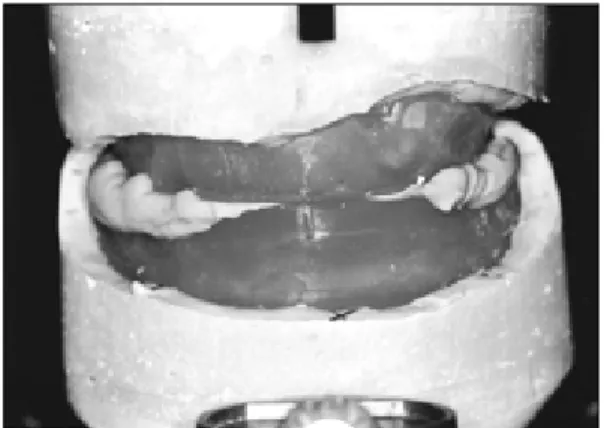
Fig. 3.Mounting of Wax rim, cast.
Fig. 5.keeper connection.
Fig. 4. Tooth arrangement.
Fig. 6.Manget.
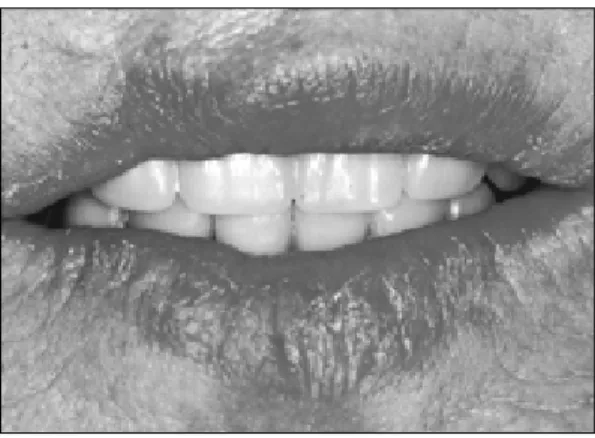
Fig. 8.Anterior view.
Fig. 7.Mangnet connection.
CASE 2 :
RESTORATION WITH IMPLANT- SUPPORTED OVERDENTURE
(BAR ATTACHMENT)
65 years old patient(Female) was selected. The
same procedure as the above case was done at sur- gical procedure. 2 fixtures(3.75�13mm, Nobel biocare) were installed at the canine sites of the mandible(Fig. 9�10).
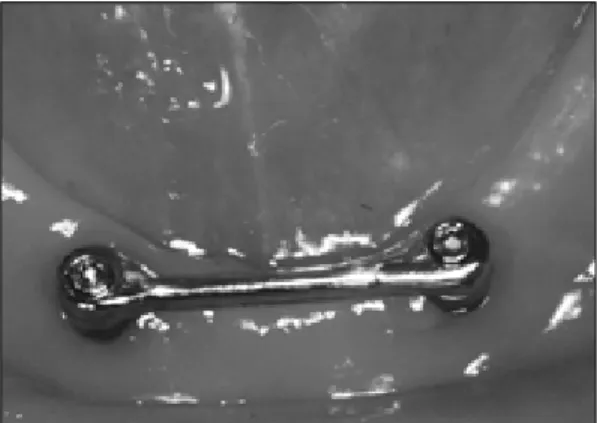
After connecting standard abutment(Nobel biocare), Hader bar was fabricated(Fig. 11).
Fig. 9. Intraoral view. Fig. 10. Installed fixture.
Fig. 11.Hader bar fabrication.
In the month, plastic clip is attached to the new denture with pink self-curing resin. Denture
was delivered to the patient(Fig. 12�14).
CASE 3 :
RESTORATION WITH IMPLANT- SUPPORTED FIXED PROSTHESIS
61 years olds(Female) patient was selected.
Between mental foramen, 5 fixture(3.75�13mm, Nobel biocare) were installed. Primary flap clo- sure was achieved. Removable denture was adjusted with a soft liner.
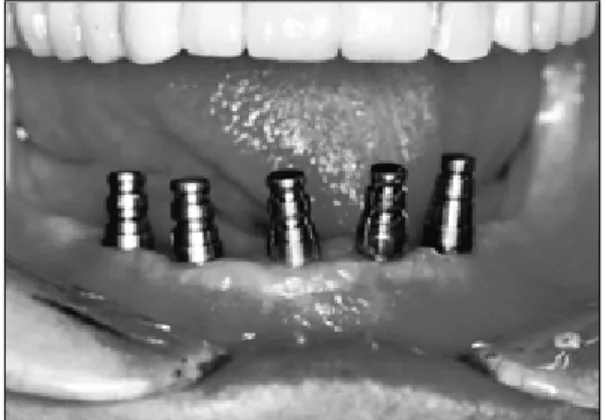
At second-stage surgery, panoramic radiograph was taken. Healing abutment were placed and the temporary denture was adjusted. Estheticone abutments(Nobel biocare) were connected and Fig. 12. Hader bar connection. Fig. 13. Clip connetion.
Fig. 15.Fixture installation. Fig. 16.Estheticone abutment.
Fig. 14.Ant. view after denture delivery.
Fig. 17. Impression coping connection. Fig. 18. Wax denture try-in.
Fig. 19. Putty index. Fig. 20. PFG framework.
Fig. 21. Occlusal view of PFG Br.
impression was taken(Fig. 15�17).
Denture tooth was arranged on the wax rim like complete denture procedure.
Putty index was taken for laboratory proce-
dure(Fig. 18�19).
After PFG framework was completed, Implants were restored with fixed ceramometal prosthe- sis(Fig. 20�22).
Fig. 22.Ant. view of PFG Br.
REFERENCES
1. Chaushu G., Schwartz-Arad D. Full-arch restora- tion of the jaw with fixed ceramo-metal prosthesis:
late implant placement. J Periodontol 1999 Jan;70(1):90-4.
2. Naert IE., Gizani S., Vuylsteke M., van Steenberghe D. A randomised clinical trial on the influence of splinted and unsplinted oral implants in mandibu- lar overdenture therapy. A 3-year report. Clin Oral Investig 1997 Jun;1(2):81-8.
3. Naert IE, Hooghe M, Quirynen M, van Steenberghe D. The reliability of implant-retained hinging overdentures for the fully edentulous mandible. An up to 9-year longitudinal study. Clin Oral Investig 1997 Sep;1(3):119-24.
4. Batenburg RH, Meijer HJ, Raghoebar GM, Vissink A. Treatment concept for mandibular overdentures supported by endosseous implants: a literature re-
view. Int J Oral Maxillofac Implants. 1998 Jul- Aug;13(4):539-45.
5. Batenburg RH, Raghoebar GM, Van Oort RP, Heijdenrijk K., Boering G. Mandibular overden- tures supported by two or four endosteal im- plants. A prospective, comparative study. Int J Oral Maxillofac Surg. 1998 Dec;27(6):435-9.
6. Tharp GE Fabrication of a mandibular implant over- denture. Miss Dent Assoc J 1999 3rd Quarter;
55(3):34-5.
Reprint requests to:
DR. YUNG-SOOKIM
DEPARTMENT OFPROSTHODONTICS, COLLEGE OFDENTISTRY,
SEOULNATIONALUNIVERSITY
28, YONKON-DONG, CHONGRO-KU, SEOUL,110-749, KOREA
E-mail:[email protected]