• 검색 결과가 없습니다.

Implant Overdenture using the Locator System and the Gothic Arch Tracer in a Mandibular Edentulous Patient: A Clinical Report

N/A
N/A
Protected

Academic year: 2021

Share "Implant Overdenture using the Locator System and the Gothic Arch Tracer in a Mandibular Edentulous Patient: A Clinical Report"

Copied!
12
0
0

로드 중.... (전체 텍스트 보기)

전체 글

(1)

Received: November 21, 2016 Revised: December 2, 2016 Accepted: December 2, 2016

Copyright © 2016. The Korean Academy of Oral &

Maxillofacial Implantology

This is an Open Access article distributed under the terms of the Creative Commons Attrib- ution Non-Commercial License (http://creative- commons.org/licenses/by-nc/4.0/) which permits unrestricted non-commercial use, distribution, and reproduction in any medium, provided the original work is properly cited.

pISSN : 1229-5418

Implantology 2016; 20(4): 208-219 http://dx.doi.org/10.000/implant.2016.20.2.048 eISSN : 0000-0000

OPEN ACCESS

Implant Overdenture using the Locator System and the Gothic Arch Tracer in a Mandibular Edentulous Patient: A Clinical Report

Seoung-Jin Hong

1

, Seung-Ryong Ha

1

*, Dong-Jae Seong

1

, Hyeon-Min Kim

2

, Jae-Hyuk Ban

3

, Hyun-Woo Kim

4

1

Department of Dentistry, Ajou University School of Medicine, Suwon, Korea

2

Department of Oral and Maxillofacial Surgery, Gil Medical Center, Gachon University, Incheon, Korea

3

Department of Oral and Maxillofacial Surgery, BK Dental Hospital, Cheongju, Korea

4

Director of Yongin Seoul Dental Clinic, Yongin, Korea

*Corresponding author: Seung-Ryong Ha, [email protected]

Abstract

Patients restored with the mandibular complete denture were often faced with complications of poor stability and retention of the prosthesis. Two implants overdenture is recognized as a standard treatment method for the edentulous mandible. In a 64-year-old man who represented severe mobility in all remaining teeth, the maxillary complete denture and the mandibular implant-retained overdenture were planned after extracting all the remaining teeth. Two implants were placed in mandibular both canine regions. To fabricate the denture, final impression was taken using a duplicate of the existing temporary denture. It is difficult to guide the mandible into the centric relation position in some denture patients. The Gothic arch tracer was used for accurate centric relation record. For conjunction with dental implants, locator attachments were used.

Keywords: Denture precision attachment, Gothic arch tracer, Implant overdenture

I. Introduction

Patients wearing complete dentures are frequently suffered from problems of poor

retention and instability of the denture, low chewing efficiency, and pain during

mastication. Several clinical reports have described that these complications may be

successfully improved by implant-retained or implant-supported dental prostheses 1-3 .

According to McGill consensus statement 4 , two implants overdenture is recognized as

the standard treatment of edentulous mandible and the evidence exists. Many studies

have demonstrated that implant-retained overdenture in mandible provides improvement

in retention, stability, chewing efficiency, biting force, quality of life, and patient

satisfaction 5-7 . Because of the smaller prosthesis space requirement, ease of cleansing,

(2)

lower technical sensitivity, and more economical advantages, solitary type have been preferred to bar type attachments 8,9 . Compared to other solitary type attachments, locators are required smaller space 10 , dual retention structure (the outer and inner contact surfaces between female and male parts) 11 and higher retention force 12 . Additionally, locators are self-aligning 12 , compensation for up to 40° implants axial discrepancy is possible 11 and could be easily repaired and replaced 13 .

It is not easy to induce the mandible into the centric relation position for some denture patients resulted from the wrong habitual closure due to inadequate dentures 14 , trismus 15 , or temporomandibular joint abnormalities 16-19 . Several methods of manipulating centric relation have been demonstrated in the literature 20 . The Gothic arch tracing is the one of those methods. It is reported that it could produce a precise and reproducible centric relation record 21-23 . This study demonstrates the application of a Gothic arch tracer and locator attachments for fabrication of the maxillary complete denture and the mandibular implant-retained overdenture.

II. Case report

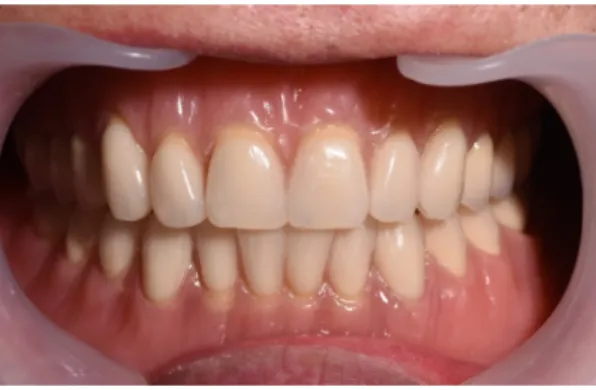
A 64-year-old healthy man visited the Ajou University Dental Hospital for treatment of his maxillary complete denture and mandibular removable partial denture. All the remaining teeth had severe mobility (Fig. 1). After extracting of all the remaining teeth, maxillary complete denture and mandibular implant-retained overdenture were planned. There was no problem of medical history for implant placement.

Fig. 1. Intraoral photo taken at first visit.

Seoung-Jin Hong et al . : Implant Overdenture using the Locator System and the Gothic Arch Tracer in a Mandibular Edentulous Patient: A

Clinical Report. Implantology 2016

(3)

An impression was taken using alginate impression materials (Aroma Fine Plus Normal set, GC, Japan) for the fabrication of an immediate temporary denture. The record base and occlusion rim was produced, contoured for phonetics, esthetics, and determined vertical dimension of occlusion. The Gothic arch tracer (Gnathometer M type 2, Ivoclar Vivadent, Germany) was attached to the record base and occlusion rim so that the central bearing pin was located in the center of the tracing plate.

The pin was adjusted for lightly touched on the plate. Wax of occlusal rim was removed until the central bearing point was the only contact between the mandibular and maxillary record bases.

Record bases were placed intraorally and instruction of mandibular movements to the patient was necessary to record a Gothic arch tracing. After the patient has described a well-defined Gothic arch, a dimple was made in the recorded plate at the apex of the arrow for maintenance in centric relation during a record was being made. In this way, the interocclusal record of centric relation was obtained using the Gothic arch tracer. A temporary denture was prepared and the remained teeth were extracted and followed by the immediate placement of the internal submerged type implants on #33 (4.0 mm × 11.5 mm; AR System, Biotem, Seongnam, Korea) and #43 (4.0 mm × 10.0 mm; AR System, Biotem, Seongnam, Korea). Two mandibular implants in both canine regions were surgically placed following the manufacturer’s protocol, and final implant insertion torques, greater than 30 Ncm were achieved (Fig. 2, 3). A healing abutment, measuring 4.5 mm in diameter with 5 mm in height (HAA455S, Biotem, Seongnam, Korea) on #33 and 4.5 mm in diameter with 7 mm in height (HAA457S, Biotem, Seongnam, Korea) on #43, was tightened onto the implant. The temporary denture was relined by a tissue conditioner (Visco-gel, Dentsply, Germany) and placed.

Fig. 2. Placement of implant fixtures (AR system, Biotem, Seongnam, Korea).

Seoung-Jin Hong et al . : Implant Overdenture using the Locator System and the Gothic Arch Tracer in a Mandibular Edentulous Patient: A

Clinical Report. Implantology 2016

(4)

Fig. 3. Panoramic view after placement of implant fixtures.

Seoung-Jin Hong et al . : Implant Overdenture using the Locator System and the Gothic Arch Tracer in a Mandibular Edentulous Patient: A Clinical Report. Implantology 2016

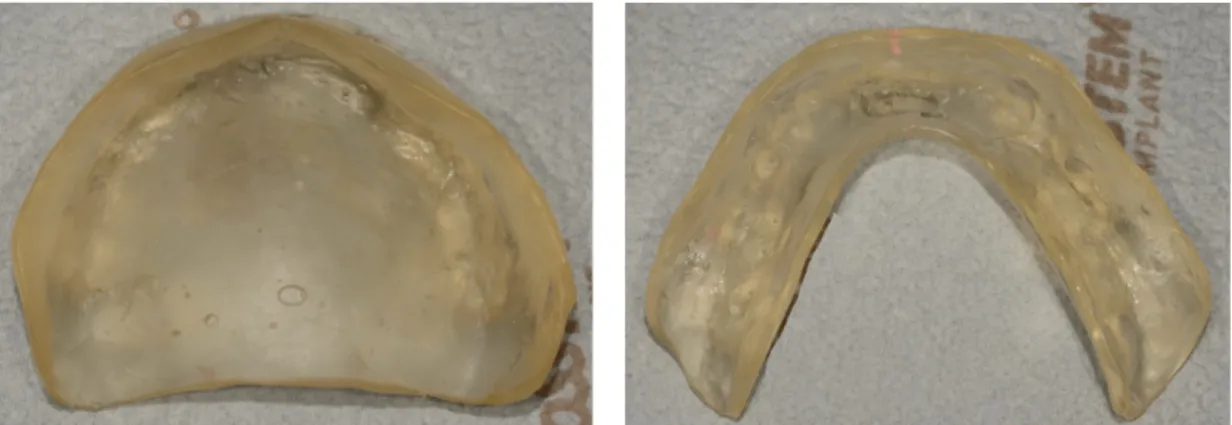
Fig. 4. Upper and lower temporary dentures were duplicated with acrylic resin to use as a custom tray.

Seoung-Jin Hong et al . : Implant Overdenture using the Locator System and the Gothic Arch Tracer in a Mandibular Edentulous Patient: A Clinical Report. Implantology 2016

Fig. 5. The interocclusal record of centric relation was checked using the Gothic arch tracer with the vinyl polysiloxane bite registration material and the horizontal incisal line was marked using bonding brush.

Seoung-Jin Hong et al . : Implant Overdenture using the Locator System and the Gothic Arch Tracer in a Mandibular Edentulous Patient: A

Clinical Report. Implantology 2016

(5)

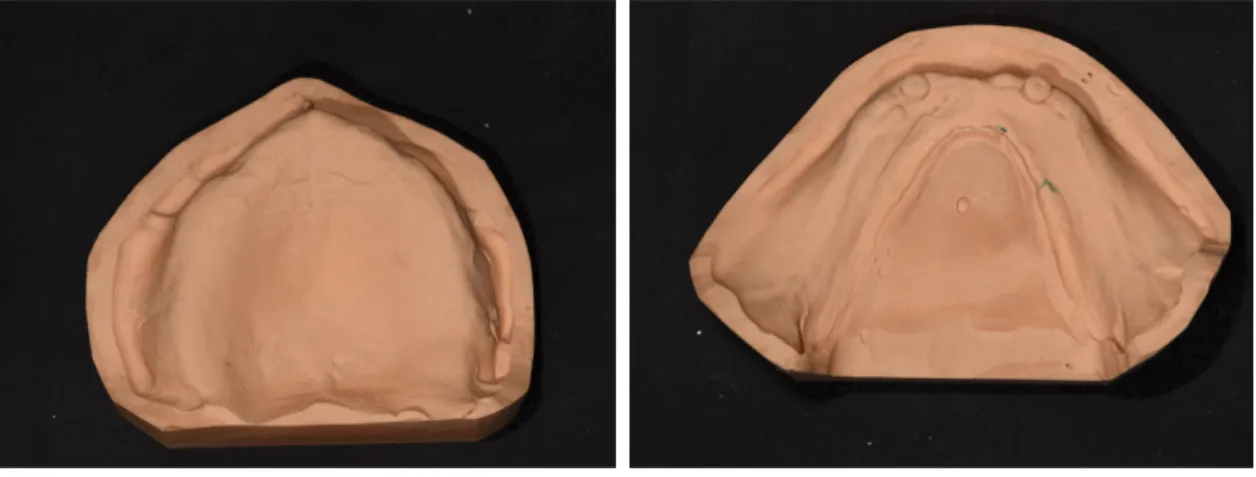
Fig. 6. Master model fabricated.

Seoung-Jin Hong et al . : Implant Overdenture using the Locator System and the Gothic Arch Tracer in a Mandibular Edentulous Patient: A Clinical Report. Implantology 2016

3 months after implant placement, a new set of temporary dentures for custom tray was duplicated to precisely represent definitive prosthesis occlusion. The maxillary and mandibular temporary denture was duplicated in acrylic resin (Orthodontic Resin, Dentsply, USA) (Fig. 4). Final impressions were taken with the polyether impression material (Monophase, 3M ESPE, Germany) after border molding with modeling plastic impression compound (Peri Compound, GC, Japan) using a custom tray duplicated of the temporary denture. Wash impressions were taken by closed mouth functional impression technique. In this case, temporary denture was duplicated as a custom tray, for appropriate horizontal relation and vertical dimensions, jaw relations were recorded. The patient was asked various functional movements of closed mouth such as Gothic arch tracing in the pre-recorded vertical dimension. Functional movements were depicted by the patients. The interocclusal record of centric relation was checked using the Gothic arch tracer with the vinyl polysiloxane bite registration material (Futar D, Roydent, USA) and the horizontal incisal line was marked using bonding brush (Dental Lab Disposable Micro applicators Brushes, Dental supply in, China) (Fig. 5).

The stone cast was mounted in a semi-adjustable articulator (Stratos ® 300, Ivoclar Vivadent, Germany) (Fig. 6). Acrylic artificial teeth (SR Vivodent, Ivoclar Vivadent, Germany) were set on the semi-adjustable articulator. For ideal tooth set-up with a dorsal increase of the occlusal plane in models according to the Spee and Wilson curves into account, a setting-up template was used (Fig. 7).

Wax dentures try-in were done in the mouth. Fit, esthetics, retention, stability and support were

evaluated finally. For the improvement of retention, the relining impression of the maxillary complete

denture was made with the polyether impression material (Monophase, 3M ESPE, Germany) and the

(6)

Fig. 7. Ideal tooth set-up with a dorsal increase of the occlusal plane in models according to the Spee and Wilson curves.

Seoung-Jin Hong et al . : Implant Overdenture using the Locator System and the Gothic Arch Tracer in a Mandibular Edentulous Patient: A Clinical Report. Implantology 2016

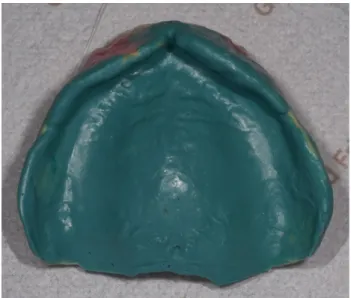
Fig. 8. Relining impression of the maxillary complete wax denture with the polyether impression material (closed-mouth technique with an occlusal interdigitation).

Seoung-Jin Hong et al . : Implant Overdenture using the Locator System and the Gothic Arch Tracer in a Mandibular Edentulous Patient: A Clinical Report. Implantology 2016

closed-mouth technique with an occlusal inter-digitation using the maxillary wax-denture (Fig. 8).

The midline was corrected. The setting of acrylic artificial teeth was also corrected. Final

prostheses were fabricated by the heat curing system. Curing definitive denture and laboratory

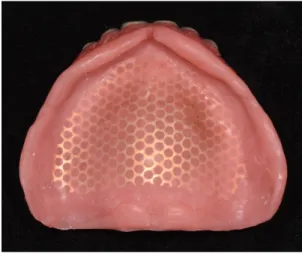
remounting was performed, but was not grinded because of balanced occlusion (Fig. 9-11).

(7)

Fig. 9. Definitive dentures.

Seoung-Jin Hong et al . : Implant Overdenture using the Locator System and the Gothic Arch Tracer in a Mandibular Edentulous Patient: A Clinical Report. Implantology 2016

Fig. 10. Intaglio surface of upper denture.

Seoung-Jin Hong et al . : Implant Overdenture using the Locator System and the Gothic Arch Tracer in a Mandibular Edentulous Patient: A Clinical Report. Implantology 2016

Fig. 11. Intaglio surface of lower denture.

Seoung-Jin Hong et al . : Implant Overdenture using the Locator System and the Gothic Arch Tracer in a Mandibular Edentulous Patient: A

Clinical Report. Implantology 2016

(8)

The definitive denture was delivered in patient oral cavity. The retention, stability, and esthetic was evaluated and denture was shown to be properly fabricated (Fig. 12, 13). The healing abutments were taken off and hand-tightened in a clockwise direction. Mobility, clinical signs of infection, pain and radiographic bone loss were not shown, and the implants were convinced to be osseointegrated.

Abutments of 4 mm cuff height on #33 (HG Locator ® Abutment; Standard, Zest Anchors, USA) and 5 mm on #43 were tightened to 30 Ncm on both implants. The blue male part (Liner, Zest Anchors, USA) of the locator was then incorporated into the overdenture with a direct technique using an auto-polymerizing pattern resin (Pattern Resin LS, GC, America). The overdenture was polished and then inserted in the mouth, and minimal adjustments were taken to the occlusion and fit. The patient was instructed prosthetic maintenance and oral hygiene. At a 1-year follow-up after treatment, the patient remained satisfied with his treatment choice and its effect on his masticatory efficiency and quality of life.

Fig. 12. The definitive denture was placed in the oral cavity.

Seoung-Jin Hong et al . : Implant Overdenture using the Locator System and the Gothic Arch Tracer in a Mandibular Edentulous Patient: A Clinical Report. Implantology 2016

Fig. 13. Extra-oral view of lip support. Before (left) and after (right) treatment.

Seoung-Jin Hong et al . : Implant Overdenture using the Locator System and the Gothic Arch Tracer in a Mandibular Edentulous Patient: A

Clinical Report. Implantology 2016

(9)

III. Discussion

Implant overdenture treatment can provide the appropriate support, retention and stability of the denture, and restored functions and esthetic such as lip support and phonation via a denture flange 24 . When planning a bar attachment, the inter-arch distance has to be evaluated. Pasciuta et al. 25 described that minimum 14 mm inter-arch distance was required when considering artificial teeth, denture base, bar thickness, and the hygienic space from the bar to the mucosa. When the inter-arch distance is insufficient, the bar attachment may resulted in over-contour of the denture, fracture of the denture, or poor oral hygiene 10 . When bar splinting attachments is considered for retention, the resilient type ERA attachments, and different direction multiple clips, the rigid type friction pin, and swivel latchet have been used previously 8 . Retention loss is the problem in such attachment caused by wearing during the repeated removal and insertion of the denture 26 . In that case, plastic male parts may be changed. However, metal female parts are required to re-manufacture. To avoid this situation, the locator attachment system can be selected. It allows 0.2 mm vertical movement and durable. The locator is easy to use and post-treatment complications are less. Special technical training is not required. The reported satisfaction of the patient is quite high 27 . In the majority of the attachment systems, reduction 28 or total loss in retentive force was found 9 . The wear patterns and related deformations of attachment during the mastication are different from during insertion-removal procedure. Denture rotation around the attachments resulted from displacing mucosa under the base of the denture when occlusal loads are applied 29 . The resiliency of attachments is determined by the amount of transmitted loads to the attachments from occlusal loads 30,31 . For reducing the denture movement and, thereby, also reducing the forces on the implants, an optimal stress distribution is important 32 . The locator retentive force is decreased down to 40% of its full retentive values when simulated mastication with a non-linear descending curve. The nylon parts were severely worn 33 . This represents maintenance correlated with mastication is needed for locator system 33 .

For the successful restoration in edentulous patients, the appropriate centric relation record is required. The wear and the deformation of attachment can be reduced by accurate centric relation.

The retentive force is also maintained for a long time, relatively. A precise centric relation record can

be obtained using the Gothic arch tracer. In addition, for the accuracy of the Gothic arch tracer

record, stable record bases are prerequisite. Especially in the Gothic arch tracing technique,

inaccuracy could be resulted from any movement of the record bases during recording of centric

relation. The closed mouth functional impression technique was used and interocclusal record of

(10)

centric relation was checked using Gothic arch tracer simultaneously, contribute to stabilize bases, and thereby minimize movement of bases during the tracing and mounting procedures.

IV. Conclusion

This clinical report describes complete denture in the maxilla and the implant overdenture using the locator system in the mandible for edentulous patient. For accurate centric relation record, the interocclusal record was obtained using the Gothic arch tracer.

References

1. Awad MA, Lund JP, Shapiro SH, et al. Oral health status and treatment satisfaction with mandibular implant overdentures and conventional dentures: a randomized clinical trial in a senior population. Int J Prosthodont. 2003; 16(4): 390-396.

2. Thomason JM, Lund JP, Chehade A, et al. Patient satisfaction with mandibular implant overdentures and conventional dentures 6 months after delivery. Int J Prosthodont. 2003; 16(5): 467-473.

3. Raghoebar GM, Meijer HJ, van’t Hof M, et al. A randomized prospective clinical trial on the effectiveness of three treatment modalities for patients with lower denture problems. A 10 year follow-up study on patient satisfaction. Int J Oral Maxillofac Surg. 2003; 32(5): 498-503.

4. Feine JS, Carlsson GE, Awad MA, et al. The McGill consensus statement on overdentures. Mandibular two-implant overdentures as first choice standard of care for edentulous patients. Gerodontology. 2002;

19(1): 3-4.

5. Awad MA, Lund JP, Dufresne E, et al. Comparing the efficacy of mandibular implant-retained overdentures and conventional dentures among middle-aged edentulous patients: satisfaction and functional assessment. Int J Prosthodont. 2003; 16(2): 117-122.

6. Allen PF, McMillan AS, Walshaw D. A patient-based assessment of implant-stabilized and conventional complete dentures. J Prosthet Dent. 2001; 85(2): 141-147.

7. van der Bilt A, van Kampen FM, Cune MS. Masticatory function with mandibular implant-supported overdentures fitted with different attachment types. Eur J Oral Sci. 2006; 114(3): 191-196.

8. Trakas T, Michalakis K, Kang K, et al. Attachment systems for implant retained overdentures: a literature review. Implant Dent 2006; 15(1): 24-34.

9. Alsabeeha NH, Payne AG, Swain MV. Attachment systems for mandibular two-implant overdentures: a review of in vitro investigations on retention and wear features. Int J Prosthodont. 2009; 22(5): 429-40.

10. Lee CK, Agar JR. Surgical and prosthetic planning for a two-implant-retained mandibular overdenture:

a clinical report. J Prosthet Dent. 2006; 95(2): 102-105.

11. Nguyen CT, Masri R, Driscoll CF, et al. The effect of denture cleansing solutions on the retention of

pink Locator attachments: an in vitro study. J Prosthodont. 2010; 19(3): 226-230.

(11)

12. Sadig W. A comparative in vitro study on the retention and stability of implant-supported overdentures.

Quintessence Int. 2009; 40(4): 313-319.

13. Kleis WK, Kammerer PW, Hartmann S, et al. A comparison of three different attachment systems for mandibular two-implant overdentures: one-year report. Clin Implant Dent Relat Res. 2010; 12(3):

209-218.

14. Celar AG, Kundi M, Piehslinger E, et al. Mandibular position at chin-point guided closure, intercuspation and final deglutition in asymptomatic and temporomandibular dysfunction subjects. J Oral Rehabil.

2000; 27(1): 70-78.

15. McCarthy JA, Knazan YL. Craniomandibular dysfunction among an edentulous Canadian population.

Gerodontics. 1987; 3(4): 155-160.

16. van der Laan GJ, Duinkerke AS, Luteijn F, et al. Relative importance of psychologic and social variables in TMJ pain dysfunction syndrome (PDS) signs. Community Dent Oral Epidemiol. 1988;

16(2): 117-121.

17. Klemetti E. Signs of temporomandibular dysfunction related to edentulousness and complete dentures:

an anamnestic study. Cranio. 1996; 14(2): 154-157.

18. Raustia AM, Peltola M, Salonen MA. Influence of complete denture renewal on craniomandibular disorders: a 1-year follow-up study. J Oral Rehabil. 1997; 24(1): 30-6.

19. Zuccolotto MC, Nobilo KA, Nunes Lde J, et al. Sliding plates on complete dentures as a treatment of temporomandibular disorder: a case report. Cranio. 1999; 17(4): 289-292.

20. Myers ML. Centric relation records-historical review. J Prosthet Dent. 1982; 47(2): 141-145.

21. el-Aramany MA, George WA, Scott RH. Evaluation of the needle point tracing as a method for determining centric relation. J Prosthet Dent. 1965; 15(6): 1043-1054.

22. Smith HF, Jr. A comparison of empirical centric relation records with location of terminal hinge axis and apex of the gothic arch tracing. J Prosthet Dent. 1975; 33(5): 511-520.

23. Myers M, Dziejma R, Goldberg J, et al. Relation of Gothic arch apex to dentist-assisted centric relation.

J Prosthet Dent. 1980; 44(1): 78-81.

24. Naert I, De Clercq M, Theuniers G, et al. Overdentures supported by osseointegrated fixtures for the edentulous mandible: a 2.5-year report. Int J Oral Maxillofac Implants. 1988; 3(3): 191-196.

25. Pasciuta M, Grossmann Y, Finger IM. A prosthetic solution to restoring the edentulous mandible with limited interarch space using an implant-tissue-supported overdenture: a clinical report. J Prosthet Dent. 2005; 93(2): 116-120.

26. Chung KH, Chung CY, Cagna DR, et al. Retention characteristics of attachment systems for implant overdentures. J Prosthodont. 2004; 13(4): 221-226.

27. Daou EE. Biomaterial aspects: A key factor in the longevity of implant overdenture attachment systems. J Int Soc Prev Community Dent. 2015; 5(4): 255-262.

28. Tabatabaian F, Alaie F, Seyedan K. Comparison of three attachments in implant-tissue supported overdentures: an in vitro study. J Dent (Tehran). 2010; 7(3): 113-118.

29. Porter JA, Jr., Petropoulos VC, Brunski JB. Comparison of load distribution for implant overdenture attachments. Int J Oral Maxillofac Implants. 2002; 17(5): 651-662.

30. Mericske-Stern R. Three-dimensional force measurements with mandibular overdentures connected to implants by ball-shaped retentive anchors. A clinical study. Int J Oral Maxillofac Implants. 1998;

13(1): 36-43.

(12)

31. Heckmann SM, Winter W, Meyer M, et al. Overdenture attachment selection and the loading of implant and denture-bearing area. Part 2: A methodical study using five types of attachment. Clin Oral Implants Res. 2001; 12(6): 640-647.

32. Tokuhisa M, Matsushita Y, Koyano K. In vitro study of a mandibular implant overdenture retained with ball, magnet, or bar attachments: comparison of load transfer and denture stability. Int J Prosthodont. 2003; 16(2): 128-134.

33. Abi Nader S, de Souza RF, Fortin D, et al. Effect of simulated masticatory loading on the retention of

stud attachments for implant overdentures. J Oral Rehabil. 2011; 38(3): 157-64.

수치

Fig. 1. Intraoral photo taken at first visit.
Fig. 2. Placement of implant fixtures (AR system, Biotem, Seongnam, Korea).
Fig. 4. Upper and lower temporary dentures were duplicated with acrylic resin to use as a custom tray.
Fig. 6. Master model fabricated.
+4

참조

관련 문서

The aim of this study is to compare the coronal bone loss and patient satisfaction between 1 and 2 implant anchored mandibular overdenture by immediate loading protocol..

Removable partial denture restoration using single implant supported with Locator � � attachment in a crossed occlusion patient: a case report.. Woon-Chul Shin, DDS,

Associate professor, Department of Prosthodontics, School of Dentistry, Pusan National University, Yangsan, Gyeongnam 626-770, Korea.. 완 전 무치악 환자에서