Clinical Performance of the 1st American Academy of
Orthopaedic Surgeons Clinical Guideline on Prevention of
Symptomatic Pulmonary Embolism after Total Knee Arthroplasty in Korean Patients
We sought to document the clinical performance of the 1st American Academy of Orthopaedic Surgeons (AAOS) guideline on the prevention of symptomatic pulmonary embolism (PE) after total knee arthroplasty (TKA) in Korean patients, in terms of the proportions of the each risk-stratified group, efficacy and safety. Consecutive 328 patients underwent TKA were preoperatively assessed for the risks of PE and bleeding and
categorized into 4 groups: 1) standard risk, 2) high risk for PE, 3) high risk for bleeding, and 4) high risks both for PE and bleeding. One of three options was administered according to the groups (aspirin in group 1 or 4; enoxaparin and following aspirin in group 2; antithrombotic stocking in group 3). Incidences of symptomatic deep vein thrombosis (DVT) and PE, and major or minor bleeding complications were evaluated. Majority of the patients (86%) were assessed to be with standard risks both for PE and bleeding. No patient experienced symptomatic DVT or PE and major bleeding. Eleven percent of the patients discontinued chemoprophylaxis because of bleeding-related wound complication.
In conclusion, the 1st AAOS guideline functions successfully in Korean patients undergoing TKA in terms of prevention of symptomatic DVT and PE while avoiding major bleeding complications.
Keywords: Arthroplasty, Replacement, Knee; Venous Thromboembolism; Pulmonary Embolism; Venous Thrombosis; Hemorrhage; Chemoprevention; Aspirin; Enoxaparin;
AAOS Guideline Young Gon Na,1 Rui Fang,2 Yeon Ho Kim,1
Kwan Jae Cho,1 and Tae Kyun Kim1,3
1Joint Reconstruction Center, Seoul National University Bundang Hospital, Seongnam, Korea;
2Department of Orthopedic Surgery, Xinjiang Medical University, Urumqi, Xinjiang, China;
3Department of Orthopedic Surgery, Seoul National University College of Medicine, Seoul, Korea Received: 11 February 2015
Accepted: 1 September 2015 Address for Correspondence:
Tae Kyun Kim, MD
Joint Reconstruction Center, Department of Orthopaedic Surgery, Seoul National University Bundang Hospital, 166 Gumi-ro, Bundang-gu, Seongnam 13620, Korea Tel: +82.31-787-7196, Fax: +82.31-787-4056, E-mail: [email protected]
http://dx.doi.org/10.3346/jkms.2015.30.12.1865 • J Korean Med Sci 2015; 30: 1865-1873
INTRODUCTION
Venous thromboembolism (VTE), consisted of deep-vein throm- bosis (DVT) and pulmonary embolism (PE), is a well-known serious complication after total knee arthroplasty (TKA) (1,2).
Without prophylaxis after TKA, the overall incidence of DVT ranges from 41% to 85% and that of proximal thrombosis ranges from 5% to 22% (1). Especially, PE can be fatal if once developed, even though its incidence was reported much lower than DVT (3). Therefore, appropriate prophylaxis of VTE should be con- sidered after TKA. However, adopting optimal prophylactic pro- tocol in clinical practice remains challenging task for orthope- dic surgeons (3,4).
As clinical guidelines for prevention of VTE by American Col- lege of Chest Physicians (ACCP) gained popularity, many ortho- pedic surgeons have experienced significant bleeding compli- cations after TKA. It seemed largely to stem from the fact that this guideline regarded arthroplasty per se as high risk factor for VTE and emphasized a routine use of potent thromboprophy- lactic drugs after arthroplasty (1,5-8). In the meanwhile, the Amer-
ican Academy of Orthopaedic Surgeons (AAOS) clinical guide- line on prevention of symptomatic pulmonary embolism in pa- tients undergoing total hip and knee arthroplasty, which was issued in 2007, was tried to balance the prevention of VTE and avoiding bleeding complications (2). According to the AAOS guideline, individualized prophylactic measures were recom- mended for each 4 types of risk-stratified groups based on pre- operative assessment of the risks for symptomatic PE and ma- jor bleeding, paying equivalent attention to the prevention of both PE and major bleeding complication (4). Considering that the ideal prophylactic protocol should prevent VTE while avoid- ing bleeding complications related to the VTE prophylaxis, the AAOS guideline was theoretically appealing concept for ortho- pedic surgeons. Although the 1st AAOS guideline had been es- tablished based on the relatively weak evidences, and conse- quently the risk-stratified approach has been mostly retrieved on its recent 2nd edition, the 1st AAOS guideline has substan- tial value as the prototype of risk-stratified, individualized VTE prophylaxis strategy (9,10). However, proper evaluation of the 1st AAOS guideline has not been conducted well in the process Musculoskeletal Disorders
of its renewal and transition to the 2nd guideline, and the re- sults of its clinical application have not been reported in the lit- erature.
This study aimed to demonstrate the clinical performance of the 1st AAOS guideline, in terms of the proportions of the each four risk-stratified group, efficacy (prevention of symptomatic PE and DVT) and safety (avoidance of bleeding complications).
We hypothesized that the majority of the patients would have standard risks for both PE and bleeding and application of this AAOS guideline would provide satisfactory efficacy and safety.
MATERIALS AND METHODS Study design and subjects
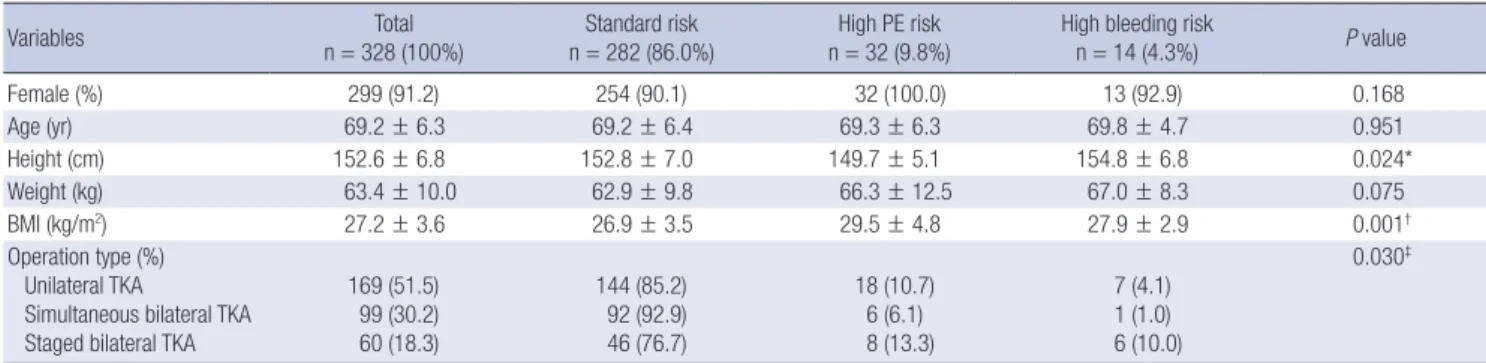
Retrospective cohort study using prospectively collected data of consecutive 328 patients was performed who undergoing pri- mary TKA due to advanced osteoarthritis, from April 2008 to March 2009 at our institution. No patients were excluded for any reasons. There were 299 females (91.2%) and 29 males (8.8%) with the mean age of 69.2 yr (SD, 6.3; range, 54-78) (Table 1). The mean body mass index (BMI) was 27.2 kg/m2 (SD, 3.6; range, 21.8-36.9). One hundred sixty-nine patients (51.5%) underwent unilateral TKA whereas simultaneous or staged bilateral TKAs were performed on 99 (30.2%) and 60 patients (18.3%) respec- tively.
Surgical procedure and postoperative care
All TKAs were performed by a single surgeon using the stan- dard medial parapatellar arthrotomy with a tourniquet. One of the two posteriorly stabilized prostheses (Genesis II; Smith and Nephew, Memphis, USA and e.motion; B.Braun Aesculap, Tut- tlingen, Germany) was implanted for every patient. In all cases, patellar resurfacing and cement fixation were done. A closed suction drainage was placed subcutaneously before wound clo- sure. A compressive dressing was applied with an immobilizer during the first 24 hr after surgery, and patients were encour-
aged to perform quadriceps strengthening exercises after they had returned to the ward from the recovery unit. After the first 24 hr, all patients were allowed to walk as tolerated using with a walker and start active and passive range-of-motion (ROM) ex- ercises. The continuous passive motion (CPM) machine was used twice a day, and ROM was increased as tolerated until discharge.
Patients were discharged between 7 to 10 days after surgery.
The same protocol for anesthesia, pain control, antibiotics and blood transfusion were applied to all patients. Neuraxial anesthesia such as spinal anesthesia for unilateral or staged bi- lateral TKA and combined spinal-epidural anesthesia for simul- taneous bilateral TKA was carried out. For pain control, preemp- tive analgesics were administered preoperatively, and multiple modalities, such as continuous femoral nerve block, intrave- nous patient controlled analgesia (PCA) or epidural PCA, oral analgesics, and acute pain rescuer injections, were employed postoperatively. Allogenic blood transfusion was done only when hemoglobin level dropped below 7.0 g/dL or when it fell to a level between 7.0 and 8.0 g/dL with anemic symptoms and signs, such as drop in systolic blood pressure below 100 mmHg, tachy- cardia defined as heart rate over 100 beats/min, or decreased urine output of less than 30 mL/hr, even after volume replacement with 500 mL of normal saline.
Risk stratification and thromboprophylaxis regimen We preoperatively assessed the risks of pulmonary embolism and bleeding complications in all patients using medical histo- ry and laboratory results. Then all patients were prospectively stratified into 4 groups, based on the thorough preoperative risks assessments: 1) standard risks for both PE and bleeding, 2) increased risk for PE and standard risk for bleeding, 3) standard risk for PE and increased risk for bleeding, and 4) increased risks for both PE and bleeding. Risk assessment criteria were based on the 1st AAOS guideline and National Institute for Health and Clinical Excellence (NICE) guideline issued in 2007 (2,11). De- tailed risk factors for PE and bleeding are listed in the Appendix
Table 1. Demographic feature of the patients in the three groups according to the AAOS guideline
Variables Total
n = 328 (100%) Standard risk
n = 282 (86.0%) High PE risk
n = 32 (9.8%) High bleeding risk
n = 14 (4.3%) P value
Female (%) 299 (91.2) 254 (90.1) 32 (100.0) 13 (92.9) 0.168
Age (yr) 69.2 ± 6.3 69.2 ± 6.4 69.3 ± 6.3 69.8 ± 4.7 0.951
Height (cm) 152.6 ± 6.8 152.8 ± 7.0 149.7 ± 5.1 154.8 ± 6.8 0.024*
Weight (kg) 63.4 ± 10.0 62.9 ± 9.8 66.3 ± 12.5 67.0 ± 8.3 0.075
BMI (kg/m2) 27.2 ± 3.6 26.9 ± 3.5 29.5 ± 4.8 27.9 ± 2.9 0.001†
Operation type (%) Unilateral TKA
Simultaneous bilateral TKA Staged bilateral TKA
169 (51.5) 99 (30.2) 60 (18.3)
144 (85.2) 92 (92.9) 46 (76.7)
18 (10.7) 6 (6.1) 8 (13.3)
7 (4.1) 1 (1.0) 6 (10.0)
0.030‡
Data of age, height, weight, and BMI are presented as mean value ± standard deviation. *The patients with high risk for PE have short stature than patients of other groups;
†The patients with high risk for PE have greater BMI than patients of other groups; ‡There were more patients with standard risks for pulmonary embolism and bleeding in the simultaneous bilateral TKA group than unilateral or staged bilateral TKA groups. AAOS, American Academy of Orthopaedic Surgeons; PE, pulmonary embolism; BMI, Body Mass Index; TKA, total knee arthroplasty.
Table 1.
The individualized postoperative thromboprophylaxis for 4 risk-stratified groups were followed by the 1st AAOS guideline (2). In patients of the elevated risk for PE and standard risk for bleeding group, enoxaparin 40 mg was administrated subcuta- neously on postoperative 1 to 7 days, followed by aspirin 100 mg once daily until postoperative 14 days. In patients of the ele- vated risk of major bleeding with standard risk for PE group, only mechanical prophylaxis (antiembolic elastic stocking) was applied without chemoprophylaxis. In patients of the standard or elevated risk for both PE and major bleeding, aspirin 100 mg was administrated once daily on postoperative 1st to 14th day.
Outcome evaluation
All patients were evaluated until 3 months after surgery, con- cerning the efficacy and safety outcome. Primary efficacy out- come was defined as the overall incidence of symptomatic DVT or PE. All patients were routinely required to visit outpatient clinic at 2 weeks, 6 weeks and 3 months after surgery, and edu- cated to visit emergency unit if any suspicious symptoms of PE developed. If a patient has symptoms which can make suspi- cion of DVT or PE, computerized tomographic (CT) angiogra- phy is performed to confirm the diagnosis of DVT, and CT angi- ography or ventilation-perfusion lung scan is performed to di- agnose PE. Suspicious symptoms or signs of DVT are pain, ede- ma, warmth or erythema of the leg or thigh and Homan’s sign, and those of PE are chest pain or discomfort and dyspnea. Pri- mary safety outcome was the overall incidence of major bleed- ing, which include bleeding in critical organ (retroperitoneal, intracranial, intraocular and intraspinal bleeding), fatal bleed- ing, bleeding leading to reoperation or other intervention, ex- trasurgical site bleeding that leading to fall in the hemoglobin level of ≥ 2 g/dL or that leading to transfusion of ≥ 2 units of packed red blood cells or whole blood (12,13). Secondary safety outcomes were minor bleeding complications and hematologi- cal changes such as the hemoglobin drop and the rate of trans- fusion. While changing wound dressing, we checked any bleed- ing-related wound problems, such as bruise (extending more than 3 cm from the incision margin), subcutaneous hematoma or hemarthrosis, oozing (persisting over 2 days after surgery which soaking 3 pieces of gauze with over 1 cm width). Surgical site infection, either superficial or deep infection, was also eval- uated during wound evaluation. Whether to discontinue che- moprophylaxis was decided on the risk of wound complication that anticipated progressive bleeding or complicated infection.
For the hematological evaluation, the hemoglobin level was chec- ked on the 2nd and 5th postoperative days (POD2 and POD5) and hemoglobin drop was calculated by subtracting those of POD2 or POD5 from the preoperative hemoglobin level. In ad- dition, allogenic or autologous transfusion rate was also noted.
Statistical analysis
Statistical analyses were conducted using SPSS for Windows (version 20.0; IBM, Chicago, IL, USA). The Kolmogorov-Smirnov test was used first to determine whether parameters were nor- mally distributed. The proportions of the each risk-stratified group were assessed and the demographics of each group were compared. The proportions of each group were further evaluat- ed by sub-grouping the patients based on the surgical timing.
The overall incidence of symptomatic DVT and PE or bleeding complications was assessed, as well as the rate of discontinua- tion of the chemoprophylaxis. The incidences of complications were also compared with each group. The overall hematologic results such as hemoglobin drop and allogenic transfusion rate were evaluated and the parameter were compared between the risk-stratified groups with the patient further divided into the unilateral or 1st knees in the staged bilateral TKAs and simulta- neous bilateral TKAs. Statistical significance of the difference between the groups was determined by analysis of variance (ANOVA) with the Bonferroni test as the post-hoc test for con- tinuous variables and chi-square test for categorical variables, regarding P values < 0.05 as statistically significant.
Ethics statement
This study was approved by the institutional review board of Seoul National University Bundang Hospital (IRB No. B-1110/
138-107). Informed consent was waived by the board.
RESULTS
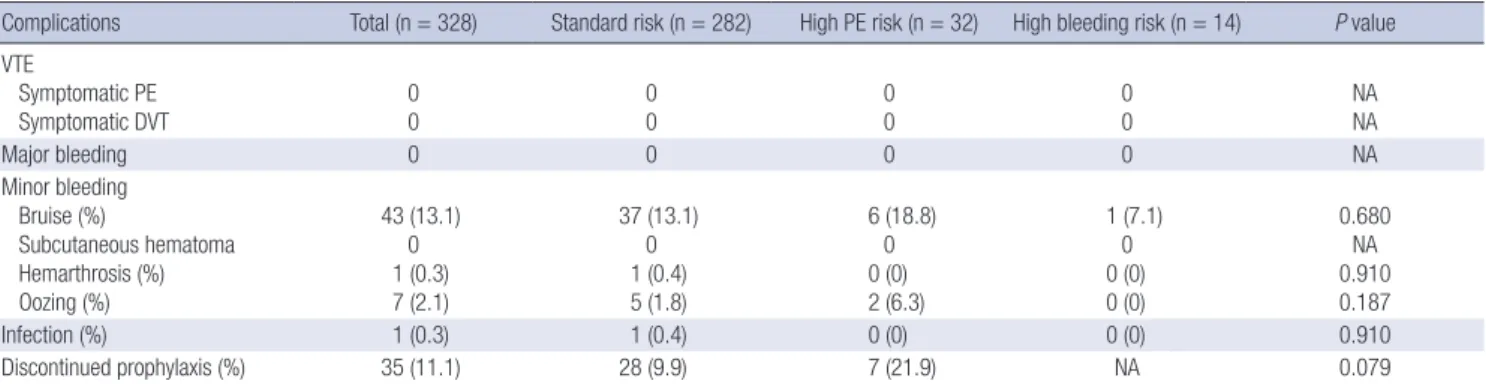
The distribution of the patients over 4 risk-stratified groups was obviously disproportionate and the demographic features are somewhat different between the groups. Of the 328 patients, 282 (86.0%) were categorized to the group with standard risks for both PE and bleeding, 32 (9.8%) to the group with increased risk for PE and standard risk for bleeding, and 14 (4.3%) to the group with standard risk for PE and increased risk for bleeding (Table 1). There were no patients with increased risks for both PE and bleeding. There were significant differences in height (P = 0.024) and BMI (P = 0.001), whereas gender, age and weight were not significantly different. The patients with simultaneous bilateral TKAs were categorized more to the standard risks group and less to the high risk for bleeding groups (P = 0.030) (Table 1). There were no patients experienced symptomatic DVT or PE in this series (Table 2).
There were no patients with any major bleeding complica- tion whereas several minor bleeding complications were noted.
There were 43 patients (13.1%) with bruise and 7 patients (2.1%) with oozing. There was 1 patient (0.3%) with hemarthrosis and deep infection, respectively, but no patients experienced sub- cutaneous hematoma. Among the patients having minor bleed- ing complications, we decided to stop chemoprophylaxis in 35
patients (10.7%) to prevent progressing into more serious com- plications. Statistical significance was not reached by any of the differences in the incidences of any complications among three groups (Table 2).
There were no significant differences in hematologic param- eters, such as hemoglobin drop and transfusion rate, among the three risk-stratified groups (Table 3). The high bleeding risk group was showed greater hemoglobin drop on POD 2 in uni- lateral or 1st staged bilateral TKA patients than other groups, but the differences did not reach statistical significance. In the simultaneous bilateral group, the hemoglobin drop and trans- fusion rate were significantly higher than the unilateral or 1st knee of staged bilateral TKA patients.
DISCUSSION
The most important findings of this study are that the majority of patients have standard risk for both PE and bleeding accord- ing to the risk stratification recommended by the 1st AAOS gui- deline, and that of efficacy and safety are favorable, although
this study was performed in single tertiary hospital in Korea. The group with standard risks for both PE and bleeding accounted for 86.0%, while the patients with increased risk for PE or bleed- ing comprised only 9.8% or 4.3%, respectively. Symptomatic DVT and PE, major bleeding complications are not occurred when followed by the 1st AAOS guideline, although substantial minor bleeding complications were noted.
Our findings coincide with the hypothesis that the majority of Korean patients undergoing TKA have standard risks for both PE and bleeding while only minor proportions have high risks for PE or bleeding according to the risk assessment system of the 1st AAOS guideline. It was not feasible to compare our re- sult directly with previous studies because of different risk as- sessment criteria. However, our results may be able to be inter- preted that the proportion of the patients with high risk of PE is not very high in Korean patients, which is consistent with the previous reports stated low risk of VTE among Asians (14-16). It might also imply that routine use of potent thromboprophylac- tic drug in all patients may be excessive treatment which can bring bleeding complication, considering that the majority of Table 2. Incidence of complications according to the risk groups
Complications Total (n = 328) Standard risk (n = 282) High PE risk (n = 32) High bleeding risk (n = 14) P value VTE
Symptomatic PE Symptomatic DVT
0 0
0 0
0 0
0 0
NA NA
Major bleeding 0 0 0 0 NA
Minor bleeding Bruise (%)
Subcutaneous hematoma Hemarthrosis (%) Oozing (%)
43 (13.1) 0 1 (0.3) 7 (2.1)
37 (13.1) 0 1 (0.4) 5 (1.8)
6 (18.8) 0 0 (0) 2 (6.3)
1 (7.1) 0 0 (0) 0 (0)
0.680 NA 0.910 0.187
Infection (%) 1 (0.3) 1 (0.4) 0 (0) 0 (0) 0.910
Discontinued prophylaxis (%) 35 (11.1) 28 (9.9) 7 (21.9) NA 0.079
PE, pulmonary embolism; VTE, venous thromboembolism; DVT, deep vein thrombosis; NA, not applicable.
Table 3. Hematologic results according to the risk groups
Parameters Total Standard risk High PE risk High bleeding risk P value
Unilateral or 1st staged bilateral n = 198 n = 167 n = 21 n = 10
Preoperative hemoglobin (g/dL) 12.9 ± 1.4 12.8 ± 1.1 13.1 ± 1.1 12.9 ± 1.4 0.796
Hemoglobin on POD2 (g/dL) 10.0 ± 1.4 10.1 ± 1.4 9.8 ± 1.5 9.4 ± 1.5 0.306
Hemoglobin drop on POD2 (g/dL) 2.9 ± 1.1 2.9 ± 1.1 3.0 ± 1.2 3.7 ± 0.9 0.079
Hemoglobin on POD5 (g/dL) 9.4 ± 1.3 9.4 ± 1.3 9.0 ± 0.9 8.9 ± 1.7 0.197
Hemoglobin drop on POD5 (g/dL) 3.5 ± 1.2 3.5 ± 1.2 3.7 ± 1.0 4.2 ± 1.1 0.138
Allogenic transfusion (%) 7 (3.5) 6 (3.6) 1 (4.8) 0 (0) 0.702
Autologous transfusion (PABD, %) 1 (0.6) 1 (0.6) 0 (0) 0 (0) 1.000
Simultaneous bilateral n = 99 n = 92 n = 6 n = 1
Preoperative hemoglobin (g/dL) 13.1 ± 1.1 13.1 ± 1.1 12.2 ± 0.5 12.7 (NA) 0.107
Hemoglobin on POD2 (g/dL) 8.1 ± 1.1 8.1 ± 1.1 7.9 ± 1.2 8.3 (NA) 0.850
Hemoglobin drop on POD2 (g/dL) 5.0 ± 1.5 5.0 ± 1.2 4.3 ± 1.0 4.4 (NA) 0.459
Hemoglobin on POD5 (g/dL) 8.1 ± 0.8 8.1 ± 0.8 7.9 ± 0.8 8.7 (NA) 0.592
Hemoglobin drop on POD5 (g/dL) 5.0 ± 1.3 5.0 ± 1.3 4.3 ± 0.6 4.0 (NA) 0.273
Allogenic transfusion (%) 14 (14.1) 13 (14.1) 1 (16.7) 0 (0) 1.000
Autologous transfusion (PABD, %) 22 (22.2) 20 (21.7) 2 (33.3) 0 (0) 0.700
Data are presented as means ± standard deviations or number of event with their percentage in the parenthesis. POD, postoperative day; PABD, preoperative autologous blood donation; NA, not applicable.
patients have standard risk of PE and bleeding. Therefore, the strategy of risk assessment and individualized approach in the 1st AAOS guideline would be theoretically appealing to the or- thopedic surgeons who want to balance the effective VTE pro- phylaxis and the safety related to the prophylactic drugs.
This study also supported our hypothesis that the application of the AAOS guideline would provide satisfactory efficacy. No patients were suffered the complications of symptomatic DVT or PE in all groups, and those incidences were significantly low- er than earlier studies followed the ACCP guideline (5,6). In ad- dition, our results are comparable to those of other studies from Korea, which reported very low incidence of symptomatic DVT or PE (Table 4) (16-22). Since this study was focused on only symptomatic events after TKA, the numbers of VTE events were comparable or even lower than those of 9th ACCP guideline (1.8% of VTE, 0.55% of PE and 1.25% of DVT after major ortho- pedic surgery with LMWH thromboprophylaxis) (23). As our results, lower incidence of DVT and PE in Asian TKA patients compared to Caucasian population were reported, even with- out VTE prophylaxis (14-16,24). It has been suggested that it is related to the low prevalence of obesity, venous disease and the absence of some genetic factors in Asian patient populations (14,25). In addition, clinical suspicion for VTE after surgery might not be as high as Western countries in Korea, owing to the rela- tive low incidence of VTE (22). This difference of clinical inter- est about VTE among countries could affect the diagnosis of symptomatic VTE. However, considering that even the patients without VTE prophylaxis are reported having very low incidence of symptomatic DVT or PE, we cannot reveal that chemopro- phylaxis can be beneficial in terms of prevention of symptom- atic VTE in Korean patients undergoing TKA (17,19,20). None- theless, our findings can be interpreted, at the very least, that the different postoperative thromboprophylactic regimen based on an individual risk assessment according to the 1st AAOS gui- deline was not insufficient for prevention of symptomatic DVT and PE for in the Korean patients undergoing TKA.
The safety of the 1st AAOS guideline was also supported by our findings that reported no major bleeding, although several bleeding related wound complications were noted. In the liter-
atures, chemoprophylaxis for VTE increases the risk of bleeding after total joint arthroplasty (4,5). The incidence of major bleed- ing variably rises to as high as 5% in patients given chemopro- phylaxis for VTE (12,26). Surgeons regard major bleeding com- plications after TKA as unacceptable, because those can lead to more serious complications compromising the surgical out- come such as infection, wound healing problems, functional disability, and loosening. The 7th and 8th ACCP guideline did not accept aspirin with minimal risk for bleeding for VTE pro- phylaxis after Total joint arthroplasty. In addition, these guide- lines did not consider significantly the possibility of bleeding complication of low molecular weight heparin (LMWH) and warfarin (5). In our study, aspirin was selected as thrombopro- phylactic regimen in standard risk group patients to keep the balance between efficacy and safety. Only mechanical measures were applied in high risk for bleeding group to focus more on safety outcome. In our series, only 1 patient (0.3%) suffered from hemarthrosis in standard risks group and no patient suffered from subcutaneous hematoma in all three groups. However, we found high incidence of bleeding-related wound complications such as bruise (13.1%) and subsequent discontinuation of che- moprophylaxis (11.1%). A previous study from Western report- ed 3.4% of clinically important operative-site hemorrhage in warfarin group, and 6.9% in enoxaparin group, which are lower than our results (12). Moreover, the mean hemoglobin drop of three groups was more than 2 g/dL in POD2 in our study, which was considered as a major bleeding event in some other studies (12,13). These findings showed the possibility that we might have underestimate bleeding complications. On the other hand, two Korean studies reported over 30% of minor bleeding complica- tions in patients treated with factor Xa inhibitor, which incidenc- es are higher than the current study (17,20). However, owing to the variability of the safety outcome measurement in other clin- ical studies, it was difficult to compare the safety outcomes of our study directly with those of other studies, especially the blee- ding-related wound complications. Of the bleeding-related wo- und complications, there were not very much significant clini- cally detrimental events other than 9 patients (2.7%) of hemar- throsis, oozing or infection. We thought these results may be Table 4. Incidence of symptomatic venous thromboembolism and bleeding complications in recent studies from Korea
Author (Reference No) Year Prophylaxis No. of patients Symptomatic DVT Symptomatic PE Major bleeding Minor bleeding
Kim (16) 2007 No 264 2 (0.8%) 0 NA NA
Kim (19) 2011 No 297 0 0 NA NA
Park (21) 2012 No 126 4 (3.2%) 0 NA NA
Kim (18) 2013 No 429 6 (1.4%) 1 (0.2%) 1 (0.2%) 1 (0.2%)
Enoxaparin 907 4 (0.4%) 2 (0.2%) 5 (0.6%) 8 (0.9%)
Cho (17) 2013 No 74 0 0 8 (10.8%) 4 (5.4%)
Fondaparinux 74 0 0 13 (17.6%) 24 (32.4%)
Lee (20) 2013 Fondaparinux + TXA 36 0 0 0 5 (13.9%)
Fondaparinux 36 0 0 0 13 (36.1%)
Yhim (22) 2014 NA 190,341 0.71% 0.37% NA NA
DVT, deep vein thrombosis; PE, pulmonary embolism; NA, not applicable; TXA, tranexamic acid.
contributed by means of well-timed clinical decision on dis- continuation of the prophylactic drugs. More bleeding related complication would be occurred if the chemoprophylaxis would have continued regardless of the clinical course. There were more discontinuation of the prophylaxis in the high risk of PE group than the standard risk group (21.9% vs. 9.9%) in spite of the statistical insignificance (P = 0.079). It could be understood as probability of more bleeding related complications with the monotonous administration of Enoxaparin, which has known as much potent anticoagulant than aspirin, without regarding the risk groups. Our findings suggest that less aggressive throm- boprophylaxis might be suitable for the Korean patients in terms of the safety. Although AAOS guideline was considered as less aggressive guideline and more balanced regarding the efficacy and safety than ACCP guideline, considerable number of bleed- ing-related wound complications should still be noted when ap- plying AAOS guideline to the Korean patients undergoing TKA.
To interpret our findings properly, several limitations should be noted. First, 91.2% of our patients were women, which the gender proportion is distinct from Western series. However, a nation-wide data of Korea confirms that this female predomi- nance is general feature of the patients’ population undergoing TKA in Korea (27). For gender can influence on the incidence of VTE, this unique gender composition should be considered before extrapolating our findings to other population. Second, this is a single center study and the subject number is too small considering the very low incidence of symptomatic PE. Caution should be exercised to generalize the results of this study. Third, the risk assessment criteria were not only based on the 1st AAOS guideline, but also on the NICE guideline issued in 2007, and the criteria were not sufficiently validated by strong evidence.
In the 2nd AAOS guideline, only previous history of VTE is ac- cepted as a risk factor of VTE, and hemophilia and active liver disease are adopted as risk factors of bleeding. However, we de- cided to overestimate the patients’ risks for both PE and bleed- ing rather than to neglect them by admitting many criteria in the NICE guideline, in order to more actively counteract to their risks, whether for PE or bleeding. Although our risk assessment criteria overestimate the risk of the patients, majority of the pa- tients in our series were categorized into standard risk group both for PE and bleeding. It may imply that racial characteris- tics of Korean patients are not prone to have risk factors for PE or bleeding. Fourth, we did not have control group in this study so the direct comparison of the efficacy and safety of the 1st AAOS guideline with other control guideline was not available.
However, our finding may have implication because there was no patient who experienced symptomatic DVT or PE and ma- jor bleeding complications. Furthermore, our study may reflect the real clinical situation, because it was performed in all con- secutive patients undergoing primary TKA during 1 yr, not in selected study population. Fifth, there was no patient with high
risks for both PE and bleeding in this series, so we could not show the result of the clinical performance of 1st AAOS guideline in that kind of patients. We thought that this unique risk group pro- portion may be linked with racial characteristics of Korea. Dif- ferent risk assessment results are anticipated in other countries, and it might affect the overall incidence of symptomatic DVT and PE or bleeding complications. Sixth, the dosage and dura- tion of aspirin administration was different from the recommen- dation of the 1st AAOS guideline. In the guideline, it was recom- mended to use 325 mg of aspirin twice a day for 6 weeks. How- ever, the aspirin form of 325 mg is not available in Korean mar- ket and 100 mg form is only produced. We used 100 mg of aspi- rin once a day for 2 weeks considering the lower incidence of DVT and PE in Asia than in westerns. The shorter duration of aspirin administration could have increased the incidence of symptomatic DVT or PE, but those did not occur in our series.
Furthermore, a dose of 100 mg, same as in our study, was used in a study about the efficacy of low-dose aspirin in prevention of recurrent VTE (28). So we thought the dose and duration of aspirin did not affect the result significantly, although that had not strictly followed the 1st AAOS guideline. Finally, routine screening studies, such as venography or ultrasonography were not performed in the current study, so the incidence of asymp- tomatic DVT was not evaluated. However, the routine screen- ing test is not recommended in the latest clinical practice guide- lines regarding VTE prophylaxis (23,29,30).
In conclusion, this study demonstrated that the risk-stratified thromboprophylaxis based on the 1st AAOS guideline on pre- vention of symptomatic pulmonary embolism after total knee arthroplasty functions successfully in Korean patients undergo- ing TKA regarding prevention of symptomatic DVT and PE while avoiding major bleeding complications. However, occurrence of minor wound complication should be considered when ap- plying the guideline in clinical practice. Individualized, risk-strat- ified thromboprophylaxis might be a reasonable option in Ko- rean patients undergoing TKA, which might be able to balance the efficacy and safety than routine use of potent chemopro- phylaxis.
DISCLOSURE
The authors have no potential conflicts of interest to disclose.
AUTHOR CONTRIBUTION
Study concept and design: Kim TK. Data collection: Kim YH, Cho KJ, Fang R. Data interpretation: Kim TK, Na YG. Statistical analysis: Na YG, Fang R. Writing: Na YG, Kim YH, Cho KJ. Re- view & revision: Kim TK, Fang R. Approval of final manuscript:
all authors.
ORCID
Young Gon Na http://orcid.org/0000-0003-2723-4328 Rui Fang http://orcid.org/0000-0002-2447-4687 Yeon Ho Kim http://orcid.org/0000-0002-5175-0018 Kwan Jae Cho http://orcid.org/ 0000-0001-5599-563X Tae Kyun Kim http://orcid.org/0000-0001-6345-4227 REFERENCES
1. Geerts WH, Pineo GF, Heit JA, Bergqvist D, Lassen MR, Colwell CW, Ray JG. Prevention of venous thromboembolism: the Seventh ACCP Confer- ence on Antithrombotic and Thrombolytic Therapy. Chest 2004; 126:
338S-400S.
2. Johanson NA, Lachiewicz PF, Lieberman JR, Lotke PA, Parvizi J, Pel- legrini V, Stringer TA, Tornetta P 3rd, Haralson RH 3rd, Watters WC 3rd.
Prevention of symptomatic pulmonary embolism in patients undergo- ing total hip or knee arthroplasty. J Am Acad Orthop Surg 2009; 17: 183- 96.
3. Haas SB, Barrack RL, Westrich G, Lachiewicz PF. Venous thromboem- bolic disease after total hip and knee arthroplasty. J Bone Joint Surg Am 2008; 90: 2764-80.
4. Parvizi J, Azzam K, Rothman RH. Deep venous thrombosis prophylaxis for total joint arthroplasty: American Academy of Orthopaedic Surgeons guidelines. J Arthroplasty 2008; 23: 2-5.
5. Burnett RS, Clohisy JC, Wright RW, McDonald DJ, Shively RA, Givens SA, Barrack RL. Failure of the American College of Chest Physicians-1A protocol for lovenox in clinical outcomes for thromboembolic prophy- laxis. J Arthroplasty 2007; 22: 317-24.
6. Callaghan JJ, Dorr LD, Engh GA, Hanssen AD, Healy WL, Lachiewicz PF, Lonner JH, Lotke PA, Ranawat CS, Ritter MA, et al.; American Col- leg of Chest Physicians. Prophylaxis for thromboembolic disease: recom- mendations from the American College of Chest Physicians--are they ap- propriate for orthopaedic surgery? J Arthroplasty 2005; 20: 273-4.
7. Geerts WH, Bergqvist D, Pineo GF, Heit JA, Samama CM, Lassen MR, Colwell CW; American College of Chest Physicians. Prevention of ve- nous thromboembolism: American College of Chest Physicians Evidence- Based Clinical Practice Guidelines (8th Edition). Chest 2008; 133: 381S- 453S.
8. Parvizi J, Ghanem E, Joshi A, Sharkey PF, Hozack WJ, Rothman RH. Does
“Excessive” Anticoagulation Predispose to Periprosthetic Infection? J Ar- throplasty 2007; 22: 24-8.
9. Eikelboom JW, Karthikeyan G, Fagel N, Hirsh J. American Association of Orthopedic Surgeons and American College of Chest Physicians Guide- lines for Venous Thromboembolism Prevention in Hip and Knee Arthro- plasty Differ: What Are the Implications for Clinicians and Patients? Chest 2009; 135: 513-20.
10. Jacobs JJ, Mont MA, Bozic KJ, Della Valle CJ, Goodman SB, Lewis CG, Yates AC Jr, Boggio LN, Watters WC 3rd, Turkelson CM, et al. American Academy of Orthopaedic Surgeons clinical practice guideline on: pre- venting venous thromboembolic disease in patients undergoing elective hip and knee arthroplasty. J Bone Joint Surg Am 2012; 94: 746-7.
11. NICE. NICE clinical guideline 46: venous thromboembolism-Reducing the risk of venous thromboembolism (deep vein thrombosis and pulmo-
nary embolism) in inpatients undergoing surgery. National Institute for Health and Clinical Excellence (United Kindom) 2007.
12. Fitzgerald RH Jr, Spiro TE, Trowbridge AA, Gardiner GA Jr, Whitsett TL, O’Connell MB, Ohar JA, Young TR; Enoxaparin Clinical Trial Group.
Prevention of venous thromboembolic disease following primary total knee arthroplasty. A randomized, multicenter, open-label, parallel-group comparison of enoxaparin and warfarin. J Bone Joint Surg Am 2001; 83- A: 900-6.
13. Turpie AG, Bauer KA, Caprini JA, Comp PC, Gent M, Muntz JE; Apollo Investigators. Fondaparinux combined with intermittent pneumatic compression vs. intermittent pneumatic compression alone for preven- tion of venous thromboembolism after abdominal surgery: a random- ized, double-blind comparison. J Thromb Haemost 2007; 5: 1854-61.
14. Klatsky AL, Armstrong MA, Poggi J. Risk of pulmonary embolism and/
or deep venous thrombosis in Asian-Americans. Am J Cardiol 2000; 85:
1334-7.
15. Stein PD, Kayali F, Olson RE, Milford CE. Pulmonary thromboembolism in Asians/Pacific Islanders in the United States: analysis of data from the National Hospital Discharge Survey and the United States Bureau of the Census. Am J Med 2004; 116: 435-42.
16. Kim YH, Yoo JH, Kim JS. Factors leading to decreased rates of deep vein thrombosis and pulmonary embolism after total knee arthroplasty. J Ar- throplasty 2007; 22: 974-80.
17. Cho KY, Kim KI, Khurana S, Bae DK, Jin W. Is routine chemoprophylaxis necessary for prevention of venous thromboembolism following knee ar- throplasty in a low incidence population? Arch Orthop Trauma Surg 2013; 133: 551-9.
18. Kim GH, Park BY, Bae TY, Kang JW, In Y. Can enoxaparin reduce throm- boembolism related events after primary TKA in Asian patients? J Ar- throplasty 2013; 28: 1862-7.
19. Kim KI, Cho KY, Jin W, Khurana SS, Bae DK. Recent Korean perspective of deep vein thrombosis after total knee arthroplasty. J Arthroplasty 2011;
26: 1112-6.
20. Lee SH, Cho KY, Khurana S, Kim KI. Less blood loss under concomitant administration of tranexamic acid and indirect factor Xa inhibitor fol- lowing total knee arthroplasty: a prospective randomized controlled tri- al. Knee Surg Sports Traumatol Arthrosc 2013; 21: 2611-7.
21. Park KH, Cheon SH, Lee JH, Kyung HS. Incidence of venous thrombo- embolism using 64 channel multidetector row computed tomography- indirect venography and anti-coagulation therapy after total knee ar- throplasty in Korea. Knee Surg Relat Res 2012; 24: 19-24.
22. Yhim HY, Jang MJ, Bang SM, Kim KH, Kim YK, Nam SH, Bae SH, Kim SH, Mun YC, Kim I, et al. Incidence of venous thromboembolism follow- ing major surgery in Korea: from the Health Insurance Review and As- sessment Service database. J Thromb Haemost 2014; 12: 1035-43.
23. Falck-Ytter Y, Francis CW, Johanson NA, Curley C, Dahl OE, Schulman S, Ortel TL, Pauker SG, Colwell CW Jr; American College of Chest Physi- cians. Prevention of VTE in orthopedic surgery patients: antithrombotic therapy and prevention of thrombosis, 9th ed: American College of Chest Physicians Evidence-Based Clinical Practice Guidelines. Chest 2012; 141:
e278S-325S.
24. Leizorovicz A, Turpie AGG, Cohen AT, Wong L, Yoo MC, Dans A; The Smart Study Group. Epidemiology of venous thromboembolism in Asian patients undergoing major orthopedic surgery without thromboprophy- laxis. The SMART Study. J Thromb Haemost 2005; 3: 28-34.
25. Zivelin A, Rosenberg N, Faier S, Kornbrot N, Peretz H, Mannhalter C, Horellou MH, Seligsohn U. A single genetic origin for the common pro- thrombotic G20210A polymorphism in the prothrombin gene. Blood 1998; 92: 1119-24.
26. Turpie AG, Bauer KA, Eriksson BI, Lassen MR. Fondaparinux vs enoxa- parin for the prevention of venous thromboembolism in major orthope- dic surgery: a meta-analysis of 4 randomized double-blind studies. Arch Intern Med 2002; 162: 1833-40.
27. Koh IJ, Kim TK, Chang CB, Cho HJ, In Y. Trends in Use of Total Knee Ar- throplasty in Korea From 2001 to 2010. Clin Orthop Relat Res 2012.
28. Brighton TA, Eikelboom JW, Mann K, Mister R, Gallus A, Ockelford P,
Gibbs H, Hague W, Xavier D, Diaz R, et al.; Aspire Investigators. Low- dose aspirin for preventing recurrent venous thromboembolism. N Engl J Med 2012; 367: 1979-87.
29. Mont MA, Jacobs JJ. AAOS clinical practice guideline: preventing venous thromboembolic disease in patients undergoing elective hip and knee arthroplasty. J Am Acad Orthop Surg 2011; 19: 777-8.
30. Bang SM, Jang MJ, Kim KH, Yhim HY, Kim YK, Nam SH, Hwang HG, Bae SH, Kim SH, Mun YC, et al.; Korean Society of Thrombosis and He- mostasis. Prevention of venous thromboembolism, 2nd edition: Korean Society of Thrombosis and Hemostasis Evidence-based Clinical Practice Guidelines. J Korean Med Sci 2014; 29: 164-71.
Appendix Table 1. Risk assessment criteria
PE risk Bleeding risk
1. Obesity (BMI > 25 kg/m2) 1. Active bleeding
2. Estrogen contraceptive 2. Acquired bleeding disease (e.g. hepatic failure)
3. Estrogen treatment 3. Anticoagulation treatment (e.g. Warfarin: INR > 2)
4. Age > 60 yr 4. Acute or recent hemorrhagic stroke history
*Patients are regarded to be elevated risk if they meet three or more of the
above-mentioned criteria. 5. Thrombocytopenia ( < 75,000/μL)
6. Uncontrolled hypertension ( > 230/120 mmHg) 7. Untreated hereditary bleeding disorder (e.g. vWD) 8. Uncontrolled bleeding history
9. Recent gastrointestinal bleeding history
*Patients are regarded to be elevated risk if they meet one or more of the above mentioned criteria.
5. Cancer or Cancer treatment
6. More than one following medical disease - Congestive heart failure
- Respiratory failure
- Metabolic-endocrinologic disease - Inflammatory disease
7. Intensive care unit (ICU) care 8. Dehydration
9. Varicose vein with phlebitis
*Patients are regarded to be elevated risk if they meet one or more of the above-mentioned criteria.
10. Previous VTE or familial History 11. Known thrombophilia
12. Lower extremity paralysis or casting
*Patients are regarded to be elevated risk if they meet one or more of the above-mentioned criteria.
Risk assessment criteria were based on the 1st AAOS guideline and National Institute for Health and Clinical Excellence (NICE) guideline issued in 2007 (2,11). PE, pulmonary embolism; BMI, body mass index; VTE,venous thromboembolism; vWD, von Willebrad disease.