The Trend of Housing Design and Town Planning of New Towns in Indonesia
인도네시아 신도시의 주거디자인 및 단지계획 경향
데위 라티 메가와티* 주서령** 히마사리 하난***
Dewi Ratih Megawati Ju, Seo Ryeung Himasari Hanan
Abstract
Recent changes in the dynamics of national economies, market liberalization, changes in technologies and movement of capital have had a major effect on the Asian Pacific region since the early 1990’s, as there has been an increasing role for foreign housing developers in those countries that experienced economic liberalization, high urbanization rates and reforms in the housing sectors. Recently the cosmopolitan cities of Indonesia attracted a global interest due to its rapid economic development and great potential of population and natural resources. New town development emerged as one of the solutions to reduce urbanization problems in Indonesia. This study aims to explore the contemporary planning principles of new town developments in representative new town projects supplied by of major housing development companies in Indonesia. We conducted case study on the new town named Kota Baru Parahyangan, which is located in outskirt of Bandung, the third biggest city in Indonesia and supplied by PT. Belaputra Intiland. As a result of this study, we can identify unique characteristics of new town development in Indonesia.
Keywords : Indonesia, New Town, New Town Planning, Housing Development, Housing Cluster 주 요 어 : 인도네시아, 신도시, 신도시 개발, 주택개발, 주거단지
I. Introduction
1. Background and Aims of the Study
Recent changes in the dynamics of national economies, economic reforms, market liberalization, changes in technologies and the movement of capital have had a major effect on previous economic situations. This transformation has mostly been evident in the Asia-Pacific region (Malaysia, Singapore, Indonesia and Hong Kong) since the early 1990s, as there has been an increasing role for foreign housing developers in those countries, as they experienced economic liberalization, high urbanization rates, and reforms in the housing sectors (Ahmed, 2007). The Korean housing industry had started to show strong interest in the global housing market and had already
launched major housing projects, especially in areas of Southeast Asia. On the other hand, Korean academic research and education had been limited to either domestic housing or western housing along with a few countries in Asia. Academic interest in Southeast Asia was scant in Korea. This study aims to expand the housing research scope by exploring the region of Southeast Asia in an effort to provide basic data and information to the Korean housing industry, which plans to develop housing projects in Southeast Asian counties, especially in Indonesia.
Indonesia consists of five main islands: Sumatra, Java, and Kalimantan, Sulawesi and New Guinea along with sixty small archipelagoes with an overall population of around 245 million. It is also a plural society consisting of diverse ethnic groups, including the Javanese (40.6%), Sundanese (15.0%), Madurese (3.3%), Minangkabau (2.7%), Betawi (2.4%), Bugis (2.4%), Banten (2.0%), Banjar (1.7%), and others (29.9%) (Minnery et al., 2013). There exist various forms of vernacular houses and various cultures as a result the different races, religions, time periods and geographic areas which make up Indonesia. Accordingly, a quick study of Indonesian housing is not an easy task.
Recently the cosmopolitan cities of Indonesia attracted a global interest due to its rapid economic development and great potential of population and natural resources. The development of new towns has emerged as one solution to
***정회원(주저자), 경희대학교 대학원 주거환경학과 석사과정
***정회원(교신저자), 경희대학교 주거환경학과 교수, 생활 과학연
구소 연구원
***정회원, Associate Professor, Department of Architecture, Institut Teknologi Bandung, Indonesia
Corresponding Author: Seo Ryeung Ju, Dept. of Housing &
Interior Design, Kyung Hee Univ., 1 Hoegi-Dong, Dongdaemun- Gu, Seoul 130-701, Korea. E-mail: [email protected]
이 논문은 2013년도 한국주거학회 추계학술발표대회에 발표한 논문 을 수정·보완한 연구임.
이 논문은 2013년도 정부(교육과학기술부)의 재원으로 한국연구재 단의 지원을 받아 수행된 기초연구사업 연구 결과임(NRF- 2013R1A1A3007821).
reduce urbanization problems in Indonesia.
This study aims to explore the contemporary housing design and planning principles associated with the development of new towns in typical new town projects supplied by major housing development companies in Indonesia. This study is expected to identify the unique characteristics of housing designs and new town development in Indonesia.
2. Research Scope and Methodology of the Study We conducted a case study of a new town named Kota Baru Parahyangan (KBP), which is located on the outskirts of Bandung, the third largest city in Indonesia. It was planned by PT. Belaputera Intiland.
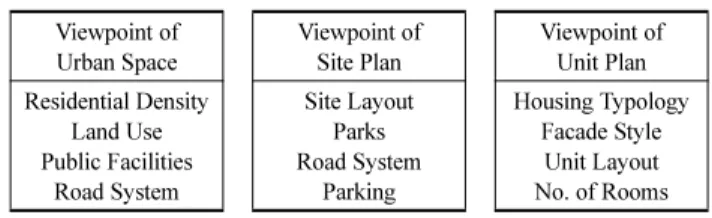
The framework of this study is based on the typical components required to develop a new town, which include urban space, the site plan and the unit plan. Detailed elements were developed and selected according to viewpoints related to each of these components, as shown in <Table 1>.
Based on this framework, the study utilizes a literature review, interviews and field surveys to collect data. Field surveys at sites in Indonesia were carried during August of 2013. We also conducted interviews with several staff members of PT. Belaputera Intiland and with local housing experts to confirm our understanding.
II. The New Town Establishment
New town development has been considered as an essential part of Indonesia’s development plan since the housing issue was attached to the 1973 GBHN (General State of Guidance) New Order during the Soeharto administration (Belgawan, 2011).
Although the government’s early idea was to establish joint participation between the public sector and the private sector with regard to the housing supply, the golden age of private sector participation did not start until the 1980s (Leaf, 1979).
The earliest established new town in Indonesia is Kebayoran Baru, constructed on 730 Ha in Jakarta for 100,000 citizens (Winarso, 2000). By the year 1989, private housing developers had successfully supplied 400,000 housing units in Indonesia, which was 50% of the total units built in the Jakarta
Metropolitan Area (Sasono, 2001). The KSNPP (Kebijakan &
Strategi Nasional Perumahan Permukiman, the National Policy and Strategy on Housing and Human Settlement) claimed that 1.5 million houses should be produced by 2020 to meet the needs given the massive population growth (Pandelaki and Shiozaki 2010).
The development of new towns in Indonesia can be divided into three generations. Each of the phases has their own target and goals. The first generation aimed to design the colonial administrative headquarters, plantation and mining towns and spacious European residential districts (Sujarto, 2002). The goal of the second generation was to address the great demand for new urban housing. The third generation started in the 1980s. This phase of new town design was intended to support the national urban strategy of creating self-contained residential cities with the central business districts (CBDs) of new towns.
This new residential style was produced in an effort to resolve the issues brought on by massive urbanization (Sujarto, 2002).
The government, through the 1984 Fourth National Development Plan, supported the growth of new towns by the planning and construction of large-scale housing projects supplied by the public or private sector in metropolitan areas such as Jakarta, Bandung, Surabaya, Semarang and Medan.
Bandung is well known as an educational city, mainly due to the major universities nearby, such as Bandung Institute of Technology, founded in 1920. Bandung has been the capital of the province of West Java since 1950, and it is the third largest city in Indonesia. The very-large-scale urbanization there, which took place between 1980 and 1990, fostered the transformation of Jakarta and Bandung from one centralized city into multiple core cities (Firman, 2008). By 1987, Bandung’s municipal area had doubled, with its name becoming Bandung Raya. The next transformation occurred in 2001, when the Bandung Metropolitan Area (BMA)
1)was established (Winarso, 2002; Minnery, 2013).
Bandung’s focus shifted toward education and research, with a business district and an industrial area. This dynamic economic situation introduced a high rate of urbanization which led to the drastic increase in the level of housing demand (Minnery, 2013). Since the economic boom in the 1980s, private sector housing developers have been the main players in the real estate industry (Raksadjaya, 2007).
Table 1. Framework of Analysis Viewpoint of
Urban Space
Viewpoint of Site Plan
Viewpoint of Unit Plan Residential Density
Land Use Public Facilities
Road System
Site Layout Parks Road System
Parking
Housing Typology Facade Style
Unit Layout No. of Rooms
1) The BMA consists of the Bandung City, Cimahi City, West Bandung Regency, Bandung Regency and three districts of Sumedang Regency (BPS 2010, wikipedia). BMA will be expected to have population inclining until 15 million in 2030. The West Bandung Regency, specially Padalarang district has the second largest population after Bandung City with 2.492 million people in 2030 (Tamin, 2005).
III. Case Study
1. Overview of the Cases
Kota Baru Parahyangan (KBP) is located in the district of West Bandung Regency and specifically in the Padalarang Sub-district, built by Belaputera Intiland
2). Based on the 2009- 2029 West Bandung Regency General Spatial Plan (RTRW), the Padalarang district is planned to be an independent settlement.
The Padalarang district is categorized as the north division of the West Bandung Regency, for which land use is to be low- to-medium density settlements (Tataruang). The Padalarang Sub-district comprises an area of 4,544 ha and has a population of 148,350 people per km
3. It is located 25 km from Bandung City and 100 km from Jakarta. The surrounding environment is mainly agriculture, local villages and industrial areas such as textile factories.
KBP has a vision that within 20 years, it will grow into a self-sufficient city, independent from Bandung as the largest yet nearest city, with its own active community. In order to realize this vision, KBP has set up several missions to promote a good quality of education; globally competitive human
resources; and community development through the creation of schools, public facilities and community supportive events.
The target market of KBP is middle and high-income groups.
When KBP launched this project in 1994, KBP had to postpone the first cluster of marketing until November of 2000 to survive the 1998 Asian financial crisis. As the Indonesian economy was reconstructed, KBP could launch the first cluster and eventually introduced a new trend in the housing market to the city.
To respond to the economic market, KBP was developed in three phases which were termed phase I, phase II and phase III. The development started in the east and expanded toward the west. Each phase is connected to the main road but each is clearly separated by bridges.
2. Analysis of Urban Space
KBP is built on 1250 ha of land and is expected to accommodate 100,000 residents. Thus far, 3,500 housing units have been built and 3,100 of them are occupied.
Based on the initial master plan, KBP was developed in three phases, as mentioned above. Phase I involved 429 ha, phase II 700 ha, and in phase III, the town center was developed (121 ha). KBP is surrounded by Bandung City in the east.
Saguling Lake to the south, a local village in the north and a hilly area in the west. One of the key issues is to integrate the local village with the variety of bordering land uses.
The land uses of this new town consist of residential areas (49.52%), commercial areas (11.01%), public facilities (6.94%),
‘green space’ areas (19.17%) and roads (13.37%). The total green space area was planned to meet the minimum Green Open Space Ratio (KDH), which is 10% to be the medium- density settlement zone, as stipulated in the Bandung General Spatial Plan. The residential area is categorized as a low-rise zone, because the approved number of stories for buildings is less than four floors. KBP is classified as medium-density housing with a maximum building coverage ratio (KDB
3)) of 60% and a floor coverage ratio of 1.2 (KLB
4)).
2) Belaputra Intiland is one of Lyman Group company’s divisions.
Lyman group initially focused in developing natural resource industry, but the company now altered its focus to develop the wider sector such as building material, distribution and property. The philosophy of the company founded by Mr. Susanta Lyman in 1959 is ‘Reliability and Quality is Our Business’. In 2011, KBP was awarded the best Green Property in the Indonesia Property Award.
Furthermore, KBP was nominated to receive the Best Housing Estate in the 2013 Property award. KBP which is located in the Saguling lakeside has strong access to highway to Bandung and Jakarta.
3) KDB (Koefisien Dasar Bangunan) or Building Coverage Ratio compares the building ground floor area to the lot area. It is one of the government’s indexes to control the density level of the areas.
KDB= ×100
4) KLB (Koefisen Lantai Bangunan) or Floor Coverage Ratio is the comparison of total building area(every floor) to the lot area.
Building height could be estimated by dividing KLB with KDB.
KLB=
Ground Floor Area Lot Area ---
Total Floor Area Lot Area --- Figure 1. Location of Bandung and Jakarta
(Source: Townland Baseline Report)
As shown in <Figure 2>, the low-density residential clusters are located in the Saguling lakeside area, while the high- density housing clusters are located in the flat area in the north.
We understand that there are greater marketing advantages for sites with beautiful scenic views and for waterfront sites. Low- density clusters for high-class residential groups match these types of sites best.
The commercial and public facilities of science center, art center, hospital, international school, supermarket, hotel, and
mosque are mainly located in the area nearby the main gate of the town. The main access to KBP is through the main arterial road, akin to the spine of the human body and named Padalarang Raya Street. This main street connects all phases of developing towns, including regional commercial centers and the town center, with the main entrance. The residential collector roads, which are branched out from the main road, connect nearly all of the residential clusters in a loop system.
Recently, a new alternative gate is being considered because the main street near the main gate is a scene of heavy traffic during peak times.
The phase I development concentrated on establishing a basic master plan and bolstering the supply of affordable housing units, which mainly consisted of mid- and high- density housing developments, to encourage the rapid input of people. To activate the town, the focus was on building public facilities in KBP. The comparatively higher income target of phase I, mid-density housing developments, were located alongside Saguling Lake, with a picturesque view, whereas high-density housing developments were built on flat land areas or were typically located close to the main road.
The main object of phase II was to develop resort-like residential towns to reflect the new increasing demand for ecological environment. Therefore, the high rate of land use for green spaces (27.57%) is noticeable. As the main target for this phase of the development is the middle and high-income groups, the residential supply consists typically of high-end villas (19.29%), customized high-end villas (8.71%), and mid- level villas (20.71%). The commercial facilities also consist of rented villas (2.14%), resort hotels (0.71%), and a golf academy (0.29%). Meanwhile, the public facilities consist of a neighborhood center (0.86%) and a golf clubhouse (0.57%).
The composition of the green space in the plan is mainly divided into green open space (15.43%) and a golf course (12.14%). Major open spaces are designed throughout the site, with diverse functions such as a hilltop park, a waterfront park and a pocket park. The golf course was intentionally developed as one of the essential attractions of this phase. Resort hotels and commercial centers are located in land areas with the best view of the lake to take advantages of the view, which maximizes the land value.
Phase III, the latest phase, consisting of 84.6 ha for the town center and 60.4 ha for the commercial center, is currently under development Townland
5). The planned location is between Phase I and Phase II so as to serve both areas. The aim of the development of the town center is to create a commercial and education hub where the inhabitants of the KBP work and study. The land use in Phase III consists of residential uses (8.72%), commercial uses (12.4%), facilities
Figure 2. Land Use and Development Phase(Source: Townland Final Report) Table 2. Overview of The Kota Baru Parahyangan
Phase I Phase II Phase III Total
Theme
Houses &
public facility
Resort- like house
City Center
Regional Commercial District Development Year 1997-
recent 2011-
recent 2012-recent
Land Size 405 ha 700 ha 84.6 ha 60.4 ha 1250 ha Population 9,900
people
26,210
people - - 36,110
people Household 3500 unit 6707 unit - - 10.207 unit
Land Use
Residential 260.87 ha 341 ha 7.38 ha 9.69 ha 618.94 ha Commercial 84.52 ha 22 ha 10.46 ha 20.58 ha 137.56 ha
Mixed
Facility 1.9 ha 10 ha 55.69 ha 19.14 ha 86.73 ha Green Area 24.6 ha 193 ha
11.07 ha 10.99 ha 239.66 ha
Road 33.1 ha 134 ha 167.1 ha
Commercial Facility
hospital, mixed use, retail recreation al facility
rented villas resort hotel golf academy,
open air mall, lifestyle center
supermarket, food festival, showroom, shophouses, hotel
Facility
research
& art center, education facility, hospital, mosque, gas station
neighbor- hood center, club house
& golf club
mixed use, university, art district, recreation center
mixed use, business/office park, recreation
(65.8%), and roads and green areas (13.1%). Given that a university campus is planned in the town center, residential buildings such as dormitories or low-rise apartments are planned. The commercial area will be developed as an open- air mall (5.23%) with a lifestyle center (5.23%). The facilities in this city center include mixed-use facilities (23.04%), a university campus (19.35%), an art district (7.36%), and a recreation compound (16.08%). The Regional Commercial District is located next to Phase I (residential & public facility), consisting of residential areas (16.04%), commercial areas (34.07%), facility areas (31.69%), and roads and green areas (18.20%).
3. Analysis of the Clusters
1) General Information about the cases
KBP consists of 50 clusters, and it has 13 theme parks. This study investigates four representative residential clusters:
Wangsakerta, Candraresmi, Ratnasasih and Larangtapa. Among these four cases, two cases are selected as new clusters and two cases are selected as old clusters. There are two middle- class and two middle-to-high class clusters.
Based on the target market, clusters in KBP are classified into two groups: middle and middle-high groups. The middle and middle-high clusters can be distinguished by the unit size and their detailed specifications. The Ratnasasih and Larangtapa clusters are mid-to-high-class clusters; they are surrounded by the Cisudimampir River and are located close to the Bandung Alliance International School and Cahaya Kaluan Hospital.
All of the clusters in the KBP are gated communities for security reasons. Wangsakerta and Candraresmi are middle- class clusters.
2) Wangsakerta Cluster
Wangsakerta is the cluster located closest to the main gate of the KBP. It was built in 2000, in the early stage of development.
The main access to the Wangsakerta cluster is from the south border, where shophouses were built along the primary road.
The shophouses serve as regional commercial facilities for the town and also as a privacy barrier for the cluster.
The total area of Wangsakerta is 12.11 ha. There are 391 household units. It has a population density of 32.29 units/ha.
This site is almost rectangular in shape. The street pattern is linear with a cul-de-sac system at the end of the road. The road system in the terrace houses area is a grid pattern, while the
5) Townland International is multi-disciplinary urban planning consultant. Its headquarter is located in Hongkong. The consultant was established in 1985 and it has developed about 3000 diverse projects. Townland Indonesia was established in 1996 and has participated in various international and domestic new town, landscape and resort planning projects.
Table 3. General Information of Clusters Surveyed Name
(Built Year)
Type
Building area /plot size
(m2)
TypologyNo. of Units
Percentage of No.
(%)
KDB KLB
W (2000)
Standard
50/126 T 129 32.99 39.68 0.4 96/162 T 101 25.83 59.26 0.6 125/198 T 56 14.32 39.76 0.6
Corner /191-340 87 22.25 - -
Special 55-170
/136-480 T 18 4.604 - -
Total 12.11 ha 391 100
Density 32.29 unit/ha
C (2011)
Standard
65/126 T 25 12.89 51.60 0.5 97/162 T 56 28.87 52.72 0.5 112/220 T 24 12.37 31.31 0.5
Corner
144/189 T 1 0.52 - 0.8
178/225 Sd 3 1.55 - 0.8
205/223-303 Sd 8 4.12 - 0.9
220/288-320 Sd 13 6.7 - 0.8
Special
Fr 340/392 T 13 6.7 - 0.9
Pr 348/403 Sd 17 8.76 - 0.9
LS /275-1072 T 34 17.52 - -
Total 8.23 ha 194 100
Density 23.57 unit/ha
R (2003-
2008)
Standard
242/300 T 23 15.23 51.83 0.8 350/420 T 33 21.85 51.49 0.9
350/SL T 14 9.27 53.69 1.1
Corner
/343 T 4 2.65 - -
/369 T 7 4.64 - -
SL T 4 2.65 - -
Special 55-170/SL T 18 0.66 - -
LS /319-1276 T 65 43.04 - -
Total 11.65 ha 151 100
Density 12.96 unit/ha
LT (2007-
2011)
Standard
171/360 T 13 5.28 29.28 0.5
214/360 T 16 6.5 - 0.6
240/360 T 20 8.13 - 0.7
256/360 T 21 8.54 - 0.7
261/360 T 7 2.85 39.50 0.8
300/420 T 8 3.252 - 0.7
349/420 T 6 2.44 41.30 0.9
293/450 Sd 10 4.07 - 0.7
263/480 Sd 16 6.5 - 0.5
303/510 Sd 2 0.81 - 0.6
293/630 Sd 6 2.85 - 0.5
349/630 Sd 7 2.44 - 0.6
Corner
269/480 Sd 2 0.82 - 0.6
269/502 Sd 4 1.63 - 0.6
/314 Sd 6 2.44 - -
/478-839 Sd 25 10.16 - -
Special
261/318 T 7 2.85 - -
Pr /302 T 2 0.81 - -
/312 T 7 2.85 - -
LS 355-2521 Sd 61 24.78 - -
Total 17.48 ha 246 100
Density 14.07 unit/ha
Total Unit 982
W: Wangsakerta, C: Candraresmi, R: Ratnasasih, LT: Larangtapa,
Fr: Frontage, Pr: Preserved, LS: Lakeside, T : Teraace House, Sd: Semi-Detached House
KDB:Building Coverage Ratio, KLB:Floor Coverage Ratio
road system in specific areas is a mixed pattern of loops and cul-de-sacs. Each housing unit has its own parking lot. The capacity of each parking lot depends on the housing size; one carpark for small size unit and three carpark for large unit.
Five unit types in total are provided. These ratio types area 50/126
6)(33%), 96/162 (25.8%) and 125/198 (56%), with the reminder being corner types (22.3%) and special types (4.6%).
The typology of all units is the terrace house. Lots are divided narrowly and deep to accomodate as many houses as possible.
Green pedestrian promenades, with no access by cars, are located symmetrically on both sides of the main road axis, whereas the other roads parallel to this axis are accessible to cars.
3) Candraresmi Cluster
The total area of Candraresmi is 8.23 ha, and it has a density of 23.57 units/ha. There are 194 housing unit in the cluster.
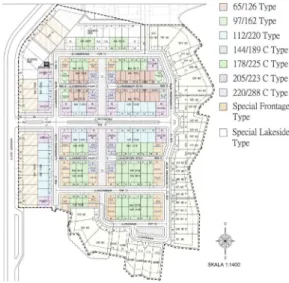
The Candraresmi cluster, which was constructed in 2011, is square-shaped and surrounded by Saguling Lake in the east and the south. In the north and the west, there are other developed clusters.
The main access is from the west boundary, and this connects directly to the main axis road, which divides the site into two parts. The basic road system is a grid pattern with inner cul-de-sacs and an extra loop pattern.
The pedestrian promenades stretches to the north-south axis, perpendicular to the main access road, which runs in the east- west direction and connect all of the housing blocks.
Pocket green spaces are scattered around the edge of the site, and there are no commercial areas built inside or on the boundary of the site.
There are several types of units. These are the 65/126
(25%), 97/162 (56%), 112/220 (24%), corner (12.89%), and special types (32.99). The special types themselves are varied and include frontage (6.7%), preserved (8.76%) and lakeside (17.53%) areas.
Along the lake side, open lot type with land size range between 275 and 965 sqm are located. Compare to the standard type, the land sizes of the special type housings are wider. However, most of this special lot area is currently vacant.
4) Ratnasasih Cluster
The Ratnasasih cluster was built during 2003 to 2008.
Nearly all Ratnasasih clusters are surrounded by the Cisudimampir River, except for the west edge, which provides the main access to the site. The total area of the cluster is 11.47 ha, while the site density is 12.96 units/ha. Ratnasasih’s total households number approximately 151 units.
Like the Wangsakerta cluster, shophouses are located in front of the main gate. Before entering the main gate, shophouses are arranged along the street. They provide conveniences for residents as well as privacy for them. They block the street sounds and provide security for the inside cluster.
This site is expanding in the east-west direction, while the unit block mostly has a north-south orientation in the direction of the river at the same time. The housing block is designed as a regular grid pattern with terrace houses as the major type of unit. The street pattern is also in the traditional grid form, with a cul-de-sac at the end of the road. Inside the cluster, there are three main parks, a jogging track along the river, and several pocket parks.
The housing types are 242/300 (15.23%), 350/420 (21.85%), Split level (9.272%), corner (9.93%), and special type (43.71%).
The special types are located along the river and their lot sizes
Figure 4. Site Plan of Candraresmi ClusterFigure 3. Site Plan of Wangsakerta Cluster
6) Indonesia developers usually classify the housing based on the total building area and the lot area. For example, type 50/126 means that the unit has 125 sqm building total area and 198 sqm lot area.
range between 319 and 1276 sqm. In comparison to the biggest standard unit type, the special unit type is approximately 1.5 times bigger.
5) Larangtapa Cluster
Larangtapa’s total area is 17.48 ha with 246 units developed.
Larangtapa, with a density of 14.07 units/ha, is located on a peninsular piece of land surrounded by Saguling Lake.
Larangtapa can be entered from the main entrance on the north-east edge of the cluster.
The main circulation is designed as a grid pattern with two wider roads on both sides. This cluster provides variety, with 12 unit types.
4. Viewpoint of the Cluster Unit
The classification of organized urban housing
7)in Indonesia after the Dutch occupancy period mainly is based on the housing size (Table 4). According to the Sentul City Director,
housing can also be classified based on consumers capabilities to purchase housing. He classified this into five segments: (1) A: <USD 17,000; (2) B: USD 17,000-40,000; (3) C: USD 40,000-87,000; (4) D: USD 87,000-174,000; and (5) E: more than USD 174,000.
Among total number of 982 housing units in KBP, only 593 units are standard types (50-350 sqm). <Table 3> To sub- classify those 593 units, this study sub-categorize the luxury types of Belgawan (2011)’s classification. Therefore the units in KBP are categorized into three groups; (1) Small size unit types (50-70 sqm) (2) Medium size unit types (70-200) sqm) (3) Large size unit type (over 200 sqm).
1) Small Type in Candraresmi
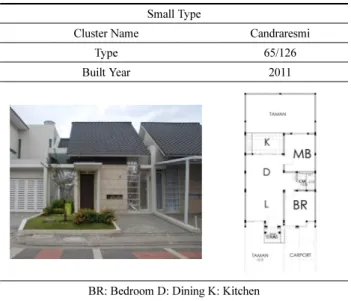
The small types of unit houses are terrace houses, which were built on 7X18 sqm plots with a building size of 65 sqm.
Typically, small houses are built on one story, where the dining and living areas are open to each other.
It is quite unique that the kitchen is located outside the terrace at the back side of the house. The kitchen has two functions, a wet and a dry kitchen, as the house has limited area on which to be built. This type of kitchen is planned as a minimal size, but its purpose is to provide the possibility of expanding it into back yard when the extra construction can be afforded. This is a design which reflects the buyer's financial ability.
Open green space is provided in front and at the back side of this unit. The front yard usually has an aesthetic function.
On the other hand the back yard, which is almost 40% of the lot, is utilized as an activity area for the residents. Moreover, it is for the future growth of the house. This green area in the back is also meant to control passive air circulation. In this unit, instead of an indoor garage, a carport is deemed to suffice for car parking.
Based on the interviews, when a small unit is designed, one of the most carefully considered factors is making this small
Figure 6. Site Plan of Larangtapa ClusterFigure 5. Site Plan of Ratnasasih Cluster
7) Kuswartojo classified Indonesia formal housing into organized and individual. Belgawan then in 2011 classified this formal organized housing into basic types, small types, and luxury types.
Table 4. Indonesian Housing Classification Guidelines
Housing Type Building Area
Basic Types
18 m2; 21 m2 Non-Commercial
Housing 27 m2-36 m2
Commercial Housing
Small Types 45 m2-54 m2 Luxury
Types
Lower-end 70 m2-150 m2 Higher-end <400 m2 Source. Belgawan, 2011
unit appear spacious. To do this, a high ceiling is provided to decrease the room temperature and for aesthetic reasons. As this is a recent cluster, the facade designs have more openings with glass and apply a more minimalist style.
2) Medium Type in Wangsakerta
The 125/198 unit type in the Wangsakerta cluster is semi- detached and consists of 78.72 sqm for the ground floor area and 47.60 sqm for the second floor area. There are one bedroom and a sitting room in the front and a living room, dining room and kitchen in the back on the ground floor.
A separate building is located at the end of the back yard as the housekeepers’ space. The first floor consists of three bedrooms and a family area between the rooms. The ground floor is designed for public activities while the upper floor is planned as a more private zone for the family.
Two parking spaces are provided, one as an indoor garage and one as a carport. The sitting rooms have started to appear in medium-sized units. The sitting room in front of the entrance space is partly separated from the living room in Indonesian houses and therefore is very unique. The guest rooms are only used to welcome formal visitors.
The unit can be entered through two entrances. The first is a formal entrance through which one can directly access the sitting room. The service entrance is from the garage, which is linked directly to the kitchen and the maid space. Access is separate for the owner and the servants.
3) Large Type in Larangtapa
The 261/360 type of housing is large unit as a terrace house.
This unit has two levels; the first level is 155.5 square meters and the second is 86.54 sqm. The ground floor has one bedroom, a huge open space as a sitting room, a dining room
and a living room. The kitchen, service area and garage are designed as separate areas from the main space.
On the first floor, there are the family space room, hall, and three bedrooms, including the master bedroom. The master bedroom is typically located on the ground floor; therefore, the location of the master bedroom on the first floor is a new housing design trend.
A huge interconnected space on the ground floor is designed as open to other areas in order create a more flexible space for family activities or special events. However, in other large units, there is a separate foyer or guest space where guests are welcomed initially.
The maid spaces (bedroom, bathroom and area for drying laundry) are also located on the first floor but are only accessible from the ground service area via stairs. The clear
Table 5. Overview of Housing UnitSmall Type
Cluster Name Candraresmi
Type 65/126
Built Year 2011
BR: Bedroom D: Dining K: Kitchen L: Living Room MB: Master Bedroom
Table 6. Overview of Housing Unit Medium Type
Cluster Name Wangsakerta
Type 125/198
Built Year 2000
BR: Bedroom D+K: Dining & Kitchen G: Guest Area L: Living Room MB: Master Bedroom
Table 7. Overview of Housing Unit Large Type
Cluster Name Larangtapa
Type 261/360
Built Year 2007-2011
BR: Bedroom D+K: Dining & Kitchen G: Guest Area L: Living Room MB: Master Bedroom
division between the owner and the maid spaces is one of the key design issues in large units. Green open spaces are located in the front and back yards. The back yard size is greater than 50% of the lot size.
IV. Conclusion
It is hard to generalize the findings of this study to account for all recent new town development in Indonesia. However by analyzing recent projects of representative development companies in Indonesia, this study can summarize the trend of new town development as follows.
The most representative housing typology in Indonesian new towns is the terrace house despite its lot size. The layouts of the clusters in KBP consist of blocks that are composed of two rows of back-to-back terrace houses except the special units which are located along the lake front or the boundary of the cluster. In the front outskirts of the early developed clusters, shophouses are located to secure the community and to provide easy access to grocery. In the center of the community, green pedestrian promenade is located to serve as an axis of revitalization for the residents.
High walls surrounding housing lots can be easily found in Indonesian residential areas, especially in new towns. These protection walls emphasize the importance of defensive implications in Indonesian housings. Housing construction in the new town cannot be finished in short periods of time, and therefore the construction itself develops in many small phases. In order to protect the territory along the building process, protection walls were built.
The KBP enforces ‘cluster system’; three or four sub- clusters were grouped to form another larger cluster. Usually at the main gate of a cluster, there are rotary spaces and curved pathways with unique symbol elements. Those gates of clusters and sub-clusters control incoming vehicles. In fact, to access the house, residents have to pass through two security gates; main cluster gate and sub-cluster gate. However KBP used natural elements including lakes and greens to set the boundaries in order to escape the defensive image of clusters.
In the Phase III, central business district (CBD) is planned but is currently vacant. Commercial buildings contain variety of facilities including stores, shopping centers, offices, university and branches of various companies densely located in the heart of the city. Through this planning, employment opportunities are maximized and job-housing proximity is easily gained.
Besides the small-sized (60 sqm or below) units, most units in KBP consist of 2 stories Conventionally, the living room, dining room, kitchen and the guest room are located on the
ground floor for public use. Bedrooms are usually situated on the first floor for private use. Although master bedrooms are for private use as well, they are typically located on the ground floor. However in newly designed units, the master bedrooms are moved to be located on the first floor.
The design of the kitchen is also unique in Indonesian housings. Typical kitchen is divided into two areas; the wet kitchen and the dry kitchen. The dry kitchen is used to prepare simple food. The wet kitchen is for more arduous jobs including laundry. To bring fresh air from outside, there is better ventilation system in the wet kitchen. Occasionally, the wet kitchen is directly connected to the garden and car parks, and functions as a workroom. There is also a private room and a separate bathroom for the housemaids in the wet kitchen.
The clear division between the owner’s living space and the maid’s space is one of key design issues in large units.
Moreover, the guest reception area in front of the entrance is very unique in design.
The units have two green open spaces; front and back yard.
The front yard has aesthetic and legal function. On the other hand, the back yard provides more private space for the family and allows future house expansion. The most essential issue of the house is the thermal comfort. Cross ventilation from the South-North side blocks the East-West side with a wall, and high ceiling improves natural ventilation.
As this study investigates trends in recent Indonesian town planning through case studies rather than through quantitative data, it has some limitations in generalizing the findings.
However, in analyzing important issues in recent projects, this study can help us to understand the key characteristics and unique identities of Indonesian new town planning.
REFERENCES
1. Ahmed, U. A. (2007). Internationalisation of the housing development sector: A study of the Malaysian scenario.
Unpublished doctoral dissertation, Universiti Sains Malaysia, Penang.
2. Belgawan, H. I. (2011). Typologies of Formal Urban Housing in Indonesia: Towards a taxonomy. in Ju et al (Eds), Proceedings of 2011 Southeast Asian Housing Forum (p. 137-158). Seoul: USD Publishing.
3. Firman, T. (2008). The Continuity and Change in Mega- urbanization in Indonesia: A survey of Jakarta-Bandung Region (JBR) development. Habitat International, 33(2009), 327-339.
4. Ju, S. R., Choi, Y. K., & Lee, L. N. (2010). A Study on the trend of new town planning of Malaysia. Journal of Korean Housing Association, 21(5), 103-113.
5. Ju, S. R., Saniah, A. Z., & Choi, Y. K. (2011). Con-tex-tual Modernization: New town planning in Petaling Jaya of Malaysia. Journal of Asian Architecture and Building
Engineering, 10(1), 93-100.
6. Millanyani, H., & Pramiyanti, A. (2013). Green Property Slogan as Marketing Communication Strategy: Case study on housing developer in Bandung-Indonesia. Proceedings of World Bussiness and Social Science Conference.
Bangok, Thailand.
7. Minnery, J. et al. (2013). Slum upgrading and urban governance: Case studies in three South East Asian cities.
Habitat International, 39(2013), 162-169.
8. Pandelaki, E. E., & Y. Shiozaki (2010). “The Core Concept and its Implementation in Indonesia: Past, present, future.”
International Journal for Housing Science, 34(4), 233-248.
9. Sasono, D. et al. (2011). New housing developments and mobility problems in Jakarta Metropolitan Area. Proceedings of the Eastern Asia Society for Transportation Studies (p.
245-260). Tokyo, Japan.
10. PT. Townland International. (2011). Conceptual Master Plan of Phase 2 Kota Baru Parahyangan, Padalarang.
Jakarta, unpublished report.
11. PT. Townland International. (2012). Conceptual Master Planning and Urban Design Guidelines of the Regional
Commercial Center District (60.4 ha) and Town Center (86.4 ha) of Kota Baru Parahyangan Padalarang District West Bandung, Padalarang. unpublished report.
12. Sujarto, D. (2002). Towards the development of metropolitan new towns in Indonesia: With special reference to the city of Jakarta and Jabotabek. In Nas (Ed.), The Indonesian Town Revisited, Singapore: LitVerlag.
13. Tamin, O. Z. (2005). Integrated public and road transport network system for Bandung Metropolitan Area (Indonesia).
Proceeding of the Eastern Asia Society for Transportation Studies (p. 1281-1300). Tokyo.
14. Raksadjaya, R. (2007). Bandung Colonial City Revisited, Diversity in Housing Neighborhood. A paper prepared for The Knowledge City International Seminar at the Department of Architecture, University of North Sumatera.
15. Winarso, H. (2000). Residential developers behaviors in Jabotabek, Indonesia. Unpublished doctoral dissertation, London: University of London.
접수일(2014. 5. 23) 수정일(1차: 2014. 7. 17) 게재확정일자(2014. 8. 5)