• 검색 결과가 없습니다.

Applications of Microbial Whole-Cell Biosensors in Detection of Specific Environmental Pollutants

N/A
N/A
Protected

Academic year: 2021

Share "Applications of Microbial Whole-Cell Biosensors in Detection of Specific Environmental Pollutants"

Copied!
6
0
0

로드 중.... (전체 텍스트 보기)

전체 글

(1)

Applications of Microbial Whole-Cell Biosensors in Detection of Specific Environmental Pollutants

Hae Ja Shin*

Energy Environmental Engineering Major, Division of Energy Bioengineering, Dongseo University, Busan 617-716, Korea Received September 27, 2010 /Accepted December 30, 2010

Microbial whole-cell biosensors can be excellent analytical tools for monitoring environmental pollutants. They are constructed by fusing reporter genes (e.g., lux, gfp or lacZ) to inducible regulatory genes which are responsive to the relevant pollutants, such as aromatic hydrocarbons and heavy metals. A large spectrum of microbial biosensors has been developed using recombinant DNA tech- nology and applied in fields as diverse as environmental monitoring, medicine, food processing, agri- culture, and defense. Furthermore, their sensitivity and target range could be improved by mod- ification of regulatory genes. Recently, microbial biosensor cells have been immobilized on chips, optic fibers, and other platforms of high-throughput cell arrays. This paper reviews recent advances and future trends of genetically modified microbial biosensors used for monitoring of specific environ- mental pollutants.

Key words : Whole-cell biosensor, recombinant DNA technology, aromatic hydrocarbons, heavy metals

*Corresponding author

*Tel:+82-51-320-1791, Fax:+82-51-320-1781

*E-mail : [email protected]

Introduction

Microbial whole-cell biosensors have been developed to detect target pollutants. Being considered as first monitoring systems, they can provide enough information for routine testing and screening of samples in various fields [15]. For environmental monitoring, microbial biosensors can provide fast and specific data on contaminated sites; not only the concentration of pollutants but also their biological effects, toxicity and bioavailability. They also offer other advantages such as portability, working on-site, and ability of measuring pollutants in complex matrices with minimal sample preparation.

Microorganisms as sensing elements in microbial bio- sensors have several advantages over other sensing elements such as enzymes, antibodies, or sub-cellular components:

ability to detect wide range of chemicals, amenability to ge- netic modification, and adaptation to broad environmental reaction conditions [20]. In the earlier microbial biosensors, the respiratory and metabolic functions of the micro- organisms have been exploited to detect such substrates or inhibitors of these processes. For example, toxicity responses of naturally luminescent Vibrio fischeri (the commercial mi-

crobial biosensor, Microtox

®

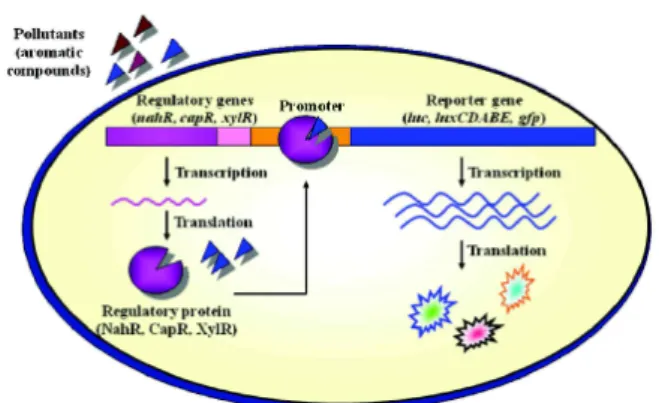
test) are detected by inhibition of light production. Recently, the recombinant DNA tech- nologies have been used to tail the microorganisms for a given purpose by artificial fusing of natural regulatory genes (coding a transcriptional regulator plus promoter/operator) with a promoter-less reporter gene [36,48]. Transcriptional regulators activated by the target chemicals interact with the promoter triggering production of the measurable signal from the reporter gene (Fig. 1). Several reviews have dis- cussed various aspects of the use of such constructs for envi- ronmental applications [2,8,14,17]. Furthermore, their bio- sensor capabilities (e.g., target range and sensitivity) could be improved by modifying regulatory genes. Our group [30,37] as well as Galvão and de Lorenzo [12] demonstrated increased sensitivities and specificities of microbial bio- sensors by engineering of effector-binding sites in regulatory proteins. More recently, microbial biosensor cells have been incorporated into chips, optic fibers, and other platforms to construct high-throughput biosensors [19,23,42]. This paper reviews recent progress in microbial whole-cell biosensors and their future trends with a focus on the development and application of genetically engineered biosensors used for monitoring of specific environmental pollutants.

- Review -

(2)

Fig. 1. The signal transmission of a specific microbial biosensor.

Here a specific chemical (e.g., aromatic compounds) in- duces a tightly regulated promoter by binding to the reg- ulatory protein (e.g., NahR, CapR, XylR). The response is usually a measurable increase in reporter protein production.

Configurations

Microbial whole-cell biosensors are constructed by fusing regulatory genes to a promoter-less reporter gene. The regu- latory genes, in the presence of the relevant pollutants or environmental signals, activate the promoter which turns on the expression of reporter gene downstream (Fig. 1). Thus, the regulatory genes determine the specificity and sensitivity of microbial biosensors. Two categories of biosensors are classified in regards to target property: ‘chemical responsive’

biosensors showing the identity of a single or a few structur- ally related specific chemicals and ‘stress responsive’ bio- sensors showing the presence of a group of toxic chemicals or adverse physiological conditions that cause stress re- sponses such as DNA or protein damage. Stress responsive biosensors will not be described in this communication, but comprehensive reviews have been published [39,48]. The de- velopment of chemical responsive biosensors exploits the high specificity of regulatory protein interactions with chemicals. Examples are depicted in microbial biosensors used for detection of aromatic hydrocarbon [29,40,49], heavy metals [9,11,13], pesticides/herbicides [10,47], and various organophosphorous nerve agents [21].

Microbial biosensors report biological interaction with tar- get chemicals by a reporter gene. The interactions reported by reporter genes can be detected in color or bio- luminescence change simply by the naked eye or converted by transducers into a measurable response such as absorp- tion of light, current, or potential through optical or electro- chemical means for being further amplified, processed and analyzed. The reporter gene usually codes an enzyme that

catalyzes an easily monitored reaction: for example, lacZ co- des for the enzyme β-galactosidase, lux or luc genes for the bacterial or firefly luciferase, and the gfp gene for green fluo- rescent protein (GFP). The intensity of the color or bio- luminescence is proportional to the level of enzyme activity present in the reaction. In addition to the reporters de- scribed, other enzymes such as alkaline phosphatase [29], horseradish peroxidase [50], and the crtA gene product [11,51] have been employed in biosensor constructions. The bioluminescence reporter gene (lux or luc) is the predom- inant gene used for the construction of biosensors for envi- ronmental monitoring. The Luc has higher sensitivity than bacterial luciferase (lux) although it requires the addition of the substrate and ATP for generation of bioluminescence.

Bacterial luciferase (Lux) is heat-labile and difficult to use in mammalian cells. GFP is a reporter produced fluorescence activity after simple irradiation at the excitation wavelength without the addition of an exogenous substrate or ATP or lysed cells [40]. However, the application of GFP to bacterial biosensors is not recommended since it has a high back- ground signal and takes time to form the fully active fluo- rophore of GFP.

Aromatic hydrocarbons

Aromatic hydrocarbons are volatile toxicants, and thus may be lost during transportation and the various steps of the analytic process, possibly leading to false negatives. In such cases, on-site monitoring by microbial biosensors could be a useful alternative to chemical analysis [38]. Diaz and Prieto [6] scrutinized the various bacterial regu- lator-promoter pairs capable of biodegrading aromatic pollu- tants, and gained insight into the molecular mechanisms through which regulatory proteins sense a given signal and activate transcription from their cognate promoters. Several microbial biosensors have been successfully developed to monitor aromatic hydrocarbons [18,29-32,40,49-50] and bio- degradation of BTEX (benzene, toluene, ethylbenzene, xy- lene) compounds-impacted soils [4,7,33]. Paitan et al. [29]

constructed whole cell electrochemical biosensors by using

the lacZ and phoA genes to detect different aromatic

compounds. These biosensors could be potentially used for

on-line and in situ monitoring. Bioavailability of BTEX com-

pounds [40,50] and naphthalene [49] have been monitored

by using GFP- or horseradish peroxidase-based and fil-

ter-immobilized microbial biosensors. The detection limit

was 10-50 μM for BTEX [50]. Our own group also developed

(3)

microbial biosensors for detection of BTEX, naphthalene, and phenolics [18,30-32,37-38]. We demonstrated on-site de- tection of phenolic compounds in soil and wastewater by a color change with the naked eye [38]. For this biosensor, a plasmid was constructed by fusing the β-gal gene with the capR promoter [32], which is activated in the presence of phenolics. The estimated concentration of phenolic com- pounds (detection range at 0.1 μM-10 mM) was similar to the values obtained by chemical analysis. The use of intact whole cells might be responsible for the excellent response at much higher concentrations of phenol (at 10 mM).

Furthermore, mutagenesis of the effector binding sites of regulators may increase their sensitivities and specificities to toxic aromatic compounds [12,30,37].

Heavy metals

Several microbial biosensors have been constructed to de- tect heavy metals by fusing metal responding regulatory genes (e.g., merR, arsR) with various reporter genes: bio- sensors for mercury [16,35], arsenite [11,41,45], cadmium [3], chromate [34], and nickel [44]. Cadmium biosensors also re- sponded to lead and antimony. Biran et al. [3] reported the novel use of a cadmium biosensor for in situ and on-line monitoring of water, sea water and soil samples. They used a cadmium-responsive promoter fused to a promoterless lacZ gene, and monitored the results with an electrochemical assay of β-galactosidase activity. The system was able to de- tect cadmium at concentrations as low as 25 nM in water and 5 μM in untreated soil samples under anaerobic conditions. Stocker et al. [41] constructed colorimetric qual- itative paper strips using β-galactosidase as the reporter which were found to produce a visible blue color at arsenite concentrations above 8 μg/l. Fujimoto et al. [11] constructed an arsenite biosensor using the crtA gene as the reporter and photosynthetic bacteria as the host strain. The color change could be detected with the naked eye at 5 μg/l arsenite in liquid culture. The time required for color development (12~24 hr) was too long for this system to be of practical on-site use [11], but future developments may broaden its applicability. Another example that has received enormous attention is the contamination of groundwater with in- organic arsenic species in Vietnam. The application of lumi- nescent arsenic biosensor bacteria [45] to samples from near- ly 200 groundwater wells from the Red River and Mekong River deltas in Vietnam resulted in more than 90% accurate measurements, suggesting that it is a quite reliable

assessment. This is a successful example of using genetically modified biosensors outside of laboratories.

Limitations and challenges

Several limitations of microbial biosensors could be due at least in part to the inherent limitations of microbial biosensors. Compared with instrumental analysis, microbial biosensors show lower sensitivity [46], poor specificity [3], and delay responses due to the time required for reporter gene expression. Continuous researches to resolve such limi- tations of microbial biosensors have been investigated by ex- ploiting more sensitive promoters [26], refining host strain [1], designing strains to produce modifying regulatory pro- teins and enzymes [12,27,30,37], surface expressed or peri- plasmic binding proteins [21,24], and controlling bacterial physiology [22]. Indeed, the surface expressed proteins can directly react with substrates without the entry of substrates into cells, making microbial biosensors faster and highly sen- sitive [21,24-25]. Thus, it is a challenging and promising task to screen the natural variety for microbial biosensor develop- ments and to extend the natural limits in terms of target range and sensitivity.

Another limitation of microbial biosensors is difficulties in maintaining the survival and activity of the cells in com- plex environments, due to lack of nutrients, inhibitory com- pounds and so on. It has been known that microorganisms show different survival and activity under various physio- logical conditions. Thus, their survival and activity of cells under harsh environment will be controlled by selecting proper microorganism and controlling cell’s physiology [20].

Final limitation might be public perception of genetically modified microbial biosensors being released into nature. In reality the risk of an adverse consequence is very low; most biosensor cells are immobilized on matrices or suspended in a compartment, and environmental samples are applied to the biosensor systems. In addition, the benefits can far outweigh the possible risks. The arsenic biosensor used for large screening campaigns is an excellent example, as this simple, sensitive, and cheap sensor kit helped prevent arsen- ite-associated diseases in Asia [45]. Standardization and leg- islation in most countries for microbial biosensors could di- minish some misconceptions about microbial biosensors.

Future trends

Future trends in biosensor research are likely to focus on

miniaturized, high-throughput, wireless/mobile, and auto-

mated devices. This growing tendency might require a

(4)

group of emerging techniques (e.g., nanotechnology, genetic engineering, microelectronics, and etc.) and substantial de- velopment and optimization of refined instruments [43].

Examples of future trends could be found in several micro- bial array chips [23,42], single-cell biosensors [43]. Advanced new platforms, as shown recently in the development of modified silk derived carbon fiber mat [5] and chitosan ma- trix [28], might be developed for immobilization of electro- chemical microbial biosensor. The development of mul- ti-functional biosensor arrays composed of highly mini- aturized signal tranducer elements enables the real-time par- allel monitoring of multiple species and accesses to micro- environment which can not be easily accessed by chemical analysis [15]. The use of miniaturized and high-throughput biosensors has benefits not only to the environment but also to economy by reducing time, sample/ waste volume, and other reagents required.

Conclusions

The whole-cell microbial biosensors described herein have been used for in situ monitoring various kinds of environ- mental pollutants. However, there are several disadvantages that must be resolved: the need for sustainable cell viability and activity even under harsh environmental conditions, de- creased response times, increased sensitivity, and improved selectivity. These critical advances might allow the growing biosensor industry to begin meeting the sizeable market de- mand for cheap, sensitive, selective and fast biosensors. At the same time, we need to reassure the public that it is safe to use genetically modified microbial biosensors. Recently, whole-cell microbial biosensor cells have been incorporated onto chips, fiber optics and other platforms of high-through- put arrays. Thus the future of microbial whole-cell bio- sensors will be advanced as more miniaturized, automated and ubiquitous devices for high-throughput monitoring of a large number of environmental variables.

Acknowledgment

This study was supported by a Frontier Project grant from Dongseo University.

References

1. Bechor, O., D. R. Smulski, T. K. Van Dyk, and R. A.

LaRossa. 2002. Recombinant microorganisms as environ- mental biosensors: pollutants detection by Escherichia coli bearing fab′::lux fusions. J. Biotechnol . 94, 125-132.

2. Belkin, S. 2003. Microbial whole-cell sensing systems of envi- ronmental pollutants. Curr. Opin. Microbiol . 6, 206-212.

3. Biran, I., R. Babai, K. Levcov, J. Rishpon, and E. Z. Ron.

2000. Online and in situ monitoring of environmental pollu- tants: electrochemical biosensing of cadmium. Environ.

Microbiol . 2, 27-33.

4. Dawson, J. J. C., C. O. Iroegbu, H. Maciel, and G. I. Paton.

2008. Application of luminescent biosensors for monitoring the degradation and toxicity of BTEX compound in soils.

J. App. Microbiol . 104, 141-151.

5. Deng, L., S. Guo, M. Zhou, L. Liu, C. Liu, and S. Dong.

2010. A silk derived carbon fiber mat modifided with Au@Pt urchilike nanoparticles: A new platform as electrochemical microbial biosensor. Biosens. Bioelectron . 25, 2189-2193.

6. Diaz, E. and M. A. Prieto. 2000. Bacterial promoters trigger- ing biodegradation of aromatic pollutants. Curr. Opin.

Biotechnol . 11, 467-475.

7. Diplock, E. E., D. P. Mardlin, K. S. Killham, and G. I. Paton.

2009. Predicting bioremediation of hydrocarbons:

Laboratory to field scale. Environ. Pollut . 157, 1831-1840.

8. D’Souza, S. F. 2001. Microbial biosensors. Biosens. Bioelectron . 16, 337-353.

9. Durrieu, C. and C. Tran-Minh. 2002. Optical algal biosensor using alkaline phosphatase for determination of heavy metals. Ecotoxicol. Environ. Saf . 51, 206-209.

10. Farre, M., C. Goncales, S. Lacorte, D. Barcelo, and M. F.

Alpendurada. 2002. Pesticide toxicity assessment using an electrochemical biosensor with Pseudomonas putida and a bi- oluminescence inhibition assay with Vibrio fischeri . Anal.

Bioanal. Chem . 373, 696-703.

11. Fujimoto, H., M. Wkabayashi, H. Yamashiro, I. Maeda, K.

Isoda, M. Kondoh, M. Kawase, H. Miyasaka, and K. Yagi.

2006. Whole-cell arsenite biosensor using photosynthetic bacterium Rhodovulum sulfidophilum : Rhodovulum sulfidophi- lum as an arsenite biosensor. Appl. Microbiol. Biotechnol . 73, 332-338.

12. Galvão, T. C. and V. de Lorenzo. 2007. Transcriptional regu- lators à la carte: engineering new effector specificities in bac- terial regulatory proteins. Curr. Opin. Biotechnol . 17, 34-42.

13. Hakkila, K., T. Green, P. Lesknen, A. Ivask, R. Marks, and M. Virta. 2004. Detection of bioavailable heavy metals in EILATox-oregon samples using whole-cell luminescent bac- terial sensors in suspension or immobilized onto fibre-optic tips. J. Appl. Toxicol . 24, 333-342.

14. Hansen, L. H. and S. J. Sørensen. 2001. The use of whole-cell biosensors to detect and quantify compounds or conditions affecting biological systems. Microb. Ecol. 42, 483-444.

15. Harms, H., M. C. Wells, and J. R. van der Meer. 2006.

Whole-cell living biosensors-are they ready for environ- mental application? Appl. Microbiol. Biotechnol . 70, 273-280.

16. Ivask, A., M. Virta, and A. Kahru. 2001. Detection of organo-

mercurials with sensor bacteria. Soil Biol. Biochem . 34,

1439-1447.

(5)

17. Keane, A., P. Phoenix, S. Goshal, and P. C. Lau. 2002.

Exposing culprit organic pollutants: a review. J. Microbiol.

Methods 49, 103-119.

18. Kim, M. N., H. H. Park, W. K. Lim, and H. J. Shin. 2005.

Construction and comparison of Escherichia coli whole-cell biosensors capable of detecting aromatic compounds. J.

Microbiol. Methods 60, 235-245.

19. Kumar, J., S. K. Jha, and S. F. D’Souza. 2006. Optical micro- bial biosensors for detection of methyl parathion pesticide using Flavobacterium sp . whole cells adsorbed on glass fiber filters as disposable biocomponent. Biosens. Bioelectron . 15, 2100-2105.

20. Lei, Y., W. Chen, and A. Mulchandani. 2006. Microbial biosensors. Anal. Chim. Acta . 568, 200-210.

21. Lei, Y., P. Mulchandani, J. Wang, W. Chen, and A.

Mulchandani. 2005. Highly sensitive and selective ampero- metric microbial biosensor for direct determination of p-ni- tropenyl-substituted organophosphate nerve agents.

Environ. Sci. Technol . 39, 8853-8857.

22. Marqués, S., I. Aranda-Olmedo, and J. L. Ramos. 2006.

Controlling bacterial physiology for optimal expression of gene reporter constructs. Curr. Opin. Biotechnol . 17, 50-56.

23. Matsui, N., T. Kaya, K. Nagamine, T. Yasukawa, H. Shiku, and T. Matsue. 2006. Electrochemical mutagen screening us- ing microbial chip. Biosens. Bioelectron . 21, 1202-1209.

24. Medintz, I. L. and J. R. Deschamps. 2006. Maltose-binding protein: a versatile platform for prototyping biosensing.

Curr. Opin. Biotechnol . 17, 17-27.

25. Mulchandani, P., W. Chen, A. Mulchandani, J. Wang, and L. Chen. 2001. Amperometric microbial biosensor for direct determination of organophosphate pesticides using re- combinant microorganism with surface expressed organo- phosphorous hydrolase. Biosens. Bioelectron . 16, 433-437.

26. Norman, A., L. H. Hansen, and S. J. Sorensen. 2005.

Construction of a ColD cda promoter-based SOS-green fluo- rescent protein whole-cell biosensor with higher sensitivity toward genotoxic compounds than constructs based on recA , umuDC , or sul4 promoters. Appl. Environ. Microbiol . 71, 2338-2346.

27. Oda, Y., K. Funasaka, M. Kitano, A. Nakama, and T.

Yoshikura. 2004. Use of a high-throughput umu-microplate test system for rapid detection of genotoxicity produced by mutagenic carcinogens and airborne particulate matter.

Environ. Mol. Mutag. 43, 10-19.

28. Odaci, D., S. Timur, and A. Telefoncu. 2009. A microbial biosensor based on bacterial cells immobilized on chitosan matrix. Bioelectrochem . 75, 77-82.

29. Paitan, Y., I. Biran, N. Shechter, D. Biran, J. Rishpon, and E. Z. Ron. 2004. Monitoring aromatic hydrocarbons by whole cell electrochemical biosensors. Anal. Biochem . 335, 175-183.

30. Park, H. H., H. Y. Lee, W. K. Lim, and H. J. Shin. 2005.

NahR: effects of replacements at Asn 169 and Arg 248 on promoter binding and inducer recognition. Arch. Biochem.

Biophys . 434, 67-74.

31. Park, H. H., W. K. Lim, and H. J. Shin. 2005b. In vitro binding

of purified NahR regulatory protein with promoter Psal . Biochim. Biophys. Acta . 1725, 247-255.

32. Park, S. M., H. H. Park, W. K. Lim, and H. J. Shin. 2003.

A new variant activator involved in the degradation of phe- nolic compounds from a strain of Pseudomonas putida . J.

Biotechnol . 103, 227-236.

33. Paton, G. I., B. J. Reid, and K. T. Semple. 2009. Application of a luminescence-based biosensor for assessing naphthalene biodegradation in soils from a manufactured gas plant.

Environ. Pollut . 157, 1643-1648.

34. Peitzsch, N., G. Eberz, and D. H. Nies. 1998. Alcaligenes eutrophus as a bacterial chromate sensor. Appl. Environ.

Microbiol . 64, 453-458.

35. Petänen, T., M. Virta, M. Karp, and M. Romantschuk. 2001.

Construction and use of broad host range mercury and ar- senite sensor plasmids in the soil bacterium Pseudomonas flu- orescens OS8. Microb. Ecol . 41, 360-368.

36. Ron, E. Z. 2007. Biosensing environmental pollution. Curr.

Opin. Biotechnol . 18, 252-256.

37. Shin, H. J. 2010. Development of highly-sensitive microbial biosensors by mutation of the nahR regulatory gene. J.

Biotechnol . 150, 246-250.

38. Shin, H. J., H. H. Park, and W. K. Lim. 2005. Freeze-dried recombinant bacteria for on-site detection of phenolic com- pounds by color change. J. Biotechnol . 119, 36-43.

39. Sørensen, S. J., M. Burmølle, and L. H. Hansen. 2006. Making bio-sense of toxicity: new developments in whole-cell biosensors. Curr. Opin. Biotechnol . 17, 11-16.

40. Stiner, L. and L. J. Halverson. 2002. Development and char- acterization of a green fluorescent protein-based bacterial bi- osensor for bioavailable toluene and related compounds.

Appl. Environ. Microbiol . 68, 1962-1971.

41. Stocker, J., D. Balluch, M. Gsell, H. Harms, J. S. Feliciano, K. A. Malick, S. Daunert, and J. R. van der Meer. 2003.

Development of a set of simple bacterial biosensors for quantitative and rapid field measurements of arsenite and arenate in potable water. Environ. Sci. Technol . 37, 4743-4750.

42. Tani, H., K. Maehana, and T. Kamidate. 2004. Chip-based bioassay using bacterial sensor strains immobilized in three-dimensional microfuidic network. Anal. Chem . 76, 6693-6697.

43. Tecon, R. and J. R. van der Meer. 2006. Information from single-cell bacteria biosensors: what is it good for? Curr.

Opin. Biotechnol . 17, 4-10.

44. Tibazarwa, C., P. Corbisier, M. Mench, A. Bossus, P. Solda, M. Mergeay, L. Wyns, and D. van der Lelie. 2001. A micro- bial biosensor to predict bioavailable nickel in soil and its transfer to plants. Environ. Pollut . 113, 19-26.

45. Trang, P. T., M. Berg, P. H. Viet, N. Van Mui, and J. R.

van der Meer. 2005. Bacterial bioassay for rapid and accurate analysis of arsenic in highly variable groundwater samples.

Environ. Sci. Technol . 39, 7625-7630.

46. van der Meer, J. R., D. Tropel, and M. Jaspers. 2004.

Illuminating the detection chain of bacterial bioreporters.

Environ. Microbiol . 6, 1005-1020.

47. Védrine, C., J. C. Leclerc, C. Durrieu, and C. Tran-Minh.

(6)

초록:특이 환경오염물질 검출을 위한 미생물 세포 바이오센서의 활용 신혜자*

(동서대학교 에너지생명공학부 에너지환경공학전공)

미생물 세포 바이오센서는 환경오염물질의 모니터링을 위한 좋은 분석도구가 될 수 있다. 이는 리포터유전자들(예 로, lux, gfp or lacZ )을 방향족 화합물이나 중금속과 같은 오염물질에 반응하는 유도 조절유전자와 결합하여 만든다.

이러한 유전자 재조합기술을 이용하여 많은 종류의 미생물 바이오센서가 개발되었으며 환경, 의학, 식품, 농업, 및 방위 등 다양한 분야에서 활용되고 있다. 또한 바이오센서의 민감도와 검출범위는 조절유전자의 변형을 통해 증가시킬 수 있다. 최근에는 미생물 바이오센서 세포를 고효율 검색용 세포 에레이의 칩, 광섬유 등에 고착하여 활용하고 있다. 본 논문은 특이 오염물질의 검출을 위한 유전자 재조합으로 만든 미생물 세포 바이오센서의 현황과 미래에 대해 고찰한다.

2003. Optical whole-cell biosensor using Chlorella vulgaris designed for monitoring herbicides. Biosens. Bioelectron . 18, 457-463.

48. Vollmer, A. C. and T. K. Van Dyk. 2004. Stress responsive bacteria: Biosensors as environmental monitors. Adv. Microb.

Physiol . 49, 131-174.

49. Werlen, C., M. C. M. Jaspers, and J. R. van der Meer. 2004.

Measurement of biologically available naphthalene in gas and aqueous phases by use of a Pseudomonas putida

biosensor. Appl. Environ. Microbiol . 70, 43-51.

50. Xu, Z., A. Mulchandani, and W. Chen. 2003. Detection of benzene, toluene, ethyl benzene, and xylenes (BTEX) using toluene dioxygenase-peroxidase coupling reactions.

Biotechnol. Prog . 19, 1812-1815.

51. Yagi, K. 2007. Applications of whole-cell bacterial sensors in biotechnology and environmental science. Appl. Microbiol.

Biotechnol . 73, 1251-1258.

수치

Fig. 1. The signal transmission of a specific microbial biosensor.

참조

관련 문서

The proliferations of MC3T3-E1 cell seeded on pristine PCL scaffold and surface modified scaffolds for 1, 3, and 5 days... ALP activity of the MC3T3-E1 cell seeded

Advancement of Clay and Clay-based Materials in the Remediation of Aquatic Environments Contaminated with Heavy Metal Toxic Ions and Micro-pollutants..

Objective: The purpose of this study was to analyze recent trend in incidence of basal cell carcinoma and squamous cell carcinoma in patients from the Gwangju City

Correlation of automated red cell count (aRBC) and mean of manual red cell counts (mRBC).. Correlation of estimated red cell count (eRBC) and mean of manual red

Selection of optimal prostate specific antigen cutoffs for early detection of prostate cancer: receiver operating characteristic curves.. Polascik TJ, Oesterling JE,

It considers the energy use of the different components that are involved in the distribution and viewing of video content: data centres and content delivery networks

After first field tests, we expect electric passenger drones or eVTOL aircraft (short for electric vertical take-off and landing) to start providing commercial mobility

1 John Owen, Justification by Faith Alone, in The Works of John Owen, ed. John Bolt, trans. Scott Clark, "Do This and Live: Christ's Active Obedience as the