http://www.medicinalcrop.org http://dx.doi.org/10.7783/KJMCS.2013.21.3.184
직파 4 ~ 6년생 인삼의 연근 및 직경에 따른 Ginsenoside 함량 비교
한진수·탁현성·이강선·김정선·최재을† 충남대학교 농업생명과학대학 식물자원학과
Comparison of Ginsenoside Content According to Age and Diameter in Panax ginseng C. A. Meyer Cultivated by Direct Seeding
Jin Soo Han, Hyun Seong Tak, Gang Seon Lee, Jung Sun Kim and Jae Eul Choi† Department of Crop Science, Chungnam National University, Daejeon 305-764, Korea.
ABSTRACT : This study was carried out to investigate ginsenoside content in different root parts and the correlation between root diameter and ginsenoside composition of Panax ginseng C. A. Meyer cultivated by direct seeding. The unit contents of ginsenoside were 29.65, 28.76, 26.34㎎/g, respectively in 4, 5, 6 years old. However, the total contents of ginseno- side were 431.97, 606.56, 657.80㎎/root, respectively. Total ginsenoside content of fine root was higher than that of main root and lateral root. These tendencies were related to decrease by the increase of root diameter. When diameter of main root and lateral root were the same in different ages, the total ginsenoside content was higher in the order of 4 > 5 > 6 years old roots.
Except for ginsenoside-Rg1, other ginsenosides components (PD/PT and total ginsenosides) had highly negative correlation with the root diameter within whole root, main root, lateral root and fine root, which indicated that ginsenoside content is correlated to root diameter. As results, it is suggested that ginsenoside content can be predicted.
Key Words : Panax ginseng, Main Root, Lateral Root, Fine Root, Ginsenoside Content, Correlation
서 언
인삼에 대한 건강기능식품에서 지표물질은 ginsenoside Rb1+ Rg1함량을 기준으로 하고 있어 원료인삼뿐만 아니라 가 공과정, 최종 제품까지 ginsenoside 함량 중심으로 품질관리가 일관성있게 수행되어야 한다. 그러나 인삼은 다년생 작물로 플 라보노이드, 페놀 함량 등 생리활성 물질 축적은 연근별에 따 라 다르고 (Chon et al., 2011), ginsenoside 함량도 차이를 나타 낸다 (Lim et al., 2005; Wang et al., 2006; Shi et al., 2007).
백삼과 태극삼에서 크기 및 연근별 ginsenoside 함량을 조사 한 결과 백삼에서는 최고 4배, 태극삼에서는 최고 2.6배 차이 를 보였다 (Hwang et al., 2005). Lee 등 (2004a)은 국내 6개 지역의 인삼재배지에서 채집한 인삼의 ginsenoside 함량을 조 사한 결과 금산, 강화, 진안, 풍기지역은 4년근에서 가장 많았 고 음성, 홍천 지역은 5년근에서 가장 많아 연근과 ginsenoside 함량과는 일정한 경향이 없었다. Ahn 등 (2008)은 인삼의 품
종과 뿌리의 부위에 따라 ginsenoside 함량이 다르다고 하였고, Bang 등 (2012)은 4년근 육성 계통 인삼 뿌리의 특성을 조사 한 결과 동직경이 9.6 ~ 24.5 ㎝ 범위로 다양하였는데, Kim 등 (1984)은 ginsenoside 함량이 동체 2.51%, 지근 3.98%, 세근 8.81%으로 경직경이 작을수록 증가한다고 하였다.
인삼의 직파재배는 이식재배에 비하여 단위면적당 수확량이 많고 (Lee et al., 1998; Won et al., 1999) 생산비 절감 효 과가 있다. Lee 등 (2005)은 4년근 직파재배와 이식재배 인삼 의 ginsenoside 함량을 조사한 결과 직파재배는 이식재배에 비 해 동체부위의 함량은 떨어졌으나 지근 부위의 함량은 비슷한 경향을 보였으며, 동체의 함량변이가 지근보다 더 큰 특징을 보였다고 하였다.
Ginsenoside는 뿌리전체에 분포하지만 동체의 대부분을 차 지하는 목질부 (xylem) 및 수 (pith)에는 거의 존재하지 않고 (Kubo et al., 1980; Tani et al., 1981), 대부분 주피 (periderm) 에 분포하므로 피층 (epidermis)이 차지하는 비율이 클수록
†Corresponding author: (Phone) +82-42-821-5721 (E-mail) [email protected]
Received 2013 April 4 / 1st Revised 2013 April 15 / 2nd Revised 2013 May 2 / 3rd Revised 2013 April 23 / Accepted 2013 Revised May 15 This is an open access article distributed under the terms of the Creative Commons Attribution Non-Commercial License (http://creativecom- mons.org/licenses/by-nc/3.0/) which permits unrestricted non-commercial use, distribution, and reproduction in any medium, provided the original work is properly cited.
ginsenoside 함량이 높다는 것을 의미한다 (Ahn, 1992; Jo et al., 2001). Li 등 (2009)은 6년근 인삼의 뿌리 부위별 ginsneoside 함량은 근 직경이 클수록 목질부의 비율이 피층의 비율보다 크기 때문에 근 직경과 ginsenoside 함량은 부의 상 관관계가 있다고 하였다. 이상과 같이 ginsenoside 함량은 근 중, 년근, 뿌리부위, 직경에 따라 차이가 있어 인삼 제품의 ginsenoside 함량을 추정하기는 매우 어려운 실정이다.
따라서 본 연구는 4, 5, 6년근 직파 인삼의 뿌리 부위별 특성 및 직경에 따른 ginsenoside 함량을 예측하기 위해 실시되었다.
재료 및 방법
1. 실험재료
연령별 인삼 시료는 전라북도 장수 지역에서 직파재배 한 4, 5, 6년생 자경종을 2012년 11월중에 수확하였으며, “농업과 학기술 연구조사 분석기준”에 따라 주근, 지근, 세근으로 분리 하여 근직경, 생근중 및 건물중을 조사하였다 (Table 1). 직경 에 따른 ginsenoside 함량 분석 시료는 수확한 인삼 중 건전 개체를 선발하여 Digmatic caliper CD-15CP (Mitutoyo Corp., Japan)를 이용하여 각 뿌리 부위별 직경이 일정한 부위를 약 0.8㎝ 두께로 잘라 -83℃ freeze drier (Model FD-8512, Ilshin Lab Co., Ltd, Korea)에서 3일간 동결 건조하여 Wonder Blender (WB-1, 220-240V, 820W, SANPLATEC CORP.)로 분말화한 후 ginsenoside 추출용 시료로 사용하였다.
2. Ginsenoside 분석
Ginsenoside 추출은 Shi 등 (2007)의 방법을 변형하여 사용
하였다. 각 시료 3 g과 70% ethanol 75 ㎖를 250 ㎖의 삼각 플라스크에 넣고 ultra-sonicater (60 khz, heat power 330 W;
JAC Ultrasonica 4020, KODO, Korea)로 60 ± 5℃에서 1시 간 추출하였다. 추출물을 냉각시켜 여과한 후 잔사에 70%
ethanol을 넣고 앞의 방법으로 2회 반복 추출하였다. 3회 추출 된 성분을 모아 rotary evaporator (LABOROTA 4000 efficient, Heidolph Instruments GmbH & Co. KG, Germany)를 이용하 여 50℃에서 감압 농축시킨 후 건조된 물질에 HPLC용 증류 수 25 ㎖를 가해 현탁하였다.
SPE 전처리 방법은 Kim 등 (2008)의 방법을 약간 변형한 Choi 등 (2009)의 방법을 사용하였다. 즉 Sep-Pak C18 cartridge 을 먼저 5 ㎖ MeOH로 서서히 용출시켜 1차 conditioning을 하고 다시 5 ㎖ dd-H2O로 2차 conditioning 시켰다. 추출시료 액 5 ㎖를 cartridge에 loading하고 5 ㎖ dd-H2O로 서서히 용출 하고 5 ㎖ 20% MeOH로 서서히 용출하였다. 이 cartridge에 10㎖ 90% MeOH를 처리하여 서서히 ginsenoside 성분을 용 출시켰다. 인삼추출 현탁액을 Sep-Pak C18 cartridge에 통과시 켜 0.45 ㎛ polytetrafluoroethylene (PTFE) syringe filter (Waters, Milford, MA, USA)로 여과하여 HPLC [Futecs model NS- 4000 apparatus (Daejeon, Korea), Evaporative Light Scattering Detector [(ELSD) Softa 300s]로 분석하였다. Column은 PRONTOSIL NC (250× 4.6 ㎜)를 사용하였고 flow rate는 0.8㎖/min, column temperature는 35℃에서 실시하였다.
HPLC 분석용매는 Solvent A (H2O:ACN = 97:3), Solvent B (20 mM Ammonium Acetate:ACN:MeOH = 55:40:5), Solvent C (H2O:ACN = 10:90)이고 Solvent A:B:C 100:0:0 (0분), 60:40:0 (7분), 48:52:0 (12분), 42:58:0 (31분), 25:75:0 (50분), 20:80:0 (66분), 15:85:0 (84분), 0:100:0 (100분), 0:50:50 (112분), 0:20:80 (130분)로 실시하였다.
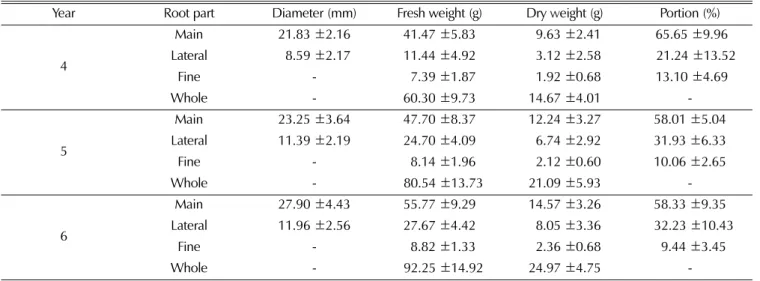
Table 1. The characteristics of growth according to age of root in Panax ginseng cultivated by direct seeding.
Year Root part Diameter (mm) Fresh weight (g) Dry weight (g) Portion (%) 4
Main 21.83±2.16 41.47±5.83 09.63±2.41 65.65±9.96 Lateral 08.59±2.17 11.44±4.92 03.12±2.58 21.24 ±13.52
Fine - 07.39±1.87 01.92±0.68 13.10±4.69
Whole - 60.30±9.73 14.67±4.01 -
5
Main 23.25±3.64 47.70±8.37 12.24±3.27 58.01±5.04 Lateral 11.39±2.19 24.70±4.09 06.74±2.92 31.93±6.33
Fine - 08.14±1.96 02.12±0.60 10.06±2.65
Whole - 80.54 ±13.73 21.09±5.93 -
6
Main 27.90±4.43 55.77±9.29 14.57±3.26 58.33±9.35 Lateral 11.96±2.56 27.67±4.42 08.05±3.36 32.23 ±10.43
Fine - 08.82±1.33 02.36±0.68 09.44±3.45
Whole - 92.25 ±14.92 24.97±4.75 -
결과 및 고찰
1. 직파재배 인삼의 연근별 뿌리 생육 특성
직파재배 인삼의 연근별 뿌리 생육 특성은 Table 1과 같다.
4, 5, 6년근에서 주근의 평균 직경은 각각 21.83, 23.25, 27.90㎜로 연근이 증가함에 따라 주근은 10% 이상 증가하였 으나, 지근의 평균 직경은 각각 8.59, 11.39, 11.96 ㎜로서 5 년과 6년근에서 큰 차이가 없었다.
4, 5, 6년근 평균 생체중을 보면 주근은 각각 41.47, 47.70, 55.77 g이고 지근은 각각 11.44, 24.70, 27.67 g이며, 세근은 각각 7.39, 8.14, 8.82 g이었다. 그리고 총 근중은 각각 60.30, 80.54, 92.25 g으로 연근이 증가함에 따라 크게 증가하였다. 4, 5, 6년근 평균 건물중을 보면 주근은 각각 9.63, 12.24, 14.57 g 이고 지근은 각각 3.12, 6.74, 8.05 g이며, 세근은 각각 1.92, 2.12, 2.36 g이었다. 그리고 총 근중은 각각 14.67, 21.09, 24.97 g으로 생체중과 같은 경향을 보였다.
이식재배한 4, 5, 6년근 인삼의 주당 지근중은 생육년수가 증가 할수록 증가하며 (Lee et al., 2004b), 6년근의 경우 3, 4, 5년근에 비해 지근과 세근이 상대적으로 더 많이 발달되어 있다고 하였는데 (Lee et al., 2001) 이러한 결과는 직파한 인 삼에서도 일치하는 경향이었다.
4, 5, 6년근의 근비율을 보면 주근은 각각 65.65, 58.01, 58.33%이고 지근은 각각 21.24, 31.93, 32.23%이며, 세근은 각 각 13.10, 10.06, 9.44%로 주근과 세근의 비율은 5, 6년근에 비 해 4년근에서 높았으나 지근의 비율은 5, 6년근에서 증가하였다.
2. 직파재배 인삼의 연근별 뿌리의 ginsenoside 함량 비교 직파재배 인삼에서 4, 5, 6년근의 total ginsenoside 함량은 각각 29.65, 28.76, 26.34 ㎎/g으로 4 > 5 > 6년근 순으로 많았 다 (Fig. 1 A). 그러나 근중을 고려한 개체당 뿌리 전체의 total
ginsenoside 함량은 4년근 431.97 ㎎/root, 5년근 606.56 ㎎/
root, 6년근 657.80 ㎎/root 순으로 6년근에서 가장 많았다 (Fig. 1 B).
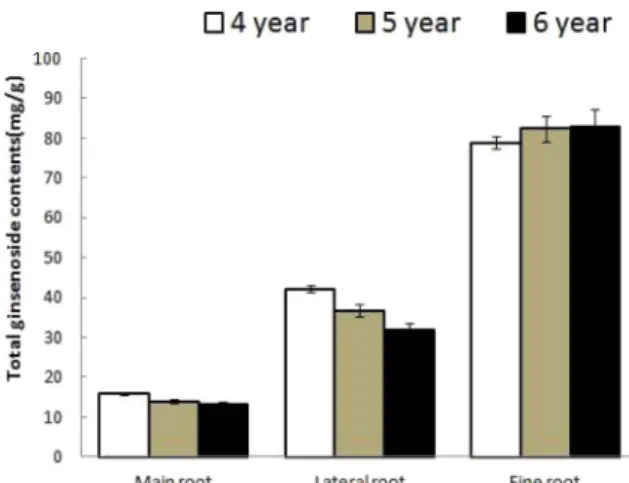
4, 5, 6년근의 g당 total ginsenoside 함량을 보면 주근은 각각 15.86, 13.99, 13.35 ㎎/g이고 지근은 각각 42.11, 36.79, 31.85㎎/g이며, 세근은 각각 78.84, 82.32, 82.98 ㎎/g으로 모 든 년근에서 세근 > 지근 > 주근 순으로 높았다 (Fig. 2).
Jang 등 (1983)은 연근별 인삼의 ginsenoside 함량은 2년근 에서 2.4%였으나, 3년근과 4년근으로 갈수록 ginsenoside 함 량이 증가하여 5년근에서는 5.19%로 최대를 이루었다고 하였 으며, 6년근이 되면 4.80%로 감소한다고 하였다. 또한, Kim 등 (1987)은 2년근 4.89%, 6년근 7.98%로서 5년근에 뿌리의 생장과 ginsenoside 합성축적이 최고 수준에 도달했다가 6년째 부터 쇠퇴하고, 5년근과 6년근의 g당 total ginsenoside 함량은 차이가 없다고 하였는데, 본 실험에서의 g당 total ginsenoside 함량은 4년근에서 가장 높아 기존의 보고와 달랐지만, 근중량 을 고려한 뿌리 전체의 total ginsenoside 함량은 6년근에서 가장 높아 기존의 보고와 비슷한 결과를 보였다.
Fig. 1. Ginsenoside content according to age in whole root of Panax ginseng cultivated by direct seeding. The unit(A) and total(B) contents of ginsenoside in whole root.
Fig. 2. Comparison of total ginsenoside content of root parts and ages in Panax ginseng cultivated by direct seeding.
3. 직파재배 인삼의 연근과 직경에 따른 ginsenoside 함량 비교 직파재배한 인삼에서 4, 5, 6년근의 부위별 직경에 따른 total ginsenoside 함량은 Fig. 3과 같다. 주근의 직경이 36 ~ 34, 33 ~ 31, 30 ~ 28, 27 ~ 25, 24 ~ 22㎜ 일 경우 total ginsenoside 함량을 보면 4년근은 각각 14.39, 15.25, 15.86, 16.22, 17.60㎎/g 이고 5년근은 각각 12.53, 14.28, 15.14, 15.94, 17.32㎎/g 이며, 6년근은 각각 11.19, 11.42, 14.09, 14.65, 15.42㎎/g으로 연근과 관계없이 직경이 클수록 total ginsenoside 함량은 감소하였고 직경이 같은 경우에는 연근이 많을수록 함량은 감소하였다.
지근의 직경이 21 ~ 19, 18 ~ 16, 15 ~ 13, 12 ~ 10, 9 ~ 7 ㎜일 경우 total ginsenoside 함량을 보면 4년근은 각각 31.61, 34.04, 38.85, 48.19, 57.84㎎/g이고 5년근은 각각 26.51, 29.48, 34.97, 44.89, 55.34㎎/g이며, 6년근은 각각 26.74, 26.12,
27.30, 34.43, 44.65㎎/g으로 주근과 유사한 경향을 나타냈다.
세근의 직경 6 ~ 4, 4 ~ 2, 2 이하 ㎜ 의 total ginsenoside 함량을 보면 4년근은 각각 65.35, 78.12, 93.06 ㎎/g이고 5년 근은 각각 72.45, 84.32, 90.21 ㎎/g이며, 6년근은 각각 69.49, 83.51, 95.95㎎/g으로 직경이 작을수록 total ginsenoside 함량 은 증가하였으나 연근 간 총 진세노사이드 함량의 크기에는 일정한 경향이 없었다.
이상과 같이 직파재배 인삼의 total ginsenoside 함량은 주근 과 지근의 직경이 감소함에 따라 증가하였으나 세근에서는 일 정한 경향이 없었다. 또한, 주근과 지근에서는 직경이 동일한 경우는 4 > 5 > 6년근 순으로 total ginsenoside 함량이 높았다.
이러한 결과는 동체부위의 경우 피층과 목질부의 구성비가 대략 1 : 1로 비슷하고, 지근부위는 2 : 1이며, 세근부위에서는 목질부가 거의 없고 대부분 피층으로 형성되어 있어 각 부위 Fig. 3. Comparison of total ginsenoside content by root diameter of ages in Panax ginseng cultivated by direct seeding.
별 ginsenoside 함량의 차이가 크기 때문이다 (Kim et al., 1987). 또한 인삼의 연근이 증가할수록 중심부의 비율이 커지 고 (Lee et al., 1987), 목질화로 인하여 (Sung, 1986) 저년근 인삼에서 피층 비율이 높게 나타나기 때문이라고 생각된다.
근 직경에 따른 ginsenoside 종류별 함량은 4, 5, 6년근 모 두 Rg1을 제외하고 세근, 지근, 주근 순으로 많았으며, 특히
ginsenoside Rb1과 Re 함량은 직경이 감소함에 따라 다른 구 성 성분에 비해 큰 폭으로 증가 하였다 (Table 2). Rg1은 작 은 폭으로 감소하거나 증가하여 일정한 경향이 없었다.
Lee 등 (2011)은 비닐하우스와 관행재배 인삼의 수량성 및 ginsenoside 함량을 비교한 결과 관행재배에서 동직경은 더 작 았으나, ginsenoside 함량은 비닐하우스 재배보다 더 높다고 Table 2. Comparison of ginsenoside composition by root diameter and age with different root part in Panax ginseng cultivated by direct seeding.
Year Root part
diameter (mm)
Ginsenosides (mg/g) PD/
PT†
Rb1 Rb2 Rb3 Rc Rd Re Rf Rg1 Rg2 Rh1
4
M‡
36~34 04.81 0.09 0.04 01.23 0.04 02.69 0.50 4.82 0.16 0.01 0.76 33~31 05.40 0.12 0.04 01.23 0.04 02.71 0.53 5.01 0.17 0.01 0.81 30~28 05.93 0.12 0.05 01.25 0.04 02.81 0.53 4.94 0.19 0.01 0.87 27~25 06.44 0.12 0.05 01.27 0.05 02.97 0.58 4.55 0.18 0.01 0.96 24~22 07.53 0.20 0.07 01.29 0.06 03.28 0.59 4.38 0.19 0.01 1.08
L
21~19 12.60 1.43 0.38 03.43 0.36 05.76 1.40 4.92 0.81 0.52 1.36 18~16 14.23 1.96 0.51 03.81 0.40 04.77 1.89 5.06 1.20 0.22 1.59 15~13 14.63 2.66 0.70 04.31 0.53 08.15 2.36 3.57 1.63 0.33 1.42 12~10 15.31 2.82 0.72 07.93 0.79 11.81 2.75 3.55 1.04 1.47 1.34 9~7 18.10 3.55 1.05 10.22 1.37 12.59 3.04 3.29 1.92 2.71 1.46
F
6~4 35.56 5.07 0.61 02.86 0.64 12.01 2.08 2.78 1.43 2.32 2.17 4~2 40.33 7.19 0.93 04.14 1.05 14.52 2.47 2.58 1.85 3.06 2.19 2> 42.73 7.95 1.30 06.11 1.88 20.44 3.01 2.43 2.43 4.77 1.81
5
M
36~34 03.72 0.18 0.05 01.12 0.04 02.39 0.17 4.00 0.07 0.01 0.77 33~31 05.05 0.22 0.05 01.13 0.04 02.64 0.20 3.93 0.06 0.01 0.95 30~28 05.87 0.29 0.05 01.14 0.04 02.53 0.22 3.83 0.05 0.01 1.11 27~25 06.63 0.30 0.06 01.15 0.06 02.52 0.22 3.66 0.08 0.01 1.26 24~22 07.01 0.35 0.06 01.18 0.06 03.52 0.37 3.52 0.09 0.01 1.15
L
21~19 11.56 1.69 0.05 00.73 0.03 05.50 0.72 4.54 0.31 0.14 1.25 18~16 12.66 1.60 0.21 01.94 0.16 06.03 0.70 4.07 0.41 0.26 1.45 15~13 14.82 1.97 0.45 02.31 0.24 07.09 1.58 3.84 0.82 0.42 1.44 12~10 17.68 2.12 0.68 05.35 0.41 07.68 2.23 4.85 1.33 1.01 1.53 9~7 19.30 3.75 1.03 07.57 1.11 10.96 3.74 3.63 1.38 1.30 1.56
F
6~4 38.36 5.56 1.10 04.02 0.54 13.62 2.22 4.24 1.66 1.13 2.17 4~2 41.23 7.40 1.90 06.88 1.02 15.56 2.54 4.02 2.42 1.34 2.26 2> 43.54 7.95 2.10 07.93 1.46 17.41 2.15 3.09 2.63 1.95 2.31
6
M
36~34 03.26 0.08 0.03 00.09 0.01 02.39 0.17 5.12 0.06 0.01 0.45 33~31 04.18 0.11 0.03 00.11 0.01 02.55 0.26 4.07 0.09 0.01 0.64 30~28 05.35 0.15 0.05 00.17 0.02 02.78 0.24 5.22 0.10 0.01 0.69 27~25 07.20 0.16 0.05 00.19 0.02 03.53 0.25 3.13 0.10 0.01 0.94 24~22 07.38 0.16 0.05 00.20 0.02 03.83 0.40 3.24 0.12 0.01 1.03
L
21~19 11.62 1.50 0.16 01.38 0.04 04.61 1.33 5.34 0.53 0.25 1.22 18~16 11.88 1.84 0.18 01.49 0.04 05.37 1.47 3.06 0.53 0.27 1.44 15~13 12.24 1.13 0.31 01.46 0.20 06.70 1.25 3.17 0.38 0.46 1.28 12~10 14.44 1.98 0.41 03.07 0.31 07.04 1.60 4.12 0.72 0.74 1.42 9~7 16.72 2.19 0.82 05.95 0.33 09.82 3.04 3.43 1.31 1.05 1.39
F
6~4 33.70 4.91 1.14 04.11 0.50 13.94 2.95 5.46 2.17 0.60 1.77 4~2 41.35 6.98 1.45 05.13 0.89 15.56 2.56 6.03 2.45 1.11 2.01 2> 44.54 7.33 2.13 08.04 1.63 19.64 2.75 3.95 3.20 2.73 1.97
†PD; Rb1+Rb2+Rb3+Rc+Rd, PT ; Re+Rf+Rg1+Rg2+Rh1.
‡M; Main root, L ; Lateral root, F ; Fine root.
하였다. Choi (1991)는 원료삼의 배합비율별 사포닌 함량을 분석한 결과 주근부에 비하여 세근과 지근의 배합비율이 높을 수록 ginsenoside Rg1/Rb1의 함유 및 Rg1/total ginsenoside의 함유비율은 현저하게 낮아진다고 하였는데, 이러한 결과는 직 경이 작을수록 Rb1 함량은 큰 폭으로 증가하는 반면 Rg1은 작은 폭으로 감소하거나 증가하였기 때문으로 생각된다.
4. 직파인삼의 연근별 직경에 따른 ginsenoside 함량 예측 직파인삼 4, 5, 6년근의 부위별 직경과 total ginsenoisde 함 량간에 상관계수 및 직선회귀식은 Table 3과 같다. 4, 5, 6년 근에서 주근은 각각 r = -0.94**, y = -0.39x + 24.64, r = -0.98**, y = -0.37x + 25.91, r = -0.96**, y = -0.25x + 23.01이고 지근은 각각 r = -0.96**, y = -1.37x + 51.54, r = -0.89**, y = -2.25x + 70.65, r = -0.89**, y = -2.05x + 71.67, 세근은 각각 r = -0.95**, y = -7.77x + 107.29로 뿌리 부위별 모든 연령에서 높은 부의 상관을 보 였다 (Table 3).
Christensen과 Jensen (2009)은 7년근 미국삼에서 근중과 ginsenoside 함량 사이에는 상관이 없다고 하였으나, Kim 등 (1984)과 Li 등 (2009)은 이식재배 6년근 인삼의 근직경과 ginsenoside 함량 간에는 높은 부의 상관을 나타내었다고 하였 고, 본 실험에서도 연령별로 인삼의 주근, 지근, 세근 모두 직 경이 감소함에 높은 부의 상관을 나타내었다.
본 연구 결과를 통하여 예시한 직선회귀식으로 원료삼의 ginsenoside 함량을 예측할 수 있다면 원료삼의 생산 및 구매 에 도움이 될 수 있을 것이며, 특히 가공용 원료삼의 선택에 유용할 것으로 생각된다.
인삼의 크기는 원료 수삼, 홍삼, 백삼, 태극삼 등에서 품질 기준으로 사용되어 큰 인삼일수록 고가에 판매되고 있다. 그 러나, 인삼 성분을 원료로한 파우치, 분말 캡슐, 화장품, 인삼 추출 함유 식품은 원형을 유지하는 가공제품이 아니기 때문에 크기보다는 주요 약리 성분 중 ginsenoside를 중심으로 동체가 작고 지근과 세근이 많은 원료삼을 사용하는 것이 유리하다.
따라서 ginsenoside 함량이 높은 원료삼 생산을 위해서는 주 근의 직경이 크게 비대하지 않고, 지근, 세근의 비율을 증가 시키는 인삼 재배법 개발이 필요하다고 생각된다.
감사의 글
본 논문은 농촌진흥청에서 시행한 지역전략작목 산학연협력 단 사업비의 지원으로 수행된 결과의 일부로 이에 감사드립니다.
LITERATURE CITED
Ahn IO, Lee SS, Lee JH, Lee MJ and Jo BG. (2008).
Comparison of ginsenoside contents and pattern similarity between root parts of new cultivars in Panax ginseng C. A.
Meyer. Journal of Ginseng Research. 32:15-18.
Ahn SD. (1992). Saponin contents, histological and cytological characteristics of ginseng root with physiological disorder.
Korean Journal of Ginseng Science. 16:44-52.
Bang KH, Seo AY, Kim YC, Jo IH, Kim JU, Kim DH, Cha SW, Cho YG and Kim HS. (2012). Variations of agronomic characteristics of cultivars and breeding lines in Korean ginseng(Panax ginseng C. A. Mey.). Korean Journal of Medicinal Crop Science. 20:231-237.
Choi JE, Li XG, Han YH and Lee KT. (2009). Changes of saponin contents of leaves, stems and flower-buds of Panax ginseng C. A. Meyer by harvesting days. Korean Journal of Medicinal Crop Science. 17:251-256.
Choi KJ. (1991). The composition and quality of raw ginseng management. Korean Journal of Ginseng Science. 15:247-256.
Chon SU and Kim YM. (2011). Differential physiological activity in different ages of Panax ginseng. Korean Journal of Crop Science. 56:80-87.
Christensen LP and Jensen M. (2009). Biomass and content of ginsenosides and polyacetylenes in American ginseng roots can be increased without affecting the profile of bioactive compounds.
Journal of Natural Medicines. 63:159-168.
Hwang JB, Ha JH, Hawer WD, Nahmgung B and Lee BY.
(2005). Ginsenoside contents of Korean white ginseng and taegeuk ginseng with various sizes and cultivation years.
Korean Journal of Food Science and Technology. 37:508-512.
Jang JG, Lee KS, Kwon DW, Nam KY and Choi JH. (1983).
Study on the changes of saponin contents in relation to root age of Panax ginseng. Korean Journal of Food and Nutrition.
12:37-40.
Jo JS, Cho HK, Park SH and Jung CS. (2001). General feature and ginsenoside content of 6 years old ginseng(Panax ginseng C. A. Meyer) root. Korean Journal of Dietary Culture. 16:478-482.
Kim GS, Hyun DY, Kim YO, Lee SW, Kim YC, Lee SE, Son Table 3. Regression equation and correlation coefficient between root diameter and total ginsenoside in 4, 5, 6-year-old Panax ginseng
cultivated by direct seeding.
Year Whole root Main root Lateral root Fine root
Y =αX + β r Y =αX + β r Y =αX + β r Y =αX + β r*
4 y = -2.22x + 79.20 -0.94** y = -0.39x + 24.64 -0.94** y = -1.37x + 51.54 -0.96**
y = -7.77x + 107.29 -0.95**
5 y = -2.32x + 79.99 -0.94** y = -0.37x + 25.91 -0.98** y = -2.25x + 70.65 -0.89**
6 y = -2.29x + 76.44 -0.89** y = -0.25x + 23.01 -0.96** y = -2.05x + 71.67 -0.89**
*** is significant at the 0.1% levels of probability.
YD, Lee MJ, Park CB, Park HK, Cha SW and Song KS.
(2008). Extraction and preprocessing methods for ginsenosides analysis of Panax ginseng C. A. Meyer. Korean Journal of Medicinal Crop Science. 16:446-454.
Kim MW, Ko SR, Choi KJ and Kim CS. (1987). Distribution of saponin in various sections of Panax ginseng root and changes of its contents according to root age. Korean Journal of Ginseng Science. 11:10-16.
Kim MW, Lee JS and Nam KY. (1984). Saponin contents in various parts of raw red ginseng. Korean Journal of Ginseng Science. 8:8-14.
Kubo M, Tani T, Katsuki K, Ishzaki S and Arichi S. (1980).
Histochemistry. Ⅰ. Ginsenosides in ginseng(Panax ginseng C.
A. Meyer, Root). Journal of Natural Products. 43:278-284.
Lee CR, Whang WK, Shin CG, Lee HS, Han ST, Im BO and Ko SK. (2004a). Comparison of ginsenoside composition and contents in fresh ginseng roots cultivated in Korea, Japan and China at various ages. Korean Journal of Food Science and Technology. 36:847-850.
Lee KH, Lee SS, Lee MG and Kim ES. (2001). Identification of root age by histochemical staining of secretory duct layers in ginseng. Journal of Ginseng Research. 25:101-105.
Lee MK, Park H and Lee CH. (1987). Effect of growth conditions on saponen content and ginsenoside pattern of Panax ginseng. Korean-Japan Panax Ginseng Symposium. p.89-107.
Lee JC, Ahn DJ, Byen JS, Cheon SK and Kim CS. (1998).
Effect of seeding rate on growth and yield of ginseng plant in direct-sowing culture. Korean Journal of Ginseng Science.
22:299-303.
Lee SW, Cha SW, Hyun DY, Kim YC, Kang SW and Seong NS. (2005). Comparison of growth characteristics and extract and crude saponin contents in 4-year-old ginseng cultured by direct seeding and transplanting cultivation. Korean Journal of Medicinal Crop Science. 13:241-244.
Lee SW, Kang SW, Seong NS, Hyun GS, Hyun DY, Kim YC and Cha SW. (2004b). Seasonal changes of growth and extract content of roots in Panax ginseng C. A. Meyer. Korean Journal of Medicinal Crop Science. 12:483-489.
Lee SW, Kim GS, Hyun DY, Kim YB, Kim JW, Kang SW and Cha SW. (2011). Comparison of growth characteristics and ginsenoside content of ginseng(Panax ginseng C. A. Meyer) cultivated with greenhouse and traditional shade facility. Korean Journal of Medicinal Crop Science. 19:157-161.
Li XG. Kang SJ, Han JS, Kim JS and Choi JE. (2009). Effects of root diameter within different root parts on ginsenoside composition of Yunpoong cultivar in Panax ginseng C. A.
Meyer. Korean Journal of Medicinal Crop Science. 17:452-457.
Lim WS. (2005). Effects of interactions among age, cultivation method (location) and population on ginsenoside content of wild Panax quinquefolium L. one year after transplanting from wild. Korean Journal of Medicinal Crop Science. 13:254-261.
Shi W, Wang YT, Li J, Zhang HQ and Ding L. (2007).
Investigation of ginsenosides in different parts and ages of Panax ginseng. Food Chemistry. 102:664-668.
Sung HS. (1986). Present and future on the processing of ginseng.
Korean Journal of Ginseng Science. 10:218-232.
Tani T, Kubo M, Katsuki T, Higashino M, Hayashi T and Arichi S. (1981). Histochemistry. Ⅱ. Ginsenosides in ginseng (Panax ginseng C. A. Meyer, Root). Journal of Natural Products.
44:401-407.
Wang YI, Pan JY, Xiao XY, Lin RC and Cheng YY. (2006).
Simultaneous determination of ginsenoside in Panax ginseng with different growth ages using high-performance liquid chromatography- mass spectrometry. Phytochemical Analysis. 17:424-430.
Won JY and Jo JS. (1999). Farm study of direct seeding cultivation of the Korean ginseng(Panax ginseng C. A. Meyer).
Korean Journal of Medicinal Crop Science. 7:308-313.