www.medcrop.or.kr http://dx.doi.org/10.7783/KJMCS.2013.21.2.118
논토양에서 해가림 피복물 종류별 6년생 인삼의 생육과 진세노사이드 함량
이성우†·박기춘·이승호·김금숙·장인복·김용범·차선우 농촌진흥청 국립원예특작과학원 인삼특작부
Growth Characteristics and Ginsenoside Contents of 6-Year-Old Ginseng (Panax ginseng C. A. Meyer)
by Shade Materials in Paddy Field
Sung Woo Lee†, Kee Choon Park, Seung Ho Lee, Geum Soog Kim, In Bok Jang, Yong Bum Kim and Seon Woo Cha
Department of Herbal Crop Research, NIHHS, RDA, Eumseong 369-873, Korea.
ABSTRACT : This study was carried out to select optimal shade materials among four-layered polyethylene (PE) net (FLPN), aluminium-coated PE sheet (APSS), and blue PE sheet (BPSS) in condition of paddy field cultivated 6-year-old gin- seng. The order of light-penetrated ratio and air temperature by shade materials was BPSS > APSS > FLPN. Light-pene- trated ratio of BPSS before two fold shade was more 3 times and 2 times than that of FLPN and APSS, respectively. Air temperature of BPSS was also higher 1.6oC and 1.4oC than that of FLPN and APSS, respectively. BPSS showed good cul- tural environment because all of light-penetrated ratio and air temperature were become higher in spring and fall season but lower in summer season by additional shade with two-layered PE net. Survived-leaf ratio was highest in BPSS and low- est in FLPN causing a little water leak on a rainy day. Rusty-root ratio was also highest in FLPN because soil moisture con- tent was increased by water leak. The order of root yield was BPSS > APSS > FLPN, and the cause of highest yield in BPSS was higher light-penetrated ratio during spring and fall season, higher survived-leaf ratio, and lower rusty-root ratio than that of APSS and FLPN. BPSS showed highest total ginsenoside content because of high light-penetrated ratio, blue light effect, and the difference in dry matter partitioning ratio such as low taproot ratio, and high lateral root ratio.
Key Words: Ginseng, Shade Material, Root Yield, Ginsenoside, Paddy Field
서 언
인삼은 연작장해가 심한 작물로 재작까지 적어도 10년 이상 의 기간이 경과되어야 하기 때문에 (Kang et al., 2007) 초작 지 부족이 점점 심화되고 있으며, 이에 따라 논토양을 이용한 재배가 늘고 있다. 논에서는 벼를 4 ~ 5년 재배하고 나면 근부 병균의 밀도가 저하되고 독소물질도 희석되어 인삼을 다시 재 배할 수 있다 (Jo et al., 1996). 그러나 논토양은 배수가 불 량한 곳이 많아 습해 발생이 많고 벼 재배시 사용한 화학비료 등으로 토양에 염류가 축적되어 황증이나 적변삼 등 생리장해 를 유발하기 쉽다 (Lee et al., 2012).
논토양에서 인삼을 안정적으로 재배하기 위해 그간 여러 가 지 연구가 시도되었다. 논·밭토양 조건에서 인삼의 생육 및 품질특성을 조사한 결과 논재배는 밭재배에 비하여 평균수량 이 약간 떨어지나 수량의 변이가 작으며, 사포닌 함량은 약간 떨어지나 엑스함량은 유의적인 차이가 없었다 (Lee et al., 2004a, 2004b).
천풍, 연풍, 황숙종, 자경종 등 4품종을 대상으로 논토양에 적합한 품종을 시험한 결과 천풍이 선발되었는데, 황숙종도 황 증에 강하고 수량성에 높으나 적변 발생이 다소 많은 단점이 있다 (Kang et al., 2010).
논토양 배수등급별 인삼 생육 및 사포닌 함량을 조사한 결
†Corresponding author: (Phone) +82-43-781-5541 (E-mail) [email protected]
Received 2013 February 6 / 1st Revised 2013 March 6 / 2nd Revised 2013 March 21 / Accepted 2013 Revised April 1
This is an open access article distributed under the terms of the Creative Commons Attribution Non-Commercial License (http://creativecom- mons.org/licenses/by-nc/3.0/) which permits unrestricted non-commercial use, distribution, and reproduction in any medium, provided the original work is properly cited.
과 ‘배수약간불량지’의 지하수위는 연중 28 ~ 71 cm의 변화를 보여 장마철 집중 강우시에는 지하수위의 급격한 상승으로 다 소 습해발생이 우려되는 반면, ‘배수불량지’의 지하수위는 연 중 20 ~ 30 cm의 변화를 보여 습해가 발생되기 쉬운 조건이었 는데, ‘배수약간불량지’는 ‘배수불량지’보다 수량성이 높고 적 변발생도 적었으며, 총진세노사이드 함량도 약간 높은 특징을 보였다 (Lee et al., 2009b, 2012).
일반적으로 인삼의 최적수분함량은 용수량의 63% 수준이고 절대수분함량 (건토수분함량)으로는 19.8% 내외인데 (Lee et al., 2007), 3년생 인삼을 대상으로 배수등급에 따라 해가림 유 형별 수량성을 조사한 결과 ‘배수불량지’ 논토양처럼 연평균 토 양수분함량이 25%로 상당히 높은 조건에서는 누수가 차단되고 투광량이 많은 청색 차광지에서 가장 높은 수량성을 보였으나
‘배수약간불량지’ 논토양처럼 연평균 토양수분함량이 17%로 적 절한 조건에서는 4중직 차광망이 가장 높은 수량성을 보였다.
또한, Song 등 (2011)도 논토양에서 해가림 유형별 3년생 인 삼의 건물생산능력을 조사한 결과 4중직 차광망 > 청색 차광 지 > 은박 차광판 순으로 4중직 차광망이 가장 높다고 하여 저 년생을 대상으로 한 연구결과는 있으나 6년생 인삼을 대상으로 조사한 결과는 없는 실정이다. 인삼은 생장속도가 매우 느려 3 년생까지는 인삼 고유의 농업적 형질이 완전히 나타나지 않는 데, 연생별 N, P, K의 흡수량을 보면 1 ~ 2년생에서는 5% 미만 이나 5 ~ 6년생에서는 55 ~ 68%를 차지할 정도로 고년근에서 생 육이 왕성하기 때문에 (Park et al., 2012) 수확 적정 연령인 6 년생에서의 생육특성과 수량성을 조사하는 것이 필요하다.
따라서 본 연구는 논재배가 가능한 배수등급인 ‘배수약간불 량지’ 논토양에서 4중직 차광망, 은박 차광판, 청색 차광지 등 3종의 피복물을 이용하여 해가림을 설치하고 6년생 인삼의 생 육 및 진세노사이드 함량을 조사하여 안정적인 논재배 기술을 개발하고자 수행하였다.
재료 및 방법
본 실험은 충북 음성군 소재 국립원예특작과학원 인삼특작 부 시험포장에서 2008년 3월부터 2012년 10월까지 수행하였 으며, 시험품종은 재래종인 자경종이었다. 묘삼 이식 전 예정 지관리를 위해 2006년 5월 상순 수단그라스를 파종하고 8월 상순 출수기에 갈아엎어 토양에 환원하였으며, 10월 중순경 호
밀을 파종하여 2007년 5월 하순에 토양에 환원하였다. 2008 년 3월 하순에 묘삼을 본밭에 7행 10열 (70주/3.3 ㎡)로 이식 하였다. 시험구 배치는 난괴법 3반복이었고 시험구 면적은 구 당 9.9 ㎡ 이었다.
시험포장은 벼를 재배했던 논포장으로 토성은 사촌통이었고 배수등급은 ‘배수약간불량지’였으며, 지하수위는 봄가을 갈수 기에는 75 cm 내외였으며, 장마철인 여름철에는 비온뒤 지하 수위가 28 cm까지 상승하였다.
해가림 유형은 A형이었고 해가림 피복물은 청색 3 + 흑 1 의 4중직 차광망, 알루미늄으로 코팅된 은박 차광판, 청색 차 광지 등 3종이였는데, 6월 상순부터 9월 중순까지 흑색 2중직 차광망을 모든 해가림 위에 추가로 피복하여 고온장해를 예방 하였다. 2중직 차광망 추가 피복시 원래의 피복물과 10 ~ 20 cm의 간격을 두어 표면이 뜨거워지는 것을 방지하였 다. 해가림별 투광량 및 기온은 Li-1400 data logger (Licor, USA)를 이용하여 측정하였는데, 투광량과 기온은 지상 15 cm 부위를 조사하였다. 이중차광 전 투광량 및 기온 측정은 6월 8일에서 6월 13일까지, 이중차광 후에는 7월 21에서 7월 25 일까지 측정하여 평균값을 이용하였다. 토양수분함량은 건토 중량법으로 측정하였다.
6년생 인삼이 재배되고 있는 본밭의 토양 화학성은 Table 1과 같은데, 토양산도는 적정치보다 매우 낮았으며, 유기물함량이 다 소 적었으나 기타 성분은 인삼재배의 적정범위 내에 있었다.
토양화학성분 중 pH, EC, 유기물, 유효인산 및 치환성 양이 온 K, Ca, Mg은 농촌진흥청 토양화학분석법에 따랐으며, Fe 과 Mn의 분석방법은 다음과 같다. 철 (Fe)과 망간 (Mn)은 토양시료를 풍건하여 분쇄 후 20 mesh (2 ㎜) 체를 통과한 다 음 유발에 미세하게 갈아 분석용으로 사용했다. 시료 10 g을 100㎖ 삼각플라스크에 평량하고 침출액 (0.1N HCl) 50 ㎖ 첨가 후 항온 수조 30℃에서 1시간 진탕 후 Toyo No. 5B로 여과하여 ICP로 측정했다.
6년생 인삼의 황증 발생주율은 6월 중순에 조사하였고 지상 부 생육특성은 7월 하순에 조사하였다. 잎의 생존율은 9월 하 순에 조사하였는데, 잎이 50% 이상 생존해 있는 그루를 조사 하여 지상부 생존주율을 구했다. 지하부 생육 및 수량성은 수 확적기인 10월 하순에 조사하였으며, 수확한 뿌리의 표면을 관 찰하여 적변 발생주율을 구했다.
수확한 인삼뿌리는 세척 후 뇌두, 동체, 지근 및 세근 등
Table 1. Soil chemical properties and groundwater table in paddy field of 6-year-old ginseng.
pH (1:5)
EC (dS/m)
(g/㎏)OM NO3
(㎎/㎏) P2O5
(㎎/㎏)
Ex. Cation (cmol+/㎏) --(㎎/㎏)-- Ground -water table (㎝)
K Ca Mg Fe Mn
4.7 0.44 11.0 24.6 68.8 0.22 2.24 0.74 200 22.0 2875
♩Drainage class: Imperfectly drained class.
♪Investigation date of soil analysis: June 29, 2012.
부위별로 분리하고 동결건조하여 부위별 건물중을 구한 다음 모두 합쳐 전체 뿌리당 진세노사이드 함량을 구하였다. 진세 노사이드 분석을 위해 뿌리 전체를 300 mesh 이하로 곱게 분 쇄하여 사용하였다. 분말시료 2.0 g을 50 ㎖ 원심분리 튜브에 평량하여 담고, 40 ㎖ 50% MeOH을 첨가한 후 뚜껑을 닫고 ultrasonic bath (Powersonic 410, 화신테크, 한국)에 넣은 다 음 15분 동안 초음파 추출하고 여과하였다. 이렇게 총 2회 추 출한 후 여과액을 합쳐서 100 ㎖ 정용 플라스크에 담아 부피 를 100 ㎖로 정확히 맞추었다. 이 시료액 1 ㎖를 취하여 Sep- Pak으로 전처리 하였다. 즉, Sep-Pak Plus C18 cartridge를 먼 저 3 ㎖ MeOH로 서서히 용출시켜 conditioning을 하고 다시 3㎖ dd-H2O로 2차 conditioning 시켰다. 추출 시료액 1 ㎖ 를 cartridge에 loading하고 10 ㎖ dd-H2O로 서서히 당류 등을 제거하였다. 이 cartridge에 2 ㎖ MeOH를 처리하여 서서히 ginsenoside 성분을 용출시켰다. 정확히 부피를 2 ㎖로 조절한 후 시료액을 0.45 ㎛ membrane filter로 여과하여 HPLC 분 석시료로 사용하였다. Ginsenoside 함량은 Agilent 1100 series (Agilent Technologies, Waldbronn, Germany) HPLC system를 이용하여 측정하였다. 칼럼은 YMC-Pack ODS AM (250× 4.6 ㎜, 5 ㎛, YMC, Inc. USA)을 사용하였으며, 기울 기 이동상 조건은 Table 2와 같다. 인삼 추출액은 20 ㎕씩 주 입하였는데, 이동상의 유속은 0.8 ㎖/min, 칼럼온도 40℃, UV 검출기의 검출파장은 203 ㎚로 분석하였다.
결과 및 고찰
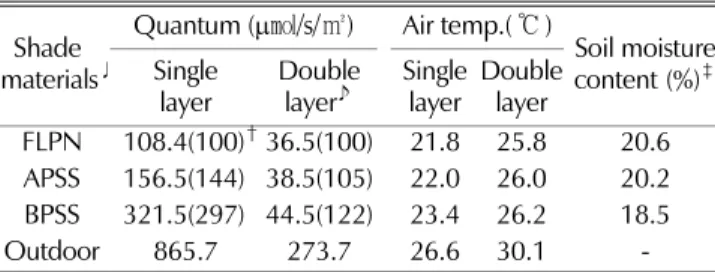
1. 해가림 피복물 종류별 투광량, 기온 및 토양수분 함량 Table 3과 같이 해가림 피복물 종류별 투광량은 청색 차광
지 > 은박 차광판 > 4중직 차광망 순으로 청색 차광지가 가장 많았는데, 청색 차광지는 4중직 차광망보다 3배, 은박 차광판 보다 2배 더 많았다. 여름철 고온장해 예방을 위해 흑색 2중 직 차광망을 추가 피복하면 투광율은 현저히 감소하여 해가림 별 차이는 크게 줄어들었는데, 청색 차광지는 4중직 차광망보 다 22%, 은박 차광판보다 16% 더 많았다.
해가림 밑의 기온은 투광량과 비례하는데 (Lee et al., 2006), 청색 차광지는 4중직 차광망보다 1.6℃, 은박 차광판보다 1.4℃
더 높았다. 여름철 흑색 2중직 차광망을 추가 피복하면 청색 차 광지는 4중직 차광망보다 0.4℃, 은박 차광판보다 0.2℃ 더 높 아 해가림별 온도 차이는 줄어들었다. 따라서 청색 차광지는 기 온이 낮은 봄가을에 상대적으로 투광량이 많은 특징을 보였다.
해가림 피복물 종류별 토양수분함량을 보면 4중직 차광망이 20.6%로 가장 높았으며, 누수가 차단되는 은박 차광판이나 청 색 차광지는 약간 낮았다. 그리고 청색차광지가 은박 차광판보 다 토양수분함량이 약간 더 낮았는데, 청색 차광지는 은박 차 광판보다 투광율이 높아 상면의 증발량이나 식물체의 증산량이 더 많았기 때문으로 생각된다. Lee 등 (2007) 도 투광량의 증 가에 따라 잎의 증산량이 뚜렷이 증가되는 결과를 보고하였다.
2. 해가림 피복물 종류별 인삼의 생육특성 및 수량성 Table 4와 같이 해가림 피복물 종류별 6년생 인삼의 지상부 Table 2. Solvent gradient program of HPLC analysis.
Time (min) Acetonitrile (%) Water (%) 0
10 45 47 68
28 28 40 100 100
72 72 60 0 0
Table 3. Quantum and air temperature by shade materials.
Shade materials♩
Quantum (µ㏖/s/㎡) Air temp.(℃ )
Soil moisture content (%)‡ Single
layer
Double layer♪
Single layer
Double layer
FLPN 108.4(100)†36.5(100) 21.8 25.8 20.6 APSS 156.5(144) 38.5(105) 22.0 26.0 20.2 BPSS 321.5(297) 44.5(122) 23.4 26.2 18.5
Outdoor 865.7 273.7 26.6 30.1 -
♩FLPN: four-layered (blue 3 + black 1) polyethylene (PE) net, APSS: aluminium-coated PE sheet, and BPSS: blue PE sheet.
♪Period of twofold shade: June 16~ September 10.
†Investigated date: single layer (June 8~ 13), double layer (July 21~ 25),
‡Investigated date: June 13.
Table 4. Aerial growth characteristics of 6-year-old ginseng by shade materials in paddy field of imperfectly drained class.
Shade materials♩
Plant height
(㎝)
Stem length
(㎝)
Leaf length
(㎝)
Leaf width
(㎝)
Stem diameter
(㎜)
Chlorophyll content (SPAD value)
Ratio of leaf discoloration
(%)
Ratio of survived leaf (%)♪
FLPN 59.5b 33.6b 14.0a 6.1a 6.8a 34.5b 22.4b 06.7c*
APSS 69.1a 39.3a 16.4a 6.9a 7.5a 34.7b 29.7a 18.3b
BPSS 66.9a 39.2a 15.6a 6.6a 8.6a 36.1a 19.8b 45.0a
*Mean with same letters are not significantly different in DMRT (p > 0.05).
♩FLPN: four-layered (blue 3 + black 1) polyethylene (PE) net, APSS: aluminium-coated PE sheet, and BPSS: blue PE sheet.
♪Investigation date: September 25, 2012. Variety: native ginseng, Jakyeongjong.
생육특성은 다음과 같다. 초장과 경장은 은박 차광판이 가장 크고 4중직 차광망이 가장 작았는데, 은박 차광판과 청색 차 광지 간에는 유의적인 차이가 없었다. 엽장과 엽폭도 은박 차 광판이 가장 크고 4중직 차광망이 가장 작았는데, 해가림 종 류별 유의적인 차이는 없었다. 줄기의 굵기 (경태)는 주당근중 과 가장 관계가 깊은 형질인데 (Ahn et al., 1987), 청색 차 광지 > 은박 차광판 > 4중직 차광망 순이었으나 처리간 유의성 은 없었다. 엽록소 함량을 나타내는 엽색은 청색 차광지가 가 장 높았으며, 은박 차광판과 4중직 차광망은 유의적인 차이가 없었다. 엽록소 함량은 대개 투광량이 많아지면 감소하는데 (Lee et al., 2008), 본 시험에서는 여름철에 이중차광을 실시 하여 투광량을 조절하였고 토양수분도 충분하였기 때문에 청 색 차광지의 엽록소 함량은 감소되지 않은 것으로 생각된다.
Lee 등 (2007)도 토양수분이 18% 내외로 적절하면 어느 정도 투광량이 높아져도 엽록소 함량이 감소되지 않고 잎이 타는 엽소증상도 발생하지 않았다고 하였다.
잎에 발생하는 황증은 청색 차광지가 가장 낮고 은박 차광 판이 다소 높았는데, 4중직 차광망과 청색 차광지 간에는 유 의차가 없었다. 지상부 생존율은 청색 차광지가 가장 높고 4 중직 차광망이 가장 낮았으며, 해가림 종류별 뚜렷한 차이를 보였다. 청색 차광지의 지상부 생존율이 가장 높았던 원인은 청색광의 유입에 의한 병해 억제효과 때문으로 생각되며 (Kim and Chung, 1992), 4중직 차광망의 지상부 생존율이 가장 낮 았던 원인은 누수로 인해 점무늬병이나 탄저병의 발생이 증가 되었기 때문으로 판단된다.
Table 5와 같이 해가림 피복물 종류별 6년근 인삼의 지하부 특성 및 수량성을 조사한 결과는 다음과 같다. 지하부 생존율 은 청색 차광지가 가장 높고 4중직 차광망이 가장 낮았는데, 청색 차광지와 은박 차광판 간에는 유의적인 차이가 없었다.
동체장은 해가림 종류별 유의차가 없었으며, 동체직경은 청색 차광지와 은박 차광판이 4중직 차광망보다 뚜렷이 컸다. 주당 근중은 청색 차광지가 가장 크고 4중직 차광망이 가장 작았는 데, 청색 차광지와 은박 차광판 간에는 유의적인 차이가 없었 다. 적변발생은 4중직 차광망에서 62.1%로 매우 높고 청색 차 광지와 은박 차광판은 각각 10.6%, 13.5%로 낮은 특징을 보 였는데, 4중직 차광망은 약간의 누수가 되는 특성 때문에 토 양수분이 증가되어 적변 발생이 많아진 것으로 판단된다 (Lee et al., 2007; Park et al., 2006).
뿌리 수량성은 청색 차광지 > 은박 차광판 > 4중직 차광망 순으로 청색 차광지의 수량성이 가장 높고 4중직 차광망이 가 장 낮았다. 청색 차광지에서 수량성이 높았던 원인은 뿌리비 대를 억제하는 황증과 적변 발생이 낮고 지상부와 지하부의 생존율이 높았기 때문으로 보인다. 또한, 봄·가을 기온이 낮 을 때 투광량이 높을 뿐 아니라 청색광의 투과 효과로 인해 광합성량이 증가되어 뿌리비대가 촉진되었다고 판단된다 (Choen et al., 2003; Lee et al., 2006). 적변 발생은 뿌리비 대를 억제하며 (Shin et al., 2003), 잎이 가을까지 생존해 있 어야 광합성기간이 증가되어 물질생산이 많아지기 때문에 조 기낙엽은 수량 감소의 중요한 원인이 된다 (Lee et al., 2011). 또한, 토양수분함량은 18% 내외 (포장용수량의 60%
Table 5. Underground growth characteristics and root yield of 6-year-old ginseng by shade materials in paddy field with imperfectly drained class.
Shade materials♩
Ratio of Survived root (%)♪
Taproot length
(㎝)
Taproot diameter
(㎜)
Root length
(㎝)
Root weight (g/plant)
Ratio of rusty root
(%)
Root yield (㎏/3.3 ㎡)
FLPN 61.4b 8.3a 24.2b 26.6b 64.6b 62.1a 1.70c*
APSS 73.0a 8.3a 30.3a 28.2ab 86.0a 13.5b 2.45b
BPSS 74.6a 8.7a 30.7a 29.1a 93.0a 10.6b 2.65a
*Mean with same letters are not significantly different in DMRT(p > 0.05).
♩FLPN: four-layered (blue 3 + black 1) polyethylene (PE) net, APSS: aluminium-coated PE sheet, and BPSS: blue PE sheet.
♪Investigation date: October 25, 2012. Variety : native ginseng, Jakyeongjong.
Table 6. Dry matter partitioning ratio by shade materials in 6-year-old ginseng of paddy field.
Shade materials♩ Dry matter partitioning ratio (%) Moisture content of
root (%)
Rhizome Taproot Lateral root Fine root
FLPN 5.6a 61.9a 22.6b 9.9a 72.2b*
APSS 5.5a 60.0a 25.8a 8.6a 72.7b
BPSS 5.5a 56.3a 28.2a 9.9a 73.5a
*Mean with same letters are not significantly different in DMRT(p > 0.05).
♩FLPN: four-layered (blue 3 + black 1) polyethylene (PE) net, APSS: aluminium-coated PE sheet, and BPSS: blue PE sheet.
♪Investigation date: October 25, 2012.
내외) 정도면 적절하여 광합성에 억제요인으로 작용하지 않는 데 (Lee et al., 2007), 본 시험이 수행된 논토양의 수분함량 은 18% 내외를 보여 적절한 수준이므로 투광량이 많은 청색 차광지에서 높은 수량성을 보였던 것으로 생각된다.
Table 6에서와 같이 해가림 피복물 종류에 따른 6년근 인삼 의 건물분배율 특성은 다음과 같다. 수량이 높았던 청색 차광 지는 동체중의 비율이 낮으나 지근중의 비율이 높은 특징을 보였다. 따라서 뿌리비대가 증가되면 동체보다는 지근의 발달 이 촉진되어 동체중의 비율은 감소되고 지근중의 비율은 증가 되는 결과를 보였다. Lee 등 (2011)과 Lee 등 (2012)도 주당 근중이 더 무거우면 지근발달이 양호하여 동체중의 비율은 낮 아지고 지근중 비율이 높아진다고 하였다.
3. 해가림 피복물 종류별 인삼의 진세노사이드 함량 Table 7에서와 같이 해가림 피복물 종류에 따른 6년근 인삼 의 진세노사이드 함량은 다음과 같다. 동체, 지근, 세근 부위 를 모두 합한 뿌리당 총진세노사이드 함량은 청색 차광지 > 4 중직 차광망 > 은박 차광판 순으로 청색 차광지가 가장 높았 으며, 4중직 차광망과 은박 차광판 간에 유의적인 차이가 없 었는데, 청색 차광지는 4중직 차광망보다 33%, 은박 차광판보 다 45% 증가되었다. 청색 차광지의 경우 Rh1을 제외한 모든 개별 진세노사이드들은 4중직 차광망 및 은박 차광판과 유의 적인 차이를 보였다.
일반적으로 인삼은 투광량이 지나치게 높아지면 수량은 감 소되나 사포닌 함량은 투광량에 비례하여 증가된다 (Lee et al., 1983). 그리고 청색 차광지는 청색광을 투과시키며, 청색 광은 사포닌 증가에 효과가 있다 (Lee et al., 2007). 따라서 본 실험에서도 청색 차광지의 높은 투광율과 청색광 유입 등 은 사포닌 함량을 증가시키는 요인이 된 것으로 생각된다. 또 한, 청색 차광지의 경우 사포닌 함량이 낮은 동체의 비율이 낮고 사포닌 함량이 높은 지근의 비율이 높아 이것 또한 사포 닌 함량을 증가시키는데 일조한 것으로 생각된다.
감사의 글
본 연구는 농촌진흥청에서 주관하는 인삼 수출증대 신기술
조기접목 및 현장애로기술 개발 과제(사업번호 PJ006913)의 연구비 지원에 의해 수행된 연구결과로 이에 감사드립니다.
LITERATURE CITED
Ahn SD, Choi KT, Kwon WS, Chung CM, Cheon SR and Nam KY. (1987). Estimation of yield in Panax ginseng.
Journal of Ginseng Science. 11:46-55.
Cheon SK, Lee TS, Yoon JH and Lee SS. (2003). Effect of light transmittance control on the growth season of Panax ginseng.
Journal of Ginseng Research. 27:202-206.
Jo JS, Kim CS and Won JY. (1996). Crop rotation of the Korean ginseng(Panax ginseng C. A. Meyer) and the rice in paddy field. Korean Journal of Medicinal Crop Science. 4:19-26.
Kang SW, Lee SW, Hyun DY, Yeon BY, Kim YC and Kim YC.
(2010). Studies on selection of adaptable varieties in paddy- field of ginseng culture. Korean Journal of Medicinal Crop Science. 18:416-420.
Kang SW, Yeon BY, Hyeon GS, Bae YS, Lee SW and Seong NS. (2007). Changes of soil chemical properties and root injury ratio by progress years of post-harvest in continuous cropping soils of ginseng. Korean Journal of Medicinal Crop Science.
15:157-161.
Kim CH and Chung HS. (1992). Differential growth response of Rhizoctonia solani, causal organism of ginseng damping-off, to light irradiation(Research Report). Rural Development Adminstration(C.P.). 34:20-27.
Lee JC, Choi JH, Cheon SK, CH Lee and Jo JS. (1983).
Studies on the optimal light intensity for growth of Panax ginseng. Ⅱ. Effect of light intensity on the contents of saponin and free sugar in the ginseng leaf. Korean Journal Crop Science. 28:497-503.
LeeSW,Cha SW, Hyun DY, Kim YC, Kang SW and Seong NS. (2006). Shading effect of different colored polyethylene net on seeding growth of Panax ginseng C. A. Meyer. Korean Journal of Medicinal Crop Science, 14:113-116.
Lee SW, Hyun DY, Park CG, Kim TS, Yeon BY, Kim CG and Cha SW. (2007). Effect of soil moisture content on photosynthesis and yield of ginseng seedling(Panax ginseng C.
A. Meyer) in Yangjik seedbed cultivation. Korean Journal of Medicinal Crop Science. 15:367-370.
Lee SW, Kang SW, Kim DY, Seong NS and Park HW. (2004a).
Comparison of growth characteristics and compounds of ginseng cultivated by paddy and upland cultivation. Korean Table 7. Ginsenoside composition by shade materials in 6-year-old ginseng of paddy field. (d.w %)
Shade materials♩
Panaxadiol (PD) Panaxatriol (PT)
Total PD/PT
Rb1 Rb2 Rb3 Rc Rd Re Rf Rg1 Rg2 Rh1
FLPN 0.135b 0.071b 0.057b 0.106b 0.019b 0.167ab 0.131b 0.321b 0.044b 0.028a 1.078b 0.48a* APSS 0.115b 0.061b 0.047b 0.099b 0.017b 0.159b 0.125b 0.286b 0.041b 0.035a 0.986b 0.45a BPSS 0.178a 0.105a 0.091a 0.144a 0.024a 0.211a 0.176a 0.405a 0.054a 0.043a 1.432a 0.51a
*Mean with same letters are not significantly different in DMRT(p > 0.05).
♩FLPN: four-layered (blue 3 + black 1) polyethylene (PE) net, APSS: aluminium-coated PE sheet, and BPSS: blue PE sheet.
♪Variety: native ginseng, Jakyeongjong. Analyzed part of ginseng root was whole root.
Journal of Medicinal Crop Science. 12:10-16.
Lee SW, Kang SW, Seong NS, Hyun GS, Hyun DY, Kim YC and Cha SW. (2004b). Comparison of growth characteristics and quality of ginseng(Panax ginseng C. A. Meyer) grown under upland and paddy field. Korean Journal of Crop Science.
49:389-393.
Lee SW,Kim CG, Hyun DY, Yeon BY, Lee KW and Cha SW.
(2008). Effect of light transmission ratio and soil moisture content on growth characteristics of seedling in Panax ginseng C. A. Meyer. Korean Journal of Medicinal Crop Science.
16:207-210.
Lee SW, Kim GS, Hyun DY, Kim YB, Kim JW, Kang SW and Cha SW. (2011). Comparison of growth characteristics and ginsenoside content of ginseng(Panax ginseng C. A. Meyer) cultivated with greenhouse and traditional shade facility. Korean Journal of Medicinal Crop Science. 19:157-161.
Lee SW,Kim GS, Hyun DY, Kim YB, Yeon BY, Kang SW and Kim YC. (2009a). Comparison of growth characteristics and ginsenoside contents of 3-year-old ginseng(Panax ginseng C. A.
Meyer) by drainage class and shade material in paddy soil.
Korean Journal of Crop Science. 54:390-396.
Lee SW,Kim GS, Yeon BY, Hyun DY, Kim YB, Kang SW and Kim YC. (2009b). Comparison of growth characteristics and ginsenoside contents by drainage classes and varieties in 3-year-
old ginseng(Panax ginseng C. A. Meyer). Korean Journal of Medicinal Crop Science. 17:346-351.
Lee SW, Park JM, Kim GS, Park KC, Jang IB, Lee SH, Kang SW and Cha SW. (2012). Comparison of growth characteristics and ginsenoside content of 6-year-old ginseng (Panax ginseng C. A. Meyer) by drainage class in paddy field. Korean Journal of Medicinal Crop Science. 20:177-183.
Park HW, Lim TK, Choi CH and Choi JE. (2006). Factors and cause of rusty-ginseng occurrence. Korean Journal of Crop Science. 51:396-400.
Park SY, Lee GA, Heo SJ, Jeong HN and Song BH. (2012).
Comparative analysis on concentration and uptake amount of major mineral nutrients in plant tissues and years old of Panax ginseng C. A. Meyer. Korean Journal of Medicinal Crop Science. 20:195-201.
Shin SH, Ban SH, Woo HJ and Yang DC. (2003). Selection of preventers for rusty ginseng roots from natural resources.
Journal of Ginseng Research. 27:66-71.
Song BH, Chang YG, Lee KA, Lee SW, Kang SW and Cha SW. (2011). Studies on analysis of growth characteristics, ability of dry matter production, and yield of Panax ginseng C.
A. Meyer at different growth stages with different cultivars and shading nets in paddy field. Korean Journal of Medicinal Crop Science. 19:90-96.