686
FOREST SOCIETY
Assessment of Teak ( Tectona grandis Linn. f.) Provenance Tests in the Bago Yoma Region, Myanmar
Ohn Lwin1,2*, Jung Oh Hyun2 and Andi Fadly Yahya2
1Research Planning and Extension, Tree Improvement Section, Forest Research Institute, Forest Department, Yezin, P.O Box 05282, Myanmar
2Department of Forest Sciences and Research Institute for Agriculture and Life Sciences, College of Agriculture and Life Sciences, Seoul National University, Seoul 151-921, Republic of Korea
Abstract :This study described the general pattern of genetic variation among ten teak (Tectona grandis Linn. f.) provenances in Myanmar and determined the most suitable seed sources for the plantation program in Bago Yoma region. Seeds of ten provenances were collected to cover the whole teak natural distribution in Myanmar and planted at four trial sites in Bago Yoma region in 1998. Seven years after planting, variation was assessed for growth, morphological characteristics and their correlation with geoclimatic factors. Statistical analysis using ANOVA revealed that there were significant differences in most of the traits measured among provenances, trial sites and provenance×site interaction at five percent level. A positive significant correlation (p<0.01) was found among most of the traits. The regression analyses between all traits and geoclimatic factors indicated the existence of ecoclinal variation in teak. Most of the traits were negatively correlated with the latitude while a positive significant correlation was found between longitude and C/B ratio, crown-diameter, average branch angle and leaf-remain. There was no significant correlation between the mean temperature and any other traits in this study. Furthermore, growth traits and crown diameter were positively correlated with the mean annual rainfall while negative correlation was found between the geographical distance and growth traits. Results indicate that the latitudinal pattern of teak genetic variations in growth performance was attributed to the limit of mean annual rainfall.
Comparative assessment showed that local provenances were generally the best and could be use as suitable seed sources for the plantation program in the Bago Yoma region.
Key words :ecoclinal variation, geoclimatic factor, growth traits, local provenances, morphological traits, pattern of genetic variation, seed source
Introduction
Teak from the natural forest has been a major source of foreign exchange earning as well as domestic uses for many years in Myanmar. However, due to long period of harvesting and unavoidable human interventions, forest degradation occurred that decreased the production of teak. Forestry sector is, therefore, faced with the chal- lenging mission of restoring its degraded forests and enhancing the existing natural stock of teak by natural and artificial regenerations (Dah, 2004). In order to sus- tain the production of timber, a special T. grandis plan- tation program has been introduced in 1998s.
To produce a tree with good growth and stem form, among other factors, seed requirement for quality and quantity is the primary necessity in a plantation program.
Seed supply from existing seed orchards and seed pro- duction areas is too few to meet the annual requirement.
Seeds from natural forests and old plantations were therefore practically used in plantation program without clear instruc- tion of seed movement to the planting site.
For that reason, further study on the selection of prov- enances with outstanding performance at a given site is urgently needed for the successful implementation of plantation programs in Myanmar. Hence, this study was sought to contribute in addressing this issue. The objec- tives of this study were: to describe the growth perfor- mance of teak and to select the suitable provenances of seed sources for plantations in Bago Yoma region.
Materials and Methods
1. Study area
This study was carried out in four teak provenance trial sites in seven years after planting. For the provenance
*Corresponding author E-mail: [email protected]
test, 10 provenances were selected from the entire nat- ural teak distribution within the country and planted at four trial sites in the Bago Yoma region where favorable soil and climate condition exist together with good acces- sibility. The two trial sites under the Oak-twin and Phyu townships are located on the eastern side of the Bago Yoma region while the other two trial sites under the
Paungte and Pauk-kaung townships are located on the western side. Geoclimatic data (latitude, longitude, tem- perature, rainfall and average distance from seed source to planting sites) of the provenances and trial sites are shown in Table 1 and Figure 1.
2. Measurements
All trees were measured for diameter at breast height (DBH) and total height to calculate the volume as growth performance. In addition, each tree was examined for a number of morphological characteristics such as C/B (Crown height and Bole height) ratio, number of branches per meter, crown diameter and average branch angle of lower-branches for stem quality, apart from percent of leaf-remain on the tree during leaf-shedding season.
3. Experimental design
The provenance test was laid out in a Randomized Complete Block Design with four replicates in S1, S3 and S4 trial sites and three replicates in S2 trial site.
Each plot originally consists of 49 trees (7 rows×7 col- umns) with 2.7 m×2.7 m spacing. In order to minimize edge effect, the inner 7 trees in each plot of the prov- enance were randomly chosen for measurement.
Table 1. Geoclimatic data of provenances and trial sites.
Code Latitude
(°N) Longitude
(°E) Mean Temp
(°C) Annual
rainfall (mm) Distance to trial site (km) Provenance
P1 Pyinmana 19° 43' 96° 13' 27.5 1631 119.2
P2 Kalay 23° 12' 94° 04' 25.6 2032 594.52
P3 Bago 17° 20' 96° 30' 26.8 3448 109.9
P4 Phyu 18° 30' 96° 27 26.0 3071 49.64
P5 Mudon 16° 14' 97° 43' 27.0 4697 351.4
P6 Padaung 18° 44' 95° 08' 27.6 1028 115.44
P7 Moemeik 22° 36' 96° 40' 23.9 1298 431
P8 Saw 21° 15' 94° 17' 25.6 1270 325.6
P9 Moehnyin 27° 47' 96° 22' 24.8 2187 667.04
P10 Mabein 23° 20' 96° 40' 27.2 1524 530.56
Trial Site
S-1 Phyu 18° 28' 96°27' 26.0 3071
S-2 Oak-twin 18° 49' 96°15' 26.9 1929
S-3 Paungte 18° 36' 95°37' 27.6 1184
S-4 Pauk-kaung 18° 52' 95° 44' 28.2 1261
Source: Htwe, 2000.
Figure 1. Location map of 10 provenances and 4 trial sites (Min and Lwin, 2004).
3. Data analysis
Data analysis compared traits with main interest on growth performance (DBH, height, and volume) and geoclimatic variation of provenances.
Two-way analysis of variance (ANOVA) was applied to investigate the variation of provenances in the overall sites, within site and their interaction. The statistical models for each site and overall sites are given as follows.
Model for each trial site:
X jk= µ + Rj+ Pk+ RPjk+ εjk
where:
Xjk = the value of the trait (eg. height) of the kth provenance in the jth replication;
µ = the overall mean;
Rj = the effect of the jth replication;
Pk = the effect of the kth provenance;
RPjk = the interaction effect of the jth replication and the kth provenance; and
εjk = within plot error.
Model for overall sites:
Xijk = µ + Si+ Rj(i)+ Pk+ SPik+ RPj(i)k+ εijk
where:
Xijk = the value of the trait in the plot of the kth prov- enance in the jth replication at the ith site;
µ = the overall mean;
Si = the effect of the ith site;
Rj(i) = the effect of the jth replication at the the ith site;
Pk = the effect of the the kth provenance;
SPik = the interaction effect of the kth provenance and the ith site;
RPj(i)k= the interaction effect of the jth replication at the the ith site and the kth provenance; and
εijk = within plot error.
Duncan’s multiple-range test (DMRT) was applied to rank the performance of provenances and trial sites.
Simple regression analysis was also used to detect the relationship between traits and geoclimatic factors. All statistical analyses were performed using Genstat 9.0, SPSS 12.0 for Windows, SAS for windows (SAS Insti- tute Inc., USA), and Microsoft Excel 2003.
Results and Discussion
1. Provenance variation for growth and morphological traits of the overall sites
Significant differences (p<.001) were found among provenances and trial sites, and provenance x site inter- action for all traits (Table 2). The results of DMRT for the mean growth performance of DBH, height and vol- ume of overall sites are presented in Table 3(a-c).
In terms of DBH, P4 was the largest followed by P3 Table 2. ANOVA for all traits among sites showing their mean square values and significant difference level (n = 1050).
Source of
Variation d.f. DBH Height Volume C/B Ratio No. of
Branch/m Crown
Diameter Angle Leaf-remain Prov 9 092.424*** 103.531*** 0.0276*** 0.253*** 1.041*** 0.504*** 921.922*** 0.137***
Site 3 140.780*** 233.801*** 0.0438*** 0.512*** 5.586*** 1.088*** 3819.197*** 4.349***
Prov×Site 27 043.280*** 064.516*** 0.0140*** 0.123*** 0.470*** 0.252*** 523.357*** 0.153***
Within plot error 900 04.5597 004.4166 0.0012 0.03280 0.103 0.0369 139.7184 0.0153 (***) indicates significant differences at p<0.001
Table 3. Result of DMRT for growth traits (DBH, height and volume) of all sites.
(a) DBH (b) Height (c) Volume
Prov. Mean
DBH Duncan’s
Grouping* Prov. Mean
Height Duncan’s
Grouping* Prov. Mean
Volume Duncan’s Grouping*
P4 10.17 a P4 9.92 a P4 0.046 a
P3 9.65 ab P3 9.70 a P3 0.041 a
P5 9.42 ab P5 8.64 b P5 0.033 b
P1 9.15 bc P1 8.60 b P1 0.031 bc
P9 8.69 cd P9 7.98 c P9 0.027 cd
P7 8.26 de P6 7.68 cd P7 0.026 cde
P8 8.07 de P7 7.61 cd P8 0.022 def
P6 7.73 ef P2 7.49 cd P2 0.021 def
P2 7.71 ef P10 7.25 d P6 0.021 ef
P10 7.41 f P8 7.08 d P10 0.018 f
*p<0.05 significantly different
and P5. For the height and volume growth, P4 and P3 were the highest followed by P5 and P1 while P2, P6, P8 and P10 were the lowest among the provenances.
The best provenances were P4, P3, and P1, which were the local sources of Bago Yoma region, except for P5 from the southernmost region and P9 from the northern marginal region. The better performance of the marginal provenances could be attributed to the similar annual rainfall in the area which favored the tree growth.
There are many contradictories on the “local is best”
in provenance tests (Wright, 1976) but they generally give an acceptable result (Kjaer and Foster, 1996). This is in contrast to the findings of Kjaer et al. (1995) who reported that teak plantations in Ghana, Africa based on seeds imported from Kerala in western India can grow 30 percent faster than the teak plantations from the local landrace seed source.
The result of this study was in agreement with the result of the oldest teak provenance trials in India con- sisting of four provenances tested at Topslip, Tamil Nadu which indicated the local provenance to be the best (Kumaravelu, 1993). Gyi (1995) on the first teak prov- enance trial at Pyinmana, Myanmar reported that the local provenance (Pyinmana) was observed best for both DBH and height measured at the age of 5 and 8 years.
Furthermore, results from the 25-year old teak prove- nance test in Indonesia with provenances from five countries (India, Myanmar, Thailand, Laos and Indonesia) showed that local sources from Java variety showed equal growth to the best of exotic provenances (Suhaendi, 1998).
In the other species, a study on Eucalyptus grandis provenance trial (17 exotic provenances from Australia
and local seed sources) to identify suitable provenances for a general plantation program in India showed that the four local provenances were found to be the best (Sub- ramanian et al., 1992). This is in compatible with the results of Kyaw (2003) who suggested that Taungoo (local area of Bago Yoma region) stand showed a diam- eter-height growth superior to the other stands of all spe- cies as well as teak while Kanbulu (northern) showed poor performance.
With regard to the performance of diameter and vol- ume, Pauk-kaung trial site was found as the best among others and Phyu site was observed as the best in terms of height performance. The Paungte site was found to be the poorest in all growth traits among others. This could be explained by the fact that heterogeneity of geoclimatic condition exists among trial sites in the Bago Yoma region (Table 4).
2. Relationship between traits and geoclimatic factors The purpose of estimating the regression models was to determine to what extent the traits of provenances being expressed that are related to geoclimatic variations (Table 5). In this study all provenances chosen were located within 11.5o differences in latitude and about 3.5o in longitude.
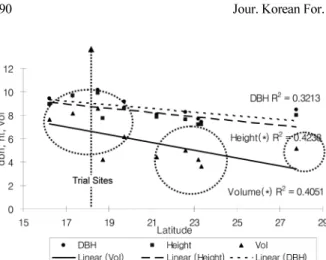
A negative relationship between most of the traits and latitude, except for the number of branch per meter of the main stem, was found in this study. Height and vol- ume growth were negatively correlated (p<.05) and DBH was moderately correlated (p<0.1) with latitude (Table 5).
Figure 2 indicated that none of the provenances from the northern region were in the top-four ranking of growth per- Table 4. Result of Duncan's Multiple Range Test for growth performances of provenances among four trial sites.
(a) DBH (b) Height (c) Volume
Site DBH Duncan’s
Grouping* Site Height Duncan’s
Grouping* Site Volume Duncan’s
Grouping*
S-4 9.43 a S-1 8.83 a S-4 0.034 a
S-2 9.01 b S-4 8.71 ab S-2 0.032 a
S-1 8.35 c S-2 8.44 b S-1 0.032 a
S-3 7.81 d S-3 6.86 c S-3 0.019 b
*p<0.05 significantly different
Table 5. Simple correlation (r) between all traits and geoclimatic factors (n = 10).
DBH Height Volume CB ratio Branch/m Crown Angle Leaf-remain
Latitude (−)0.567(*) (−)0.651(*) (−)0.637(*)*)(−)0.309(** 0.439 (−)0.493(** (−)0.449(** (−)0.294(**
Longitude 0.528(*) 0.465(*) 0.547(**) 0.716(*) 0.071 0.724(*) 0.696(*) 0.723(*) Temp 0.103(*) 0.235(*) 0.145(**) 0.338(** (−)0.356 0.160(** 0.353(** (−)0.063(**
Rainfall 0.726(*) 0.701(*) 0.803(**) 0.589(** 0.090 0.671(*) 0.600(** 0.590(**
Distance (−)0.680(*) (−)0.778(**) (−)0.681(*)*(−)0.398(** 0.364 (−)0.624(** (−)0.534(** (−)0.434(**
The pair(s) of variables with positive correlation coefficients and (−) indicates inverse correlation between two components, (*), (**): Correlation significance at the 0.05 and 0.01 level (2-tailed), respectively.
formance, as also shown in Table 3(a-c). The latitudinal variation of all provenances revealed that provenances from the southern region generally had better growth than those from the north (Figure 2). The results showed that growth performances of the provenances decreased with the increased in latitude until 27o N, even though there was a little increase in growth of P9 from the northernmost marginal area of teak distribution where the average annual rainfall was similar to the trial sites.
This result was generally supported by Bhat and Priya (2004) who studied various relationships between growth- structure-property (quantitative and qualitative) of three 65 year-old major teak provenances tested in Western Ghat, India. They found out that a geographical trend of increasing mechanical strength was associated with the greater cell wall percentage at the southern geographic location within a range of 9o to 15oS. Similar observa- tions were reported on other species. Roberds et al.(1990) studied on the fifth year heights of white ash prove- nances and pointed out the presence of northern and south- ern ecotypes. Furthermore, Hyun (1981) reported that there was a moderate north-south trend of genetic variation in growth rate of black spruce (Picea mariana (Mill) B.S.P.) seedlings and superior growth rate of southern sources appears to be advantageous.
Positive significant correlations (p<.05) were found between longitude and the traits such as C/B ratio, crown- diameter, average branch angle and leaf-remain, and a low significant correlation (p<0.1) with volume trait even though the provenances were within the narrow range of longitude (94o04' to 97o43'E) (Table 5). When prove- nances were selected from the eastern part of trial sites, the C/B ratio, crown diameter, and average branch angle showed greater amount of value, in addition to better growth performance (Figure 3).
The present result is in agreement with the result of the study in teak provenance trials consisting of 30 prov- enances established in 1966 at Huey Tak in Thailand
where there was a pattern of east-west clinal and also, to some extent, north-south differences in genetic variation of teak (Graudal et al., 1999). Another observation in six Thai and Laos teak provenances tested under the inter- national teak provenance trial at Pha Nok Khao in Thai- land supports a trend towards difference between eastern and western provenances based on the multivariate anal- ysis (Graudal et al., 1999).
There was no significant correlation found between temperature and any other traits (Table 5). It could be due to favorable temperature for growing teak and nar- row variation in the mean annual temperature among the provenances selected (23.9 to 27.6C), and among trial sites (26.0 to 28.2C) considering the minimum and max- imum temperature limits for teak which is from 9 to 41 C (White, 1991).
A positive significant correlation (p<.01) was found between mean annual rainfall and volume, and a signif- icant correlation (p<.05) with DBH, height and crown diameter (Table 5). Figure 4 indicated that performance of growth increased together with the annual rainfall, but it gradually leveled off when rainfall exceeded its opti- mum limit of 3500 mm for teak. The annual average rainfall between 3000 to 3500 mm was best for the growth of teak. This result was supported by previous Figure 2. Relationship between latitude and DBH (cm),
height (m) and volume (5000 cm3). Figure 3. Relationship between longitude and traits (C/B ratio, crown diameter, branch-angle and leaf-remain).
Figure 4. Relationship of rainfall with DBH (cm), height (m), volume (5000 cm3) and crown diameter (m).
observation that rainfall of 1300-3800 mm was optimal for teak growth.
The annual growth of teak is known to be dependent on the rainfall and the soil moisture availability at the beginning and the end of the monsoon season (White, 1991). Moreover, this result is compatible with the find- ings of Kyaw (2003) who reported that relationship between rainfall and natural teak growth shows that teak has periodic growth and a marked seasonal growth rhythm. Correlation analyses in our study revealed that tree growth was mainly driven by May-October precip- itation of the current year.
A negative significant correlation (p<.01) was found between distance and height as well as with DBH and volume (Table 5). Figure 5 generally indicated that prov- enances close to the trial site performed better growth than those far from the trial sites. This result is sup- ported by Lauridsen and Olesen (1994) reporting that the shorter the distance between the trial sites and the area where seeds of the provenance collected, the greater the survival, growth and health. But the result may need to be confirmed by further experiment with scatter distri- bution of trial sites along the geographic scale.
To examine the distance effect on growth performance, regression line could be divided into two at the centre about 350 km from the seed-origin as shown in Figure 5. Results revealed that the provenances from the left- side of the division line would indicate better growth compared to provenances of the right-side which showed poorer growth. Thus, considering seed transfer move- ment within 300 km to planting site of Bago Yoma region could be proposed.
This result, from the conservation point of view, is sup- ported by Campbell (1979) and McKay et al. (2005) stat- ing that movement of seeds from their collection site to other environmentsmayincrease the risk of mal-adapta- tion which could reducethe success of plantation projects, and gene flow from mal-adaptedplanted trees into adja-
cent native populations could negativelyaffect adaptation to local conditions. Thus, seed transfer guidelines must be carefully applied to minimize the risk of mal-adap- tation and to increase the survival and growth in forestry plantation programs.
Conclusions
Assessment of teak (Tectona grandis Linn.f) prove- nance trials at the 7th year after planting indicated that there was a significant variation in all traits of the tested provenances and also significant correlation between growth traits and the geoclimatic factors. The results of the com- parative assessment revealed that local provenances (P4, P3 and P1) and the southernmost provenance (P5) gen- erally showed better growth performances at the Bago Yoma region. Thus, provenances from southern region generally performed better in this region than those from the northern regions. The study found out that growth was highly influenced by the most favorable annual rain- fall, but declined when rainfall exceeded the maximum limits of teak (3500 mm). In addition, provenances close to trial sites generally performed better than those far from trial sites. It would serve as a general guideline for seed transfer of teak in Myanmar.
Recommendations
For further development of tree improvement program in Myanmar, there should be a great effort to continue this experiment for the third phase or further in mature ages to achieve consistent results in the future. More trial sites should be designed in the future program to cover the entire geoclimatic distribution pattern of teak species. For further conservation purpose, as deforesta- tion occurs, there is an urgent need for provenance col- lections as well.
Acknowledgements
This research was supported by the ASEAN-Korea Environmental Cooperation Project (AKECOP). The authors wish to thank U Saw Eh Dah for providing some con- structive comments.
Literature Cited
Bhat, K.M. and Priya, P.B. 2004. Influence of provenance Variation on Wood Properties of Teak from the Western Ghat Region in India. International Association of
Wood Anatomists Journal 25(3): 273-282.
Campbell, R.K. 1979. Genecology of Douglas-fir in a water- shed in the Oregon cascades. Ecology 60(5): 1036-1050.
Figure 5. Relationship of distance with DBH (cm), height (m) and volume (5000 cm3).
Dah, S.E. 2004. Teak and Forest Management in Myanmar.
ITTO Tropical Forest Update 14(1): 12-13.
Graudal, L., Kjaer, E.D., Suangtho, V., Saardavut, P. and Kaosa-ard, A. 1999. Conservation of genetic resources of teak (Tectona grandis) in Thailand. Technical Note 52. DANIDA Forest Seed Centre, Humlebaek, Den- mark. 36 p.
Gyi, K.K. 1995. Teak Provenance Trial. Proceeding of the Teak Symposium under Myanmar-Japan Technical Coop- eration Program. 28-29 March 1995, Yangon. Myanmar.
Htwe, T. 2000. Comparative performance of Teak (Tectona grandis Linn.f.) provenances in special teak plantations particularly in Bago Yoma region. pp. 85-122. In: Pro- ceeding of Annual Research Conference – Forestry Sci- ence. 3-5 April 2000, Yangon, Myanmar.
Hyun, J.O. 1981. Genetic variation in a Minnesota popu- lation of black spruce (Picea mariana (Mill) B.S.P.).
Unpublished PhD dissertation. University of Minne- sota, St. Paul, Minnesota, United States.
Kjaer, E.D., Lauridsen, E.B. and Wellendorf, H. 1995. Sec- ond Evaluation of an International Series of Teak (Tec- tona grandis Linn.f.) Provenance Trials. Research Report.
DANIDA Forest Seed Centre, Humlebaek, Denmark.
114p.
Kjaer, E.D. and Foster, G.S. 1996. The economics of tree improvement of teak (Tectona grandis Linn.f.). Tech- nical Note 43. DANIDA Forest Seed Centre, Humle- baek, Denmark.
Kumaravelu, G. 1993. Teak in India. pp. 27–34. In: Wood, H. (Ed.), Teak in Asia. FORSPA Publication No. 4, Forestry Research Support Programme for Asia and the Pacific, Bangkok, Thailand. 126p.
Kyaw, N.N. 2003. Site influence on growth and phenotype of teak (Tectona grandis Linn.f.) in natural forests of Myanmar. Unpublished PhD dissertation. Göttingen Uni-
versity, Göttingen, Germany.
Lauridsen, E.B. and Olesen, K. 1994. Identification, estab- lishment and management of seed source. Lecture Note B-2. DANIDA Forest Seed Centre, Humlebaek, Den- mark.
Mckay, J.K., Christian, C.E., Harrison, S. and Rice, K.J.
2005. “How local is local?” - A review of practical and conceptual issues in the genetics of restoration. Resto- ration Ecology13(3): 432-440.
Min, Z.O. and Lwin, K. 2004. Growth Performance of Teak (Tectona grandis Linn.f.) Provenance Trials Established in Bago Yoma: Evaluation in the 5th year after planting.
pp. 330-353. In: Proceeding of Annual Research Con- ference – Forestry Science. 7-9 January 2004, Yangon, Myanmar.
Roberds, J.H., Hyun, J.O., Namkoong, G. and Rink, G.
1990. Height response functions for white ash prove- nances grown at different latitudes. Silvae Genetica 39:
121-129.
Subramanian, K.N.,Mandal, A.K., Govindaraj, P. and Sasidha- ran, K.R. 1992. Provenance trial in Eucalyptus grandis and its implication to forestry programs. Silvae Genet- ica 41: 239-242.
Suhaendi, H. 1998. Teak improvement in Indonesia. pp.
179-188. In: Kashio, M. and White, K. (Eds.), Teak for the Future - Proceedings of the Second Regional Sem- inar on Teak. FAO Regional Office for Asia and the Pacific. 29 May-3 June 1995, Yangon, Myanmar.
White, K.J. 1991. Teak: some aspects of research and develop- ment. FAO Regional Office for Asia and the Pacific (RAPA), Publication 1991/17. 53p.
Wright, J.W. 1976. Introduction to forest genetics. Aca- demic Press, New York, US. 463p.
(Received June 11, 2010; Accepted July 7, 2010)