Research in Plant Disease pISSN 1598-2262, eISSN 2233-9191 www.online-rpd.org
The Korean Society of Plant Pathology
This is an open access article distributed under the terms of the Creative Commons Attribution Non-Commercial License (http://creativecommons.org/licenses/
by-nc/4.0/), which permits unrestricted non-commercial use, distribution, and reproduction in any medium, provided the original work is properly cited.
Research Article Open Access https://doi.org/10.5423/RPD.2020.26.2.61
당근검은잎마름병균 Alternaria dauci에 대한 살균제 효과 검정 및 병원 균 집단에 대한 저항성 검정
Detection of Fungicidal Activities against Alternaria dauci Causing Alternaria Leaf Spot in Carrot and Monitoring for the Fungicide Resistance
도지원1ㆍ민지영1ㆍ김용수2ㆍ박용2ㆍ김흥태1*
1충북대학교 농업생명환경대학 식물의학과, 2한중당근육종연구소
Jiwon Do1, Jiyoung Min1, Yongsu Kim2, Yong Park2, and Heung Tae Kim1*
1Department of Plant Medicine, College of Agriculture, Life & Environment Sciences, Chungbuk National University, Cheongju 28644, Korea
2K. C. Carrot Breeding Institute, Yeongcheon 38883, Korea
With 32 fungicides, it was examined the inhibitory effects on the mycelial growth of Alternaria dauci KACC42997 causing Alternaria leaf blight of carrot. Showing the results of the agar dilution method, the fungicides belonging to C2, C5, G1, E2, and E3 group were excellent in inhibiting mycelial growth. Protective fungicides belonging to M group, except for iminoctadine tris-albesilate, and pyraclostrobin belonging to C3 group were effective in inhibiting spore germination of pathogens. The fungicides included into C2 group inhibiting succinate dehydrogenase activ- ity and the G1 group inhibiting demethylase activity showed the excellent inhibitory effect on mycelial growth but the inhibitory effect of spore germination was very low. However, fluazinam belonging to C5 group was excellent in inhibiting spore germination as well as mycelial growth. Especially, when 100 μg/ml of fluxapyroxad belonging to the C2 group was treated, 47.1% of spore formation was inhibited on the medium. In comparison of the resis- tance factors of 3 fungicide groups, as G, C, and E group, in populations of A. dauci isolates collected from Gumi, Pyeongchang, and Jeju, resistance factor in the population of Jeju was the lowest. However, two isolates resistant to fludioxonil belonging to E2 group were found in the isolate group of Pyeongchang, and both showed cross- resistance to iprodione and procymidone.
Keywords: Alternaria dauci, Alternaria leaf spot in carrot, Fungicidal activity, Fungicide resistance monitoring
서 론
당근은 유용한 영양성분과 다량의 기능성 물질을 함유하는
근채류로서, 2018년을 기준으로 재배면적과 생산량은 2,154 ha 와 73,143톤으로 보고되어 있다(Korea Statistical Information Service, 2020). 이런 당근을 재배하는 포장에서 생산성을 위협 하는 여러 가지 병해 중에서 Alternaria dauci가 일으키는 당근 검 은잎마름병은 전 세계적으로 큰 피해를 입히는 병이다(Netzer와 Kenneth, 1969; Strandberg, 1993; Vintal 등, 1999). 검은잎마름병 이 발생하게 되면, 당근에서 광합성이 감소하게 되어, 품질 저하
*Corresponding author Tel: +82-43-261-2556 Fax: +82-43-271-4414 E-mail: [email protected]
Received March 8, 2020 Revised April 7, 2020 Accepted April 7, 2020
와 수확량 감소로 이어질 뿐만 아니라, 대규모 재배지에서 기계 수확할 때에는 지상부가 쉽게 잘려져 나가 수확량의 감소는 물론 노동의 곤란으로 이어지기도 한다(Ben-Noon 등, 2001; Dugdale 등, 2000; Strandberg, 1983). 국내에서도 2003년과 2004년에 국 내 고랭지 재배지에서 당근 검은잎마름병이 70% 이상 심하게 발 생하였고, 최근에는 가을 작형뿐만 아니라 봄 하우스 및 터널 작 형에서까지 발생한다(Kwon 등, 2007). 국내 당근의 최대 주산지 인 제주 지역에서도 당근 검은잎마름병은 주의해야할 병으로 알 려져 있다. 병원균인 A. dauci는 최적 생장 조건에서 당근을 감염 한 후 6–10일 안에 2차 전염원을 생성하며, 상대 습도가 낮을 때 에는 생성된 포자가 바람을 타고서 다른 기주로 쉽게 전반되기 때문에 피해를 가속화시킨다(Langenberg 등, 1977; Strandberg, 1977). 또한, A. dauci의 포자는 내건성이 강하여 10% 정도의 포자 는 수분 없이도 12시간까지 생존 가능할 뿐만 아니라, 오랜 기간 동안 종자, 토양 혹은 병든 잎의 잔재물에서 월동할 수 있기 때문 에 방제가 어렵다(Park 등, 2011; Pryor 등, 2002). 당근 검은잎마름 병 방제 방법으로 수확 후 포장에서 병든 잎 제거, 토양의 질소 함 량조절과 종자 온탕처리 등과 같은 경종적 혹은 물리적인 방제 방 법이 시도되고 있지만, 가장 확실하고 신속하며 용이하게 방제할 수 있는 방법 중 하나는 살균제를 이용하는 화학적 방제 방법이 다(Ben-Noon 등, 2001; Bounds 등, 2006; Koch 등, 2010; Kwon 등, 2007; Lee 등, 2011; Westerveld 등, 2008). 그러나 국내에서 당근 검은잎마름병을 살균제를 사용하여 방제하는 연구는 미미한 실 정이다. 작물보호제지침서에는 같은 병임에도 불구하고 당근 검 은잎마름병과 먹잎마름병으로 약제를 구분하여 표기함으로써 정보획득에 어려움을 겪게 하기도 한다(Korean Crop Protection Association, 2019). 또한 국내에 등록된 살균제는 chlorothalonil, propineb 등 보호 살균제 5종과 demethylation inhibiting계 2종 으로 매우 단순하다. 등록된 살균제가 보호살균제인 ‘카’군과 탈 메틸화효소의 활성을 억제하는 ‘사1’군만 있기 때문에 포장 살균 제 처리 체계를 확립하고자 할 때, 살균제 선택이 매우 제한적이 다. 또한 등록되어 있는 살균제의 대부분이 보호살균제이기 때문 에 예방적으로 처리하는 시기를 맞추지 못하거나 초기 전염원 밀 도가 높아 발병에 대한 심한 선택압을 받게 될 경우 방제 효과가 크게 감소할 수도 있다. 살균제 저항성 관리 차원에서도 작용기작 이 다른 다양한 살균제가 사용되어야 한다.
따라서 본 실험에서는 작용기작이 다른 다양한 살균제를 선 발하여 당근검은잎마름병균에 대한 in vitro상에서의 다양한 작용 특성을 조사하여, 당근 검은잎마름병의 방제에 사용할 수 있도록 제안하고, 또 주요한 살균제 그룹에 대한 포장 병원균의 저항성 모니터링을 실시하여 기존 살균제에 대한 감수성 기준 을 정하고자 하였다.
재료 및 방법
실험에 사용한 균주와 균주의 보관. 실험에 사용한 당근검은무 늬병균 Alternaria dauci KACC42997은 농업미생물보관센터에서 분양 받아 사용하였다. 분양받은 A. dauci KACC42997은 potato dextrose agar (PDA) 배지에 접종하여 25°C의 암조건에서 10일간 배양하였다.
병원균 균총의 선단부에서 균사조각을 떼어내어 PDA 사면 배지에 접종하고 25°C에서 7일간 배양한 다음, 4°C에 보관하면서 실험에 사 용하였다. 또한 장기간 보관하기 위하여 300 μg/ml의 streptomycin 을 첨가한 멸균증류수를 각각의 cryotube vial (직경, 12 mm; 높이, 48 mm; Nunc Co. Ltd., Quebec, Canada)에 1.6 ml씩 담은 후, 배양한 균주 의 균총 선단부에서 떼어낸 직경 3 mm의 균사조각을 떼어내어 cryo- tube vial에 각각 15조각을 넣고 상온에서 보관하였다.
살균제의 균사생장 억제 효과 조사. 여러 그룹의 살균제의 효과를 조사하기 위하여 보호살균제(‘카’군) 5종, 에르고스테 롤 생합성 저해 살균제 중에서 ‘사1’군 6종과 ‘사3’군 1종, 세포호 흡을 저해하는 ‘다2’군 살균제 5종과 ‘다3’군 살균제 4종 그리고
‘다5’군 살균제 1종, 미세소관 형성 억제 살균제(‘나1’군) 3종과
‘나1’군과 ‘나2’군의 혼합제 1종, 삼투압 신호 전달 저해 살균제 (‘마2’와 ‘마3’군) 3종, 키틴 생합성 저해 살균제(‘아4’군) 2종, 병원 균 세포막 합성 저해 살균제(‘바’군) 1종 등 총 32종의 살균제를 선발하여 당근검은잎마름병균 A. dauci KACC42997에 대한 균 사생장 억제효과를 한천희석법으로 조사하였다. 세균 오염 방 지를 위해 PDA배지에는 300 μg/ml의 streptomycin을 첨가하 였으며, 배지에 첨가한 살균제의 최종 농도가 100, 10, 1, 0.1 μg/
ml이 되도록 조절하였다. 한천희석법으로 살균제의 균사생장 억제효과를 조사하기 위해서 병원균을 25oC의 V-8 juice 배지 (V-8 juice, 200 ml; CaCO3, 3 g; agar, 15 g; 증류수, 1 l)에서 10일 간 배양한 후, 균총의 선단부에서 직경 3 mm의 균사조각을 떼 어 정해진 농도 별로 살균제가 첨가된 PDA 배지에 접종하였다.
동일한 조건에서 10일간 배양 후, 배지의 균총의 직경을 조사하 여 약제를 첨가하지 않은 무처리 PDA 배지의 균총 직경과 비교 함으로써, 균사생장 억제율(%)을 다음의 식으로 계산하였다.
균사생장
억제율(%) = (1- 살균제 첨가 배지의 균총 직경
)×100
살균제 무첨가 배지의 균총 직경
살균제의 포자 발아 및 발아관 신장 억제 효과. 실험에 사용 한 32종의 살균제 중에서 보호 살균제 4종과 치료 살균제 8종 을 선발하여 병원균의 발아 억제 효과를 실험하였다(Table 1).
A. dauci KACC42997의 포자 형성을 위해 병원균을 암조건의
25°C V-8 juice 배지에서 7일간 배양한 후, 멸균한 슬라이드글라 스로 공중균사를 긁어 제거하였다. 공중균사를 제거한 병원균 은 12시간 간격으로 근자외선을 조사하며 통기 상태의 20°C에서 7일간 배양하며 포자형성을 유도하였다. 형성된 포자는 150 μg/
ml의 Tween 20 용액을 부어 수확한 후, 멸균된 거즈에 여과하여 균사조각을 제거한 포자 현탁액을 얻었다. 포자 현탁액은 3,000 rpm으로 20분간 2회 원심분리하여 세척 후, 다시 멸균수에 현탁 하여 포자의 최종 밀도가 5×10⁴ 개/ml가 되도록 조절하였다. 포 자 발아와 발아관 신장은 살균제를 첨가한 PDA 배지 위에 멸균 된 셀로판막을 올려놓고 실시하였다. PDA 배지에 300 μg/ml의 streptomycin과 선발한 각 살균제의 최종농도가 100, 10, 1 μg/
ml이 되도록 첨가하였다. 살균제를 처리하지 않은 무처리 PDA 배 지와 처리한 PDA 배지 위에 동일한 크기(1.5 cm×1.5 cm)로 잘라 멸균한 셀로판막을 올려놓은 후, 한 장의 셀로판막 위에 준비한 포자 현탁액을 150 μl씩 점적하였다. 병원균을 접종한 PDA 배지 는 포화습도가 유지되는 플라스틱상자에 넣어 25°C 암조건에서 배양하였으며, 모든 처리는 3반복으로 실시하였다. 살균제의 포 자발아 억제율은 1반복당 100개의 포자를 조사하여 발아율을 구한 후 아래의 식으로 계산하였다. 이 때 포자의 발아 여부는 발
아관이 포자의 단경보다 길게 발아한 경우만 발아한 것으로 판 단하였다. 또한 각 처리구의 반복당 발아된 50개의 포자에서 발 아관의 길이를 조사하였으며, 다음 식으로 발아관 신장 억제율 (%)을 조사하였다. 발아관 길이는 포자에서 나온 발아관 중 단경 보다 긴 발아관의 길이를 모두 재어 평균값을 구하였다.
발아
억제율(%) = (1- 살균제 첨가 배지의 발아율
)×100
살균제 무첨가 배지의 발아율
발아관 신장
억제율(%) = (1- 살균제 첨가 배지의 발아관 길이
)×100 살균제 무첨가 배지의 발아관 길이
살균제의 포자 형성 억제 효과. A. dauci KACC42997을 직경 9 cm의 페트리접시에 부어 준비한 V-8 juice 배지에 접종하여 25oC 의 암조건에서 7일간 배양한 후, 균총의 직경이 75 mm 이상이 된 배지만을 선발하여 멸균된 슬라이드글라스로 공중 균사를 제거 하였다. 선발한 살균제 농도를 100 μg/ml로 조절한 다음, 살균제 용액 150 μl를 균총 전면에 고르게 점적하여 처리하였다. 살균제 를 처리한 배지는 20°C의 통기 조건에서 12시간 간격으로 근자외 선을 조사하며 7일간 배양하며 포자 형성을 유도하였다. 형성된 포자는 10 ml 멸균수를 부어 수확한 후 2겹의 멸균한 거즈에 여 과하여 균사체 등을 제거하였다. 수확한 포자현탁액의 포자 밀 도는 혈구계산기를 이용하여 조사하였으며, 무처리구와 비교하 여 다음과 같은 식으로 포자 형성 억제율을 계산하였다.
포자형성
억제율(%) = (1- 살균제 첨가 배지에서 포자 형성량
)×100 살균제 무첨가 배지에서 포자 형성량
각 지역 균주에 대한 살균제 반응 조사. 주요 당근 재배지역 인 구미, 제주, 평창에서 채집한 병든 당근 잎으로부터 단포자 분리를 통하여 각각 28, 23, 21개 균주를 선발하였다. 선발한 모 든 균주는 한천희석법으로 에르고스테롤 생합성 저해 살균제 (‘사1’군 4종과 ‘사3’군 1종), 세포호흡 저해 살균제(‘다2’군 3종과
‘다3’군 1종), 신호전달 저해 살균제(‘마2’군 1종과 ‘마3’군 2종)에 대한 감수성 정도를 조사하였다.
결과 및 고찰
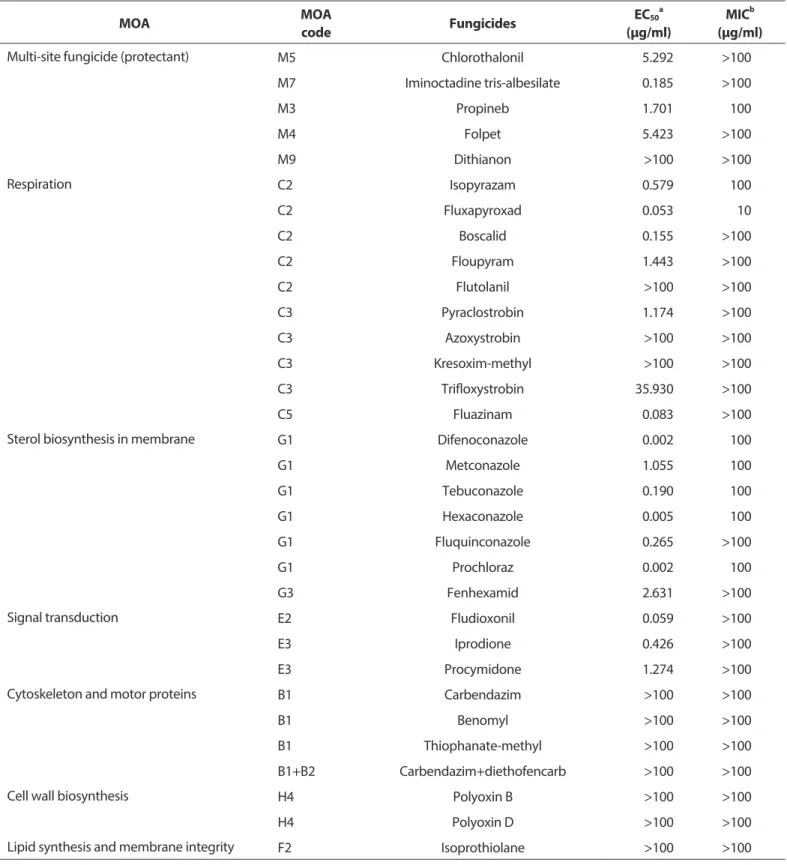
병원균 균사생장에 대한 살균제의 억제 효과. 실험에 사용 한 5종의 보호살균제(‘카’군) 중에서 iminoctadine tris-albesi- late를 제외한 나머지 4종의 EC50값은 모두 1.5 μg/ml 이상으로 효과가 저조하였다(Table 2).
Table 1. Fungicides used in this study for evaluating inhibiting effects on the spore germination and the elongation germ-tube inhibition of Alternaria dauci KACC42997 causing Alternaria leaf spot of carrot
Groups Fungicides Active ingredient (%) and formulationsa Chloronitrile Chlorothalonil 75.0, WPa Phenylpyridinamine Fluazinam 50.0, WG
Guanidine Iminoctadine
tris-albesilate 40.0, WP
Quinone Dithianon 75.0, WG
Phthalimide Folpet 50.0, WP
DMI Difenoconazole 10.0, WG
Metconazole 20.0, SC
SDHI Fluxapyroxad 15.3, SC
Boscalid 49.3, WG
Strobilurin type Pyraclostrobin 22.9, EC
Phenylpyrrole Fludioxonil 20.0, SC
Dicarboximide Iprodione 50.0, WG
DMI, demethylation inhibiting; SDHI, succinate dehydrogenase inhibitor.
aThe abbreviations for each formulation are as follows: WP, wet- table powder; WG, water-dispersible granule; SC, suspension concentrate; EC, emulsifiable concentrate.
Table 2. Effect of fungicides on the mycelial growth of Alternaria dauci KACC42997 causing Alternaria leaf blight of carrot
MOA MOA
code Fungicides EC50a
(μg/ml) MICb
(μg/ml)
Multi-site fungicide (protectant) M5 Chlorothalonil 5.292 >100
M7 Iminoctadine tris-albesilate 0.185 >100
M3 Propineb 1.701 100
M4 Folpet 5.423 >100
M9 Dithianon >100 >100
Respiration C2 Isopyrazam 0.579 100
C2 Fluxapyroxad 0.053 10
C2 Boscalid 0.155 >100
C2 Floupyram 1.443 >100
C2 Flutolanil >100 >100
C3 Pyraclostrobin 1.174 >100
C3 Azoxystrobin >100 >100
C3 Kresoxim-methyl >100 >100
C3 Trifloxystrobin 35.930 >100
C5 Fluazinam 0.083 >100
Sterol biosynthesis in membrane G1 Difenoconazole 0.002 100
G1 Metconazole 1.055 100
G1 Tebuconazole 0.190 100
G1 Hexaconazole 0.005 100
G1 Fluquinconazole 0.265 >100
G1 Prochloraz 0.002 100
G3 Fenhexamid 2.631 >100
Signal transduction E2 Fludioxonil 0.059 >100
E3 Iprodione 0.426 >100
E3 Procymidone 1.274 >100
Cytoskeleton and motor proteins B1 Carbendazim >100 >100
B1 Benomyl >100 >100
B1 Thiophanate-methyl >100 >100
B1+B2 Carbendazim+diethofencarb >100 >100
Cell wall biosynthesis H4 Polyoxin B >100 >100
H4 Polyoxin D >100 >100
Lipid synthesis and membrane integrity F2 Isoprothiolane >100 >100
MOA, mode of action.
aEC50 value refers to the concentration of fungicide that inhibits mycelial growth of the pathogen, A. dauci KACC42997, by 50%.
bMIC represents the minimum concentration of fungicide that completely inhibits mycelial growth of A. dauci KACC42997 causing Alter- naria leaf spot of carrot.
이러한 결과는 Stepanović 등(2015)의 실험 결과와 동일 하였다. 토마토에서 겹둥근무늬병을 일으키는 A. solani에 대 해서 보호살균제인 chlorothalonil과 치료살균제인 defeno- conazole의 균사생장 억제효과를 한천희석법을 사용하여 조 사한 결과, chlorothalonil의 EC50값은 2.99–4.54 μg/ml이었 고, difenoconazole의 EC50값은 0.018–0.037 μg/ml로, 보호 살균제의 병원균에 대한 균사생장 억제효과가 ‘사1’군에 속 하는 살균제보다 저조하였다. 하지만 동일한 ‘카’군에 속하는 iminoctadine tris-albesilate의 EC50값은 0.185 μg/ml로 우수 하였는데, 저장 감귤의 부패에 관여하는 Penicillium italicum 과 P. digitatum에 대한 균사생장 억제효과를 조사한 Hyun 등(2001)의 결과에서도 P. italicum과 P. digitatum에 대한 iminoctadine tris-albesilate의 EC50값은 각각 0.01–0.02 μg/
ml와 0.01 μg/ml로, 균사생장 억제효과가 우수하였다. 하지 만 고추흰비단병균에 대한 iminoctadine tris-albesilate의 균 사생장 억제효과는 EC50값이 100 μg/ml 이상으로 매우 저조 하였다(Lee 등, 2017). 이처럼 살균제의 효과는 적용하는 병원 균에 따라서 효과가 다르게 나타나기 때문에, 특정 살균제의 적용 병해 확대를 위해서는 살균제의 효과 검정을 정확하게 수행한 후 결정해야 할 것으로 생각한다.
세포 호흡을 저해하는 ‘다’군 살균제는 미토콘드리아 전자 전달계의 복합체 II를 구성하는 숙신산 탈수소 효소 기능 저 해제(‘다2’군) 5종, 복합체 III을 구성하는 cytochrome bc1 효 소의 기능 저해제(‘다3’군) 4종, 그리고 산화적 인산화 반응 저 해제(‘다5’군) 1종의 살균제를 선발하여 균사생장 억제효과 를 조사하였다. ‘다2’군에 속하는 살균제 중에서 isopyrazam, fluxapyroxad, boscalid, fluopyram의 EC50값은 0.579, 0.053, 0.155, 1.443 μg/ml이었으나, 동일한 작용기작을 갖는 fluto- lanil은 100 μg/ml 이상으로 효과가 저조하였다. Flutolanil 은 Rhizoctonia solani의 숙신산 탈수소효소의 기능을 저해 하여 균사생장을 억제하는 살균제로 알려져 있지만(Hirooka 등, 1990a, 1990b), 담자균류 이외의 자낭균이나 난균문에 속 하는 병원균에 대한 효과는 매우 미미하며 숙신산 탈수소효 소의 기능도 전혀 억제하지 않는다(Motoba 등, 1988). 본 연 구 결과에서도 자낭균문에 속하는 A. dauci에 대해서는 EC50
값이 100 μg/ml 이상으로 균사생장 억제효과가 아주 미미하 였다. ‘다3’군에 속하는 cytochrome bc1 효소 활성 억제 살 균제 중에서 pyraclostrobin의 EC50값만이 1.174 μg/ml이었 으며, 나머지는 모두 30 μg/ml 이상으로 균사생장 억제효과 가 저조하였다. ‘다3’군에 속하는 strobilurin계 살균제는 병원 균의 포자발아 억제효과에 비하여 균사생장 억제효과가 떨 어진다(Steinfeld 등, 2001). 따라서 한천희석법을 이용한 살
균제 효과 검정에서는 포자 발아를 억제하는 살균제의 효과 는 저조하게 나올 수 있기 때문에, 살균제의 특성을 정확하 게 검정할 수 있는 방법으로 살균제의 실내 검정을 실시하여 야 한다. 미토콘드리아 내막에서 H+ 이온의 이동을 억제하 는 ‘다5’군에 속하는 fluazinam의 균사생장 억제효과에 대한 EC50값은 0.083 μg/ml로 우수하였다. 동일하게 호흡을 저해 하는 살균제라고 하더라도 병원균의 종류와 미토콘드리아의 전자전달과정에서 활성을 억제하는 작용점 효소가 달라짐 에 따라서 균사 생장을 억제하는 효과는 크게 달라졌다. ‘다 2’군의 살균제에서 보는 것과 같이 동일한 효소를 작용점으 로 가지는 경우에도 살균제의 화학 구조에 따라서 효과는 달 라졌다. 효과가 우수하였던 isopyrazam과 fluxapyroxad는 pyrazole-4-carboxamide계에 속하며, boscalid는 pyridine- carboxamide계에 속하지만, 효과가 감소한 fluopyram 은 pyridinyl-ethyl-benzamide계에 속하였고, flutolanil은 phenyl-benzamide계의 살균제였다.
에르고스테롤 생합성을 억제하는 ‘사’군 살균제에서는 탈메 틸효소 활성저해 살균제(‘사1’군) 6종과 케토 환원 효소의 활 성을 저해하는 살균제(‘사3’군)인 fenhexamid 1종을 선발하 여 실험하였다(Table 2). 탈메틸 효소의 활성을 억제하여 에 르고스테롤 생합성을 억제하는 살균제는 metconazole의 EC50값이 1.055 μg/ml이었을 뿐, 나머지 5종 살균제의 EC50값 은 모두 1.0 μg/ml 이하로 A. dauci의 균사생장을 크게 억제하 였다. 하지만 케토 환원 효소의 활성을 저해하는 fenhexamid 의 EC50값은 2.631 μg/ml로, ‘사1’군에 속하는 살균제의 균사 생장 억제효과보다 저조하였다. ‘사1’군의 살균제 중에서 효과 가 가장 우수하였던 살균제는 difenoconazole로서 EC50값이 0.002 μg/ml이었다.
신호전달을 저해하는 ‘마’군에 속하는 살균제 중에서 ‘마2’군 이며 phenylpyrrole계인 fludioxonil의 EC50값은 0.017 μg/ml 이었으며, ‘마3’군인 dicarboximide계인 iprodione과 procymi- done의 EC50값은 각각 0.414와 1.926 μg/ml이었다. 미세소관 형 성을 억제하는 4종의 benzimidazole계 살균제와, 키틴 합성 저 해제인 polyoxin, 지질 생합성 저해제인 isoprothiolane의 EC50
값과 minimum concentration (MIC) 값은 모두 100 μg/ml 이상 으로, 당근검은잎마름병균인 A. dauci KACC42997에 대한 균사 생장 억제효과가 매우 미미하였다. Table 2에서 보면 iminocta- dine tris-albesilate처럼 EC50값이 낮은데도 불구하고 MIC값은
>100 μg/ml인데, EC50값이 1.701 μg/ml로 iminoctadine tris- albesilate보다 큰 propineb의 MIC값은 100 μg/ml이었다. 이런 결과는 살균제에 따라서 충분히 나타날 수 있는 결과이기 때문 에, 균사생장 억제효과를 조사하여 살균제의 효과를 비교하고
자 할 때에는 EC50값과 MIC값을 동시에 조사하여 비교하는 것 이 타당하다.
살균제의 포자 발아 및 발아관 신장 억제 효과. A. dauci KACC42997을 PDA 배지 위에 올려놓은 셀로판막 위에 접종 하고 25oC에서 배양하면, 1.5시간 배양한 후부터 병원균 포자 의 각각의 세포에서 발아관이 생성되며 발아하기 시작하였다 (Fig. 1).
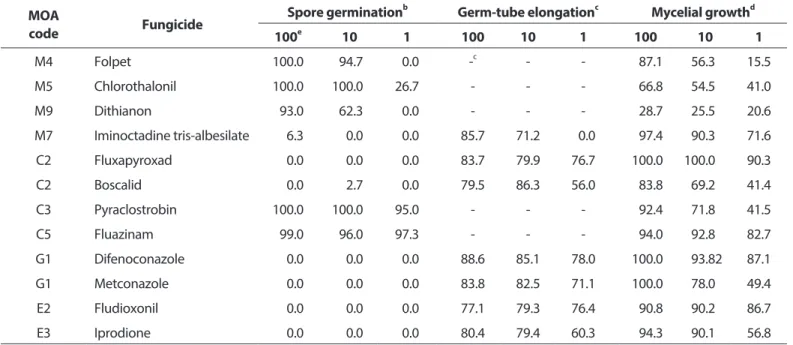
배양 시간별로 포자 발아 상태를 확인하였을 때, 3시간 후에 이미 97.2%의 포자가 발아하였으며, 6시간 후에는 100.0% 포 자가 발아하고, 발아관이 분지하며 자라기 시작하였다. 병원균 의 포자를 9시간 동안 배양한 후에는 다세포 포자에서 생성된 여러 개의 발아관이 서로 얽혀 자라기 때문에 발아관의 길이 를 조사가 용이하지 못하였다. 따라서 보호 살균제 4종과 치료 살균제 8종의 포자 발아 억제율과 발아관 신장 억제율은 살균 제 배지에 올려놓은 셀로판막 위에 포자 현탁액을 접종하고 6 시간 동안 배양한 후에 포자 발아율과 신장한 발아관의 길이 를 조사하여 계산하였다. 살균제 무처리구의 포자는 100%가 발아하였으며, 발아관 길이는 평균 226.01 μm이었다. ‘카’군 살 균제에 속하는 chlorothalonil, dithianon, folpet, iminoctadin tris-albesilate 중에서 chlorothalonil, dithianon, folpet은 병원 균에 대한 포자발아 억제효과가 우수한 반면에 균사생장 억제 효과는 낮았으나, iminoctadin tris-albesilate는 반대로 포자
발아 억제효과는 낮았지만 균사생장 억제효과는 우수하였다 (Table 3). Cytochrome bc1 복합체의 활성을 저해하여 호흡을 저해하는 다3군에 속하는 pyraclostrobin은 병원균의 균사생 장뿐만 아니라 포자발아에 대한 억제효과도 우수하였다. 하지 만 pyraclostrobin의 균사생장 억제효과와 포자발아 억제효과 를 EC50값으로 비교하여 보면, 균사생장에 대한 EC50값은 1.763 μg/ml이고 포자발아에 대한 EC50값은 0.001 μg/ml 이하로, 균 사생장에 대한 억제효과보다는 포자발아에 대한 억제효과가 훨씬 우수함을 알 수 있었다. 세포 호흡에서 산화적 인산화 반 응을 저해하는 다5군에 속하는 fluazinam은 병원균의 균사 생장뿐만 아니라 포자발아에 대한 억제효과도 우수하였는데, 1.0 μg/ml의 농도에서도 포자발아와 균사생장을 각각 97.3%와 82.7% 억제하였다. 발아관 신장 억제효과는 균총의 길이를 측 정하여 조사한 균사생장 억제효과와 높은 상관관계를 보이면 서, 균사생장 억제효과가 우수하였던 살균제의 발아관 신장 억 제효과도 우수하였다(Table 3).
병원균의 포자 형성 억제 효과. 6종의 살균제 중에서 100 μg/
ml의 fluxapyroxad를 처리한 배지에서 생성된 포자의 수가 무 처리구에서 생성된 포자 수보다 47.1% 억제되었으며, fluazi- nam 처리는 36.2%를 억제되었다(Fig. 2). 그 외 살균제는 무처 리구의 포자 형성량과 거의 차이가 없었다. 다만 fludioxonil 처 리구의 경우 포자 형성량에는 큰 차이가 없었으나, 포자의 형 Fig. 1. Germinated conidium of Alternaria dauci on a cellophane membrane placing on potato dextrose agar (PDA) according to incubation time. On the cellophane membrane placing on PDA, 150 μl of conidial suspension adjusted to 5×10⁴ conidia/ml was inoculated and incu- bated at 25°C. (A) Conidium incubated for 1.5 hr, and observed at 400× magnification. (B) Conidium incubated for 3 hr, and observed at 400× magnification. (C) Conidium incubated for 6 hr, and observed at 200× magnification. (D) Conidium incubated for 12 hr, and observed at 100× magnification. (E) Conidium incubated for 24 hr, and observed at 100× magnification.
태가 일부 변형되어 있었다(Fig. 3). 이처럼 포자가 변형되는 원 인은 fludioxonil의 작용기작과 관련이 있을 것으로 추정한다.
Fludioxonil은 병원균의 삼투압에 대한 신호전달을 저해하는 살균제로 알려져 있는데, 이런 작용기작이 새롭게 생성되는 A.
dauci의 포자를 형태적으로 변형시켰을 것으로 추정한다. 따라 서 이런 추론을 증명하기 위한 생화학적인 실험이 뒷받침되어 야 할 것으로 본다(Fig. 3).
Table 3. Inhibition rate (%)a according to several fungicides in vitro assay MOA
code Fungicide Spore germinationb Germ-tube elongationc Mycelial growthd
100e 010. 1 100 10 1 100. 010. 1
M4 Folpet 100.0 094.7 00.0 -c - - 087.1 056.30 15.5
M5 Chlorothalonil 100.0 100.0 26.7 - - - 066.8 054.50 41.0
M9 Dithianon 093.0 062.3 00.0 - - - 028.7 025.50 20.6
M7 Iminoctadine tris-albesilate 006.3 000.0 00.0 85.7 71.2 00.0 097.4 090.30 71.6
C2 Fluxapyroxad 000.0 000.0 00.0 83.7 79.9 76.7 100.0 100.00 90.3
C2 Boscalid 000.0 002.7 00.0 79.5 86.3 56.0 083.8 069.20 41.4
C3 Pyraclostrobin 100.0 100.0 95.0 - - - 092.4 071.80 41.5
C5 Fluazinam 099.0 096.0 97.3 - - - 094.0 092.80 82.7
G1 Difenoconazole 000.0 000.0 00.0 88.6 85.1 78.0 100.0 093.82 87.1
G1 Metconazole 000.0 000.0 00.0 83.8 82.5 71.1 100.0 078.00 49.4
E2 Fludioxonil 000.0 000.0 00.0 77.1 79.3 76.4 090.8 090.20 86.7
E3 Iprodione 000.0 000.0 00.0 80.4 79.4 60.3 094.3 090.10 56.8
MOA, mode of action.
aInhibition rate (%) was determined by comparing the growth of Alternaria dauci KACC42997 in the untreated control and the treatment with each fungicide.
bThe inhibitory effect of the fungicides on the spore germination was investigated after incubating the conidia of A. dauci on cellophane membrane placing on potato dextrose agar at 25°C for 6 hr. Just only spores with a germination tube longer than the spore width were considered as germinated spores. In each replicate of all treatments, 100 spores were examined.
cNo detection.
dAfter spores of A. dauci were incubated on cellophane membrane at 25°C for 6 hr, germ-tube lengths of 50 germinated conidia were examined to determine the inhibitory effect on germ-tube elongation.
eInhibitory effect of each fungicide on the mycelial growth was obtained by incubating A. dauci on V-8 agar medium at 25°C for 10 days and then measuring the diameter of the colony.
Fig. 2. Inhibitory effect of fungicides on the sporulation of Alternaria dauci KACC42997 on V-8 juice agar media. Each fungicide was applied by dropping on colony where aerial mycelia were removed to pro- duce conidia, after growing on V-8 juice agar media for 7 days. The fungicide solution was adjusted to 100 μg/ml. The colony of A. dauci KACC42997 treated with and without the fungicide was irradiated with near-ultraviolet light at 12 hr at 20°C for 7 days to form conidia. Conidia were harvested by pouring 10 ml of sterile distilled water into each colony.
Fig. 3. Conidium of Altanaria dauci KACC42997 harvested from the colony untreated (A) and treated with fludioxonil (B). Conidia were observed under a light microscope at 400× magnification.
각 지역 병원균 집단의 살균제에 대한 감수성 차이. 에르고 스테롤 생합성 저해 살균제에 대한 병원균 집단의 모니터링 결 과, prochrolaz의 EC50값은 0.158 μg/ml (0.002–0.476 μg/ml) 로, 실험한 살균제 중에서 병원균의 균사생장을 가장 효과적으 로 억제하였다. 또한 당근 검은잎마름병 방제를 위해서 등록되 어 있는 살균제인 difenoconazole과 metconazole도 0.219 μ g/ml (0.018–0.946 μg/ml), 0.350 μg/ml (0.042–1.683 μg/ml) 로 병원균의 균사생장 억제효과가 우수하였다. 그러나 에르 고스테롤 생합성 저해 과정 중 C-4 위치의 탈메틸화 과정에서 3-keto reductase의 활성을 저해하는 fenhexamid의 경우, ‘사1’
군에 속하는 다른 살균제에 비해서 균사생장 억제효과가 낮았 다. Table 4에서 보는 것과 같이 각 지역 별 병원균 집단의 살균 제 반응에는 차이가 있었다. 구미 지역 병원균 집단은 difeno- conazole과 prochloraz에 대한 Rf(저항성 요인)값이 다른 지역 보다 크게 나타나, 병원균 집단 내에서 살균제에 대한 감수성 정도가 타 지역보다 다양하다는 사실을 알 수 있었다. Tebuco- nazole에 대해서도 구미 지역 집단은 제주 지역 집단과 대등한
평균 EC50값을 보이면서도 Rf값이 큰 것을 보면 집단 내 각 균 주 간의 감수성 정도가 다양한 것을 알 수 있다. 평창 지역의 집 단은 metconazole과 tebuconazole에 대해서 평균 EC50값뿐 만 아니라 Rf값마저 높게 나타나, 지역 병원균 집단에 속하는 A.
dauci 균주의 살균제에 대한 감수성이 전체적으로 저하되었을 뿐만 아니라 집단 내의 다양성 역시 높음을 보여주었다. 하지만 fenhexamid에 대한 각 지역 병원균 집단의 EC50값과 Rf값은 비 슷하였다. 조사한 세 지역 중에서 제주 지역 병원균 집단이 살 균제에 대한 감수성 정도의 다양성이 가장 낮았다. Rf(저항성 요인)값이 크다는 의미는 지역 내 병원균 집단의 감수성 정도에 대한 다양성이 높다는 것을 뜻하는데, 집단 내에서 각 균주의 감수성 정도가 다르기 때문에 그만큼 저항성 발현이 용이한 상 태임을 말하고 있다.
실험에 사용한 모든 A. dauci 균주는 숙신산탈수소효소를 저해하는 isopyrazam과 fluxapyroxad에 대한 평균 EC50값이 2.350과 fluxapyroxad 1.644 μg/ml이었다. 그러나 숙신산탈수 소효소의 활성을 저해하면서도 isopyrazam이나 fluxapyroxad Table 4. EC50 values (μg/ml) of Alternaria dauci isolated from 3 regions cultivating carrots against fungicides inhibiting ergosterol biosyn- thesis
Fungicides Regionsa EC50 valueb (μg/ml)
Rf valuec
Minimum Mean Maximum
Difenoconazole GM 0.018 0.207 00.946 053.0
JJ 0.044 0.262 00.762 017.4
PC 0.032 0.190 00.384 011.9
Metconazole GM 0.111 0.280 00.685 006.2
JJ 0.098 0.329 00.801 008.2
PC 0.042 0.465 01.682 039.7
Tebuconazole GM 0.146 0.788 02.383 016.3
JJ 0.218 0.794 01.953 009.0
PC 0.209 1.205 04.302 020.6
Prochloraz GM 0.002 0.155 00.443 241.4
JJ 0.007 0.175 00.320 047.3
PC 0.003 0.144 00.476 160.7
Fenhexamide GM 1.649 7.215 14.583 008.8
JJ 4.703 8.378 29.996 006.4
PC 3.006 7.848 14.029 004.7
aTo examine the sensitivity of Alternaria dauci to fungicides inhibiting ergosterol biosynthesis, isolates of A. dauci were collected from 3 regions such as Gumi (GM), Jeju (JJ), and Pyeongchang (PC) where carrots were cultivated.
bEC50 value refers to the concentration of fungicide that inhibits mycelial growth of the pathogen, A. dauci, by 50%.
cRf value means resistance factor that calculated by dividing the maximum value of EC50 with the minimum value of EC50.
와는 화학구조가 다른 boscalid와 complex III에 작용하여 ATP 합성을 저해하는 pyraclostrobin에 대한 EC50값은 높았다 (Table 5). 검은잎마름병균의 지역별 감수성 차이를 비교했을 때, 구미와 평창보다 제주의 Rf값이 적게 나타나, 제주 지역 병 원균 집단의 살균제 감수성 정도는 다른 지역보다 다양성이 낮 다는 것을 알 수 있었다. 이런 결과는 제주 지역이 다른 지역보 다 살균제 사용이 많지 않았을 가능성을 보여준다. A. dauci에 대한 각 살균제 반응의 상관관계를 조사해 보면 isopyrazam과 fluxapyroxad, isopyrazam과 boscalid에서 0.01 수준으로 유의
한 상관관계가 나타났다(Table 6). 하지만 pyraclostrobin은 나 머지 3개 살균제와는 상관관계가 없었다.
Phenylpyrrole계에 속하는 fludioxonil(‘마2’군)에 대한 A.
dauci 반응을 조사하였을 때, 평창 포장에서 2개의 저항성 균 주가 발견되었다(Fig. 4). 이 두 저항성 균주는 dicarboximide계 (‘마3’군)에 속하는 iprodione과 procymidone에 대해서도 높 은 저항성을 보였다. Fig. 5에서 보는 것과 같이 감수성인 CD- SPC2-3 균주는 50 μg/ml의 fludioxonil과, 100 μg/ml의 iprodi- one과 procymidone이 첨가된 PDA 배지에서 생장이 크게 억 제되었지만, 저항성인 CDSPC5-1 균주는 살균제를 첨가한 배지 에서의 생장이 살균제를 첨가하지 않은 PDA 배지에서 생장과 차이가 없었다.
이 결과는 A.dauci가 phenylpyrrole계의 fludioxonil과 dicar- boximide계에 속하는 iprodione과 procymidone 사이에 교차 저항성이 존재함을 보여 주고 있다. 저항성 균주인 A. dauci CD- SPC5-1과 CDSPC5-2를 제외하고 지역 별로 각 균주의 EC50값을 구하여 비교한 Rf값을 보면, 다른 기작을 지닌 살균제의 경우와 동일하게 제주 지역 병원균 집단의 Rf값이 여전히 낮았다. 제주 지역에서는 당근을 유기농으로 재배하는 곳이 많기 때문에 살 균제의 사용이 적어서 타 지역에 비하여 적었기 때문이라고 생 각한다.
Table 5. EC50 values (μg/ml) of isolates of Alternaria dauci obtained from 3 regions cultivating carrots against fungicides inhibiting the respiration of the pathogen
Fungicides Regionsa Isolates EC50 valueb (μg/ml)
Rf valuec
Minimum Mean Maximum
Isopyrazam GM 28 0.537 02.252 006.492 12.1
JJ 23 0.499 02.332 004.818 09.7
PC 21 0.369 02.500 006.431 17.4
Fluxapyroxad GM 28 0.527 01.640 003.926 07.8
JJ 23 0.485 01.857 003.054 06.3
PC 21 0.343 01.416 002.802 08.2
Boscalid GM 28 1.164 14.716 085.500 73.5
JJ 23 1.033 09.420 026.450 25.6
PC 21 3.413 17.466 124.967 36.6
Pyraclostrobin GM 28 0.587 10.587 032.966 56.1
JJ 23 3.060 15.300 042.944 14.0
PC 21 1.497 09.359 030.359 20.3
aTo examine the sensitivity of Alternaria dauci to fungicides inhibiting the respiration, isolates of A. dauci were collected from 3 regions such as Gumi (GM), Jeju (JJ), and Pyeongchang (PC) where carrots were cultivated.
bEC50 value refers to the concentration of fungicide that inhibits mycelial growth of the pathogen, A. dauci, by 50%.
cRf value means resistance factor that calculated by dividing the maximum value of EC50 with the minimum value of EC50.
Table 6. Correlation between fungicides inhibiting the respiration Isopyrazam Fluxapy-
roxad Boscalid Pyraclos- trobin
Isopyrazam -a 0.51** 0.33** 0.11
Fluxapyroxad - - 0.13 0.10
Boscalid - - - 0.22
Pyraclostrobin - - - -
**The symbol indicates that the correlation coefficient is signifi- cant at 0.01.
aThe symbol indicates that the correlation coefficient between each fungicide was not calculated.
요 약
당근검은잎마름병균인 Alternaria dauci KACC42997에 대해 서 32개 살균제를 선발하여 균사생장 억제효과를 조사한 결과,
‘다2‘군, ’다5‘군, ’사1‘군, ’마2‘군, ’마3‘군에 속하는 살균제의 균사 생장 억제효과가 우수하였다. Iminoctadine tris-albesilate를 제외한 ‘카’군에 속하는 보호살균제와 ’다3‘군에 속하는 pyra- clostrobin은 병원균의 포자발아를 억제하는 효과가 우수하였 다. 균사생장 억제효과가 우수했던 숙신산탈수소효소 활성을 저해하는 ’다2‘군과 탈메틸효소 활성을 저해하는 ’사1‘군 살균 제는 우수한 균사생장 억제효과를 보여주면서도, 포자발아 억
제효과는 저조하였다. 하지만 ’다5‘군에 속하는 fluazinam은 균 사생장 억제효과뿐만 아니라 포자발아 억제효과도 우수하였 다. 특별히 ’다2‘군에 속하는 fluxapyroxad를 100 μg/ml 처리한 경우, 배지 상에서 포자형성을 47.1% 억제하였다. 구미, 평창, 제 주 등에서 분리한 검은잎마름병균 집단의 ’사‘군, ’다‘군, ’마‘군 살균제에 대한 저항성 요인값을 비교하면, 제주 지역 병원균 집 단의 저항성 요인값이 가장 낮았다. 평창 지역 균주 집단에서 ’ 마2‘군에 속하는 fludioxonil 저항성 균주가 2개 발견되었으며, 그들은 모두 iprodione과 procymidone에 대해서 교차저항성 을 보였다.
Fig. 4. Response curve of Alternaria dauci isolates obtained from 3 regions to each concentration of fludioxonil (A), iprodione (B), and pro- cymidone (C). Black line means a susceptible isolate and red line means a resistance isolate. The response of A. dauci isolates to the fungi- cides was examined by an agar dilution method.
Fig. 5. The response of Alternaria dauci CDSPC2-3 and CDSPC5-1 on potato dextrose agar with or without each fungicide. Concentrations of each fungicide, as fludioxonil, Iprodione, and procymidone, were adjusted to 50, 100, and 100 μg/ml, respectively.
Conflicts of Interest
No potential conflict of interest relevant to this article was reported.
Acknowledgments
This work was supported by the project (research num- ber : 116090-03-2-SB010) of Korea Institute of Planning and Evaluation for Technology in Food, Agriculture and Forestry, Korea.
References
Ben-Noon, E., Shtienberg, D., Shlevin, E., Vintal, H. and Dinoor, A.
2001. Optimization of chemical suppression of Alternaria dauci, the causal agent of Alternaria leaf blight in carrots. Plant Dis. 85:
1149-1156.
Bounds, R. S., Hausbeck, M. K. and Podolsky, R. H. 2006. Comparing disease forecasters for timing fungicide sprays to control foliar blight on carrot. Plant Dis. 90: 264-268.
Dugdale, L. J., Mortimer, A. M., Isaac, S. and Collin, H. A. 2000. Dis- ease response of carrot and carrot somaclones to Alternaria dauci. Plant Pathol. 49: 57-67.
Hirooka, T., Kasahara, H., Miyagi, Y. and Kunoh, H. 1990a. Effects of the systemic fungicide flutolanil on morphology of Rhizoctonia solani following inhibition of succinate oxidation. J. Pestic. Sci.
15: 47-53. (In Japanese)
Hirooka, T., Miyagi, Y., Araki, F. and Kunoh, H. 1990b. Biological mode of action of flutolanil in its systemic control of rice sheath blight. Phytopathology 79: 1091-1094.
Hyun, J.-W., Lee, S.-C., Ihm, Y.-B., Kim, D.-H., Ko, S.-W. and Kim, K.-S.
2001. Protective effect of iminoctadine tris(albesilate) and kres- oxim-methyl fungicides to citrus postharvest diseases caused by Penicillium spp. Korean. J. Pestic. Sci. 5: 37-44. (In Korean) Koch, E., Schmitt, A., Stephan, D., Kromphardt, C., Jahn, M., Krau-
thausen, H.-J. et al. 2010. Evaluation of non-chemical seed treat- ment methods for the control of Alternaria dauci and A. radicina on carrot seeds. Eur. J. Plant Pathol. 127: 99-112.
Korean Crop Protection Association. 2019. Guidelines for Crop Pro- tection Agents. Samjung Press, Seoul, Korea. 256 pp.
Korea Statistical Information Service. 2020. URL http://kosis.kr/in- dex/index.do [10 May 2020].
Kwon, M. Ryu, K. Y., Kim, J. S. and Shin, G. Y. 2007. Occurrence pat-
tern of pests in carrot fields and effect of plant debris removal after harvest at highland area. Korean J. Hortic. Sci. 25: 316-321.
(In Korean)
Langenberg, W. J., Sutton, J. C. and Gillespie, T. J. 1977. Relation of weather variables and periodicities of airborne spores of Alter- naria dauci. Phytopathology 67: 879-883.
Lee, J. E., Yeoung, Y. R., Kwon, S. B. and Kim, B. S. 2011. Screening of seed treatment agents against leaf blight and black root rot for carrot organic cultivation. Res. Plant Dis. 17: 148-154. (In Korean) Lee, S. M., Min, J. and Kim, H. T. 2017. Fungicide selections for con- trol of chili pepper stem rot caused by Sclerotium rolfsii using an agar dilution method. Korean. J. Agric. Sci. 44: 339-347. (In Korean)
Motoba, K., Uchida, M. and Tada, E. 1988. Mode of antifungal action and selectivity of flutolanil. Agric. Biol. Chem. 52: 1445-1449.
Netzer, D. and Kenneth, R. G. 1969. Persistence and transmission of Alternaria dauci (Kühn) Groves & Skolko in the semi‐arid condi- tions of Israel. Ann. Appl. Biol. 63: 289-294.
Park, K.-H., Yun, H.-J., Ryu, K.-Y., Yun, J.-C., Kim, S.-R., Kim, W.-I. et al.
2011. Influence of environmental factors on conidial germina- tion of Alternaria dauci. Res. Plant Dis. 17: 381-385. (In Korean) Pryor, B. M., Strandberg, J. O., Davis, R. M., Nunez, J. J. and Gilbert-
son, R. L. 2002. Survival and persistence of Alternaria dauci in carrot cropping systems. Plant Dis. 86: 1115-1122.
Steinfeld, U., Sierotzki, H., Parisi, S., Poirey, S. and Gisi, U. 2001. Sen- sitivity of mitochondrial respiration to different inhibitors in Venturia inaequalis. Pest. Manag. Sci. 57: 787-796.
Stepanović, M., Jevremović, S., Rekanović, E., Mihajlović, M., Milijašević-Marčić, S., Potočnik, I. et al. 2015. In vitro sensitivity of Alternaria solani to conventional fungicides and a biofungicide based on tea tree essential oil. Pestic. Phytomed. 30: 25-33.
Strandberg, J. O. 1977. Spore production and dispersal of Alternaria dauci. Phytopathology 67: 1262-1266.
Strandberg, J. O. 1983. Infection and colonization of inflorescences and mericarps of carrot by Alternaria dauci. Plant Dis. 67: 1351- 1353.
Strandberg, J. O. 1993. Alternaria leaf blight. Bad news for carrot production everywhere. Carrot Count. 1: 24-25.
Vintal, H., Ben-Noon, E., Shlevin, E., Yermiyahu, U., Shtienberg, D.
and Dinoor, A. 1999. Influence of rate of soil fertilization on Al- ternaria leaf blight (Alternaria dauci) in carrots. Phytoparasitica 27: 193-200.
Westerveld, S. M., McKeown, A. W. and McDonald, M. R. 2008. Re- lationship between nitrogen fertilization and Cercospora leaf spot and Alternaria leaf blight of carrot. HortScience 43: 1522- 1527.