주류의 풍미 및 품질 향상을 위한 야생 효모의 분리 및 특성분석
백성열1, 이유정1,2, 김재현1, 여수환1*
1농촌진흥청국립농업과학원농식품자원부발효식품과
2충북대학교농업생명과학대학식품생명공학과
Received: February 24, 2015 / Revised: March 6, 2015 / Accepted: March 9, 2015
서 론
우리나라의전통주는주로찹쌀이나멥쌀을원료로하고 누룩을발효제로사용하여만들어진다
.
전통주는담금후,
누 룩중의미생물에의한효소작용으로원료성분이분해되어 당분,
아미노산,
유기산등이생성된다.
그리고효모나젖산 균등의미생물에의한알코올발효로휘발성향미성분이생성되어색과함께품질의조화를이룬다
[22].
전통주의담금과정중미생물학적변화에대한연구는지 금까지많은연구자들에의하여진행되었으며
, Seo
등[21]
은 탁·
약주발효과정중의미생물균총변화를, Lee
등[14, 15]
은효모종류를달리하여탁주술덧의품질특성과향기성분 을
, Kim [12]
은증자와무증자탁·
약주의품질특성과발효 미생물 분석을 연구하였다.
또한Kwon
등[13]
은PCR-
DGGE
법을이용한막걸리발효중의미생물다양성을조사한결과
, Pichia kudriavzevii, Saccharomyces cerevisiae, Asidia idahoensis, Kluyveromyces marxianus, Saccharomycopsis fibuligera
및Torulaspora delbrueckii
로6
종이주요효모로 나타났으며,
우점효모는배양2
일까지Pichia kudriavzevii
가이후에는Saccharomyces cerevisiae
로나타났다고보고 하였다.
최근 와인 제조 분야에서는
S. cerevisiae
가 아닌non- Saccharomyces
효모에관한연구가활발히진행되고있다.
non-Saccharomyces
효모는포도밭에서기인한야생효모이며
,
다양한효소를세포밖으로분비함으로써와인의향기성분증가에중요한영향을준다고알려져있다
[3].
와인제조사및미생물학자들은
non-Saccharomyces
효모가와인의관 능적특성에관여하고있음을인지하고,
산업적응용에대한 관심을가지고있다[4]. non-Saccharomyces
효모의일부종 과S. cerevisiae
와의혼합발효를통해와인의품질을향상 시킨연구결과도보고되었다[4].
발효능이낮은레몬형효 모인Hanseniaspora uvarum
와이의무성세대인Kloeckera
apiculata
는포도과피표면에가장많이존재하는미생물이며
,
와인의알코올발효초기에우점종으로작용하는것으로Isolation and Characterization of Wild Yeasts for Improving Liquor Flavor and Quality
Seong Yeol Baek
1, You Jung Lee
1,2, Jae Hyun Kim
1, and Soo-Hwan Yeo
1*
1
Fermented Food Division, Department of Agro-food Resource, NAAS, RDA, Jeollabuk-do 565-851, Republic of Korea
2
Department of Food Science and Biotechnology, Chungbuk National University, Cheongju 362-763, Republic of Korea It has been known for some time to the wine industry that non-Saccharomyces yeasts play an important role in increasing volatile components through the secretion of extracellular enzymes. The objective of this study was to investigate what types of enzymes are produced by 1,007 non-Saccharomyces yeast strains isolated from Korean fermented foods. Among 1,007 yeast strains, the 566, 45 and 401 strains displayed β-glucosidase, glucanase and protease activity, respectively. In addition, the 563 and 610 strains possessed tolerances against cerulenin and TFL, and the 307 strain was tolerant to 15% ethanol. Yeasts pro- ducing harmful biogenic amines and hydrogen sulfide were excluded from further study, and eventually 12 yeast strains belong- ing to the genera Wickerhamomyces, Hanseniaspora, Pichia, Saccharomyces were identified, based on the 26S rRNA gene sequences. Among the 12 strains, the 9 and 5 strains possessed glucose and ethanol tolerance, respectively. Yeasts belonging to the genus Saccharomyces produced more than 8% alcohol, but non-Saccharomyces yeasts produced only 3% alcohol.
Keywords: Yeast, non-Saccharomyces, extracellular enzyme, fermentation, liquor
*Corresponding author
Tel: +82-63-238-3610, Fax: +82-63-238-3843 E-mail: [email protected]
© 2015, The Korean Society for Microbiology and Biotechnology
관찰되었다
[6].
이러한효모들은와인의휘발성향기성분생성에중요한역할을하는것으로알려져있다
[4].
국내연구진에의해
non-Saccharomyces
인Pichia anomala Y197-13
으로막걸리품질향상을위한연구가수행되었다[11].
일본의대표술인사케의향기성분중
isoamyl acetate
는 과일향과달콤한향을내는주요성분이며,
이것은alcohol acetyltransferase
와esterase
의 가수분해에 의해isoamyl alcohol
과acetyl coenzyme A
의 합성물질로 알려져 있다[28]. Isoamyl alcohol
은leucine
생합성과정의전구물질로 α-ketoisocaproate
로부터생성된다[10]. Leucine
생합성과 정에서 α-isopropyl malate
생합성 효소(
α-IPM)
가L-
leucine
의양이 많을 때피드백 억제에 의해 조절되어 α-
isopropyl malate
에서 α-kotoisovalerate
로의변환을촉진한 다[2].
이러한경우isoamyl alcohol
합성이감소된다.
효모 중에서α-IPM
의피드백조절을상실되어L-leucine
이과생 산되는균주는에스테르와고급알코올류의생산이증가하 여isoamyl alcohol
과isoamyl acetate
또한증가한다.
이러한 균주의 탐색법은5,5,5-trifluor-DL-leucine (TFL)
즉L-
leucine
유사물질에미생물을노출시켜저항성균주를선발하는것으로보고되었다
[1].
최근에L-leucine
피드백조절이제 거된LEU4
유전자(
α-IPM)
돌연변이균주는isoamyl alcohol
을고생산하는것으로나타난연구결과도보고되었다[19].
효모가내는또다른중요한향기성분은에스테르인
ethyl caproate
이다[28].
이물질의축적과합성은전구체(ethanol, caproic acid), alcohol acyl transferase
와esterase
효소의 존재에달려있다[25].
지방산생합성은cerulenin
에의해억 제되는지방산생합성효소에의해촉진되며,
지방산고생성균주의탐색은
cerulenin
저항성균주를탐색하는것으로알려져있다
[8].
본연구의목적은발효식품에서분리된효모의특성연구 를통해
,
우리술의품질향상을위한우수한효모종균의다 양성을확보하고자하였다.
따라서효모의세포외효소인β- glucosidase, glucanase, protease, amino acid decarboxylase
등 을조사하였으며,
에탄올내성,
황화수소생성능등효모의 환경내성을탐색하였다.
또한효모의경우,
아미노산생합성 및지방산생합성경로를통해고급알코올류,
향기성에스 테르계열의물질을생산하는데이생합성경로저해제에대 해내성을가지는균주를발굴함으로써,
향기가뛰어난것으 로예상되는효모생물자원12
균주를확보하였다.
재료 및 방법
효모 균주 및 사용 시약
본실험에사용한효모는전국에서수집한발효액등의발 효식품
126
점에서1,007
주를분리하여사용하였다.
비교균주로시판효모인
Fermivin (Sacchromyces cerevisiae, Gist Brocades, Denmark), Frootzen (Pichia kluyvery, Chr.
Hansen, Denmark)
를사용하였다.
배지 및 효소활성 분석수집된발효식품
(10 g)
을0.85% NaCl (90 ml)
용액에현 탁하여tYPD (1% yeast extract, 2% peptone, 2% glucose, 0.0018% tartaric acid)
한천 배지[16]
에100
μl
도말하여30
oC
에서48
시간배양하였다.
배양된효모의집락모양,
크 기,
색깔등형태적특징을관찰하여서로다른균주를YPD (1% yeast extract, 2% peptone, 2% glucose)
한천 배지를사용하여순수분리하였다
.
순수분리된효모는YPD
액체배지에배양후
, glycerol
를20%
함유하도록첨가하여80
oC
에서보관하여실험에사용하였다.
분리효모의β
-glucosidase (EC 3.2.1.21.), glucanase (EC 3.2.1.6.), protease (EC 3.4.), amino acid decarboxylase (EC
4.1.1.)
활성을확인하였다.
한천평판법으로실험하였고각효소의적합한한천평판을만든후분리효모를접종하여효 소활성 유무를 확인하였다
.
β-Glucosidase
활성은esculin (Sigma-Aldrich Co., St. Louis, USA)
을YPD
한천배지에농 도가0.5% (w/v)
가되도록첨가하고pH 5.0
으로조정후멸 균한 다음, 1% ferric ammonium citrate (Sigma-Aldrich Co., St. Louis, USA)
를농도가2% (v/v)
되도록첨가하여배 지를제조하였다.
이배지에효모를접종하고30
oC
에서24
시 간배양후집락주변에검은색환의생성유무에따라평가 하였다[7]. Glucanase
는β-D-glucan (Sigma-Aldrich Co., St.
Louis, USA)
을YPD
한천배지전체농도의0.2% (w/v)
로첨 가하여제조후효모를접종하고30
oC
에서48
시간배양한다 음congo red (Sigma-Aldrich Co., St. Louis, USA)
를0.1%
으로희석한용액으로염색후집락주변에형성된투명환 의 생성 여부로 활성을 확인하였다
[23]. Protease
는YM (0.3% yeast extract, 0.3% malt extract, 0.5% peptone, 1%
glucose)
한천배지에skim milk
농도가1%
되도록 첨가하 여제조후효모를 접종하고30
oC
에서48
시간배양한다 음집락주변에형성된투명환으로활성을확인하였다.
그리 고amino acid decarboxylase
는YPD
한천배지에아미노산1% (histidine, tyrosine, phenylalanine, tryptophane, lysine, leucine) (Sigma-Aldrich Co., St. Louis, USA), bromocresol purple (Sigma-Aldrich Co., St. Louis, USA)
을0.006%
가되도록첨가하고
pH 5.3
으로조정한다음효모를접종후집락주변보라색환의생성여부에따라평가하였다
[18].
에탄올, 아황산 내성 및 황화수소 생성능 분석
에탄올내성평가는
YPD
한천배지에5%, 10%, 15%
의에 탄올을첨가하여제조한후효모를접종하여집락의생성여부에따라내성을평가하였다
[17].
아황산내성평가는YPD
한천 배지에tartaric acid (Sigma-Aldrich Co., St. Louis, USA)
을전체농도의1.8%
가되도록첨가하고1 M K
2S
2O
5 를(Daejung Chemicals Co., Ltd, Korea)
첨가하여SO
2의농도가
20 mg
으로조정한후효모를접종하여집락의생성여부에따라내성을평가하였다
[5].
황화수소생성능을알아 보기 위해Biggy
한천 배지(Becton Dickinson GmbH, Heidelberg, Germany)
에효모를접종하여30
oC
에서48
시간 배양한다음,
집락색깔의진하기에따라황화수소생성능 을평가하였다[5].
Cerulenin 및 5,5,5-trifluor-DL-leucine 내성
Cerulenin
과5,5,5-trifluor-DL-leucine (TFL) (Sigma- Aldrich Co., St. Louis, USA)
의대한저항성은0.67% YNB (yeast nitrogen base), 2% glucose, 2% agar
조성의 한천 배지에cerulenin (25
μM)
과TFL (1 mM)
을각각첨가하여 제조후효모를접종하고30
oC
에서48
시간배양한다음집 락생성여부에따라평가하였다[26].
효모의 동정
분리효모를동정하기위하여
26S rRNA
유전자의D1/D2
부위 염기서열을 분석하였다.
프라이머[27]
로NL1 (5'- GCATATCAATAAGCGGAGGAAAAG-3')
및NL4 (5'- GGTCCGTGTTTCAAGACGG-3')
를 사용하여26S rRNA D1/D2
부위단편을증폭후,
㈜ZEOTECH
사에의뢰하여염 기서열을 분석하였다.
염기서열은National Center for Biotechnology Information (NCBI, Bethesda, MD, USA)
의BLAST
를사용하여26S rRNA
유전자단편의염기서열 상동성을비교하였으며,
염기서열은DNASTAR pro software (SeqMan Pro, Ver 8.1.5., Lasergene)
를이용하여수행하였 다.
효모의계통분석도(phylogenetic tree)
작성은GenBank
에보고된다른효모균주의
26S rRNA
염기서열을비교분석하여
, MEGA version 4.0 [24]
의neighbor-joining method [20]
로작성하였다.
당 및 에탄올 내성 측정
분리효모의포도당에대한내성측정은포도당농도를
20,
30, 40%
첨가한YPD
액체배지(yeast extract 1%, peptone 2%, glucose 1.5%, pH 6.5)
에 효모를 접종하고30
oC
에서180 rpm
으로24
시간동안진탕배양한후600 nm
에서흡 광도를측정하여균주의성장을비교하였다.
이때대조구는포도당
1%
를첨가한YPD
액체배지에서효모균주의성장으로하였다
.
에탄올내성은에탄올이각각0, 5, 10, 15%
의농도로함유된
YPD
액체배지10 ml
에전배양한효모의배양액을
0.1%
농도로접종하고25
oC
에서5
일간배양후,
600 nm
에서흡광도를측정하여균주의성장을조사하였다.
에탄올 발효능 분석
효모의에탄올생성량은전배양한효모를포도당
25%
가 함유된YPD
액체배지100 ml
에0.1%
의농도로접종하고30
oC
에서48
시간동안정치 배양한후, 10,000 rpm
에서10
분간원심분리하여상등액을회수하고생성된에탄올함 량을측정하였다.
에탄올함량은비중법을이용하여배양상 등액100 ml
를증류한다음70% (v/v)
를메스실린더에회수하고다시증류수를이용하여
100 ml
로정용한다음주정계를이용하여측정하였다
[9].
결과 및 고찰
효모의 효소활성
효모의 β
-glucosidase, glucanase, protease
및amino acid decarboxylase
효소활성을확인한결과는Table 1
에 나타내었다.
β-Glucosidase
는분리균주1,007
주중에서566
균주가활성을보였고, glucanase
는45
균주만이활성을보 였다. Protease
활성은401
균주에서나타났다.
바이오제닉 아민(biogenic amine, BAs)
은아미노산의탈탄산작용,
아미 노기전이작용등의화학적작용에의해생성되는질소화합 물이다.
바이오제닉아민류는단백질을함유한식품이미생 물에의해분해되는과정에서생성되며,
알러지유발물질인 히스타민(histamine)
과티라민(tyramine)
이대표적이다[18].
Amino acid decarboxylase
활성을보유한효모는바이오제 닉아민류생성가능성이높으며,
각아미노산기질을바이오 제닉아민류로변화시킨 균주를 조사한결과, histidine
은69
균주, tyrosine
은306
균주, phenylanine
은171
균주,
Table 1. Yeast isolates used in this study.
β
-Glucosidase Glucanase Protease AA decarboxylation
His Tyr Phe Trp Lys Leu
566 45 401 69 306 171 23 197 198
Tolerance Ethanol tolerance H
2S production
Cerulenin TFL 5% 10% 15%
563 610 934 792 307 500
tryptophane
은23
균주, lysine
은197
균주, leucine
은198
균주로나타났다.
또한cerulenin, TFL, SO
2,
에탄올내성균주및황화수소생성능에대한결과는
Table 1
에나타내었다
. Cerulenin, TFL
내성균주는각각563, 610
균주로나타 났고, SO
2내성은22
균주로상대적으로적은수의효모에 서나타났다.
에탄올내성의경우,
에탄올농도가높을수록 내성을나타내는균주는현저히감소하였으며,
에탄올농도 가5%, 10%, 15%
에대하여각각934, 792, 307
균주로나타 났다.
황화수소를생성할것으로추정되는효모는500
균주 로분석되었다.
위결과를바탕으로
biogenic amine decarboxylase
활성 미보유균주,
황화수소저생성균주중심으로1
차선별하였 으며,
이후효소활성능, cerulenin, TFL, SO
2,
에탄올내성 특성등을보유한12
균주를선별하였다(Table 2).
β
-Glucosidase
는와인제조시비휘발성향기성분으로중요한역할을한다고알려져있으며
,
이는non-Saccharomyces
효 모에서많이발견된다고보고되었다[7, 23].
특히, Hansenispora vinea
와Candida
종이생산한glucosidase
가와인의다양한 향에영향을미친다고알려져있다[23].
β-Glucosidase
활성 은시판효모인S. cerevisiae, P. kluyvery
보다분리효모인N43-8, N77-4, SM2-7, Y685, BY30-1, M1-9, SD1-2
등7
균주가더우수한것으로나타났다.
Glucanase
활성은시판효모인S. cerevisiae, P. kluyvery
에서나타나지않았으며, N43-8, Y685 2
균주만활성을나타내었다
. Glucanase
활성을 보유한 균주로는Candida stellata, C. hellenica, C. pulcherrima, Kloeckera apiculata
효 모들로보고된바있다[23]. Protease
의경우,
약한활성을보 인균주가7
균주로나타났다.
또한, amino acid decarboxylase
활성은선발효모와시판효모모두음성으로나타난것으 로보아바이오제닉아민류생성가능성이매우낮을것으로 예상되었다.
Cerulenin, TFL, SO2, 알코올 내성 균주
효모가생성하는고급알코올류와에스테르계열의성분
들이주류의향을증진시킬수있음을감안하여
, cerulenin
과
TFL
에내성을보유한효모를탐색하였다. Cerulenin
과TFL
은isoamyl alcohol
과caproic acid
를생산할수있는균 을 선별하는데 사용되어왔다[8].
선별된12
주의 효모 중cerulenin
과TFL
에대하여내성을나타낸효모는각각8, 7
균주로나타났다(Table 3). N43-8, N56-10, N77-4, SM2-7, Y447, Y685
및HP1-2
균주는cerulenin
과TFL
에대한내 성을동시에가지며, CM4-5
균주는cerulenin
내성만가지 는것으로나타났다. A9-1, BY30-1, M1-9, SD1-2
효모와시 판효모인S. cerevisiae
는두가지항생물질에대해민감한 것으로나타났다. non-Saccharomyces
시판효모인P. kluyvery
는cerulenin
과TFL
에내성을나타내어,
두항생물질에감 수성을보인S. cerevisiae
와대조적인결과를나타내었다. Cerulenin
과TFL
에내성을나타낸7
주의효모는고급알코Table 2. Production of extracellular enzymes of selected wild type yeasts and commercial yeasts.
Strains
β-Glucosidase Glucanase Protease AA decarboxylation
1His Tyr Phe Trp Lys Leu
N43-8 +++ + - - - - - - -
N56-10 - - + - - - - - -
N77-4 +++ - + - - - - - -
SM2-7 +++ - + - - - - - -
Y447 - - - - - - - - -
Y685 +++ + - - - - - - -
A9-1 - - + - - - - - -
BY30-1 ++ - - - - - - - -
CM4-5 + - + - - - - - -
M1-9 ++ - + - - - - - -
SD1-2 ++ - + - - - - - -
HP1-2 + - - - - - - - -
Frootzen ++ - - - - - - - -
Fermivin + - + - - - - - -
Positive result clear or fluorescence zone of more than 1 mm margin from edge of colony: +, 1 mm; ++, 2 mm; +++, 3 mm; –, negative result.
1
Amino acid decarboxylase activity means biogenic amines production.
올류와에스테르계열의향기성분을생산할수있을것으로 예상되며
,
이에대한추가적인연구가필요할것으로판단된 다. SO
2에대하여내성을나타낸효모는2
균주로A9-1
과HP1-2
로나타났다.
시판효모인S. cerevisiae
는SO
2에대한 내성이높은것으로나타났다.
알코올내성에대해서는대부 분의효모가높은내성을보였으며,
그중N56-10, Y447
균 주는알코올내성이상대적으로낮은것으로나타났다.
황화 수소는와인이나알코올음료에좋지않는냄새로미생물발효에의해생성될수있는데
[5],
본연구에사용한시판효모를포함하여대부분의효모는황화수소생성능이낮았으며
, SM2-7, Y447, CM4-5, M1-9, SD1-2, HP1-2
균주는생성능 이거의없는것으로보아와인이나전통주발효산업에사 용가능할것으로기대된다.
효모 동정
선발된효모
12
균주의26S rRNA
유전자의D1/D2
부위 염기서열분석결과를Fig. 1
에나타내었다.
효모12
주는C.
tropicalis, H. opuntiae, H. uvarum, P. kudriavzevii, S.
cerevisiae
및Wickerhamomyces anomalus
로각각동정되 었다. SD1-2, M1-9, CM4-5, A9-2, BY30-1
균주는S.
cerevisiae
로동정되었다. HP1-2
균주는H. opuntiae, N56- 10
균주는H. uvarum, N43-8, SM2-7, Y685
균주는W.
anomalus, Y447
균주는C. tropicalis, N77-4
균주는P.
kudriavzevii
로각각동정되었다.
효모의 내당성 및 에탄올 내성
주류제조에이용되는효모는고농도의당에서충분히생 육을하면서알코올발효를진행할수있어야하므로선발 된효모
12
균주를대상으로포도당이20%, 30%, 40%
로첨 가된YM
액체배지에서생육과당내성을비교하였다(Fig.
2). S. cerevisiae
효모중에서BY30-1
균주를제외하고,
대체 적으로포도당40%
가첨가된YM
액체배지에서양호한생 육을 나타내었다. non-Saccharomyces
효모 중에서는H.
opuntiae HP1-2, C. tropicalis Y447
균주를제외하고포도 당40%
가첨가된YM
액체배지에서생육이양호한것으로 보아내당성이우수하며주류제조에사용가능성이충분한 것으로판단된다.
일반적으로일정수준이상의에탄올농도에서는효모생 육이저해되어더이상알코올발효가일어나지않는것으
로알려져있으며
[24],
주류등알코올발효음료제조용효모는에탄올에우수한내성을보유하는것이바람직하다
.
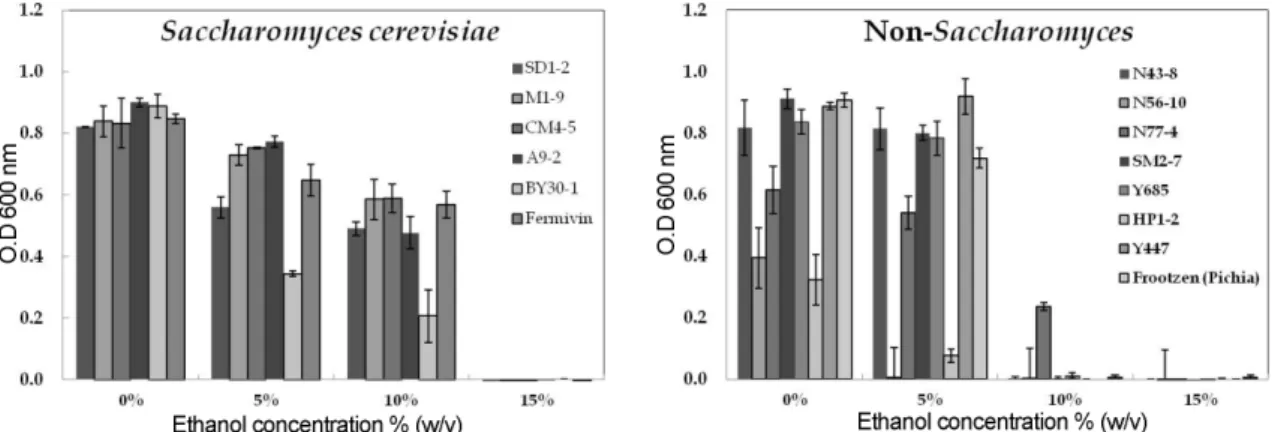
효 모12
균주를대상으로에탄올을5%, 10%, 15%
농도로첨 가한YM
액체배지에서효모생육과에탄올을첨가하지않 은YM
액체배지에서의생육을비교한결과(Fig. 3),
배양5
일뒤S. cerevisiae
효모중에서BY30-1
를제외하고는10%
에탄올첨가한
YM
액체배지에서효모의생육은양호하였으나
15%
에탄올농도에서는모두생육이낮게나타났다.
non-Saccharomyces
효모중에서는균주마다다른특성이나 타났다. 5%
에탄올 농도의 경우, H. uvarum N56-10, H.
Table 3. The cerulenin, TFL, SO
2and ethanol tolerance and production of H
2S of selected wild type yeasts and commercial yeasts.
Strains Cerulenin TFL SO
2Ethanol con. H
2S
production
15% 10% 15%
N43-8 + + - + + + +
N56-10 + + - + - - +
N77-4 + + - + + + +
SM2-7 + ++ - + + + -
Y447 + + - + - - -
Y685 + + - + + + +
A9-1 - - + + + + +
BY30-1 - - - + + - +
CM4-5 + - - + + + -
M1-9 - - - + + + -
SD1-2 - - - + + + -
HP1-2 + + + + + - -
Frootzen + + + + + - ++
Fermivin - - ++ + + + +
Tolerance symbols ; + growth, - no growth.
1
-, no color; +, light brown; ++, dark brown.
Fig. 1. Phylogenetic tree based on 26S rDNA sequences showing the relative genetic position of the selected 12 yeast strains isolated from Korean fermented food.
Fig. 2. Glucose tolerance of selected wild yeast strains and commercial yeasts. The selected wild yeast strains were grown shaking
on 100 ml of YPD broth medium containing 1, 20, 30, and 40% glucose in 250 ml flask at 30
oC for 24 h. Glucose tolerance was determined
by absorbance of yeasts growth at 660 nm. The data were averages based on three trials.
opuntiae HP1-2
균주를제외하고는양호한생육을보였다.
그러나
10%
에탄올첨가한YM
액체배지에서효모의생육은
P. kudriavzevii N77-4
를제외한모든효모가저조하였으 며, P. kudriavzevii N77-4
는에탄올농도15%
에서생육이 낮은것으로나타나에탄올내성이non-Saccharomyces
효 모중에서상대적으로높은것으로나타났다.
효모의 에탄올 발효능
효모
12
균주를대상으로포도당을25%
첨가한YM
액체 배지에서48
시간배양한후각균주의에탄올생성량을측 정한결과(Fig. 4), S. cerevisiae SD1-2
균주의에탄올생성 량이9.5%
로가장우수하였으며, S. cerevisiae
속균주들은 최소7.3%
에서최고9.5%
의에탄올생성량을나타내었다. non-Saccharomyces
균주 중에서는W. anomalus N43-8, SM2-7
균주가4.7%
으로높은에탄올생성량을보였으며,
최소
2.2%
에서 최고4.7%
로 나타났다. Kim
등[11]
이P.
anomala Y197-13
효모로막걸리제조연구에서알코올함량이
11.1%
로나타나막걸리제조시좋은후보균주가될수있다고보고하였다
.
또한Pichia
속효모와non-Saccharomyces
속효모들은와인등의아로마형성에중요한역할을한다 고알려져[3, 23]
본연구에서선발한7
주의non-Saccharomyces
속효모균주역시추가적인주류제조연구를진행하고있 으며독특한향미를가진주류발효음료제조가능성이있 을것으로판단된다.
요 약
non-Saccharomyces
효모는야생효모로서,
다양한효소를 세포밖으로분비하여와인의향기성분증가에중요한영 향을준다고알려져있다.
본연구에서는한국의발효식품에Fig. 3. Ethanol tolerance of selected wild yeast strains and commercial yeasts. The selected wild yeast strains were grown static culture on 10 ml of YPD broth medium containing 0, 5, 10, and 15% ethanol in test tube at 25
oC for 5 days. Ethanol tolerance was deter- mined by absorbance of yeasts growth at 660 nm. The data were averages based on three trials.
Fig. 4. Ethanol production by selected wild yeast strains and commercial yeasts. The selected wild yeast strains were grown static
culture on 100 ml of YPD broth containing 25% glucose in 500 ml flask at 30
oC for 48 h. Ethanol production was determined by alco-
holometer. The data were averages based on three trials. *, significance between commercial yeasts (Fermivin and Frootzen) and selected
strains, p < 0.05.
서분리된효모
1,007
주의세포외효소활성을조사하였다.
그결과,
β-glucosidase 566, glucanase 45, protease 401
로 나타났으며, AA decarboxylase
활성균주는각아미노산별 로His 69, Tyr 306, Phe 171, Trp 23, Lys 197, Leu 198
균주로나타났다. Cerulenin
과TFL
내성균주는각각563, 610
주로, 15%
에탄올내성균주는307
주로나타났다.
황화 수소생성균은500
주로조사되었다. AA decarboxylation
와 황화수소저생성균주중유용효모12
균주를선발하여26S rDNA
염기서열을분석한결과, C. tropicalis, H. opuntiae, H. uvarum, P. kudriavzevii, S. cerevisiae, W. anomalus
로각각동정되었다. 12
주의효모중당내성우수균주는9
주이며,
알코올내성우수균주는5
균주로나타났다.
알코 올발효능은Saccharomyces
효모는8%
이상으로나타났으 며, non-Saccharomyces
효모는3%
내외로나타났다.
Acknowledgments
This work was carried out with the support of “Cooperative Research Program for Agriculture Science & Technology Develop- ment (Project No. PJ00947701)” Rural Development Administra- tion, Republic of Korea.
References