This is an Open Access article distributed under the terms of the Creative Commons Attribution Non-Commercial License (http: //creativecommons.org/licenses/by- nc/4.0/) which permits unrestricted non-commercial use, distribution, and reproduction in any medium, provided the original work is properly cited.
© 2021 THE KOREAN SOCIETY OF MYCOLOGY.
Accepted: February 19, 2021 Revised: February 05, 2021 Received: January 25, 2021 https://doi.org/10.4489/KJM.20210007 Kor. J. Mycol. 2021 March , 49(1): 67-79
OPEN ACCESS pISSN : 0253-651X eISSN : 2383-5249
RESEARCH ARTICLE
금강 상류와 태안, 순천만 해변들로부터 야생효모의 분리 및 국내 미기록 효모들의 균학적 특성
박선정
1, 장지은
1, 이향범
2, 이종수
1,*1
배재대학교 바이오의약학부,
2전남대학교 응용생물공학부
Isolation of Wild Yeasts from Riversides in Geumgang Upstream, Taean and
Suncheonman Seashores and Microbiological Characteristics of the Unrecorded Wild Yeasts
Seon-Jeong Park
1, Ji-Eun Jang
1, Hyang-Burm Lee
2, and Jong-Soo Lee
1,*1
Faculty of Biomedicine and Biotechnology, Paichai University, Daejeon 35345, Korea
2
Division of Food Technology, Biotechnology and Agrochemistry, Chonnam National University, Gwangju 61186, Korea
*Corresponding author: [email protected]
ABSTRACT
This study aimed to isolate wild yeasts from waters and soils on the riversides of Geumgang upstream in Geumsan, seashores of Cheongpodae in Taean and Suncheonman in Suncheon, Korea, and to investigate their unrecorded microbiological characteristics. Forty-nine species of wild yeasts, including Aureobasidium pullans YH 4-3, were isolated from 40 samples of Cheonnaegang in Geumgang upstream. Fifty-six species and 36 species of wild yeasts were also isolated from 80 samples of Cheongpodae Beach and Suncheonman Mashland, respectively. Species from Candida genus were isolated from all three locations. Among them, Candida michaelii NNIBRFG28278, Sporobolomyces japonicus NNIBRFG28271, Dioszegia buhagiarii NNIBRFG28279, Ustilago spermophora NNIBRFG28273, Nakazawaea pomicola NNIBRFG31590, Candida natalensis NNIBRFG31591, Candida pseudorhagii NNIBRFG31592, Candida santamariae NNIBRFG31593, Cutaneotrichosporon terricola NNIBRFG31594, and Meira nashicola NNIBRFG31595 represent newly recorded yeast strains in Korea. Almost all of these unrecorded yeasts were oval shaped, and Sporobolomyces japonicus NNIBRFG28271 and Candida natalensis NNIBRFG31591 have ascospores. All the strains grew well in yeast extract-peptone-dextrose (YPD) and yeast extract-malt extract (YM) media, and Ustilago spermophora NNIBRFG28273 grew well in vitamin-free medium. Sporobolomyces japonicus NNIBRFG28271 grew well in 15% NaCl-containing YPD medium, and Ustilago spermophora NNIBRFG28273 and Dioszegia buhagiarii NNIBRFG28279 assimilated starch, and Ustilago spermophora NNIBRFG28273 produced ethanol.
Keywords: Cheongpodae beach, Geumgang upstream, Suncheonman mashland,
Unrecorded yeasts, Wild yeasts
서론
효모는 진핵세포를 가진 고등 미생물로서 오래전부터 우리나라 전통 발효식품의 제조에 이용 되어왔고[1] 최근에는 효모의 여러 가지 생리활성[2-5]과 probiotics 균들이[6] 알려짐에 따라 이들 의 산업적 응용성이 크게 증가하고 있다. 또한, 대표 균주인 Saccharomyces cerevisiae의 게놈분석 이 완료됨에 따라 이들을 이용한 고부가가치의 의약이나 건강소재 물질 생산과 외래단백질 발현 을 위한 많은 분자생물학적 연구 등이 실시되고 있다[7].
최근 새로운 생물자원의 발굴과 이들의 이용에 관한 연구 필요성이 크게 대두됨에 따라 우리 나라 내륙지역과 섬 등의 야생화나 토양 등 자연환경과 담수환경으로부터의 새로운 효모균류 발 굴로 영산강과 낙동강 및 금강 하류와 공주부근의 중류 등의 주변 물과 토양 등으로부터 2,000여 종의 다양한 야생 효모들을 분리, 동정하여 보고하였고[8-28] 이들 중 국내 미기록 야생효모들이 선별되어 이들의 균학적 특성 등이 보고되었다[15,17,20,23-26,28].
한편, 금강 상류인 충남 금산주변에는 봉황천과 금산천 등 및 천내강, 적벽강 등이 금강 상류로 이어지며 주변 비옥한 산림토양에서는 많은 약용 작물들이 재배되고 있다. 그러나 이들 지역의 생물 생태 연구는 주로 자생식물과 버섯류의 분포 조사 등이 일부 이루어져 있을 뿐, 효모를 비롯 한 다양한 미생물 종 분포특성과 새로운 자원 발굴 연구는 필자 등이 향신료 재배 산림토양으로 부터 야생효모들을 분리하여 보고[23,25] 하였을 뿐 금강 상류 주변의 미생물 분포조사는 이루어 지지않은 실정이다.
우리나라는 3면이 바다로 둘러싸여 이들 해안에 많은 해수욕장들과 해상 공원들이 조성되어 많은 사람들의 휴식공간과 생태환경 체험 등으로 활용되고 있다. 그러나 많은 간척사업과 무분 별한 생활 편의시설 등으로 주변 생물환경이 크게 훼손되고 있어 이들 공원의 생태보존과 새로 운 생물자원 발굴이 조속히 실시되어야 한다.
따라서 본 연구에서는 금강 상류인 충남 금산지역과 태안 해상국립공원의 청포대 해수욕장 및 순천만 국가정원 습지대 주변의 야생효모 종 분포특성을 알아보기 위해 이들 지역 주변의 물과 토양 등으로부터 야생효모들을 분리하여 동정하였다. 또한, 이들 야생효모들 중 국내에 보고되 지 않은 미기록 야생효모들을 선별하여 이들의 균학적 특성을 조사하였다.
재료 및 방법
야생효모의 분리 및 동정
금강 상류 금산군 동쪽에 위치한 천내강(36°05'46.9"N,127°35'44.1"E)과 태안 국립해상공원 청포 대 해수욕장(36°38'23.2"N,126°18'05.2"E) 및 순천만 국가정원 습지대(34°52'23.3"N, 127°31'09.5"E) 주변 물, 토양과 야생화 등 시료 120점들을 2020년 4월부터 9월사이에 무균적으로 채취하여 멸균 튜브에 넣고, 5 mL의 멸균수를 첨가한 후 2시간 동안 진탕하였다. 이들 현탁액 일부를 스트렙토 마이신(100 µg/mL)과 앰피실린(100 µg/mL)이 들어 있는 YPD (yeast extract-peptone-dextrose)한천배 지에 도말하고 30℃에서 48시간 배양한 후 형성된 효모 집락들을 일반 야생 효모균주로 분리하 였다[25]. 또한 20% 포도당을 함유한 YPD배지에서 분리한 효모들을 내당성 효모로, 5% NaCl을 함유한 YPD배지에서 생육한 효모들을 내염성 야생효모로 분리하였다.
분리 효모들의 동정을 위하여 먼저 이들의 26S rDNA의 D1/D2 부위의 염기서열들을 결정한 후 결정된 염기서열들을 NCBI의 BLAST를 사용하여 데이터베이스에 등록되어 있는 효모들과의 상 동성 비교와 분자생물학적 유연관계를 분석하여 동정하였다[26].
국내 미기록 효모들의 선별 및 특성
위와 같이 분리, 동정한 야생효모들을 대상으로 국립 생물자원관 DB와 한국 진균관련 학술자 료들을 이용하여 국내 미기록 효모들을 선별한 후 일반 미생물 실험방법 등을 이용하여 이들의 형태학적 특성과 배양학적 특성을 조사하였고[25, 26], 탄소원들에 대한 자화성과 발효성은 최소 배지에 시험 탄소원들을 첨가하여 배양한 후를 생육과 이산화탄소 생성 유무를 확인하여 조사 하였다. 또한, YPD배지에 에탄올을 0-10%, CoCl2등의 중금속들을 400 ppm첨가하여 배양한 후 이 들의 생육도를 측정하여 내성을 조사하였고[1,27], 단백질분해효소와 전분분해효소 생성 여부를
skim milk와 가용성 전분 등을 이용하여 측정하였다[29].
결과 및 고찰
금강 상류 금산 천내강, 태안 해상국립공원과 순천만 습지대 주변 생태환경으로부터 야생효모의 분리 및 동정
금강 상류인 충남 금산의 천내강 주변 물과 토양 40점에서 49종의 야생효모들을 분리, 동정 하였고, 이들 야생효모들 중 Candida 속 균이 7주로 가장 많이 분리되었고 Cryptococcus 속 균과 Rhodotonular 속 균도 6균주씩 분리되었다(Table 1).
또한 이들 금강 상류 천내강 주변 생태환경에서 분리한 야생효모들 중 Candida michaelii NNIBRFG28278, Sporobolomyces japonicus NNIBRFG28271, Dioszegia buhagiarii NNIBRFG28279, Ustilago spermophora NNIBRFG28273 등 4균주들이 우리나라에 아직까지 보고되지 않은 국내 미 기록 야생효모들로 선별되었다.
충남 태안 국립공원의 청포대 해수욕장과 전남 순천의 순천만 습지대 주변 물과 식물체 부식물 및 토양 80점에서 각각 56종, 36종의 야생효모들을 분리, 동정하였다(Table 2 and Table 3). 이들 해상 국립공원 시료에서도 Candida 속 균이 10종 (태안), 5종 (순천), Cryptococcus속 균이 7종 (태안)과 5종 (순천)씩 가장 많이 분리되었다.
위와 같이 서해안 청포대 해수욕장과 전남 순천의 순천만 습지대 주변에서 분리한 야생효모 들 중 Nakazawaea pomicola NNIBRFG31590, Candida natalensis NNIBRFG31591, C. pseudorhagii NNIBRFG31592, C. santamariae NNIBRFG 31593, Cutaneotrichosporon terricola NNIBRFG31594, Meira nashicola NNIBRFG31595 등 6균주들이 우리나라에 아직까지 보고되지 않은 국내 미기록 야생효모들로 선별되었다.
한편 이들 금강 상류와 청포대 해수욕장, 순천만 습지대에서 공통적으로 Aureobasidium pullulans, Papiliotrema flavescens, Cryptococcus flavus, C. laurentii, Debaryomyces hansenii, C. aureus, Moesziomyces aphidis등 7종들이 분리, 동정되었고 이들 중 Aureobasidium pullulans와 C. laurentii균 들이 각각 6종으로 가장 많았다.
Table 1. Isolated wild yeasts from freshwaters and soils in riversides of Cheonaegang in Geumgang
upstream of Geumsan-gun, Chungcheongnam-do, Korea.No. Putative species Isolated No. Related GenBank No. Identity (%)
1 Aureobasidium pullulans YH4-3 KC160612.1 573/575(99%)
AYH2-1 KC160612.1 574/575(99%)
2 Barnettozyma californica AYH24-3 EF550276.1 598/603(99%)
YH29-2 KU316729.1 591/593(99%)
3 Bullera japonica YH2-2 AF444760.2 598/609(98%)
4 Candida carpophila YH20-2 FM180531.1 574/582(99%)
5 Candida michaelii NNIBRFG28278 DQ466545.1 525/533(98%)
6 Candida parapsilosis HW5-4 KU316730.1 570/572(99%)
7 Candida pseudolambica HHW5-2 KU316731.1 557/560(99%)
8 Candida sake HW7-1 MF462783.1 564/567(99%)
AHW5-1 MF462787.1 559/562(99%)
9 Candida solani AYH29-2 KU167670.1 494/494(100%)
10 Candida vartiovaarae AHW22-1 KU316734.1 578/580(99%)
11 Cryptococcus adeliensis AYH12-2 KJ410348.1 605/610(99%)
12 Cryptococcus aureus YH-1 KT895965.1 594/600(99%)
13 Cryptococcus flavus YH31-1 EU177572.1 588/590(99%)
14 Cryptococcus laurentii HW2-1 KU316755.1 598/599(99%)
HHW7-1 JQ968469.1 609/613(99%)
YH19-1 KU316755.1 599/599(100%)
15 Cryptococcus luteolus YH41-3 AM160633.1 604/609(99%)
16 Cryptococcus terricola HW3-2 AM039670.1 608/612(99%)
17 Cryptococcus zeae YH41-1 AM748533.1 599/605(99%)
18 Cyberlindnera mrakii HHW4-1 KY849583.1 582/585(99%)
19 Cyberlindnera saturnus HHW20-1 KU316712.1 575/579(99%)
AHW17-1 KT895984.1 577/579(99%)
20 Cystobasidium slooffiae HYH12-1 JQ277256.1 594/596(99%)
21 Debaryomyces hansenii HYH2-1 KU316715.1 574/575(99%)
22 Dioszegia buhagiarii NNIBRFG28279 AY562151.1 561/570(98%)
23 Dioszegia hungarica HW12-4a AB558455.1 594/609(98%)
24 Hannaella oryzae AHW1-1 KT895972.1 603/609(99%)
YH41-4 JN544025.1 592/598(99%)
25 Holtermanniella takashimae HW14-2 MF448307.1 598/599(99%)
26 Leucosporidium golubevii HW15-1 DQ513269.1 594/601(99%)
27 Moesziomyces aphidis HYH31-1 KY992087.1 617/624(99%)
28 Papiliotrema aspenensis HW13-3 KX621788.1 576/577(99%)
29 Papiliotrema flavescens YH35-3 MF448286.1 599/600(99%)
30 Papiliotrema laurentii YH13-1 KX118629.1 605/609(99%)
31 Pichia occidentalis YH13-2 GU373797.1 561/563(99%)
32 Pichia pijperi YH33-1 AB449698.1 558/563(99%)
33 Pseudozyma graminicola HYH21-1 HQ637570.1 588/588(100%)
34 Rhodosporidiobolus fluvialis YH3-1 KU316718.1 579/580(99%)
35 Rhodotorula glutinis HW5-2 MF045460.1 588/590(99%)
36 Rhodotorula ingeniosa AHW5-2 AJ749834.1 596/599(99%)
37 Rhodotorula mucilaginosa HYH23-1 AF335987.1 580/583(99%)
38 Rhodotorula oryzicola HHW13-1 AY335161.1 547/549(99%)
HYH25-2 AB863570.1 498/504(99%)
39 Rhodotorula taiwanensis YH41-2 KR995814.1 553/554(99%)
40 Rhodotorula vanillica HW12-2 KC442286.1 592/594(99%)
41 Saturnispora silvae HW14-1 FJ463644.1 534/535(99%)
42 Sporobolomyces carnicolor HW21-2 KU316784.1 578/582(99%)
43 Sporobolomyces japonicus NNIBRFG28271 AY070009.1 569/577(99%)
44 Sporobolomyces phaffii AHW14-1 KU316719.1 574/576(99%)
45 Torulaspora delbrueckii YH39-1 FJ468458.1 573/573(100%)
46 Trichosporon moniliiforme AYH4-3 KU316725.1 597/598(99%)
YH4-1 KT895976.1 604/607(99%)
47 Ustilago trichophora HYH33-1 AJ236141.2 611/617(99%)
48 Ustilentyloma graminis YH24-1 MF448317.1 575/577(99%)
49 Ustilago spermophora NNIBRFG28273 FJ527112.1 579/580(99%)
Table 2. Isolated wild yeasts from freshwaters and soils in seashore of Cheongpodae beach of Taean,
Chungcheongnam-do, Korea. (to be continued)No. Putative species Isolated No. Related GenBank No. Identity (%)
1 Aureobasidium pullulans TC4-1 JX067768.1 585/618(95%)
HTC29-1 MF979208.1 564/567(99%)
2 Bullera pseudoalba CPD10-2 KC006449.1 591/594(99%)
3 Candida bombiphila CPD22-4 LT631807.2 562/568(99%)
4 Candida catenulata CPD33-1 LN998135.1 458/458(100%)
5 Candida cretensis TC7-1 KU316775.1 609/615(99%)
6 Candida haemulonii CPD2-1 EU568918.1 295/300(98%)
7 Candida natalensis NNIBRFG31591 KJ794716.1 560/563(99%)
8 Candida parapsilosis CPD3-1 KY296076.1 609/614(99%)
HCPD3-1 KU316730.1 609/613(99%)
ACPD19-4 EF063136.1 599/604(99%)
9 Candida pseudorhagii NNIBRFG31592 EF120600.1 527/533(99%)
10 Candida tropicalis ATC9-3 FJ432611.1 606/614(99%)
TC19-1 AJ749824.1 608/614(99%)
ACPD22-4 FJ432611.1 607/618(98%)
11 Candida vartiovaarae TC27-1 KU316734.1 612/619(99%)
12 Clavispora lusitaniae HCPD23-1 FJ627986.1 552/557(99%)
13 Cryptococcus adeliensis ACPD9-1 KT239028.1 594/594(100%)
14 Cryptococcus aureus TC3-1 KT895965.1 632/641(99%)
15 Cryptococcus flavus HTC16-2 EU177572.1 631/639(99%)
CPD15-3 EU523632.1 572/574(99%)
16 Cryptococcus friedmannii CPD28-1 KP789311.1 588/590(99%)
17 Cryptococcus laurentii HTC31-1 KU316736.1 626/641(98%)
CPD18-1 KP789312.1 594/596(99%)
18 Cryptococcus magnus ATC34-1 AY242120.1 634/643(99%)
TC34-1 AY242120.1 637/643(99%)
19 Cryptococcus victoriae ATC3-1 AJ749830.1 626/639(98%)
20 Cyberlindnera saturnus TC11-1 KU316712.1 614/617(99%)
21 Debaryomyces hansenii ATC19-2 KU316714.1 605/612(99%)
HTC19-1 KR062070.1 573/590(97%)
HCPD32-1 FJ432605.1 594/600(99%)
22 Diutina catenulata ACPD38-3 KU167676.1 455/455(100%)
23 Hannaella oryzae TC22-3 JN544025.1 608/613(99%)
24 Hannaella sinensis TC29-2 AF363648.1 617/625(99%)
25 Hannaella zeae ATC29-5 KY826437.1 576/597(96%)
26 Kluyveromyces lactis TC35-1 HE660059.1 582/588(99%)
27 Metschnikowia bicuspidata TC10-2 EU285506.1 556/560(99%)
28 Metschnikowia koreensis ACPD2-1 KC160550.1 500/500(100%)
29 Meyerozyma guilliermondii CPD8-3 KU316708.1 609/613(99%)
HCPD8-1 JQ965868.1 579/580(99%)
30 Moesziomyces aphidis ACPD8-1 KY992087.1 644/648(99%)
31 Naganishia globosa ATC2-1 KU316758.1 625/636(98%)
32 Nakazawaea pomicola NNIBRFG31590 JF749218.1 555/559(99%)
33 Papiliotrema aurea ACPD10-2 JN004200.1 591/595(99%)
34 Papiliotrema flavescens ATC7-1 MF045447.1 634/641(99%)
TC22-2 MF045447.1 635/640(99%)
35 Pichia guilliermondii TC14-1 AM160625.1 608/613(99%)
HCPD19-1 FJ432597.1 611/615(99%)
ACPD22-2 AY894828.1 600/605(99%)
36 Pichia kudriavzevii CPD19-2 KY296068.1 602/608(99%)
37 Pichia scolyti HTC22-1 U45788.1 514/520(99%)
CPD40-2 EF042018.1 483/487(99%)
38 Pseudozyma antarctica CPD28-2 JQ650240.1 635/642(99%)
39 Pseudozyma aphidis CPD8-4 JX049426.1 598/598(100%)
HCPD8-2A GU373766.1 606/611(99%)
40 Pseudozyma hubeiensis ACPD1-2 KC845938.1 592/594(99%)
41 Pseudozyma pruni ACPD23-2 EU379943.1 633/639(99%)
42 Rhodosporidium paludigenum ACPD3-1 FJ463627.1 560/560(100%)
43 Rhodotorula mucilaginosa ATC22-1 KU316772.1 608/614(99%)
Table 2. Isolated wild yeasts from freshwaters and soils in seashore of Cheongpodae beach of Taean,
Chungcheongnam-do, Korea.No. Putative species Isolated No. Related GenBank No. Identity (%)
HTC25-1 AF335987.1 607/615(99%)
44 Rhodotorula nothofagi TC22-1 KC006668.1 613/620(99%)
45 Rhodotorula paludigena CPD8-2 KX771202.1 558/558(100%)
46 Rhodotorula taiwanensis CPD15-1 KR995814.1 554/555(99%)
47 Rhodotorula toruloides ATC12-1 KU316747.1 602/616(98%)
48 Sarocladium strictum CPD17-3 KF488736.1 479/483(99%)
49 Saturnispora silvae ACPD19-3 KU167683.1 537/537(100%)
50 Scheffersomyces shehatae ATC1-1 JQ714021.1 604/613(99%)
51 Vanrija humicola CPD5-1 KU316773.1 634/637(99%)
52 Yamadazyma mexicana ACPD32-2 KM816739.1 517/518(99%)
53 Yamadazyma mexicana CPD32-1 KM816739.1 516/517(99%)
54 Zygoascus polysorbophila CPD19-1 LC060996.1 585/590(99%)
55 Zygosaccharomyces rouxii CPD22-6 JX848543.1 539/539(100%)
Table 3. Isolated wild yeasts from freshwaters and soils in Suncheonman marshland of Jeollanam-do, Korea.
No. Putative species Isolated No. Related GenBank No. Identity (%)
1 Aureobasidium proteae ASCM4-5 HE802542.1 566/566(100%)
2 Aureobasidium pullulans SCM4-8 JX067761.1 614/614(100%)
ASCM5-1 KR995769.1 544/544(100%)
3 Auriculibuller fuscus SCM4-7 AM748525.1 615/627(98%)
4 Barnettozyma californica SCM19-3 DQ377655.1 633/633(100%)
5 Candida homilentoma SCM35-2 EU523619.1 497/497(100%)
6 Candida melibiosica SCM30-3 MN203651.1 509/511(99%)
7 Candida pseudolambica SCM1-1 KU316731.1 602/602(100%)
8 Candida santamariae NNIBRFG31593 GQ911489.1 565/565(100%)
9 Candida zeylanoides SCM32-1 KU316697.1 608/613(99%)
10 Clavispora lusitaniae HSCM27-1 KJ756765.1 495/495(100%)
11 Cryptococcus aureus SCM39-1 KT895965.1 640/640(100%)
12 Cryptococcus bestiolae SCM26-1 AY917100.1 593/595(99%)
13 Cryptococcus flavus SCM15-1 EU177572.1 639/639(100%)
14 Cryptococcus laurentii ASCM16-1 KU316735.1 583/583(100%)
15 Cryptococcus podzolicus SCM3-1 FN428938.1 615/616(99%)
16 Cutaneotrichosporon terricola NNIBRFG31594 KU167667.1 580/583(99%)
17 Cyberlindnera fabianii SCM30-1 LK392383.1 607/615(99%)
18 Debaryomyces hansenii HSCM12-1 JQ916047.1 563/563(100%)
19 Hannaella kunmingensis SCM16-1 FJ828962.1 567/587(97%)
20 Hanseniaspora opuntiae SCM26-1 KU316739.1 615/615(100%)
HSCM26-1 KP975393.1 568/568(100%)
21 Lachancea thermotolerans SCM36-1 JX129903.1 557/557(100%)
ASCM4-2 KT922407.1 556/557(99%)
22 Meira nashicola NNIBRFG31595 JX896169.1 565/566(99%)
23 Metschnikowia viticola ASCM26-1 JN544019.1 493/496(99%)
24 Meyerozyma guilliermondii HSCM6-1 KY108543.1 564/564(100%)
ASCM35-2 MN123970.1 564/564(100%)
25 Moesziomyces aphidis ASCM35-1 KY992087.1 600/600(100%)
26 Papiliotrema flavescens SCM12-3 MF045447.1 640/640(100%)
27 Pichia manshurica HSCM13-1 KF268291.1 547/547(100%)
28 Pseudozyma antarctica SCM27-1 JQ650240.1 597/598(99%)
29 Pseudozyma aphidis ASCM9-2 KC763347.1 583/583(100%)
30 Pseudozyma tsukubaensis HSCM4-2 LC333508.1 589/590(99%)
31 Rhodosporidiobolus fluvialis ASCM19-1 KU316718.1 570/570(100%)
32 Saccharomyces cerevisiae HSCM15-1 MF966571.1 568/568(100%)
33 Sporobolomyces carnicolor SCM4-1 KU316784.1 614/614(100%)
34 Trichosporon moniliiforme SCM40-1 KT895976.1 639/639(100%)
ASCM40-1 KU316725.1 591/591(100%)
35 Vanrija humicola SCM26-1 KU316773.1 637/637(100%)
36 Wickerhamomyces anomalus SCM2-1 HF952838.2 616/616(100%)
ASCM5-2 MF769591.1 563/563(100%)
HSCM5-1 KP171608.1 570/570(100%)
필자 등은 지금까지 금강의 야생 효모 종 분포 특성 규명을 위해 금강 하류인 충남 서천군 한산 면 신성리부터 대전광역시 신탄진의 대청호까지 4년동안 금강주변 담수와 토양 환경에서 우점 균으로 Candida subhashii, Bullera japonica, Cr. magnus, Rhodotonular속 균, Hansenia속 균, C. chauliodes, Holtermanniella takashimae 등을 분리, 동정하여 보고하였고[22,26], 영산강과 낙동강[20] 시료 등에 서도 우점균으로 Cryptococcus속 균, Rhodotonular속 균, Candida 속 균등을 보고 하였다.
본 연구에서도 위의 담수환경 야생효모 분리 결과와 유사하게 Candida, Cryptococcus, Rhodotonular속 균들이 많이 분리되었으나 해안 환경과 습지대 주변 환경에서 좀더 다양한 야생 효모 종들이 분리된 것이 특이점이었다. 또한 이들 담수환경에서 10균주의 국내 미기록 효모들 을 선별할 수 있었다. 최근 유 등[28]은 강원도 태백시 등의 담수시료에서 Candida railenensis등 7종 의 국내 미기록 야생효모들은 분리하여 이들의 균학적 특성을 보고하였다.
국내 미기록 야생효모들의 균학적 특성 및 효소활성
위와 같이 금강 상류 금산의 천내강과 적벽강, 태안 국립해상공원과 순천만 습지대 주변에서 분리, 동정한 야생효모들 중 국내 미기록 야생효모들로 최종 선별된 C. michaelii NNIBRFG28278, Sp. japonicus NNIBRFG28271, D. buhagiarii NNIBRFG28279, U. spermophora NNIBRFG28273, N. pomicola NNIBRFG31590, C. natalensis NNIBRFG31591, C. pseudorhagii NNIBRFG31592, C.
santamariae NNIBRFG31593, Cu. terricola NNIBRFG31594, M. nashicola NNIBRFG31595 등 10균주 들에 대하여 균학적 특성으로 형태학적, 배양학적 특성과 에탄올 등에 대한 내성 및 탄소원들에 대한 자화성과 발효성을 조사하였다.
형태학적, 배양학적 특성; 이들 미기록 효모들의 형태적, 배양적 특성과 이들의 phylogenetic
trees는 각각 Table 4, Fig. 1, Fig. 2와 같다. 이들 미기록 효모들은 C. pseudorhagii NNIBRFG31592와 Cu. terricola NNIBRFG31594만이 구형이고 나머지 균들은 난형으로 출아에 의해 영양 증식을 하 였으며 Sp. japonicus NNIBRFG28271과 C. natalensis NNIBRFG31591 두 균주만이 포자를 생성하였 다. U. spermophora NNIBRFG28273 균주는 vitamin-free배지에서도 생육이 아주 양호하였고 20%포도당을 함유한 YPD배지에서 모두 생육이 양호하였으며, 특히 Sp. japonicus NNIBRFG28271 균 주는 15% NaCl을 함유한 YPD배지에서도 생육이 양호한 호염성균으로 내염성 효소등의 유용 대 사산물 생산에 매우 유용할 것으로 사료된다.
에탄올과 중금속에 대한 내성; 10주의 국내 미기록 야생효모들의 에탄올과 중금속들에 대한 내
성을 조사한 결과는 Table 4와 같다. D. buhagiarii NNIBRFG28279, U. spermophora NNIBRFG28273, C.natalensis NNIBRFG31591, C. santamariae NNIBRFG31593, Cu. terricola NNIBRFG31594등 5균주들이 10% 에탄올을 함유한 YPD배지에서 생육하여 강한 에탄올 내성을 보였다.
한편, 미기록 야생 효모들은 Pb, Hg, Li, Co, Cu, Fe등의 2가 중금속 이온들에 대하여 400 ppm에 서도 생육하는 내성을 보였으나 Zn이온에 대하여는 Sp. japonicus NNIBRFG28271, D. buhagiarii NNIBRFG28279, Cu. terricola NNIBRFG31594등 3균주는 내성이 없었다. 이러한 중금속 이온들 과 에탄올에 대한 내성은 이 등[1]이 재래식 된장과 고추장에서 분리한 Saccharomyces속 균들과 Zygosaccharomyces 속 균들이 Pb, Hg, Co, Cu 2가이온들에 대하여 800ppm 내성을 보였고 8% 에탄올 내성 결과와 유사하였다. 또한, 김 등[30]이 재래식 메주에서 분리한 고온성 S. cerevisiae OE-16의 Pb,
Hg, Co 이온들에 대한 내성(800 ppm)들과도 유사한 결과이었으나 에탄올 내성(6%)은 본 연구결과 보다 낮았다.
Table 4. Microbiological characteristics of unrecorded wild yeasts from Cheonnaegang of Geumsan-gun, Cheonpodae beach of Taean and
Suncheonman marshland in Korea.Characteristics Candida michaelii Sporobolomyces japonicus Dioszegia buhagiarii Ustilago spermophora Nakazawaea pomicola
NNIBRFG28278 NNIBRFG28271 NNIBRFG28279 NNIBRFG28273 NNIBRFG31590
Morphological characteristics
Shape/size (μm) Oval/ 1.3
×0.8 Oval/ 2.0
×1.2 Oval/ 1.4
×1.0 Oval/ 1.8
×1.1 Oval/ 1.5
×1.2
Vegetative reproduction Budding Budding Budding Budding Budding
Spore/ Pseudomycelium -/- +/+ -/- -/- -/-
Cultural characteristics
Growth on YPD /YM/PD media ++/++/++ +/++/++ ++/++/+ ++/++/++ ++/++/++
Color on YPD medium cream pink cream cream White
Growth:
Vitamin-free medium - + - ++ +
10/20% glucose YPD medium ++/+ ++/++ ++/++ ++/++ ++/++
5/15% NaCl YPD medium +/- +/++ +/- ++/- ++/-
5/10% ethanol YPD medium -/- -/- +/+ +/+ -/-
Heavy metal resistance
aAll Part Part All All
Growth on temp/ pH 20-40℃/ pH 6-7 20-30℃/ pH 4,6-8 20-40℃/ pH 6-7 20-30℃/pH 4-8 20-30℃/pH4-8 +; Growth; -: No growth; YPD: yeast extract-peptone-dextrose; YM: yeast extract-malt extract; PD: potato dextrose
a
All: growth in 400 ppm of Pb
+2, Hg
+2, Li
+2, Co
2+, Cu
2+, Fe
2+and Zn
2+; Part: all except Zn
2Table 4. Microbiological characteristics of unrecorded wild yeasts from Cheonnaegang of Geumsan-gun, Cheonpodae beach of Taean and
Suncheonman marshland in Korea.Characteristics Candida michaelii Sporobolomyces japonicus Dioszegia buhagiarii Ustilago spermophora Nakazawaea pomicola
NNIBRFG28278 NNIBRFG28271 NNIBRFG28279 NNIBRFG28273 NNIBRFG31590
Morphological characteristics
Shape/ Size (μm) Oval/ 1.7
×1.6 Global/ 1.2
×1.2 Oval/ 1.7
×1.3 Global/ 1.3
×1.3 Oval/ 2.1
×0.6
Vegetative reproduction Budding Budding Budding Budding Budding
Spore/ Pseudomycelium +/- -/- -/+ -/- -/-
Cultural characteristics
Growth on YPD /YM/PD media ++/++/++ +/+/+ ++/++/+ ++/++/++ +/+/+
Color on YPD medium cream cream White White cream
Growth:
Vitamin-free medium + - + - -
10/20% glucose YPD medium +/+ ++/+ ++/+ ++/+ ++/+
5/15% NaCl YPD medium +/- +/- +/- +/+ -/-
5/10% ethanol YPD medium +/+ -/- +/+ +/+ -/-
Heavy metal resistance
aAll All All Part All
Growth on temp/ pH 20-40℃/pH 6-7 20-40℃/ pH 5-7 20-40℃/pH 6-7 20-40℃/pH 6-7 20-30℃/pH 6-7
+: Growth; -: No growth; YPD: Yeast extract-peptone-dextrose; YM: Yeast extract-malt extract; PD: Potato dextrose.
a
All: growth in 400 ppm of Pb
+2, Hg
+2, Li
+2, Co
2+, Cu
2+, Fe
2+and Zn
2+; Part: all except Zn
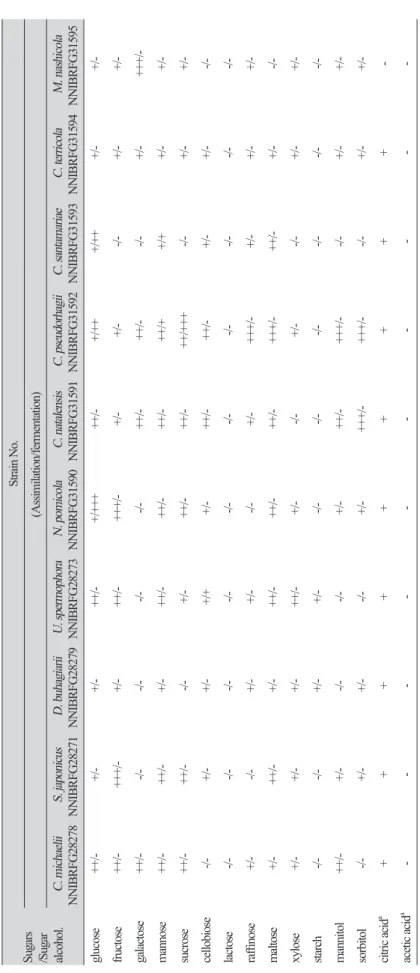
2탄소원들에 대한 자화성과 발효성; 미기록 야생효모들의 탄소원으로 당류와 당알코올 및 유기
산들에 대한 자화성과 발효성을 조사한 결과 Table 5와 같이 미기록 효모들 모두 포도당을 자화시 키고 발효하였으나 lactose는 모두 자화시키지 못하였다. Maltose는 M. nashicola NNIBRFG31595 외 9균주들이 자화시켰고 특히, U. spermophora NNIBRFG28273 균주는 cellobiose를 자화시키면 서 알코올 발효하였고, 동시에 D. buhagiarii NNIBRFG28279와 더불어 전분을 자화시켜 이들 두 미 기록 효모들은 앞으로 섬유소를 이용한 bioethanol생산에 유용하게 활용될 것으로 사료된다. 한편 탄소원으로 구연산을 M. nashicola NNIBRFG31595외 9균주들이 모두 이용할 수 있었으나 초산은 모두 이용하지 못하였다.Fig. 1. Phylogenetic tree of the unrecorded yeasts isolated from freshwaters and soils of Cheonnaegang
in Geumgang upstream, based on the nucleotide sequences of large subunit 26S ribosomal DNA D1/D2 region. The tree was generated by the neighbor-joining method, using MEGA 7. The bar indicates the number of substitutions per position. The new isolates from the present study are shown in bold and its detailed characteristics were described in Table 4.Fig. 2. Phylogenetic tree of the unrecorded yeasts isolated from freshwaters and soils of Cheongpodae
beach in Taean and Suncheonman marshland in Suncheon, based on the nucleotide sequences of large subunit 26S ribosomal DNA D1/D2 region. The tree was generated by the neighbor-joining method, using MEGA 7. The bar indicates the number of substitutions per position. The new isolates from the present study are shown in bold and its detailed characteristics were described in Table 4.Table 5. Assimilation and fermentation on sugars, sugar alcohols and or ganic acid of unrecorded wild yeasts.
Sugars /Sugar alcohol.
Strain No. (Assimilation/fermentation) C. michaelii NNIBRFG28278 S. japonicus NNIBRFG28271 D. buhagiarii NNIBRFG28279
U. spermophora NNIBRFG28273 N. pomicola NNIBRFG31590 C. natalensis NNIBRFG31591 C. pseudorhagii NNIBRFG31592 C. santamariae NNIBRFG31593
C. terricola NNIBRFG31594 M. nashicola NNIBRFG31595 glucose ++/- +/- +/- ++/- +/+++ ++/- +/++ +/++ +/- +/- fructose ++/- +++/- +/- ++/- +++/- +/- +/- -/- +/- +/- galactose ++/- -/- -/- -/- -/- ++/- ++/- -/- +/- +++/- mannose ++/- ++/- +/- ++/- ++/- ++/- ++/+ +/+ +/- +/- sucrose ++/- ++/- -/- +/- ++/- ++/- ++/+++ -/- +/- +/- cellobiose -/- +/- +/- +/+ +/- ++/- ++/- +/- +/- -/- lactose -/- -/- -/- -/- -/- -/- -/- -/- -/- -/- raffinose +/- -/- +/- +/- -/- +/- +++/- +/- +/- +/- maltose +/- ++/- +/- ++/- ++/- ++/- +++/- ++/- +/- -/- xylose +/- +/- +/- ++/- +/- -/- +/- -/- +/- +/- starch -/- -/- +/- +/- -/- -/- -/- -/- -/- -/- mannitol ++/- +/- -/- -/- +/- ++/- +++/- -/- +/- +/- sorbitol -/- +/- +/- -/- +/- +++/- +++/- -/- +/- +/- citric acid
a+ + + + + + + + + - acetic acid
a- - - - - - - - - - +: assimilated or fermented; -: not assimilated or fermented. ;
a: Only assimilation of citric acid and acetic acid were investigated.
적요
금강 상류와 태안, 순천만 등 해안주변환경의 야생효모들의 효모 종 분포특성을 조사하고 국내 미발표된 효모들을 선별하여 이들의 균학적 특성들을 알아보고자 금강 상류인 충남 금산의 천내 강과 서해안에 있는 청포대 해수욕장 및 순천만 습지대 주변의 물과 토양들로부터 야생효모들을 분리, 동정하였고 이들 중 국내 미기록 효모들을 선별하여 이들의 균학적 특성을 조사하였다. 금 산의 천내강 주변 물과 토양 40점에서 49종의 야생효모들을 분리, 동정하였고, 태안의 청포대 해 수욕장과 순천만 습지대 주변 물과 식물체 부식물 및 토양 80점에서 각각 56종, 36종의 야생효모 들을 분리, 동정하였다. 이들 지역에서 분리, 동정한 야생효모들 중 C. michaelii NNIBRFG28278, Sp.
japonicus NNIBRFG28271, D. buhagiarii NNIBRFG28279, U. spermophora NNIBRFG28273, N. pomicola NNIBRFG31590, C. natalensis NNIBRFG31591, C. pseudorhagii NNIBRFG31592, C. santamariae NNIBRFG31593, Cu. terricola NNIBRFG31594, M. nashicola NNIBRFG31595등 10균주들이 국내 미 기록 야생효모들로 최종 선별되었다. 이들 미기록 효모들은 C. pseudorhagii NNIBRFG31592과 Cu.
terricola NNIBRFG31594 만이 구형이고 나머지 균들은 난형으로 Sp. japonicus NNIBRFG28271와 C.
natalensis NNIBRFG31591 두 균주만이 포자를 생성하였다. U. spermophora NNIBRFG28273균주는 vitamin-free배지에서도 생육이 아주 양호하였고 Sp. japonicus NNIBRFG28271균주는 15% NaCl을 함유한 YPD배지에서도 생육이 양호한 호염성균이었다.
ACKNOWLEDGEMENTS
This work was supported by a grant from the Nakdonggang National Institute of Biological Resources (NNIBR, project No: NNIBR202001207), funded by the Ministry of Environment (MOE) of the Republic of Korea.
REFERENCES
1. Lee JS, Choi YJ, Kwon SJ, Yoo JY, Chung DH. Screening and characterization of osmotolerant and gas-producing yeasts from traditional Doenjang and Kochujang. Food Biotechnol 1996;5:54-8.
2. Lee DH, Lee DH, Lee JS. Characterization of a new antidementia β-secretase inhibitory peptide from Saccharomyces cerevisiae. Enzyme and Microbiol Technol 2007;42:83-8.
3. Jeong SC, Lee DH, Lee JS. Production and characterization of an anti-angiogenic agent from
Saccharomyces cerevisiae K-7. J Microbiol Biotechnol 2006;16:1904-11.
4. Han SM, Lee JS. Production and its anti-hyperglycemia effects of gamma-aminobutylic acid from the wild yeast strain Pichia silvicola UL6-1 and Sporobolomyces carnicolor 402-JB-1 Mycobiol 2017:45;199-203.
5. Kim JY, Lee SY, Han SM, Lee JS. Production of anti-dementia acetylcholinesterase from the wild yeasts Saccharomyces cerevisiae WJSL0113 and Wickerhamomyces anomalus JSF0128 Kor J Mycol 2018;46:447-57.
6. Moon JE, Heo W, Lee SH, Lee SH, Lee HG, Lee JH, Kim YJ. Trehalose protects the probiotic yeast Saccharomyces boulardii against oxidative stress-induced cell death. J Microbiol Biotechnol 2020;30:54-61.
7. Ryu HY. Advanced technologies and mechanisms for yeast evolutionary engineering.
Mycobiol 2020;48:423-8.
8. Min JH, Ryu JJ, Kim HK, Lee JS. Isolataion and identification of yeasts from wild flowers in Gyejoksan, Oseosan and Baekamsan of Korea. Kor J Mycol 2013;41:47-51.
9. Hyun SH, Mun HY, Lee HB, Kim HK, Lee JS. Isolation of yeasts from wild flowers in Gyonggi-do province and Jeju island in Korea and the production of anti-gout xanthine oxidase inhibitor. Kor J Microbiol Biotechnol 2013;41:383-90.
10. Hyun SH, Lee JK, Park WJ, Kim HK, Lee JS. Isolation and diversity of yeasts from fruits and flowers of orchard in Sinam-myeon of Yesan-gun, Chungcheongnam-do, Korea. Kor J Mycol 2014;42:21-7.
11. Hyun SH, Min JH, Lee HB, Kim HK, Lee JS. Isolation and diversity of yeasts from wild flowers in Ulleungdo and Yokjido, Korea. Kor J Mycol 2014;42:28-33.
12. Hyun SH, Min JH, Kim SA, Lee JS, Kim HK. Yeasts associated with fruits and blossoms collected from Hanbat arboretum, Daejeon, Korea. Kor J Mycol 2014;42:178-82.
13. Hyun SH, Han SM, Lee JS. Isolation and physiological functionality of yeasts from wild flowers in Seonyudo of Gogunsanyeoldo, Jeollabuk-do, Korea. Kor J Mycol 2014;42:201-6.
14. Han SM, Hyun SH, Lee JS. Isolation and identification of yeasts from wild flowers in Deogyu mountain and their physiological functionalities. Kor J Mycol 2015;43:47-52.
15. Han SM, Hyun SH, Lee HB, Lee HW, Kim HK, Lee JS. Isolation and identification of yeasts from wild flowers collected around Jangseong lake in Jeollanam-do, Republic of Korea, and characterization of the unrecorded yeast Bullera coprosmaensis. Mycobiol 2015;43:266-71.
16. Han SM, Han JW, Bae SM, Park WJ, Lee JS. Isolation and identification of wild yeasts from soils of paddy fields in Daejeon metropolitan city and Chungcheongnam-do, Korea. Kor J Mycol 2016;44:1-7.
17. Han SM, Lee JS. Isolation and identification of wild yeasts from soils of an herb park in Seoul metropolitan city and characteristics of unrecorded yeasts. Kor J Mycol 2016;44:108-12.
18. Han SM, Lee SY, Kim HK, Lee JS. Characterization of wild yeasts Isolated from leaves obtained from Mt. Daedun and Mt. Chilgap, Korea. Kor J Mycol 2017;45:31-42.
19. Han SM, Lee JS. Characterization of unrecorded yeasts Isolated from leaves of trees of Oknyeobong peak and Yeonjasan mountain in Daejeon, Korea, Kor J Mycol 2017;45:23-30.
20. Han SM, Kim HK, Lee HB, Lee JS. Isolation and identification of wild yeasts from freshwaters and soils of Nakdong and Yeongsan river, Korea, with characterization of two unrecorded yeasts. Kor J Mycol 2016;44:350-4.
21. Han SM, Lee SY, Kim HK, Lee JS. Isolation and diversity of wild yeasts from the waters and bank soils of Daejeoncheon, Gapcheon, and Yedeungcheon in Daejeon Metropolitan city, Korea. Kor J Mycol 2017;45:259-69.
22. Han SM, Kim JY, Lee HB, Kim HK, Lee JS. Isolation and characterization of wild yeasts from water and riverside soils of Geumgang midstream in Gongju City, Korea. Kor J Mycol 2018;46:98-104.
23. Han SM, Kim JY, Kim CM, Lee JS. Characteristics of unrecorded wild yeasts obtained from the soil of spices plant fields and its physiological functionality. Kor J Mycol 2019;47:75-81.
24. Kim HK, Kim JY, Han SM, Kim CM, Lee JS. Microbiological characteristics and physiological functionalities of unrecorded wild yeast strains in the soils of Hajodae and Gyungpodae beaches in Korea. Kor J Mycol 2019;47:249-58.
25. Kim JY, Han SM, Park SJ, Jang JE, Lee JS. Isolation and characterization of unrecorded wild
yeasts obtained from soils of spice fields and mountains. Kor J Mycol 2020;48:151-60.
26. Han SM, Park DJ, Kim JY, Lim HJ, Lee HB, Lee JS. Isolation of wild yeasts obtained from waters and soils of riversides in Sangjubo of Nakdong river and Daechung dam of Geumgang midstream, Korea and characterization of unrecorded wild yeasts. Kor J Mycol 2020;48:237- 49.
27. Kim JS, Lee M, Kim JY, Heo J, Kwon SW, Yun BS, Kim SJ. Distribution and species diversity of wild yeasts isolated from flowers in Korea. Kor J Mycol 2020;48:475-84.
28. Jeon YJ, Park S, Hwang H, Park YH, Cheon W, Goh J, Chung N, Mun HY. Seven yeast strains isolated from freshwaters for the first record in Korea. Kor J Mycol 2020;48:523-31.
29. Lee JS, Lee SH, Kwon SJ, Ahn C, Yoo JY. Enzyme activities and physiological functionality of yeasts from traditional Meju. Kor J Appl Microbiol Biotechnol 1997;25:448-53.
30. Kim JH, Kim NM, Lee JS. Physiological characteristics and ethanol fermentation of thermotolerant yeast Saccharomyces cerevisiae OE-16 from traditional meju. Kor J Food Nutr 1999;12:490-5.