야생효모의 분리, 동정과 이를 이용한 오미자 발효주의 이화학 및 관능 특성의 비교
이시형
1
․박혜경2
․김명희2†
1농림수산식품기술기획평가원 기술기획실
2영남대학교 식품공학과
Isolation and Identification of Wild Yeasts from Schizandra (Schizandra chinensis) for Wine Production and Its Characterization for
Physicochemical and Sensory Evaluations
Sihyung Lee, Hae-Kyung Park, and Myunghee Kim
†
1
Technology Planning Office, Korea Institute of Planning and Evaluation for Technology in Food, Agriculture, Forest and Fisheries, Gyeonggi-do 431-810, Korea
2
Dept. of Food Science and Technology, Yeungnam University, Gyeongbuk 712-749, Korea
Abstract
The purpose of this research was to characterize physicochemical properties and sensory evaluation of schi- zandra wines fermented by the yeasts, Sacchromyces cerevisiae SH8094 (S. cerevisiae SH8094) and Sacchromyces
cerevisiae SH2855 (S. cerevisiae SH2855) isolated from schizandra fruits and stems and compare these results
with the results from commercial activated yeast (Lalvin 1118) and a commercial schizandra wine. Three different schizandra wines fermented by S. cerevisiae SH8094, S. cerevisiae SH2855, and Lalvin 1118 showed similar results in pH and titratable acidity. On the other hand, the schizandra wines fermented by S. cerevisiae SH8094 and S. cerevisiae SH2855 showed high brix (14obrix), low alcohol content (9%), and low yeasts count (4.1 log CFU/mL), compared with the schizandra wine fermented by Lalvin 1118. Both schizandra wines made withS. cerevisiae SH8094 and S. cerevisiae SH2855 showed higher scores in swallowing and overall acceptability
than the schizandra wine made with Lalvin 1118. When compared with a commercial schizandra wine, the schi- zandra wine fermented with S. cerevisiae SH8094 showed better qualities in aroma (6.65±1.47), color (7.53±1.14), and overall acceptability (6.76±1.03). In conclusion, S. cerevisiae SH8094 which was isolated from schizandra fruits and stems has a high potential in schizandra wine fermentation.Key words: schizandra, physicochemical characterization, Saccharomyces cerevisiae, sensory evaluation, yeast
†Corresponding author. E-mail: [email protected]
†Phone: 82-53-810-2958, Fax: 82-53-810-4662
서 론
오미자(Schizandra chinensis)는 목련과(Magnoliaceae) 에 속하는 자생목(1)으로 우리나라 중북부 지방에 주로 분포 되어 있고 전 세계적으로 10여종이 존재하고 있으며, 오미자 의 피육은 달고도 시며, 핵중은 맵고도 떫으며 또한 써서 합하면 오미라고 하여 그 명칭이 유래되었다(2). 오미자는 붉은 색을 띈 과실로, 예로부터 식품과 기호음료(3)로 이용 되어 왔고, 한방과 민간에서는 약재로서 거담, 자양, 강장제 등으로 널리 통용되고 있다.
최근에는 건강에 대한 관심이 증가함에 따라 오미자의 생 리활성에 관한 연구보고(4-8)와 오미자 성분에 관한 연구보 고(9-12)와 같은 생약성분에 관한 연구가 주를 이루고 있으 며, 오미자를 이용한 가공기술에 관한 보고로는 오미자를
이용한 젤리 제조(13,14) 등이 있다. 그러나 빛깔이 아름답고 여러 가지 맛이 잘 조화된 전통 발효주로 가정 등에서 약용 주로도 음용되어온 오미자 전통 발효주의 가공기술에 대한 연구는 미비한 실정이다.
오미자 전통 발효주는 단순히 소주 등과 같은 술에 오미자 열매를 담근 상태에서 다섯 가지 맛을 침출시켜 제조한 침출 주로 오미자 그 과실자체에 발효성 당이 거의 없어(15) 효모 영양원의 부족으로 다른 과실 발효주에 비해 개발되지 못한 것이 사실이다. 시판되고 있는 오미자주는 주로 누룩을 이용 하여 주정을 만들고 오미자즙을 첨가하는 방식으로 누룩 고 유의 냄새로 인하여 오미자 특유의 맛을 살릴 수 없는 단점 을 가지고 있다(16).
현재 효모를 이용한 다른 과실 발효주의 품질개선을 위한 연구로 Kim 등(17)과 Lee 등(18)은 포도와 감에서 효모를
분리하여 제조한 발효주로 품질을 향상시키는 방안을 제시 했으며, Moon 등(19)의 복분자 발효주, Jung 등(20)의 벌꿀 발효주, Joeng 등(21)은 딸기 발효주의 특성 등을 규명하여 과실주에서 효모의 중요성을 시사했다. 효모를 이용한 오미 자 발효에 관련된 연구는 Jang 등(22)의 효모를 이용한 오미 자 발효 방법이 있으며, 특허로는 Park 등(23)과 Jang 등(24) 의 주기적으로 포도즙을 첨가하는 오미자 발효주 개발과 건 조오미자를 사용한 오미자 발효주 개발 등이 있고, Ko 등 (25)은 밀감 양조주 생산용 효모를 선별, 동정하여 양조주 발효에 영향을 미치는 효모의 중요성을 제시하였다.
이와 같이 과실 발효주 효모의 중요성을 파악한 연구와 전보(26)의 제조방법을 달리한 오미자주의 이화학 특성과 관능 특성에 대한 연구 보고를 이용하여 오미자로부터 야생 효모를 분리, 이를 이용한 오미자 발효주의 이화학 특징과 관능 특성을 검토한 후 시판 발효주와 관능 특성을 비교하고 이를 토대로 야생효모를 이용한 오미자 발효주의 제조방법 을 제시하고자 하였다.
재료 빛 방법
재료
본 실험에서 사용된 오미자는 2008년 가을에 경상북도 문 경시에서 재배한 오미자를 냉동 보관하여서 사용하였다.
오미자에서 야생효모 분리
생오미자 10 g을 취하여 YM broth(Becton, Dickinson Co., Sparks, MD, USA) 90 mL에 가하여 28oC에서 48시간 증균 배양하였다. 배양액을 단계희석 후 1 mL을 취하여 yeast extract glucose chloramphenicol agar plate(Becton, Dickinson Co.)에 28oC에서 48시간 선택 배양하여 효모를 분리한 후 API 20C AUX kit(Bio‐Merieux, Marcy I’Etoile, France)를 사용하여 생화학적 동정을 한 후 1차적으로 효모 를 분리하였다.
18S rRNA를 이용한 효모의 동정
DNA 추출은 분리된 효모 균주를 yeast extract peptone dextrose broth(Becton, Dickinson Co.)에 접종하여 30oC에 서 48시간 배양한 후, 원심분리하여 genomic DNA puri- fication kit(Promega Co., Madison, WI, USA)를 이용하여 DNA를 추출하였으며, DNA 증폭은 18S rRNA 단편을 증폭 하기 위하여 Cletus 등(27)이 제안한 universal primer ITS 1(5'-TCC GTA GGT GAA CCT GCG G-3'), ITS 4(5'- TCC TCC GCT TAT TGA TAT GC-3')를 이용하였으며, PCR(GeneAmp PCR System 2700, Applied Biosystems, Chromos, Singapore) 반응조건은 PCR PreMix(Bioneer Corp., Seoul, Korea)에 template DNA 2 μL, 각 primer 0.75 μM를 넣어 총량을 50 μL로 맞추어 수행하였다.
PCR 증폭조건은 pre-denature 95oC/15분, denature 95
oC/20초, annealing 50oC/40초, extension 72oC/1.5분, final extension 72oC/5분의 조건으로 30 cycles를 실시하여 18S rRNA 단편을 증폭하였다.
18S rRNA 염기 서열 분석은 솔젠트사(SolGent Co., Seoul, Korea)에 의뢰하였으며, 사용한 primer는 forward NL1(5'-GCATATCAATAAGC GGAGGAAAAG-3')이 며, 또한 National Center for Biotechnology Information (NCBI, Bethesda, MD, USA)의 BLAST를 사용하여 18S rRNA 단편의 유전자염기 서열상동성을 근거로 동정하였다 (28).
오미자 발효주 제조
생오미자 1,200 g, 설탕 1,800 g, 증류수 5,000 g을 혼합하 여 70oC에서 30분간 저온 살균 후 방냉하였으며, 오미자 발 효주에 이용된 효모는 대조구 효모로 시중에 판매되고 있는 Lalvin 1118(Mouins de Granges, Granges-près-Marnand, Switzerland)을 사용하였고, 시험구 효모는 오미자에서 분 리한 야생효모 Saccharomyces cerevisiae SH 8094(S.
cerevisiae SH8094), Saccharomyces cerevisiae SH2855(S.
cerevisiae SH2855)를 사용하여 28
oC에서 28일간 발효한 후 오미자주를 제조하였다.화학적 특성 분석
pH는 pH meter로 실온에서 pH를 측정하였으며, 산도는 AOAC법(29)에 따라 오미자즙 20 mL을 pH가 8.3에 도달할 때까지 0.1 N NaOH 용액으로 적정한 후 0.1 N NaOH 소요 량을 lactic acid(%) 함량으로 환산하였고, 당도는 당도계를 사용하여 측정하였다. 알코올 함량은 시료 100 mL를 증류한 후 실온에서 주정계를 이용하여 측정하였다(30).
효모수 측정
효모 배양은 식품공전(31) 방법에 따라 오미자 발효주 10 mL을 무균적으로 분주한 다음 표준평판법에 준하여 각 희 석액 1 mL씩을 취하여 YM 평판배지에 도말 후 28oC에서 48시간 배양하였다. 효모수 측정은 각 배지에 형성된 집락을 계수하여 log colony forming unit(log CFU/mL)로 나타내 었다.
색도 분석
야생효모를 이용하여 제조한 오미자 발효주와 현재 시판 되고 있는 오미자 주의 색도를 측정하였으며, 색도는 발효 후 여과한 시료를 색차계 CR-200(Minolta, Osaka, Japan)을 이용하여 Hunter value(L, lightness; a, redness; b, yellow- ness)로 표시하였다. 이때 사용된 표준색판은 L=96.43, a=
+0.03, b=+1.79이었다.
관능검사 비교 분석 및 통계분석
시판효모와 야생효모로 제조된 오미자주의 관능평가 비 교를 위해 20~34세로 분포된 20명을 패널로 선정하여 훈련 시켰으며, 시중에 판매되고 있는 오미자 주와의 관능평가
Table 1. Results of identification based on the biochemical properties of the strains isolated from
schizandrafruits and stems using an API 20C AUX-kit
Strains Decision Significant taxa % ID T index
No. 1 No. 17 No. 22 No. 23 No. 30 No. 31
Good identification Good identification Good identification Good identification Good identification Good identification
Saccharomyces cerevisiae 1 Saccharomyces cerevisiae 2 Saccharomyces cerevisiae 2 Saccharomyces cerevisiae 1 Saccharomyces cerevisiae 2 Saccharomyces cerevisiae 2
98.7 93.5 93.5 97.5 93.5 93.5
1.00 0.88 0.88 0.79 0.88 0.88
Table 2. Results of BLAST searching of the 18S rRNA region sequence obtained from SH8094 and SH2855 strains Fragment sequenced (bp) Species and strain designation GenBank accession no. Similarity (%)1)
9150 591 9150 612 615 607
Synthetic construct clone pNOY373
Saccharomyces cerevisiae strain SYGYC
Synthetic construct clone pNOY373Saccharomyces cerevisiae isolate 27 Saccharomyces cerevisiae isolate 35 Saccharomyces cerevisiae strain TJY20a
DQ888227 EU809455 DQ888227 EU285510 EU285514 EU327093
99 99 99 99 99 99
1)Relation of similarity of nucleotide in 18S rDNA fragment between isolate and GenBank accession.
Fermentation (day)
―▲―
Lalvin 1118 (commercial yeast)
―■―
SH8094 (isolated strain)
―◆―
SH2855 (isolated strain)
Fig. 1. Changes of pH in schizandra wines by using various yeasts during fermentation at 28oC.
Fermentation (day)
―▲―
Lalvin 1118 (commercial yeast)
―◆―
SH8094 (isolated strain)
―■―
SH2855 (isolated strain)
Fig. 2. Changes of titratable acidity in schizandra wines by using various yeasts during fermentation at 28oC.
비교는 20~68세로 분포된 109명을 패널로 선정하여 실시하 였다. 관능평가는 오미자 발효주의 색, 향, 맛, 목넘김, 종합 적 기호도에 대해 9점 평점법으로 평가하여 최고로 좋다 9, 가장 싫다 1의 점수로 표시하였다. 통계분석은 SPSS Ver.
17.0 package program을 이용하여 각 시험군의 평균과 표준 편차를 산출하고 Duncan의 다중범위분석법을 이용하여 각 시험구간의 유의차를 5%(p<0.05) 유의수준에서 검증하였 다.
결과 및 고찰
야생효모의 분리
오미자로부터 분리한 80 여종의 효모를 API 20C AUX kit를 사용하여 동정한 결과, good identification과 S. cere-
visiae로 판정된 5종의 효모를 1차 선별하여 Table 1에 나타
내었다. T index 값은 표준균주와 비교했을 때 1에 가까울수 록 표준균주와 같다는 것을 나타내는 값으로 1번 효모는 T index 값이 1로 표준균주와 같다는 것을 나타냈다.분리 균주의 동정
분리 균주의 동정은 18S rRNA 유전자 염기서열의 해석을 통하여 동정하였으며(Table 2), 분리된 균주는 포도주 발효 에 주로 이용되고 있는 S. cerevisiae와 99%의 염기서열 유 사성을 나타내었다. 따라서 이 균주를 S. cerevisiae SH8094 와 S. cerevisiae SH2855로 명명하였다.
오미자 발효 중 pH 및 산도 측정
발효과정 28일 동안 4일 간격으로 시료를 채취하여 pH를 측정한 결과는 Fig. 1과 같다. 대조구로 이용된 시판효모 Lalvin 1118을 사용하여 만든 오미자 발효주는 초기에 pH 3.15에서 발효 종료 시 pH 2.85로 감소하였고, 시험구 야생효 모 S. cerevisiae SH8094로 제조한 오미자 발효주는 초기에
pH 3.1에서 발효 종료 시 pH 2.76으로 감소하였으며, S.
cerevisiae SH2855로 제조한 오미자 발효주는 pH 3.1에서
pH 2.8로 감소하였다. 오미자 과즙의 pH 값이 2.9이기 때문 에 발효 초기의 pH가 낮게 나타난 것으로 보인다.산도는 4일 간격으로 28일간 측정하여 Fig. 2에 표시하였
Fermentation (day)
―▲―
Lalvin 1118 (commercial yeast)
―◆―
SH8094 (isolated strain)
―■―
SH2855 (isolated strain)
Fig. 5. Changes of yeast counting in schizandra wines by using various yeasts during fermentation at 28oC.
Fermentation (day)
―▲―
Lalvin 1118 (commercial yeast)
―◆―
SH8094 (isolated strain)
―■―
SH2855 (isolated strain)
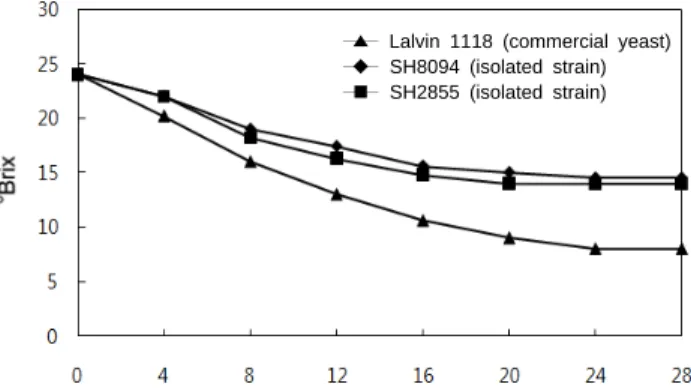
Fig. 3. Changes of sugar contents in schizandra wines by using various yeasts during fermentation at 28oC.
Fermentation (day)
―▲―
Lalvin 1118 (commercial yeast)
―◆―
SH8094 (isolated strain)
―■―
SH2855 (isolated strain)
Fig. 4. Changes of alcohol concentration in schizandra wines by using various yeasts during fermentation at 28oC.
다. Lalvin 1118을 사용하여 만든 오미자 발효주는 산도가 0.1%에서 1.3%로 증가하였고, S. cerevisiae SH8094로 제조 한 오미자 발효주의 산도는 0.1%에서 1.1%로 증가하였으며,
S. cerevisiae SH2855로 제조한 오미자 발효주는 산도가
0.1%에서 1.2%로 증가하였다. Lalvin 1118은 4일째 되는 날 산도가 1.3%로 야생효모를 사용한 오미자 발효주보다 빨리 증가하였다.일반적으로 총 산도는 발효주의 품질에 중요한 영향을 미 치는데 특히 총 산도가 높으면 신맛이 강하기 때문에 부재료 를 가하여 총 산도를 낮추거나 calcium carbonate 등을 이용 한 화학적 중화법으로 총 산도를 낮추는 방법이 사용되기도 한다(32).
오미자 발효 중 당도 및 알코올 함량 측정
발효과정 28일 동안 오미자 발효주를 4일 간격으로 시료를 채취하여 측정한 당도는 Fig. 3, 알코올 함량은 Fig. 4에 표시 하였다. 대조구 Lalvin 1118을 사용하여 만든 오미자 발효주 의 당도는 초기에 24oBrix에서 발효 종료 시 8oBrix로 감소하 였다. 시험구 S. cerevisiae SH8094로 제조한 오미자 발효주 의 당도는 24oBrix에서 14.5oBrix로 감소하였고 S. cere-
visiae SH2855로 제조한 오미자 발효주의 당도는 24
oBrix에서 14oBrix로 감소하였다.
알코올 함량은 Lalvin 1118을 사용하여 만든 오미자 발효 주는 발효 종료 시 14%로 나타났으며, S. cerevisiae SH8094 와 S. cerevisiae SH2855로 제조한 오미자 발효주는 발효 종료 시 9%로 나타났다. 시판효모 Lalvin 1118을 사용한 오 미자 발효주가 야생효모를 사용한 오미자 발효주보다 알코 올 함량이 더 빨리 증가하였다.
단감, 생대추, 수박을 이용한 발효주의 경우 당도는 모두 감소하였다고 보고되어 있고(33-35), 당 성분은 효모의 영양 원이나 발효 기질로 이용되므로 발효 후기에 총 당 함량은 감소하게 되며 발효기간 중 당분이 효모 발효기질로 이용되 어 일정한 기간까지 알코올 함량이 상승한다(34,35).
효모수 측정
발효과정 28일간 오미자 발효주를 4일 간격으로 시료를 채취하여 측정한 효모수는 Fig. 5에 나타내었다. 세 종류 효 모 모두 8일까지 6.9~7.3 log CFU/mL로 증가하였으며 8일 에서 16일 사이 6.9~7.4 log CFU/mL로 가장 많은 효모수를 나타냈다. 야생효모 S. cerevisiae SH8094와 S. cerevisiae SH2855는 16일에서 20일 사이에 4.2 log CFU/ mL로 급격히 감소하였다. Lalvin 1118을 사용하여 만든 오미자 발효주는 발효 초기 4.9 log CFU/mL에서 발효 종료 시 4.4~4.6 log CFU/mL로 감소하였고, S. cerevisiae SH8094와 S. cere-
visiae SH2855로 제조한 오미자 발효주는 5.7 log CFU/mL
에서 4.1 log CFU/mL로 감소하였다. Kang 등(34)의 연구에 서 생대추를 이용한 와인에서는 10일째 가장 많은 효모수를 보였으며 Kim 등(36)의 참다래를 이용한 발효주의 제조에 서는 2일째 가장 많은 효모수가 나타났다고 보고되고 있다.이는 발효가 진행되는 동안 효모의 수는 효모와 당의 종류, 호기적 또는 혐기적 발효조건 및 발효 방법 등에 따라 차이 가 나타나는 것으로 사료된다. 따라서 발효기간에 따른 효모 균체수의 변화는 발효주의 알코올 함량은 물론 산도, 맛, 향 등 술의 전반적인 품질을 좌우하는데 큰 영향을 미치므로 발효주 제조에 있어서 효모 총 균수의 조절은 매우 중요한
Table 3. Color values of schizandra wines fermented by vari- ous yeasts
Schizandra wine Hunter’s value4)
L a b
Lalvin 11181)
S. cerevisiae SH8094
2)S. cerevisiae SH2855
3)70.87±5.24a5) 55.95±0.95b 52.85±8.84b
12.05±5.08b 31.75±8.34a 30.81±6.29a
2.58±2.90b 9.63±3.69a 10.33±3.03a
1)Schizandra wine fermented by commercial yeast strain, Lalvin 1118.
2,3)Schizandra wines fermented by isolated yeast strains.
4)L, lightness 0~100 (black: 1, white: 100); a, redness (-: green, +: red); b, yellowness (-: blue, +: yellow).
5)Mean±SD; Values in the same column not sharing a common superscript are significantly various at α=0.05 by Duncan’s multiple range test.
Table 4. Sensory evaluation of schizandra wines fermented by various yeasts
Schizandra wine
Sensory characteristics Overallacceptability
Taste Aroma Color Swallowing
Lalvin 11181)
S. cerevisiae SH8094
2)S. cerevisiae SH2855
3)4.05±1.58a4) 4.95±1.12a 4.86±1.23a
5.45±0.88a 6.23±1.35a 5.91±1.08a
6.86±0.88a 6.91±1.46a 7.09±1.92a
3.82±1.34b 5.55±1.29a 5.14±0.97a
4.41±1.82b 6.55±1.64a 5.82±1.59a
1)Schizandra wine fermented by commercial yeast strain, Lalvin 1118.
2,3)Schizandra wines fermented by isolated yeast strains.
4)Mean±SD; Values in the same column not sharing a common superscript are significantly various at α=0.05 by Duncan’s multiple range test.
요인이라 사료된다.
색도 측정
Lalvin 1118을 이용하여 제조한 오미자 발효주와 야생효 모 S. cerevisiae SH8094, S. cerevisiae SH2855로 제조한 오미자 발효주의 색도 비교는 Table 3에 나타냈다.
밝은 정도를 나타내는 L 값은 Lalvin 1118로 제조한 오미 자 발효주에서 70.87로 높게 나타났고, S. cerevisiae SH8094, S. cerevisiae SH2855로 제조한 오미자 발효주에서 55.95, 52.85로 낮게 나타났다. 시판효모용 오미자주와 야생 효모용 오미자주의 L 값은 5% 수준에서 유의적 차이가 있는 것으로 나타났다.
적색도 a 값은 S. cerevisiae SH8094와 S. cerevisiae SH2855로 제조한 오미자 발효주에서 31.75, 30.81로 높게 나타났고, Lalvin 1118을 사용하여 만든 오미자 발효주에서 12.05로 낮게 나타나났으며, 이들은 5% 수준에서 유의적 차 이가 있는 것으로 나타났다.
황색도 b 값은 S. cerevisiae SH8094와 S. cerevisiae SH2855로 제조한 오미자 발효주에서 9.63, 10.33로 높게 나 타났고, Lalvin 1118로 제조한 오미자 발효주에서 2.58로 낮 게 나타났다. 이들은 5% 수준에서 유의적 차이가 있는 것으 로 나타났다.
관능평가
활성건조효모 Lalvin 1118용 오미자 발효주와 야생효 모 S. cerevisiae SH8094와 SH2855용 오미자 발효주의 관능 비교: 시판효모 Lalvin 1118을 사용하여 만든 오미자
발효주와 야생효모 S. cerevisiae SH8094, S. cerevisiae SH2855로 제조한 오미자 발효주의 맛, 향, 색, 목넘김, 종합 적 기호도는 Table 4에 나타내었다.
맛에 대한 기호도는 시판효모용 오미자 발효주 4.05, 야생 효모용 오미자 발효주 4.95, 4.86으로 5% 수준에서 유의적 차이가 없는 것으로 나타났다. 향의 기호도는 시판효모용 오미자 발효주 5.45, 야생효모용 오미자 발효주 6.23, 5.91로, 5% 수준에서 유의적 차이가 없었고, 색감은 시판효모용 오 미자주 6.86, 야생효모용 오미자 발효주 6.91, 7.09로 5% 수준 에서 유의적 차이가 없는 것으로 나타났다.
목넘김에 대한 기호도는 시판효모용 오미자 발효주 3.82, 야생효모용 오미자 발효주 5.55, 5.14로 5% 수준에서 유의적 차이가 있는 것으로 나타났다. 종합적 기호도는 시판효모용 오미자 발효주 4.41, 야생효모용 오미자 발효주 6.55, 5.82로 5% 수준에서 유의적 차이가 있는 것으로 나타났다.
야생효모 중 S. cerevisiae SH8094로 제조한 오미자 발효 주가 상업적으로 판매되는 Lalvin 1118용 오미자 발효주보 다 관능적 평가에서 좋은 결과를 나타냈으므로 오미자 발효 주 제조 시 오미자에서 분리한 야생효모 S. cerevisiae SH8094를 사용한 오미자 발효주가 관능적으로 더 적합하였 다.
시판 오미자 발효주와 야생효모 S. cerevisiae SH8094 와 SH2855용 오미자 발효주의 관능 비교: 현재 시중에서 판매되고 있는 오미자 발효주와 오미자에서 분리한 야생효 모 S. cerevisiae SH8094, S. cerevisiae SH2855로 제조한 오미자 발효주의 맛, 향, 색, 목넘김, 종합적 기호도는 Table 5에 나타내었다.
맛에 대한 기호도는 시판 오미자 발효주 6.00, 야생효모
S. cerevisiae SH8094, S. cerevisiae SH2855로 제조한 오미
자 발효주가 5.65, 6.15로 5% 수준에서 유의적 차이가 없는 것으로 나타났다. 향에 대한 기호도는 시판 오미자 발효주 5.31, 야생효모용 오미자 발효주가 6.65, 6.66으로 5% 수준에 서 유의적 차이가 있는 것으로 나타났다.색에 대한 기호도는 시판 오미자 발효주가 4.69, 야생효모 용 오미자 발효주는 7.53, 7.33으로 5% 수준에서 유의적 차 이가 있는 것으로 나타났고, 목넘김에 대한 기호도는 시판 오미자 발효주 5.95, 야생효모용 오미자 발효주 5.91, 5.80으 로 5% 수준에서 유의적 차이가 없는 것으로 나타났다. 종합
Table 5. Sensory evaluation of schizandra wines fermented by isolated yeasts and commercial schizandra wine
Schizandra wine Characteristics Overall
acceptability
Taste Aroma Color Swallowing
Control1)
S. cerevisiae SH8094
2)S. cerevisiae SH2855
3)6.00±2.01a4) 5.65±1.86a 6.15±1.27a
5.31±1.56b 6.65±1.47a 6.66±1.38a
4.69±0.87b 7.53±1.14a 7.33±1.25a
5.95±1.43a 5.91±1.82a 5.80±1.29a
5.81±1.52b 6.76±1.03a 6.65±1.88a
1)Commercial schizandra wine.
2,3)Schizandra wines fermented by isolated yeast strains.
4)Mean±SD; Values in the same column not sharing a common superscript are significantly various at α=0.05 by Duncan’s multiple range test.
적 기호도는 시판 오미자 발효주 5.81, 야생효모용 오미자 발효주 6.76, 6.65로 5% 수준에서 유의적 차이가 있는 것으 로 나타났다.
위 결과로 볼 때, 생오미자에서 분리된 야생효모 S. cere-
visiae SH8094로 제조한 오미자 발효주가 상업적으로 판매
되는 오미자 발효주보다 향, 색, 종합적 기호도에 있어서 우 수하게 나타났다.요 약
오미자로부터 야생효모 Saccharomyces cerevisiae(S.
cerevisiae) SH8094와 S. cerevisiae SH2855를 분리, 동정하
였으며, 이 효모를 이용하여 오미자 발효주를 제조하였다.야생효모 S. cerevisiae SH8094와 S. cerevisiae SH2855를 이용한 오미자 발효주와 시판효모 Lalvin 1118을 이용한 오 미자 발효주의 이화학 특징과 관능 특성을 비교 분석하였다.
그 결과, 야생효모 S. cerevisiae SH8094로 제조한 오미자 발효주가 pH 2.8, 산도 1.1%, 당도 14.5oBrix, 알코올 함량 9%를 나타냈으며, 목넘김, 종합적 기호도에 있어서 높은 점 수를 얻었다. 또한 오미자로부터 분리된 야생효모 S.
cerevisiae SH8094와 S. cerevisiae SH2855를 이용하여 만
든 오미자 발효주와 상업적으로 판매되는 오미자 발효주의 관능 특성을 비교한 결과, 생오미자에서 분리된 야생효모S. cerevisiae SH8094로 제조한 오미자 발효주가 상업적으
로 판매되는 오미자주보다 향, 색, 종합적 기호도에 있어서 우수하게 나타났다. 이로써 오미자로부터 분리한 효모 S.cerevisiae SH8094를 이용한 우수한 오미자 발효주 제조의
가능성을 확인하였다.문 헌
1. Kim JS. 1995. New Chinese Medicine. You Sung publish- ing Co., Seoul, Korea. p 265-266.
2. Lee JS, Lee MG, Lee SW. 1989. A study on the general components and minerals in parts of omija (Schizandra chi-
nensis Baillon). Korean J Dietary Culture 4: 173-176.
3. Kang KC, Park JH, Baek SB, Jhin HS, Rhee KS. 1992.
Optimization of beverage preparation from Schizandra chi-
nensis Baillon by response surface methodology. Korean J Food Sci Technol 24: 74-81.
4. Jang EH, Pyo YH, Ahn MS. 1996. Antiradiant effect of omi-
ja (Schiznadra chinesis Baillon) extracts. Korean J Soc
Food Sci 12: 372-376.
5. Kim HG, Kim YU, Do JJ, Lee YC, Lee BY. 1995. Antiradiant activity and physiological activity of some Korean medici- nal plants. Korean J Food Sci Technol 27: 80-85.
6. Park UY, Chang DS, Cho HR. 1992. Screening of anti- microbial activity for medicinal herb extracts. J Korean Soc
Food Nutr 21: 91-96.
7. Lee SH, Lim YS. 1997. Antimicrobial effects of Schizandra
chinensis extract against Listeria minocytogenes. Kor J Appl Microbiol Biotechnol 25: 442-447.
8. Lee SH. 1997. The antimicrobial activity and mechanism of the omija (Schizandra chinensis Baillon) extracts. PhD
Dissertation. Chung Ang University, Seoul, Korea.
9. Kim KI, Nam JH, Kwon TW. 1973. On the proximate com- position organic acids and anthocyanins of omija, Schizan-
dra chinensis Baillon. Korean J Food Sci Technol 5: 178-
185.10. Lee JS, Lee SW. 1989. A study on the compositions of free sugars, lipids, and nonvolatile organic acids in parts of omi- ja (Schizandra chinensis Baillon). Korean J Dietary Culture 4: 177-179.
11. Lee JS, Lee SW. 1989. A study on the composition of total amino acids and free amino acids in parts of omija (Schi-
zandra chinensis Baillon). Korean J Dietary Culture 4:
181-184.
12. Kim OC, Jang HJ. 1994. Volatile components of Schizandra
chinensis Baillon. Agric Chem Biotechnol 37: 30-36.
13. Chun HJ. 1995. Influence of carrageenan addition on the rheological properties of omija extract jelly. Korean J Soc
Food Sci 11: 33-36.
14. Lyu HJ, Oh MS. 2002. Quality characteristics of omija jelly prepared with various starches. Korean J Food Cookery
Sci 18: 534-542.
15. Hyun HK, Kim HJ, Jeong HC. 2002. A study on determining chemical compositions of Schizandra chinensis. Korean J
Plant Res 15: 1-7.
16. No WS, Lee SH. 2004. Zymurgy. Baek-san publishing Co., Seoul, Korea. p 114-117.
17. Kim JI, Lee NK, Hahm YT. 2007. Isolation and identification of wild yeast and its use for the production of grape wine.
Korean J Microbiol 43: 217-221.
18. Lee JH, Park HD. 1997. Isolation and characterization of alcohol fermentation yeasts from persimmon. Korean J
Appl Microbiol Biotechnol 25: 266-270.
19. Moon YJ, Lee MS, Sung CK. 2005. Physicochemical prop- erties of raspberry wine using active dry yeast strains.
Korean J Food Nutr 18: 302-308.
20. Jung ST, Rhim JW, Kim DH. 1999. Fermentation charac- teristics of honey wine by Saccharomyces bayanus. Korean
J Food Sci Technol 31: 1044-1049.
21. Jeong EJ, Kim YS, Jeong DY, Shin DH. 2006. Yeast se-
lection and comparison of sterilization method for making strawberry wine and changes of physicochemical charac- teristics during its fermentation. Korean J Food Sci
Technol 38: 642-647.
22. Jang EJ. 1985. Studies on the production of omija wine. MS
Thesis. Korea University, Seoul, Korea. p 1-39.
23. Park YS, Baek YH, Lee YB, Park GJ, Oh JH, Jang EJ, Kim YB. 1990. Method of omija wine. Korean Patent 90-003705.
24. Jang SG, Jung MJ, Lee HY. 2006. Method of omijaju.
Korean Patent 10-0566939.
25. Ko YH, Kim JH, Koh JS, Kim CJ. 1997. Screening and iden- tification of the yeasts for orange wine and their citric acid decomposition. Korean J Food Sci Technol 29: 588-594.
26. Lee S, Kim M. 2009. Comparison of physicochemical and organoleptic characteristics of omija wines made by differ- ent methods. J Korean Soc Food Sci Nutr 38: 182-187.
27. Cletus PK, Christie JR. 1998. Identification and phylogeny of ascomycetous yeasts from analysis of nuclear large sub- unit (26S) ribosomal DNA partial sequences. Antonie Van
Leeuwenhoke 73: 331-371.
28. Baleiras Couto MM, Reizinho RG, Duarte FL. 2005. Partial 26S rDNA restriction analysis as a tool to characterize non-
Saccharomyces yeast present during red wine fermenta-
tions. Int J Food Microbiol 102: 49-56.29. AOAC. 2000. Official Methods of Analysis. 17th ed. Associ- ation of Official Analytical Chemists, Washington, DC, USA. p 942.
30. NTSTSI. 2008. Official Analysis Methods of NTSTSI.
National Tax Service Technical Service Institute. Seoul, Korea. p 37-115.
31. KFDA. 2006. Food Code. Korean Food Industry Association, Seoul, Korea. p 689.
32. Park MH, Lee JO, Kim EJ, Kim JW, Lee HH, Kim HH, Lee SI, Kim YH, Ryu CH. 2008. Establishment of tannin enhancement conditions for development of high quality wild grape wine. J Korean Soc Food Sci Nutr 37: 1-7.
33. Cho KM, Lee JB, Kahng GG, Seo WT. 2006. A study on the making of sweet persimmon (Diospyros kaki T) wine.
Korean J Food Sci Technol 38: 785-792.
34. Kang TS, Woo KS, Lee JS, Jeong HS. 2006. Fermentation characteristics of wine using fresh jujube. Food Eng Prog 10: 164-171.
35. Hwang Y, Lee KK, Jung GT, Ko BR, Choi DC, Choi YG, Eun JB. 2004. Manufacturing of wine with watermelon.
Korean J Food Sci Technol 36: 50-57.
36. Kim JO, Jang K, Cho NC. 2001. Studies on manufacture of kiwi fruit-wine. J Korean Soc Ind Food Technol 5:
99-104.
(2010년 10월 25일 접수; 2010년 11월 23일 채택)