• 검색 결과가 없습니다.

10444, 국민건강보험 일산병원 재활의학과

N/A
N/A
Protected

Academic year: 2021

Share "10444, 국민건강보험 일산병원 재활의학과"

Copied!
4
0
0

로드 중.... (전체 텍스트 보기)

전체 글

(1)

VOL. 16, NO. 2, 2017

CLINICAL PAIN 95 접수일 : 2017621, 게재승인일 : 201797

책임저자 : 김형섭 , 경기도 고양시 일산동구 일산로 100

10444, 국민건강보험 일산병원 재활의학과

Tel: 031-900-0137, Fax: 031-900-0343 E-mail: [email protected]

비정상 천지굴근으로 인해 발생한 수근관 증후군에서 보튤리늄 주사를 이용한 치료

증례 보고

국민건강보험 일산병원 재활의학과

장찬웅ㆍ김형섭

Carpal Tunnel Syndrome Associated with the Anomalous Flexor Digitorum Superfi- cialis Was Treated with Botulinum Toxin A Injection

A Case Report

Chan Woong Jang, M.D. and Hyoung Seop Kim, M.D.

Department of Physical Medicine and Rehabilitation, National Health Insurance Service Ilsan Hospital, Goyang, Korea The cases of anomalous flexor digitorum superficialis (FDS) are rare and asymptomatic in most cases. They may result in neurologic symptoms if there is tendon impingement un- der flexor retinaculum as often seen in patients with trigger finger at wrist level. In such cases, carpal tunnel syndrome (CTS) can be developed as a result. The anomalous FDS showed low attenuation at the carpal tunnel on ultra- sonography without tenosynovial swelling. Secondarily oc- curred CTS can be diagnosed by ultrasonography and mag- netic resonance imaging. In the case of space occupying lesions, the treatment of choice is usually surgical removal of muscle mass or tumor with carpal tunnel release.

However, in our case, we tried to reduce the compression of carpal tunnel by Botulinum toxin A injection directly into anomalous muscle. Through this effect, we expected to re- duce the entrapment of median nerve and improve the symptoms. This approach has never been reported.

(Clinical Pain 2017;16:95-98)

Key Words: Carpal tunnel syndrome, Flexor digitorum super- ficialis, Botulinum toxin A

INTRODUCTION

The cases of anomalous flexor digitorum superficialis (FDS) are extremely uncommon. These accessory muscles are generally asymptomatic but in some cases, they can pri- marily cause the trigger finger at wrist level that decreases digital mobility and secondarily carpal tunnel syndrome (CTS) associated with paresthesia on hands, atrophied the- nar muscles and so on.

1

The common management of symptoms was surgical debulking of the muscle mass and carpal tunnel release reported by plastic and hand surgeons.

2

We report the case of the outcome of intra- muscular Botulinum toxin A injection, differently from the previous treatment, into the anomalous FDS in a case of trigger finger at wrist with CTS.

CASE REPORT

A 65-year-old female with a medical history for left hemiplegia due to right basal ganglia infarction presented to the hospital with a complaint of the stiffness of right hand, which was aggravated when the third, fourth, and fifth digits were being flexed or extended regardless of day and night. She also described numbness, tingling sensation in the wrist and palm side of the right hand, and expressed difficulty to grab the cane. She had had such symptoms for about 1 month after using a cane to assist walking.

On physical examinations, both active and passive range of motion, as well as hand intrinsic and grip strength of right side, were normal. The thenar muscles were not atro- phic, and Phalen, reverse Phalen and Tinel sign were all negative.

First, nerve conduction study was done and the findings

showed relatively low amplitude and prolonged transcarpal

latency of sensory nerve action potential at right median

(2)

VOL. 16, NO. 2, 2017

CLINICAL PAIN 96

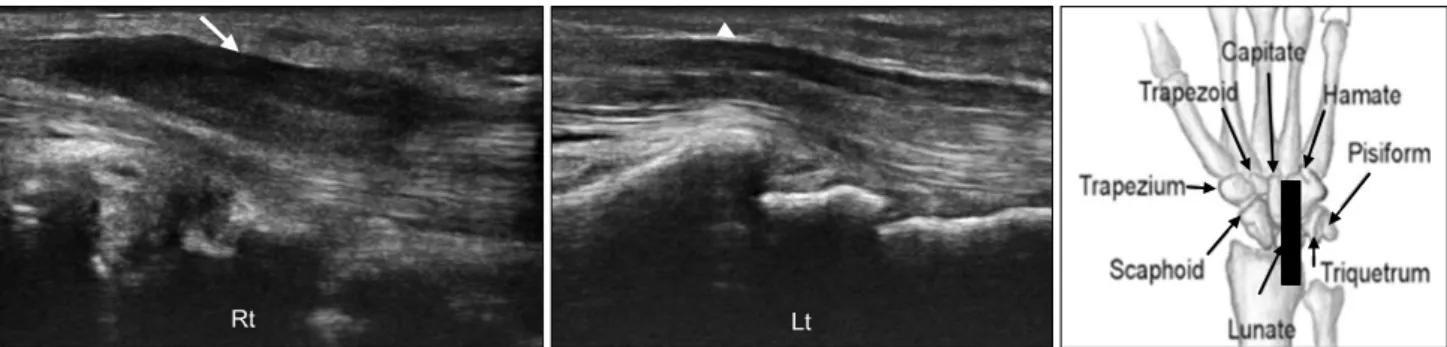
Fig. 2. Comparison between right and left longitudinal wrist ultrasonographic findings. The right arrow indicates abnormal FDS muscle belly and the left arrowhead indicates median nerve.

Fig. 1. Comparison between right and left transverse wrist ultrasonographic findings. The right arrow indicates abnormal FDS muscle belly and right arrowhead does median nerve. The left arrow indicates flexor retinaculum.

Table 1. Findings of Electrodiagnostic Study

Sensory nerve conduction study Motor nerve conduction study Onset latency

(ms)

Peak latency (ms)

Amplitude (μV)

Latency (ms)

Amplitude (mV)

Velocity (m/s) Left median nerve

2

nd

finger Wrist 2.5 3.2 66.1 3.4 6.0 52

3

rd

finger Palm 1.1 1.6 39.6 Transcarpal latency = 1.5

Wrist 2.6 3.1 39.3

Right median nerve

2

nd

finger Wrist 2.5 3.3 31.3 3.4 8.1 53

3

rd

finger Palm 0.9 1.4 30.9 Transcarpal latency = 2.0

Wrist 2.9 3.4 31.0

nerve compared to left (Table 1). Needle electromyography revealed no abnormal spontaneous activities in the abductor pollicis brevis and other muscles innervated by median nerve.

And then, under suspicion of CTS, the ultrasonographic examination was performed with the GE Voluson i ultra- sound machine (GE Healthcare Technologies, Milwaukee,

WI, USA). The image showed no carpal tunnel retinac-

ulum’s swelling and low-echo, the typical manifestations of

CTS, but sensed low attenuation around FDS at the wrist

around carpal tunnel, which was suspected to be hyper-

trophic compared to the left one (Fig. 1, 2). When compar-

ing both sides with the ultrasonographic transverse view in

proximal carpal tunnel inlet, it showed that the cross sec-

(3)

장찬웅ㆍ김형섭: 비정상 천지굴근으로 인해 발생한 수근관 증후군에서 보튤리늄 주사를 이용한 치료

CLINICAL PAIN 97 Fig. 4. Comparison of right longitudinal wrist ultrasonographic findings between before and after Botulinum toxin A injection. The arrow indicates abnormal FDS muscle belly and the arrowhead does decreased and atrophic muscle belly before and after injection respectably.

Fig. 3. Comparison of right transverse wrist ultrasonographic findings between before and after Botulinum toxin A injection. The cross sectional area (CSA) of right carpal tunnel before the injection was 1.81 cm

2

, but after the injection, the CSA of right carpal tunnel decreased to 1.51 cm

2

. In addition, the CSA of median nerve after injection was 0.11 cm

2

, but the CSA of median nerve decreased to 0.09 cm

2

after injection. The arrow indicates abnormal FDS muscle belly and the arrowhead does decreased and atrophic muscle belly. UA: Ulnar Artery, L: Lunate, S: Scaphoid.

tional area (CSA) of right carpal tunnel and median nerve were 1.81 cm

2

and 0.11 cm

2

respectively (Fig. 3). And it also revealed that the CSA of left carpal tunnel and median nerve were 1.42 cm

2

and 0.07 cm

2

respectively. Inclusively, the patient was diagnosed with CTS associated with anom- alous FDS.

For 3 weeks, she had applied pain medications but the symptoms were not improved. After that, the patient re- ceived an intramuscular injection of Botulinum toxin A 30 IU (Botox

, Allergan Inc., California, USA), mixed with 1 cc of normal saline, in the accessory FDS muscle using ultrasonography guidance. The procedure was done by K.H.S. who has more than 8-year experience in muscu- loskeletal ultrasonography. The symptoms were signifi- cantly improved after 2 weeks without any side effects.

Furthermore, the mass of accessory FDS muscle was de- creased and atrophied in follow-up ultrasonography, which was taken 2 weeks after injection, showing that cross sec-

tional area (CSA) of the right carpal tunnel and median nerve were 1.51 cm

2

and 0.09 cm

2

respectively, and the symptoms were improved (Fig. 3, 4).

DISCUSSION

The trigger finger is a disease in which there are in- flammation and thickening of pulleys, leading to tendon nodule formation restricting the motion of the flexor tendon.

3

Moreover the trigger finger at wrist, or trigger wrist, may be caused by space-occupying lesions such as fibroma, lipoma,

4

anomalous muscle belly of the FDS or flexor digitorum profundus, etc.

1,5

While the trigger finger occurs in a digit including the thumb, trigger finger at wrist occurs in all digits excluding the thumb and is mostly ac- companied by CTS.

6

Secondarily occurred CTS can be diagnosed by ultra-

sonography and magnetic resonance imaging.

7,8

In this

(4)

VOL. 16, NO. 2, 2017

CLINICAL PAIN 98

case, the muscle belly of FDS showed low attenuation at the carpal tunnel on ultrasonography without tenosynovial swelling and also active contraction was observed along with muscle movement.

9

On ultrasonographic scan per- formed on both proximal carpal tunnels located proximally from the scaphoid bone and the pisiform bone, low attenu- ation was more conspicuous around the 2nd digital flexor tendon in the right hand, which showed that FDS had been abnormally inserted into the carpal tunnel.

In the case of space occupying lesions, the treatment of choice is usually surgical removal of muscle mass or tumor with carpal tunnel release.

2

After Richard J. Smith first re- ported in 1971, several case reports about surgical decom- pression have been documented. In such cases, the FDS muscle belly within the palm was completely excised and the symptoms were immediately relieved.

However, in our case, we tried to reduce the com- pression of carpal tunnel by Botulinum toxin A injection directly into anomalous muscle. Botulinum toxin A is a pa- ralytic neurotoxin that inhibits the release of acetylcholine at the neuromuscular junction, leading to muscle atrophy.

10

Through this effect, we expected to reduce the entrapment of median nerve and improve the symptoms. As hypothe- sized, the FDS muscle was atrophied, as we could see in ultrasonography, and our patient’s symptoms showed dras- tic improvement after injection. One disappointing thing is that we failed to do follow-up electrodiagnostic study and check for improvements.

Evidence for efficacy from a single case report has sev- eral limitations. First, the superiority of Botulinum toxin A injection compared to conventional treatments, such as sur- gical decompression, has not been studied. Second, the du- ration of effect remains uncertain. It is known that the ef- fect of Botulinum toxin A usually persists for 6 months and generally re-injection is needed. But in our case, the patient did not complain of symptoms since then. Third, more thorough analysis of potential side effects of Botulinum toxin A injection should be conducted. Injection into unin- tended muscles may lead to paralysis or atrophy of the wrong muscle. Additionally, allergic reactions, headaches, nausea, and vomiting can be associated with the injection.

If similar cases congregate in the future, it is helpful to clarify the effectiveness of Botulinium toxin A injection in- to anomalous muscles in the nerve entrapment syndrome.

In conclusion, Botulinum toxin A injection as part of the management of trigger finger at wrist level associated CTS caused by anomalous FDS could be considered as one of the beneficial treatment choices. 

REFERENCES

1. Aghasi M, Rzetelny V, Axer A. The flexor digitorum su- perficialis as a cause of bilateral carpal-tunnel syndrome and trigger wrist. A case report. JBJS 1980; 62: 134-135 2. Bakriga B, Amouzou SK, Ayouba G, Kombate N, Dellanh

Y, Walla A, et al. Anomalous Muscles, A Rare Cause of Carpal Tunnel Syndrome: A Case Report. International Journal of Orthopaedics 2017; 4: 705-707

3. Hueston J, Wilson W. The aetiology of trigger finger:

Explained on the basis of intratendinous architecture. The Hand 1972; 4: 257-260

4. Sonoda H, Takasita M, Taira H, Higashi T, Tsumura H.

Carpal tunnel syndrome and trigger wrist caused by a lip- oma arising from flexor tenosynovium: a case report. The Journal of hand surgery 2002; 27: 1056-1058

5. Kernohan J, Benjamin A, Simpson D. Trigger wrist due to anomalous flexor digitorumprofundus muscle in association with fibroma of tendon sheath. The Hand 1982; 14: 59-60 6. Carneiro R, Velasquez L, Tietzman A. Trigger wrist caused

by a tumor of the tendon sheath in a teenager. American journal of orthopedics (Belle Mead, NJ) 2001; 30: 233 7. Beekman R, Visser LH. Sonography in the diagnosis of

carpal tunnel syndrome: a critical review of the literature.

Muscle & nerve 2003; 27: 26-33

8. Mesgarzadeh M, Triolo J, Schneck C. Carpal tunnel syndrome. MR imaging diagnosis. Magnetic resonance imaging clinics of North America 1995; 3: 249-264 9. Kim JH, Kim JS. Statistical methods used in the Journal

of Korean Academy of Rehabilitation Medicine. Journal of Korean Academy of Rehabilitation Medicine 1998; 22:

46-55

10. Rosales RL, Arimura K, Takenaga S, Osame M. Extrafusal

and intrafusal muscle effects in experimental botulinum

toxin‐A injection. Muscle & nerve 1996; 19: 488-496

수치

Table  1.  Findings  of  Electrodiagnostic  Study
Fig.  3.  Comparison  of  right  transverse  wrist  ultrasonographic  findings  between  before  and  after  Botulinum  toxin  A  injection

참조

관련 문서

Modern Physics for Scientists and Engineers International Edition,

Secondly, M&A of non-chaebol and chaebol showed low improvement in profitability, output growth and productivity during the period before the

The indication of the viscosity range for a multigrade oil (e.g. 10W-40) specifies the oil performance at high and low

그것은 이미지를 문자적 으로 서술하는 문제이며 옐름슬레브Hjelmslev[4]의 용어를 쓰자면 (코노테 이션과 반대되는 의미로서) 공정작용operation의

웹 표준을 지원하는 플랫폼에서 큰 수정없이 실행 가능함 패키징을 통해 다양한 기기를 위한 앱을 작성할 수 있음 네이티브 앱과

(in case of partially miscible and form a low-boiling azeotrope).

 Performed by multiplying the spectrum by a low-pass filter and then applying the inverse transform to obtain the

The key issue is whether HTS can be defined as the 6th generation of violent extremism. That is, whether it will first safely settle as a locally embedded group