http://dx.doi.org/10.5534/wjmh.2014.32.3.145
Original Article
Received: Oct 10, 2014; Revised: Oct 15, 2014; Accepted: Oct 18, 2014 Correspondence to: Hyun Jun Park
Department of Urology, Pusan National University School of Medicine, 179 Gudeok-ro, Seo-gu, Busan 602-739, Korea.
Tel: +82-51-240-7347, Fax: +82-51-247-5443, E-mail: [email protected]
*Do Hoon Kong and Nam Cheol Park contributed equally to this study.
Copyright © 2014 Korean Society for Sexual Medicine and Andrology
This is an Open Access article distributed under the terms of the Creative Commons Attribution Non-Commercial License (http://creativecommons.
org/licenses/by-nc/3.0) which permits unrestricted non-commercial use, distribution, and reproduction in any medium, provided the original work is properly cited.
The Efficacy of Mirodenafil for Chronic Prostatitis/Chronic Pelvic Pain Syndrome in Middle-Aged Males
Do Hoon Kong*, Chang Jin Yun, Hyun Jun Park, Nam Cheol Park*
Department of Urology, Pusan National University School of Medicine, Busan, Korea
Purpose: The aim of this study was to investigate the efficacy of mirodenafil in middle-aged male patients with chronic prostatitis/chronic pelvic pain syndrome (CP/CPPS).
Materials and Methods: Eighty-eight males with CP/CPPS were randomized to receive either levofloxacin (500 mg/d) (group L, 40 patients) or levofloxacin (500 mg/d) and mirodenafil (50 mg/d) (group ML, 48 patients) for six weeks. The International Prostate Symptom Score (IPSS), National Institutes of Health Chronic Prostatitis Symptom Index (NIH-CPSI), and erectile function (EF) domain scores of the International Index of Erectile Function (IIEF) questionnaire were used to grade symptoms at baseline and 6 weeks after treatment.
Results: The mean change in total IPSS from baseline was higher in group ML than that in group L (group L, −1.1 vs. group ML,
−4.3; p<0.05). Significant improvements were also seen in the IPSS voiding subscore (group L, −0.7 vs. group ML, −3.0; p
<0.05). Changes observed in the NIH-CPSI of group ML at six weeks were greater than those at baseline (group L, −3.2 vs. group ML, −7.2; p<0.05). Significant improvements were seen in the NIH-CPSI voiding (group L, −0.5 vs. group ML, −1.7; p<0.05) and quality of life domains (group L, −1.0 vs. group ML, −1.8; p<0.05). Group ML showed a significantly greater increase in the IIEF-EF score than did group ML (group L, +0.2 vs. group ML, +7.8; p<0.05).
Conclusions: Mirodenafil (50 mg once daily) was well tolerated and resulted in significant symptomatic improvement in middle-aged males with CP/CPPS.
Key Words: Chronic prostatitis with chronic pelvic pain syndrome; Erectile dysfunction; Phosphodiesterase 5 inhibitors;
Treatment outcome
INTRODUCTION
The United States National Institutes of Health (NIH) International Collaborative Prostatitis Network developed a prostatitis classification system in 1995. The most com-
mon type of prostatitis is category III, or chronic prostatitis.
The definition of chronic prostatitis/chronic pelvic pain syndrome (CP/CPPS) includes genitourinary pain with or without voiding symptoms in the absence of uropatho- genic bacteria, as detected by standard microbiological
methods, or another identifiable cause such as malig- nancy [1]. CP/CPPS is a highly prevalent condition affect- ing males of a wide age range, but its etiology remains unclear. Lifetime CP/CPPS prevalence is 2% to 10% [2].
Many etiologies and mechanisms for CP/CPPS patho- genesis have been proposed, including infection, de- trusor-sphincter dysfunction, immunological dysfunction, interstitial cystitis, and neuropathic pain [3]. The efficacy of various medical therapies, such as antibiotics, al- pha-adrenergic blockers, anti-inflammatory agents, hor- monal therapies, and phytotherapies, has been evaluated in clinical studies of CPPS [2,4,5]. However, evidence is lacking or conflicting [6]. Among these therapies, al- pha-adrenergic antagonists provide symptomatic relief for some patients with CP/CPPS. The mechanism by which al- pha-blockers relieve lower urinary tract symptoms (LUTS) in patients with CP/CPPS involves smooth muscle relaxa- tion of the bladder neck and prostate due to alpha-adrener- gic blockade, leading to increased urinary flow and de- creased urinary retention [7]. Both nitric oxide synthase and phosphodiesterase-5 (PDE-5) are present in human prostatic tissue. Many studies have shown that PDE-5 in- hibitors improve LUTS through several mechanisms.
Urinary reflux into prostatic ducts has been suggested as a mechanism of CP [8]. The results of nitric oxide donors and PDE-5 inhibitors in in vitro studies indicate that PDE-5 inhibitors relax prostatic smooth muscle, which increases the washout of prostatic reflux products and reduces pro- static inflammation and consequent prostatitis symptoms [8,9]. We postulate that mirodenafil, a newly developed PDE-5 inhibitor, may relieve prostatitis symptoms.
MATERIALS AND METHODS
1. Study design
Eighty-eight males with CP/CPPS were randomized in a single-blind fashion to receive either levofloxacin (500 mg once daily, group L, 40 patients) or levofloxacin (500 mg once daily) and mirodenafil (50 mg once daily, group ML, 48 patients) for six weeks. Approval for this study was ob- tained from the Institutional Review Board of Pusan National University Hospital.
2. Subjects
The diagnostic evaluation of CP/CPPS included a de- tailed history and physical examination, transrectal ultra- sonography, urine flow measurements, residual urine vol- ume measurements, standard microbiological cultures, and a urinalysis. Expressed prostatic secretions were ana- lyzed if available. Patients included in the study fulfilled the requirements for NIH category III CP/CPPS [1].
Exclusion criteria included symptoms for <three months, proven urinary tract infection, invasive prostate-related procedures (transurethral resection of the prostate, tran- surethral incision of the prostate, or transurethral needle ablation), LUTS without significant pain, significant signs and symptoms of obstructive voiding, or prostate vol- ume of >50 cm3.
3. Outcome measurements
The International Prostate Symptom Score (IPSS), NIH Chronic Prostatitis Symptom Index (NIH-CPSI), and erec- tile function (EF) domain scores of the International Index of Erectile Function (IIEF) questionnaire were used to grade symptoms at baseline and after six weeks of treatment.
4. Statistical analysis
All variables were compared between the groups at the end of the six-week treatment arm. Data are presented as means±standard deviations. The baseline characteristics of the two groups were assessed using the Mann-Whitney U test. Changes from baseline within each group were as- sessed using repeated-measures analysis of variance (ANOVA). Two-way ANOVA was performed to evaluate the interaction between levofloxacin and mirodenafil.
Statistical analyses were performed using SPSS for Windows version 15.0 (SPSS Inc., Chicago, IL, USA). A value of p<0.05 was considered statistically significant.
RESULTS
The mean ages of the two groups were 44.2±6.9 and 45.3±7.0 years, respectively. No differences were ob- served between groups L and ML in terms of age, prostate volume, prostate-specific antigen level, maximum urinary
Table 1. Baseline characteristics
Patient characteristic Group L
(n=40) Group ML (n=48)
Age (yr) 44.2±6.9 45.3±7.0
Prostate volume (cm3) 33.0±5.4 34.0±5.5 Prostate-specific antigen (ng/mL) 1.2±0.5 1.4±0.7 Maximum urinary flow rate (mL/s) 14.0±4.2 15.0±5.1 Residual urine volume (mL) 20.0±6.4 21.0±6.1 Symptom duration (mo) 19.2±3.9 21.5±4.5 Values are presented as mean±standard deviation.
Group L: levofloxacin group, Group ML: mirodenafil+
levofloxacin group.
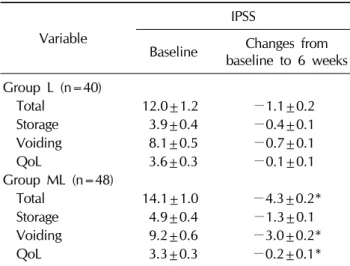
Table 2. Changes in the IPSS from baseline to 6 weeks
Variable
IPSS
Baseline Changes from baseline to 6 weeks Group L (n=40)
Total 12.0±1.2 −1.1±0.2
Storage 3.9±0.4 −0.4±0.1
Voiding 8.1±0.5 −0.7±0.1
QoL 3.6±0.3 −0.1±0.1
Group ML (n=48)
Total 14.1±1.0 −4.3±0.2*
Storage 4.9±0.4 −1.3±0.1
Voiding 9.2±0.6 −3.0±0.2*
QoL 3.3±0.3 −0.2±0.1*
Values are presented as mean±standard deviation.
IPSS: International Prostate Symptom Score, QoL: quality of life, Group L: levofloxacin group, Group ML: mirodenafil+
levofloxacin group.
*Significant difference compared to group L (p<0.05).
Table 3.Changes in the NIH-CPSI from baseline to 6 weeks
Variable
NIH-CPSI
Baseline Changes from baseline to 6 weeks Group L (n=40)
Total 22.1±1.5 −3.2±0.2
Pain 10.5±0.5 −1.7±0.1
Urinary 4.2±0.4 −0.5±0.2
QoL 7.4±0.5 −1.0±0.2
Group ML (n=48)
Total 19.5±1.6 −7.2±0.1*
Pain 7.9±0.4 −3.7±0.1
Urinary 4.4±0.5 −1.7±0.1*
QoL 7.2±0.5 −1.8±0.1*
Values are presented as mean±standard deviation.
NIH-CPSI: NIH-Chronic Prostatitis Symptom Index, QoL:
quality of life, Group L: levofloxacin group, Group ML:
mirodenafil+levofloxacin group.
*Significant difference compared to group L (p<0.05).
Table 4. Changes in the IIEF-EF from baseline to six weeks
Variable
IIEF-EF
Baseline Changes from baseline to 6 weeks Group L (n=40), total 18.8±6.2 0.2±2.4 Group ML (n=48), total 18.2±6.0 7.8±1.8*
Values are presented as mean±standard deviation.
IIEF-EF: International Index of Erectile Function-Erectile Function, Group L: levofloxacin group, Group ML:
mirodenafil+levofloxacin group.
*Significant difference compared to group L (p<0.05).
flow rate, residual urine volume, or symptom duration.
The IPSS, NIH-CPSI, and IIEF-EF domain scores were the same in both groups at baseline (Table 1). Mirodenafil sig- nificantly improved the mean change in IPSS from base- line at six weeks (group L, −1.1 vs. group ML, −4.3; p
<0.05) (Table 2). Significant improvements were also seen in the IPSS voiding subscore (group L, −0.7 vs. group ML, −3.0; p<0.05). Changes from baseline in the NIH-CPSI at six weeks observed in group ML were greater than those in group L (group L, −3.2 vs. group ML, −7.2;
p<0.05). Significant improvements were also seen in the NIH-CPSI voiding score (group L, −0.5 vs. group ML,
−1.7; p<0.05) and the quality of life (QoL) domains
(group L, −1.0 vs. group ML, −1.8; p<0.05) (Table 3).
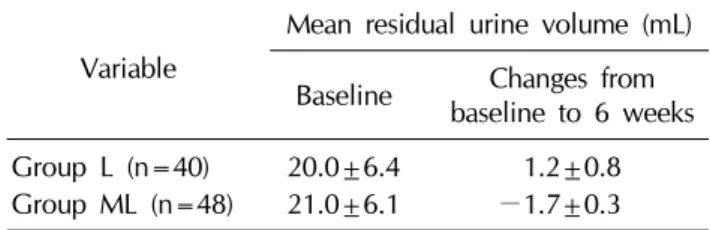
Group ML showed a significantly greater increase in the IIEF-EF score than group L (group L, +0.2 vs. group ML, +7.8; p<0.05) (Table 4). No significant change from baseline to the end of treatment and no significant differ- ence in maximum urinary flow rate or mean residual urine volume were observed between the two groups (Table 5, 6). No significant levofloxacin-mirodenafil interaction was detected. Commonly reported (≥1 case) adverse treatment events in group ML were frequent erections, dyspepsia, and headache (each, ≤2 cases); however, no patient discontinued treatment due to adverse events.
Table 6. Changes in mean residual urine volume pre- and post-treatment from baseline to 6 weeks
Variable
Mean residual urine volume (mL) Baseline Changes from
baseline to 6 weeks Group L (n=40) 20.0±6.4 1.2±0.8 Group ML (n=48) 21.0±6.1 −1.7±0.3 Values are presented as mean±standard deviation.
Group L: levofloxacin group, Group ML: mirodenafil+
levofloxacin group.
Table 5. Changes in mean maximum urinary flow rate pre- and post-treatment from baseline to six weeks
Variable
Mean maximum urinary flow rate (mL/s) Baseline Changes from
baseline to 6 weeks
Group L (n=40) 14.0±4.2 1.1±2.1
Group ML (n=48) 15.0±5.1 −0.7±0.3 Values are presented as mean±standard deviation.
Group L: levofloxacin group, Group ML: mirodenafil+
levofloxacin group.
DISCUSSION
The most recent NIH classification of prostatitis adopted in 1995 includes several clinical entities, such as acute and chronic bacterial infections, CPPS, and asymptomatic inflammation of the prostate. The most common type of prostatitis is category III, also known as CP. The current NIH definition of CP/CPPS includes genitourinary pain with or without voiding symptoms in the absence of ur- opathogenic bacteria, as detected by standard micro- biological methods, or another identifiable cause such as malignancy [1,4]. The efficacy of various medical thera- pies, such as antibiotics, alpha-adrenergic blockers, an- ti-inflammatory agents, hormonal therapies, and phyto- therapies, has been evaluated clinically [2,4,5]. However, evidence is lacking or conflicting [6]. Several reports have suggested that PDE-5 inhibitors improve LUTS. Chung et al [10] showed that a PDE-5 inhibitor improved IPSS and IIEF scores as well as Qmax compared with placebo. LUTS is one of the main symptoms in patients with CP/CPPS.
The mechanism includes expression and wide dis- tribution of nitric oxide/cyclic guanosine monophos- phate/PDE-5 pathway components in the human lower urinary tract and supports involvement of this pathway. In particular, PDE-5 inhibitors regulate smooth muscle activ- ity in these organs. Increased smooth muscle tension plays a central role in LUTS pathophysiology, and very com- monly prescribed medications, such as alpha-adrenergic blockers and antimuscarinics, relax smooth muscle in ei- ther the prostate or the bladder [11]. We speculated that mirodenafil would improve CP/CPPS symptoms. Our re- sults show that a six-week mirodenafil treatment sig- nificantly improved total and voiding volumes, as well as
QoL on the IPSS. These findings are consistent with results from previous studies revealing the effect of mirodenafil on LUTS [10,12,13]. However, to the best of our knowl- edge, thus far, no study has evaluated the efficacy of PDE-5 inhibitors in patients with CP/CPPS, and there has been no controlled human clinical study on the effect of PDE-5 in- hibitors in patients with CP/CPPS. Thus, our study is the first human trial to evaluate the therapeutic effects of a PDE-5 inhibitor on CP/CPPS. In this study, mirodenafil sig- nificantly improved the total, urinary, and QoL domains, but no change in the pain scale was detected. Thus, we concluded that the effect of mirodenafil on CP/CPPS main- ly depended on the improvement in LUTS, because LUTS is the main symptom in patients with CP/CPPS.
Mirodenafil is a newly developed pyrrolopyrimidinone compound and a potent selective oral PDE-5 inhibitor [14,15]. Mirodenafil was launched in Korea in 2007, and an orally disintegrating mirodenafil film was developed in 2011 for patients who have difficulty swallowing tablets [16]. The Tmax and T1/2 values of mirodenafil are 1.25 hours and 2.5 hours, respectively [17]. Preclinical studies have revealed that the selectivity of mirodenafil to PDE-5 is 10-fold higher than that of sildenafil, whereas the in- hibitory effects of mirodenafil on other PDEs are lower than those of sildenafil [18]. One study showed that mir- odenafil significantly improves erectile dysfunction (ED) and is well tolerated in a representative population of Korean males with broad-spectrum ED of various etiol- ogies and severities [14].
In our study, mirodenafil significantly increased the IIEF-EF domain by 7.8±1.8; however, no changes in max- imal urinary flow rate or mean residual urine volume were observed. These findings are consistent with those of Lee
et al [12]. However, two studies reported improvements in Qmax after mirodenafil treatment [10,13]. This incon- sistency in the effect of mirodenafil on urinary flow rate is similar to that of other PDE-5 inhibitors, such as tadalafil [18]. The variable urinary flow rate results after treatment with a PDE-5 inhibitor may be due to the diverse baseline characteristics of the enrolled patients.
Several limitations of this study should be noted.
Although we identified significant improvements in IPSS and NIH-CPSI after mirodenafil treatment, we found no change in pain or storage symptoms. Further studies to as- sess these parameters will enhance our understanding of the mechanism of action of mirodenafil in patients with CP/CPPS. In addition, the number of patients and the treat- ment duration were insufficient to elucidate the effects of mirodenafil on CP/CPPS. Finally, this study was not dou- ble blinded, and no placebo treatment arm was included.
CONCLUSIONS
Although mirodenafil did not improve all CP/CPPS do- mains, a six-week treatment of mirodenafil (50 mg) once daily was well tolerated by and resulted in significant symptomatic improvement in middle-aged males with CP/CPPS. This result indicates that mirodenafil may be a useful agent for the treatment of CP/CPPS as monotherapy or combination therapy with other empirical drugs. Future studies to establish the mechanism and effect of treatment are needed.
ACKNOWLEDGEMENTS
This study was supported by Pusan National University Hospital Clinical Research Grants (2014).
REFERENCES
1. Krieger JN, Nyberg L Jr, Nickel JC. NIH consensus defi- nition and classification of prostatitis. JAMA 1999;282:
236-7.
2. Strauss AC, Dimitrakov JD. New treatments for chronic prostatitis/chronic pelvic pain syndrome. Nat Rev Urol 2010;7:127-35.
3. Issa W, Roumeguere T, Bossche MV. Chronic pelvic pain syndrome. Rev Med Brux 2013;34:29-37.
4. Pontari MA, Ruggieri MR. Mechanisms in prostatitis/chronic pelvic pain syndrome. J Urol 2004;172:839-45.
5. Nickel JC. Prostatitis and related conditions, orchitis, and epididymitis. In: Wein AJ, Kavoussi LR, Novick AC, Partin AW, Peters CA, editors. Campbell-Walsh urology. 10th ed.
Philadelphia: Saunders; 2012;327-71.
6. Pontari M, Giusto L. New developments in the diagnosis and treatment of chronic prostatitis/chronic pelvic pain syndrome. Curr Opin Urol 2013;23:565-9.
7. Nickel JC, Narayan P, McKay J, Doyle C. Treatment of chronic prostatitis/chronic pelvic pain syndrome with tam- sulosin: a randomized double blind trial. J Urol 2004;171:
1594-7.
8. Kirby RS, Lowe D, Bultitude MI, Shuttleworth KE. Intra-pro- static urinary reflux: an aetiological factor in abacterial prostatitis. Br J Urol 1982;54:729-31.
9. Burnett AL, Maguire MP, Chamness SL, Ricker DD, Takeda M, Lepor H, et al. Characterization and localization of nitric oxide synthase in the human prostate. Urology 1995;45:
435-9.
10. Chung JH, Kang DH, Oh CY, Chung JM, Lee KS, Kim TH, et al. Safety and efficacy of once daily administration of 50 mg mirodenafil in patients with erectile dysfunction: a multi- center, double-blind, placebo controlled trial. J Urol 2013;
189:1006-13.
11. Giannitsas K, Mitropoulos D, Konstantinopoulos A, Athanasopoulos A, Perimenis P. Phosphodiesterase-5 in- hibitors in the treatment of lower urinary tract symptoms and benign prostatic hyperplasia. Expert Opin Pharmaco- ther 2008;9:1687-93.
12. Lee JY, Cho SY, Oh CY, Ha US, Lee SH, Park SY, et al.
Efficacy and safety of combination therapy with mirodenafil and α1-blocker for benign prostatic hyperplasia-induced lower urinary tract symptoms accompanied by erectile dys- function: a multicenter, open-label, prospective study. Int J Impot Res 2011;23:249-56.
13. Bang WJ, Oh CY, Yoo C, Cho JS, Yang DY, Lee DH, et al.
Efficacy and safety of the simultaneous administration of mirodenafil and an α-blocker in men with BPH-LUTS: a multicenter open-label prospective study. Int J Impot Res 2013;25:149-54.
14. Park HJ, Moon KH, Lee SW, Lee WK, Kam SC, Lee JH, et al.
Mirodenafil for the treatment of erectile dysfunction: a sys- tematic review of the literature. World J Mens Health 2014;
32:18-27.
15. Paick JS, Ahn TY, Choi HK, Chung WS, Kim JJ, Kim SC, et al. Efficacy and safety of mirodenafil, a new oral phospho- diesterase type 5 inhibitor, for treatment of erectile dysfunc- tion. J Sex Med 2008;5:2672-80.
16. Paick JS, Choi HK, Kim SC, Ahn TY, Kim JJ, Park JK, et al.
Efficacy and safety of oral SK3530 for the treatment of erec- tile dysfunction in Korean men: a multicenter, randomized, double-blind, placebo-controlled, fixed dose, parallel group clinical trial. Asian J Androl 2008;10:791-8.
17. Lee J, Yoo HH, Rhim KJ, Sohn DR, Kim DH. Metabolism
and excretion of 5-ethyl-2-{5-[4-(2-hydroxyethyl)piperazine- 1-sulfonyl]-2-propoxyphenyl}-7-propyl-3,5-dihydropyrrolo [3,2-d]-pyrimidin-4-one (SK3530) in rats. Rapid Commun Mass Spectrom 2007;21:1139-49.
18. Lee SW, Paick JS, Park HJ, Won JE, Morisaki Y, Sorsaburu S,
et al. The efficacy and safety of tadalafil 5 mg once daily in Korean men with lower urinary tract symptoms suggestive of benign prostatic hyperplasia: an integrated analysis.
World J Mens Health 2014;32:28-35.