79 Received:March 29, 2016, Revised:April 14, 2016, Accepted:April 14, 2016
Corresponding to:Wan-Hee Yoo, Division of Rheumatology, Department of Internal Medicine, Research Institute of Clinical Medicine of Chonbuk National University-Biomedical Research Institute of Chonbuk National University Hospital, 20 Geonji-ro, Deokjin-gu, Jeonju 54907, Korea. E-mail:[email protected]
pISSN: 2093-940X, eISSN: 2233-4718
Copyright ⓒ 2016 by The Korean College of Rheumatology. All rights reserved.
This is a Free Access article, which permits unrestricted non-commerical use, distribution, and reproduction in any medium, provided the original work is properly cited.
Editorial
Journal of Rheumatic Diseases Vol. 23, No. 2, April, 2016 http://dx.doi.org/10.4078/jrd.2016.23.2.79
Effect of Tocilizumab on Serum Hepcidin and Anemia Response in Patients with Rheumatoid Arthritis
Won-Seok Lee, Wan-Hee Yoo
Division of Rheumatology, Department of Internal Medicine, Chonbuk National University Medical School, Jeonju, Korea
Many chronic inflammatory rheumatic diseases are complicated by hematologic abnormalities. Anemia is one of the most common hematologic abnormalities in patients with rheumatologic diseases; it is the most com- mon extra-articular manifestation of rheumatoid arthritis (RA) and was estimated to occur in 30% to 70% of pa- tients in various studies [1,2]. However, the importance of anemia in patients with RA is frequently underestimated.
There are two primary types of anemia in patients with RA: anemia of chronic disease (ACD) and iron deficiency anemia [3,4].
ACD is characterized by hypoferremia in the presence of adequate iron stores; however, the pathogenesis of ACD is not clear. Two major factors appear to be important:
trapping of iron in macrophages, making it relatively un- available for new hemoglobin synthesis; and inability of the morphologically normal marrow to increase eryth- ropoiesis in response to the anemia [5]. Proinflammatory cytokines, including tumor necrosis factor (TNF)-α, in- terleukin (IL)-1, IL-6, IL-10, and interferon γ, play im- portant roles in RA-associated anemia and are likely to act directly on red cell precursors in the bone marrow [5].
Therefore, the treatment of RA with inhibitors of in- flammatory cytokines has significant therapeutic im- plications for the treatment of anemia in the context of in- flammation and abnormal iron metabolism.
In a previous issue of The Journal of Rheumatic Disease, Park et al. [6] described the activity of tocilizumab, a humanized monoclonal antibody against the IL-6 re- ceptor, in diminishing the level of inflammatory anemia by inhibiting hepcidin production in Korean patients with
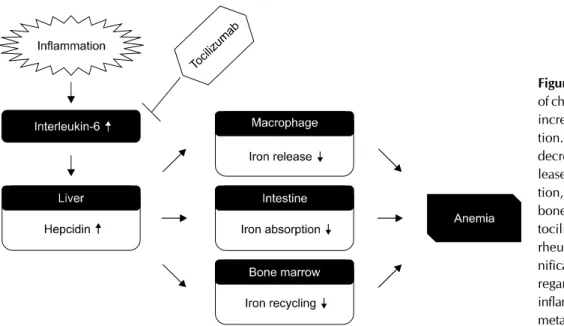
RA. Hepcidin (hepatic bacterial protein) is an acute phase reactant that is produced in the liver and in im- munocompetent cells. It was initially identified as a uri- nary antimicrobial peptide. Further studies showed that hepcidin is a master regulator of iron homeostasis in hu- mans and in other mammals [7]. It inhibits iron absorp- tion in the small intestine and the release of recycled iron from macrophages, effectively decreasing iron delivery to maturing erythrocytes in the bone marrow (Figure 1) [8].
Hepcidin is abnormally high, such as during inflam- mation, and thus serum iron levels fall due to iron trap- ping within macrophages and liver cells, and due to de- creased absorption of iron in the gut [9]. Inflammation and infection increase hepcidin synthesis. Macrophages are stimulated during the inflammatory process; the stimulation depends on the severity of the inflammation.
Activated macrophages release a network of cytokines. Of these, IL-6 is an attractive target as a mediator of ACD be- cause its production is increased in patients with RA.
In fact, Song et al. [10] demonstrated that tocilizumab inhibited IL-6-induced hepcidin expression in hep- atoma-derived cell lines, and it ameliorated ACD by in- hibiting hepcidin production in Castleman’s disease.
Likewise, tocilizumab plays the same role in RA-asso- ciated ACD. In animals, administration of tocilizumab to monkeys with collagen-induced arthritis rapidly im- proved anemia and induced a rapid but transient reduc- tion in serum hepcidin. Hepcidin mRNA expression was more potently induced by serum from arthritic monkeys, and this was inhibited by administering tocilizumab [11].
Recent human studies showed that an increase in serum
Won-Seok Lee and Wan-Hee Yoo
80 J Rheum Dis Vol. 23, No. 2, April, 2016
Figure 1. Hepcidin and anemia of chronic disease. Inflammation increases interleukin-6 produc- tion. The increase in hepcidin decreases macrophage iron re- lease, intestinal iron absorp- tion, and iron recycling in the bone marrow. Administering tocilizumab in a patient with rheumatoid arthritis has sig- nificant therapeutic implications regarding ameliorating anemia, inflammation, and abnormal iron metabolism.
hepcidin in patients with active RA was associated with an elevated level of serum IL-6 [12-14]. It has been re- ported that TNF-α blockers also improved anemia in pa- tients with RA [15]. Moreover, the administration of a TNF-α blocker quickly reduced serum IL-6 levels in pa- tients with RA [16]. However, TNF-α does not induce expression of hepcidin mRNA in liver cells [17].
Therefore, these data suggest that improvement of ane- mia by administering a TNF-α blocker occurs indirectly via the suppression of IL-6 production. However, the pathogenesis of RA-associated anemia is complex and multifactorial. Sometimes RA-associated anemia is caused by gastrointestinal blood loss associated with the use of non-steroidal anti-inflammatory drugs or by bone marrow suppression associated with the use of other im- munosuppressants, such as methotrexate. Another prob- lem is the fluctuation of diurnal hepcidin levels; hepcidin levels are lower in the morning and higher in the afternoon. In addition, assay sensitivity is related to the amount of iron introduced by the diet [9]. Therefore, a thorough study of patients with RA-associated anemia needs to be carried out in a large population-based pro- spective study, using meta-analysis to clarify the influ- ence of other therapies on the pathogenesis of RA.
In this respect, the evidence provided by Park and col- leagues [6] is of great significance to the design of future epidemiological and clinical studies.
CONFLICT OF INTEREST
No potential conflict of interest relevant to this article
was reported.
REFERENCES
1. Baer AN, Dessypris EN, Goldwasser E, Krantz SB. Blunted erythropoietin response to anaemia in rheumatoid ar- thritis. Br J Haematol 1987;66:559-64.
2. Hochberg MC, Arnold CM, Hogans BB, Spivak JL. Serum immunoreactive erythropoietin in rheumatoid arthritis: im- paired response to anemia. Arthritis Rheum 1988;31:
1318-21.
3. Vreugdenhil G, Wognum AW, van Eijk HG, Swaak AJ.
Anaemia in rheumatoid arthritis: the role of iron, vitamin B12, and folic acid deficiency, and erythropoietin res- ponsiveness. Ann Rheum Dis 1990;49:93-8.
4. Baer AN, Dessypris EN, Krantz SB. The pathogenesis of anemia in rheumatoid arthritis: a clinical and laboratory analysis. Semin Arthritis Rheum 1990;19:209-23.
5. Means RT Jr, Krantz SB. Progress in understanding the pathogenesis of the anemia of chronic disease. Blood 1992;80:1639-47.
6. Park KJ, Jin HM, Cho YN, Kang JH, Jung HJ, Kang JH, et al.
Clinical and hematological effects of tocilizumab on serum hepcidin, anemia response and disease activity in patients with active rheumatoid arthritis. J Rheum Dis 2016;23:
37-46
7. Ganz T. Hepcidin, a key regulator of iron metabolism and mediator of anemia of inflammation. Blood 2003;102:
783-8.
8. Rivera S, Nemeth E, Gabayan V, Lopez MA, Farshidi D, Ganz T. Synthetic hepcidin causes rapid dose-dependent hy- poferremia and is concentrated in ferroportin-containing organs. Blood 2005;106:2196-9.
9. D'Angelo G. Role of hepcidin in the pathophysiology and di- agnosis of anemia. Blood Res 2013;48:10-5.
10. Song SN, Tomosugi N, Kawabata H, Ishikawa T, Nishikawa T, Yoshizaki K. Down-regulation of hepcidin resulting from long-term treatment with an anti-IL-6 receptor antibody
Tocilizumab on Serum Hepcidin and Anemia Response in RA
www.jrd.or.kr 81
(tocilizumab) improves anemia of inflammation in multi- centric Castleman disease. Blood 2010;116:3627-34.
11. Hashizume M, Uchiyama Y, Horai N, Tomosugi N, Mihara M. Tocilizumab, a humanized anti-interleukin-6 receptor antibody, improved anemia in monkey arthritis by sup- pressing IL-6-induced hepcidin production. Rheumatol Int 2010;30:917-23.
12. Song SN, Iwahashi M, Tomosugi N, Uno K, Yamana J, Yamana S, et al. Comparative evaluation of the effects of treatment with tocilizumab and TNF-α inhibitors on se- rum hepcidin, anemia response and disease activity in rheu- matoid arthritis patients. Arthritis Res Ther 2013;15:R141.
13. Kim HR, Kim KW, Yoon SY, Kim SH, Lee SH. Serum pro-hepcidin could reflect disease activity in patients with rheumatoid arthritis. J Korean Med Sci 2010;25:348-52.
14. Demirag MD, Haznedaroglu S, Sancak B, Konca C, Gulbahar
O, Ozturk MA, et al. Circulating hepcidin in the crossroads of anemia and inflammation associated with rheumatoid arthritis. Intern Med 2009;48:421-6.
15. Davis D, Charles PJ, Potter A, Feldmann M, Maini RN, Elliott MJ. Anaemia of chronic disease in rheumatoid arthri- tis: in vivo effects of tumour necrosis factor alpha blockade.
Br J Rheumatol 1997;36:950-6.
16. Charles P, Elliott MJ, Davis D, Potter A, Kalden JR, Antoni C, et al. Regulation of cytokines, cytokine inhibitors, and acute-phase proteins following anti-TNF-alpha therapy in rheumatoid arthritis. J Immunol 1999;163:1521-8.
17. Constante M, Wang D, Raymond VA, Bilodeau M, Santos MM. Repression of repulsive guidance molecule C during inflammation is independent of Hfe and involves tumor ne- crosis factor-alpha. Am J Pathol 2007;170:497-504.