Received:October 11, 2017, Revised:December 8, 2017, Accepted:December 29, 2017 Corresponding to:Yeong Wook Song http://orcid.org/0000-0002-5384-3437
Division of Rheumatology, Department of Internal Medicine, Seoul National University Hospital, 101 Daehak-ro, Jongno-gu, Seoul 03080, Korea. E-mail:[email protected]
Copyright ⓒ 2018 by The Korean College of Rheumatology. All rights reserved.
This is a Open Access article, which permits unrestricted non-commerical use, distribution, and reproduction in any medium, provided the original work is properly cited.
Transaminase Changes in Korean Rheumatoid Arthritis Patients with Chronic Hepatitis C after Biologic Therapy
Hyun Mi Kwon1, Kichul Shin2, Jin Young Moon1, Shin-Seok Lee3, Won Tae Chung4, Jisoo Lee5, Sang-Heon Lee6, Seong-Wook Kang7, Chang Hee Suh8, Seung-Jae Hong9, Ran Song10, Jung-Yoon Choe11, Yeong Wook Song1,12
Division of Rheumatology, Department of Internal Medicine, 1Seoul National University Hospital, 2SMG-SNU Boramae Medical Center, Seoul,
3Chonnam National University Hospital, Gwangju, 4Dong-A University Hospital, Busan, 5Ewha Womans University Mokdong Hospital, 6Konkuk University Medical Center, Seoul, 7Chungnam National University Hospital, Daejeon, 8Ajou University Hospital, Suwon, 9Kyung Hee University Medical Center, 10Kyung Hee University Hospital at Gangdong, Seoul, 11Daegu Catholic University Medical Center, Daegu, 12Department of Molecular Medicine and Biopharmaceutical Sciences, Graduate School of Convergence Science and Technology, and College of Medicine, Medical Research Center, Seoul National University, Seoul, Korea
Objective. Coexisting chronic hepatitis C can be problematic when treating rheumatoid arthritis (RA). This study examined the changes in the transaminase and viral load in hepatitis C virus (HCV)-infected RA patients after initiating biologic agents.
Methods. A multicenter retrospective study was conducted at 12 University Hospitals in Korea between November 2014 and November 2015, and 78 RA patients, who met the 2010 American College of Rheumatology and European League Against Rheumatism classification criteria for RA and were concomitantly infected with HCV, were identified. The baseline and longi- tudinal clinical data, changes in liver function, and viral RNA titers were evaluated. Results. Seventeen (21.8%) patients were treated with biologic agents, including etanercept (n=8), adalimumab (n=8), infliximab (n=2), tocilizumab (n=2), abatacept (n=1), and golimumab (n=1) (median 1.5 patient-years). Four patients experienced marked increases in transaminase during treatment with adalimumab (n=2) and tocilizumab (n=2). Two patients (one using adalimumab, the other using tocilizumab) were treated with anti-viral agents and showed dramatic improvement in both the viral RNA and transaminase. One patient dis- continued adalimumab due to the repeated elevated transaminase levels along with a twofold increase in the viral RNA titer, and the transaminase level subsequently normalized. No case of overt viral reactivation was identified. Conclusion. The data support that changes in transaminase and/or viral load associated with biologic agents in HCV-infected RA patients are possible.
Therefore, the liver function and viral RNA titer should be followed regularly during biologic therapy. (J Rheum Dis 2018;25:108- 115)
Key Words. Hepatitis C, Rheumatoid arthritis, Biological therapy, Antirheumatic agents
INTRODUCTION
Biologic disease-modifying antirheumatic drugs (DMARDs) have emerged as essential and effective therapies for a wide spectrum of conditions including treating cancer, preventing transplant rejection or graft-versus-host disease, and suppressing autoimmune diseases [1]. Comorbidities in biologic recipients can be problematic; increased replication or even reactivation of
latent viral infection is one of the major concerns [2].
Hepatitis B viral (HBV) reactivation has been a possibility in cancer chemotherapy and tumor necrosis factor alpha (TNF-α) inhibitor treatment [3-5]. The clinical spec- trum of viral reactivation can be diverse, ranging from simple transaminitis to characteristic hepatitis flare, de- compensated hepatic failure, or even death [1]. Recent treatment guidelines recommend prophylactic or pre- emptive anti-viral therapy for patients with chronic hep-
atitis B [6]. In contrast, prophylaxis for patients with chronic hepatitis C during biologic DMARD use is not emphasized. Hepatitis C virus (HCV) infection is one of the leading causes of liver cirrhosis and hepatocellular carcinoma, and it often requires liver transplantation [7].
Immunosuppression is also known to induce viral repli- cation of HCV [1,8-10], and clinical outcomes of HCV re- activation owing to biologic DMARDs appear to be no less severe than the outcomes of reactivated HBV [1,8,9].
Thus, identifying patients at risk or early detection of HCV reactivation is pivotal for decreasing the incidence of related morbidities.
Rheumatoid arthritis (RA) is one of the most common chronic inflammatory diseases for which biologic DMARDs are used. The prevalence of HCV infection in RA patients ranges from 0.02% to 0.65% [11,12].
Although we now encounter an increasing number of RA patients with concomitant chronic HCV infection who have an inadequate response to conventional DMARDs, prescribing biologic DMARDs to this group of patients is often reserved owing to concerns about increased viral replication or overt viral hepatitis [13].
Only a few studies have followed the outcomes of viro- logic breakthrough in RA patients with chronic HCV in- fection treated with biologic DMARDs. The aim of this study was to investigate the changes in transaminase and viral load in HCV-infected Korean RA patients after they began taking biologic agents.
MATERIALS AND METHODS
Patient enrollment
This was a multicenter retrospective study for which we enrolled RA patients with chronic HCV infection who were identified from 12 University Hospitals in Korea be- tween November 2014 and November 2015. All patients met the 2010 American College of Rheumatology and European League Against Rheumatism classification cri- teria of RA [14]. We defined biologic DMARD users as patients who received at least one biologic DMARD dur- ing the course of RA treatment. HCV infection had been identified by the presence of anti-HCV antibodies, and the diagnosis was verified by the attending physician. The protocol was approved by the ethics committee in each in- stitute (no. 1402-080-558).
Collection of study data
Baseline and longitudinal clinical data had been ob-
tained including body mass index, history of cigarette smoking, date of RA diagnosis, duration of disease, co- morbidities, rheumatoid factor (RF) and anti-cyclic cit- rullinated peptide antibody (anti-CCP) titers, erythrocyte sedimentation rate and C-reactive protein levels at diag- nosis, prior and concomitant use of conventional DMARDs, and number of biologic agents (etanercept, adalimumab, infliximab, golimumab, tocilizumab, abatacept, and rit- uximab) prescribed during the study period. Information related to chronic HCV infection included the HCV geno- type, viral RNA titer, list of anti-viral treatments, and ex- trahepatic manifestations.
Definitions of acute exacerbation and reactivation of hepatitis C
We evaluated safety profiles including changes in trans- aminase (i.e., serum aspartate aminotransferase [AST], alanine aminotransferase [ALT]), and viral HCV RNA tit- er during biologic therapy. Data on serum AST and ALT had been collected every three months from initiation of the biologic agent. We were also able to obtain available serum HCV RNA levels before and after biologic therapy.
We defined HCV reactivation as an increase in HCV RNA viral load >1 log10 IU/mL (virologic breakthrough) plus a ≥threefold increase in serum ALT or AST that could be explained by no other cause [2,15,16].
RESULTS
Characteristics of RA patients
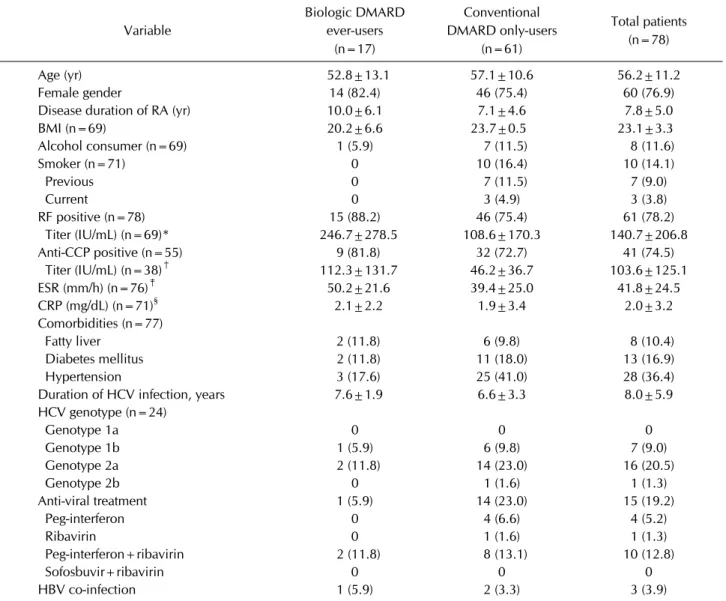
We identified 78 RA patients with concomitant HCV in- fection (60 women and 18 men); demographics and clin- ical characteristics are summarized in Table 1. A total of 17 patients received biologic DMARD(s) during RA treatment. Mean age (SD) at RA diagnosis was 52.8 (13.1) years and mean disease duration was 10.0 (6.1) years. Six of the 17 patients (35.3%) had been diagnosed with hep- atitis C prior to RA. One patient was co-infected with HBV and HCV. Two patients had extrahepatic manifes- tations of HCV infection: hypothyroidism (n=1), and mixed cryoglobulinemia (n=1). The most common cDMARD prescribed was hydroxychloroquine (83.6%), followed by methotrexate (50.8%) and sulfasalazine (36.1%); see Figure 1 for details. Regarding anti-viral treatment, one patient previously received interferon (IFN) and ribavirin (RBV) as acute hepatitis C treatment before initiating DMARD therapy (approximately 46 months ago).
Table 1. Characteristics of patients with chronic hepatitis C at the time of rheumatoid arthritis diagnosis Variable
Biologic DMARD ever-users
(n=17)
Conventional DMARD only-users
(n=61)
Total patients (n=78)
Age (yr) 52.8±13.1 57.1±10.6 56.2±11.2
Female gender 14 (82.4) 46 (75.4) 60 (76.9)
Disease duration of RA (yr) 10.0±6.1 7.1±4.6 7.8±5.0
BMI (n=69) 20.2±6.6 23.7±0.5 23.1±3.3
Alcohol consumer (n=69) 1 (5.9) 7 (11.5) 8 (11.6)
Smoker (n=71) 0 10 (16.4) 10 (14.1)
Previous 0 7 (11.5) 7 (9.0)
Current 0 3 (4.9) 3 (3.8)
RF positive (n=78) 15 (88.2) 46 (75.4) 61 (78.2)
Titer (IU/mL) (n=69)* 246.7±278.5 108.6±170.3 140.7±206.8
Anti-CCP positive (n=55) 9 (81.8) 32 (72.7) 41 (74.5)
Titer (IU/mL) (n=38)† 112.3±131.7 46.2±36.7 103.6±125.1
ESR (mm/h) (n=76)‡ 50.2±21.6 39.4±25.0 41.8±24.5
CRP (mg/dL) (n=71)§ 2.1±2.2 1.9±3.4 2.0±3.2
Comorbidities (n=77)
Fatty liver 2 (11.8) 6 (9.8) 8 (10.4)
Diabetes mellitus 2 (11.8) 11 (18.0) 13 (16.9)
Hypertension 3 (17.6) 25 (41.0) 28 (36.4)
Duration of HCV infection, years 7.6±1.9 6.6±3.3 8.0±5.9
HCV genotype (n=24)
Genotype 1a 0 0 0
Genotype 1b 1 (5.9) 6 (9.8) 7 (9.0)
Genotype 2a 2 (11.8) 14 (23.0) 16 (20.5)
Genotype 2b 0 1 (1.6) 1 (1.3)
Anti-viral treatment 1 (5.9) 14 (23.0) 15 (19.2)
Peg-interferon 0 4 (6.6) 4 (5.2)
Ribavirin 0 1 (1.6) 1 (1.3)
Peg-interferon+ribavirin 2 (11.8) 8 (13.1) 10 (12.8)
Sofosbuvir+ribavirin 0 0 0
HBV co-infection 1 (5.9) 2 (3.3) 3 (3.9)
Values are presented as mean±standard deviation or number (%). DMARD: disease-modifying antirheumatic drug, RA:
rheumatoid arthritis, BMI: body mass index, RF: rheumatoid factor, Anti-CCP: anti-cyclic citrullinated protein antibody, ESR:
erythrocyte sedimentation rate, CRP: C-reactive protein, HCV: hepatitis C virus, HBV: hepatitis B virus. p-values were generated by using Mann-Whitney U test; *p=0.024, †p=0.300, ‡p=0.080, §p=0.402.
Clinical traits of biologic DMARD users
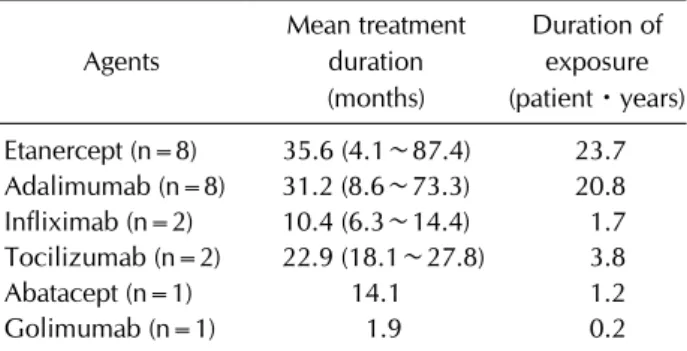
Seventeen patients were prescribed with biologic DMARD(s) during RA treatment: etanercept (n=8), ada- limumab (n=8), infliximab (n=2), tocilizumab (n=2), abatacept (n=1), and golimumab (n=1). The mean treat- ment durations were 35.6 months for etanercept, 31.2 months for adalimumab, 10.4 months for infliximab, 22.9 months for tocilizumab, 14.1 months for abatacept, and 1.9 months for golimumab (Table 2). Etanercept was the agent with the longest exposure (23.7 patientㆍyears) followed by adalimumab (20.8 patientㆍyears). Detailed information on each patient is provided in Table 3.
Biologic DMARD users had higher levels of inflam-
matory markers and RF and/or anti-CCP titers at RA di- agnosis than did conventional DMARD (-only) users.
Methotrexate and sulfasalazine were more commonly prescribed during biologic DMARD use (Figure 1). One patient received IFN and RBV as acute hepatitis C treat- ment approximately 46 months before starting etanercept.
Outcomes of HCV replication and transaminitis in biologic DMARD users
There was no case of HCV over-reactivation in RA pa- tients with chronic HCV infection who were exposed to biologic DMARD(s). Methotrexate was the most com- mon anchoring drug at initiating biologic therapy (8/16,
Figure 1. Conventional disease-modifying antirheumatic drug (DMARD) use in rheumatoid arthritis patients with chron- ic hepatitis C. HCQ: hydroxychloroquine, MTX: methotrex- ate, SSLZ: sulfasalazine, LEF: leflunomide, TAC: tacrolimus, CsA: cyclosporine A.
Table 2. Biologic agents used in 17 rheumatoid arthritis patients with chronic hepatitis C
Agents
Mean treatment duration (months)
Duration of exposure (patientㆍyears) Etanercept (n=8) 35.6 (4.1∼87.4) 23.7 Adalimumab (n=8) 31.2 (8.6∼73.3) 20.8 Infliximab (n=2) 10.4 (6.3∼14.4) 1.7 Tocilizumab (n=2) 22.9 (18.1∼27.8) 3.8
Abatacept (n=1) 14.1 1.2
Golimumab (n=1) 1.9 0.2
Values are presented as mean (minimum to maximum) or mean only.
50%). In the majority of patients, transaminase level was stable during biologic therapy. Liver function in eight RA patients who received etanercept were stable throughout the course of etanercept (patients 1∼7 and 14). Three patients who received etanercept as the first biologic DMARD switched to abatacept (patient 5), adalimumab (patient 6), or golimumab followed by tocilizumab (patient 7). Patient 7 developed a transient increase in ALT at 21.3 months (tocilizumab), but it normalized within two months.
Two of eight patients (patients 8 and 9) who used adali- mumab developed transaminitis; patient 8 discontinued adalimumab at 29 months because of repeatedly elevated ALT with increased HCV RNA, and ALT normalized after discontinuing adalimumab. Patient 9 experienced ele- vated ALT plus a substantially high viral RNA titer at 24.7 months and was preemptively treated with IFN and RBV (Table 3). The viral RNA titer rapidly decreased within three months.
Among patients treated with tocilizumab, one (patient 17) with a history of compensated liver cirrhosis and hep- atocellular carcinoma developed an increase of 4.7 times in viral RNA titer plus a 10-fold increase in ALT. He was immediately treated with sofosbuvir and RBV, and his vi- ral RNA titer decreased markedly within a month.
Changes in transaminase and viral RNA were unremarkable in other patients who received infliximab (patients 15 and 16) and abatacept (patient 5).
DISCUSSION
Treatment guidelines for RA have evolved during the past decade driven by the incorporation of biologic DMARDs, enabling patients to better achieve clinical re- mission or low disease activity. In patients infected with chronic viral hepatitis, the decision to treat with biologic therapy is often reserved due to concerns about viral re- activation and/or deterioration of hepatic function. We reviewed 78 Korean RA patients with chronic HCV in- fection; 17 patients had been treated with biologic DMARDs, mainly TNF-α inhibitors, and most had stable liver func- tion during biologic therapy. Two patients experienced transaminitis plus notably increased viral RNA titers compared with baseline, but preemptive anti-viral ther- apy readily solved the events.
Adverse hepatic outcomes of TNF-α inhibitors in HCV-infected RA patients have been reported in the liter- ature [13,17-27]. In one study, the safety profiles of TNF-α inhibitors in HCV-infected patients appeared to be ac- ceptable, irrespective of agent or underlying chronic in- flammatory condition [13]. One study showed that eta- nercept was most frequently used in RA patients with chronic HCV infection [12]; patients maintained their hepatic function and viral load, with only one of 61 pa- tients experiencing HCV reactivation [13,28]. Safety sig- nals of etanercept plus methotrexate in a prospective, multicenter study concluded that TNF-α inhibitors can be used in daily clinical practice without increased risk of hepatotoxicity or viral replication in HCV carriers [20]. In our study, etanercept users also showed no significant hepatic dysfunction or virologic breakthrough during fol- low-up (23.7 patientㆍyears).
Long-term use of TNF-α inhibitors in HBV and HCV
Table 3. Clinical characteristics of biologic users in rheumatoid arthritis patients with chronic hepatitis C NoGen- derAge (yr)
Disease duration of RA (yr)
RF titer (IU/mL)
Anti- CCP titer (IU/mL)
Duration of HCV infection (yr)
HCV RNA titer before biologic use (IU/mL)
Prophylactic anti-viral therapy Biologic agent(s) Treatment duration (mo)
Concomit-ant DMARD use
Baseline AST/ALT (U/L)
Follow-up HCV RNA titer (IU/mL) (mo) Peak AST/ALT (U/L) within the 2nd year (mo)
Subsequent anti-viral therapies 1F71 7.1NC 1.516.2 17,600NoETX87.4None190/218NC105/39 (8)- 2F6910.563435.5 4.32,760,000Previous (IFN+RBV)ETX 5.3MTX41/28NC33/22 (9)- 3F3715.1152>100 4.8NegativeNoETX67.5None21/16Negative 40/22 (24)- 4F7618.8 68.128.3 4.7NCNoETX18.5None22/9NC30/10 (9)- 5F58 8.5224NC 0.3NCNoETX → ABT4.1 →3.8MTX →MTX15/9NC 21/18 (15)- 6F7317.3175NC17.3NegativeNoETX → ADA19.6 →19.1MTX →None17/12Negative23/15 (8)- 7F78 7.8 36NCUn- known3,811,947NoETX → GOL → TCZ
9.8 →1.9 →27.7
None68/34NC165/140 (21.3) →53/13 (22.6)- 8F59 3.5218.2NC18.5NCNoADA29.4MTX, HCQ85/8325,590 (3) →52,512 (27)238/162 (16)- 9F6921.5 4369 1.3NCNoADA40.6MTX37/202,330,000 (24.7) →17,500 (27.5) 134/75 (24.7) →44/23(27.5)IFN +RBV 10F39 8.8 12.3NC 8.8NegativeNoADA73.3MTX 12/8Negative24/28 (6)- 11M62 7.8 26.196.1 7.6NCNoADA 8.6MTX18/25NC 22/29 (6)- 12F42 3.4 67.5>200 3.5NegativeNoADA29.7MTX26/13NC23/11 (9)- 13F68 1.6405.9NC 2.9NCNoADA11.1MTX18/15<15 (34.5) →15 (43.1) 20/13 (24)- 14F6818.1960.8>100 6.8NegativeNoADA →ETXUnknownUnknownUnknow nNCUnknown- 15M747251>6007NCNoIFX 6.3SSLZ18/13NC19/14 (4)- 16F53 3.9 26.5<722.3NCNoIFX14.4None69/18 205,000 (21.1)48/26 (9)- 17M73 9.4647>10025.5 839,227NoTCZ18.1SSLZ37/302,110,902 (4.5) → 3,958,308 (14.4)366/438 (18.1)Sofosbuvir +RBV RA: rheumatoid arthritis, RF: rheumatoid factor, Anti-CCP: anti-cyclic citrullinated protein antibody, HCV: hepatitis C virus, DMARDs: disease-modifying antirheumatic drugs, AST: aspartate aminotransferase, ALT: alanine transaminase, NC: not checked, IFN: interferon, RBV: ribavirin, ETX: etanercept, ABT: abatacept, ADA: adalimumab, GOL: golimumab, TCZ: tocilizumab, MTX: methotrexate, HCQ: hydroxychloroquine, SSLZ: sulfasalazine.
co-infected patients may augment viral replication, re- quiring anti-viral therapy [18]. In our study, one out of three HBV and HCV co-infected patients received adali- mumab followed by etanercept with no alarming safety signals. In fact, HCV RNA was negative and HBV DNA titer was low when the patients began the biologics.
Unfortunately, whether the patient received prophylactic anti-viral therapy for HBV infection was unknown in this case. In contrast, two of eight patients treated with adali- mumab experienced transaminitis plus increased viral RNA titers. This result suggests that there may be a high- er risk of hepatic events in users of monoclonal TNF-α inhibitors.
Two case reports suggested that short-term tocilizumab treatment may not affect hepatitis C viral load or serum transaminase [29,30]. The authors concluded that tocili- zumab can be utilized in RA patients with chronic HCV infection, although monitoring liver function and viral RNA levels is required. On the contrary, there is a report of HCV reactivation in an asymptomatic carrier with RA within the first 12 months of tocilizumab treatment [31].
In our study, one patient with compensated liver cirrhosis experienced acute deterioration of hepatic function with an HCV RNA titer that was 4.7 times higher within 24 months treatment of tocilizumab. A study showed that interleukin-6 contributes to liver regeneration and pro- tection against liver injury [32], therefore tocilizumab needs to be used with caution in patients with liver cir- rhosis, especially with high copies of HCV RNA.
Previous studies reported 8.8% to 15% in HCV infected RA patients who received TNF inhibitors experienced transaminitis [13,19]. In our study, 23.5% patients devel- oped transaminitis during biologic therapies, which was relatively higher than previous studies.
Eshbaugh and Zito [33] described four cases of abata- cept-treated RA patients with hepatitis C; the authors ob- served no adverse event of hepatic function deterioration or increased viral load and suggested that abatacept could be used in patients with HCV infection. As for rituximab, its use is recommended with caution in patients with HBV infection [34]. Furthermore, Chen et al. [35] re- ported that B-cell target therapy may influence HCV re- activation to a greater extent than TNF-α inhibitors. No patient had been treated with rituximab in our study.
This is the first Korean multicenter study to investigate virologic or biochemical changes in RA patients who were receiving biologic therapy and who were also infected with HCV. There are some limitations that need to be
discussed. First, this was a retrospective study based on a relatively limited number of HCV-infected patients, espe- cially biologic DMARD users, with heterogeneous clin- ical characteristics, different biologics, and different fol- low-up periods; etanercept and adalimumab were the agents that were most prescribed, with the latter being as- sociated with more events of interest. Second, there were missing data on viral RNA titers at certain time points, which made it difficult to assess the presence of virologic breakthrough in the presence of transaminitis. Third, bio- logic DMARD prescription as well as its selection or com- bination with a conventional DMARD was determined by the attending physician, and selected patients were likely prone to have better prognoses in terms of safety. Thus, our patients may not have fully featured the untoward outcomes in HCV-infected RA patients.
CONCLUSION
Although we could not highlight the biologic DMARD of choice, etanercept is one option for RA patients with chronic HCV infection. Importantly, HCV-infected RA patients are not free from developing hepatitis or in- creased viral loads during biologic DMARD use.
Therefore, physicians should be vigilant in monitoring liver function and viral RNA titer before and during bio- logic therapy.
ACKNOWLEDGMENTS
This work was supported by a grant from the Korea Health Technology R&D Project through the Korea Health Industry Development Institute, funded by the Ministry of Health & Welfare, Republic of Korea (grant number HI14C1277), a grant from the Korea Healthcare Technology R&D Project, Ministry of Healthcare &
Welfare, Republic of Korea (grant number. HI10C2020), and a grant from the Ministry of Science, ICT and Future Planning (grant number. NRF-2015M3A9B6052011).
CONFLICT OF INTEREST
No potential conflict of interest relevant to this article was reported.
REFERENCES
1. Bojito-Marrero L, Pyrsopoulos N. Hepatitis B and Hepatitis
C reactivation in the biologic Era. J Clin Transl Hepatol 2014;2:240-6.
2. Yazici O, Sendur MA, Aksoy S. Hepatitis C virus re- activation in cancer patients in the era of targeted therapies.
World J Gastroenterol 2014;20:6716-24.
3. Yeo W, Chan TC, Leung NW, Lam WY, Mo FK, Chu MT, et al. Hepatitis B virus reactivation in lymphoma patients with prior resolved hepatitis B undergoing anticancer therapy with or without rituximab. J Clin Oncol 2009;27:605-11.
4. Pérez-Alvarez R, Díaz-Lagares C, García-Hernández F, Lopez-Roses L, Brito-Zerón P, Pérez-de-Lis M, et al. Hepatitis B virus (HBV) reactivation in patients receiving tumor ne- crosis factor (TNF)-targeted therapy: analysis of 257 cases.
Medicine (Baltimore) 2011;90:359-71.
5. Lau GK, Leung YH, Fong DY, Au WY, Kwong YL, Lie A, et al. High hepatitis B virus (HBV) DNA viral load as the most important risk factor for HBV reactivation in patients pos- itive for HBV surface antigen undergoing autologous hema- topoietic cell transplantation. Blood 2002;99:2324-30.
6. Nathan DM, Angus PW, Gibson PR. Hepatitis B and C virus infections and anti-tumor necrosis factor-alpha therapy:
guidelines for clinical approach. J Gastroenterol Hepatol 2006;21:1366-71.
7. National Institutes of Health Consensus Development Conference Panel statement: management of hepatitis C.
Hepatology 1997;26(3 Suppl 1):2S-10S.
8. Torres HA, Davila M. Reactivation of hepatitis B virus and hepatitis C virus in patients with cancer. Nat Rev Clin Oncol 2012;9:156-66.
9. Mahale P, Kontoyiannis DP, Chemaly RF, Jiang Y, Hwang JP, Davila M, et al. Acute exacerbation and reactivation of chronic hepatitis C virus infection in cancer patients. J Hepatol 2012;57:1177-85.
10. Vento S, Cainelli F, Mirandola F, Cosco L, Di Perri G, Solbiati M, et al. Fulminant hepatitis on withdrawal of che- motherapy in carriers of hepatitis C virus. Lancet 1996;
347:92-3.
11. Lawrence RC, Hochberg MC, Kelsey JL, McDuffie FC, Medsger TA Jr, Felts WR, et al. Estimates of the prevalence of selected arthritic and musculoskeletal diseases in the United States. J Rheumatol 1989;16:427-41.
12. Maillefert JF, Muller G, Falgarone G, Bour JB, Ratovohery D, Dougados M, et al. Prevalence of hepatitis C virus infection in patients with rheumatoid arthritis. Ann Rheum Dis 2002;61:635-7.
13. Brunasso AM, Puntoni M, Gulia A, Massone C. Safety of an- ti-tumour necrosis factor agents in patients with chronic hepatitis C infection: a systematic review. Rheumatology (Oxford) 2011;50:1700-11.
14. Aletaha D, Neogi T, Silman AJ, Funovits J, Felson DT, Bingham CO 3rd, et al. 2010 Rheumatoid arthritis classi- fication criteria: an American College of Rheumatology/
European League Against Rheumatism collaborative initiative. Arthritis Rheum 2010;62:2569-81.
15. Nguyen TT, Sedghi-Vaziri A, Wilkes LB, Mondala T, Pockros PJ, Lindsay KL, et al. Fluctuations in viral load (HCV RNA) are relatively insignificant in untreated pa- tients with chronic HCV infection. J Viral Hepat 1996;
3:75-8.
16. Fanning L, Kenny-Walsh E, Levis J, Choudhury KR, Cannon B, Sheehan M, et al. Natural fluctuations of hepatitis C viral
load in a homogeneous patient population: a prospective study. Hepatology 2000;31:225-9.
17. Iannone F, Gremese E, Ferraccioli G, Lapadula G; GISEA.
Comment on "Tumor necrosis factor-α antagonist therapy for concomitant rheumatoid arthritis and hepatitis C virus infection: a case series study". Clin Rheumatol 2016;35:839- 40.
18. Temel T, Cansu DÜ, Korkmaz C, Kaşifoğlu T, Özakyol A.
The long-term effects of anti-TNF-α agents on patients with chronic viral hepatitis C and B infections. Int J Rheum Dis 2015;18:40-5.
19. Lin KM, Cheng TT, Lin JC, Chen CJ. Tumor necrosis factor-α antagonist therapy for concomitant rheumatoid arthritis and hepatitis C virus infection: a case series study. Clin Rheumatol 2015;34:1039-46.
20. Iannone F, La Montagna G, Bagnato G, Gremese E, Giardina A, Lapadula G. Safety of etanercept and methotrexate in pa- tients with rheumatoid arthritis and hepatitis C virus in- fection: a multicenter randomized clinical trial. J Rheumatol 2014;41:286-92.
21. Ballanti E, Conigliaro P, Chimenti MS, Kroegler B, Di Muzio G, Guarino MD, et al. Use of anti-tumor necrosis factor al- pha therapy in patients with concurrent rheumatoid arthri- tis and hepatitis B or hepatitis C: a retrospective analysis of 32 patients. Drug Dev Res 2014;75 Suppl 1:S42-5.
22. Pompili M, Biolato M, Miele L, Grieco A. Tumor necrosis factor-α inhibitors and chronic hepatitis C: a compre- hensive literature review. World J Gastroenterol 2013;19:
7867-73.
23. Li S, Kaur PP, Chan V, Berney S. Use of tumor necrosis fac- tor-alpha (TNF-alpha) antagonists infliximab, etanercept, and adalimumab in patients with concurrent rheumatoid ar- thritis and hepatitis B or hepatitis C: a retrospective record review of 11 patients. Clin Rheumatol 2009;28:787-91.
24. Ferri C, Ferraccioli G, Ferrari D, Galeazzi M, Lapadula G, Montecucco C, et al. Safety of anti-tumor necrosis factor-al- pha therapy in patients with rheumatoid arthritis and chronic hepatitis C virus infection. J Rheumatol 2008;35:
1944-9.
25. Parke FA, Reveille JD. Anti-tumor necrosis factor agents for rheumatoid arthritis in the setting of chronic hepatitis C infection. Arthritis Rheum 2004;51:800-4.
26. Calabrese LH, Zein N, Vassilopoulos D. Safety of anti- tumour necrosis factor (anti-TNF) therapy in patients with chronic viral infections: hepatitis C, hepatitis B, and HIV infection. Ann Rheum Dis 2004;63 Suppl 2:ii18-ii24.
27. Peterson JR, Hsu FC, Simkin PA, Wener MH. Effect of tu- mour necrosis factor alpha antagonists on serum trans- aminases and viraemia in patients with rheumatoid arthritis and chronic hepatitis C infection. Ann Rheum Dis 2003;
62:1078-82.
28. Pritchard C. Etanercept and hepatitis C. J Clin Rheumatol 1999;5:179.
29. Nagashima T, Maruyama A, Kamata Y, Minota S. Unchanged serum viral load and liver function during tocilizumab treat- ment in a patient with rheumatoid arthritis and hepatitis C virus infection. Rheumatol Int 2012;32:2231-2.
30. Dragonas C, Ehrenstein B, Fleck M. Tocilizumab treatment in a patient suffering from rheumatoid arthritis and con- comitant chronic hepatitis C infection. Rheumatology (Oxford) 2012;51:1520-1.
31. Mori S, Fujiyama S. Comment on: Tocilizumab treatment in a patient suffering from rheumatoid arthritis and con- comitant chronic hepatitis C infection. Rheumatology (Oxford) 2012;51:2300-2.
32. Streetz KL, Luedde T, Manns MP, Trautwein C. Interleukin 6 and liver regeneration. Gut 2000;47:309-12.
33. Eshbaugh M, Zito S. Abatacept therapy for rheumatoid ar- thritis in patients with hepatitis C virus infection co- morbidity: a series of four patients. Rheumatology (Sunnyvale)
2014;S16:007.
34. Tsutsumi Y, Yamamoto Y, Ito S, Ohigashi H, Shiratori S, Naruse H, et al. Hepatitis B virus reactivation with a ritux- imab-containing regimen. World J Hepatol 2015;7:2344-51.
35. Chen YM, Chen HH, Chen YH, Hsieh TY, Hsieh CW, Hung WT, et al. A comparison of safety profiles of tumour ne- crosis factor α inhibitors and rituximab therapy in patients with rheumatoid arthritis and chronic hepatitis C. Ann Rheum Dis 2015;74:626-7.