<접수일:2007년 10월 9일, 심사통과일:2007년 10월 19일>
※통신저자:김 상 현
광주시 동구 서석동 375번지 조선대학교병원 내과
Tel:062) 230-6381, Fax:062) 234-9653, E-mail:[email protected] 이 논문은 2006년도 조선대학교 학술연구비의 지원을 받아 연구되었음.
류마티스관절염 환자의 혈청 내 항GPI 항체의 임상적 의의
조선대학교 의과대학 내과학교실, 가톨릭대학교 의과대학 내과학교실*
변 유 미ㆍ김 상 현ㆍ박 성 환*
= Abstract =
Clinical Significance of Autoantibodies to Glucose-6-phosphate Isomerase in Serum of Patients with Rheumatoid Arthritis
Yu-Mi Byeon, M.D., Sang-Hyon Kim, M.D., Sung-Hwan Park, M.D.*
Department of Internal Medicine, Chosun University College of Medicine, Gwanju, Department of Internal Medicine, The Catholic University of Korea School of Medicine,
Seoul*, Korea
Objective: Anti-glucose-6-phosphate isomerase (GPI) antibody (Ab) is known to be arthrito- genic in K/BxN mice. Anti-GPI Ab is present in some patients with rheumatoid arthritis (RA), but their clinical manifestations are not clearly elucidated. The purpose of this study was to evaluate whether GPI serves as a specific autoantigen in patients with RA and to investigate the relationship of anti-GPI Ab with clinical parameters of RA.
Methods: Sera were collected from 54 patients with RA, 15 patients with osteoarthritis (OA) and 28 healthy controls. The samples were tested by enzyme-linked immunosorbent assay (ELISA) using human recombinant GPI as antigen. Patients with RA were classified according to rheumatoid factor (RF) positivity, the presence of RA shared epitope (SE), the presence of extraarticular manifestations, and evidence of bony erosive changes.
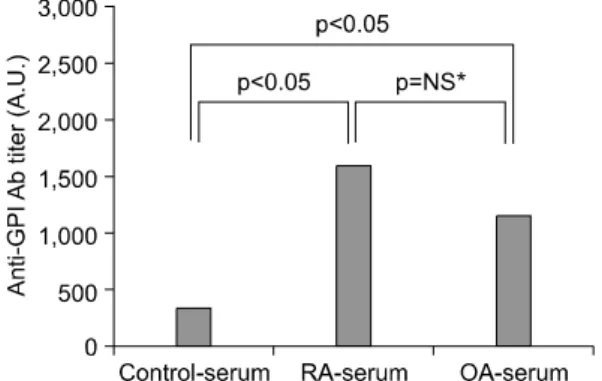
Results: Serum levels of anti-GPI Ab were higher in patients with RA than controls (1599.46±1022.48 versus 344.82±223.16 AU, p<0.001), and the levels of patients with OA were also higher than controls (1161.47±917.44 versus 344.82±223.16 AU, p<0.01). In RA, there were no significant difference in anti-GPI Ab levels according to RF positivity, the presence of RA SE, the presence of extraarticular manifestations, and evidence of bony erosive changes.
Conclusion: Our results suggest that anti-GPI Ab may not be RA specific Ab and not related
to the severity of RA.
Key Words: Anti-GPI antibody, Rheumatoid arthritis, Shared epitope
서 론
류마티스관절염은 비교적 흔한 전신성 염증성 자 가면역질환으로 만성적으로 진행되는 다발성 관절염 과 이로 인한 관절조직의 파괴가 특징이다 (1). 그러 나, 수많은 연구에도 불구하고 류마티스관절염을 일 으키는 자가항원은 지금까지도 완전히 규명되지 못 했다 (2).
최근, 사람의 류마티스관절염의 발생에 glucose-6- phosphate-isomerase (GPI)가 특이적인 자가항원의 역 할을 한다는 연구가 발표되어 주목을 받았으나 (3), 다른 만성 염증성 질환에서도 류마티스관절염에서와 유사한 역가로 항GPI항체가 발현되며 류마티스관절 염에 특이적이지 않다는 연구가 다수 보고되었다 (2,4). 그러나, 일부 연구자들은 활성도가 증가된 류 마티스관절염 환자에서 항GPI항체가 높게 발현된다 고 하였다 (5).
국내에서도 활액 내 항GPI항체에 대한 연구가 있 었으나, 아직까지 한국인에서 혈청 내 항GPI항체에 대한 연구는 없었다 (6,7). 이에, 류마티스관절염과 밀접한 연관성이 있다고 알려진 HLA-DR4를 비롯한 여러 임상 지표들과 혈청 내 항GPI항체와의 상관관 계를 알아보기 위해 본 연구를 시행하였다.
대상 및 방법 1. 대상 환자
가톨릭대학교 강남성모병원 류마티스 센터에 내원 한 환자 중 1987년에 개정된 미국류마티스학회의 분 류 기준에 적합한 54명의 류마티스관절염 환자와 15 명의 골관절염 환자 및 28명의 건강 대조군을 대상 으로 하였다.
2. 혈청의 채취
각각 54명의 류마티스관절염, 15명의 골관절염 환 자 및 28명의 건강대조군은 혈액을 채취하여 혈청을
분리하여 즉시 원심 분리한 후에 20oC 냉동고에 보 관하였다.
3. 임상검사
류마티스관절염 환자들을 대상으로 혈액을 채취하 여 말초혈액 검사와 적혈구침강속도(ESR), C-반응단 백(CRP), 혈청 류마티스 인자(rheumatoid factor, IgM) 등의 검사를 시행하였다. 류마티스관절염 환자들의 골미란의 유무는 손관절과 손목관절, 무릎 관절의 단순 방사선 촬영을 통하여 확인하였다. 44명의 환자에 서 HLA-DR typing을 실시하였으며, HLA-DRB1*0101, 0401, 0404, 0405 가 존재하는 경우는 shared epitope (SE) 양성으로 정의하였다 (8).
관절외 합병증 양성은 다음의 경우로 정의하였다.
말초혈액 검사상 심한 빈혈(혈색소 10.0 g/dL 미만), 류마티스모양결절(rheumatoid nodule)의 존재, 흉부방 사선 촬영상 확인된 폐침범(폐결절, 흉수, 폐쇄세기 관지기질화폐렴), 안과 검진상 안구 침범의 존재, 피 부 궤양이 동반된 혈관염의 유무를 조사하였고 이중 1가지라도 있을 때 관절외 합병증 양성으로 판단하 였다.
4. 혈청 내 항GPI 항체의 측정
항GPI 항체는 ELISA 방법으로 측정하였다. 96개 의 well plate에 PBS (phosphate-buffered saline)에 희 석한 4μg/mL 농도의 recombinant human GPI 100 (L 를 각각의 well에 도포한 후 4oC에서 밤새 방치하였 다. ELISA plate를 PBS로 2회 세척한 후, 1% bovine serum albumin (BSA)이 포함된 PBS 150μL를 각 well에 넣고 실온에서 30분간 방치하여 비특이적 결 합을 차단하였다. 그리고, ELISA plate를 PBS에 2회 세척한 후, 환자의 혈액 검체를 0.1% BSA가 포함된 PBS로 희석하였다. 희석된 검체를 각각의 well에 첨 가한 후 실온에서 2시간 동안 반응시킨 다음 PBS에 3회 세척하였다. 2,000배 희석한 goat anti-human IgG- alkaline phosphatase 100μL를 첨가하여 실온에서 1시간 반응시킨 후 3회 세척, 그 후 1 mg/mL 농도의 PNPP/
Fig. 1. Antibodies to glucose-6-phosphate-isomerase (GPI) in serum of healthy controls, patients with rheumatoid arthritis (RA), and with osteoarthritis (OA) by enzyme linked immunosorbent assay (NS*: not significant).
Fig. 2. In rheumatoid arthritis, there were no significant difference in serum anti-glucose-6-phosphate-iso- merase (GPI) antibody levels according to rheu- matoid factor (RF) positivity, evidence of bony erosive changes, the presence of extraarticular manifestations, and HLA-DR4 positivity. NS*:
not significant, EAM**: extraarticular manifes- tations.
DEA solution 50μL을 첨가하여 발색반응을 시킨 후 0.2 M의 NaOH 50μL를 첨가하여 발색반응을 중지 시킨 뒤 405 nm에서 흡광도를 측정하였다.
5. 통계분석
실험결과는 평균과 표준편차로 표기하였으며 Win- dows용 SPSS 12.0 프로그램(SPSS, Chicago, IL)를 이 용하여 T-test, Mann-Whitney U test의 통계기법을 사 용하였고, 상관 분석은 Pearson's correlation coeffi- cienct를 사용하였다. 처리된 결과가 p<0.05일 경우 통계적으로 유의한 것으로 간주하였다.
결 과 1. 환자의 임상적 특성
류마티스관절염 환자 중 여자가 46명이고 남자는 8명이었고, 평균 연령은 48.72±12.04세이었다. 진단 후 평균 이환 기간은 62.31±54.22개월이었다. 골관절 염 환자는 15명 모두 여자였고, 평균연령은 62.27±
9.04세이었다. 진단 후 평균 이환 기간은 50.76±
44.31개월이었다. 건강 대조군 28명 중 남자는 12명 이었고, 평균 연령은 53.46±10.23세이었다.
류마티스관절염 환자의 평균 ESR은 34.04±26.36 mm/hr이었고, CRP는 1.86±2.12 mg/dL이었다. 류마티 스관절염 환자에서 류마티스 인자는 87.04%에서 양 성이었고, 골미란이 있는 환자는 57.41%이었다. 관절
외 합병증은 29.63%에서 관찰되었다. 류마티스관절 염 환자 중 steroid를 복용 중인 환자는 97.06%이었 고, 모든 환자에서 1가지 이상의 항류마티스 약물 (DMARDs)을 복용하고 있었다. HLA-DR typing을 실 시한 44명의 환자에서 HLA-DR4 양성은 27명(61.36%) 이었으며, HLA-DRB1*0101 (2명), 0401 (1명), 0404 (4명), 0405 (16명)으로, HLA-DR4 양성 환자 중 SE 양성은 85.16%였다.
2. 혈청 내에서의 항GPI 항체
류마티스관절염 환자의 혈청 내의 항GPI항체는 1599.46±1022.48 arbitrary unit (A.U.)이었고, 골관절염 환자는 1161.47±917.44 A.U. (p=0.219)로 차이가 없었다.
그러나, 건강대조군의 혈청 내 항GPI항체는 344.82±
223.15 A.U.로 류마티스관절염 환자(p<0.001)와 골 관절염 환자(p<0.01)에 비해 낮게 측정되었다(그림 1). 그림 2에서와 같이 류마티스 인자 유무에 따라 서는 1556.28±1051.20 A.U. 대 1826.50±864.41 A.U.로 차이가 없었다(p=0.633). 골미란(1643.19±1083.14 A.U. 대 1540.52±955.24 A.U., p=0.719), 관절외 합병증(1656.94±
992.35 A.U. 대 1575.26±1047.04 A.U., p=0.792)의 유 무에 따른 통계적인 차이는 없었다. HLA-DR4 양성 인 환자들에서도 음성에 비해(1589.85±998.21 A.U.
대 1618.93±885.68 A.U., p=0.633) 차이가 없었다. 한
Fig. 3. In patients with rheumatoid arthritis (RA), there were no correlations between serum anti-glucose-6- phosphate-isomerase (GPI) antibody levels and erythrocyte sedimentation rate (ESR) or C-reactive protein (CRP).
NS: no significance.
국인 류마티스관절염 발생과 심한 질병 활성도와 연 관성이 높다고 알려진 SE인 HLA-DRB1*0405 양성 환자와 다른 SE 양성 환자들 사이에서도(1398.94±
939.77 A.U. 대 2162.18±999.56 A.U., p=0.870) 차이 를 관찰할 수가 없었다 (8).
3. 류마티스관절염 환자에서 질병 활성도와의 관계
류마티스관절염에서 질병 활성도를 반영하는 ESR 및 CRP와 혈청 항GPI항체와는 서로 상관 관계가 관 찰되지 않았다(그림 3).
고 찰
사람의 류마티스관절염과 유사한 관절염이 저절로 발생하는 KRN T세포 수용체-트랜스제닉 마우스 (K/BxN 모델)의 혈청에서 GPI에 대한 자가항체가 높은 역가로 발현되며, 이 항GPI항체를 건강한 마우 스에 주입하였을 때 관절염이 발생한다는 것이 증명 되었다 (9-11). 이 후 항GPI항체의 류마티스관절염 특이성에 관한 연구들이 발표되었으나, 일치된 결과 를 보여주지 못하고 있다 (2-4). 일부 연구에서는 심 한 류마티스관절염에서 항GPI항체가 비교적 높게 검출된다고 하였다 (5).
본 연구에서는 혈청 항GPI항체가 류마티스관절염 이나 골관절염에서 정상 대조군에 비해 높게 검출되 었으나, 질병 특이적이지는 않았다(그림 1). 이는 최
근의 여러 연구와 비슷한 결과를 보였다 (2,4,12).
그러나, 일본인들을 대상으로 한 연구에서 임상적 으로 활동성이 강하고, 심한 임상 양상을 가진 류마 티스관절염 환자에서 혈청 항GPI항체의 역가가 증 가되어 있었다고 하였다 (5). 또한, Gaalen 등의 연구 에서는 심한 관절외 합병증을 가진 류마티스관절염 환자에서 대조군에 비해 혈청 항GPI항체의 역가가 증가되어 있었다고 하였다 (13). 그러나, Matsumoto 등은 혈청 내의 항GPI항체 역가와 질병의 이환 기 간, 류마티스 인자의 존재 유무, 골미란의 존재유무, 치료 방법의 차이와는 서로 관계가 없다고 하였다 (4).
아직까지 한국인을 대상으로 한 혈청 항GPI항체 와 여러 임상 지표들과의 관계에 대한 연구는 없었 다. 저자들은 류마티스 인자의 유무와 골미란 유무, 관절외 합병증의 유무, HLA-DR4에 따른 환자 군간 에 혈청 항GPI항체를 측정하여 비교하였으나, 혈청 항GPI항체 역가의 차이를 관찰 할 수가 없었다(그림 2). 한국인 류마티스관절염 발생 및 심한 질병 활성 도와 연관성이 높다고 알려진 SE인 HLA-DRB1*0405 양성 환자와 다른 SE 양성 환자들 사이에서도 차이 를 관찰할 수가 없었다 (8). 또한, 항GPI항체 역가와 적혈구침강속도 및 C-반응단백과의 사이에서 유의한 상관관계를 관찰 할 수가 없었다(그림 3).
이상의 결과로 미루어보아 혈청 항GPI항체는 관 절염 환자의 혈청에서 증가되어 있을 수있으나, 한
국인 류마티스관절염 환자에서 질병 특이적이지 않 고 질병의 활성도를 반영하지 못한다. 또한, 류마티 스관절염의 나쁜 예후 인자로서의 가능성은 떨어진 다고 할 수 있다.
본 연구의 제한 점으로는 첫째, 질병의 이환 기간 이 평균 5년 이상으로 진행된 환자라는 점, 둘째 단 일 기관의 환자를 대상으로 하여 한국인 류마티스관 절염을 대변할 수 없다는 점을 들 수 있어 비교적 초기의 류마티스관절염 환자들을 대상으로 한 보다 큰 규모의 다기관 연구가 필요할 것으로 사료된다.
결 론
본 연구에서는 류마티스관절염의 새로운 자가항체 로 제시된 항GPI항체의 질병 특이성에 대하여 알아 보고자 하였다. 한국인 류마티스관절염 환자의 혈청 항GPI항체는 질병 특이적이지는 않았으나, 정상인에 비하여 높게 측정되었다. 그러나, 류마티스관절염 환 자의 불량예후 인자와 항GPI항체 사이에는 상관관 계가 없었다.
감사의 글
Recombinant human GPI를 제공해 주신 서울대학 교 약학대학의 강창률 교수님과 장선영 선생님, 환 자들의 샘플 수집을 위해 수고해 주신 김선준 선생 님과 백승인 간호사, ELISA 검사를 위해 애써주신 박미경 연구원께 감사의 말씀을 드립니다.
REFERENCES
1) Feldmann M, Brennan FM, Maini RN. Rheumatoid arthritis. Cell 1996;85:307-10.
2) Herve CA, Wait R, Venables PJ. Glucose-6-phosphate isomerase is not a specific autoantigen in rheumatoid arthritis. Rheumatology (Oxford) 2003;42:986-8.
3) Schaller M, Burton DR, Ditzel HJ. Autoantibodies to GPI in rheumatoid arthritis: linkage between an animal model and human disease. Nat Immunol 2001;
2:746-53.
4) Matsumoto I, Lee DM, Goldbach-Mansky R, Sumida T, Hitchon CA, Schur PH, et al. Low prevalence of antibodies to glucose-6-phosphate isomerase in patients with rheumatoid arthritis and a spectrum of other chronic autoimmune disorders. Arthritis Rheum 2003;
48:944-54.
5) Hayashi T, Matsumoto I, Muraki Y, Takahashi R, Chino Y, Goto D. Clinical characteristics of anti- glucose-6-phosphate isomerase antibody-positive Ja- panese patients with rheumatoid arthritis. Mod Rheu- matol 2005;15:258-63.
6) Cha HS, Kim TJ, Kim JY, Lee MH, Jeon CH, Kim J, et al. Autoantibodies to glucose-6-phosphate iso- merase are elevated in the synovial fluid of rheuma- toid arthritis patients. Scand J Rheumatol 2004;33:
179-84.
7)김상현, 김성동, 김해림, 박성환, 김호연. 류마티스관절 염 환자의 활액 내 항GPI항체의 임상적 유용성. 대한류 마티스학회지 2005; 12: 12-7.
8) Kim HY, Min JK, Yang HI, Park SH, Hong YS, Jee WH, et al. The impact of HLA-DRB1*0405 on disease severity in Korean patients with seropositive rheuma- toid arthritis. Br J Rheumatol 1997;36:440-3.
9) Kouskoff V, Korganow AS, Duchatelle V, Degott C, Benoist C, Mathis D. Organ-specific disease provoked by systemic autoimmunity. Cell 1996;87:811-22.
10) Maccioni M, Zeder-Lutz G, Huang H, Ebel C, Gerber P, Hergueux J, et al. Arthritogenic monoclonal antibodies from K/BxN mice. J Exp Med 2002;195:
1071-7.
11) Ji H, Pettit A, Ohmura K, Ortiz-Lopez A, Duchatelle V, Degott C, et al. Critical roles for interleukin 1 and tumor necrosis factor alpha in antibody-induced arthritis. J Exp Med 2002;196:77-85.
12) Schaller M, Stohl W, Tan SM, Benoit VM, Hilbert DM, Ditzel HJ. Raised levels of anti-glucose-6- phosphate isomerase IgG in serum and synovial fluid from patients with inflammatory arthritis. Ann Rheum Dis 2005;64:743-9.
13) van Gaalen FA, Toes RE, Ditzel HJ, Schaller M, Breedveld FC, Verweij CL, et al. Association of autoantibodies to glucose-6-phosphate isomerase with extraarticular complications in rheumatoid arthritis.
Arthritis Rheum 2004;50:395-9.