* Corresponding author : Tae-Hwan Kim, Department of Animal Science, Institute of Agriculture Science and Technology, College of Agriculture & Life Science, Chonnam National University, Gwangju 61186, Korea. Tel: +82-62-530-2126, Fax:
+82-62-530-2129, E-mail: [email protected]
Research Article
Ammonification and NH
3emission in the Soil Amended with Different Animal Manures
Xin-Lei Wang
1, QianZhang
1, Sang-HyunPark
1, Bok-Rye Lee
1,2and Tae-Hwan Kim
1*
1
Department of Animal Science, Institute of Agriculture Science and Technology, College of Agriculture & Life Science,
2
Biotechnology Research Institute, Chonnam National University, Gwangju 61186, Korea
ABSTRACT
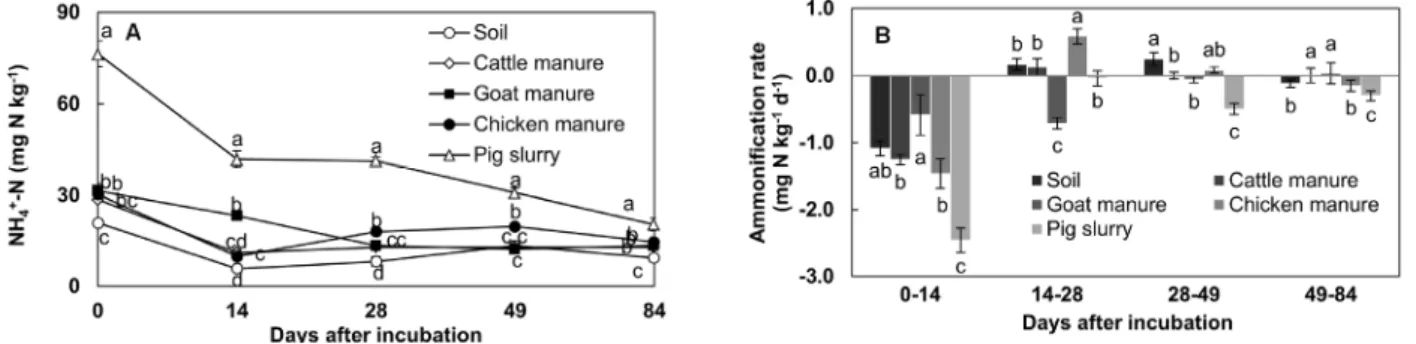
Mineralization is an important biological process for conversion of organic nitrogen (N) to inorganic N which can be used by plants directly. To investigate the effect of different manures on soil mineralization, the soil amended with cattle (CtM), goat (GM), chicken manure (ChM) and pig slurry (PS) were incubated under in vitro condition and ammonium N (NH4+-N), ammonification rate and ammonia emission were determined for eighty-four days.
NH4+-N was the highest in PS-amended soil for the whole experimental period. NH4+-N in PS-amended soil was gradually decreased until day 84, whereas it was rapidly decreased for the first 14 days and then slightly increased until 84 days in ChM-, CtM- and GM-amended soil. The ammonification rate showed negative value for the first 14 days in all treatments. From day 14, ammonification rate started to increase in CtM- and ChM-amended soil, whereas it was maintained in GM- and PS-amended soil until day 84. The daily ammonia emission was the highest in PS-amended soil (41mg kg-1 d-1), followed by CtM-, ChM-, and GM-amended soil at day 1. It was gradually decreased until day 84 in all treatments. The total NH3 emission was the highest in PS-amended soil with 0.6 mg kg-1 for 84 days, while less than 0.1 mg kg-1 in three other plots. These results indicate that different manures showed different soil ammonification rate and NH3 emission.
(Key Words : Animal manure, Ammonium-N, Ammonia emission, Ammonification)
I. INTRODUCTION
Animal manure is considered important nutrient source for plant growth. Manure is recognized as resource like supply of organic matter and ameliorant to soil. Roy et al. (2002) have predicted global utilization of N from animal manure is going to be 50 million tons by 2070. The application of manure to soil not only improves physical and chemical properties of soil but also provides nutrient such as N for plant growth (Mӧller and Stinner, 2009). However, plant cannot directly uptake the organic N in manure. Thus, it should be mineralized as ammonium (NH
4+) and nitrate (NO
3-) to form plant available N (Park et al., 2016). Generally, N mineralization process consists in two steps. Ammonification is the first step which is conversion of organic nitrogen into NH
4+by soil microorganism. After ammonification of N occurs, ammonium is rapidly converted to nitrate by soil bacteria through a process known as nitrification, which is the second step.
Therefore, mineralization is the key process for controlling to obtain plant -available N (Badia, 2000).
It has been well reported that soil N mineralization are affected by many factors such as manure composition, soil physical and chemical characteristic, management, and microorganisms (Harris 1981; Haynes, 1986; Eckard et al., 2003; Li and Li, 2014). For example, N mineralization increases with increasing temperature under agricultural soils (Eghball, 2000). Mineralization increases by nearing field capacity (Cassman and Munns, 1980). In addition, mineralization is significantly affected by manure characteristics (Eghball et al., 2002). However, few studies have specifically compared the effects of various kinds of manures on mineralization.
NH
3volatilization from agricultural soils occur a direct loss
of plant N (Salazar et al., 2014). Once volatilized to the
atmosphere, it is going to be stored on soil and water after
deposition, contributing to soil acidification, water
Materials Total N (g N kg
-1DM)
Inorganic N
NH
4+(mgNkg
-1DM) NO
3-(mgNkg
-1DM)
Soil 0.3 ± 0.0
e10.5 ± 0.9
e7.0 ± 4.4
bCattle manure 16.8 ± 0.3
b302.2 ± 0.6
d13.1 ± 0.5
aGoat manure 16.4 ± 0.1
c383.3 ± 1.8
c2.3 ± 0.6
cChicken manure 38.3 ± 0.2
a3485.1 ± 1.5
b2.6 ± 0.5
cPig slurry 4.8 ± 0.0
d4445.7 ± 36.8
a2.1 ± 0.4
cValues are mean ± SE (n=3) of three biological replicates. Different letters in column indicate significant difference at p < 0.05 according to the Duncan’s multiple range test.
Table 1. Chemical property of soil and animal manures used for the experiment.
eutrophication eventually influences on human health (Hristov et al., 2011). Moreover, NH
3is considered as indirect greenhouse gas because ammonium deposition could induce the formation of nitrous oxide in the atmosphere (Sanderson et al., 2006). Several studies reported that NH
3volatilization depends on the manure characteristics and the environmental conditions.
Pagans et al. (2006) reported that ammonia emissions rapidly increased by high temperature during first few days. Matsusada et al. (2002) have shown that NH
3emissions from composting animal manure varied from 15 mg/kg to 2840 mg/kg in swine manure, dairy manure and poultry. However, NH
3emission occurred during soil mineralization with different animal manure has not been well documented.
Therefore, this study was conducted to evaluate soil ammonification rate and ammonia emission from different animal manures having same amount of N content. To test this experiment, 4 kinds of animal manures as cattle manure (CtM), goat manure (GM), chicken manure (ChM) and pig slurry (PS) were applied to soil in vitro condition.
Ⅱ. MATERIAL AND METHODS 1. Experiment design
The present study based on an incubation experiment conducted in laboratory. The soil was collected from the surface layer (0-15cm) in Gwangju, South Korea (N35º10', E126º54'). Cattle, goat, chicken manure and pig slurry were sourced from Barebong fertilizer, farming association articles of incorporation (Namwon-si, Korea). The soil was sifted
through a 6 mm mesh sieve. Air-dried soil was adjusted to attain at 50 % water hold capacity (WHC) by adding distilled water and packed to the bulk density of field at 1.40 g cm
-3to be pre-incubated for one week under 25°C. Both manures and soil were ground to 0.2 mm and stored in 4°C to measure total N content and inorganic N content. Chemical property of soil and animal manures used for the experiment were provided in Table. 1. The experiment was allocated with five treatments; control (unfertilized soil), cattle manure (CtM), goat manure (GM), chicken manure (ChM) and pig slurry(PS).
The 2 kg of soil was adjusted to 60% WHC and mixed with manures as 200 mg N kg
-1. Soil and manure mixture were transferred into 5.7 L chamber and incubated. The chamber was opened 1 hour for sample harvest, air change and maintain soil moisture every day for the first 7 days and then once per week until 84 days. NH
3gas was collected when chamber was opened. The soil mixed with manures samples collected at day 0, 14, 28, 49 and 84.
2. Chemical analysis
N property of pig slurry used for this study was determined according to the method of Bremner (1996). The pH measurement was regularly done after shaking a 1:5 (sample:water, w/v) solution for 1 h on a rotary shaker. Total nitrogen was determined by digestion using the Kjeldahl procedure. Inorganic nitrogen was extracted with 2 M KCl and the NH
4+-N was determined by distillation in an alkaline
medium (MgO). The same procedure was used for NO
3--N
after reduction with Devarda’s alloy (Lu, 2000). For the
determination of NH
3volatilization, the N concentration in
collected samples by beakers placed on the soil surface which
Fig. 1. Changes in amount of ammonium-N (NH
4+-N, A) and ammonification rate (B). in the soil with unfertilized control, cattle manure, goat manure, chicken manure and pig slurry. Data are mean ± SE (n=3). Different letters indicate significantly different at p < 0.05 according to the Duncan's multiple range test.
containing 10 mL, 0.2 M sulfuric acid to collect NH
3. The solution in the form of (NH
4)
2SO
4was quantified by a colorimetric determination with ammonium color reagent (Nessler’s reagent, Sigma, 72190) as described by Kim and Kim (1996). The net ammonification rate was calculated by following equation, where t is incubation time (Kirkham and Bartholomew, 1954).
Net ammonification rate = (NH
4+Dt
– NH
4+ D0)/t 3. Statistical analysis
Statistical analyses were conducted using the SAS 9.1.3 package. Duncan’s multiple range tests were used to compare means of three replications between different animal manure amended soils. Statistical significance was set at p ≤ 0.05.
Ⅲ. RESULTS AND DISCUSSION
In this study, sandy loam soil which contained 0.25 ± 0.02 g kg
-1total-N including 10.5±0.88 mg kg
-1NH
4+-N and 7.0 ± 4.38 mg kg
-1NO
3--N, was used for experiment. The soil and manures nitrogen components were presented in Table 1.
Chicken manure (ChM) contained the highest total-N (38.3 g N kg
-1),whereas pig slurry(PS) contained lowest total-N (4.8 g N kg
-1).Thecattle manure (CtM), goat manure (GM) and ChM is consisted of mostly organic N (more than 90%), whereas PS was mainly composed of inorganic N (NH
4+and NO
3-).
The ammonium nitrogen (NH
4+-N) and ammonification rate in the soil with unfertilized control, CtM-, GM-, ChM-, and PS-amended soil were shown in Fig. 1. The NH
4+-N was
decreased in all treatment during incubation period (Fig. 1A).
After 84 days of inoculation, NH
4+-N was decreased by 56, 55, 57, 52 and 73% in the soil with unfertilized control, CtM-, GM-, ChM- and PS-amended soil compared to initial level (day 0), respectively. The NH
4+-N was continuously decreased in GM- and PS-amended soil for the whole experimental period. On the other hand, in CtM- and ChM-amended soil it was slightly increased after 14 days of experiment. A significant decrease of NH
4+-N in early period of experiment might be due to volatilization of NH
3. Similar results were recorded that organic fertilizer increased the amount of ammonium nitrogen at initial period and then it was decreased until 90 days in incubation period (Khalil et al., 2005). The decrease of NH
4+-N influenced ammonification rate (Fig. 1B).
The ammonification is the conversion of organic nitrogen as animal manure into ammonium nitrogen (NH
4+-N) by soil microbes. At initial period of experiment (0 to 14 days), all of treatments recorded negative ammonification rate. The ChM-amended soil increased ammonification rate during 14-28 day while NH
4+-N was increased. The decrease of NH
4+-N and ammonification rate was result from nitrogen volatilization as ammonia (NH
3) emission. The lowest amount of NH
4+-N and ammonification rate was due to a large amount of gas losing (Wolter et al., 2004).
It is well known that ammonia volatilization is closely related to manure characteristics such as total nitrogen, NH
4+-N
and percentage of dry matter (%, DM) during manure
application to soils. The NH
3was emitted approximately 41.22
µg kg
-1, 33.2 µg kg
-1, 25.2 µg kg
-1and 7.0 µg kg
-1in PS-,
CtM-, ChM- tand GM-amended soil, respectively, for the first
day (Fig. 2A). Afterwards, the NH
3emission was dramatically
Fig. 2. Daily ammonia (NH
3) emission and cumulative ammonia (NH
3) emission from the soil amended with cattle manure (◇), goat manure (■), chicken manure (●), pig slurry(△) and soil alone (control, ○) for 84 days of in vitro incubation
decreased in CtM- and ChM-amended soil, whereas NH
3was gradually decreased in PS-amended soil. The highest NH
3emission was observed in PS-amended soil. Similar results observed by Park et al. (2015) who reported that ammonia gas was more emitted in pig slurry than cattle manure. Generally, liquid manure and slurry have a high rate of ammonia loss compared to solid manure. It probably related to abundant uric acid in pig slurry (Krogdahl and Dalsgard, 1981). On the other hand, NH
3emission was low in GM-amended soil for the whole experimental period. The cumulative NH3 emission was the highest in PS-amended soil with 0.6 mg kg
-1for 84 days, while less than 0.1 mg kg
-1in three other plots (Fig. 2B). The cumulative NH
3emission in PS-amended soil was rapidly increased until 35 days and then it was maintained. A similar tendency was observed ChM-, GM- and CatM-amended soil, but the rate of emission was much less than in PS-amended soil throughout experimental period. Similarly, Chambers et al.
(1997) found that emissions of NH
3from applied solid manure follow a similar pattern over time as slurry but at a lower initial rate and continue for longer because the total ammoniacal N would not infiltrate into the soil to the same degree as that in slurry. These results suggested that manures addition provided a beneficial environment for microorganism lead to accelerate N mineralization.
Taken together, in present study, different manures showed different soil ammonification and ammonia emission even though same amount of N supply. For future study needs soil incubation by using isotope method for N use efficiency and plant available nitrogen for herbage yield.
Ⅳ. ACKNOWLEDGEMENTS
This study was financially supported by the Rural Development Administration Grant (RDA-PJ010099), Republic of Korea.
Ⅴ. REFERENCES
Badia, D. 2000. Potential nitrification rates of semiarid cropland soils from the Central Ebro Valley, Spain. Arid Soil Research and Rehabilitation. 14:281-292.
Bremner, J.M. 1996. Nitrogen-total. In: Sparks, D.L., Page, A.L., Helmke, P.A., Loeppert, R.H., Soltanpour, P.N., Tabatabai, M.A., Johnston, C.T. and Sumner, M.E. (Eds) Methods of soil analysis.
Part 3: chemical methods. SSSA Book Series 5. SSSA and ASA.
Madison. pp .1085-1121.
Cassman, K.G. and Munns, D.N. 1980. Nitrogen mineralization as
affected by soil moisture, temperature, and depth. Soil Science Society of America Journal 44: 1233-1237.
Chambers, B.J., Smith, K. and van der Weerden, T.J. 1997. Ammonia emissions following the land spreading of solid manures. In: Jarvis, S.C., Pain, B.F. (Eds.), Gaseous nitrogen emissions from grasslands.
CAB International Wallingford, pp. 275–280.
Eckard, R.J., Chen, D., White, R.E. and Chapman, D.F. 2003. Gaseous nitrogen loss from temperate perennial grass and clover dairy pastures in south-eastern Australia. Australian Journal of Agricultural Research. 54(6): 561-570.
Eghball, B. 2000. Nitrogen mineralization from field-applied beef cattle feedlot manure or compost. Soil Science Society of America Journal 64: 2024-2030.
Eghball, B., Wienhold, B.J., Gilley, J.E. and Eigenberg, R.A. 2002.
Mineralization of manure nutrients. Journal of Soil and Water Conservation 57: 470-473.
Harris, R.F. 1981. Effect of water potential on microbial growth and activity. Water Potential Relations in Soil Microbiology. Soil Science Society America, Madison, WI, pp. 23-95.
Haynes, R.J. 1986. Mineral nitrogen in the plant-soil system. Academic Press, Orlando, Florida. pp. 127-165.
Hristov, A.N., Hanigan, M., Cole, A., Todd, R., McAllister, T.A., Ndegwa, P.M. and Rotz, A. 2011. Ammonia emissions from dairy farms and beef feedlots: A review. Canadian Journal of Animal Science. 91:1-35.
Khalil, M. I., Hossain, M. B. and Schmidhalter, U. 2005. Carbon and nitrogen mineralization in different upland soils of the subtropics treated with organic materials. Soil Biology and Biochemistry. 37:
1507-1518.
Kim, T.H. and Kim, B.H. 1996. Ammonia microdiffusion and colorimetric method for determining nitrogen in plant tissues.
Journal of the Korean Society of Grassland Science. 16:253-259.
Kirkham, D. and Bartholomew, W.V. 1954. Equations for following nutrient transformations in soil utilizing tracer data. Soil Science Ⅱ Society Proceedings. 19:189-192.
Krogdahl, A. and Dalsgard, B. 1981. Estimation of nitrogen digestibility in Poultry. Content and distribution of major urinary nitrogen compounds in excreta. Poultry Science.60:2480-2485.
Li, L.L. and Li, S.T. 2014. Nitrogen mineralization from animal manures
and its relation to organic N fractions. Journal of Integrative Agriculture. 13(9): 2040-2048.
Lu, R. 2000. Soil Agricultural Chemical Analysis Methods. China Agricultural Science and Technology Press, Beijing.
Matsusada J., Maeda, T. and Ohmiya, K. 2002. Ammonia emissions from composting of livestock manure. In: Takahashi, J. and Young, B.A. (Ed). Proceedings of the 1st International Conference on Greenhouse Gases and Animal Agriculture, Elsevier Science Inc., Amsterdam, pp. 283- 286.
Möller, K. and Stinner, W. 2009. Effects of different manuring systems with and without biogas digestion on soil mineral nitrogen content and on gaseous nitrogen losses (ammonia, nitrous oxides). European Journal of Agronomy. 30:1 -16.
Pagans, E., Barrena R., Font X. and Sanchez, A. 2006. Ammonia emissions from the composting of different organic wastes:
dependency on process temperature. Chemosphere. 62: 1534-1542.
Park, S.H., Lee, B.R. and Kim, T.H. 2015. Effects of cattle manure and swine slurry acidification on ammonia emission as estimated by an acid trap system. Journal of the Korean Society of Grassland Science. 35: 212-216.
Park, S.H., Lee, B.R. and Kim, T.H. 2016. Effect of dicyandiamide and hydroquinone on ammonia and nitrous oxide emission from pig slurry applied to Timothy (Phleum pretense L.) sward. Journal of the Korean Society of Grassland Science. 36: 199-204.
Roy, R.N., Misira, R.V. and Montanez, A. 2002. Decreasing reliance on mineral nitrogen-yet more food. Ambio. 31:177-183.
Salazar, F., Martinez-Lagos, J., Alfaro, M. and Misselbrook, T. 2014.
Ammonia emission from a permanent grassland on volcanic soil after the treatment with dairy slurry and urea. Atmospheric Environment. 95: 591-597.
Sanderson, M.G., Collins, W.J., Johnson, C.E. and Derwent, R.G. 2006.
Present and future acid deposition to ecosystems: The effect of climate change. Atmospheric Environment. 40: 1275-1283.
Wolter, M., Prayitno, S. and Schuchardt, F. 2004. Greenhouse gas emission during storage of pig manure on a pilot scale. Bioresource Technology. 95: 235-244.
(Received : 2017. January. 31 | Revised : 2017. March. 21 | Accepted : 2017. March. 21)