항온 배양 논토양 조건에서 비산재 처리에 따른 CH
4와 CO
2방출 특성
임상선·최우정*·김한용1·정재운2·윤광식
전남대학교 지역․바이오시스템공학과, 1전남대학교 식물생명공학부, 2국립환경과학원 영산강물환경연구소
Fly Ash Application Effects on CH
4and CO
2Emission in an Incubation Experiment with a Paddy Soil
Sang-Sun Lim, Woo-jung Choi*, Han-Yong Kim1, Jae-Woon Jung2, and Kwang-Sik Yoon Department of Rural & Biosystems Engineering, Chonnam National University, Gwangju 500-757, Republic of Korea
1Department of Applied Plant Science, Chonnam National University, Gwangju 500-757, Republic of Korea
2Yeongsan River Environment Research Center, National Institute of Environmental Research, Gwangju, 500-480, Republic of Korea
To estimate potential use of fly ash in reducing CH4 and CO2 emission from soil, CH4 and CO2 fluxes from a paddy soil mixed with fly ash at different rate (w/w; 0, 5, and 10%) in the presence and absence of fertilizer N ((NH4)2SO4) addition were investigated in a laboratory incubation for 60 days under changing water regime from wetting to drying via transition. The mean CH4 flux during the entire incubation period ranged from 0.59 to 1.68 mg CH4 m-2 day-1 with a lower rate in the soil treated with N fertilizer due to suppression of CH4
production by SO42- that acts as an electron acceptor, leading to decreases in electron availability for methanogen. Fly ash application reduced CH4 flux by 37.5 and 33.0% in soils without and with N addition, respectively, probably due to retardation of CH4 diffusion through soil pores by addition of fine-textured fly ash. In addition, as fly ash has a potential for CO2 removal via carbonation (formation of carbonate precipitates) that decreases CO2 availability that is a substrate for CO2 reduction reaction (one of CH4
generation pathways) is likely to be another mechanisms of CH4 flux reduction by fly ash. Meanwhile, the mean CO2 flux during the entire incubation period was between 0.64 and 0.90 g CO2 m-2 day-1, and that of N treated soil was lower than that without N addition. Because N addition is likely to increase soil respiration, it is not straightforward to explain the results. However, it may be possible that our experiment did not account for the substantial amount of CO2 produced by heterotrophs that were activated by N addition in earlier period than the measurement was initiated. Fly ash application also lowered CO2 flux by up to 20% in the soil mixed with fly ash at 10% through CO2 removal by the carbonation. At the whole picture, fly ash application at 10%
decreased global warming potential of emitted CH4 and CO2 by about 20%. Therefore, our results suggest that fly ash application can be a soil management practice to reduce green house gas emission from paddy soils.
Further studies under field conditions with rice cultivation are necessary to verify our findings.
Key words: CH4 emission, CO2 emission, Chemical fertilizer, Fly ash, Carbonation.
접수 : 2012. 8. 16 수리 : 2012. 10. 10
*연락저자 : Phone: +82625302153
E-mail: [email protected]
서 언
토양은 육상 생태계에서 가장 큰 탄소 저장고이지만, 토 지이용 변화 및 토양 훼손 등 부적절한 관리에 의해 매년 약 58 Pg의 탄소가 토양으로부터 대기권으로 방출되고 있으 며, 이 양은 화석 연료 사용에 의해 배출되는 탄소 (6.3 Pg) 의 9배에 해당한다 (Houghton, 2007). 농업분야에서 배출 되는 온실 가스는 인간 활동에 의해 배출되는 전체 가스의
10~12%를 차지하기 때문에 농경지 토양 관리를 통한 온실 가스 감축 및 대기 CO2 격리가 필요하다 (IPCC, 2007). 농 경지에서 대기 CO2를 식물체를 매개로 토양 유기물로 저장 하여 안정화 시키는 토양탄소격리 (soil C sequestration)는 기후 (Jastrow et al., 2007; Nouchi and Yonemura, 2005), 작부체계 (Ellert and Janzen, 2008; Mandal et al., 2007) 및 수분조건 (Dalal et al., 2008; Lim et al., 2012a)등에 영 향을 받는다. 또한, 동일한 기후, 작부 및 수분 조건에서 토 양 탄소격리량은 작물 잔사 환원, 가축분퇴비나 녹비와 같 은 유기질 비료 시용에 의해 직접적으로 증가시키거나 (Chen et al., 2011; Jastrow et al., 2007; Lim et al., 2012a;
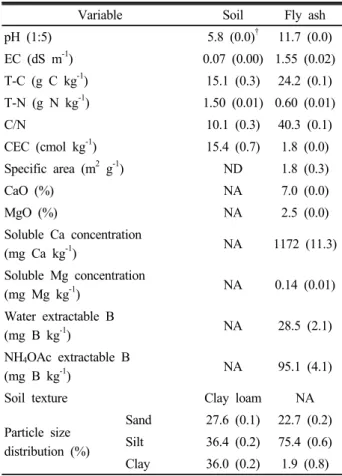
Table 1. Selected properties of soil and fly ash used.
Variable Soil Fly ash
pH (1:5) 5.8 (0.0)† 11.7 (0.0)
EC (dS m-1) 0.07 (0.00) 1.55 (0.02)
T-C (g C kg-1) 15.1 (0.3) 24.2 (0.1) T-N (g N kg-1) 1.50 (0.01) 0.60 (0.01)
C/N 10.1 (0.3) 40.3 (0.1)
CEC (cmol kg-1) 15.4 (0.7) 1.8 (0.0) Specific area (m2 g-1) ND 1.8 (0.3)
CaO (%) NA 7.0 (0.0)
MgO (%) NA 2.5 (0.0)
Soluble Ca concentration
(mg Ca kg-1) NA 1172 (11.3)
Soluble Mg concentration
(mg Mg kg-1) NA 0.14 (0.01)
Water extractable B
(mg B kg-1) NA 28.5 (2.1)
NH4OAc extractable B
(mg B kg-1) NA 95.1 (4.1)
Soil texture Clay loam NA
Particle size distribution (%)
Sand 27.6 (0.1) 22.7 (0.2) Silt 36.4 (0.2) 75.4 (0.6) Clay 36.0 (0.2) 1.9 (0.8) ND, Not determined; NA, Not applicable.
†Values in parentheses are standard errors (n=3).
Meijide et al., 2010) 경운 등 보존적 토양 관리를 통한 토 양 탄소 무기화 속도 조절에 의해 CO2 배출을 억제하여 간 접적으로 증가시킬 수 있다 (Halvorson et al., 2002).
하지만, 이와 같은 고전적인 토양관리와 시비관리에 의 한 탄소격리량 증대는 한계가 있기 때문에 비산재나 바이오 차와 같은 비표면적이 큰 물질을 투입하여 유기물과의 결합 을 통해 미생물에 대한 분해 저항성을 증대 시킬 필요가 있 다고 제안된 바 있다 (Jastrow et al., 2007). 석탄 화력발전 소 부산물인 비산재는 석탄 원료에 따라 특성이 상이하지만 대부분 주성분인 SiO2와 Al2O3 이외에 CaO, MgO 등 다양한 알칼리성 금속산화물을 포함하는 강알칼리성 (>pH 11) 물질 이다 (Jala and Goyal, 2006). 비록 비산재에 함유된 독성 원소 (특히 붕소)에 의해 농경지 토양 시용이 제한되어 있지 만, 우리나라와 같은 산성토양에서 알칼리성 비산재 처리에 의한 토양 개량과 작물 생장 증대 효과가 보고된 바 있기 때문에 비산재 처리에 의한 근권 뿌리 생장 증대 및 지상부 환원에 의한 토양탄소 저장량 증대가 기대된다 (Lee et al., 2006). 또한, Maroto-Valer el al. (2008)과 Montez-Hernandez et al., (2009)은 비산재가 가스 형태의 CO2를 흡착할 수 있 음을 보고하였으며, 최근 Lim et al. (2012b)은 토양과 비 산재를 다양한 비율로 혼합하여 탄소원으로 글루코스를 처 리한 조건에서 비산재의 구성원소중 Ca 또는 Mg의 산화물 (CaO과 MgO), 수산화물 (Ca(OH)2과 Mg(OH)2) 및 이온 (Ca2+과 Mg2+)이 토양수내의 탄산이온 (CO32-
)과 결합하는 탄산염화 (carbonation)에 의해 CaCO3나 MgCO3의 형태로 CO2가 침전되어 CO2 방출을 억제할 수 있다고 하였지만 후 속 연구는 부족하다.
CH4은 CO2와 함께 대표적인 온실 가스로서 주로 혐기적 조건에서 발생하며, 특히 작물생육기간 대부분이 호기적인 조건으로 유지되는 밭과는 달리 일정 기간 동안 담수상태 와 건조상태가 반복되는 논에서 배출되는 CH4은 전 세계 육 상생태계에서 배출되는 온실가스양의 10~15%에 해당한다 (Chen et al., 2011; IPCC, 2007; Nyberg et al., 2002). 토 양으로부터 CH4 발생은 수분조건, 화학비종, 유기물의 화학 적 안정도, 토양 반응 (pH), 전자 수용체 (Fe3+, Mn4+, SO42-
, NO3-
)농도에 영향을 받는 것으로 알려져 있다 (Bédard and Knowles, 1989; Hűtsch, 1998; Lim et al., 2012a; Mer and Roger, 2001). 그 중 토양 pH는 메탄 생성균 (methanogenes) 활성에 직접적으로 영향을 주는데, 메탄 생성균은 pH 5.0∼
8.0에서 안정적으로 활동하며 특히 중성과 약알칼리성에서 활동성이 가장 큰 것으로 알려져 있다 (Dalal et al., 2008;
Mer and Roger, 2001). 따라서, 비산재와 같은 강알칼리성 개량제가 산성 토양에 투입되었을 때 토양 pH 개량에 의해 CH4 발생이 증가할 가능성이 있지만 (Dunfield et al., 1993;
Mer and Roger, 2001) 이에 대한 실험적 증거는 충분하지 못하다. 따라서, 본 연구에서는 향후 농경지 토양에서 CO2
및 CH4 발생 저감을 위한 토양개량제로서의 비산재의 활용 가능성을 탐색하기 위한 예비 연구의 한 방편으로 농경지 토양을 대상으로 수분변동조건에서 비산재 처리 수준에 따 른 CO2와 CH4 방출량을 조사하였다.
재료 및 방법
시험재료 시험토양은 전남대학교 부속 논에서 표토 (0-20 cm)를 채취하였으며, 이 토양은 미 농무성 Soil taxonomy 에 의하면 coarse loamy, mixed, nonacid, mesic family of Fluvaquetic Endoaquepts (석천통)로 분류되며 토성은 식양 토였다. 채취한 토양을 풍건한 후 2 mm 체를 통과한 시료 를 대상으로 토양산도 (pH), 전기전도도 (EC), 총탄소, 총질 소, 양이온교환용량 (CEC), 토성을 분석하였다 (Table 1).
pH는 토양과 증류수의 비를 1:5 (w/v)로 혼합하여 150 rpm 에서 30분 진탕한 후 pH meter (Ecomet P25, Istek, Inc, Korea)를 이용하여 측정하였으며, EC는 pH 측정 후 #42 여 과지로 여과한 토양용액을 EC meter (Orion 3 star, Thermo, Singapore)를 이용하여 측정하였다. 양이온교환용량 (CEC) 은 토양 10 g에 NH4OAc-Ethanol-NaCl 연속 침출하여 침
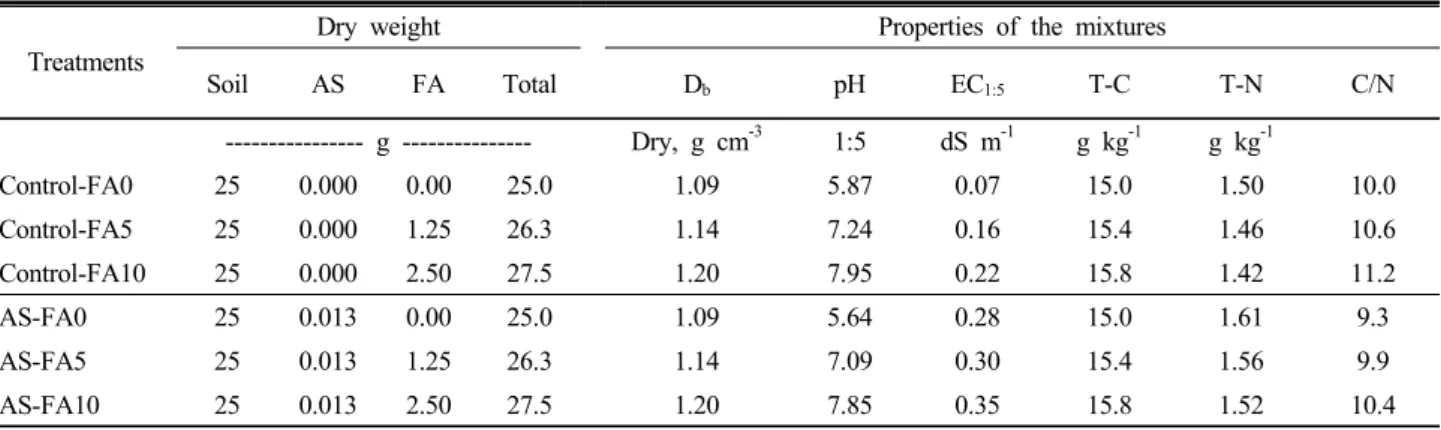
Table 2. Treatments laid out and properties of the soil without (control) or with ammonium sulfate (AS) after mixing with fly ash (FA) at 0% (FA0), 5% (FA5), and 10% (FA10).
Treatments
Dry weight Properties of the mixtures
Soil AS FA Total Db pH EC1:5 T-C T-N C/N
--- g --- Dry, g cm-3 1:5 dS m-1 g kg-1 g kg-1
Control-FA0 25 0.000 0.00 25.0 1.09 5.87 0.07 15.0 1.50 10.0
Control-FA5 25 0.000 1.25 26.3 1.14 7.24 0.16 15.4 1.46 10.6
Control-FA10 25 0.000 2.50 27.5 1.20 7.95 0.22 15.8 1.42 11.2
AS-FA0 25 0.013 0.00 25.0 1.09 5.64 0.28 15.0 1.61 9.3
AS-FA5 25 0.013 1.25 26.3 1.14 7.09 0.30 15.4 1.56 9.9
AS-FA10 25 0.013 2.50 27.5 1.20 7.85 0.35 15.8 1.52 10.4
출액을 켈달증류기로 증류하여 측정하였다 (Sumner and Miller, 1996). 입경분포 (clay:silt:sand)는 pipette법으로 분 석하였으며, 토성은 미농무성 분류기준을 따랐다 (Gee and Bauder, 1986). 건조 토양 중 일부를 고운 분말 (<0.42 mm) 로 만든 후 탄소와 질소함량을 원소분석기 (FLASHEA-1112, Thermo, USA)로 분석하였다.
비산재는 하동화력발전소에서 수집하였으며, pH, EC, 총 탄소, 총질소, CEC, 입경분포는 토양분석법과 동일한 방 법으로 분석하였다 (Table 1). 비산재의 주요광물은 X-ray diffraction (XRD; D5005, Bruker, Germany)로 원소구성은 X-ray fluorescence (XRF; S4 Pionner, Bruker AXS, Germany)로 분석하였다. 수용성 칼슘, 마그네슘 및 붕소 함 량은 비산재와 증류수를 1:5로 진탕 후 여과한 여액을 ICP-AES (Optima-7000DV, PerkinElmer, Boston, USA)로 분석하였으며, NH4OAc-침출태 붕소 함량은 양이온교환용 량에서 NH4OAc로 침출한 여액을 이용하여 ICP-AES로 분 석하였다. 비산재의 pH는 11.7로 강알칼리성을 나타냈으며, CaO와 MgO가 각각 7.0%, 2.5%로 나타났다.
시험구 처리 및 항온배양시험 시비처리는 무처리 (control)와 유안 ((NH4)2SO4) 처리구 (AS, 110 kg N ha-1 기 준 처리)를 두었으며, 각 시비 처리구에서 비산재 (FA)를 무 처리 (FA0), 무게기준 5% 처리 (FA5), 10% 처리 (FA10)하였 으며, 3반복 실험하였다 (Table 2). 구체적으로 Septa 마개 가 있는 50 mL 유리병에 토양 25 g을 충진 하고 수분함량을 25% (v/v)로 조절한 후 25℃에서 5일간 사전배양 하여 미생 물 활성을 회복시켰다. 별도의 플라스틱용기에 동일하게 비 산재와 비료를 처리한 후 pH와 EC를 측정하였으며, 총탄 소, 총질소, 탄질비는 공시재료의 이화학성을 기준으로 계 산하였다 (Table 2). 시료가 충진된 각 유리병에 수분을 공 급하여 담수심을 표토에서 1 cm 높이로 조절한 후 25℃에 서 60일간 항온배양실험을 수행하였다.
항온배양실험 중에 충분한 산소가 공급될 수 있도록 마
개를 열어두었다. 담수심 1 cm를 유지하기 위해 매일 부족 한 수분을 공급하였으며, 수분 변동 조건을 모의하기 위해 30일째에 과잉의 수분을 제거하고 수분공급을 중단하여 혐 기적인 조건에서 호기적인 조건으로 전환시켰다. 별도의 유 리병에 동일한 처리를 한 후 산화환원전위계 (RM-20P, TOA, DKK, Japan)를 설치하여 산화환원전위 (Eh)를 주기 적으로 모니터링 하였으며, 동시에 유리병을 칭량하여 수분 함량을 계산하였다.
가스 flux 측정 및 분석 항온 배양 2, 4, 15, 30, 35, 40, 50, 60일 째에 유리병의 마개를 닫고 0, 10, 20분 간격 으로 유리병 상단부 공간 (headspace)에서 1-mL syringe로 가스를 채취하여 가스크로마토그래피 (7890A GC system with methanizer, Agilent Technologies, USA)로 CH4과 CO2
농도를 측정하였다. 가스크로마토그래피의 칼럼은 Porapak Q를 사용하였으며, 온도는 column 50℃, Front inlet 250℃, FID 300℃, methanizer 375℃이었고, Flow rate는 column 이 N2 15 mL min-1, FID가 H2 45 mL min-1, Air 400 mL min-1, N2 0.3 mL min-1, methanizer가 H2 45 mL min-1였다. 가스 크로마토그래피에서 분석된 CH4과 CO2 농도 변화로부터 다 음의 식을 이용하여 flux를 계산하였다 (Denmead, 1995).
Flux (mg CH4 m-2 day-1또는 mg CO2 m-2 day-1) = ρ × V / A × ⊿C / ⊿t × 273 / T
계산식에서 ρ는 CH4과 CO2의 밀도 (0℃ 기준; CH4 0.716 g L-1, CO2 1.963 g L-1)이고, V와 A는 각각 유리병의 상단 부 공간의 체적 (m3)과 바닥면적 (m2), ⊿C/⊿t는 단위 시 간당 CH4 또는 CO2의 농도변화 (mg L-1 hr-1), T는 유리병 내부의 평균온도 (273+℃)이다.
계산 및 통계분석 CO2와 CH4의 지구온난화지수 (GWP)를 고려하여 전체 GWP를 탄소당량 (g C m-2 day-1)으
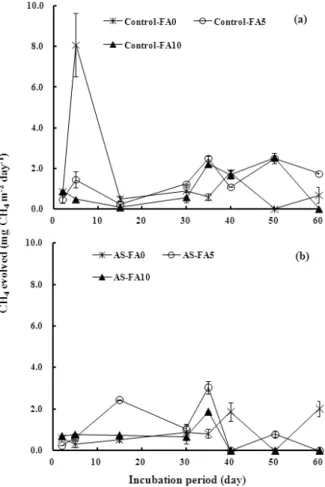
Fig. 1. Temporal changes in CH4 flux of the incubated soils amended with different rates of fly ash: (a) without ammonium sulfate and (b) with ammonium sulfate. Vertical bars are standard errors of the means of tripicated (n=3).
Treatments code are described in Table 2.
로 계산하였다 (IPCC, 2001). 질소 처리와 비산재 처리 수준 에 따른 CH4 및 CO2 flux 차이는 SPSS 17.0 (SPSS Inc.
Chicago, IL)의 일반선형모형을 이용한 ANOVA 분석으로 평 가하였으며, 처리효과가 인정될 경우 Duncan의 다중비교를 통해 처리 간 차이를 비교하였다 (α=0.05).
결과 및 고찰
Eh 및 수분함량 변화 본 연구는 비료 종류 및 토양개 량제 투입에 따른 CO2와 CH4 방출 특성을 구명하기 위해 수 행된 다양한 연구의 일부로 수행되었으며, Eh 및 수분함량 변화는 이미 Lim et al. (2012a)에 이미 보고되었다. 개략적 으로 설명하면, 산화환원전위차는 처리간 차이가 나타나지 않았으며, 담수 직후 200 mV에서 30일까지 Eh가 -400 mV 까지 지속적으로 감소하였고, 수분공급을 중단한 30일 이후 부터 지속적으로 증가하여 50일 이후부터는 약 500 mV를 유지하였다 (Lim et al., 2012a). 수분함량도 이에 상응하게 30일까지는 포화상태를 유지하였으며, 건조기간을 모의하
기 위해 담수를 제거한 이후 지속적으로 감소하여 최종 수 분함량은 33%였다 (Lim et al., 2012a). 따라서, 토양수분변 동을 기준으로 항온 배양기간 0~30일까지는 습윤기간, 30~40일은 전이기간, 40~60일은 건조기간으로 구분할 수 있었다.
CH4 flux 항온배양 실험기간 동안 질소 무처리구와 처 리구의 CH4 flux는 각각 0~8.1 mg CH4 m-2 day-1와 0~3.0 mg CH4 m-2 day-1 범위로 (Fig. 1) 일반적으로 담수 논 조건 에서 보고된 CH4 flux (0~1,980 mg CH4 m-2 day-1)보다 낮 았다 (Mer and Roger, 2001; Yun et al., 2012). 이는 전체 CH4 배출량의 90% 이상이 벼의 통기조직을 통한 확산으로 발생되지만 본 연구에서는 벼가 없는 실내 항온 배양실험 조건에서 수행되었기 때문으로 판단된다 (Mer and Roger, 2001; Yun et al., 2012). 습윤 기간 중 질소 무처리구에서 는 담수 처리 후 5일째 최대 flux가 관측된 반면, 질소 처 리구에서는 15일째 최대 flux가 나타났는데 (Fig. 1), 이는 시용된 유안 (0.38 g SO42-
kg-1 soil)의 SO42-
이 전자수용체 로 작용하여 CH4 생성이 억제되었기 때문으로 판단된다 (Bédard and Knowles, 1989). 하지만, 수분 전이기간에 해 당하는 35일째에는 질소 처리 여부와 상관없이 모두 CH4 배 출량이 증가하였는데 (Fig. 1), 이는 습윤기간 중 토양에 잔 류되어 있던 CH4이 수분 공급이 중단된 전이기간에 형성된 통기성 공극을 통해 배출되었기 때문으로 판단된다 (Dalal et al., 2008; Lim et al., 2012a).
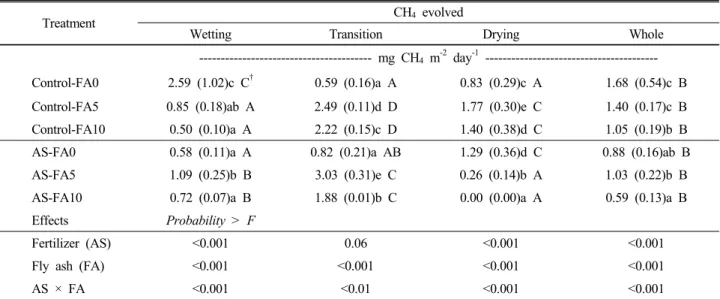
항온배양 전체 기간의 평균 CH4 flux는 질소 무처리구가 1.05~1.68 mg CH4 m-2 day-1로 질소 처리구의 0.59~1.03 mg CH4 m-2 day-1보다 높았는데 (Table 3), 이는 앞에서 언 급한 바와 같이 질소 처리시 함께 시용된 SO42-
의 전자 수 용체 기능에 의한 것으로 판단된다 (Bédard and Knowles, 1989). 본 연구에서 AS-FA5를 제외하고 각 질소 처리구내 에서 비산재 처리에 의해 CH4 flux가 통계적으로 유의하게 (P<0.001) 감소하였으며, 특히 대조구에 비해 비산재 10%
처리에 의해 질소 무처리구에서 37.5%, 질소 처리구에서 33.0% 감소하였다 (Table 3). 알칼리성 비산재 처리에 일반 적으로 토양의 pH가 상승되는데, 본 연구에서도 토양 pH가 5.87에서 최대 7.95로 상승하였다. 일반적으로 CH4 생성 균은 토양 pH가 중성이나 약알칼리성에서 가장 활동도가 높은 것으로 보고되고 있기 때문에 (Dalal et al., 2008;
Inobushi et al., 2005; Mer and Roger, 2001; Wang et al., 1993), 본 연구 결과는 이에 대치된다. 또한, 비록 비산재에 함유된 붕소와 같은 독성 물질 및 높은 염농도에 의해 토양 미생물 활동 저해 가능성이 제기된 바 있지만 (Nable et al., 1997), 본 연구에서 사용된 비산재와 동일한 비산재를 이용 하여 미생물 호흡을 조사한 결과에 의하면 전체 미생물 활 동 저해는 나타나지 않았다 (Lim et al., 2012b). 따라서, 본
Table 3. Mean values of CH4 flux measured during wetting, transition, drying, and whole periods of incubation.
Treatment CH4 evolved
Wetting Transition Drying Whole
--- mg CH4 m-2 day-1 --- Control-FA0 2.59 (1.02)c C† 0.59 (0.16)a A 0.83 (0.29)c A 1.68 (0.54)c B
Control-FA5 0.85 (0.18)ab A 2.49 (0.11)d D 1.77 (0.30)e C 1.40 (0.17)c B
Control-FA10 0.50 (0.10)a A 2.22 (0.15)c D 1.40 (0.38)d C 1.05 (0.19)b B
AS-FA0 0.58 (0.11)a A 0.82 (0.21)a AB 1.29 (0.36)d C 0.88 (0.16)ab B
AS-FA5 1.09 (0.25)b B 3.03 (0.31)e C 0.26 (0.14)b A 1.03 (0.22)b B
AS-FA10 0.72 (0.07)a B 1.88 (0.01)b C 0.00 (0.00)a A 0.59 (0.13)a B
Effects Probability > F
Fertilizer (AS) <0.001 0.06 <0.001 <0.001
Fly ash (FA) <0.001 <0.001 <0.001 <0.001
AS × FA <0.001 <0.01 <0.001 <0.001
Treatments codes are provided in Table 2.
Values in parentheses are standard errors (n=3).
†Data followed by different lowercase letters indicate significant fly ash effect and by different uppercase letters indicate significant water regime effect at a=0.05.
Fig. 2. Temporal changes in CO2 flux of the incubated soils amended with different rates of fly ash: (a) without ammonium sulfate and (b) with ammonium sulfate. Vertical bars are standard errors of the means of tripicated (n=3).
Treatments code are described in Table 2.
연구에서 비산재 처리에 의한 CH4 flux 감소는 미생물 활성 에 대한 직접적인 영향보다는 미세입자인 실트 (75.4%)로 구성된 비산재 혼합에 의해 전용적밀도 (FA0, 1.09 g cm-3; FA5, 1.14 g cm-3; FA10, 1.20 g cm-3)의 증가와 이에 따른 통기성(예를 들면, 대공극) 공극율이 감소되어 CH4 확산 속 도가 저감되었기 때문으로 판단된다 (Chang et al., 1977).
또한, 토양에서 CH4 생성은 아세트산 발효 (CH3COOH → CH4 + CO2)와 이산화탄소 환원 (CO2 + H2 → CH4)에 의해 생성되는데 (Mer and Roger, 2001), 서론에서 언급한 바와 같이 비산재는 용액 중 CO2를 탄산염의 형태로 침전시키는 특성이 있기 때문에 이산화탄소 환원에 필요한 CO2 농도가 감소하여 CH4 발생량이 감소했을 가능성도 존재한다 (Lim et al., 2012b).
CO2 flux CO2 flux는 질소 무처리구와 처리구에서 각 각 0.4~1.8 g CO2 m-2 day-1과 0.4~1.2 g CO2 m-2 day-1으 로 분포하였으며 경시적으로 감소하였다. 시기적으로 습윤 기간 초기에 CO2 flux가 최대치를 보인 후 경시적으로 감소 하다가 전이기간에 다시 증가하는 경향을 보였다 (Fig. 2).
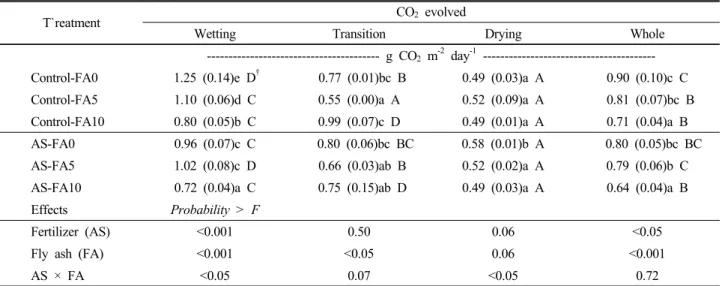
일반적으로 농경지 토양에서는 질소 투입에 의해 유기물 분 해가 촉진되어 CO2 발생이 증가되는 것으로 알려져 있는데 (Lee et al., 2011), 본 연구에서는 질소 무처리구의 최대 CO2 flux가 처리구에 비해 높았다 (Fig. 2). 이는 CO2 flux 측정 시점과 관련된 것으로 판단되는데, 본 연구에서는 최 초 flux 측정 시점이 처리 후 2일인 반면 외부로 부터의 물 질 (유기물과 양분) 공급에 의한 토양 미생물 활성 반응은 이 보다 더 빠를 수 있다. 예를 들면, Lim et al. (2012b)이
본 연구와 동일한 토양을 사용하여 토양 호흡을 조사한 결 과에 의하면 이분해성 유기물 투입 6 시간 후에 최대 CO2
Table 4. Mean values of CO2 flux measured during wetting, transition, drying, and whole periods of incubation.
T`reatment CO2 evolved
Wetting Transition Drying Whole
--- g CO2 m-2 day-1 --- Control-FA0 1.25 (0.14)e D† 0.77 (0.01)bc B 0.49 (0.03)a A 0.90 (0.10)c C
Control-FA5 1.10 (0.06)d C 0.55 (0.00)a A 0.52 (0.09)a A 0.81 (0.07)bc B
Control-FA10 0.80 (0.05)b C 0.99 (0.07)c D 0.49 (0.01)a A 0.71 (0.04)a B
AS-FA0 0.96 (0.07)c C 0.80 (0.06)bc BC 0.58 (0.01)b A 0.80 (0.05)bc BC
AS-FA5 1.02 (0.08)c D 0.66 (0.03)ab B 0.52 (0.02)a A 0.79 (0.06)b C
AS-FA10 0.72 (0.04)a C 0.75 (0.15)ab D 0.49 (0.03)a A 0.64 (0.04)a B
Effects Probability > F
Fertilizer (AS) <0.001 0.50 0.06 <0.05
Fly ash (FA) <0.001 <0.05 0.06 <0.001
AS × FA <0.05 0.07 <0.05 0.72
Treatments codes are provided in Table 2.
Values in parentheses are standard errors (n=3).
†Data followed by different lowercase letters indicate significant fly ash effect and by different uppercase letters indicate significant water regime effect at a=0.05.
Table 5. Global warming potential (GWP) of CO2, CH4, and total in CO2 equivalent from the soils during the whole incubation periods.
T`reatment CH4 GWP CO2 GWP Total GWP
g C m-2 day-1 g C m-2 day-1 g C m-2 day-1
Control-FA0 0.029 (0.009)d† 0.246 (0.027)d 0.275 (0.018)d
Control-FA5 0.024 (0.003)c 0.222 (0.019)c 0.246 (0.003)c
Control-FA10 0.018 (0.003)d 0.194 (0.012)b 0.212 (0.002)b
AS-FA0 0.015 (0.003)ab 0.218 (0.014)c 0.233 (0.002)c
AS-FA5 0.018 (0.004)b 0.215 (0.017)c 0.233 (0.004)c
AS-FA10 0.010 (0.002)a 0.174 (0.010)a 0.185 (0.001)a
Effects Probability > F
Fertilizer (AS) <0.001 <0.001 <0.001
Fly ash (FA) <0.001 <0.01 <0.001
AS × FA 0.06 0.27 0.07
Treatments codes are provided in Table 2.
Values in parentheses are standard errors (n=3).
†Data followed by different lowercase letters indicate significant fly ash effect at a=0.05.
flux가 관측되었다. 이와 같은 이유로 전체 항온 배양 기간 의 평균 CO2 flux 역시 질소 무처리구 (0.71~0.90 g CO2
m-2 day-1)가 질소 처리구 (0.64~0.80 g CO2 m-2 day-1)보다 높은 것으로 판단된다 (Table 4).
CH4과 유사하게 CO2 flux도 비산재 처리에 의해 유의하 게 (P<0.001) 감소하였으며, 비산재 무처리구에 비해 비산 재 10% 처리구에서 약 20% 감소하였다 (Table 4). 비산재 처리에 따른 토양 호흡 변화에 대해서 다양한 연구 결과가 보고되고 있다 (Pandey and Singh, 2010; Klubek, et al., 1992). 예를 들면, 비산재에 포함되어 있는 일부 미량원소 (철, 망간, 구리)와 다량원소 (인, 칼리, 칼슘, 마그네슘)에
의한 양분공급 효과로 토양 호흡이 활성화 될 수 있지만 (Pandey and Singh, 2010), 비산재의 높은 pH와 전기전도 도, 그리고 고농도의 붕소는 토양호흡을 감소시킬 수 도 있 으며 (McCarty et al., 1994), 이들 긍정적 및 부정적 요인의 상호작용에 의해 토양 호흡량에 변화가 나타나지 않을 수도 있다 (Wong and Wong, 1986). 특히, 붕소 독성과 관련된 연 구가 다양하게 진행되어 왔는데, 비산재에 포함되어 있는 붕소의 농도는 10~618 mg B kg-1으로 보고되고 있지만, 비 산재의 알칼리 특성상 미생물에 독성을 갖는 붕소의 유효도 가 감소하여 독성이 높지 않을 수 도 있다 (Jala and Goyal, 2006; Nable et al., 1997; Pandey and Singh 2010). 또한,
Lee et al. (2008)은 국내에서 생산된 비산재의 총 붕소함량 중 생물에 유효한 붕소함량은 3%미만인 것으로 보고하였으 며, 특히 본 연구와 비산재와 토양을 사용하여 연구한 Lim et al. (2012b)에 의하면 토앙에 비산재를 2~50% 수준으로 투입하였을 때 미생물 독성에 의한 토양 호흡 감소가 나타 나지 않은 반면, 탄산염 형성에 의한 비산재의 CO2 제거율 이 10.7 g C kg-1으로 보고한 바 있다. 따라서, 이와 같은 연 구 결과를 종합하면 본 연구에서 나타난 비산재에 의한 CO2
flux 감소의 주요 기작은 비산재의 원소 구성 중 Ca과 Mg과 토양수내 탄산이온의 탄산염 (CaCO3 및 MgCO3)화 반응에 의한 CO2 침전으로 판단된다 (Lim et al., 2012b; Montes- Hernandez et al., 2009).
지구온난화지수 질소 무처리구의 전체 GWP는 0.212
~0.275 g C m-2 day-1로 질소 처리구 (0.185~0.233 g C m-2 day-1)보다 높았는데, 이는 앞에서 언급한 바와 같이 질소 처리구에서 SO42-
에 의한 CH4 생성 감소 및 CO2 flux 측정 시점과 발생 시점의 차이에 의한 미측정 CO2 발생 때문이다 (Table 5). GWP는 비산재 처리에 의해서 유의하게 (P<0.001) 감소하였으며, 감소폭은 비산재 10% 처리구에서 가장 높았 는데 질소 무처리구와 처리구에서 비산재 10% 처리에 의해 GWP가 각각 23%와 21% 감소하였다.
요 약
비산재 혼합에 의한 CH4 과 CO2 방출 저감 가능성을 조 사하기 위해 질소 ((NH4)2SO4) 무처리구와 처리구를 두고 비산재를 0, 5, 10% 수준으로 혼합한 후 토양 수분 변동조 건 (습윤기간, 전이기간, 건조기간)에서 60일간 실험실내 항온배양실험을 통해 CH4과 CO2 flux를 분석하였다. 전체 항온배양기간 중 평균 CH4 flux는 0.59~1.68 mg CH4 m-2 day-1의 범위였으며, 질소 무처리구에 비해 처리구에서 flux 가 낮았는데, 이는 질소 처리시 함께 시용된 SO42-
의 전자 수용체 기능에 의해 CH4 생성이 억제되었기 때문으로 판단 되었다. 질소 무처리구와 처리구에서 비산재 10% 처리에 의 해 CH4 flux가 각각 37.5%와 33.0% 감소하였는데, 이는 물 리적인 측면에서 미립질 (실트 함량 75.4%)인 비산재 시용 에 의해 통기성 대공극량이 감소되어 CH4 확산 속도가 저감 되었기 때문으로 판단되었다. 또한, 생화학적 측면에서는 비산재의 CO2 흡착능에 의해 CH4 생성의 주요 기작 중 하나 인 이산화탄소 환원에 필요한 CO2 공급이 억제된 것도 원인 일 수 있다. 한편, 전체 항온 배양 기간의 평균 CO2 flux (0.64~0.90 g CO2 m-2 day-1) 역시 질소 무처리구가 질소 처리구보다 높았다. 이는 일반적으로 질소 시비에 의해 토 양 호흡량이 증가한다는 기존의 연구결과와는 상이한데, 본
연구에서 질소 처리에 의해 활성화된 미생물에 의해 CO2
flux 최초 측정 시점 (처리 후 2일째) 이전에 이미 상당한 양 의 CO2가 이미 방출되어 실측 flux에 반영되지 못했기 때문 으로 설명이 가능했다. CH4과 유사하게 CO2 flux도 비산재 무처리구에 비해 비산재 10% 처리구에서 약 20% 감소하였 는데, 이는 비산재의 원소 구성 중 Ca과 Mg과 토양수내 탄 산이온의 탄산염 (CaCO3과 MgCO3)화 반응에 의한 CO2 침 전 때문이다. 이상과 같은 비산재 처리에 의한 CH4과 CO2
flux 감소에 의해 지구온난화지수 역시 비산재 10% 처리구 에서 약 20% 감소하였다. 따라서, 비산재는 논 토양에서 CH4과 CO2 방출 저감에 효과가 있는 것으로 나타났으며, 실 재 벼 재배 포장에서의 실험을 통한 추가적인 검증이 필요 하다.
사 사
본 논문은 농촌진흥청 공동연구사업 (과제번호: PJ0074 0032012)의 지원에 의해 이루어진 것임.
인 용 문 헌
Bédard, C. and R. Knowles. 1989. Physiology, biochemistry, and specific inhibitors of CH4, NH4+, and CO oxidation by methanotrophs and nitrifiers. Microbiol. Mol. Biol. Rev.
53:68-84.
Chang, A.C., L.J. lund, A.L. Page, and J.E. Warneke. 1977.
Physical properties of fly ash amended soils. J. Environ.
Qual. 6(3):267-270.
Chen, R., X. Lin, Y. Wang, and J. Hu. 2011. Mitigating methane emissions from irrigated paddy fields by application of aerobically composted livestock manures in eastern China. Soil Use Manage. 27:103-109.
Dalal, R.C., D.E. Allen, S.J. Livesley, and G. Richards. 2008.
Magnitude and biophysical regulators of methane emission and consumption in the Australian agricultural, forest, and submerged landscapes: a review. Plant Soil 309:43-76.
Denmead, O.T. 1995. Novel meterological methods for measuring trace gas fluxes. Phil. Trans. R. Soc. Lond. A 351:383-396.
Dunfield, P., R. Knowles, R. Dumpont, and T.R. Moore.
1993. Methane production and consumption in temperate and subarctic peat soils - response to temperature and pH.
Soil Biol. Biochem. 25:321-326.
Ellert, B.H. and H.H. Janzen. 2008. Nitrous oxide, carbon dioxide and methane emission from irrigated cropping systems as influenced by legumes, manure and fertilizer.
Can. J. Soil Sci. 88:207-217.
Gee, G.W. and J.W. Bauder. 1986. Particle size analysis. p.
383-412. In Campbell, G.S. et al. (ed.) Methods of soil analysis, Part 1, Physical and mineralogical methods. Soil Sci. Soc. of Am., Madison, Wi, USA.
Halvorson, A.D., B.J. Wienhold, and A.L. Black. 2002.
Tillage, nitrogen, and cropping system effects on soil carbon sequestration. Soil Sci. Soc. Am. J. 66:906-912.
Hűtsch, B.W. 1998. Methane oxidation in arable soil as inhibited by ammonium, nitrite, and organic manure with respect to soil pH. Biol. Fertil. Soils 28:27-35.
Houghton, R.A. 2007. Balancing the global carbon budget.
Annu. Rev. Earth Pl. Sc. 35:313-347.
Inobushi, K., Y. Furukawa, N. Shibasaki, M. Ali., A.M. Itang, and H. Tsurta. 2005. Factors influencing methane emission from peat soils, comparison of tropical and temperate wetlands. Nutrient Cycl. Agroecosys. 71:93-99.
Intergovernmental Panel on Climate Change (IPCC). 2001.
Climate Change 2001: The Scientific Basis. Cambridge University Press, New York.
Intergovernmental Panel on Climate Change (IPCC). 2007.
Climate Change 2007: Mitigation. Contribution of working group Ⅱ to the fourth assessment report of the intergovern- mental panel on climatic change. Cambridge University Press, New York.
Jala, S. and D. Goyal. 2006. Fly ash as a soil ameliorant for improving crop production-a review. Bioresour. Technol.
97:1136-1147.
Jastrow, J.D., E.J. Amonette, and V.L. Bailey. 2007.
Mechanisms controlling soil carbon turnover and their potential application for enhancing carbon sequestration.
Climatic Change 80:5-23.
Klubek, B., C.L. Carson, J. Oliver, and D.C. Adriano. 1992.
Characterization of microbial abundance and activity from three coal fly ash basin. Soil Biol. Biochem. 24:1119-1125.
Lee, H., S.H. Ha, C.H. Lee, Y.B. Lee, and P.J. Kim. 2006. Fly ash effect on improving soil properties and rice productivity in Korean paddy soils. Bioresour. Technol. 97:1490-1497.
Lee, S.B., Y.B. Lee, C.H. Lee, C.O. Hong, P.J. Kim, and C.
Yu. 2008. Characteristics of boron accumulation by fly ash application in paddy soil. Bioresour. Technol. 99:5928- 5932.
Lee, S.I., S.S. Lim, K.S. Lee, D.S. Lee, J.H. Kwak, X. Hao, H.M. Ro, and W.J. Choi. 2011. Kinetic responses of soil carbon dioxide emission to increasing urea application rate.
Korean J. Envrion, Agric. 30:209-215.
Lim, S.S., W.J. Choi, and H.Y. Kim. 2012a. Fertilizer and organic inputs effects on CO2 and CH4 emission from a soil under changing water regimes. Korean J. Environ. Agric.
31(2):104-112.
Lim, S.S., W.J. Choi, K.S. Lee, and H.R. Ro. 2012b.
Reduction in CO2 emission from normal and saline soils amended with coal fly ash. J. Soils Sediment 12:1299-1308.
Mandal, B., B. Majumder, P.K. Bandyopadhay, G.C. Hazra, A. Gangopadhyay, R.N. Samantaray, A.K. Mishra, J.
Chaudhury, M.N. Saha, and S. Kundu. 2007. The potential of cropping systems and soil amendments for carbon sequestration in soils under long-term experiments in subtropical India. Global Change Biol. 13:357-369.
Maroto-Valer, M.M., Z. Lu, Y. Zhang, and Z. Tang. 2008.
Sorbents for CO2 capture from high carbon fly ashes. Waste Manage. 28:2320-2328.
McCarty, G.W., R. Siddaramappa, R.J. Wright, E.E. Codling, and G. Gao. 1994. Sorbents for CO2 capture from high carbon fly ashes. Waste Manage 28:2320-228.
Meijide, A., L.M. Cardenas, L. Sanchez-Martin, and A.
Vallejo. 2010. Caron dioxide and methane fluxes from a barely field amended with organic fertilizers under Medi- terranean climatic conditions. Plant Soil 328:353-367.
Mer, J.L. and P. Roger. 2001. Production, oxidation, emission and consumption of methane by soils: A review. Eur. J. Soil Biol. 37:25-50.
Montes-Hernandez, G., R. Prez-Lopez, F. Renard, J.M.
Nieto, and L. Charelt. 2009. Mineral sequestration of CO2
by aqueous carbonation of coal combustion fly-ash. J.
Hazard. Mater. 161:1347-1354.
Nable, R.O, G.S. Banuelos, and J.G. Paull. 1997. Boron toxicity. Plant Soil 193:181-198.
Nouchi, I. and S. Yonemura. 2005. CO2, CH4 and N2O fluxes from soybean and barely double-cropping in relation to tillage in Japan. Phyton-ann. Rei. Bot. A. 45:327-338.
Nyberg, G., A. Ekblad, R. Buresh, and P. Hὄgberg. 2002.
Short-term patterns of carbon and nitrogen mineralization in a fallow field amended with green manures from agroforesty trees. Biol. Fert. Soils 36:18-25.
Pandey, V.C. and N. Singh. 2010. Impact of fly ash incor- poration in soil systems. Agr. Ecosyst. Environ. 136:16-27.
Sumner, M.E. and W.P. Miller. 1996. Cation exchange capacity and exchange coefficient. p. 1201-1229. In Sparks, et al. (ed.) Methods of soil analysis, Part3, Chemical methods. Soil Sci. Soc. of Am., Madison, Wi, USA.
Wang, Z.P., C.W. Lindau, R.D. Delaune, and W.H. Patrick.
1993. Soil redox and pH effects on methane production in a flooded rice soil. Soil Science Soc. Am. J. 57:382-385.
Wong, M.H. and J.W.C. Wong. 1986. Effects of fly ash on soil microbial activity. Environ. Pollut. Ser. A. 40:127-144.
Yun, S.I., B.M. Kang, S.S. Lim, W.J. Choi, J. Ko, J. Yoon, H.M. Ro, and H.Y. Kim. 2012. Further understanding CH4
emission from a flooded rice field exposed to experimental with elevated [CO2]. Agric. For. Meteorol. 154-155:75-83.