* Corresponding author : Tae-Hwan Kim, Department of Animal Science, Institute of Agriculture Science and Technology, College of Agriculture & Life Science, Chonnam National University, Gwangju, 61186, Korea. Tel: +82-62-530-2126, Fax:
+82-62-530-2129, E-mail: [email protected]
Research Article
NH
3, CO
2and N
2O emissions in relation to soil mineralization from the soils amended with Different Manures in vitro Incubation
Xin-Lei Wang
1, Sang-Hyun Park
1, Qian Zhang
1, Bok-Rye Lee
1,2and Tae-Hwan Kim
1,*
1
Department of Animal Science, Institute of Agriculture Science and Technology, College of Agriculture & Life Science, Chonnam National University, Gwangju, 61186, Korea.
2
Biotechnology Research Institute, Chonnam National University, Gwangju, 61186, Korea
ABSTRACT
In order to compare greenhouse gases emission from different animal manures and to explore how different animal manures effect on soil mineralization, three kinds of materials, cattle, goat and chicken manure were amended to soil for 14 days incubation as CtS (cattle manure-amended soil), GS (goat manure-amended soil) and ChS (chicken manure-amended soil). Cumulative NH3 emissions in all treatments were rapidly increased until day 7 and then it was slightly increased in three manure-amended soils but maintained in control until day 14. GS had the highest NH3 emission at 0.14 mg kg-1 during the entire experimental period. Emissions of CO2 were highly increased by 7.8-, 9.0- and 12.4-fold in CtS, GS and ChS, respectively, compared to control at day 14. A significant increase of N2O emission in all treatments occurred within 5 days and then it was slightly increased until day 14. N2O emission was 2-fold higher in all manure-amended soils than that of control. Compared to day 1, inorganic N (NH4+ plus NO3--N) content was highly increased in all four treatments at day 14. The increase rate was the highest in CtS treatment. Net N mineralization was increased by 4.0-, 2.4- and 2.9-fold in CtS, GS and ChS, respectively, compared to control. These results indicate that increase of NH3, CO2
and N2O gas emissions was positively related to high N mineralization.
(Key words : Animal manure, Greenhouse gases emission, Mineralization)
Ⅰ. INTRODUCTION
Nowadays animal manure is used as fertilizer for agricultural crops worldwide because of increase of crop productivity.
Animal manures have lots of nitrogen (N), it can provide enough N for plant growth (Gilley and Eghball, 2002).
Generally, manure N is present in organic and inorganic forms but most of N is organic form. Because organic N is not used immediately by plants, organic N is firstly converted by soil microbes to inorganic forms, mainly ammonium (NH
4+) and nitrate (NO
3-) which are quickly taken up by plants (Rao and Batra, 1983; Sullivan et al., 2003). This is the process of mineralization. Therefore, the mineralization rate reflects available N for plant needs. The manure N mineralization is affected by manure types and incubation periods. Many studies reported that N mineralization rate varies among different types of animal manures. For example, mineralization of organic N from dairy manure and chicken manure averaged
35% and 41%, respectively (Van Kessel and Reeves, 2002). In addition, Abbasi et al. (2007) reported that the mineralization rate of cattle manure is rapid during initial 10-20 days and slow during last 90-120 days, as similar results in poultry manures (Bitzer and Sims, 1988).
Manure with high amount of nutrient such as nitrogen (N), potassium (K) and phosphorus (P) could generate environment hazards after application into soil. For example, N evaporation by NH
3and N
2O could bring about a bad influence on global warming and nutrient by leaching could raise water problems.
NH
3is defined as a primary pollutant gas released from farming industry. Moreover, carbon dioxide (CO
2) and N
2O released from soil are considered to be the main gases leading to global warming (Wang et al., 2005). Although CO
2is utilized as carbon source for plants, it should not be ignored because of large proportion of greenhouse gas emission (Philippe et al., 2007).
Moreover, emission by N
2O, which is released from nitrification
and denitrification processes, is also important. Comparing with
CO
2, N
2O is a 300-times more puissant greenhouse gas (USEPA, 2013). Besides, He et al. (2016) suggested that N
2O more effectively impacts on global warming caused by its capacity to trap solar energy. These greenhouse gases emissions mainly occurred during mineralization. However, the relationship between greenhouse gas emission and N mineralization during incubation was not fully understood.
The objectives of this study were to 1) compare contribution of different animal manures to gas emissions; 2) to explore how different animal manures effect on soil mineralization. To achieve this goal, three treated soils including cattle manure amended soil (CtS), goat manure amended soil (GS) and chicken manure amended soil (ChS) were incubated under a laboratory condition for 14 days.
Ⅱ. MATERIAL AND METHODS 1. Manure and soil preparation
Cattle manure, goat manure, chicken manure and a surface soil (0-15 cm) were collected from a local area in Gwangju, South Korea. After air drying, manure was homogenized by blender. Four millimeters sieved, air-dried soil was adjusted to attain at 20 % water content by adding distilled water and packed to the bulk density of field at 1.40 g cm
-3. Seven days pre-incubation was conducted to grow microorganism. Samples were ground to 0.2 mm to measure total N content and inorganic N (NH
4+-N + NO
3--N) content.
2. Laboratory incubation
Fourteen days of soil incubation was conducted in laboratory under 25 ± 1°C. Four treatments were prepared:
control (bared soil), cattle manure amended soil (CtS), goat manure amended soil (GS) and chicken manure amended the soil (ChS). For each repetition, 1.7 kg air-dried soil was added to a 5.7 L square chamber. The jar was sealed by a lid with a hole which was used for gas collection and air change. After the application of manure containing 200 mg N kg
-1, the soil was adjusted to obtain 60% water hold capacity (WHC). The chamber to incubate soil was attached to gas trapping bottles
which contains 10 mL of 0.2 M sulfuric acid to collect NH
3and 20 mL of 1.5 M sodium hydroxide to collect CO
2. A vacuum system with meter flow of 2 L min
-1was settled to pull air out through rubber tubes. Sulfuric acid was changed on day 1, 2, 3, 5, 7, 10, 12 and 14, while sodium hydroxide was changed on day 3, 8, 10, 11, 12, 13 and 14. To create an aerobic incubation environment, 1-hour of air exchange was allowed after renew of absorption solutions. The appropriate volume of distilled water was added to maintain the constant soil moisture. Soil and manure mixture were sampled at day 1 and day 14.
3. Chemical analysis
The pH measurement was regularly done after shaking a 1:5 (sample:water, w/v) solution for 1 h on a rotary shaker. Total nitrogen was determined using Kjeldahl procedure (Park et al., 2015). Inorganic nitrogen was determined by shaking 10 g of the sample with 50 mL of 2 M KCl. The extract was filtered through prewashed (2 M KCl) with Whatman’s filter paper.
NH
4+-N was determined by distillation in an alkaline medium (MgO). The same procedure was used for NO
3--N after reduction with Devarda’s alloy. Net N mineralization was calculated as the difference between post- and pre-incubation inorganic N (NH
4+-N + NO
3--N), which was referred to Hood et al. (2003), the equation was following: Soil N mineralization rate = [(NH
4+-N + NO
3--N + NH
3-N + N
2O-N) Day
T– (NH
4+-N + NO
3--N) Day
1] / T, where T was incubation period (day). Ammonia (NH
3) was analyzed by a colorimetric method with Nessler’s reagent (Kim and Kim, 1996). Carbon dioxide (CO
2) was detected by acid-base titration method, using phenolphthalein as indicator. N
2O gas was measured with a 10 mL BD vacutainer tube via a Gas Chromatograph (Agilent technologies 7890A).
4. Statistical analysis
Statistical analyses were conducted using the SAS 9.1.3
package. Duncan’s multiple range tests were used to compare
means of three replications between different animal manure
amended soils. Statistical significance was set at p ≤ 0.05.
Table 1. Chemical property of soil and animal manures used for the experiment.
Materials pH Total N
(g N kg
-1DM)
Inorganic N (mg N kg
-1DM)
NH
4+NO
3-Soil 6.04 0.3 ± 0.02
c11.4 ± 0.88
d7.9 ± 4.38
bCattle manure 9.31 22.9 ± 0.07
a614.3 ± 1.24
a3.5 ± 0.00
cGoat manure 8.52 21.0 ± 0.51
a354.4 ± 1.86
b23.6 ± 4.33
aChicken manure 6.63 4.7 ± 0.12
b95.4 ± 0.62
c2.6 ± 0.62
cValues are mean ± SE (n=3) of three biological replicates. Different letters in column indicate significant difference at p < 0.05 according to the Duncan’s multiple range test.
Fig. 1. Cumulative ammonia (NH
3) emission from control(only soil, ○), CtS (cattle manure amended soil, ●), GS (goat manure amended soil, ◆) and ChS (chicken manure amended soil, ■) for 14 days in vitro incubation. Data are mean ± SE (n=3). Different letters indicate significantly different at p < 0.05 according to the Duncan’s multiple range test.
Ⅲ. RESULTS AND DISCUSSION
Soil and manures used in this study were stated in Table 1.
We used clay soil with pH 6.04, and 0.3 g total-N kg
-1including 11.4 mg NH
4+-N kg
-1and 7.9 mg NO
3--N kg
-1. Cattle and goat manure were alkaline materials as pH 9.31 and 8.52, respectively. They contained high amount of N more than 21.0 g kg
-1. Compared to these, chicken manure showed the lowest content of total-N (4.7 g N kg
-1) and inorganic-N (95.4 mg NH
4+-N kg
-1and 2.6 mg NO
3--N kg
-1).
The patterns of the cumulative amount of NH
3emission after incubation are shown in Fig. 1. Cumulative amount of NH
3emissions from all manure treatments were continuously increased during 14 days. However, NH
3emission in control was gradually increased until day 7 and then maintained until day 14. The emission rate was relatively higher in all manure treatments than that in control throughout experimental period.
Especially, GS treatment showed the highest NH
3emission
(0.137 mg NH
3kg
-1) at day 14, compared to other treatments.
It has been reported that high NH
3emission is associated with high soil pH and high free NH
3concentration (Luo et al., 2004; Park et al., 2015). Thus, the higher NH
3emission in GS treatment is due to higher pH and NH
4+concentration compared to other treatment (Figs. 1 and 4).
The patterns of cumulative amount of N
2O emission was
shown in Fig. 2. The most important N
2O emission appeared
at earlier 5 days after incubation. Similarly, Guo et al. (2012)
found the highest N
2O emission within 1 week of the fertilizer
application. In this study, the highest total N
2O emission was
observed in CtS and GS treatments during initial 5 days of
incubation. It might due to the alkaline of cattle and goat
manure (Table 1) as suggested by Baggs et al (2010) who
reported that the difference of pH has ability to alter N
2O
emission, resulting higher N
2O emission in manure with high
pH. In addition, these results are associated with nitrification
and denitrification processes, because N
2O is generated as an
Fig. 2. Cumulative nitrous oxide (N
2O) emission from control (only soil, ○), CtS (cattle manure amended soil, ●), GS (goat manure amended soil, ◆) and ChS (chicken manure amended soil, ■) for 14 days in vitro incubation. Data are mean ± SE (n=3). Different letters indicate significantly different at p < 0.05 according to the Duncan’s multiple range test.
Fig. 3. Cumulative carbon dioxide (CO
2) emission from control (only soil, ○), CtS (cattle manure amended soil, ●), GS (goat manure amended soil, ◆) and ChS (chicken manure amended soil, ■) for 14 days in vitro incubation. Data are mean ± SE (n=3). Different letters indicate significantly different at p < 0.05 according to the Duncan’s multiple range test.
intermediate product (Philippe and Nicks, 2015).
As expected, carbon dioxide (CO
2) emission increased gradually in all three manure amended soils as incubation progressed (Fig. 3). These CO
2emissions occur when organic matter is decomposed by soil microbe (Dutta and Stehouwer, 2010). Compare to control, cumulative amount of CO
2emission in CtS, GS and ChS treatments were higher 7.8-, 9.0- and 12.4-fold, respectively (Fig. 3). Because chicken manure is composed mainly of feces, chicken manure is quickly decomposed than cattle and goat manure which are composed feces and urines (Krogdahl and Dalsgard, 1981). Similar results reported by Abbas and Fares (2009) who found the highest rate of CO
2emission in chicken manure correlated with high organic C.
Organic N is converted to inorganic N such as ammonium (NH
4+-N) and nitrate (NO
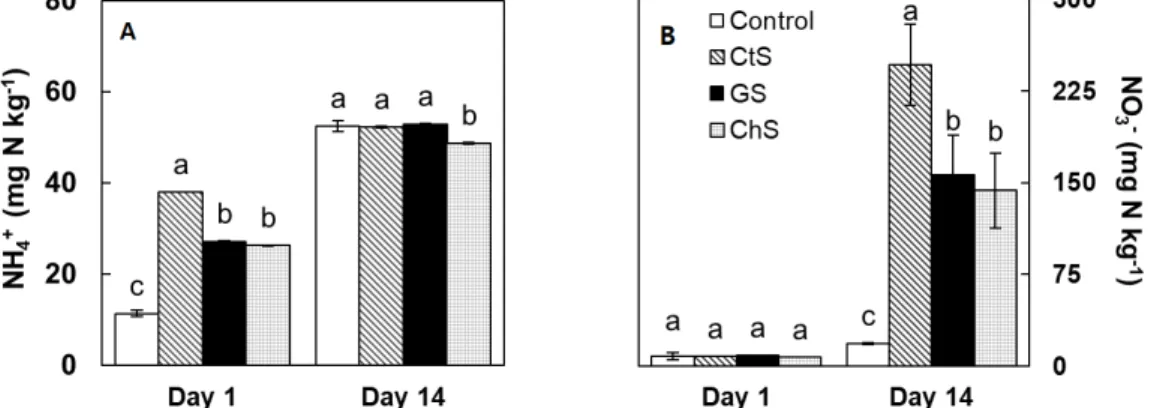
3--N) which is immediately available to plants. As expected the organic manure application produced higher amount of available NH
4+-N in soils compared to control. At day 1, NH
4+-N content was the highest in CtS treatment among the treatments (3.3-fold higher than control). It was 2-fold higher in GS and ChS treatments than that of control (Fig. 4). Compare to day 1, NH
4+-N content was largely increased more than 2-fold in all four treatments at day 14. NO
3--N content was not different between treatments at day 1, while it was increased rapidly in all treatments during 14 days except control. The increase rate in NO
3--N content was 2.3-, 32.0-, 18.1- and 20-fold in
control, CtS, GS and ChS treatment at day 14, respectively,
Fig. 4. Changes in amount of ammonium-N (NH
4+-N, A) and nitrate-N (NO
3--N, B) in the soil amended with control (only soil, □), CtS (cattle manure amended soil, ▧), GS (goat manure amended soil, ■) and ChS (chicken manure amended soil, ▦) for 14 days of in vitro incubation. Data are mean ± SE (n=3). Different letters indicate significantly different at p < 0.05 according to the Duncan’s multiple range test.
Fig. 5. Soil net nitrogen mineralization rate in the soil amended with control (only soil), CtS (cattle manure amended soil), GS (goat manure amended soil) and ChS (chicken manure amended soil) during 14 days of in vitro incubation. Data are mean ± SE (n=3). Different letters indicate significantly different at p < 0.05 according to the Duncan’s multiple range test.
compared to day 1. These results suggested that N availability of cattle manures was higher than chicken or goat manures (Fig. 4), similar results observed by Abbasi et al. (2007). Net mineralization of organic N was observed for all manures as measured by amount of total mineral N at the end of incubation subtract amount of initial mineral N of manures and control soils per incubation time. Mineralization of N from manures was significantly affected by manure type. The highest net N mineralization was observed in CtS treatment within 14 days (Fig. 5), followed by ChS and GS treatments.
These results were consistent with inorganic N content (Fig 4).
Generally, it has been known that C/N ratio of manure affects N mineralization (Cordovil et al., 2007; Abbas and Fares, 2009). In present study, the lowest CO
2emission was observed in CtS treatment (Fig. 3). The low CO
2emission may be
resulted in low organic C, followed by low C/N ratio, as suggested by Abbas and Fares (2009). Overall, these results indicate that cattle manure having high pH, NH
3+and N
2O emission, and low CO
2emission showed high net N mineralization.
Consequently, manures addition provided a beneficial
environment for microorganism, but also be able to lead to
global warming more due to greenhouse gases emission and N
losing. N mineralization rate had a similar sequence with
cumulative NH
3and N
2O emissions among different manures,
which implied a positive relationship between mineralization
and N losing by gas. Therefore, these results suggested that
cattle manure showed a comprehensive N provider potential
considering N content, gas emission and N mineralization. In
later experiment, N use efficiency through
15N isotope method
should be practiced to promote our knowledge of N cycling in system of plant-manure-soil.
Ⅳ. ACKNOWLEDGEMENTS
This study was financially supported by the Rural Development Administration Grant (RDA-PJ010099), Republic of Korea.
Ⅴ. REFERENCES
Abbas, F. and Fares, A. 2009. Soil organic carbon and carbon dioxide emission from an organically amended Hawaiian tropical soil. Soil Science Society of America Journal. 73:995-1003.
Abbasi, M.K., Hina, M., Khalique, A. and Khan, S.R. 2007.
Mineralization of three organic manures used as nitrogen source in a soil incubated under laboratory conditions. Communications in Soil Science and Plant Analysis. 38:1691-1711.
Baggs, E.M., Smales, C.L. and Bateman, E.J. 2010. Changing pH shifts the microbial source as well as the magnitude of N2O emission from soil. Biology and Fertility of Soils. 46:793-805.
Bitzer, C.C. and Sims, J.T. 1988. Estimating the Availability of Nitrogen in Poultry Manure through Laboratory and Field Studies. Journal of Environmental Quality. 1:47-54.
Cordovil, C.M.S., Cabral, F. and Coutinho, J. 2007. Potential mineralization of nitrogen from organic wastes to ryegrass and wheat crops. Bioresource Technology. 98:3265-3268.
Dutta, T. and Stehouwer, R.C. 2010. N2O and CO2 Emission from mine soil reclaimed with organic amendments. 19th World Congress of Soil Science, Soil Solutions for a Changing World. 1–6 August 2010, Brisbane, Australia. Published on DVD.
Gilley, J. E. and Eghball, B. 2002. Residual effects of compost and fertilizer applications on nutrients in runoff. American Society of Agricultural and Biological Engineers. 45:1905-1910.
Guo, L., Porro, J., Sharma, K., Amerlinck, A., Benedetti, L., Nopens, I., Shaw, A., Van Hulle, S.W.H., Yuan, Z. and Vanrolleghem, P.A.
2012. Towards a benchmarking tool for minimizing wastewater utility greenhouse gas footprints. Water Science and Technology.
66:2483-2495.
He, Z.Q., Pagliari, P.H. and Waldrip, H.M. 2016. Applied and Environmental Chemistry of Animal Manure: A Review. Pedosphere. 26:779-816.
Hood, R., Bautista, E. and Heiling, M. 2003. Goss mineralization and plant N uptake from animal manures under non-N limiting conditions, measured using 15N isotope dilution techniques.
Phytochemistry Reviws. 2:113-119.
Kim, T.H. and Kim, B.H. 1996. Ammonia microdiffusion and colorimetric method for determining nitrogen in plant tissues.
Journal of the Korean Society of Grassland Science. 16:253-259.
Krogdahl, A. and Dalsgard, B. 1981. Estimation of nitrogen digestibility in Poultry. Content and distribution of major urinary nitrogen compounds in excreta. Poultry Science. 60:2480-2485.
Luo, J., Kulasegarampillai, M., Bolan, N. and Donnison, A. 2004.
Control of gaseous emissions of ammonia and hydrogen sulphide from cow manure by use of natural materials. New Zealand Journal of Agricultural Research. 47:545-556.
Park, S.H., Lee, B.R. and Kim, T.H. 2015. Effects of Cattle Manure and Swine Slurry Acidification on Ammonia Emission as Estimated by an Acid Trap System. Journal of the Korean Society of Grassland and Forage Science. 35:212-216.
Philippe, F.X., Laitat, M., Canart, B., Vandenheede, M. and Nicks, B.
2007. Comparison of ammonia and greenhouse gas emissions during the fattening of pigs: kept either on fully slatted floor or on deep litter. Livestock Science. 111:144-152.
Philippe, F.X. and Nicks, B. 2015. Review on greenhouse gas emissions from pig houses: production of carbon dioxide, methane and nitrous oxide by animals and manure. Agriculture, Ecosystems &
Environment. 199:10-25.
Rao, D. L. N. and L. Batra. 1983. Ammonia volatilization from applied nitrogen in alkali soils. Plant and Soil. 70:219-228.
Sullivan, D.M., Bary, A.I., Nartea,T.J., Myrhe, E.A., Cogger, C.G. and Fransen, S.C. 2003. Nitrogen availability seven years after a high-rate food waste compost application. Compost Science and Utilization. 11:265-275.
United States Environmental Protection Agency (USEPA). 2013. Inventory of U.S. greenhouse gas emissions and sinks: 1990-2011. Available online at http://epa.gov/climatechange/Downloads/ghgemissions/US- GHG-Inventory-2013-Main-Text.pdf (verified on Jan. 17, 2014).
Van Kessel, J. and Reeves, J. 2002. Nitrogen mineralization potential of dairy manures and its relationship to composition. Biology and Fertility of Soils. pp. 118-123.
Wang, L.F., Cai, Z.C., Yang, L.F. and Meng, L. 2005. Effects of disturbance and glucose addition on nitrous oxide and carbon dioxide emissions from a paddy soil. Soil & Tillage Research.
82:185-194.
(Received : July 10, 2017 | Revised : August 23, 2017 | Accepted : August 28, 2017)