Korean J Environ Agric (2012) Online ISSN: 2233-4173 Vol. 31, No. 2, pp. 104-112 http://dx.doi.org/10.5338/KJEA.2012.31.2.104 Print ISSN: 1225-3537
토양 수분 변동 조건에서 시비 및 유기물 투입에 따른 CO
2
와 CH4
방출 특성임상선,1 최우정,1* 김한용2
1전남대학교 지역ㆍ바이오시스템공학과, 2전남대학교 식물생명공학부
Fertilizer and Organic Inputs Effects on CO2 and CH4 Emission from a Soil under Changing Water Regimes
Sang-Sun Lim,
1Woo-Jung Choi
1*and Han-Yong Kim
2(
1Department of Rural & Biosystems Engineering, Chonnam National University, Gwangju 500-757, Republic of Korea,
2Department of Applied Plant Science, Chonnam National University, Gwangju 500-757, Republic of Korea)
Received: 18 May 2012 / Accepted: 25 June 2012
ⓒ 2012 The Korean Society of Environmental Agriculture
*교신저자(Corresponding author),
Phone: +82-62-530-2153; Fax: +82-62-530-2159;
E-mail: [email protected]
104
Abstract
BACKGROUND: Agricultural inputs (fertilizer and organic inputs) and water conditions can influence CH
4and CO
2emission from agricultural soils. This study was conducted to investigate the effects of agricultural inputs (fertilizer and organic inputs) under changing water regime on CH
4and CO
2emission from a soil in a laboratory incubation experiment.
METHODS AND RESULTS: Four treatments were laid out: control without input and three type of agricultural inputs ((NH
4)
2SO
4, AS; pig manure compost, PMC; hairy vetch, HV). Fertilizer and organic inputs were mixed with 25 g of soil at 2.75 mg N/25 g soil (equivalent to 110 kg N/ha) in a bottle with septum, and incubated for 60 days.
During the first 30-days incubation, the soil was waterlogged (1 cm of water depth) by adding distilled water weekly, and on 30 days of incubation, excess water was discarded then incubated up to 60 days without addition of water. Based on the redox potential, water regime could be classified into wetting (1 to 30 days), transition (31 to 40 days), and drying periods (41 to 60 days). Across the entire period, CH
4and CO
2flux ranged from 0 to 13.8 mg CH
4/m/day and from 0.4∼1.9 g CO
2/m/day, and both were relatively higher in the early wetting period and the
boundary between transition and drying periods. During the entire period, % loss of C relative to the initial was highest in HV (16.4%) followed by AS (8.1%), PMC (7.5%), and control (5.4%), indicating readily decomposability of HV.
Accordingly, both CH
4and CO
2fluxes were greatest in HV treatment. Meanwhile, the lower CH
4flux in AS and PMC treatments than the control was ascribed to reduction in CH
4generation due to the presence of oxidized compounds such as SO
42-, Fe
3+, Mn
4+, and NO
3-that compete with precursors of CH
4for electrons.
CONCLUSION: Green manure such as HV can replace synthetic fertilizer in terms of N input, however, it may increase CH
4emission from soils. Therefore, co-application of green manure and livestock manure compost needs to be considered in order to achieve satisfactory N supply and to mitigate CH
4and CO
2emission.
Key Words: CH
4emission, CO
2emission, Organic input, Synthetic fertilizer, Water regime
서 론
농경지 토양은 기후변화 조건에서 기상 및 영농관리 조건에 따라 CH
4, CO
2, N
2O와 같은 온실가스(GHG
s, Greenhouse gases)의 배출원 또는 흡수원 으로 기능할 수 있다(Jastraw et al., 2007; Nouchi and Yonemura, 2005). 온실가스 배 출원의 측면에서는 실내 실험(Moore and Dalva, 1997;
Zheng et al., 2007), 포장 실험(Galang et al., 2007; Yan et al., 2007), 모델링(Blanco-Canqui and Lal, 2004)을 통
Open Access
Research Article
해 기후와 토지이용 형태별 CH
4과 CO
2발생량을 정량화하 기 위한 연구가 진행되고 있다. 한편, 흡수원의 측면에서는 작부체계(Ellert and Janzen, 2008; Mandal et al., 2007), 시비 관리(Ellert and Janzen, 2008; Meijide et al., 2010), 기상(Meijide et al., 2010; Mikha et al., 2005), 미생물 (Hou et al., 2000) 등의 개별 요인 및 이들 개별 요인의 상 호작용에 따른 토양 탄소 동역학 변동 기작을 해석하고, 더 나아가 토양으로부터 CH
4이나 CO
2발생 저감 또는 대기 탄 소를 토양에 저장시키는 탄소격리(Carbon sequestration)에 대한 연구가 활발히 진행되고 있다(Jastrow et al., 2007;
Powlson et al., 2011).
수분 조건과 비료 종류는 농경지 토양에서 CH
4과 CO
2방출에 대한 주요 영향 인자이다(Dalal et al., 2008; Jastraw et al., 2007; Mer and Roger, 2001; Shin et al., 2003). 예 를 들면, 밭과 달리 작물 생육기 중 일정 기간 동안 담수상태 에서 혐기적 토양 조건을 형성하는 논으로부터 발생되는 CH
4은 전 세계 육상생태계 배출량의 10∼15%를 차지한다(Chen et al., 2011; Hűtsch, 1998; IPCC, 2007; Nyberg et al., 2002). 또한, 벼 재배기 동안 일시적으로 배수시키는 중간낙 수 기간 동안 전체 벼 생육기간 동안에 배출되는 CH
4의 7%
가 발생하는 것으로 추정된 바 있다(Yagi et al., 1996).
비료 종류와 관련해서 화학비료 시용은 토양 미생물 활성 을 일시적으로 증가시키고 그 결과 토양 유기물 분해를 촉진 하여 CO
2방출이 증가할 수 있다(Iqbal et al., 2009). 한편, 유기물이 풍부하고 토양개량 및 양분공급효과가 우수하여 화 학비료를 대체할 수 있는 가축분 퇴비나 녹비는 이들 유기물 분해에 의한 CO
2의 발생량이 증가하지만, 그 정도는 투입되 는 유기물 기질의 특성에 따라 상이하다(Lee et al ., 2010;
Lim et al., 2011; Lim et al., 2012). 예를 들면, 탄소 무기 화 속도 및 무기화 가능한 탄소 용량(pool size)은 탄질비, 리그닌 및 폴리페놀 함량, 암모늄태 질소/질산태 질소비 등 에 영향을 받는 것으로 알려져 있다(Nyberg et al., 2002;
Lim et al., 2011; Lim et al., 2012). 또한, 유기물의 분해 정도를 나타내는 화학적 안정도(CSD, chemical stability degree) 역시 유기물 기질 특성의 한 지표로 이용될 수 있다.
예를 들면, López 등(2010)은 볏짚, 가축분퇴비, 하수오니퇴 비 등의 유기물의 CSD를 조사한 결과 이분해성 유기물로 분 류되는 볏짚의 경우 CSD는 20% 이하였으며, 난분해성 유기 물로 분류되는 가축분퇴의 경우 30-60%였다.
한편, 토양으로부터의 CH
4발생은 CH
4생성속도와 CH
4소비(산화)속도에 의해 결정된다. 따라서 CH
4생성속도가 균 일할 경우에 CH
4발생은 CH
4산화속도에 의존하기 때문에 CH
4산화균이 기질로 이용할 수 있는 NH
4+과 NO
2-등이 고 농도로 존재할 경우 상호간의 경쟁에 의해 CH
4발생이 증가 할 수 있다(Bédard and Knowles, 1989; Hűtsch, 1998).
또한, CH
4생성의 측면에서 협기적 조건에서 CH
4생성균인 methanogene은 에너지원(수소)과 탄소원을 얻기 위해 전자 수용체인 Fe
3+, Mn
4+, SO
42-, NO
3-와 경쟁을 하기 때문에 이 러한 이온이 고농도로 존재할 때 CH
4발생이 감소할 가능성
이 있다(Ali et al., 2009; Dalal et al., 2008; Mer and Roger, 2001).
따라서, 정밀한 환경 제어가 가능한 실내 실험에서 다양한 비료원과 중간 낙수를 모의하는 수분 변화 조건에 따른 논 토 양의 CH
4과 CO
2플럭스 변화에 대한 연구는 향후 포장 연 구를 위해 선행될 필요가 있다. 본 연구에서는 논 토양을 모 의하는 조건에서 토양에 투입된 비료의 종류와 토양수분상태 에 따른 CH
4과 CO
2플럭스 특성을 평가하기 위해 실험실 조건에서 화학비료(유안), 이분해성 유기비료(헤어리베치), 난 분해성 유기비료(가축분 퇴비)를 토양에 혼합 후 수분 변동조 건을 습윤기간, 전이기간, 건조기간으로 구분하여 CH
4과 CO
2플럭스를 조사하였다.
재료 및 방법
공시재료
전남대학교 부속 논에서 표토(0-20 cm)를 채취하여 풍건 한 후 2 mm 체를 통과시켜 실험에 사용하였다. 공시 토양은 미 농무성 Soil taxonomy에 의하면 coarse loamy, mixed, nonacid, mesic family of Fluvaquetic Endoaquepts로 분류된다(Gee and Bauder, 1986). 토양은 토양산도(pH), 전기전도도(EC), 총탄소, 총질소, 양이온교환용량(CEC), 토성 을 분석하였다(Table 1). pH는 토양을 1 M KCl와 1:5(W/V) 로 혼합한 후 30분간 교반하여 pH meter (EcoMet P25, Istek, Inc., Korea)를 이용하여 측정하였으며, EC는 pH 측 정 후 토양용액을 #42 여과지로 여과 후 EC meter (Orion 3 star, Thermo, Singapore)를 이용하여 측정하였다. 탄소 와 질소함량은 원소분석기(FLASHEA-112, Thermo, USA) 로 분석하였다. 무기태 질소(NH
4+와 NO
3-)는 토양을 2 M KCl 용액과 1:5(W/V)로 혼합하고 1시간동안 교반한 후
#42 여과지로 여과한 액을 켈달 증류장치(Pronitro 1. J.P.
Selecta, S.a, Spain)을 이용하여 MgO와 Devarda’s alloy 를 이용하여 연속적으로 증류한 후 산-염기 적정법에 의해 분 석하였다(Keeney and Nelson, 1982). 양이온 교환능(CEC) 은 NH
4OAc-Ethanol-NaCl 연속 침출법으로 분석하였다 (Sumner and Miller, 1996). 입경분포(clay:silt:sand)는 피 펫법으로 분석하였으며, 토성은 미국 농무성법 분류기준을 따 랐다(Gee and Bauder, 1986).
화학비료는 유안(AS, (NH
4)
2SO
4), 가축분 퇴비는 돈분퇴 비(PMC, Pig manure compost), 녹비는 헤어리베치(HV, Hairy vetch)를 사용하였으며. 탄소와 질소 함량은 토양 분 석법과 동일한 방법으로 분석하였으며(Table 1), CSD는 72%
H
2O
4를 가하여 분해한 후 전기로(WiseTherm F, DAIHAN
Scientific, Korea)에 550℃에서 4시간 가열한 후 감열감량
으로 계산하였다(López et al., 2010). 사용한 PMC와 HV
의 탄소함량은 각각 295 g C/kg과 401 g C/kg, 질소함량
은 27.5 g N/kg과 34.9 g N/kg이었으며, CSD는 PMC에
서 27.3%와 HV에서 2.2%였다. 따라서, PMC에 비해서 HV
가 이분해성으로 나타났다.
Variable Soil Pig manure
compost Hairy vetch
pH (1:5) 5.8 (0.0)a ND NA
EC (dS/m) 0.07 (0.00) ND NA
T-C (g C/kg) 15.1 (0.3) 295 (1.2) 401 (1.8) T-N (g N/kg) 1.5 (0.01) 27.5 (0.3) 34.9 (0.2) C/N 10.1 (0.3) 10.7 (0.1) 11.5 (0.2)
CEC (cmol/kg) 15.4 (0.7) NA NA
Soil texture Clay loam NA NA
Chemical stability
degree (%) NA 27.3 (3.4) 2.2 (0.4) Particle size
distribution (%)
Sand 27.6 (0.1) NA NA
Silt 36.4 (0.2) NA NA
Clay 36.0 (0.2) NA NA
NDNot determined, NANot applicable
aValues are means with standard errors in parentheses (n=3).
Table 1. Selected properties of soil, pig manure compost and hairy vetch used
시험구 처리 및 항온배양시험
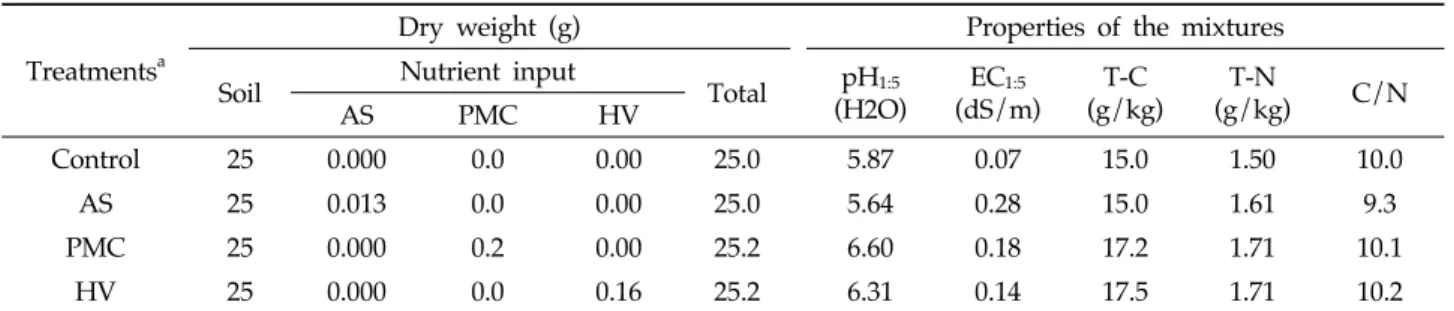
대조구로 무처리(Control)와 비료 처리구인 AS, PMC, HV를 각 3반복 실험하였다. Septa 마개가 있는 50 mL 유 리병에 토양 25 g을 충진 하고 수분함량 25%(v/v)에서 5일 간 사전배양한 후, 각 처리별로 벼의 질소 시비량(110 kg N/ha)을 기준으로 투입물을 처리하였다. 별도의 유리병에 동일하게 처리한 후 pH와 EC를 측정하였고, 총탄소 및 질 소, 탄질비는 공시재료의 이화학성을 기준으로 계산하였다 (Table 2). 수분을 포화시킨 후 담수심을 1 cm로 하여 25℃
에서 60일간 항온배양 실험하였다.
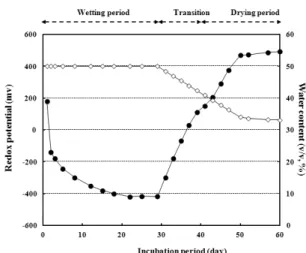
항온배양기간 중에는 산소가 충분히 공급되도록 마개를 열어 두었다. 항온배양시 매일 증류수를 공급하여 담수심을 유지하였고, 30일째에 과잉 수분을 제거하고 수분 공급을 중 단하여 호기적 조건으로 전환하였다. 별도의 유리병에 토양을 충진하고 산화환원전위계(RM-20P, TOA DKK, Japan)를 설치하여 산화환원전위(Eh)를 모니터링 하였으며, 주기적으 로 항온배양병을 칭량하여 수분함량을 계산하였다.
가스 플럭스 측정 및 분석
항온 배양 2, 4, 15, 30, 35, 40, 50, 60일 째 Septa 마개 를 닫고 0, 10, 20분 간격으로 가스시료를 채취하여 가스크로 마토그래피(7890A GC System with methanizer, Agilent Technologies, USA)로 CH
4과 CO
2농도를 측정하였다. 칼 럼은 Porapak Q를 사용하였으며 온도(℃)는 column 50, Front inlet 250, FID 300, methanizer 375이었고, Flow rate(mL/min)는 column이 N
215, FID: H
245, Air 400, N
20.3, methanizer가 H
245였다. 가스크로마토그래피에서 분석된 CH
4과 CO
2농도 변화로부터 다음의 식으로 플럭스 를 계산하였다(Denmead, 1995).
Flux = ρ × V / A × ⊿c / ⊿t × 273 / T (mg CH
4(또는 CO
2)/m/hr)
계산식에서 ρ는 CH과 CO
2의 밀도(0℃, g/m)이고, V와 A는 각각 유리병의 내부 체적(m
3)과 바닥면적(m
2), ⊿c/⊿t 는 단위 시간당 CH
4또는 CO
2농도의 변화(ppm/hr), T는 유리병 내부의 평균온도 (273 + ℃)이다.
항온배양 중 탄소손실률을 계산하기 위해 60일 후 유리병 에 잔류하는 토양을 칭량하고 건조하였다. 건조 토양은 원소 분석기(FLASHEA-112, Thermo, USA)로 탄소함량을 정량 하였다.
Treatmentsa
Dry weight (g) Properties of the mixtures
Soil Nutrient input
Total pH1:5
(H2O)
EC1:5
(dS/m)
T-C (g/kg)
T-N
(g/kg) C/N
AS PMC HV
Control 25 0.000 0.0 0.00 25.0 5.87 0.07 15.0 1.50 10.0
AS 25 0.013 0.0 0.00 25.0 5.64 0.28 15.0 1.61 9.3
PMC 25 0.000 0.2 0.00 25.2 6.60 0.18 17.2 1.71 10.1
HV 25 0.000 0.0 0.16 25.2 6.31 0.14 17.5 1.71 10.2
aAS, ammonium sulfate; PMC, pig manure compost; HV, hairy vetch.
Table 2. Treatments laid out and properties of the soil and fertilizer inputs mixture
Fig. 1. Changes in the redox potential (Eh) and volumetric water content of the soil during 60 days of incubation. The period was classified into wetting, transition, drying periods on the basis of the Eh.
Vertical arrows depict gas sampling time.
통계분석
비료의 종류와 수분조건에 따른 가스 플럭스 차이는 SPSS 17.0(SPSS Inc. Chicago, IL)의 일반선형모형을 이용한 ANOVA 분석으로 평가였으며, 처리효과가 인정될 경우 Duncan의 다중비교를 통해 처리 간 차이를 비교하였다 ( a =0.05).
결과 및 고찰
Eh 및 수분함량 변화
산화환원전위차는 처리간 차이가 나타나지 않았지만, 담수 직후 200 mV에서-180 mV로 급격히 감소하였고 이후 30일 까지-400 mV로 지속적으로 감소하였다(Fig. 1). 수분 공급을 중단 한 30일 이후부터 지속적으로 증가하여 50일 이후부터 는 약 500 mV를 유지하였다. 수분함량도 이에 상응하게 30 일까지 50%를 유지하다 건조기간을 모의하기 위해 수분 공 급을 중단한 이후 지속적으로 감소하여 최종 수분함량은 33%를 나타냈다(Fig. 1). 따라서 항온 배양기간을 0-30일까 지를 습윤기간, 30-40일을 전이기간, 40-60일을 건조기간으 로 구분할 수 있었다.
CH
4플럭스
항온배양 실험기간 동안 전체 처리구의 CH
4플럭스는 0
∼13.8 mg CH
4/m/ day의 범위였는데, 이는 본 연구에서 사용한 토양을 채취한 논 포장에서 측정되 CH
4플럭스 (10
∼300 mg CH
4/m/day) 보다 낮은 수준이다(Yun et al., 2012). 담수 논 조건에서 대부분의 CH
4은 벼의 통기조직을 통해 기공으로 배출되기 때문에 벼가 없는 실내 항온 배양실 험 조건에서 CH
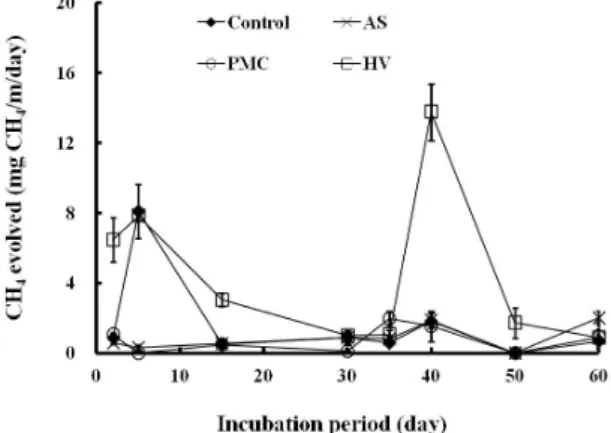
4플럭스는 포장 조건에 비해 낮다(Yun et al., 2012). 시기적으로 습윤기간 초기, 전이기간과 건조기간 경계 시점에서 상대적으로 플럭스가 높았는데(Fig. 2), 습윤
기간 초기의 CH
4플럭스는 이분해성 유기물의 급격한 혐기 성 분해에 기인한 것으로 판단된다. 전이기간과 건조기간 경 계 시점의 경우에는 습윤기간 중 생성되어 토양내 체류된 CH
4이 수분 공급 중단에 의해 형성된 통기성 공극을 통해 배 출되었기 때문이다(Yagi et al., 1996; Yun et al., 2012).
전체 기간 중 각 처리별 평균 CH
4플럭스(mg CH
4/m/day) 는 HV(4.5) > Control(1.7) > AS(0.9) > PMC(0.8)의 순서 였다(Fig. 3). 대조구는 습윤기간의 플럭스가 가장 높았고, AS 처리구는 수분변화에 따른 CH
4플럭스 차이가 나타나지 않았으며, PMC 처리구에서는 전이기간 중 CH
4플럭스가 가 장 높았다(Fig. 3). 한편, HV 처리구는 전이기간 중 CH
4플 럭스가 가장 낮았지만, 습윤 및 건조기간 동안의 CH
4플럭스 는 타 처리에 비해 높았다(Fig. 3). HV 처리구에서 평균 CH
4플럭스가 AS나 PMC 처리구에 비해 높았는데, 이는 비 료 처리에 따른 추가 탄소원 공급과 탄소원의 분해성에 따른 차이로 설명이 가능하다. AS의 경우 비료투입에 따른 추가적 인 탄소 공급이 없었고, PMC는 퇴비화 과정 동안 충분한 부 숙에 의해 주로 난분해성 유기물(CSD, 27.3%)로 구성된 반 면(Dala et al., 2008; Nyberg et al., 2002; Mer and Roger, 2001; Yagi and Minami, 1990), HV는 이분해성 유기물(CSD, 2.2%)이기 때문에 습윤기간 중 유기물의 혐기 적 분해에 의한 CH
4발생이 상대적으로 활발했기 때문으로 판단된다(Dala et al., 2008; López et al., 2010; Nyberg et al., 2002; Mer and Roger , 2001). Mer과 Roger(2001) 는 탄질비와 리그닌/총질소비가 낮은 이분해성 유기물일수록 토양의 CH
4발생이 증가한다고 보고하였으며, Bronson 등 (1997)은 녹비(12 Mg/ha, wet)를 시용했을 때 질소기준으 로 동일한 양을 시용한 요소나 유안 처리구에 비해 CH
4발생 이 약 50배까지 증가한다고 보고한바 있다.
한편, 본 연구에서는 AS과 PMC 처리구에서 평균 CH
4플럭스가 대조구(Control)에 비해 낮았는데, 이는 AS나 PMC 처리에 따른 전자 수용체 유효도 변동에 기인한 것으 로 판단된다. 미생물이 혐기적 조건에서 유기물을 분해하여 에너지원과 탄소원을 얻는 과정에서 토양내에 다른 산화형 반응성 물질(Fe
3+, Mn
4+, SO
42-, NO
3-)이 존재할 경우 이들 물질을 전자수용체로 활용하여 CH
4생성이 감소될 수 있다 (Ali et al., 2009; Dalal et al., 2008; Mer and Roger, 2001). 본 연구에서는 퇴비의 산화형 반응성 물질인 Fe
3+, Mn
4+, SO
42-를 직접 분석하지 않았지만, 기존 연구에 의하면 가축분 퇴비의 Fe과 Mn의 함량은 각각 86∼2,713 mg/kg, Mn 11∼566 mg/kg으로 보고된 바 있다(Gil et al., 2008;
Kim et al., 2000; Turner, 2004). 따라서, 유안의 SO
42-와 퇴비에 함유된 산화형 물질(Fe
3+, Mn
4+, SO
42-, NO
3-)과 같은 전자 수용체에 의해 습윤기간 중 AS(0.6 mg CH
4/m/day) 와 PMC(0.4 mg CH
4/m/day) 처리구의 CH
4플럭스가 대 조구(2.6 mg CH
4/m/day)에 비해 낮아 진 것으로 판단된다.
한편, 토양의 CH
4플럭스는 CH
4생성뿐 만 아니라 산화에 의
해서도 영향을 받는데, 특히 CH
4산화균(methanotrops)은
질산화(nitrification)에도 참여하기 때문에 토양내 NH
4+의
농도가 높을 경우 CH
4플럭스가 증가될 수 있다 (Bédard and Knowles, 1989; Hűtsch, 1998). 하지만, 본 연구에서 는 산화가능한 질소가 추가로 투입된 AS나 PMS 처리구에서 CH
4플럭스가 대조구에 비해 낮았는데(Fig. 3), 이는 질산화 가 억제되기 쉬운 습윤 조건에서 CH
4산화균에 의한 CH
4플럭스 변동은 크지 않음을 의미한다.
Fig. 2. Temporal changes in CH4 flux of incubated soils. Vertical bars are standard errors of the means (n=3). Details of the treatment codes are provided in Table 2.
Fig. 3. Means values of CH4 flux measured during whole 60-days of incubation, and wetting, transition, and drying periods. Vertical bars are standard errors of the means (n=3). Data followed by different lowercase letters indicate significant fertilizer effect and by different uppercase letters indicate significant water regime effect at α=0.05.
Details of the treatment codes are provided in Table 2.
CO2 플럭스
CO
2플럭스는 0.4∼1.9 g CO
2/m/day로 탄소 당량으로 계산했을 때 CH
4에 비해 최대 20배 이상 높았다. CO
2플럭 스는 항온 배양 초기에 최대치를 보이고 지속적으로 감소하였 는데(Fig. 4), 이는 일반적으로 수분 불포화 조건의 항온 배양 실험에서 배양 초기에 이분해성 유기물 분해에 의해 토양 CO
2플럭스가 상대적으로 높고, 배양 후기로 진행됨에 따라
이분해성 유기물 고갈에 따라 플럭스가 감소하는 경향과 일치 한다(Choi et al., 2011; Lee et al., 2011; Lim et al., 2011;
Lim et al., 2012). HV 처리구에서 CO
2플럭스의 경시적 변 화는 타 처리와 달리 항온 배양 2일째 최대 플럭스(1.9 g CO
2/m/day)를 보인 후 4∼30일 기간 동안 매우 급격히 감 소하다가 전이기간에 다시 증가하는 경향을 보였다. Nyberg 등(2002)은 상대적으로 (리그닌+폴리페놀)/총질소비가 낮은 이분해성 녹비(e.g. Sesbania and Grevillea )를 토양에 투입 후 4일 이내에 토양 호흡에 의해 전체 탄소무기화의 84%가 진행된다고 보고한 바 있다. 따라서, 초기 CO
2플럭스는 HV 의 이분해성을 반영하는 것으로 판단된다. 반면, 전이기간의 CO
2플럭스는 CH
4플럭스와 유사하게 습윤기간 동안 생성된 CO
2가 통기성 공극을 통해 빠르게 방출된 결과로 판단된다 (Franzluebbers et al., 1994; Mikha et al., 2005). PMC 처 리구에서는 전이기간 동안 CO
2플럭스 증가가 HV 보다 크지 않았는데, 이는 PMC의 CSD 27.3%로 HV(CSD 2.2%)에 비 해 상대적으로 난분해성으로 급격한 유기물 분해가 없었기 때 문으로 판단된다(Ajawa and Tabatabi, 1994; Bernal et al., 1998; Fog, 1988; López et al., 2010).
전체 평균 CO
2플럭스(g CO
2/m/day)는 대조구(0.90)에 비해 AS에서 0.80으로 가장 낮았고 PMC(0.96)과 HV(0.93) 처리구에서 상대적으로 높았지만, 통계적 유의성은 없었다 (Fig. 5). 토양 호흡에 의한 CO
2플럭스는 비료 처리량, 유기 물 분해도, 수분조건, 온도 등에 영향을 받는다(Ajawa and Tabatabai, 1994; Alluvione et al., 2010; Blanco-Canqui and Lal, 2004; Chu et al., 2007; Franzluebbers et al., 1994; Kimetu et al., 2008). 일반적으로 호기적인 수분 불포 화 조건에서는 비료 처리에 의한 CO
2플럭스 증가가 예상되 지만(Choi et al., 2011; Lee et al., 2011; Lim et al., 2011;
Lim et al., 2012), 본 연구에서는 이와 같은 경향이 관찰되 지 않았다. 이는 호기성 미생물 활동이 낮은 수분 포화조건에 서 토양 유기물 분해가 외부 요인의 영향에 상대적으로 덜 민 감하게 반응할 수 있다는 것을 제시한다.
Fig. 4. Temporal changes in CO2 flux of incubated soils. Vertical bars are standard errors of the means (n=3). Details of the treatment codes are provided in Table 2.
Fig. 5. Means values of CO2 flux measured during whole 60-days of incubation, and wetting, transition, and drying periods. Vertical bars are standard errors of the means (n=3). Data followed by different lowercase letters indicate significant fertilizer effect and by different uppercase letters indicate significant water regime effect at α=0.05. Details of the treatment codes are provided in Table 2.
탄소 손실률
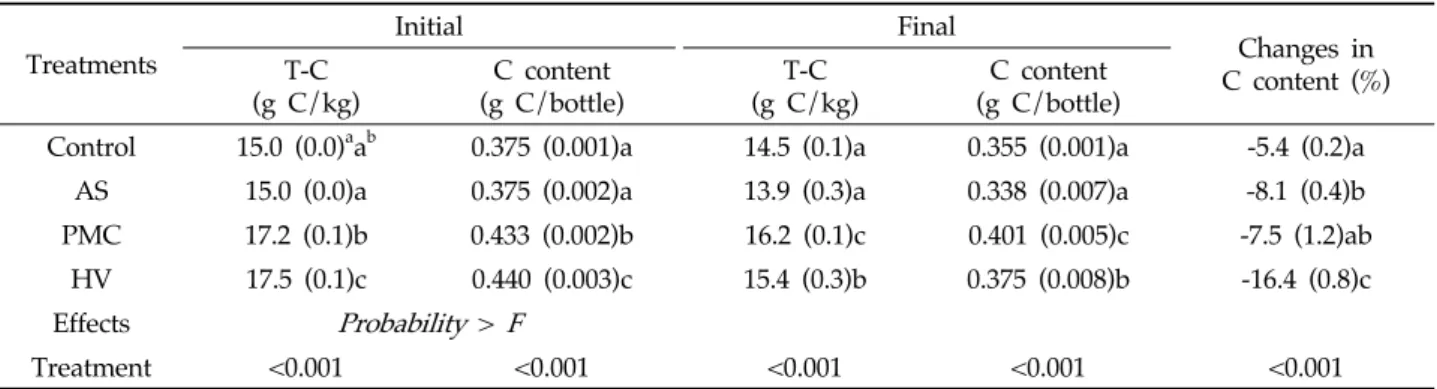
최종토양의 탄소 함량은 대조구에서 0.355 g C/bottle이 었고, 비료 처리구에서는 0.338∼0.401 g C/bottle이었으며, 탄소 손실률은 HV(16.4) > AS(8.1) > PMC(7.5) >
Control(5.4) 순서로 나타났다(Table 3). HV의 높은 손실율 (Table 3)은 CH
4플럭스(Fig. 3) 경향과 일치하지만 CO
2플 럭스와는 상응하지 않았다. 이는 본 연구에서 전체 가스 플럭 스를 측정하지 않아 손실된 탄소를 모두 정량하지 못했기 때 문이다. 하지만, PMC와 HV의 탄소 손실률을 비교하면, 가 축분 퇴비와 같은 난분해성 유기물이 HV와 같은 이분해성 유기물에 비해 토양 탄소량 증대에 유리함을 알 수 있었다.
따라서, PMC와 HV의 양분공급력에 대한 기존 연구를 고려 하면, 이분해성 유기물(HV)과 난분해성 유기물(PMC)을 혼 합 시용할 경우 양분 공급과 탄소저장량 증대에 유리할 것으 로 기대된다.
Treatments
Initial Final
Changes in C content (%) T-C
(g C/kg)
C content (g C/bottle)
T-C (g C/kg)
C content (g C/bottle)
Control 15.0 (0.0)aab 0.375 (0.001)a 14.5 (0.1)a 0.355 (0.001)a -5.4 (0.2)a AS 15.0 (0.0)a 0.375 (0.002)a 13.9 (0.3)a 0.338 (0.007)a -8.1 (0.4)b PMC 17.2 (0.1)b 0.433 (0.002)b 16.2 (0.1)c 0.401 (0.005)c -7.5 (1.2)ab HV 17.5 (0.1)c 0.440 (0.003)c 15.4 (0.3)b 0.375 (0.008)b -16.4 (0.8)c Effects
Probability
>F
Treatment <0.001 <0.001 <0.001 <0.001 <0.001
aValues are means with standard errors in parentheses (n=3).
bValues followed by the same letter are not statistically different at α=0.05.
Table 3. Changes in C concentration and C content of soils
요 약
논 생태계를 모의하여 토양에 투입된 비료의 종류(AS, PMC, HV)와 토양 수분 변동조건(습윤기간, 전이기간, 건조 기간)으로 구분하여 CH
4과 CO
2플럭스를 조사하였다. CH
4플럭스는 0∼13.8 mg CH
4/m/day의 범위에서 변화하였으 며, 시기적으로 습윤기간 초기와 전이기간과 건조기간 경계 시점에서 높은 값을 보였다. CO
2플럭스는 습윤 초기에 최대 치를 보이고 지속적으로 감소하다가 전이기간에 다시 상승하 였다. 최종토양의 탄소함량 변화는 대조구에서-5.4%이었고, 비료 처리구에서는-7.5∼-16.4%이었다. HV 시용은 타 비종 에 비해 CH
4과 CO
2플럭스를 증가시켰는데, 이는 녹비작물 이 가축분 퇴비에 비해 상대적으로 이분해성으로 배양 초기 에 유기물 분해에 의해 CH
4과 CO
2발생량이 높았기 때문이 다. AS나 PMC 처리구에서 CH
4플럭스가 대조구에 비해 낮
았는데, 이는 AS의 SO
42-와 퇴비에 함유된 산화형 물질(Fe
3+, Mn
4+, NO
3-)과 같은 전자 수용체에 의해 습윤기간 중 이들 물질이 전자수용체로 활용되어 CH
4생성이 감소할 수 있음 을 의미한다. PMC와 HV의 탄소 손실률을 비교하면, HV와 같은 이분해성 유기물에 비해 PMC와 같은 난분해성 유기물 의 시용이 토양 탄소량을 증가시키는 것으로 나타났다. 또한, 본 연구는 HV와 같은 녹비 작물이 질소 공급의 측면에서 화 학비료를 대체할 수 있지만, 화학비료 시용에 비해 CH
4발생 이 증가할 수 있음을 제시한다. 따라서, 이분해성 유기물(녹비 작물)과 난분해성 유기물(가축분퇴비)을 혼합 시용할 경우 양 분공급과 탄소저장량 증대에 모두 유리할 것으로 기대된다.
감사의 글
This work was carried out with the support of
“Cooperative Research Program for Agricultural Science & Technology Development (Project No.
PJ007409032012)”, Rural Development Administration, Republic of Korea.
참고문헌