243 ORIGINAL ARTICLE
DOI 10.4070 / kcj.2009.39.6.243
Print ISSN 1738-5520 / On-line ISSN 1738-5555 Copyright ⓒ 2009 The Korean Society of Cardiology
Comparison of Clinical Outcomes Following Acute Myocardial Infarctions in Hypertensive Patients With or Without Diabetes
Min Goo Lee, MD1, Myung Ho Jeong, MD1, Youngkeun Ahn, MD1, Shung Chull Chae, MD2, Seung Ho Hur, MD3, Taek Jong Hong, MD4, Young Jo Kim, MD5, In Whan Seong, MD6, Jei Keon Chae, MD7, Jay Young Rhew, MD8, In Ho Chae, MD9, Myeong Chan Cho, MD10, Jang Ho Bae, MD11, Seung Woon Rha, MD12, Chong Jim Kim, MD13, Donghoon Choi, MD14, Yang Soo Jang, MD14, Junghan Yoon, MD15, Wook Sung Chung, MD16, Jeong Gwan Cho, MD1,
Ki Bae Seung, MD16, Seung Jung Park, MD17 and Other Korea Acute Myocardial Infarction Registry Investigators Korea Acute Myocardial Infarction Registry Investigators of Korean Society of Cardiology
1Chonnam National University Medical School, Gwangju, 2Kyungpook National University College of Medicine, Daegu,
3Keimyung University College of Medicine, Daegu, 4Pusan National University Schoool of Medicine, Busan,
5Yeungnam University College of Medicine, Daegu, 6Chungnam National University College of Medicine, Daejeon,
7Chonbuk National University College of Medicine, Jeonju, 8Jeonju Presbyterian Medical Center, Jeonju,
9Seoul National University College of Medicine, Seongnam, 10Chungbuk National College of Medicine, Cheongju,
11Konyang University College of Medicine, Daejeon, 12Korea University College of Medicine, Seoul,
13Kyunghee University College of Medicine, Seoul, 14Yonsei University College of Medicine, Seoul,
15Yonsei University Wonju College of Medicine, Wonju, 16The Catholic University of Korea College of Medicine, Seoul,
17University of Ulsan College of Medicine, Seoul, Korea
ABSTRACT
Background and Objectives: It is thought that patients with diabetes mellitus (DM) have a poor prognosis after an acute myocardial infarction (AMI), but the effect of diabetes on the outcomes of hypertensive patients with AMIs has not been elucidated in the Korean population. The aim of this study was to investigate the effects of diabetes on long- term clinical outcomes following AMIs in patients with hypertension. Subjects and Methods:Using data from the Korea Acute Myocardial Infarction Registry (November 2005 to December 2006), 2,233 hypertensive patients with AMIs were grouped as follows based on the presence of DM: group I, diabetic hypertension (n=892, 544 men, mean age=66.2±10.9 years); and group II, non-diabetic hypertension (n=1341, 938 men, mean age=63.9±12.8 years).
The primary study outcomes included in-hospital death and major adverse cardiac events (MACE; cardiac death, myocardial infarction (MI), repeat percutaneous coronary intervention, and coronary artery bypass surgery) at the 1 year follow-up. Results:Hypertensive patients with DM were older and more likely to be women. The diabetic group had lower blood pressure (p<0.001), a lower left ventricular ejection fraction (p<0.001), a more severe degree of heart failure (p<0.001), a longer duration of coronary care unit admission (p<0.001), and a higher incidence of hyperlipidemia (p=0.007). The N-terminal pro-brain natriuretic peptide level (4602.5±8710.6 pg/mL vs. 2320.8
±5837.9 pg/mL, p<0.001) was higher and the creatinine clearance (62.4±29.9 mL/min vs. 73.0±40.8 mL/min, p<0.001) was lower in the diabetic group than the non-diabetic group. Coronary angiographic findings revealed more frequent involvement of the left main stem (p=0.002) and multiple vessels (p<0.001) in the diabetic group.
The rate of in-hospital death was higher in the diabetic group (p<0.001). During follow-up, the rates of composite MACE at 1 month, 6 months, and 12 months were higher in the diabetic group (p<0.001). Conclusion: In hy- pertensive patients with AMI, DM was associated with worse clinical and angiographic features, with a higher risk of development of severe heart failure, and an increased risk of MACE on long-term clinical follow-up. (Korean Circ J 2009; 39:243-250)
KEY WORDS: Diabetes mellitus; Hypertension; Myocardial infarction.
Received: December 18, 2008 Revision Received: January 16, 2009 Accepted: February 17, 2009
Correspondence: Myung Ho Jeong, MD, The Heart Center of Chonnam National University Hospital, 671 Jaebong-ro, Dong-gu, Gwangju 501-757, Korea Tel: 82-62-220-6243, Fax: 82-62-228-7174·E-mail: [email protected]
244·Diabetes in Hypertension and AMI
Introduction
Diabetes mellitus (DM) is a common disease with sub- stantial morbidity and mortality.1)2) Hypertension is a well- known risk factor for coronary artery disease and there is considerable evidence for an increased prevalence of hypertension in diabetics, affecting up to 60%.2-5) More- over, each pathophysiologic disease entity serves to exa- cerbate the other.3)6) The presence of hypertension in dia- betic patients significantly increases the risk of cardiovas- cular disease (CVD), including acute coronary syndro- me.5)7) Generally, hypertension in type 2 diabetics clusters with other CVD risk factors, such as microalbuminuria, central obesity, insulin resistance, dyslipidemia, hyper- coagulation, increased inflammation, and left ventricular hypertrophy.5) This clustering of risk factors in diabetics ultimately results in the development of CVD, which is the major cause of premature mortality in patients with type 2 DM. Previous studies are in agreement that DM is an independent risk for mortality after an acute myocar- dial infarction (AMI).8-10) Also, other several studies have shown that hypertension is associated with a worse pro- gnosis after an AMI.11-13) Despite this consensus, the ef- fect of DM on the outcomes of hypertensive patients following an AMI has not been clearly demonstrated within the Oriental population.
Therefore, we conducted the present study to analyze the clinical impact of DM on patients with hypertension following an AMI who were registered in the Korea Acute Myocardial Infarction Registry (KAMIR).
Subjects and Methods
Patient population and study design
The KAMIR is a prospective, multi-center, observati- onal registry designed to examine current epidemiology, in-hospital management, and outcome of patients with AMIs in Korea for the commemoration of the 50th an- niversary of the Korean Circulation Society.14)15) Among the patients with AMIs, 2,233 hypertensive patients who were followed-up at 1 year were included in the present study. These patients were grouped as follows based on the presence of DM: group I, patients who were assigned to the diabetic hypertensive group (total 892, 544 males, mean age=66.2±10.9 years); and group II, patients who were assigned to the non-diabetic hypertensive group (total 1,341, 938 males, mean age=63.9±12.8 years).
Hypertension was defined as a blood pressure ≥140/90 mmHg, or when the patient was taking antihypertensive medication based on a history of diagnosed hypertension.
DM was defined as a fasting plasma glucose level ≥126 mg/dL, a random plasma glucose level ≥200 mg/dL, or when the patient was taking oral hypoglycemic agents or using subcutaneous insulin based on a history of diag- nosed DM. Eligible patients for this study were required
to have all three of the following: 1) symptoms of ische- mia increasing or occurring at rest, 2) an elevated cardiac troponin-I level (≥2.0 ng/mL) or creatine kinase- myocardial infarction (CK-MB) (19 U/L, exceeding twi- ce the upper limit of normal), and 3) ischemic changes assessed by electrocardiography (ST-segment elevation, depression, or T wave inversion of ≥0.2 mV in two contiguous leads). Our study included patients in car- diogenic shock state (Killip class IV).
We analyzed baseline demographic and clinical cha- racteristics, relevant laboratory results and pharmacothe- rapy. Echocardiography was performed in all patients before discharge. Major adverse cardiac events (MACE) at the 1 month, 6 months, and 1 year clinical follow-up were evaluated and were defined as the composite of 1) cardiac death, 2) non-cardiac death, 3) non-fatal myocar- dial infarction (MI), and 4) re-percutaneous coronary intervention (PCI) or coronary artery bypass graft (CABG).
Re-infarction was defined as the recurrence of symptoms or electrocardiographic changes in association with a rise in cardiac enzymes above the upper limit of normal. All data were recorded on a standardized, electronic, web- based registry at http://www.kamir.or.kr.
Statistical analysis
We compared the in-hospital mortality, the duration of admission to the coronary care unit, and the inciden- ce of MACE during 1 month, 6 months, and 1 year of clinical follow-up between the 2 groups. The predictive factors for MACE at the 1 year clinical follow-up were calculated by multiple logistic regression analysis.
The Statistical Package for Social Sciences (SPSS) for Windows, version 15.0 (SPSS, Inc., Chicago, IL, USA) was used for all analysis. Continuous variables with normal distributions were expressed as the mean±standard de- viation (SD) and they were compared with the use of an unpaired Student’s t-test. Categorical variables were com- pared with the use of the chi-square test, where appro- priate. A p<0.05 was deemed to be statistically signi- ficant.
Results
Baseline clinical characteristics of the study population
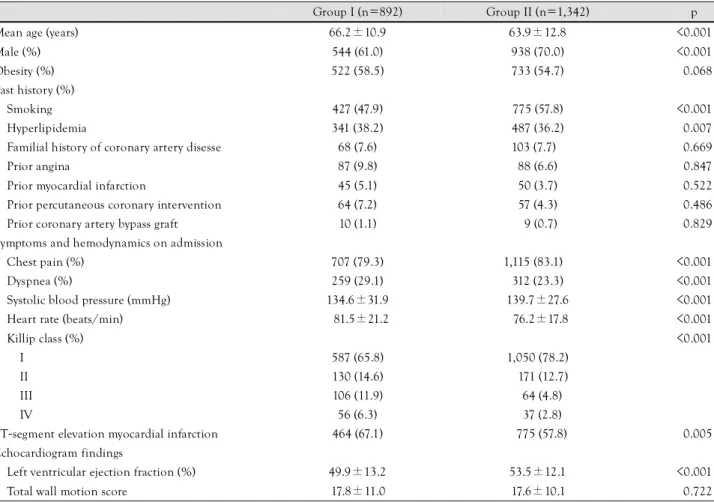
Among the 2,233 hypertensive patients with AMI who were followed-up for 1 year, there were 892 diabetic pa- tients and 1,342 non-diabetic patients. The baseline cli- nical characteristics and laboratory findings of the study population are described in Table 1 and 2. Hypertensive patients with DM were older (p<0.001) and more likely to be women (p<0.001). Also, patients with DM had a higher proportion of smokers (p<0.001) and hyperlipi- demia (p=0.007). The diabetic group had lower blood pressure (p<0.001), a lower left ventricular ejection frac-
Min Goo Lee, et al.·245
tion (p<0.001), more severe heart failure (p<0.001), and a higher proportion of ST segment elevation myocardial infarction (STEMI; p=0.005). N-terminal pro-brain na- triuretic peptide level (p<0.001) was higher and creatinine clearance (p<0.001) was lower in the diabetic group than the non-diabetic group.
Coronary angiographic findings
In the diabetic hypertension group, coronary angio- graphy was performed in 92.9% of the patients during hospitalization, compared with 95.4% of the patients in the non-diabetic hypertension group. Also, PCI was done
in 89.5% of patients in the diabetic group relative to 94.4% in the non-diabetic group, but the success rate of PCI showed no significant difference between the 2 gro- ups. The baseline coronary angiographic characteristics are shown in Table 3. The most common infarct-related artery was the left anterior descending artery in both gro- ups. The types of lesions according to the American Col- lege of Cardiology/American Heart Association (ACC/
AHA) classification and the Thrombolysis In Myocardial Infarction (TIMI) flow grade before and after PCI showed no significant differences between the two groups. Left main stem and multivessel involvement were more pre
Table 1. Baseline characteristics according to the presence of diabetes
Group I (n=892) Group II (n=1,342) p
Mean age (years) 66.2±10.9 63.9±12.8 <0.001
Male (%) 544 (61.0) 938 (70.0) <0.001
Obesity (%) 522 (58.5) 733 (54.7) <0.068
Past history (%)
Smoking 427 (47.9) 775 (57.8) <0.001
Hyperlipidemia 341 (38.2) 487 (36.2) <0.007
Familial history of coronary artery disesse 68 (7.6) 103 (7.7) <0.669
Prior angina 87 (9.8) 88 (6.6) <0.847
Prior myocardial infarction 45 (5.1) 50 (3.7) <0.522
Prior percutaneous coronary intervention 64 (7.2) 57 (4.3) <0.486 Prior coronary artery bypass graft 10 (1.1) 09 (0.7) <0.829 Symptoms and hemodynamics on admission
Chest pain (%) 707 (79.3) 1,115 (83.1) <0.001
Dyspnea (%) 259 (29.1) 312 (23.3) <0.001
Systolic blood pressure (mmHg) 134.6±31.9 139.7±27.6 <0.001
Heart rate (beats/min) 81.5±21.2 76.2±17.8 <0.001
Killip class (%) <0.001
I 587 (65.8) 1,050 (78.2)
II 130 (14.6) 171 (12.7)
III 106 (11.9) 64 (4.8)
IV 56 (6.3) 37 (2.8)
ST-segment elevation myocardial infarction 464 (67.1) 775 (57.8) <0.005 Echocardiogram findings
Left ventricular ejection fraction (%) 49.9±13.2 53.5±12.1 <0.001
Total wall motion score 17.8±11.0 17.6±10.1 <0.722
Table 2. Laboratory findings according to the presence of diabetes
Group I (n=892) Group II (n=1,342) p
Creatinine clearance (mL/min) 62.4±29.9 73.0±40.8 <0.001
CK-MB (U/L) 118.5±169.8 144.7±216.6 <0.001
Troponin-I (ng/mL) 46.4±76.0 50.2±92.9 <0.368
Total cholesterol (mg/dL) 188.3±44.6 181.3±47.5 <0.001
Triglyceride (mg/dL) 139.1±116.6 128.5±85.3 <0.020
Low density lipoprotein-cholesterol (mg/dL) 116.5±45.2 121.2±42.3 <0.017 High density lipoprotein-cholesterol (mg/dL) 43.9±13.9 46.3±16.5 <0.001 High sensitivity C-reactive protein (mg/dL) 30.3±130.7 25.6±119.2 <0.423 N-terminal pro-brain natriuretic peptide (pg/mL) 4602.5±8710.6 2320.8±5837.9 <0.001 CK-MB: creatine kinase-myocardial band isoenzyme
246·Diabetes in Hypertension and AMI
Table 3. Coronary angiographic findings according to the presence of diabetes
Group I (n=892) Group II (n=1,342) p
Coronary angiogram, n (%) 829 (92.9) 1,280 (95.4) <0.009
Infarct-related artery, n (%)
Left main stem 25 (3.0) 14 (1.1) <0.002
Left anterior descending artery 389 (47.0) 648 (50.6) <0.113
Left circumflex artery 138 (16.6) 240 (18.8) <0.229
Right coronary artery 277 (33.4) 378 (29.5) <0.070
ACC/AHA lesion type, n (%) <0.666
A 27 (4.5) 65 (5.1)
B1 144 (17.2) 207 (16.2)
B2 184 (22.2) 302 (23.6)
C 364 (43.9) 546 (42.7)
Diseased vessel number, n (%) <0.001
Single vessel 281 (33.9) 562 (43.9)
Two vessel 273 (32.9) 425 (33.2)
Three vessel 275 (33.2) 293 (22.9)
Percutaneous coronary intervention (PCI) 798 (89.5) 1,267 (94.4) <0.001
Successful result of PCI 759 (95.1) 1,225 (96.7) <0.080
Pre-PCI TIMI flow grade, n (%) <0.281
0 303 (36.5) 524 (40.9)
I 108 (13.0) 132 (10.3)
II 149 (18.0) 213 (16.6)
III 269 (32.5) 411 (32.2)
Post-PCI TIMI flow grade, n (%) 0.090
0 19 (2.5) 22 (1.9)
I 11 (1.5) 10 (0.9)
II 35 (4.7) 44 (3.7)
III 685 (91.3) 1,091 (93.5)
ACC/AHA: American College of Cardiology/American Heart Association, TIMI: Thrombolysis In Myocardial Infarction
Table 4. Clinical outcomes and MACE during follow-up and 12 months after discharge
Group I (n=892) Group II (n=1,342) p Outcomes in-hospital period
In-hospital death, n (%) 87 (9.8) 51 (3.8) <0.001
Coronary care unit admission duration (days) 4.5±5.7 3.2±3.0 <0.001 The composite of MACE at 1 month, n (%) 63 (7.1) 48 (3.8) <0.001
Cardiac death 24 (2.7) 12 (0.9) <0.002
Non-cardiac death 08 (0.9) 04 (0.3) <0.061
Myocardial infarction 12 (1.3) 14 (1.0) <0.514
Re-percutaneous coronary intervention 14 (1.6) 17 (1.1) <0.548
Coronary artery bypass graft 05 (0.6) 01 (0.1) <0.028
The composite of MACE at 6 months, n (%) 147 (16.5) 143 (10.7) <0.001
Cardiac death 46 (5.2) 28 (2.1) <0.001
Non-cardiac death 14 (1.6) 09 (0.7) <0.052
Myocardial infarction 19 (2.1) 19 (1.4) <0.204
Re-percutaneous coronary intervention 60 (6.7) 80 (6.0) <0.460
Coronary artery bypass graft 08 (0.9) 07 (0.5) <0.292
The composite of MACE at 12 months, n (%) 172 (19.3) 165 (12.3) <0.001
Cardiac death 53 (5.9) 33 (2.5) <0.001
Non-cardiac death 18 (2.0) 12 (0.9) <0.025
Myocardial infarction 20 (2.2) 23 (1.7) <0.374
Re-percutaneous coronary intervention 72 (8.1) 88 (6.6) <0.173
Coronary artery bypass graft 09 (1.0) 09 (0.7) <0.384
MACE: major adverse cardiac event
Min Goo Lee, et al.·247
valent in the diabetic group than the non-diabetic group (p=0.002 and p<0.001 respectively).
In-hospital outcomes and major adverse cardiac events
The clinical outcomes during the 1 year follow-up are shown in Table 4. The estimated in-hospital mortality was 9.8% in the diabetic group and 3.8% in the non- diabetic group (p<0.001). The duration of admission to the coronary care unit was significantly longer in the dia- betic group (4.5 vs. 3.2 days, p<0.001). The rates of car- diac death were higher in the diabetic group at the 1 month, 6 months, and 12 months clinical follow-ups (p=
0.002, p<0.001, and p<0.001 respectively). The rates of CABG at 1 month and non-cardiac death at 12 months were higher in the diabetic group (p=0.028 and p=0.025 respectively). The incidence of composite MACE was higher in the diabetic group at the 1 month, 6 months,
and 12 months clinical follow-ups (p<0.001, p<0.001, and p<0.001 respectively).
Survival curve and multivariate analysis of predic- tors of 1 year major adverse cardiac events
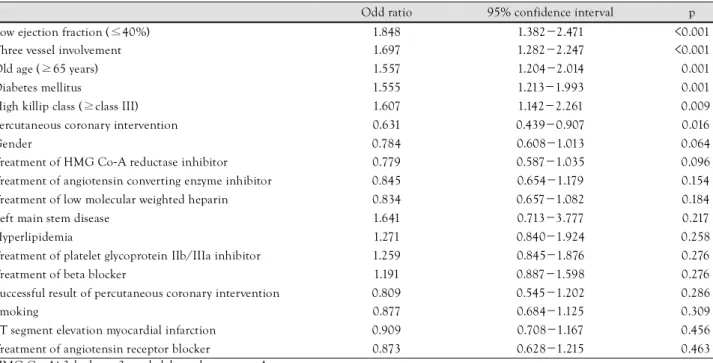
The Kaplan-Meier survival curve for mortality showed a significantly higher mortality in diabetic hypertensive patients (Fig. 1). Multivariate analysis was conducted to identify the independent predictors of the 1 year MACE using the meaningful factors in univariate analysis (Table 5 and 6).
The independent predictors for 1 year MACE were 3- vessel involvement (p=0.001), presence of DM (p=0.017), and a lower ejection fraction (p=0.045) (Table 7).
Discussion
The aim of this study was to examine the relationship between DM and clinical outcomes in 2,233 hypertensive patients with AMIs in the KAMIR during 12 months of follow-up. Our results demonstrated that diabetic hy- pertensive patients with AMIs have a poorer outcome in clinical and angiographic features, and a higher risk of death on short- and long-term follow-up relative to non- diabetic hypertensive patients.
DM is associated with a high risk of CVD and is the leading cause of end-stage renal disease, blindness, and non-traumatic amputations. Hypertension by itself is a powerful risk factor for cardiovascular morbidity and mortality. Although the effects of DM and hypertension on the cardiovascular system are often distinct, we can easily presume that their combined presence in the same patient is devastating to the cardiovascular system. Epi-
Table 5. Univariate analysis for the predictors of 1 year major adverse cardiac events
Odd ratio 95% confidence interval p
Low ejection fraction (≤40%) 1.848 1.382-2.471 <0.001
Three vessel involvement 1.697 1.282-2.247 <0.001
Old age (≥65 years) 1.557 1.204-2.014 <0.001
Diabetes mellitus 1.555 1.213-1.993 <0.001
High killip class (≥class III) 1.607 1.142-2.261 <0.009
Percutaneous coronary intervention 0.631 0.439-0.907 <0.016
Gender 0.784 0.608-1.013 <0.064
Treatment of HMG Co-A reductase inhibitor 0.779 0.587-1.035 <0.096 Treatment of angiotensin converting enzyme inhibitor 0.845 0.654-1.179 <0.154 Treatment of low molecular weighted heparin 0.834 0.657-1.082 <0.184
Left main stem disease 1.641 0.713-3.777 <0.217
Hyperlipidemia 1.271 0.840-1.924 <0.258
Treatment of platelet glycoprotein IIb/IIIa inhibitor 1.259 0.845-1.876 <0.276
Treatment of beta blocker 1.191 0.887-1.598 <0.276
Successful result of percutaneous coronary intervention 0.809 0.545-1.202 <0.286
Smoking 0.877 0.684-1.125 <0.309
ST segment elevation myocardial infarction 0.909 0.708-1.167 <0.456 Treatment of angiotensin receptor blocker 0.873 0.628-1.215 <0.463 HMG Co-A: 3-hydroxy-3-methylglutaryl coenzyme A
Fig. 1. Kaplan-Meier survival curves for the 2 groups. Survival cur- ve analysis reveals significantly higher mortality rate in diabetic group than non-diabetic group.
Cumulative survival (%)
0 100 200 300 400 Follow-up duration (Days)
Non-DM group
DM group 100
90 80 70 60 50 40
Log Rank p<0.001
248·Diabetes in Hypertension and AMI
demiologic studies have provided evidence for the co- existence of hypertension and DM and possibly point toward a common genetic and environmental factor pro- moting both DM and hypertension. Similarly, clustering of hypertension, insulin resistance, frank type 2 DM, hy- perlipidemia, and central obesity has been documented in several populations.16) Insulin resistance, increased tis- sue inflammation, and reactive oxygen species produc- tion, resulting in endothelial dysfunction, increased tissue renin-angiotensin-aldosterone activity, and increased sym- pathetic nervous system activity have all been implicated in this complex pathophysiology of DM and hypertension.
It is estimated that about 25% to 47% of persons with hypertension have insulin resistance or impaired glucose tolerance.17) With insulin resistance there is impaired biologic and physiologic tissue responses to insulin. The relationship between insulin resistance, DM, and hyper- tension is complex and interrelated. Untreated patients with essential hypertension have higher fasting and post- prandial insulin levels than age- and gender-matched
normotensive persons, regardless of body mass; a direct correlation between plasma insulin levels and blood pres- sure exists.5)18) Interestingly, the relationship between hyperinsulinemia and hypertension is not observed in secondary hypertension.18) This indicates that insulin resistance and hyperinsulinemia are not consequences of hypertension, but rather a genetic predisposition that exists for both diseases. This notion is supported by the observation that there is abnormal glucose metabolism in the offspring of hypertensive patients.19) Thus, there is a strong association between hypertension, DM, and insulin resistance.
Both hypertension and DM are well-identified risk factors for atherogenesis. Coronary artery disease is much more common in patients with both DM and hyperten- sion than in patients with hypertension alone, and the development of atherosclerosis was found to be accele- rated, with more plaque fissure and a lower coronary perfusion reserve index when DM and hypertension co- exist.20)21) Our study revealed that diabetic hypertensive
Table 7. Multivariate analysis for the predictors of one year major adverse cardiac events
Odd ratio 95% confidence interval p
Multivessel involvement <0.001
2 vessel 1.929 1.330-2.799 <0.001
3 vessel 2.462 1.681-3.605 <0.001
Diabetes mellitus 1.439 1.068-1.938 <0.017
Ejection fraction (%) <0.045
≤29 1.910 1.218-1.986 <0.011
30-39 1.696 1.034-2.782 <0.036
40-49 1.225 0.804-1.868 <0.345
50-59 1.460 0.777-2.741 <0.239
60-69 1.039 0.532-2.029 <0.912
Percutaneous coronary intervention 1.432 0.873-2.351 <0.155
N-terminal pro-brain natriuretic peptide (pg/mL) 1.110 0.874-1.473 <0.222
Killip class <0.614
II 1.117 0.733-1.703 <0.607
III 1.416 0.815-2.460 <0.217
IV 1.270 0.591-2.726 <0.540
Age <0.668
40-49 0.734 0.255-2.113 <0.567
50-59 0.539 0.194-1.492 <0.234
60-69 0.612 0.225-1.666 <0.336
70-79 0.639 0.234-1.741 <0.381
≥80 0.739 0.254-2.152 <0.579
Creatinine clearance (mL/min) 1.001 0.993-1.009 <0.792
Table 6. Laboratory findings according to the MACE
MACE group No MACE group p
N-terminal pro-brain natriuretic peptide (pg/mL) 5480.8±9034.9 2902.3±6848.1 <0.001
Creatinine clearance (mL/min) 61.7±29.8 69.1±28.8 <0.001
CK-MB (U/L) 124.2±187.0 135.3±201.2 <0.354
MACE: major adverse cardiac event, CK-MB: creatine kindase-myocardial band isoenzyme
Min Goo Lee, et al.·249
patients have a higher prevalence of multivessel involve- ment than the non-diabetic population following an AMI and multivessel disease is related to worse long- term clinical outcome. Patients with combined DM and hypertension also tend to have impaired systolic and dia- stolic ventricular function with more severe left ventri- cular hypertrophy and congestive heart failure than coun- terparts with hypertension alone.20)22) The extensive degenerative changes in the diabetic hypertensive heart may be related to abnormalities in the microcirculation.
The most striking microscopic findings of the hyperten- sive diabetic heart seem to be the distribution of dense interstitial connective tissue throughout the myocardium.
As expected, we found that in diabetic hypertensive pa- tients left ventricular ejection fraction was significantly lower. In our analysis of patients, the combination of DM and hypertension was more common in females, but after univariate analysis, the risk of death was not significantly different among male and female patients as in a previous study.23)
The most important result of this study was that DM is a strong risk factor for cardiovascular events; hyperten- sive patients with DM were more likely to have a cardio- vascular event than non-diabetic hypertensive patients.
Our study showed that the in-hospital mortality rate for diabetic hypertensive patients with an AMI was higher than for non-diabetic hypertensive patients. In many pre- vious studies, hospital case-fatality rates for diabetic pa- tients with acute coronary syndrome were almost twice as high as those for non-diabetic patients.24-27) Also, these results agree with a previous study which reported DM to be one of the most important risk factors for new cardiovascular events following an AMI.28) Factors, such as diabetic cardiomyopathy, small vessel disease, increased platelet activity, decreased fibrinolysis, and autonomic neuropathy leading to ventricular arrhythmia may acco- unt for the poor prognostic outlook of diabetic hyper- tensive patients.29)30) In our analysis, long-term clinical outcomes of diabetic hypertensive patients following an AMI showed worse progression relative to the non-dia- betic hypertensive population.
This study had several limitations. First, our study was a multi-center prospective registry, and it was not a ran- domized, controlled study. Thus, there was probably a selection bias when enrolling patients into both study groups.
The proportion of STEMI patients was higher in the group I patients than in the group II patients. Second, a value of blood glucose at follow-up was not recorded in the registry, therefore the relationship between adequate control of blood glucose and the prognosis of the patie- nts was not estimated exactly. Third, whether long-term and more aggressive treatment of high blood glucose in patients with AMI can reduce adverse outcomes remains unknown. Finally, the period of our study was relatively
short because our study was a comparison of the MACE at the 1 year clinical follow-up.
In conclusion, in hypertensive Korean patients with AMIs, DM was associated with worse clinical and angio- graphic features, with a higher risk of development of severe heart failure and increased risk of MACE on long- term clinical follow-up.
Acknowledgments
This study was performed with the support of The Korean Society of Circulation in celebration of the 50th Anniversary of The Korean Society of Circulation.
Korea Acute Myocardial Infarction Registry (KAMIR) Study Group of Korean Society of Cardiology
Myung Ho Jeong, MD, Youngkeun Ahn, MD, Shung Chull Chae, MD, Jong Hyun Kim, MD, Seung Ho Hur, MD, Young Jo Kim, MD, In Whan Seong, MD, Dong Hoon Choi, MD, Jei Keon Chae, MD, Taek Jong Hong, MD, Jae Young Rhew, MD, Doo Il Kim, MD, In Ho Chae, MD, Jung Han Yoon, MD, Bon Kwon Koo, MD, Byung Ok Kim, MD, Myoung Yong Lee, MD, Kee Sik Kim, MD, Jin Young Hwang, MD, Myeong Chan Cho, MD, Seok Kyu Oh, MD, Nae Hee Lee, MD, Kyoung Tae Jeong, MD, Seung Jea Tahk, MD, Jang Ho Bae, MD, Seung Woon Rha, MD, Keum Soo Park, MD, Chong Jin Kim, MD, Kyoo Rok Han, MD, Tae Hoon Ahn, MD, Moo Hyun Kim, MD, Ki Bae Seung, MD, Wook Sung Chung, MD, Ju Young Yang, MD, Chong Yun Rhim, MD, Hyeon Cheol Gwon, MD, Seong Wook Park, MD, Young Youp Koh, MD, Seung Jae Joo, MD, Soo Joong Kim, MD, Dong Kyu Jin, MD, Jin Man Cho, MD, Byung Ok Kim, MD, Sang-Wook Kim, MD, Jeong Kyung Kim, MD, Tae Ik Kim, MD, Deug Young Nah, MD, Si Hoon Park, MD, Sang Hyun Lee, MD, Seung Uk Lee, MD, Hang-Jae Chung, MD, Jang Hyun Cho, MD, Seung Won Jin, MD, Yang Soo Jang, MD, Jeong Gwan Cho, MD and Seung Jung Park, MD
REFERENCES
1) Cowie CC, Rust KF, Byrd-Holt DD, et al. Prevalence of diabetes and impaired fasting glucose in adults in the U.S. population:
National Health and Nutrition Examination Survey 1999-2002.
Diabetes Care 2006;29:1263-8.
2) Bonora E, Kiechl S, Willeit J, et al. Population-based incidence rates and risk factors for type 2 diabetes in white individuals. Dia- betes 2004;53:1782-9.
3) National High Blood Pressure Education Program Working Group.
National High Blood Pressure Education Program Working Group report on hypertension in diabetes. Hypertension 1994;23:145-58.
4) Gress TW, Nieto FJ, Shahar E, Wofford MR, Brancati FL. Hy- pertension and antihypertensive therapy as risk factors for type 2 diabetes mellitus. N Engl J Med 2000;342:905-12.
5) Sowers JR, Epstein M, Frohlich ED. Diabetes, hypertension, and cardiovascular disease: an update. Hypertension 2001;37:1053-9.
6) Saydah SH, Fradkin J, Cowie CC. Poor control of risk factors for vascular disease among adults with previously diagnosed diabetes.
JAMA 2004;291:335-42.
7) Adler AI, Stratton IM, Neil HA, et al. Association of systolic blood pressure with macrovascular and microvascular complications of type 2 diabetes (UKPDS 36): prospective observational study. BMJ
250·Diabetes in Hypertension and AMI
2000;321:412-9.
8) Malmberg K, Ryden L. Myocardial infarction in patients with dia- betes mellitus. Eur Heart J 1988;9:259-64.
9) Behar S, Boyko V, Reicher-Reiss H, Goldbourt U. Ten-year sur- vival after acute myocardial infarction: comparison of patients with and without diabetes. Am Heart J 1997;133:290-6.
10) Mak KH, Moliterno DJ, Granger CB, et al. Influence of diabetes mellitus on clinical outcome in the thrombolytic era of acute myo- cardial infarction. J Am Coll Cardiol 1997;30:171-9.
11) Fresco C, Avanzini F, Bosi S, et al. Prognostic value of a history of hypertension in 11,483 patients with acute myocardial infarction treated with thrombolysis. J Hypertens 1996;14:743-50.
12) Lee KL, Woodlief LH, Topol EJ, et al. Predictors of 30-day mor- tality in the era of reperfusion for acute myocardial infarction:
results from international trial of 41,021 patients. Circulation 1995;91:1659-68.
13) Herlitz J, Bang A, Karlson BW. Five year prognosis after acute myocardial infarction in relation to a history of hypertension. Am J Hypertens 1996;9:70-6.
14) Lee KH, Jeong MH, Ahn YK, et al. Gender differences of success rate of percutaneous coronary intervention and short term cardiac events in Korea Acute Myocardial Infarction Registry. Int J Car- diol 2008;130:227-34.
15) Kwon TG, Bae JH, Jeong MH, et al. N-terminal Pro-B-type nat- riuretic peptide is associated with adverse short-term clinical out- comes in patients with acute ST-elevation myocardial infarction underwent primary percutaneous coronary intervention. Int J Cardiol 2008. [Epub ahead of print]
16) Cha BS, Kim HJ. Metabolic syndrome and cardiovascular disea- se. Korean Circ J 2003;33:645-52.
17) Bonora E, Kiechl S, Willeit J, et al. Prevalence of insulin resist- ance in metabolic disorders. Diabetes 1998;47:1643-9.
18) Cho HK, Goh CW, Kim SS, et al. Insulin resistance as an asso- ciated factor of essential hypertension in Korean. Korean Circ J 1996;26:1020-9.
19) Sechi LA, Melis A, Tedde R. Insulin hypersecretion: a distinctive feature between essential and secondary hypertension. Metabolism
1992;41:1261-6.
20) Grossman E, Messereli FH. Diabetic and hypertensive heart di- sease. Ann Intern Med 1996;125:304-10.
21) Arora GD, Reeves WC, Movahed A. Alteration of coronary per- fusion reserve in hypertensive patients with diabetes. J Hum Hy- pertens 1994;8:51-7.
22) Cho KI, Park JH, Lee CK, et al. Isolated and combined influen- ces of diabetes and hypertension on the myocardial function and geometry. Korean Circ J 2006;36:411-7.
23) Jonas M, Reicher-Reiss H, Boyko V, Behar S, Grossman E. Hos- pital and 1-year outcome after acute myocardial infarction in patients with diabetes mellitus and hypertension. J Hum Hyper- tens 2003;17:665-70.
24) Gustafsson L, Hildebrandt P, Seibaek M, et al. Long-term prog- nosis of diabetic patients with myocardial infarction: relation to antidiabetic treatment regimen. Eur Heart J 2000;21:1937-43.
25) Eagle KA, Goodman SG, Avezurn A, Budaj A, Sullivan CM, Lo- pez-Sendon J. Practice variation and missed opportunities for reperfusion in ST-segment-elevation myocardial infarction: findings from the Global Registry of Acute Coronary Events (GRACE). Lancet 2002;359:373-7.
26) Hsu LF, Mak KH, Lau KW, et al. Clinical outcomes of patients with diabetes mellitus and acute myocardial infarction treated with primary angioplasty or fibrinolysis. Heart 2002;88:260-5.
27) Franklin K, Goldberg RJ, Spencer F, et al. Implications of dia- betes in patients with acute coronary syndromes. Arch Intern Med 2004;164:1457-63.
28) Levantesi G, Macchia A, Marfisi R, et al. Metabolic syndrome and risk of cardiovascular events after myocardial infarction. J Am Coll Cardiol 2005;46:277-83.
29) Calcera-Tomas, Melgarejo-Moreno A, Garcia-Alberola A, et al.
Prognostic significance of diabetes in acute myocardial infarction:
are the differences linked to female gender? Int J Cardiol 1999;
69:289-98.
30) Aronson D, Rayfield EJ, Chesebro JH. Mechanisms determining course and outcome of diabetic patients who have had acute myo- cardial infarction. Ann Intern Med 1997;126:296-306.