INTRODUCTION
The family Dasyatidae, which belongs to the order Myliobatiformes, has six genera with about 68 species worldwide(Froese and Pauly, 2017). This family is char- acterized by following morphological characters: disc width less than 1.3 times of disc length; no caudal fin; tail long(distance from cloaca to the tip much longer than breadth of disc), very slender to whiplike, without dorsal fin but the tail with one or more long, poisonous spines (Nelson et al., 2006). Seventeen dasyatid species with seven genera have been reported in Japan(Yamaguchi et al., 2013) and six species with two genera in Korea up to the date(NIBR, 2011).
At the commercial fishing ground for the yellow croak- er, a single specimen of unrecorded dasyatid species was caught in the north-western coastal waters of Jejudo Island (off Biyangdo Island) by using drift gill net. The specimen was identified as Pteroplatytrygon violacea, based on the shape of snout and tail, and color of the ventral surface.
This species is widely distributed tropical and subtropical
areas of the Atlantic, Pacific and Indian Oceans(Mollet, 2002), and it has been found from the surface to a depth of 381m but usually in the upper layer to 100m(Mundy, 2005; Antonenko et al., 2015). Because of exploitation and lack of assessment, this species was placed under “Least Concern” status in the IUCN Red List of Threatened Spe- cies. Thus, the knowledge of its biology, migration and its exact taxonomic position is still found wanting(IUCN, 2017). The Korean name and a brief de scription of P.
violacea was previously reported with a sample collect- ed in overseas(NFRDI, 1999), but this species has not been caught in Korean waters so far. We firstly collected a single specimen of P. violacea from the north-western coastal waters of Jejudo in Korea, and the morphological characteristics of P. violacea were described in order to be added to the list of Korean fish fauna.
MATERIALS AND METHODS
Identification procedure of the specimen collected from Jejudo Island was followed by the method of Yamaguchi et al.(2013). After a small piece of muscle tissue was sam- pled from the fresh specimen to extract genomic DNA,
—114 — http://www.fishkorea.or.kr
* Corresponding author: Choon Bok Song Tel: 82-64-754-3471, Fax: 82-64-756-3493, E-mail: [email protected]
First Record of the Pelagic Stingray, Pteroplatytrygon violacea (Dasyatidae, Myliobatiformes) from Korea
By Byeong Yeob Kim, Meang Jin Kim
1and Choon Bok Song*
College of Ocean Sciences, Jeju National University, Jeju 63243, Republic of Korea
1West Fisheries Research Institute, National Institute of Fisheries Sciences, Incheon 22383, Republic of Korea
ABSTRACT A single specimen(1,058mm TL) of Pteroplatytrygon violacea, belonging to the family Dasyatidae, was firstly collected by using drift gill net in the north-western coastal waters of Jejudo Island, Korea on 6 July, 2017. This species was characterized by having a broadly rounded snout, five pairs of gill openings, tail with a large spine, ventral tail fold not reaching to the tip of tail, no dorsal fold, and ventral surface of disc dark purple. Based on such morphological characters, the specimen was identified as P. violacea and confirmed with the nucleotide sequence of the mitochondrial cytochrome c oxidase subunit I gene. We added P. violacea to the Korean fish fauna and propose the new Korean names, “Bo-ra-saek-ga-o-ri-sok” and “Bo-ra-saek-ga-o-ri” for the genus and species, respectively.
Key words: Dasyatidae, Pteroplatytrygon violacea, new record, Jejudo Island
the specimen was stored in the freezer maintaining its temperature at -50℃. Measurements followed the meth- od of Wallace(1967) and Ebert(2014). The examined specimen is deposited at the Fish Genetics and Breeding Laboratory of Jeju National University(JNU), Korea.
Molecular identification of the specimen was conduct- ed by using DNA sequences(617bp) of the mitochondri- al cytochrome c oxydase subunit I(COI) gene. Genomic DNA extraction and PCR were performed according to Chang et al.(2016). The DNA sequence of COI gene (Accession No.: MG573151) obtained from the present specimen was compared with those of P. violacea(USA California, GU440486; Italy, KT307373; Moroco, KT 307370; India, KF899656) deposited at the National Center for Biological Information(NCBI) databases. The genetic distances between them were calculated using the program MEGA 7.0(Kumar et al., 2016).
Genus Pteroplatytrygon Fowler, 1910 (New Korean name: Bo-ra-saek-ga-o-ri-sok) Pteroplatytrygon Folwer, 1910: 474(type species: Ptero-
platytrygon violacea(Bonaparte, 1832)
Disk width much greater than length, front margin broadly convex. No upper tail fold after caudal spines (Fowler, 1910).
Pteroplatytrygon violacea(Bonaparte, 1832) (New Korean name: Bo-ra-saek-ga-o-ri)
(Fig. 1; Table 1)
Trygon violacea Bonaparte, 1832: fasc. 1, punt. 6(type
locality: Italy, western Mediterranean Sea).
Pteroplatytrygon violacea: McEachran and Fechhelm, 1998: 181(Gulf of Mexico); Carpenter and Niem, 1999: 1505(Central Pacific); Randall and Lim, 2000:
583(South China Sea); Bilecenoglu et al., 2002: 26 (Turkey); Mundy, 2005: 106(Hawaii); Gomon et al., 2008: 141(Australia); Hsu et al., 2013: 254(Taiwan);
Yamaguchi et al., 2013: 222(Japan); Parin et al., 2014:
39(Russia); Last and Stewart, 2015: 200(New Zea- land).
Material examined. JNU-1461, one specimen, 1,058 mm in total length(TL), northwestern Jejudo Island, 6 July 2017, by using drift gill net.
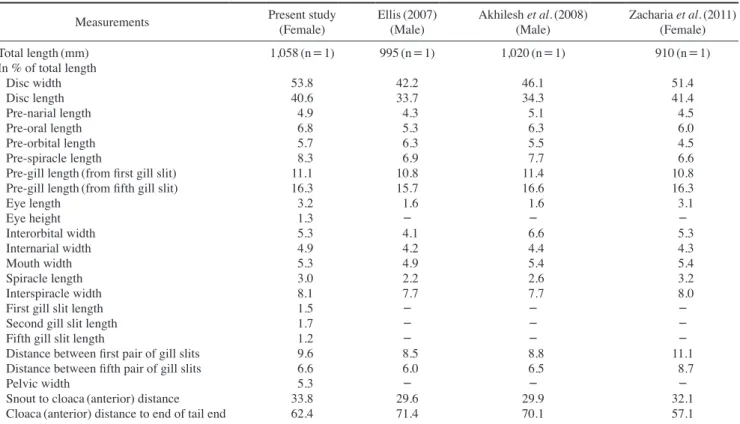
Description. Measurements for the present specimen are shown in Table 1. Body trapezoid(body broad and disc wedge shaped), depressed and disc width about 1.3 times longer than disc length; the body covered with slimy mucous; distance between the tip of snout and eye about 7.5 times the disc width or 0.8 times the interorbi- tal width; upper surface of the disc and tail covered with close-set prickles; eyes moderately size with thick eyelid, smaller than spiracles, its length 0.6 times spiracle length and close to spiracles; no dorsal and anal fin; mouth small; several rows of teeth present in the mouth, oral teeth small and rounded; teeth counts about 38 rows in upper and 35 rows in lower jaw; gill openings small, five pairs on underside of front half of pectoral disc; third gill slits larger than others, but fifth shorter; pelvic fins small and oar sharped; tail less than twice disc length; tail with distinct ventral fold, dorsal fold absent; ventral fold not
Fig. 1. Pteroplatytrygon violacea, JNU-1461, 1,058mm TL, 569mm DW, female, drift gill net, north-western coastal waters of Jejudo Island, Korea, 6 July, 2017. A, dorsal view; B, ventral view.
A B
reaching to the tip of tail without dorsal fold; tail narrow in backward; single prominent stinging spine on the dor- sal surface of tail; a row of 46 irregular spinules facing downward runs through the middle of the body; no clasp- ers because of female specimen.
Coloration. Dorsal side was uniformly black purple without spots, and ventral one uniformly dark purple without spots.
Distribution. Known from widely distributed tropical and subtropical areas of the Atlantic, Pacific and Indi- an Oceans: southern California of USA, Brazil, Russia, Japan, China, Taiwan, Indonesia, Philippines, northern India, Australia to Mediterranean, southern Africa(Com- pagno, 1996; Mollet, 2002). In Korea, it occurs around Jejudo Island(present study).
Remarks. The present specimen collected from Jeju- do Island is characterized by having a broadly rounded snout, five pairs of gill openings, tail with a large sting spine, ventral tail fold not reaching to the tip of tail, no dorsal fold, and ventral surface of the disc dark purple.
These morphological characteristics of the present spec- imen were well matched with those described by Bona- parte(1832). However, as there was no detailed mea- surements in the original paper(Bonaparte, 1832), we compare our measurements with those in other previous
studies on P. violacea(Ellis, 2007; Akhilesh et al., 2008;
Zacharia et al., 2011)(Table 1). Although our proportio- nal measurements of the present specimen agreed almost in its morphological characters with those of the female specimen described in Zacharia et al.(2011), some dif- ferences existed when compared with those of males (Ellis, 2007; Akhilesh et al., 2008). These differences in measurements seem to be caused by gender or intraspe- cific variation. Thus, we adopted molecular identification method based on COI DNA sequences to make sure of the accurate species identification. The result indicated that COI sequence of the present specimen was almost identical(99.2~99.8%) to those of P. violacea from NCBI(data not shown). Thus, we identified our speci- men to be P. violacea based on both morphological and molecular characters.
P. violacea is morphologically similar to species of the genus Dasyatis, but the former can be clearly distin- guished from the latter by having the disc trapezoidal (vs. rhomboidal), anterior margin uniformly convex(vs.
angular), ventral surface almost entirely dark(vs. pale) (Yamaguchi et al., 2013). The Korean name for P. viola- cea was adopted as “Bo-ra-saek-ga-o-ri” which was pre- viously suggested with a specimen collected in overseas (NFRDI, 1999).
Table 1. Morphometric characters compared between present and previous studies on Pteroplatytrygon violacea
Measurements Present study
(Female) Ellis(2007)
(Male) Akhilesh et al.(2008)
(Male) Zacharia et al.(2011) (Female)
Total length(mm) 1,058(n=1) 995(n=1) 1,020(n=1) 910(n=1)
In % of total length
Disc width 53.8 42.2 46.1 51.4
Disc length 40.6 33.7 34.3 41.4
Pre-narial length 4.9 4.3 5.1 4.5
Pre-oral length 6.8 5.3 6.3 6.0
Pre-orbital length 5.7 6.3 5.5 4.5
Pre-spiracle length 8.3 6.9 7.7 6.6
Pre-gill length(from first gill slit) 11.1 10.8 11.4 10.8
Pre-gill length(from fifth gill slit) 16.3 15.7 16.6 16.3
Eye length 3.2 1.6 1.6 3.1
Eye height 1.3 - - -
Interorbital width 5.3 4.1 6.6 5.3
Internarial width 4.9 4.2 4.4 4.3
Mouth width 5.3 4.9 5.4 5.4
Spiracle length 3.0 2.2 2.6 3.2
Interspiracle width 8.1 7.7 7.7 8.0
First gill slit length 1.5 - - -
Second gill slit length 1.7 - - -
Fifth gill slit length 1.2 - - -
Distance between first pair of gill slits 9.6 8.5 8.8 11.1
Distance between fifth pair of gill slits 6.6 6.0 6.5 8.7
Pelvic width 5.3 - - -
Snout to cloaca(anterior) distance 33.8 29.6 29.9 32.1
Cloaca(anterior) distance to end of tail end 62.4 71.4 70.1 57.1
ACKNOWLEDGEMENTS
This work was funded by a grant from the National In- stitute of Fisheries Sciences(No: R2018029), Korea.
REFERENCES
Akhilesh, K.V., H. Manjebrayakath, U. Ganga, K.K. Bineesh and C.P.R. Shanis. 2008. Morphometric characteristics of the pelagic stingray Pteroplatytrygon violacea(Bonaparte, 1832) caught off Cochin, South-west coast of India, J. Mar.
Biol. Ass. India, 50: 235-237.
Antonenko, D.V., A.A. Balanov, S.P. Matveichuk and N.M. Bil- ishak. 2015. Record of rare for waters of Russia pelagic stingray Pteroplatytrygon violacea(Dasyatidae) in the south Kuril region. J. Ichthyol., 55: 911-913.
Bilecenoglu, M., E. Taskavak, S. Mater and M. Kaya. 2002. Check- list of the marine fishes of Turkey. Zootaxa, 113: 1-194.
Bonaparte, C.L. 1832. Iconografia della fauna italica per le quat- tro classi degli animali vertebrati. Tomo III. Pesci. Roma, 556pp, 78 pls.
Carpenter, K.E. and V.H. Niem. 1999. Species identification guide for fisheries purposes. The living marine resources of the western central Pacific. Batoid fishes, chimeras and bony fishes part 1(Elopidae to Linophrynidae). FAO, Rome, v. 3:
1398-2068.
Chang, C.H., K.T. Shao, H.Y. Lin, Y.C. Chiu, N.Y. Lee, S.H. Liu and P.L. Lin. 2016. DNA barcodes of the native ray-finned fishes in Taiwan, Mol. Eco. Resour., 17: 796-805.
Compagno, L.J.V. 1996. Family No. 30: Dasyatidae. In: Smith, M.M. and P.C. Heemstra(eds.), Smith’s sea fishes. Springer- Verlag, Grahamstown, pp. 135-142.
Ebert, D.A. 2014. Deep-sea cartilaginous fishes of the Indian Ocean.
Volume 2. Batoids and Chimaeras. FAO Species Catalogue for Fishery Purposes. No. 8, Vol. 2. Rome, FAO, 129pp.
Ellis, J.R. 2007. Occurrence of pelagic stingray Pteroplatytrygon violacea(Bonaparte, 1932) in the North Sea. J. Fish. Biol., 71: 933-937.
Fowler, H.W. 1910. Notes on batoid fishes. Proc. Acad Nat. Sci.
Philadelphia, 62: 468-475.
Froese, R. and D. Pauly. 2017. FishBase. World wide web electronic publication. www.fishbase.org, version(06/2017).
Gomon, M.F., D.J. Bray and R.H. Kuiter. 2008. Fishes of Australia’s Southern Coast. New Holland Publishers. Sydney, Austra- lia, 928pp.
Hsu, H.H., S.J. Joung, D.A. Ebert and C.Y. Lin. 2013. Records of new and rare elasmobranchs from Taiwan. Zootaxa, 3751:
249-255.
IUCN 2017. The IUCN Red List of Threatened Species. Version 2017-2. <http://www.iucnredlist.org>. Downloaded on 14 September 2017.
Kumar, S., G. Stecher and K. Tamura. 2016. MEGA7: Molecular evolutionary genetics analysis version 7.0 for bigger data- sets. Mol. Biol. and Evol., 33: 1870-1874.
Last, P.R. and A.L. Stewart. 2015. 32 Family Dasyatidae. In: Roberts, C.D., A.L. Stewart and C.D. Struthers(eds.), The Fishes of New Zealand. Volume Two. Systematic Accounts. Te Papa Press, Wellington, 2: 97-200.
McEachran, J.D. and J.D. Fechhelm. 1998. Fishes of the Gulf of Mexico. Volume 1: Myxiniformes to Gasterosteiformes.
Univ. of Texas Press, Austin, 1112pp.
Mollet, H.F. 2002. Distribution of the pelagic stingray, Dasyatis violacea(Bonaparte, 1832), off California, Central America, and worldwide. Mar. Freshwater Res., 53: 525-530.
Mundy, B.C. 2005. Checklist of the fishes of the Hawaiian Archi- pelago. Bishop Museum Bulletins in Zoology, 6: 1-703.
Nelson, J.S. 2006. Fishes of the World. 4th ed. John Wiley and Sons Inc., New York, p. 79.
NFRDI. 1999. Fishes the Pacific Ocean. Hageul graphics, Busan, Korea, p. 224.(in Korean)
NIBR. 2011. Fish species of Korea. In: National list of species of Korea(Vertebrates). NIBR(National Institute of Biological Resources), pp. 3-189.
Parin, N.V., S.A. Evseenko and E.D. Vasil’eva. 2014. Fishes of Rus- sian Seas: Annotated Catalogue. KMK Scientific Press, Mos- cow, 53: 733pp.
Randall, J.E. and K.K.P. Lim. 2000. A checklist of the fishes of the South China Sea. Raffles Bulletin of Zoology, Suppl., 8:
569-667.
Wallace, J.H. 1967. The batoid fishes of the east coast of southern Africa. Part. 2. Manta, eagle, duckbill, cownose, butterfly and stingrays. Investigational Report. 16. Oceanographic.
Research Institute, South Africa, 56pp.
Yamaguchi, A., Y. Anonuma, N. Yagishita and T. Yoshino. 2013.
Dasyatidae. In: Nakabo, T.(ed.), Fishes of Japan with picto- rial keys to the species, 3rd edition, Tokai University Press, Kanagawa, pp. 220-226.(in Japanese)
Zacharia, P.U., K.K. Joshi and P. Kandan. 2011. First record the pe- lagic stingray Pteroplatytrygon violacea(Bonaparte, 1932) (Family: Dasyatidae) from the east coastal of India. Indian.
J. Fish., 58: 95-98.
한국산 색가오리과 (Dasyatidae) 어류 1미기록종, Pteroplatytrygon violacea
김병엽
·
김맹진1·
송춘복제주대학교 해양과학대학, 1국립수산과학원 서해수산연구소
요 약 : 매가오리목, 색가오리과에 속하는 Pteroplatytrygon violacea 1개체(전장 1,058 mm)가 2017년 7월 6일 제주도 북서쪽 연안에서 처음으로 유자망에 의해 채집되었다. 이 종은 넓은 주둥이를 갖는 점, 5쌍의 아가미구멍이
있는 점, 꼬리에 1개의 가시가 있는 점, 꼬리의 배쪽에 있는 피습이 꼬리끝까지 이르지 않는 점, 꼬리의 등쪽에는
피습이 없는 점, 그리고 배의 표면은 전체적으로 어두운 자주색을 띠는 것이 특징이다. 이러한 형태적 특징에 따라
서 이 종을 P. violacea로 동정하였으며, 표본의 COI 유전자 염기서열을 이용하여 종동정을 확인하였다. 이 미기록
종은 배 표면의 체색으로 인해 기존에 붙여진 이름에 따라 종명과 속명을 각각 “보라색가오리”와 “보라색가오리
속”으로 제안한다.
찾아보기 낱말 : 색가오리과, 보라색가오리속, 보라색가오리, 미기록종, 제주도