• 검색 결과가 없습니다.

The Role of HS-1200 Induced Autophagy in Oral Cancer Cells

N/A
N/A
Protected

Academic year: 2021

Share "The Role of HS-1200 Induced Autophagy in Oral Cancer Cells"

Copied!
8
0
0

로드 중.... (전체 텍스트 보기)

전체 글

(1)

http://dx.doi.org/10.11620/IJOB.2013.38.3.093

*Correspondence to:Bong-Soo Park, Department of Oral Ana- tomy, School of Dentistry, Pusan National University, Yangsan 626-870, Korea. Tel : 82-51-510-8242, Fax : 82-51-510-8241, E-mail : [email protected]

This is an Open-Access article distributed under the terms of the Creative Commons Attribution Non-Commercial License(http://creati- vecommons.org/licenses/by-nc/3.0) which permits unrestricted non- commercial use, distribution, and reproduction in any medium, pro- vided the original work is properly cited.

The Role of HS-1200 Induced Autophagy in Oral Cancer Cells

Nam-Mi Jang, Sang-Hun Oh, In-Ryoung Kim, Hae-Ryoun Park

1

, and Bong-Soo Park*

Department of Oral Anatomy, School of Dentistry, Pusan National University, Yangsan, Korea

1

Department of Oral Pathology, School of Dentistry, Pusan National University, Yangsan, Korea (received July 9, 2013 ; revised August 2, 2013 ; accepted August 7, 2013)

Bile acids and synthetic bile acid derivatives induce apop- tosis in various kinds of cancer cells and thus have anti- cancer properties. Recently, it has been suggested that autop- hagy may play an important role in cancer therapy. How- ever, few data are available regarding the role of autophagy in oral cancers and there have been no reports of autophagic cell death in OSCCs (oral squamous cell carcinoma cells) in- duced by HS-1200, a synthetic bile acid derivative. We thus examine whether HS-1200 modulates autophagy in OSCCs.

Our findings indicate that HS-1200 has anticancer effects in OSCCs, and we observed in these cells that autophagic vacuoles were visible by monodansylcadaverine (MDC)and acridine orange staining. When we analyzed HS-1200-treated OSCC cells for the presence of biochemical markers, we observed that this treatment directly affects the conversion of LC-3II, degradation of p62/SQSTM1 and full-length beclin-1, clea- vage of ATG5-12 and the activation of caspase. An autop- hagy inhibitor suppressed HS-1200-induced cell death in OSCCs, confirming that autophagy acts as a pro-death signal in these cells. Furthermore, HS-1200 shows anticancer acti- vity against OSCCs via both autophagy and apoptosis. Our current findings suggest that HS-1200 may potentially cont- ribute to oral cancer treatment and thus provide useful infor-

mation for the future development of a new therapeutic agent.

Key words: HS-1200, autophagy, apoptosis, OSCC

Introduction

Bile acids are polar derivatives of cholesterol which is essential for the absorption of dietary lipids. It plays a major role in regulation of transcription of genes that control cho- lesterol homeostasis. In addition, natural bile salts were repor- ted to have distinct biological effects. It inhibit cell proli- feration and induce apoptosis in various cells. Based on these findings several studies developed derivatives of bile acids, such as ursodeoxycholic acid (UDCA) and chenodeox- ycholic acid (CDCA) derivatives, and it has been reported that the derivatives had apoptosis-inducing effect in various cancer cell [1-3]. HS-1200, the synthetic bile acid derivatives which is developed by CDCA derivative, have also demon- strated to induce apoptosis in a variety of cancer cells [4-7].

Autophagy is an evolutional phenomenon by which long- lived proteins and damaged organelles within cells are di- gested in lysosomes [8,9]. Autophagy also promotes cancer cell survival under conditions of stress and functions as a defense mechanism in response to various anticancer drugs [10,11]. Therefore, anti-cancer reagent induced autophagic cell death has been recognized as an important role in cancer therapy [12-14].

Oral squamous cell carcinoma (OSCC) is the most com-

93

(2)

mon type of oral cancer. OSCC is considered one of the reason by cancer related death and affect nearly 500,000 pa- tients annually world-wide [15]. OSCC is one of the most ma- lignancies that remain incurable with current therapies [16].

OSCC patients are treated by classical modalities of treat- ment consisting of surgery, radiotherapy, and/or chemo- therapy. However, OSCC still shows noticeable mortality rates [17-19]. Therefore, new therapeutic approaches have been investigated and the use of natural agents the most promising has been suggested as one of anti-cancer treat- ment. HS-1200 also has been examined in the application of OSCC treatment, and known that it causes death of OSCC cells via apoptosis. However, there have been no reports of autophagic cell death by HS-1200 on OSCC cell line. This study was undertaken to examine whether HS-1200 induces autophagy and underlying molecular mechanism in OSCC.

Materials and Methods

Reagents

The synthetic bile acid derivative, HS-1200 was kindly provided by Professor Young-Hyun Yoo (Department of Anatomy, College of Medicine, Dong-A University, Busan, Korea). The following reagents were obtained commercially:

3-[4,5-dimethylthiazol-2-yl]2,5-diphenyl tetrazolium bromide (MTT), acridine orange, monodansylcadaverine (MDC), N- acetylcystein (NAC), and dichlorofluorescein diacetate (DCF- DA) were purchased from Sigma (St. Louis, MO, USA). 3- methyladenine (3-MA, class III PI3K inhibitor) was obtai- ned from Calbiochem (La Jolla, CA, USA).

Antibodies against the cleaved form of PARP and cas- pase-3 were purchased from Cell Signaling Technology (Be- verly, MA, USA). Antibodies against LC3 (Sigma) were also used. The mouse anti-actin antibody, mouse anti-rabbit IgG antibody, and rabbit anti-mouse IgG antibodies were purchased from Santa Cruz Biotechnology (Santa Cruz, CA, USA). All other chemicals and reagents were purchased from Sigma unless otherwise specified.

Cell culture

The SCC25 human oral saquamous carcinoma cell line was purchased from ATCC (Rockville, MD, USA). YD10B OSCC cells were a gift from the Department of Oral Patho- logy, College of Dentistry, Yonsei University (Seoul, Korea).

Cells were maintained at 37

o

C in a humidified atmosphere

containing with 5% CO

2

in Dulbecco's Modified Eagle Medium: Nutrient Mixture F-12 (DMEM / F-12) with 4 mM L-glutamine, 1.5 g/l sodium bicarbonate, 4.5 g/l glucose and 1.0 mM sodium pyruvate supplemented with 10% FBS (GIBCO-BRL, Rockville, MD, USA).

Treatment of HS-1200

Stock solutions of the HS-1200 (100 mM) which were made by dissolving them in DMSO were kept frozen at -20

o

C until use. The stock was diluted to their concentration with DMEM / F-12 when needed. Prior to HS-1200 treat- ment cells were grown to about 80% confluence and then exposed to HS-1200 at different concentrations (0 - 50 µM) for 24 h. Cells grown in medium containing an equivalent amount of DMSO without HS-1200 served as control. For autophagy control, cells were grown in Earle's Balanced Salt Solution (EBSS, GIBCO).

MTT assay

Cells were placed in a 96-well plate and were incubated for 24 h. Then they were treated with various doses of HS- 1200 (0 - 50 µM) for 24 h. After cells were treated with 500 g/ml of thiazolyl blue tetrazolium bromide (MTT solution), they were incubated at 37

o

C with 5% CO

2

for 4 h. The medium was aspirated and formed formazan crystals were dissolved in DMSO. Cell viability was measured by an ELISA reader (Tecan, Mnnedorf, Switzerland) at 570 nm excitatory emission wavelength.

Flow cytometer analysis

For quantification of DNA hypoploidy, cells were harves- ted by trypsinization, and ice cold 95% ethanol with 0.5%

Tween 20 was added to the cell suspensions to a final concentration of 70% ethanol. Fixed cells were pelleted, and washed in 1% Bovin serum albumin(BSA)-PBS solution.

Cells were resuspended in 1 ml PBS containing 20 µg/ml RNase A, incubated at 4

o

C for 30 min, washed once with BSA- PBS, and resuspended in PI solution (10 µg/ml). After cells were incubated at 4

o

C for 5 min in the dark, DNA content were measured on a CYTOMICS FC500 flow cytometry system (Beckman Coulter, FL, CA, USA) and data was ana- lyzed using the Multicycle software which allowed a simul- taneous estimation of cell-cycle parameters and apoptosis.

To quantify the development of acidic vesicular orga-

nelles (AVOs), the cells were stained with acridine orange

(1 µg/mL) for 15 min, removed from the plate with trypsin-

(3)

EDTA (GIBCO-BRL), and analyzed using a FACScan flow cytometer. For autophagy inhibition, cells were pretreated with 1 mM 3-MA for 1 h and incubated with HS-1200 for 24 h.

To determine ROS in HS-1200-treated cells, the cells were stained with 10 µM DCF-DA for 30 min, and ROS generation was analyzed using the flow cytometer.

Fluorescence microscopy

Cells were grown on coverslips and treated with HS- 1200. After 24 h, cells were stained with 0.05 mM MDC, a selective fluorescent marker for autophagic vacuoles, at 37 C for 1 h. The cellular fluorescence changes were observed using a fluorescence microscope (Axioskop, Carl Zeiss, Ger- many). As an autophagy control, cells were starved using EBSS.

For further detection of the acidic cellular compartment, we used acridine orange, which emits bright red fluores- cence in acidic vesicles but fluoresces green in the cyto- plasm and nucleus. Cells were stained with 1 µg/mL acridine orange for 15 min and washed with PBS. AVOs formation was obtained under a confocal microscope LSM 700 (Carl Zeiss, Germany).

Western blot analysis

Cells (2 × 10

6

) were washed twice in ice-cold PBS, resu- spended in 200 l ice-cold solubilizing buffer [300 mM NaCl, 50 mM Tris-Cl (pH 7.6), 0.5% Triton X-100, 2 mM PMSF, 2 µg/ml aprotinin and 2 µg/ml leupeptin] and incubated at 4

o

C for 30 min. The lysates were centrifuged at 14,000 revolutions per min for 15 min at 4

o

C. Protein concen- trations of cell lysates were determined with Bradford pro- tein assay (Bio-Rad, Richmond, CA, USA) and 20 µg of proteins were resoved by 10% SDS/PAGE. The gels were transferred to Polyvinylidene fluoride (PVDF) membranes (Millipore, Billerica, MA, USA) (Amersham GE Health- care, Little Chalfont, UK) and reacted with appropriate pri- mary antibodies. Immunostaining with secondary antibodies was detected using SuperSignal West Femto (Pierce, Rockford, IL, USA) enhanced chemiluminescence substrate and detected with Alpha Imager HP (Alpha Innotech, Santa Clara, USA).

Results

Toxicity and apoptotic effect of HS-1200

The effect of HS-1200 on OSCC cells (SCC25 and YD10B) was investigated over a wide concentration range. Cells were

Fig. 1. HS-1200 showed cytotoxicity and induced apoptosis in OSCC cells. (A) Cells were treated with either vehicle or HS- 1200 (5~50 µM) for 24 h, and cell viability was analyzed using the MTT assay. The data were calculated as percent of vehicle control and expressed as the mean of at least three experi- ments. (B) Cells were treated with vehicle, HS-1200 (5~50 µM) for 24 h, and the ratio of apoptotic cells was determined by flow cytometry analysis.

treated with HS-1200 (0 - 50 µM) for 24 h, and cell viability was then assessed by the MTT assay. Our results showed that the viability of HS-1200-treated SCC25 and YD10B cells were decreased in a dose-dependent manner. HS-1200 concentrations from 5 to 50 µM potently induced SCC25 and YD10B cell death (Fig. 1A). Then flow cytometry assay was undertaken to test whether this cell death induction is mediated via apoptosis. The percentages of subdiploid cells, indicative of apoptotic cells, were increased in a dose- dependent fashion by HS-1200 (Fig. 1B).

HS-1200 treatment leads to induction of autophagy in OSCC cells

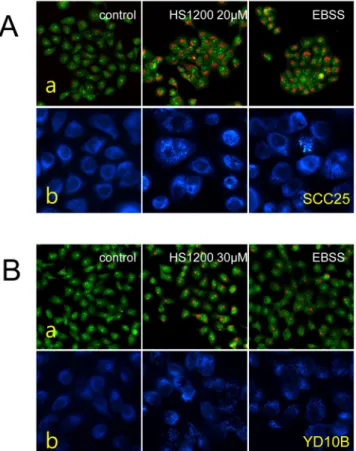
Based on the above observations, we investigated whe- ther autophagy occurs in HS-1200 treated SCC25 and YD10B cells. When cells were stained with monodansyl- cadaverine (MDC), a selective fluorescent marker of au- tophagic vesicles, HS-1200-treated OSCC cells exhibited strong staining compared to control cells (Fig. 2A-b and 2B-b). To confirm the formation of autophagic vacuoles by HS- 1200, acridine orange was used to stain acidic vesicular organelles (AVOs) which represents autophagic vacuoles in HS-1200-treated cells. It resulted in apparent formation of AVOs (red fluorescence) in OSCC cells. As shown in Fig.

2A-a and 2B-a, orange-colored autophagic vacuoles were

(4)

Fig. 2. HS-1200 induced autophagy in OSCC cells. Cells were stained with acridine orange (A-a, B-a) and MDC (A-b, B-b) as described in Materials and Methods. SCC25 (A) and YD10B (B) cells were grown on coverslips and treated with 20 and 30 µM HS-1200. As an autophagy control, cells were cultured in EBSS for 6 h. Autophagic vacuoles were observed and imaged on a fluorescence microscope.

observed following treatment with 20 µM HS-1200 in SCC25 and 30 µM HS-1200 in YD10B for 24 h. The findings indicate that HS-1200 treated OSCC are sufficient to inves- tigate an autophagic response as observed by MDC and ac- ridine orange staining of autophagic vacuoles.

HS-1200 accelerates the formation of apoptotic molecules and the autophagy-related proteins in OSCC cells

This study tested whether HS-1200 was induced autophagy in OSCC cells by observing various autophagy markers, such as p62/SQSTM1, LC3, ATG5-12 complex and beclin-1.

Conversion of LC3-I to LC3-II as well as the total levels of LC3 proteins were increased in HS-1200 OSCC cells in dose-dependent manners. The level of p62/SQSTM1, a protein that is degraded by autophagy, was reduced in HS- 1200 treated SCC25 and YD10B cells. After treatment of HS-1200, full length Beclin-1 was cleaved into three major

fragments of 52, 37 and 35 kDa, which accumulated in a dose- dependently (Fig. 3A).

To further investigate the mechanism of HS-1200-induced cell death, the levels of PARP cleavage and procaspase clea- vage to active caspase-3,-8 and -9, markers of apoptotic activity, were also studied in SCC25 and YD10B cells. As

Fig. 3. HS-1200 changed expressions of autophagy-related pro- teins in OSCC cells. (A) Cells were treated with various concentrations of HS-1200 for 24 h and the expression levels of autophagy-related proteins, such as p62/SQSTM1, LC3, ATG5-ATG12 complex and beclin-1, were analyzed by wes- tern blotting. (B) Cells were treated with HS-1200 for the in- dicated time points and levels of caspase-8, caspase-9, cas- pase-3 and PARP were measured by western blot analysis.

Fig. 4. The effect of on the production of reactive oxygen spe-

cies (ROS) in HS-1200 treated cells. The cells were treated

with HS-1200, then the cells were stained with dichlorofluo-

rescein diacetate (DCF-DA) for 30 min and the intracellular

ROS level was determined using flow cytometer.

(5)

shown in Fig. 3B, HS-1200 induced the degradation of cas- pase-8, caspase-9 and caspase-3, and produced the proces- sed PARP 85 kDa (Fig. 3B).

HS-1200 induced ROS production was insignificant in both OSCC cells

ROS accumulation by HS-1200 in OSCC cells was not ob- served. For 24 h, 20 µM HS-1200 treated SCC25 cells and 30 µM HS-1200 treated YD10B cells showed the increase of in- tracellular ROS levels which is detected by DCF-DA (Fig. 4).

3-methyladenine inhibits HS-1200-induced cell death and blo- cks the formation of autophagic vacuoles by HS-1200

To clarify the role of HS-1200-induced autophagy in OSCC, we investigated the consequences of treatment with 3-methy- ladenine (3-MA), a selective autophagy inhibitor, on the HS-1200-treated OSCC cells. To determine whether 3-MA could inhibit HS-1200-induced autophagy, we first exa- mined the cell viability in HS-1200-treated both cell lines pretreated with 1 mM 3-MA for 1 h. 3-MA increased the cell viability in HS-1200 treated cells (Fig 5A). The accumu- lation of AVOs in 20 µM HS-1200-treated SCC25 cells pre- treated with 3-MA. 3-MA prevented the formation of autop- hagic vacuoles induced by HS-1200 treatment. In addition, inhibitory effects of AVO formation by 3-MA was confir- med by quantitatively measuring the red-to-green fluores- cence ratio after acridine orange staining (Fig. 5B). The same results were observed in 30 µM HS-1200-treated YD10B cells (Fig 5C). The results indicate that the inhibition of the autophagic process with 3-MA resulted in attenuation of the cytotoxic activity of HS-1200. Taken together, these results suggest that autophagy may be at least one of the pathways by which HS-1200 induces death in OSCC cells.

Discussion

The present study elucidated that HS-1200, a synthetic bile acid derivate, induced autophagy as well as apoptosis in OSCC cells. The natural bile salts were reported to inhibit cell proliferation and induce apoptosis in various cancer cells [20-23]. Depending on the nature of chemical structures, each kind of bile acid exhibits distinct biological effects [22-24]. Modified structures of natural bile salts showed more potent effets on the suppression of cancer cells. It was reported that several synthetic CDCA derivatives have an

Fig. 5. HS-1200-induced autophagy was inhibited by 3MA in OSCC cells. SCC25 (A, B) and YD10B (A, C) cells were pretreated with 1 mM 3-MA for 1 h, and then exposed to 20 µM and 30 µM HS-1200 for 24 h. Cell viability were analyzed using the MTT assay (A). Vital staining was then performed using acridine orange, it is observed with a confocal micros- cope and the ratio of red fluorescence was quantified by flow cytometry. Cells were stained with MDC and observed with a fluorescence microscope (B, C).

apoptosis-inducing effects in several cancer cells. HS-1200, the synthetic chenodeoxycholic acid (CDCA) derivatives, induced apoptosis via a mitochondrial pathway in hepatic, stomach, colon cancer cell lines [3-7].

Autophagy is widely known as an important process in

cell physiology, for both cell survival and death [25]. Au-

(6)

tophagy starts with the elimination of cytoplasmic orga- nelles in a double-membrane vacuole, an autophagosome, and delivered into a degradative organelle, the vacuole/ lyso- some, for breakdown and eventual recycling of the resulting macromolecules. Because numerous recent studies have shown that increased autophagic activity is associated with cell death [14,26], autophagy is now considered to be a type of cell death.

Previous studies in our laboratory have also showed that HS-1200 induced cell death of OSCC cells via apoptosis.

Though, recent studies suggested that autophagy is initially activated in response to bile acids in various cancer cell lines [27-29]. The effect of HS-1200 in autophagic process in OSCC has not determined yet. Our data demonstrated that the HS-1200-treated OSCC cells were decreased cell viability and induced cell death via apopotisis and autophagy (Fig.

1A, B). In our study, to confirm the autophagic effect of HS- 1200 in OSCC cells, we used the AO staining and MDC staining. Our data showed that HS-1200 induced the for- mation of cytoplasmic vacuole and acidic organelles (AVOs) in both SCC25 and YD10B cell lines (Fig. 2A, B).

We also analyzed HS-1200-treated OSCC cells for the presence of biochemical markers of autophagy, such as p62/

SQSTM1, LC3, ATG5-ATG12 complex and beclin-1, asso- ciated with autophagy. Our results showed that the HS-1200 treatment directly affected conversion of LC-3II, degrada- tion of p62/SQSTM1 and full-length beclin-1, and cleavage- formation of ATG5-12 and beline-1 (Fig. 3A). Several previous studies have reported that a relationship may exist between LC3 and p62/SQSTM1, and p62/SQSTM1 is se- lectively degraded undergoing autophagy [30-33]. Autophagy mediates a nonspecific bulk degradation pathway respon- sible for degradation of the majority of long lived proteins and some organelles. Atg12-Atg5 conjugation systems are necessary for the formation of the autophagosome [34].

Beclin-1 (Bcl-2-interacting protein-1) is a key protein in au- tophagy signaling and its functions as Vps34, UVRAG, AMBRA-1 and Barkor to assemble the PI3KC3 complex during initiation of autophagosome formation [35-37]. Se- veral recent studies using different cell types and stimuli also described that caspase-mediated cleavage of Beclin-1 and ATG proteins enhances apoptosis [38-41]. Our results showed that HS-1200 led to degradation of caspase-8, -9 and -3, and it assumes a decisive role on beclin-1 (Fig. 3B).

In addition, it has been reported that autophagy regulated by

reactive oxygen species (ROS) in lymphoblast cells, resve- ratrol which is a polyphenol found in grapes, induced apop- tosis via ROS-triggered autophagy in colon cancer cells [42,43]. Nevertheless, our results demonstrated that HS- 1200 was not related with the ROS accumulation in OSCC (Fig. 4).

Our study to clarify the role of autophagy in OSCC demonstrated that HS-1200 induced cell death was sup- pressed by 3-MA, an inhibitor of autophagy. This result strongly implies that HS-1200-induced autophagy is a pro- death rather than a pro-survival signal (Fig. 5).

This is the first report of HS-1200-induced autophagic cell death in OSCC. As HS-1200 clearly has autophagic cell death-inducing activity and the ability to suppress pro- liferation in OSCC, it could be a potentially useful the- rapeutic agent for oral cancer. Characterizing the molecular mechanism by which HS-1200 acts will provide useful in- formation for its development as a novel therapeutic agent in the management of OSCC.

Acknowledgement

This work was supported by for two years Pusan National University research grant.

References

1. Park YH, JA Kim, JH Baek, EJ Jung, TH Kim, H Suh, MH Park, and KW Kim, Induction of apoptosis in HepG2 hu- man hepatocellular carcinoma cells by a novel derivative of ursodeoxycholic acid (UDCA). Arch Pharm Res, 1997;

20:29-33.

2. Im E and JD Martinez, Ursodeoxycholic acid (UDCA) can inhibit deoxycholic acid (DCA)-induced apoptosis via mo- dulation of EGFR/Raf-1/ERK signaling in human colon cancer cells. J Nutr, 2004;134:483-6.

3. Moon B, MC Kim, and JS Park, Synthetic CDCA deri- vatives-induced apoptosis of stomach cancer cell line SNU-1 cells. Cancer Res Treat, 2004;36:132-9.

4. Park SE, SW Lee, MA Hossain, MY Kim, MN Kim, EY Ahn, YC Park, H Suh, GY Kim, YH Choi, and ND Kim, A chenodeoxycholic derivative, HS-1200, induces apoptosis and cell cycle modulation via Egr-1 gene expression control on human hepatoma cells. Cancer Lett, 2008;270:77-86.

5. Liu H, CK Qin, GQ Han, HW Xu, WH Ren, and CY Qin,

Synthetic chenodeoxycholic acid derivative, HS-1200, in-

duces apoptosis of human hepatoma cells via a mitochon-

drial pathway. Cancer Lett, 2008;270:242-9.

(7)

6. Yee SB, YS Song, SH Jeong, HS Lee, SY Seo, JH Kim, H Suh, ND Kim, and YH Yoo, A novel chenodeoxycholic derivative HS-1200 enhances radiation-induced apoptosis in MCF-7 cells. Oncol Rep, 2007;17:919-23.

7. Seo SY, EJ Jun, SM Jung, KH Kim, YJ Lim, BS Park, JK Kim, S Lee, H Suh, ND Kim, and YH Yoo, Synthetic che- nodeoxycholic acid derivative HS-1200-induced apoptosis of p815 mastocytoma cells is augmented by co-treatment with lactacystin. Anticancer Drugs, 2003;14:219-25.

8. Yorimitsu T and DJ Klionsky, Autophagy: molecular mac- hinery for self-eating. Cell Death Differ, 2005;12 Suppl 2:1542-52.

9. Codogno P, [Autophagy in cell survival and death]. J Soc Biol, 2005;199:233-41.

10. Michaud M, I Martins, AQ Sukkurwala, S Adjemian, Y Ma, P Pellegatti, S Shen, O Kepp, M Scoazec, G Mignot, S Rello-Varona, M Tailler, L Menger, E Vacchelli, L Gal- luzzi, F Ghiringhelli, F di Virgilio, L Zitvogel, and G Kroe- mer, Autophagy-dependent anticancer immune responses induced by chemotherapeutic agents in mice. Science, 2011;

334:1573-7.

11. Zhang J, Y Li, X Chen, T Liu, Y Chen, W He, Q Zhang, and S Liu, Autophagy is involved in anticancer effects of matrine on SGC-7901 human gastric cancer cells. Oncol Rep, 2011;26:115-24.

12. Guo XL, D Li, F Hu, JR Song, SS Zhang, WJ Deng, K Sun, QD Zhao, XQ Xie, YJ Song, MC Wu, and LX Wei, Targeting autophagy potentiates chemotherapy-induced apoptosis and proliferation inhibition in hepatocarcinoma cells. Cancer Lett, 2012.

13. Giannopoulou E, A Antonacopoulou, P Matsouka, and HP Kalofonos, Autophagy: novel action of panitumumab in colon cancer. Anticancer Res, 2009;29:5077-82.

14. Gozuacik D and A Kimchi, Autophagy as a cell death and tumor suppressor mechanism. Oncogene, 2004;23:2891-906.

15. Clayman GL, S Ebihara, M Terada, K Mukai, and H Goep- fert, Report of the Tenth International Symposium of the Foundation for Promotion of Cancer Research: Basic and Clinical Research in Head and Neck cancer. Jpn J Clin Oncol, 1997;27:361-8.

16. Shen J, C Huang, L Jiang, F Gao, Z Wang, Y Zhang, J Bai, H Zhou, and Q Chen, Enhancement of cisplatin induced apop- tosis by suberoylanilide hydroxamic acid in human oral squamous cell carcinoma cell lines. Biochem Pharmacol, 2007;73:1901-9.

17. Lo WL, SY Kao, LY Chi, YK Wong, and RC Chang, Out- comes of oral squamous cell carcinoma in Taiwan after surgical therapy: factors affecting survival. J Oral Maxil- lofac Surg, 2003;61:751-8.

18. Shintani S, C Li, M Mihara, SK Klosek, N Terakado, S Hino, and H Hamakawa, Anti-tumor effect of radiation res- ponse by combined treatment with angiogenesis inhibitor, TNP-470, in oral squamous cell carcinoma. Oral Oncol, 2006;42:66-72.

19. Bell RB, D Kademani, L Homer, EJ Dierks, and BE Potter, Tongue cancer: Is there a difference in survival compared with other subsites in the oral cavity? J Oral Maxillofac Surg, 2007;65:229-36.

20. Katona BW, S Anant, DF Covey, and WF Stenson, Cha- racterization of enantiomeric bile acid-induced apoptosis in colon cancer cell lines. J Biol Chem, 2009;284:3354-64.

21. Park SE, HJ Choi, SB Yee, HY Chung, H Suh, YH Choi, YH Yoo, and ND Kim, Synthetic bile acid derivatives inhibit cell proliferation and induce apoptosis in HT-29 human colon cancer cells. Int J Oncol, 2004;25:231-6.

22. Powell AA, JM LaRue, AK Batta, and JD Martinez, Bile acid hydrophobicity is correlated with induction of apop- tosis and/or growth arrest in HCT116 cells. Biochem J, 2001;356:481-6.

23. Martinez JD, ED Stratagoules, JM LaRue, AA Powell, PR Gause, MT Craven, CM Payne, MB Powell, EW Gerner, and DL Earnest, Different bile acids exhibit distinct bio- logical effects: the tumor promoter deoxycholic acid induces apoptosis and the chemopreventive agent ursodeoxycholic acid inhibits cell proliferation. Nutr Cancer, 1998;31:111-8.

24. Qiao D, W Chen, ED Stratagoules, and JD Martinez, Bile acid-induced activation of activator protein-1 requires both extracellular signal-regulated kinase and protein kinase C signaling. J Biol Chem, 2000;275:15090-8.

25. Lum JJ, DE Bauer, M Kong, MH Harris, C Li, T Lindsten, and CB Thompson, Growth factor regulation of autophagy and cell survival in the absence of apoptosis. Cell, 2005;

120:237-48.

26. Tsujimoto Y and S Shimizu, Another way to die: autop- hagic programmed cell death. Cell Death Differ, 2005;12 Suppl 2:1528-34.

27. Roesly HB, MR Khan, HD Chen, KA Hill, N Narendran, GS Watts, X Chen, and K Dvorak, The decreased expres- sion of Beclin-1 correlates with progression to esophageal adenocarcinoma: The role of deoxycholic acid. Am J Phy- siol Gastrointest Liver Physiol, 2012.

28. Zhang G, MA Park, C Mitchell, T Walker, H Hamed, E Studer, M Graf, M Rahmani, S Gupta, PB Hylemon, PB Fis- her, S Grant, and P Dent, Multiple cyclin kinase inhibitors promote bile acid-induced apoptosis and autophagy in primary hepatocytes via p53-CD95-dependent signaling. J Biol Chem, 2008;283:24343-58.

29. Payne CM, C Crowley-Skillicorn, H Holubec, K Dvorak, C Bernstein, MP Moyer, H Garewal, and H Bernstein, De- oxycholate, an endogenous cytotoxin/genotoxin, induces the autophagic stress-survival pathway: implications for colon carcinogenesis. J Toxicol, 2009;2009:785907.

30. Chen LH, CC Loong, TL Su, YJ Lee, PM Chu, ML Tsai, PH Tsai, PH Tu, CW Chi, HC Lee, and SH Chiou, Au- tophagy inhibition enhances apoptosis triggered by BO- 1051, an N-mustard derivative, and involves the ATM sig- naling pathway. Biochem Pharmacol, 2011;81:594-605.

31. Ichimura Y and M Komatsu, Selective degradation of p62 by autophagy. Semin Immunopathol, 2010;32:431-6.

32. Ichimura Y, E Kominami, K Tanaka, and M Komatsu, Se- lective turnover of p62/A170/SQSTM1 by autophagy. Autop- hagy, 2008;4:1063-6.

33. Pankiv S, TH Clausen, T Lamark, A Brech, JA Bruun, H

Outzen, A Overvatn, G Bjorkoy, and T Johansen, p62/ SQS-

TM1 binds directly to Atg8/LC3 to facilitate degradation of

ubiquitinated protein aggregates by autophagy. J Biol Chem,

(8)

2007;282:24131-45.

34. Jounai N, F Takeshita, K Kobiyama, A Sawano, A Miya- waki, KQ Xin, KJ Ishii, T Kawai, S Akira, K Suzuki, and K Okuda, The Atg5 Atg12 conjugate associates with innate antiviral immune responses. Proc Natl Acad Sci U S A, 2007;104:14050-5.

35. Fimia GM, A Stoykova, A Romagnoli, L Giunta, S Di Bar- tolomeo, R Nardacci, M Corazzari, C Fuoco, A Ucar, P Sch- wartz, P Gruss, M Piacentini, K Chowdhury, and F Cec- coni, Ambra1 regulates autophagy and development of the nervous system. Nature, 2007;447:1121-5.

36. Kihara A, Y Kabeya, Y Ohsumi, and T Yoshimori, Beclin- phosphatidylinositol 3-kinase complex functions at the trans-Golgi network. EMBO Rep, 2001;2:330-5.

37. Sun Q, W Fan, and Q Zhong, Regulation of Beclin 1 in autophagy. Autophagy, 2009;5:713-6.

38. Djavaheri-Mergny M, MC Maiuri, and G Kroemer, Cross talk between apoptosis and autophagy by caspase-mediated cleavage of Beclin 1. Oncogene, 2010;29:1717-9.

39. Wirawan E, L Vande Walle, K Kersse, S Cornelis, S Claer- hout, I Vanoverberghe, R Roelandt, R De Rycke, J Vers

purten, W Declercq, P Agostinis, T Vanden Berghe, S Lip- pens, and P Vandenabeele, Caspase-mediated cleavage of Beclin-1 inactivates Beclin-1-induced autophagy and enhan- ces apoptosis by promoting the release of proapoptotic factors from mitochondria. Cell Death Dis, 2010;1:e18.

40. Cho DH, YK Jo, JJ Hwang, YM Lee, SA Roh, and JC Kim, Caspase-mediated cleavage of ATG6/Beclin-1 links apoptosis to autophagy in HeLa cells. Cancer Lett, 2009;

274:95-100.

41. Betin VM and JD Lane, Caspase cleavage of Atg4D stimu- lates GABARAP-L1 processing and triggers mitochondrial targeting and apoptosis. J Cell Sci, 2009;122:2554-66.

42. Miki H, N Uehara, A Kimura, T Sasaki, T Yuri, K Yoshi- zawa, and A Tsubura, Resveratrol induces apoptosis via ROS- triggered autophagy in human colon cancer cells. Int J Oncol, 2012;40:1020-8.

43. Alexander A, SL Cai, J Kim, A Nanez, M Sahin, KH Mac-

Lean, K Inoki, KL Guan, J Shen, MD Person, D Kusewitt,

GB Mills, MB Kastan, and CL Walker, ATM signals to

TSC2 in the cytoplasm to regulate mTORC1 in response to

ROS. Proc Natl Acad Sci U S A, 2010;107:4153-8.

수치

Fig. 1. HS-1200 showed cytotoxicity and induced apoptosis in  OSCC cells. (A) Cells were treated with either vehicle or HS-  1200 (5~50  µM) for 24 h, and cell viability was analyzed using  the MTT assay
Fig. 2. HS-1200 induced autophagy in OSCC cells. Cells were  stained with acridine orange (A-a, B-a) and MDC (A-b, B-b)  as described in Materials and Methods
Fig. 5. HS-1200-induced autophagy was inhibited by 3MA in  OSCC cells. SCC25 (A, B) and YD10B (A, C) cells were  pretreated with 1 mM 3-MA for 1 h, and then  exposed to 20  µM and 30 µM HS-1200 for 24 h

참조

관련 문서

CK17: Cytokeratin 17; IHC: Immunohistochemistry; OSCC: Oral squamous cell carcinoma; p53: Protein 53; PD-L1: Programmed cell death ligand 1; TCs: Tumor cells; TILs:

The role of high-risk human papillomavirus infection in oral and or- opharyngeal squamous cell carcinoma in non-smoking and non-drinking patients:

As shown in Figure 2A, no significant cell death was induced by cetuximab treatment alone in squamous cell carcinoma lines originating from human oral cancer (MSKQLL1, SCCQLL1,

A lipopeptide extract of Bacillus amyloliquefaciens BACY1 (BLE) was found to induce cell death in human oral squamous cell carcinoma (OSCC) cell lines, SCC4 and SCC25, in

Effect of autophagy in human tongue squamous cell carcinoma SCC 25 cells from Scutellariae Radix by ethanol extract..

Autophagy is involved in MLN4924-induced cell growth inhibition and cell death in colon cancer cells To further investigate the role of autophagy in colon cancer cell growth and

In this review, the types of autophagy, mechanism of autophagosome biogenesis, and modulating molecules and therapeutic candidates affecting the induction of autophagic cell

Recombinant Azurin from Pseudomonas aeruginosa Induces Apoptotic Cell Death in Oral Squamous Carcinoma Cells.. Uk-Kyu Kim, Hyun-Jun Jeon, Moo-Hyung Lee 1 , Gyoo-Cheon