663
F
ORESTS
OCIETYPollen Morphology of the Genus Rhododendron (Ericaceae) in Korea Joonmoh Park
1and Unsook Song
2*1Jeollabuk-Do Forest Environment Research Inst., Jinan 567-883, Korea
2Inst. of Agricultural Science & Technology, Chonbuk Nat. University, Jeonju, 561-756, Korea
Abstract :
The pollen morphology of eleven species and three forms of the genus
Rhododendron(Ericaceae) in Korea was examined using light, scanning electron and transmission electron microscopy. The pollen grains are grouped in permanent tetrahedral tetrads; viscin threads are present on the tetrads. The hexacolporate tetrads are of tricolporate monads whereby the apertures form in pairs at six points in the tetrad. The exine sculpture pattern is rugulate, scabrate or verrucate on mesocolpium but psilate, rugulate or microscabrate around the aperture on apocolpium. The exine of Korean
Rhododendronpollen consists of tectum, columella, foot layer and endexine. The surface of viscin threads is more or less smooth. The threads are sometimes tangled together and occasionally divided into strands. Six types are recognized based on the pollen morphology.
The types are: (1)
Micranthum-type (rugulate mesocolpium and psilate apocolpium), (2)
Tomentosum-type (rugulate mesocolpium and apocolpium), (3)
Aureum-type (scabrate mesocolpium and rugulate apocolpium), (4)
Brachycarpum-type (scabrate mesocolpium and rod shaped-microscabrate apocolpium), (5)
Schlippenbachii- type (scabrate mesocolpium and round-microscabrate apocolpium) and (6)
Weyrichii-type (verrucate mesocolpium).
Key words :pollen type, Rhododendron, tetrahedral tetrad, viscin thread
Introduction
The
RhododendronL., one of the largest genera in the Ericaceae, belongs to the Rhododendroideae (Rehder, 1940; Leach, 1961; Cronquist, 1981). It consists of about 1,200 taxa, and widespread in temperate, cool, subtrop- ical regions and in tropical mountains except for Africa and South America regions (Leach, 1961; Bailey and Bailey, 1978; Galle, 1995). There are 22 native
Rhodo- dendrontaxa in Korea, and their distribution ranges from very low areas along seacoasts to
ca. 2,000 m high mountains (Lee, 1989).
Since
R. schlippenbachiiMaxim. was firstly documented in 1870 as a Korean
Rhododendronspecies (Nakai, 1919), there have been a number of fragmentary systematic studies on the genus in Korea. Nakai (1919) reported 12 species and three varieties of the Korean
Rhododendron. However, some scientific names and morphological characters proposed by Nakai were turned out not to be correct. The number range of
Rhododendrontaxa has been 17 to 23 by different scientists (Nakai, 1952; Chung, 1957; Lee, 1989; Lee, 1996a; Lee, 1996b). Though recent systematic studies (Choo, 1987; Hwang, 1987; 1999;
Lee, 1988) tried to solve those problems, there has been no taxonomic progress because of almost the same char- acters and methods used in the studies.
The pollen of
Rhododendronis a tetrahedral tetrad com- bined from four monads while pollen grains of other plants are commonly monads. The size of tetrads and exine strat- ification vary according to authors (Wodehouse, 1935; Erdt- man, 1952; 1969; Yang, 1952; Waha, 1982; Praglowski and Grafstrom, 1985). The genus has been palynologically attrac- tive because of viscin threads (Bowers, 1930; Ikuse, 1956;
Oldfield, 1959; Ueno, 1978; Foss, 1988; Keri and Zetter, 1992; Crepet, 1996; Abraham-Peskir
et al., 1997).
Pollen morphology of Korean
Rhododendronhas been reported (Lee, 1979; Jang, 1986; Choo, 1987) briefly using light microscopy and scanning electron micros- copy. There have not been any transmission electron microscopic studies on Korean
Rhododendron, yet.
Therefore, this study aimed to examine eleven species and three forms of Korean
Rhododendronusing light, scanning electron and transmission electron microscopy, and further contribute to the systematics of Korean
Rhododendron.
Materials and Methods
Pollen material from 11 species, 3 forms of Korean
*Corresponding author
E-mail: [email protected]
664 Jour. Korean For. Soc. Vol. 99, No. 5 (2010)
Rhododendron
was collected throughout the country from March 1998 to July 1999. Pollen of five species;
R.aureum, R. confertissimum, R. dauricum, R. tomentosum
and
R. redowskianumin North Korea was extracted from the specimens in Chonbuk Nat. University and Seoul Nat. University herbaria (Specimens Investigated). The pollen specimens are preserved in the herbarium of the Department of Forest Resources, Chonbuk Nat. Univer- sity, Korea.
For LM, the pollen grains were acetolysed and mounted in glycerol jelly (Erdtman, 1952; Song and Kim, 1999).
An Olympus B201 was used to measure seven charac- ters; tetrad diameter (TD), diameter of top grain (DT), apocolpium diameter (AD), monad polar axis length (PL), monad equatorial width (EW), colpus length (CL) and colpus width (CW) at 400X (Figure 1). Fifty tetrads per taxon were investigated.
For SEM, acetolysed pollen grains were dehydrated in ethanol series and transferred onto aluminum stubs (Har- ley and Daly, 1995; Harley
et al., 2005). The pollen sus- pensions on the stubs were covered with an inverted glass beaker and left to evaporate at room temperature.
The pollen grains were coated with
ca. 90 nm of plat- inum (Cressington Sputter Coater Q108). The examina- tion of pollen grains was conducted with a JEOL JSM- 5600 LV at 650-10,000X (2,000 accelerating voltage).
For TEM, pollen was fixed in 2% of glutaraldehyde solution for 90 minutes and in 1% of OsO
4solution for another 90 minutes, and dehydrated using propylene oxide.
Then the pollen was embedded in epoxy resin for two hours and the ultra-thin sectioning was done by an Ultra-
microtome (Rechert-Jung, Type 701704). The exine struc- ture and viscin thread were examined by a JEM-1200EXII at 1,500-10,000X (2,000 accelerating voltage).
Terminology
Terminology follows Punt
et al. (2007).
Results
1. Pollen morphology of Korean Rhododendron taxa The pollen grains of the genus are compound grains.
Four monads are combined into a tetrahedral tetrad hav- ing viscin threads. Each pollen grain of the tetrad is iso- polar and radially symmetrical, either circular (Figure 2c) or somewhat rounded triangular (Figure 3c) in polar view, and oblate to oblate spheroidal in equatorial view. The tetrads are rhomboidal. The hexacolporate tetrads are of tricolporate monads whereby the apertures form in pairs at six points in the tetrad. There are 12 lalongate endoapertures in the tetrad. The mesocolpium is sca- brate, rugulate or verrucate while the aperture area is microscabrate, rugulate or psilate (Figures 2-4).
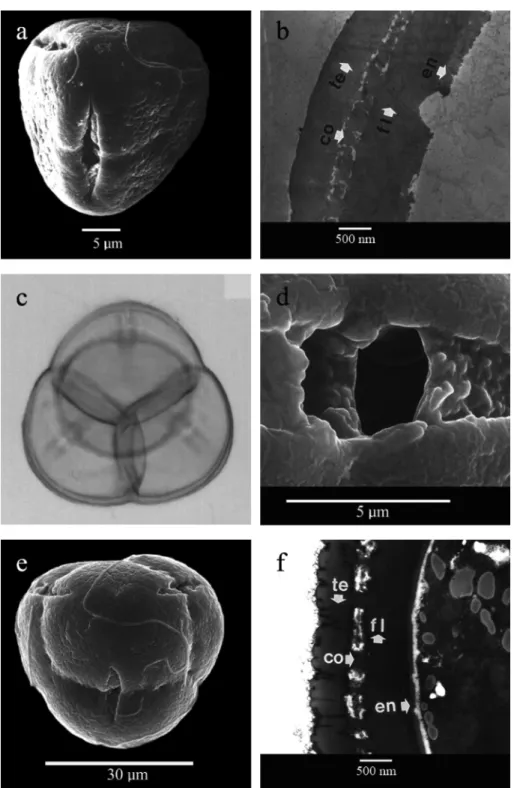
The exine of the Korean Rhododendron pollen con- sists of tectum, columella, foot layer and endexine. The exine thickness shows a tendency to get thicker toward apertures. The tectum is thicker than the columella. And the foot layer is thicker than the endexine. The tectum is either eutectate or tectate-perforate according to taxa. The columella is of either rod shape (Figure 2f) or granule (Figure 3d). The foot layer is the thickest while endexine is the thinnest with some irregular grooves (Figure 2b).
The viscin threads are almost smooth. Most of them are long and drooping or tangled. Sometimes, the threads are branched into two strands and some are very short.
2. Pollen grain size
The diameter range of tetrads is 30.0 to 70.0
µm which are medium to big pollen grains according to Erdtman (1952).
Rhododendron tomentosumis the smallest with the mean size of 32.0
µm while
R. schlippenbachiif.
albiflorum
is the biggest (60.9
µm). The pollen size of monads and tetrads varies according to taxa (Table 1).
3. Aperture
The monads are isopolar. The hexacolporate tetrads are of tricolporate monads whereby the apertures form in pairs at six points in the tetrad. There are 12 lalongate endoapertures.
Rhododendron tomentosumhas the short- est aperture length (14.1
µm) while
R. weyrichiihas the longest (21.5
µm) one. For the aperture diameter,
R. tomen- tosumhas the shortest (2.30
µm) one while
R. yedoensef.
poukhanensehas the longest (3.40
µm) one (Table 1).
Figure 1. Schematic representation of tetrad tetrahedral
grains of
Rhododendronindicating the positions of pollen
characters measured (TD=tetrad diameter, DT=diameter
of top grain, AD=apocolpium diameter, PL=polar axis length,
EW=equatorial width, CL=colpus length and CW=colpus
width).
4. Equatorial and polar view
The every pollen grain in equatorial view is oblate to oblate spheroidal (P/E=0.68-0.95) but the mean P/E of each taxon shows that the pollen is suboblate. The tet- rads are rounded lozenge shaped in equatorial view. They are radially symmetrical and either circular or somewhat
rounded triangular in polar view.
5. Exine pattern
The exine sculpture pattern is rugulate, scabrate or verru- cate on mesocolpium but psilate, rugulate or microsca- brate around the aperture and on apocolpium.
RhododendronFigure 2. LM, SEM and TEM images of pollen types I (a-b) and II (c-f). a-b. R. micranthum. (a) a tetrad showing rugulate
mesocolpium but psilate apocolpium and aperture areas (SEM), (b) a part of exine on mesocolpium showing tectum (arrow,
te), columellae (arrow, co), foot layer (arrow, fl) and endexine (arrow, en) (TEM). c, e, f. R. redowskianum . (c) a high
focused tetrahedral tetrad (LM), (e) a rugulate tetrad (SEM), and (f) a part of exine showing tectum (te), columellae (co),
foot layer (fl) and very thin endexine (en) (TEM). d. R. tomentosum of detail of apertural region (SEM).
666 Jour. Korean For. Soc. Vol. 99, No. 5 (2010)
micranthum
is characterized with its psilate pattern in aperture margins and on apocolpium (Figure 2a). The rest 13 taxa are rugulate or microscabrate around the aperture and on apocolpium.
Rhododendron weyrichiiis verrucate having wart-like sexine elements of wider than 1
µm on mesocolpium while the others are rugulate or microscabrate on mesocolpium (Figure 4f).
Rhododen- dron brachycarpumis characterized by the rod shaped elements of the microscabrate apocolpium and aperture (Figure 3e). The rest eight taxa with microscabrate apo- colpium and aperture have round shaped elements instead. These various exine patterns are major features to be used in the key to six Korean
Rhododendronpol- len types (Figures 2-4, Table 2).
6. Exine stratification
The exine of the Korean
Rhododendronpollen con- sists of four layers: the tectum, the columella, the foot layer and the endexine. The exine thickness shows a ten- dency to get thicker toward apertures. Exine thickness of the genus is 0.97 to 2.50
µm. The exine thickness of
R.confertissimum
is the thinnest being 1.19
µm.
Rhodo- dendron weyrichiihas the thickest exine thickness with the range of 2.00 to 2.50 (mean 2.22)
µm while the rest 13 taxa are in 0.97 to 1.92
µm (Table 2).
The tectum of
R. micranthum(Figure 2b),
R. tomen- tosum, and
R. redowskianum(Figure 2f) is nearly eutec- tate while that of the rest 11 taxa is close to tectate- perforate (Figure 2b) or semitectate. The columella is of either rod shape or granule. The foot layer is the thickest while endexine is the thinnest with some irregular grooves.
7. Viscin thread
The genus has viscin threads on the pollen surface.
The diameter of the threads is 0.15 to 0.62 .
Rhododen- dron micranthumhas the narrowest thread diameter (0.22
µm) but
R. mucronulatumf.
ciliatumhas the wid- est one (0.51
µm). The thread surface is nearly smooth.
Long pendent threads are sometimes tangled together and occasionally divided into two strands (Figure 2e).
Relatively short threads are observed as well (Figures 2a, 2e, 3a, 3e, and 4d).
8. Key to the Rhododendron pollen types in Korea
Six pollen types of 11 species and 3 forms of Korean
Rhododendronare recognized based on differences in exine sculpture pattern and exine thickness.
1. Rugulate on mesocolpium
2. Psilate on apocolpium and around the aperture
···Micranthum
-type (I) 2. Rugulate on apocolpium and around the aperture
···
Tomentosum-type (II) 1. Scabrate or verrucate on mesocolpium
3. Scabrate mesocolpium with exine thickness of thinner than 1.92
µm
4. Rugulate on apocolpium and around the aper- ture
··· Aureum-type (III) 4. Microscabrate on apocolpium and around the
aperture
5. Microscabrate pattern with rod shaped ele- ments
···Brachycarpum
-type (IV) Table 1. Pollen morphological data of the genus
Rhododendronin Korea by LM.
Taxon TD
(
µm) DT
(
µm) AD
(
µm) PL
(
µm) EW
(
µm) P/E Aperture
CL(
µm) CW(
µm)
Rhododendron aureum53.0±2.9 35.2±2.6 20.1±1.3 31.3±2.4 36.5±1.4 0.86±0.04 17.1±1.8 2.80±0.26
R. brachycarpum51.0±2.9 32.4±1.5 18.4±2.4 27.9±1.6 34.4±1.9 0.81±0.05 18.4±1.6 2.90±0.39
R. confertissimum44.6±3.2 30.6±1.4 16.6±1.8 25.2±2.6 31.2±2.1 0.81±0.07 15.4±1.2 2.65±0.34
R. dauricum45.7±1.9 30.6±0.9 16.2±1.1 25.3±2.0 33.0±2.9 0.77±0.03 16.5±2.4 2.95±0.28
R. micranthum32.2±1.3 22.4±1.2 9.8±0.9 18.0±1.2 22.4±0.9 0.80±0.06 14.3±1.5 2.70±0.42
R. mucronulatum49.0±2.3 32.4±3.3 17.9±1.8 27.3±1.4 33.9±1.5 0.81±0.04 18.4±2.3 3.00±0.33
R. m. f.
ciliatum52.3±6.5 32.1±2.0 17.7±1.2 28.2±2.7 36.0±4.1 0.79±0.07 17.5±2.0 2.80±0.54
R. redowskianum46.9±1.9 31.4±2.8 15.9±1.2 27.5±1.6 34.0±2.0 0.81±0.04 14.7±1.9 2.50±0.41
R. schlippenbachii59.7±5.5 37.8±3.0 19.3±1.9 34.2±3.1 40.8±3.3 0.84±0.06 21.3±2.5 2.80±0.67
R. s.f.
albiflorum60.9±4.3 40.4±2.6 21.6±1.1 35.3±2.7 44.0±3.3 0.80±0.02 21.3±1.7 3.15±0.88
R. tomentosum32.0±2.2 21.7±1.2 11.2±1.1 18.3±1.9 23.2±2.2 0.79±0.06 14.1±2.4 2.30±0.48
R. tschonoskii41.9±2.4 28.8±1.2 14.4±0.9 22.6±1.3 28.8±1.4 0.79±0.05 16.0±1.2 2.90±0.32
R. yedoensef.
poukhanense51.1±1.9 34.5±2.5 18.5±1.1 26.1±1.8 34.2±1.4 0.76±0.05 20.6±2.6 3.40±0.99
R. weyrichii54.2±2.7 36.7±2.0 19.3±1.6 29.3±1.9 36.6±1.3 0.80±0.07 21.5±3.3 2.55±0.37 TD=Tetrad diameter, DT=Diameter of top grain, AD=Apocolpium diameter, PL=Polar axis length, EW=Equatorial width, P/E=PL/
EW, CL=Colpus length and CW=Colpus width
5. Microscabrate pattern with round shaped ele- ments
···Schlippenbachii
-type (V) 3. Verrucate mesocolpium with exine thickness of
thicker than 2.00
µm
··· Weyrichii
-type (VI)
1) Micranthum-type (Pollen type I)
(Figures 2a-2b, Table 2). The tetrad is 30.0 to 35.0 (mean 32.2)
µm. Each pollen grain of the tetrad is cir- cular or rounded triangular in polar view, suboblate (P/
E=0.71-(0.80)-0.91) in equatorial view. Exine is rugulate
on mesocolpium and psilate on apocolpium and around
Figure 3. LM, SEM and TEM images of pollen types III (a-b) and IV (c-e). a-b. R. aureum. (a) a part of scabrate
mesocolpium (SEM), (b) showing tectate tectum (arrow, te), columellae (arrow, co), foot layer (arrow, fl) and endexine
(arrow, en) (TEM). c-e. R. brachycarpum . (c) a low focused tetrad showing a polar view tetrad of lalongate apertures
(arrows) (LM), (d) a part of the exine on mesocolpium showing tectum (te), columellae (co), foot layer (fl) and endexine
(en) (TEM), and (e) rod-shaped microscabrate sculpturing on apocolpium with viscin threads (SEM).
6 6 8 J o u r . K o r e a n F o r . S o c . V o l . 9 9 , N o . 5 ( 2 0 1 0 )
Ta ble 2 . P oll en m orp ho logi ca l d ata of th e g en us
Rhododendronin Ko rea by SE M an d T EM . Ta xo n Sc ulpt ure p att ern SE T(
µm) NET(
µm) EX T (
µm)
③+
⑥VT D (
µm) Po llen type
Me soco lpiu m Ap oc olpi um & ap ertu re reg ion TET
①COT
②①+
②=
③FO T
④ENT
⑤④+
⑤=
⑥ Rhododendron aureumscab rat e rugu lat e 0.34 ±0 .04 0.15± 0.04 0.4 9± 0.0 6 0.6 1± 0.05 0.2 2± 0.0 7 0.8 3± 0.08 1.3 2± 0.0 8 0.5 1± 0.0 4 IV
R. brachycarpumscab rat e mi crosca brat e (ro d-s ha pe d) 0.4 6±0 .11 0.2 4± 0.0 7 0.71 ±0 .09 0.6 1± 0.0 9 0.16 ±0 .06 0.7 7± 0.0 8 1.47 ±0. 13 0.2 8±0 .03 III
R. confertissimumr ug ula te rugu lat e 0.49 ±0 .06 0.26± 0.04 0.7 6± 0.0 7 0.3 7± 0.03 0.0 6± 0.0 2 0.4 3± 0.03 1.1 9± 0.0 6 0.4 9± 0.0 4 II
R. dauricumscab rat e mi crosca brat e (ro un de d) 0.4 0±0 .05 0.3 2± 0.0 4 0.72 ±0 .05 0.4 4± 0.0 2 0.06 ±0 .02 0.5 1± 0.0 2 1.22 ±0. 06 0.3 2±0 .03 V
R. micranthumru gu lat e psi lat e 0.3 8±0 .09 0.1 5± 0.0 5 0.53 ±0 .13 0.5 7± 0.0 6 0.15 ±0 .06 0.7 2± 0.0 9 1.25 ±0. 16 0.2 2±0 .03 I
R. mucronulatumscab rat e mi crosca brat e (ro un de d) 0.4 4±0 .06 0.2 1± 0.0 3 0.65 ±0 .08 0.4 8± 0.0 8 0.12 ±0 .04 0.6 0± 0.0 6 1.25 ±0. 13 0.2 8±0 .05 V
R. m. f.
ciliatumscab rat e mi crosca brat e (ro un de d) 0.3 8±0 .08 0.2 3± 0.0 7 0.60 ±0 .12 0.4 4± 0.0 7 0.16 ±0 .08 0.5 9± 0.0 8 1.20 ±0. 17 0.5 1±0 .06 V
R. redowskianumru gu lat e rug ula te 0.5 6±0 .05 0.2 4± 0.0 4 0.80 ±0 .06 0.6 2± 0.1 1 0.16 ±0 .05 0.7 8± 0.0 5 1.58 ±0. 09 0.6 7±0 .13 II
R. schlippenbachiiscab rat e mi crosca brat e (ro un de d) 0.4 9±0 .09 0.2 2± 0.0 5 0.71 ±0 .09 0.6 5± 0.0 3 0.18 ±0 .05 0.8 3± 0.1 2 1.54 ±0. 20 0.3 5±0 .05 V
R. s.f.
albiflorumscab rat e mi crosca brat e (ro un de d) 0.5 7±0 .14 0.1 5± 0.0 4 0.73 ±0 .14 0.5 7± 0.0 6 0.19 ±0 .07 0.7 6± 0.1 0 1.49 ±0. 23 0.3 8±0 .04 V
R. tomentosumr ug ula te rugu lat e 0.45 ±0 .05 0.23± 0.03 0.6 8± 0.0 7 0.5 4± 0.08 0.1 4± 0.0 7 0.6 8± 0.08 1.3 7± 0.1 3 0.2 2± 0.0 4 II
R. tschonoskiiscab rat e mi crosca brat e (ro un de d) 0.4 2±0 .05 0.2 2± 0.0 5 0.64 ±0 .06 0.4 6± 0.0 8 0.16 ±0 .06 0.6 2± 0.0 9 1.26 ±0. 14 0.3 0±0 .03 V
R. yedoensef.
poukhanensescab rat e mi crosca brat e (ro un de d) 0.6 3±0 .07 0.1 6± 0.0 3 0.79 ±0 .07 0.6 8± 0.1 0 0.19 ±0 .04 0.8 7± 0.0 9 1.66 ±0. 12 0.3 6±0 .03 V
R. weyrichiiv err uca te mi crosca brat e (ro un de d) 0.6 8±0 .08 0.3 2± 0.0 8 1.00 ±0 .13 0.8 4± 0.0 6 0.38 ±0 .05 1.2 2± 0.0 7 2.22 ±0. 18 0.2 8±0 .02 VI
TET=Tectum thickness, COT=Colummella thickness, SET=Sexine thickness, FOT=Foot layer thickness, ENT=Endexineness, NET=Nexine thickness, EXT=Exine thickness, VTD=Viscin thread diameter, Pollen type I=Type Micranthum, II=Type Hypoleucum, III=Type Aureum, IV=Type Brachycarpum, V=Type Schlippenbachii and VI=Type Weyrichiithe aperture. Tectum is nearly eutectate and exine thickness is 1.02 to 1.44 (mean 1.25)
µm. Endexine is thicker than ectexine. The viscin threads, with a diam- eter range of 0.15 to 0.27 (mean 0.22)
µm, are smooth and either drooping or tangled. Taxon included:
R.micranthum.
2) Tomentosum-type (Pollen type II)
(Figures 2c-2f, Table 2). The tetrad is 30.0 to 50.5 (mean 41.2)
µm. Each pollen grain of the tetrad is cir- cular or rounded triangular in polar view, suboblate (P/
E=0.68-(0.80)-0.92) in equatorial view. Exine is rugulate on mesocolpium, apocolpium and around the aperture.
Figure 4. LM and SEM images of pollen types V (a-d) and VI (e-f). a, c. Rhododendron tschonoskii . LM. (a) a high focused
tetrad, (c) a low focused tetrad showing tricolporate apertures (arrows) (LM) b. R. yedoense f. poukanense of microscabrate
mesocolpium with round shaped elements (SEM). d. R. schlippenbachii f. albiflorum of 4 tetrads with tangled viscin
threads (SEM). e-f. R. weyrichii . (e) a high focused tetrad (LM), (f) a part of verrucate mesocolpium but rounded microscabrate
around the aperture (SEM).
670 Jour. Korean For. Soc. Vol. 99, No. 5 (2010)
Tectum of
R. tomentosumand
R. redowskianumis nearly eutectate when
R. confertissimumis tectate-perforate.
Exine thickness is 1.08 to 1.76 (mean 1.38)
µm. Ectex- ine of
R. confertissimumand
R. redowskianumis thicker than endexine. The thickness of ectexine and endexine of
R. tomentosumis similar. The viscin threads, with a diameter range of 0.15 to 0.91 (mean 0.46)
µm, are smooth and either drooping or tangled. They sometimes get divided into two strands (Figure 2e) and can be relatively short.
Taxa included:
R. confertissimum, R. tomentosumand
R.redowskianum
.
3) Aureum-type (Pollen type III)
(Figures 3a-3b, Table 2). The tetrad is 50.0 to 60.0 (mean 53.0)
µm. Each pollen grain of the tetrad is cir- cular or rounded triangular in polar view, suboblate (P/
E=0.79-(0.86)-0.95) in equatorial view. Exine is scabrate on mesocolpium and regulate on apocolpium and around the aperture. Tectum is either tectate-perforate or semi- tectate, and exine thickness is 1.20 to 1.43 (mean 1.32)
µ
m. Endexine is thicker than ectexine. The viscin threads, with a diameter range of 0.45 to 0.59 (mean 0.51)
µm, are smooth and either drooping or tangled. Taxon included:
R. aureum
.
4) Brachycarpum-type (Pollen type IV)
(Figures 3c-3e, Table 2). The tetrad is 45.5 to 55.0 (mean 51.0)
µm. Each pollen grain of the tetrad is cir- cular or rounded triangular in polar view, suboblate (P/
E=0.74-(0.81)-0.91) in equatorial view. Exine is scabrate on mesocolpium and microscabrate with rod shaped ele- ments on apocolpium and around the aperture. Tectum is either tectate-perforate or semitectate and exine thick- ness is 1.28 to 1.76 (mean 1.47)
µm. Endexine is thicker than ectexine. The viscin threads, with a diameter range of 0.24 to 0.36 (mean 0.28)
µm, are smooth and either drooping or tangled. Taxon included:
R. brachycarpum.
5) Schlippenbachii-type (Pollen-type V)
(Figures 4a-4d, Table 2). The tetrad is 39.5 to 70.0 (mean 51.1)
µm. Each pollen grain of the tetrad is cir- cular or rounded triangular in polar view, suboblate (P/
E=0.69-(0.79)-0.93) in equatorial view. Exine is scabrate on mesocolpium, and microscabrate with rounded ele- ments on apocolpium and around the aperture. Tectum is either tectate-perforate or semitectate. Exine thickness is 0.97 to 1.92 (mean 1.40)
µm. Ectexine of
R. dauricum, R. mucronulatum, R. mucronulatumf.
ciliatumand
R.tschonoskii
is thicker than endexine. However, endexine of
R. schlippenchii, R. schlippenchiif.
albiflorumand
R.yedoense
f
. poukhanenseis thicker than ectexine. The thickness of ectexine and endexine of
R. hypoleucumis similar. The viscin threads, with a diameter range of 0.20
to 0.62 (mean 0.36)
µm, are smooth and either drooping or tangled. They sometimes get divided into two strands and can be relatively very short. Taxa included:
R. dau- ricum, R. mucronulatum, R. mucronulatumf.
ciliatum,
R.schlippenchii
,
R. schlippenchiif.
albiflorum,
R. tschonoskiiand
R. yedoensef
. poukhanense.
6) Weyrichii-type (Pollen type VI)
(Figures 4e-4f, Table 2). The tetrad is 51.0 to 60.0 (mean 54.2)
µm. Each pollen grain of the tetrad is cir- cular or rounded triangular in polar view, suboblate (P/
E=0.73-(0.80)-0.94) in equatorial view. Exine is verru- cate on mesocolpium and microscabrate with rounded elements on apocolpium and on the aperture margins.
Tectum is either tectate-perforate or semitectate and exine thickness is 2.00 to 2.50 (mean 2.22)
µm which is significantly thicker than those of the rest 13 taxa (0.97- 1.92
µm). Endexine is significantly thicker than ectex- ine. The viscin threads, with a diameter range of 0.23 to 0.32 (mean 0.28)
µm, are smooth and either drooping or tangled (Figure 4d). Taxon included:
R. weyrichii.
Discussion
The exine sculpture pattern of
Rhododendronpollen was reported to be microreticulate connected with micros- cabrae (Lee, 1979; Jang, 1986). In the present study, it is rather various according to pollen types; scabrate, rugu- late or verrucate on mesocolpium, psilate, rugulate or microscabrate on apocolpium and the aperture margins.
The difference among past studies might result from the fact that those early studies were based on LM results, and did not include SEM observations.
Rhododendron tomentosum
, formerly included in the genus
Ledum(Ericaceae) has recently been transferred to
Rhododendronas a result of further systematic studies (Chamberlain
et al., 1996). Another species,
R. redowski- anum, formerly included in
Therorhodion(Kron and Judd, 1990) was transferred to
Rhododendronby Kron (1997). Notably the pollen of both species as well as
R.confertissimum
, have a similar rugulate exine pattern (
Tomentosumpollen type). This lends some support to the systematic opinion of Chamberlain
et al. (1996) regarding the position of
R. tomentosumand
R. confer- tissimumin section
Rhododendron(subgenus
Rhododen- dron). However,
R. redowskianumis in a different subgenus,
Therorhodion.
Erdtman (1952) pointed out that the tetrad pollen mor-
phology of Ericaceae is similar to that of Empetraceae,
Epacridaceae and Pyrolaceae in the order Ericales. The
exine layers of the present study; ectexine and the
endexine, are similar to the exine stratification of Empe-
traceae (Kim
et al., 1988). Empetraceae, along with
Epacridaceae and Pyrolaceae, is now included in the Eri- caceae, following DNA studies (Angiosperm Phylogeny Group, 1998; 2003).
Rhododendron micranthum
was so characterized with its pollen grain size, exine pattern and structure from the rest taxa in the genus that it could make its own pollen type (
Micranthum-type) by itself. Even though Cham- berlain
et al. (1996) put
R. micranthumalong with
R.mucronulatum
in the same subgenus
Rhododendron, there was no significant pollen morphological similarity between these two species. However, the present pollen morphological results are in agreement with Hwang (1999)’s study. He reviewed 20
Rhododendrontaxa based on 51 morphological characters and also reported that
R. micranthumwas quite independent.
Conclusion
The various exine pattern being scabrate, rugulate or ver- rucate in mesocolpium area, and psilate, rugulate or micros- cabrate in apocolpium and aperture areas, was the major character to create a key to six pollen types in Korean
Rhododendron. The Korean
Rhododendronexine consists of four layers; tectum, columella, foot layer and endexine. The exine thickness of
R. weyrichiiwas thicker than those of the rest taxa.
Rhododendron micranthumwas distinguished from the others in the pollen grain size and exine pattern.
Acknowledgements
Lots of thanks are due to Dr. Madeline Harley at Royal Botanic Gardens, Kew, UK for her helpful com- ments, and Prof. Lee, Wang-Hyu at College of Agricul- ture & Life Sciences and Mr. Kim, Wan-Cheol at the EM Lab., College of Medicine, Chonbuk Univ., Korea for their SEM & TEM technical assistance.
Specimens Investigated
Rhododendron aureum
Georgi. Democratic People's Republic of KOREA: Baekdusan, Hambuk. CNU-98-100.
R. brachycarpum
D. Don. ex G. Don. Republic of KOREA: Sadong, Ulleungdo, Gyeonbuk. JMP RB060699.
Republic of KOREA: Socheongbong, Seoraksan, Gang- won. JMP RB120699. Republic of KOREA: Jungcheon- gbong, Seoraksan, Gangwon. JMP RB140699.
R. confertissimum
Nakai. Democratic People's Repub- lic of KOREA: Bujeongowon, Hamnam. SNU-1937-84.
R. dauricum
L.. Democratic People's Republic of KOREA:
Agr. Division Research Institute, Hamnam. SNU-1927-79.
R. micranthum
Turcz.. Republic of KOREA: Daeseong- san, Danyang, Chungbuk. JMP RMI040698.
R. mucronulatum
Turcz.. Republic of KOREA: Gyebuk,
Jangsu, Jeonbuk. JMP RMU040498. Republic of KOREA:
Tookdong valley, Deogyusan, Jeonbuk. JMP RMU100499.
R. mucronulatum
f.
ciliatum(Nakai) Kitag.. Republic of KOREA: Nogodan, Jirisan, Jeonnam. JMP RMC040699.
Republic of KOREA: Banyabong, Jirisan, Jeonbuk. JMP RMC050699. Republic of KOREA: Hangyeryeong, Seorak- san, Gangwon. JMP RMC080699. Republic of KOREA:
Jungheongbong, Seoraksan, Gangwon. JMP RMC090699.
Republic of KOREA: Namdeogyusan, Gyeongnam. JMP RMC130699.
R. redowskianum
Maxim.. Democratic People's Republic of KOREA: Baekdusan, Hambuk. JMP RR230898.
R. schlippenbachii
Maxim.. Republic of KOREA: Hyang- jeokbong, Deogyusan, Jeonbuk. JMP RS050699. Republic of KOREA: Haeinsa, Gayasan, Gyeongnam. JMP RS200599. Republic of KOREA: Hangyeryeong, Seorak- san, Gangwon. JMP RS080699. Republic of KOREA:
Seongsamjae, Jirisan, Jeonnam. JMP RS110699. Republic of KOREA: Banyabong, Jirisan, Jeonbuk. JMP RS120699.
R. schlippenbachii
f.
albiflorumY. N. Lee. Republic of KOREA: Daecheongbong, Mt. Seorak, Gangwon. JMP RSA080699.
R. tomentosum
Harmaja. Democratic People's Repub- lic of KOREA: Hamnam. SNU-1925-125.
R. tschonoskii
Maxim.. Republic of KOREA: Namsan- jeilbong, Gayasan, Gyeongnam. JMP RT150698. Republic of KOREA: Namdeogyusan, Gyeongnam. JMP RT120699.
Republic of KOREA: Sangwangbong, Gayasan, Gyeo- ngnam. JMP RT200699. Republic of KOREA: Namsan- jeilbong, Gayasan, Gyeongnam. JMP RT210699. Republic of KOREA: Banyabong, Jirisan, Jeonbuk. JMP RT040799.
R. yedoense
f.
poukhanense(H. Lév.) M. Sugim. ex T.
Yamaz.. Republic of KOREA: Gyebuk, Jangsu, Jeonbuk.
JMP RY250498. Republic of KOREA: Seongsamjae, Jirisan, Jeonnam. JMP RY300499. Republic of KOREA:
Deogyusan, Jeonbuk. JMP RY040599. Republic of KOREA:
Jirisan, Jeonnam. JMP RY070599.
R. weyrichii
Maxim.. Republic of KOREA: Halla Arbo- retum, Jeju. JMP RW110599.
Literature Cited
1. Abraham-Peskir, J.V., Searle, R. and Medenwaldt, R. 1997.
A new technique of examining pollen-connecting threads.
Grana 36: 343-346.
2. The Angiosperm Phylogeny Group. 1998. An ordinal classification for the families of flowering plants. Annals of the Missouri Botanical Garden 85: 531-553.
3. The Angiosperm Phylogeny Group. 2003. An update of the Angiosperm Phylogeny Group classification for the orders and families of flowering plants: APG II. Botan- ical Journal of the Linnean Society 141: 399-436.
4. Bailey, L.H. and Bailey, E.Z. 1978. Hortus Third. Mac-
672 Jour. Korean For. Soc. Vol. 99, No. 5 (2010)
millan Publishing Company, New York. pp. 949-965.
5. Bowers, C.G. 1930. The development of pollen and vis- cin strands in
Rhododendron catawbiense. Bulletin of the Torrey Botanical Club 57: 285-316.
6. Chamberlain, D.F., Hyam, R., Argent, G., Fairweather, G. and Walter, K.S. 1996. The genus
Rhododendron-Its classification and synonymy, Royal Botanic Garden Edinburgh (RBGE), The Alden Press, Oxford. pp. 184.
7. Chung, T.H. 1957. Korean Flora (I. Woody plants).
Shinji Publ. Co. Ltd., Seoul. pp. 507. (in Korean) 8. Choo, G.C. 1987. Taxonomic studies of Genus
Rhodo-dendron
in Korea. Master Degree Thesis. Kon-Kuk University, Seoul. pp. 40. (in Korean)
9. Crepet, W.L. 1996. Timing in the evolution of derived floral characters: Upper Cretaceous (Turonian) taxa with tricolpate and tricolpate-derived pollen. Review of palaeobotany and palynology 90: 339-359.
10. Cronquist, A. 1981. An Integrated System of Classifi- cation of Flowering Plants. Columbia University Press.
New York. pp. 1262.
11. Erdtman, G. 1952. Pollen Morphology & Plant Taxon- omy: Angiosperms (An Introduction to Palynology 1).
Munksgard, Copenhagen, Denmark. pp. 539.
12. Erdtman, G. 1969. Handbook of Palynology (An intro- duction to the study of pollen grains and spores).
Munksgard, Copenhagen, Denmark. pp. 486.
13. Foss, P.J. 1988. A palynological study of the Irish Eri- caceae and
Empetrum. Pollen et Spores 30: 151-178.
14. Galle, F.C. 1995.
Azaleas. Timber Press, Hong Kong.
pp. 486.
15. Harley, M.M. and Daly, D.C. 1995. Burseraceae: Protieae.
- World Pollen and Spore Flora 20, Scandinavian Univer- sity Press, Stockholm, Oslo, Copenhagen. pp. 44.
16. Harley, M.M., Song, U. and Banks, H.I. 2005. Pollen morphology and systematics of Burseraceae. Grana 44:
282-299.
17. Hwang, H.J. 1987. Interspecific relationships and cross compatibilities in the genus
Rhododendron. Master Degree Thesis, Seoul National University, Seoul. pp.
54. (in Korean)
18. Hwang, H.J. 1999. Systematic study on the genus
Rhododendronin Korea. Ph. D. Dissertation, Seoul National University, Seoul. pp. 140. (in Korean) 19. Ikuse, M. 1956. Pollen Grain of Japan. Hirokawa Pub-
lishing Company, Tokyo. pp. 115-116.
20. Jang, N.K. 1986. Illustrated flora and fauna of Korea, Vol. 29 Pollens, Ministry of Education, Korea. pp. 899.
(in Korean)
21. Keri, C. and Zetter, R. 1992. Notes on the exine ultra- structure of Onagraceae and Rhododendroideae (Eri- caceae). Grana 31: 119-123.
22. Kim, K.H., Nilsson, S. and Praglowski, J. 1988. A note on the pollen morphology of the Empetraceae. Grana 27: 283-290.
23. Kron, K.A. 1997. Phylogentic relationships of Rhodo- dendroideae (Ericaceae). The American Journal of Bot- any 84: 973-980.
24. Kron, K.A. and Judd, W.S. 1990. Phylogenetic relation- ships within the Rhodoreae (Ericaceae) with specific comments on the placement of
Ledum. Systematic Bot- any 15: 57-68.
25. Leach, D.G. 1961. Rhododendrons of the world and how to grow them. Charkes Scribner's Sons, New York.
pp. 544.
26. Lee, H.C., 1988. Taxonomic studies on the genus
Rhododendronby numerical analysis of morphological characters. Master Degree Thesis, Seoul National Uni- versity, Seoul. pp. 51. (in Korean)
27. Lee, T.B. 1989. Illustrated Flora of Korea. Hyangmoon Publ. Co. Ltd., Seoul. pp. 990. (in Korean)
28. Lee, Y.H. 1979. A Study on the pollen grains of Korean plants. Korean Journal of Plant Taxonomy 9: 7-25. (in Korean)
29. Lee, Y.N. 1996a. Flora of Korea. Kyohak Publ. Co.
Ltd., Seoul. pp. 1237. (in Korean)
30. Lee, W.T. 1996b. Standard Illustrations of Korean Plants.
Academic Publ. Co. Ltd., Seoul. pp. 624. (in Korean) 31. Nakai, T. 1919. Notulae ad plants Japonicae et Coreae
8. Botanical Magazine Tokyo. pp. 66.
32. Nakai, T. 1952. A synoptical sketch of Korean Flora.
Bulletin of the National Science Museum, 31. pp. 152.
33. Oldfield, F. 1959. The pollen morphology of some of the west European Ericales. Pollen et Spores 1: 19-48.
34. Praglowski, J. and Grafstrom, E. 1985. The genus
Car- podetus(Escalloniaceae): A pollen morphological enigma.
Grana 24: 11-21.
35. Punt, W., Hoen, P.P., Blackmore, S., Nilsson, S. and Le Thomas, A. 2007. Glossary of Pollen and Spore Terminol- ogy. Review of Palaeobotany and Palynology 143: 1-82.
36. Rehder, A. 1940. Manual of cultivated trees and shrubs (Hardy in North American), (2
nded). Macmillan Publ.
Co. Inc., New York. pp. 996.
37. Song, U. and Kim, K.H. 1999. A contribution to the pollen morphology of
Indigofera(Fabaceae) in Korea.
Journal of Korean Forest Society 88: 213-220.
38. Ueno, J. 1978. Study of palynology, Kazama Shobo Publ. Co. Tokyo. pp. 210. (in Japanese)
39. Waha, M. 1982. Zur ultrastruktur und funktion pollen- verbindender. Fden bei Angiospermen, insbesondere der Viscinfden bei Ericaceae. Ph. D. Dissertation. Univ.
Vienna, Vienna. (in German)
40. Wodehouse, R.P. 1935. Pollen grains (Their structure, identification and significance in science and medicine).
McGraw-Hill Com. Inc., New York, London. pp. 574.
41. Yang, B.Y. 1952. Pollen grain morphology in the Eri- caceae. Quarterly Journal of the Taiwan Museum 5: 1-24.
(Received January 20, 2010; Accepted May 13, 2010)