Print ISSN: 2288-4637 / Online ISSN 2288-4645 doi:10.13106/jafeb.2021.vol8.no8.0475
Islamic Legal Reasoning for the Justification of Tax Evasion: The Case of Indonesia*
Nurul HIDAYAT
1, Nolan SHARKEY
2Received: April 20, 2021 Revised: July 04, 2021 Accepted: July 15, 2021
Abstract
Religiosity is often perceived as a trait that can effectively suppress attitudes and behavior that lead to people evading taxes. However, this study finds that Islamic religiosity has a complicated relationship with tax evasion. This study employs a mixed-method, which involves collecting, analyzing, and integrating quantitative and qualitative research, and this integration provides a better understanding of the research problem. Qualitative analyses of the sermons of prominent Islamic clerics speaking on taxes on YouTube channels revealed different views.
The textualists/conservative clerics viewed taxes are prohibited based on the fact of Islamic history and tax prohibition stated in a hadith.
Furthermore, tax compliance is determined solely by the threat of punishment from the government. On the other hand, the moderate preachers seem to be more flexible in response to tax issues. They involve the framework of contextual and analogical-historical practice. Quantitative analyses from the survey found that Islamic religiosity is not directly correlated with tax evasion. However, the sentiment of Islamic law adoption by the state has significantly mediated the correlation between them. In addition, respondents who affiliate with moderate Islamic organizations tend to have less justification of tax evasion than those who affiliate with conservative organizations or movements.
Keywords: Tax Evasion, Islamic Religiosity, Islamic Clerics, Islamic Law JEL Classification Code: H26, K34, K42
attempts to interpret Islamic law progressively often result in challenges and polarization. In general, the interpretation of Islamic law can be placed into two camps: moderate and conservative.
The goal of implementing Islamic law as a foundation for Islamic politics has driven Islamic dimensions toward a more comprehensive system. Non-compliance with the law of the state is often justified on the basis that the state does not adhere to the Islamic law. Tax evasion, for example, may be seen as justified because taxes are not considered to be part of Islamic teachings. Most conservative people believe that taxation is forbidden.
This study explores Islamic legal reasoning for tax evasion approval and investigates these arguments collated in the survey. The study was conducted in Indonesia, the largest Muslim country globally that does not adhere to Islamic law as state law.
2. Literature Review and Hypothesis Development
Many studies have addressed the issue of tax evasion.
Some scholars have identified certain prerequisites for the act. Alm (2012), suggested that tax evasion is an intentional
*Acknowledgements:
The research was funded by the Indonesia Endowment Fund for Education (LPDP), Indonesia Ministry of Finance.
1
First Author and Corresponding Author. Ph.D. Student, Law School, The University of Western Australia, Australia [Postal Address:
35 Stirling Highway, Perth, Western Australia, 6009, Australia]
Email: [email protected]
2
Winthrop Professor, Law School, The University of Western Australia, Australia. Email: [email protected]
© Copyright: The Author(s)
This is an Open Access article distributed under the terms of the Creative Commons Attribution Non-Commercial License (https://creativecommons.org/licenses/by-nc/4.0/) which permits unrestricted non-commercial use, distribution, and reproduction in any medium, provided the original work is properly cited.
1. Introduction
Like other religions, Islam has multi-dimensional teachings and practices. What may differentiate Islam from other religions is the fact that it helps Muslims understand how they should lead every aspect of their lives according to God’s wishes. The facet of Islamic laws that are applied to every part of life. The process of implementing Islamic law within the arena of states often shapes Islamic politics.
By contrast, Islamic law is often regarded as a static
jurisdiction, constrained by time and location. In addition,
illegal behavior leading to a direct violation of tax law to escape the payment of tax. Taxes are also evaded through the concealment of business transactions to avoid or reduce tax liability (Tsakumis et al., 2007).
Some theories seek to explain why tax evasion occurs. Riahi-Belkaoui (2004) outlined three theoretical perspectives: general deterrence theory, economic deterrence models, and fiscal and social psychology. General deterrence theory implies that tax noncompliance is modeled as a purely economic decision controlled through tax rates and deterred by audits and sanctions. Fiscal psychology and social psychology models resolve that tax compliance behavior is determined by non-economic factors such as socio- demographics, socioeconomic, attitudes, and perceptions.
The economic deterrence model highlights the economic rationality of evading taxes, i.e., expected costs and benefits.
When taxpayers enjoy a higher benefit from saving their money than the expected costs of being caught, they will evade taxes (Hasseldine & Bebbington, 2009). Aspects from all three theories offer insights in which to investigate these economic and non-economic factors of tax compliance.
Feld and Frey (2002) developed the concept of a psychological tax contract to establish a fair and reciprocal obligation between government and taxpayers, where one party gives something, and the other takes something -a quid pro quo situation. Based on this theory, taxpayers feel discouraged to pay tax if they perceive the quality of state institutions as low in general. Another important influence on taxpayers’ attitudes and beliefs is religiosity. Religiosity can function as an internal moral force that persuades an individual to pay taxes. Specifically, some studies find that religiosity influences taxpayers to oppose tax evasion (Alm et al., 2016; Grasmick et al., 1991). However, the study in Indonesia found that religiosity does not significantly affect people to make donations to a secular fund (Susanto et al., 2021).
Within Islam, various verses either encourage or discourage tax payment. One of the Islamic traditions, which often becomes the legitimation for the state to encourage citizens to obey, is ‘God will punish us if we do not pay to the state’ (Jalili, 2012, p. 167). The Quran commands people to obey God and His Prophet and those who are given authority over them (Coulson, 1964). In addition, the essence of Islamic teachings is about values, ethics, and equality. Therefore, these teachings are relevant to any kind of instrument designed to achieve justice. From this perspective, taxes seem to be in accordance with Islamic teachings and values.
However, the lawfulness of tax in the Islamic perspective is disputed, especially between conservative and reformist Muslim spokesmen. The reformists’ interpretation (ijtihad) is that the imposition of tax laws adopted from Western jurisprudence is allowed, especially if such regulations are more suited to the current rapid development of business
and the economy. In addition, the fundamental concept of taxation is in accordance with the spirit of zakat, an obligatory annual payment that is paid by qualifying adult Muslims whose wealth exceeds the Nisab value for one Islamic (lunar) year. By contrast, traditionalists believe that Islamic law is the only true law, hence, Western tax laws should not be recognized in Islamic jurisprudence.
These traditionalists also contend that the tax regulations adopted from the West, such as the progressive tax rate, are contrary to the principles of justice embodied in Islamic law.
They suggest that governments should impose Islamic tax or zakat rather than a Western tax (Saidi, 2006). They consider any adoption of Western tax regulations to be prohibited or at least neutral insofar as being a good citizen is concerned.
Jalili (2021) argued that Islamic religiosity does not influence individual views as to whether tax evasion is ethical or not. He holds that the most critical factor affecting tax compliance is the perception of government legitimacy.
Some scholars consider government legitimacy to be strongly linked with the implementation of Islamic law as the basis of state law. Hence, if governments are perceived to be illegitimate, tax evasion may be seen as ethical.
Specifically, Yusuf (1971) highlighted government legitimacy as a crucial aspect of the perception of fairness in tax regulations. They claimed that Islamic law allows an individual to not pay income tax under certain circumstances, for instance, if a government imposes an income tax unfairly, such as stipulating an unreasonable tax rate or tax base.
Some Islamic scholars hold that a progressive tax rate and tax base from income is unfair compared to a proportional tax rate and tax base from accumulated assets (Ross &
McGee, 2012). This principle is adopted from the primary rule in zakat payment.
The hypotheses of this study are based on the foregoing literature:
H1: The sentiment of Islamic law adoption by the state does not influence the justification of tax evasion.
H2: The affiliation with moderate/conservative Islamic organizations and movements does not influence the justification of tax evasion.
3. Methodology
This study used mixed methods of research, qualitative and quantitative methods. The qualitative method was conducted first, followed by the quantitative one.
3.1. The Qualitative Method
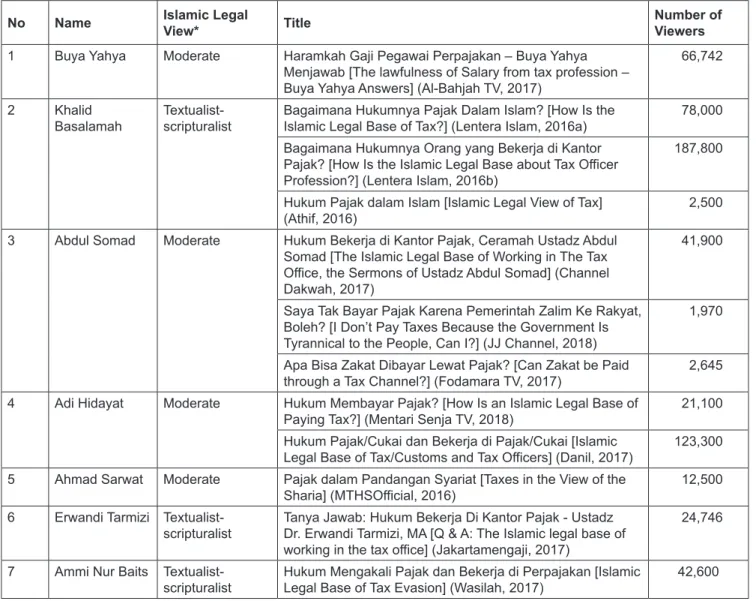
Video contents from selected YouTube channels were
collected and analyzed (Table 1). The content was used
to define the issues and structure the questionnaire for the
quantitative method. The published video contents were
Table 1: The List of Selected YouTube Channels Containing the Tax Issue
No Name Islamic Legal
View* Title Number of
Viewers 1 Buya Yahya Moderate Haramkah Gaji Pegawai Perpajakan – Buya Yahya
Menjawab [The lawfulness of Salary from tax profession – Buya Yahya Answers] (Al-Bahjah TV, 2017)
66,742
2 Khalid
Basalamah Textualist-
scripturalist Bagaimana Hukumnya Pajak Dalam Islam? [How Is the
Islamic Legal Base of Tax?] (Lentera Islam, 2016a) 78,000 Bagaimana Hukumnya Orang yang Bekerja di Kantor
Pajak? [How Is the Islamic Legal Base about Tax Officer Profession?] (Lentera Islam, 2016b)
187,800
Hukum Pajak dalam Islam [Islamic Legal View of Tax]
(Athif, 2016) 2,500
3 Abdul Somad Moderate Hukum Bekerja di Kantor Pajak, Ceramah Ustadz Abdul Somad [The Islamic Legal Base of Working in The Tax Office, the Sermons of Ustadz Abdul Somad] (Channel Dakwah, 2017)
41,900
Saya Tak Bayar Pajak Karena Pemerintah Zalim Ke Rakyat, Boleh? [I Don’t Pay Taxes Because the Government Is Tyrannical to the People, Can I?] (JJ Channel, 2018)
1,970
Apa Bisa Zakat Dibayar Lewat Pajak? [Can Zakat be Paid
through a Tax Channel?] (Fodamara TV, 2017) 2,645 4 Adi Hidayat Moderate Hukum Membayar Pajak? [How Is an Islamic Legal Base of
Paying Tax?] (Mentari Senja TV, 2018) 21,100
Hukum Pajak/Cukai dan Bekerja di Pajak/Cukai [Islamic
Legal Base of Tax/Customs and Tax Officers] (Danil, 2017) 123,300 5 Ahmad Sarwat Moderate Pajak dalam Pandangan Syariat [Taxes in the View of the
Sharia] (MTHSOfficial, 2016) 12,500
6 Erwandi Tarmizi Textualist-
scripturalist Tanya Jawab: Hukum Bekerja Di Kantor Pajak - Ustadz Dr. Erwandi Tarmizi, MA [Q & A: The Islamic legal base of working in the tax office] (Jakartamengaji, 2017)
24,746
7 Ammi Nur Baits Textualist-
scripturalist Hukum Mengakali Pajak dan Bekerja di Perpajakan [Islamic
Legal Base of Tax Evasion] (Wasilah, 2017) 42,600
*Based on the list of moderate Islamic clerics issued by the Indonesian Islamic Clerics Association (ADDAI Online, 2020) and lists of Salafi clerics (AlQuranPedia.org, 2018).
derived from seven prominent Indonesian Islamic clerics and scholars, which have significant viewers. These were Abdul Somad, Adi Hidayat, Khalid Basalamah, Erwandi Tarmizi, Buya Yahya, Ahmad Sarwat, and Ammi Nur Baits.
The clerics in these videos address the issue of taxation in Indonesia from an Islamic perspective, and the videos were published before August 2018.
3.2. The Quantitative Method 3.2.1. Samples
This study involved a survey of purposive samples of 504 self-employed Muslim taxpayers from several business
markets, drawn from Jakarta (139), Surabaya (100), Bandung (100), Jogjakarta (68), Banda Aceh (22), and Padang (75). The number of samples of 504 respondents was preferably to account for ten times or more from the total variables (Sekaran & Bougie, 2013). Furthermore, the selected cities were seen as representing various types of Islamic organizations and movements. The mapping of the respondents’ affiliations was necessary for gauging whether an individual’s opinions on tax evasion vary between moderate and conservative Muslim taxpayers.
Moreover, the big cities in Indonesia have the highest numbers of self-employed taxpayers.
The questionnaire was designed to assess the degree of
Islamic religiosity among participants and their perceptions
of Islamic law and attitude toward tax evasion. This survey was designed to investigate whether Islamic religiosity and belief that the state should adhere to Islamic law shape views on tax evasion.
3.2.2. Variables
The survey had four main variables: the religious affiliation on the Islamic organization or movement (AFFIS), Islamic religiosity (ISREL), sentiment in the Islamic law for the state (ISLAW), and justification of tax evasion (EVADE).
AFFIS is a categorical variable. It can be used to test the correlation with EVADE. Categorical variables can have values consisting of integers (1–9) that are assumed to be continuous numbers by a modeling algorithm. Specifically, Multivariate Analysis of Variance (MANOVA) was used to test this correlation, which is an extension of the univariate analysis of variance (ANOVA). MANOVA essentially tests whether or not the independent grouping variable simultaneously explains a statistically significant amount of variance in the dependent variable.
The ISREL is an exogenous variable. It contains five statements, three using a seven-point Likert scale and two using a frequency scale. The statements were adopted from Glock and Stark’s dimensions of religiosity (Glock & Stark, 1965). These statements were considered to be generally accepted by all varieties of Islamic legal views. These dimensions were favored because they involved three critical aspects of religiosity: theology and creed or the realm of faith (Iman), devotional and interpersonal relations or realm of action (Islam), and spiritual cultivation or field of virtue (Ihsan) (Parrot, 2019).
ISLAW was designed as a mediator variable. It contains four statements by using a seven-point Likert scale.
It contains: gaining state legitimacy by the adoption of Islamic law, formalizing zakat as a tax instrument, attitudes to zakat compared to taxes, dealing with the fairness and sense of legitimacy. The first statement is the foundation of Islamic law in the context of its relationship to the nation. In this statement, the establishment of a fundamental law creates legitimacy. In the context of Islam, the implementation of Islamic law deepens government legitimacy. The other statements are considered to be the derivative law, which takes the zakat as representing Islamic law. To some extent, this becomes the antithesis of taxation.
Finally, the EVADE is an endogenous variable. It was designed from the findings of qualitative analyses. There were three indicators in this variable using a seven-point Likert scale. The justification was measured by considering the type of fundamental state law, Islamic legal base of taxation, and double payment issue. Partial Least Squares Analyses were conducted to check the correlation between Islamic religiosity, sentiments of Islamic law, and justification of tax
evasion, with the confidence level at 95%. SEM research was carried out using SMART-PLS software.
4. Results
4.1. Qualitative Analyses
Information from social media is an effective way to shape the attitude of the readers or viewers (Sihombing &
Pramono, 2021). In particular, religion is regarded as the most influential factor in people’s lives, and the spread of Islamic teaching on social media increases its impact.
Therefore, opinions about taxation from prominent Islamic figures would be pertinent for explaining this issue from an Islamic perspective.
Given the large numbers of viewers of these channels, it seems likely that the clerics’ views on tax opinions could shape the attitudes of Muslim taxpayers. Textualist clerics’
sermons are particularly likely to be successful in attracting viewers. In fact, the textualist clerics have more YouTube views than those of moderate clerics.
In general, the moderate and conservative clerics have different opinions on taxation. Most of the moderate clerics argue that taxation is permissible according to Islamic jurisprudence. Only Buya Yahya argued that taxation is not recognized in Islamic law. Taxation can only be imposed in an emergency, such as when the country is at war as in the era of Caliph Umar bin Khattab. Taxation is strictly imposed only when the state is short of funds, such as when zakat is insufficient for helping the needy. The state can impose taxes, but it should not exceed the zakat rate and must not be strict.
Despite most of them having the same views on the legitimacy of taxation lawfulness, the clerics have varied opinions on the motivation to pay tax, tax evasion, and tax implementation. Abdul Somad suggests that Indonesia does not need to impose taxes because the country has rich natural resources that can be used to finance government operations and provide public services. As regards compliance with government tax regulations, he argued that people must obey as long as the government is trustworthy and fair. If these conditions are not met, he holds that it is permissible to disobey the government.
The moderate clerics also have different opinions on
the motivation to pay taxes. Buya Yahya believes that the
current system is not fair to Muslims. He recommends an
integration between taxes and zakat, where Muslims who
already pay zakat will not need to pay taxes, save for the
non-zakatable income. He holds, however, that people need
to cooperate with the government to pay taxes to avoid
fines and other penalties. Two other moderate clerics, Abdul
Somad and Adi Hidayat considered that the imposition
of taxes should be allowed because this revenue is used
to provide public facilities and services. In addition, Adi Hidayat spoke about indirect taxes, which he argued to not gel with the spirit of Islamic law, describing such taxes as close to usury.
The most interesting arguments came from Ahmad Sarwat. He attempted to justify tax contextually under Islamic law while integrating the spirit and value of Islamic rewards for paying taxes. By contrast, the text- ualist clerics have commonly shared views of motivation to pay tax. The encouragement to pay tax is to avoid the tax sanction or penalty or any other harm. The moderate and textualists clerics’ opinions about taxes are summarized in Table 2.
Furthermore, there are some statements in the sermons that may justify tax evasion:
The Issue of Double Payment for Muslims
The practice in the model of Islamic states, such as in the era of Prophets Muhammad and Caliph, was that Muslims paid only the zakat, whereas non-Muslims paid jizyah (tax).
This practice is currently adopted in Saudi Arabia, in which the Muslim residents only need to pay zakat, whereas non- Muslim residents pay income tax.
Buya Yahya:
“Zakat systems should be appropriately managed in current conditions, so Muslims only need to pay zakat, whereas non-Muslims should pay jizyah (tax). Each of these citizens has a responsibility in this country. What is
happening now is that Muslims pay zakat and taxes, resulting in double payments.”
Abdul Somad:
“Zakat is not allowed to be paid through the tax channels.
Taxpayers are a mix of Muslims and non-Muslim. Tax is used to finance the bridges, markets. In Malaysia, zakat payment can be a credit of tax payable (tax rebate). That is the correct practice.”
The Imposition of Islamic Sharia Law
The dual obligations of religious and citizenship commitments often lead to a sense of unfairness. This sense happens when there two similar instruments that must be obeyed at the same time. Relating to taxes, Buya Yahya acknowledged that the Islamic State (the country that adopts the Sharia law in all its systems) is fair.
Buya Yahya:
“An Islamic state is fair. Non-Muslims pay jizyah, or often translated as a tribute, whereas Muslims pay zakat.
Zakat and jizyah are equal. There is an opportunity to impose taxes for Muslims, but its amount should not be a burden.
Buya Yahya:
“Historically, this tax was known at the time of the Caliph Umar bin Khattab. Taxes are imposed for the benefit of the state, but their rate must not exceed the rate of zakat and are only superficial.
Table 2: The Summary of Moderate Clerics’ Opinions about Motivation to Pay Tax and Tax Evasion Attitudes
No Clerics Tax
Lawfulness Motivation to Pay
Tax Tax Evasion
Attitudes Notes
1 Buya Yahya Strictly to
impose To avoid sanctions
and penalties Not encouraged Separation of law, zakat for Muslims, and jizyah for non-Muslims
2 Abdul Somad Allowed but no need to impose
Social In a particular
circumstance, it is not unethical to do so
No need to impose the tax
3 Adi Hidayat Allowed Social Oppose Indirect tax is not suitable for the
Islamic law 4 Ahmad Sarwat Allowed Social and intrinsic
motivation Oppose Tax is an equal instrument with waqf (endowment)
5 Khalid Basalamah Prohibited To avoid sanctions
and penalties Is not sinful It is not allowed to take people’s assets by force
6 Erwandi Tarmizi Prohibited To avoid sanctions
and penalties Is not sinful There are some countries that can survive without imposing taxes 7 Ammi Nur Baits Prohibited To avoid sanctions
and penalties Is not sinful Reporting tax based on the designed
book records
On the other hand, Abdul Somad explained the verse of obedience to the government. He stressed the condition needed for obedience to the government.
Abdul Somad:
“There is a verse in Islam “Obey Allah, obey the prophets, obey the leaders. But looking at the previous verse, Allah commanded leaders to be trustworthy and fair. If they are not trustworthy and unjust rulers, then we do not need to comply.”
The Existence of Islamic Jurisprudence for Taxes Taxes adopted in most countries, including Islamic countries, lead to debatable issues regarding the history of their practice during the era of Prophet Muhammad and Caliphs. Adi Hidayat acknowledged that tax is an instrument not referring to Islamic law. However, he referred to jizyah as an instrument to justify the existence of current tax practice.
Adi Hidayat:
“Regarding taxes, this is not the law in our religion, but tax payment is a form of obedience to the government that regulates our businesses. In Islam, if the government has established it (regulation), we must follow it; that is what we call muamalah law. The term ‘tax’ is well known in Islam, namely jizyah for non-Muslims. Non-Muslims are subject to jizyah because they have no obligation to pay zakat”.
By contrast, Khalid Basalamah affirmed that taxation is not recognized in Islam. Since taxes are coercive, this practice is against the principle of Islamic law.
Khalid Basalamah:
“The consensus of the majority of Islamic scholars stated that taxation is not recognized in Islam. It is the state robbing the business. Some scholars have said that taxes are permissible as long as people are allowed to pay taxes at their will (not determined by the tax law).
On the contrary, Ahmad Sarwat listed several Islamic practices that are the same as taxation. These instruments were applied during the early Islamic state models.
Ahmad Sarwat:
“In ancient times, during the time of the Prophet Muhammad and his companions, the term ‘tax’ was known as al-kharaj (in the book of al-Imam al Mawardi), which meant the fee collected from the landowners. In the past, there was the term al ‘usyr’, meaning one-tenth. It is the obligation to pay one-tenth of income from a person to the ruler. Another term is al-maks, which is in the hadith of the Prophet. People who collect maks (taxes) have a place in Hell.
The Lawfulness of Taxes According to the Islamic Law The textualist clerics shared the view that taxation is prohibited. Three arguments undergird their Islamic legal interpretation. First, the coercive systems are not in line with the spirit of Islamic law. Second, there is the existence of al-maks, which is found in the hadith. Al-maks is described as an illegal levy, and the al-maks collectors will be punished in Hell.
Khalid Basalamah:
“In Islam, it is not permissible to collect any other properties by force. If we ask people, do they want to pay taxes or not pay taxes? (he rhetorically asking the audience
… and he concluded) They do not choose to pay taxes. Most of the scholars do not allow the collection of taxes. How does the government finance its operations? There are many resources (as the source of national income), such as zakat assets; it can be paid to the government, or trade regulations make it easier to revive the people’s economy.
“The Prophet Muhammad mentioned in his hadith the term al-maks. People who collect maks bear a big sin. Maks means an illegal collection. How do we determine whether tax collection is an illegal collection? We can ask people whether they are willing to pay taxes. It is evident that they do not want to, but they are forced to do so. Therefore, they compose illegal collections. This enforcement is the same as the thuggery system, but it is packaged legally.”
Erwandi Tarmizi:
Rasulullah (Prophet Muhammad) said that tax collectors would not be accepted in Heaven. “In one hadith, it is stated that the sins of tax collectors equal to the sins of adulterous women. Is it not the case that in a modern country like Indonesia, 70-80% of its budget is financed from taxes?
You can see in the era of the Prophet Muhammad, and the early Caliphs, they did not impose taxes. In the current situation, you can see Saudi Arabia does not impose taxes (on Muslims). Tax is forbidden.”
Furthermore, Ammi Nur Baits believed that the fundamental Islamic legal basis for taxes is tyranny.
Therefore, evading taxes would be allowed.
Ammi Nur Baits:
“If you pay IDR 600,000 (instead of required IDR 1
million), and the tax officials do not collect the rest, then
keep silent. We must not make a false report. It must be
honest, although we must not report all transactions. Allah
says that if there are accounts payable up to a certain period,
it should be recorded, but we are not obliged to record cash
receipts. So, not recording all transactions is allowed. Why
do we allow tax evasion? Because the fundamental Islamic
legal basis of taxes is tyranny. People who collect taxes will not enter Heaven”.
In a similar vein, Khalid Basalamah stated that not paying taxes is not sinful as taxes are not regulated in Islamic law.
Khalid Basalamah:
“… but I am not saying that not paying taxes is sinful because it is not regulated in Islam, but if there are consequences that harm humans, then consider the benefits over harm. We should not bring ourselves into harm when we are actually able to avoid it.”
Regarding the term al-maks, which often becomes the justification for prohibiting taxes, some moderate clerics argued that the prohibition should be understood contextually.
Abdul Somad:
“The hadith that prohibits taxes is in the context of the taxation of the Roman and Persian era. Historically, the imposition of taxes was ruthless, and the tax proceeds were used for the personal benefit of kings. Meanwhile, today’s taxes imposed in developing countries are used for public purposes, such as the building of schools.”
Adi Hidayat:
“In a hadith, Abu Daud mentioned “La yadhulul jannata shohibal maksi.” Imam An-Nawawi explained that al-maks is an illegal levy that is taken in the community. Taxes are not illegal levies because there are rules. The term “al- maks” emerged because there was an illegal collection in the market.”
Ahmad Sarwat:
“Ilat (cause) of tax becomes prohibited as referred to the hadith because the government officers did not collect it, but market thugs or criminals did. Their job was to steal;
the monies they collected did not go to the cash country (budget), but they were only for their benefit. The money collected is not for the public interest. The collection is not based on provisions or regulations. We now know (the current tax practice) that taxes in Indonesia have a legal basis in Islam. When the government does not have income other than taxes, such as an inadequate collection of zakat and income from foreign exchange, the rich or people with specific criteria are asked for alms to finance the community or the term dues. The taxes we apply cannot be equated with al- maks because taxes are collected legally (by tax officers).
Tax money is used for financing the government operation and the construction of public facilities. If we pay taxes with
good intentions, for example, the intention is to build roads, have electricity, security, health, then the taxes become waqf (endowment), depending on the intention. We will get the reward from paying taxes.”
4.2. Quantitative Analyses 4.2.1. Descriptive Analyses
The quantitative analyses comprise 504 samples sorted by the demographic factor as can be seen in Table 3.
4.2.2. Research Instrument Test
Evaluation of the Measurement Model
This study constructed the formative model for the three variables (ISREL, ISLAW, and EVADE). Different from the reflective model, the validity and reliability of the formative model were evaluated from collinearity, and the significance and relevance of the formative model (Hair et al., 2012). The tolerance (TOL) for these variables was above 0.2 and the variance inflation factor (VIF) is less than 5. The TOL values for the indicators of ISREL are 0.826, 0.685, 0.762, 0.763, and 0.902 and their VIFvalues are 1.211, 1.460, 1.312, 1.310, and 1.108. The TOL values for the indicators of ISLAW are 0.675, 0.584, 0.549, and 0.678, while their VIF values are 1.481, 1.713, 1.823, and 1.476.
Last, the TOL values for the indicators of EVADE are 0.489, 0.417, and 0.581, and their VIF values are 2.046, 2.400, and 1.722. Therefore, the model was valid and reliable.
In addition, the significance test indicated that all indicators were accepted because they have an outer weight greater than 1.95 (based on the t-test) at a 5% level of significance (see in Figure 1). There are three indicators (D1, E1, and H2), whose outer weights are not significant, but their outer loadings are more than 0.5 (0.533, 0.521, and 0.832, respectively), so they were accepted.
Evaluation of the Structural Model
The R
2value evaluates the structural model’s predictive accuracy, while the f
2value is used to assess the role of exogenous constructs in explaining endogenous constructs’
variance (Hair et al., 2012). The R
2value for EVADE is 0.208 and ISLAW is 0.312, and these R
2values were considered high to predict the accuracy of the model (Bobek et al., 2007). Furthermore, the f
2value for ISLAW > EVADE, and ISREL > ISLAW, which were 0.177 (medium), and 0.453 (large), respectively.
MANOVA Assumptions
There are two assumptions to run the MANOVA:
the normal distribution and homogeneity (Finch, 2005).
The coefficient of correlation between ISREL and AFFIS measured by the normal distribution, that is the value between χ
2quantile and Mahalanobis distance is 0.996 (normal). The homogeneity of the correlation between ISREL and AFFIS, measured by Box’s test, indicated p-value is 0.182, which is above the threshold of 0.05 (homogenous).
4.2.3. Hypothesis Testing
The Sentiment of Islamic Law Adoption by the State Has a Significant Mediating Effect on the Correlation between Islamic Religiosity and the Justification of Tax Evasion
The statistical analyses, as illustrated in Figure 1, indi- cated that Islamic religiosity directly does not significantly affect the increase of tax evasion justification. However, Islamic religiosity has a mediator effect on the relation between the sentiment of the Islamic law variable and the justification of tax evasion (see Table 4). This mediator variable indirectly but significantly affects the correlation between Islamic religiosity and the justification of tax evasion. Therefore, the null hypothesis H1 was rejected.
The Affiliation of the Secular/Conservative Islamic Organizations and Movements Has a Significant Impact on the Justification for Tax Evasion
From the data, it is recognized that some Islamic organizations were known to proselytize moderation. These include NU, Muhammadiyah, and Persis. By contrast, FPI and Salafi movements are often stigmatized as having radical, conservative, or textualist interpretations of Islamic law (Rahmat, 2005).
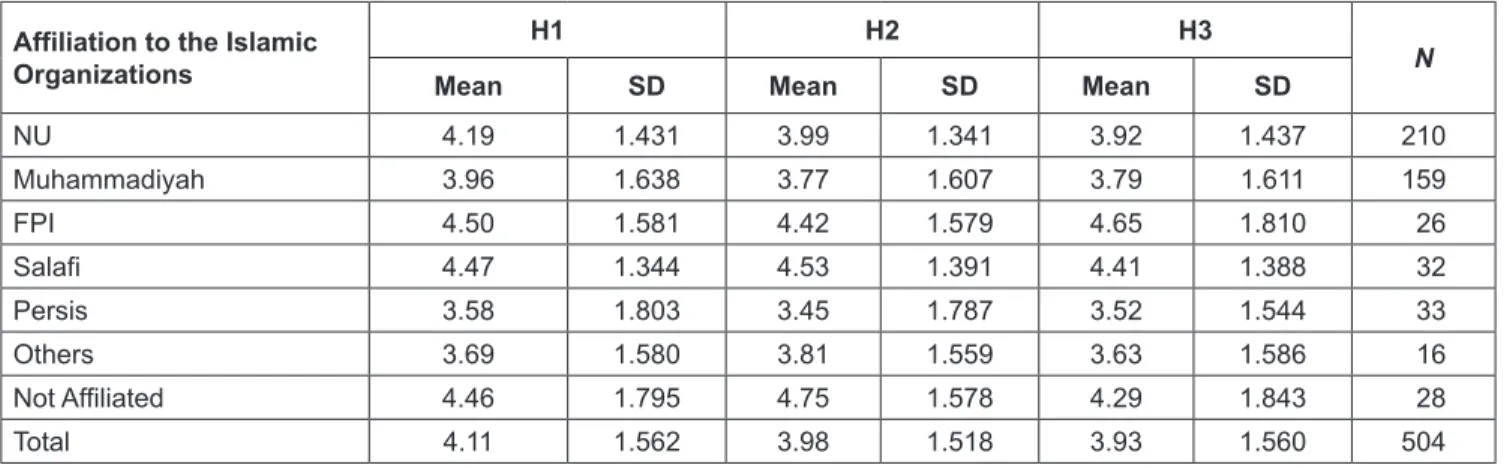
The average scores of justification of tax evasion for respondents based on the affiliation to the Islamic organizations are FPI (4.526), Not affiliated (4.500), Salafi (4.469), NU (4.032), Muhammadiyah (3.843), Persis (3.515), and others (3.708). These scores indicate that respondents from FPI and Salafi (conservative and textualist, respectively) tend to have a higher score than those of other movements in all indicators (Table 5).
Based on the multivariate tests (Wilk’s λ) at the significance level of 5%., there is a statistically significant difference in affiliation to Islamic organizations and the justification of tax evasion (F: 1.612, ρ-value: 0.050, η²:
0.019 and observed power: 0.925). It seems that respondents who are affiliated with moderate Islamic organizations Table 3: Demographic Characteristics of Respondents
Respondent Characteristics Information Frequency Percentage
Age Group Under 30 years old 180 35.70%
30–49 years old 263 52.20%
Over 50 years old 61 12.10%
Gender Male 291 57.70%
Female 213 42.30%
Marital Status Married 356 70.60%
Unmarried 148 29.40%
Education Level Junior High School and under 18 3.60%
Senior High School 259 51.40%
The diploma I/III 70 13.90%
Bachelor 144 28.60%
Postgraduate 13 2.60%
Islamic Organisation or Movement
Affiliation Nahdlatul Ulama (NU) 210 41.70%
Muhammadiyah 159 31.50%
Front of Islamic Defender (FPI) 26 5.20%
Salafi 32 6.30%
Islam United (Persis) 33 6.50%
Others 16 3.17%
Not Affiliated 28 5.56%
Table 4: Significance and Relevance of Path Correlation of Islamic Religiosity, the Sentiment of Islamic Law and The Justification of Tax Evasion
Paths Path coefficients T-stat P-values The Significance Level at 5%
Effect of Islamic religiosity on the sentiment of Islamic law
ISREL → ISLAW 0.558 14.169 0.000 Significant
Effect of religiosity and sentiment of Islamic law on tax evasion justification
ISREL → EVADE 0.260 4.971 0.000 Significant
ISLAW → EVADE 0.451 8.371 0.000 Significant
Table 5: The Influence of the Affiliation to the Islamic Organizations and Movements on the Justification of Tax Evasion Affiliation to the Islamic
Organizations
H1 H2 H3
Mean SD Mean SD Mean SD N
NU 4.19 1.431 3.99 1.341 3.92 1.437 210
Muhammadiyah 3.96 1.638 3.77 1.607 3.79 1.611 159
FPI 4.50 1.581 4.42 1.579 4.65 1.810 26
Salafi 4.47 1.344 4.53 1.391 4.41 1.388 32
Persis 3.58 1.803 3.45 1.787 3.52 1.544 33
Others 3.69 1.580 3.81 1.559 3.63 1.586 16
Not Affiliated 4.46 1.795 4.75 1.578 4.29 1.843 28
Total 4.11 1.562 3.98 1.518 3.93 1.560 504
ISREL
ISLAW
0.312*** EVADE
0.208***
A2 B1 D1 E1
F1
G1 G21 G31 G41 H1 H21 H3
0.467*
0.492*
0.366*
0.078**
0.072**
0.354*
0.313* 0.317* 0.292* 0.624* 0.178** 0.340*
0.08****
0.558****
0.451****