Clinical Factors Associated with Carotid Plaque and Intima-Medial Thickness in HIV-Infected Patients
Su Jin Jeong, Hye Won Kim, Nam Su Ku, Sang Hoon Han, Chang Oh Kim, Jun Yong Choi, Young Goo Song, and June Myung Kim
Department of Internal Medicine and AIDS Research Institute, Yonsei University College of Medicine, Seoul, Korea.
Received: July 27, 2012 Revised: October 15, 2012 Accepted: October 22, 2012
Corresponding author: Dr. Sang Hoon Han, Department of Internal Medicine and AIDS Research Institute,
Yonsei University College of Medicine, 50 Yonsei-ro, Seodaemun-gu, Seoul 120-752, Korea.
Tel: 82-2-2228-1991, Fax: 82-2-393-6884 E-mail: [email protected]
∙ The authors have no financial conflicts of interest.
© Copyright:
Yonsei University College of Medicine 2013 This is an Open Access article distributed under the terms of the Creative Commons Attribution Non- Commercial License (http://creativecommons.org/
licenses/by-nc/3.0) which permits unrestricted non- commercial use, distribution, and reproduction in any medium, provided the original work is properly cited.
Purpose: HIV-infected patients are at increased risk for cardiovascular disease, which may be mediated in part by inflammation. This study aimed to evaluate the risk factors of carotid plaque, and clinical factors associated with carotid athero- sclerosis measured by carotid intima-medial thickness (cIMT) in HIV patients.
Materials and Methods: Clinical and cardiometabolic factors as well as cIMT were prospectively measured in 145 HIV-infected participants who had received combined antiretroviral therapy for ≥6 months. The mean value of the bilateral av- erage cIMT level was used as Mean-IMT in the analysis, and the greatest value among the measured cIMT levels was used as Max-IMT. Results: Among 145 pa- tients, 34 (23.4%) had carotid plaque. Multivariate logistic regression analysis re- vealed three independent risk factors of carotid plaque: old age [odds ratio (OR) 6.16, 95% confidence interval (CI) 1.09-34.88; p=0.040], hypertension (OR 12.62, 95% CI 1.72-92.49; p=0.013) and higher low-density lipoprotein cholesterol (LDL-C) (OR 1.08, 95% CI 1.01-1.16; p=0.039). Levels of estimated glomerular filtration rate were inversely associated with Mean-IMT (r=-0.379, p<0.001) and Max-IMT (r=-0.389, p<0.001). Stepwise multivariate regression analyses revealed that age, total cholesterol and fasting glucose were positively correlated with cIMT, independent of other risk factors. Conclusion: The presence of hyperten- sion, old age and a higher level of LDL-C were independent risk factors of carotid plaque among HIV-infected subjects.
Key Words: Carotid plaque, carotid artery intima-media thickness, atherosclero- sis, combined antiretroviral therapy, HIV infection
INTRODUCTION
Combined antiretroviral therapy (cART) plays a critical role in suppressing viral
titers and increasing CD4+ T lymphocyte counts, which translate to significantly
reduced morbidity and mortality in HIV-infected individuals.
1,2However, it now
appears clear that both HIV infection itself and cART are associated with a higher
risk of stroke and metabolic disorders.
3,4In a cross-sectional study of 292 sub-
jects, a CD4+ T-cell count less than 100 cells/mm
3was associated with a higher
MATERIALS AND METHODS
Study population and design
HIV-infected Koreans, who had continuously received cART comprising more than three antiretroviral drugs for at least six months with good clinical compliance to regular tri- monthly visits at a university-affiliated tertiary care referral hospital (Seoul, Republic of Korea), were requested to par- ticipate in the present study. We prospectively enrolled a to- tal of 145 HIV-infected patients, excluding participants with a medication history of anti-platelet agents or statins that can affect cIMT level and plaque. The study protocol was approved by the Institutional Review Board of the Clinical Research Institute of Severance Hospital. Written informed consent was obtained from each participant.
Carotid IMT measurement
Carotid US was performed by a single specialist to deter- mine the extent of subclinical carotid atherosclerosis. Scan- ning of the extracranial common carotid artery, carotid bulb, and internal carotid artery in the neck was performed bilat- erally from three different longitudinal and transverse pro- jections.
23The average distance between the inner echogen- ic line representing the luminal-intimal interface and the outer echogenic line representing the media-adventitia in- terface was calculated by automatic IMT measurement software (Intimascope; Media Cross, Tokyo, Japan).
23,24The mean value of the bilateral average cIMT level was used as Mean-IMT in the analysis, and the greatest value among the measured cIMT levels was used as Max-IMT. For ca- rotid US, a high-resolution real-time B-mode US with a 10- MHz linear probe (LOGIQ 7; GE Medical Systems, Mil- waukee, WI, USA) was used. Carotid plaque was defined as the presence of focal wall thickening that was at least 50%
greater than that of the surrounding vessel wall, or as a focal region with a cIMT greater than 1.5 mm that protruded into the lumen and was distinct from the adjacent boundary.
25Body composition measurement and collection of laboratory and clinical data
Height, body weight, waist/hip circumference, and systolic and diastolic blood pressure (BP) were directly measured on the day of carotid US evaluation in all participants. Body mass index (BMI) and waist-hip ratio (WHR) were calcu- lated. Blood samples were obtained after a 12 h overnight fast. Circulating levels of total cholesterol (T-C), low-densi- risk of metabolic syndrome.
5In parallel, metabolic compli-
cations were frequently observed after a few years of cART initiation.
6Many morphologic and metabolic chang- es correspond to metabolic syndrome criteria, according to the Adult Treatment Panel III (ATPIII) definition.
7These metabolic complications have been shown to be with an increased lifespan in HIV patients on cART, and naturally raise the question of whether HIV patients are at a higher risk for cardiovascular morbidity.
8Therefore, early detec- tion of atherosclerosis may be necessary to prevent cardio- vascular disease (CVD) in HIV-infected patients receiving cART.
Atherosclerosis is commonly observed in the carotid and coronary arteries.
9Measurement of carotid intima-media thickness (cIMT) and atherogenic plaque using ultrasound (US) is a noninvasive, sensitive and reproducible method for identifying and quantifying subclinical vascular athero- sclerosis and for evaluating the risk of CVD.
10It is well known that cIMT level is a surrogate marker of atheroscle- rosis,
11and is significantly associated with risks for myocar- dial infarction, stroke and coronary heart disease in individ- uals without symptomatic CVD.
12,13Carotid plaque has also been shown to be associated with cardiovascular events in healthy populations, with a prognostic power similar to or better than that of cIMT.
14-16In addition, pathological carot- id US findings, including the existence of plaques and/or a cIMT level of more than 0.9 mm, exhibited a highly signifi- cant direct association with all cardiovascular risk predic- tors including estimated Framingham risk score in cART- naïve HIV patients.
17,18Several previous studies have revealed that a decrease in estimated glomerular filtration rate (eGFR) is one risk fac- tor for CVD
19and is correlated with cardiovascular mortali- ty and morbidity in both high-risk groups
20,21and the gener- al population.
22To the best of our knowledge, studies have yet to investi-
gate risk factors of carotid plaque and subclinical atheroscle-
rosis according to cIMT level in HIV-infected Asians receiv-
ing cART. In addition, there is little data on the clinical
characteristics and associated factors of subclinical carotid
atherosclerosis including eGFR among HIV-infected sub-
jects in the Asia-Pacific region. The objective of this study
was to evaluate the risk factors of asymptomatic carotid
plaque and the associations between cardiometabolic fac-
tors and carotid atherosclerosis as measured by cIMT in
HIV-infected Asians and to discern whether eGFR level is
associated with cIMT or the existence of plaque.
evaluate the relationships between the value of cIMT or eGFR and other variables. The predictive power of cIMT to discriminate patients who had carotid plaque from those who did not was assessed by calculating the area under the receiv- er operating characteristic (ROC) curve (AUC). The AUC ranged from 0.5 to 1.0, and the greater the AUC was, the bet- ter the variables were. The optimal cutoff values of cIMT were selected to maximize the sum of the sensitivity and specificity derived from the ROC curves and the AUC analy- sis (Youden index). All statistical analyses were performed using SPSS 12.0 software (SPSS Inc., Chicago, IL, USA).
RESULTS
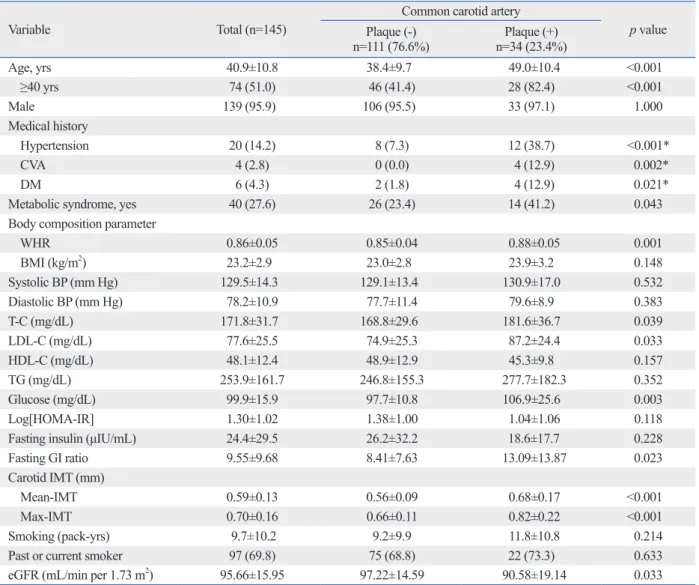
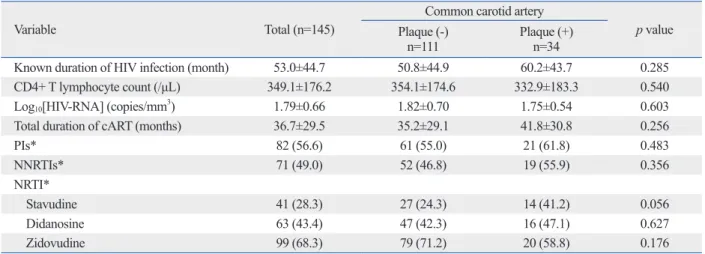
Thirty-four (23.4%) of the 145 patients had carotid athero- genic plaque. The mean age of the patients was 40.9±10.8 years, and 139 patients were male. The mean duration of known HIV infection was 53.0±44.7 months, and the mean total duration of cART was 36.7±29.5 months. The mean values of CD4+ T lymphocyte count and log
10[plasma HIV- RNA VL] at the time of cIMT measurement were 349.1±
176.2 cells/μL and 1.79±0.66 copies/mm
3, respectively (Ta- ble 1).
Patients with carotid plaque were significantly older (49.0±
10.4 yrs vs. 38.4±9.7 yrs, p<0.001) and had a higher preva- lence of hypertension (38.7% vs. 7.3%, p<0.001), cerebro- vascular attack (CVA) (12.9% vs. 0.0%, p=0.002), diabetes mellitus (12.9% vs. 1.8%, p=0.021) and metabolic syn- drome (41.2% vs. 23.4%, p=0.043), compared to patients without plaque. WHR was significantly higher in patients with carotid plaque than in those without (0.88±0.05 vs.
0.85±0.04, p=0.001) (Table 1).
Among the serum lipid profiles, glucose, and IR parame- ters, T-C (181.6±36.7 mg/dL vs. 168.8±29.6 mg/dL, p=
0.039), LDL-C (87.2±24.4 mg/dL vs. 74.9±25.3 mg/dL, p=0.033), glucose (106.9±25.6 mg/dL vs. 97.7±10.8 mg/dL, p=0.003), and fasting glucose-insulin ratio (13.09±13.87 vs.
8.41±7.63, p=0.023) were significantly higher in patients with carotid plaque than in those without. In addition, the carotid plaque group had a higher cIMT level (Mean-IMT;
0.68±0.17 mm vs. 0.56±0.09 mm, p<0.001 and Max-IMT;
0.82±0.22 mm vs. 0.66±0.11 mm, p<0.001) and lower eGFR (90.58±19.14 mL/min per 1.73 m
2vs. 97.22±14.59 mL/min per 1.73 m
2, p=0.033) (Table 1). However, vari- ables associated with HIV infection and cART were not significantly different between the groups (Table 2).
ty lipoprotein cholesterol (LDL-C), high-density lipopro- tein cholesterol (HDL-C), triglyceride (TG), fasting insulin, and fasting glucose were analyzed using an enzymatic colo- rimetric assay and lipoprotein electrophoresis (Hitachi, To- kyo, Japan). Homeostasis model assessment of insulin resis- tance as a marker for insulin resistance (IR) was calculated according to the following formula: [fasting glucose (mmol/
L)×fasting insulin (μIU/mL)/22.5].
26CD4+ T lymphocyte count was measured by flow cytometry (Beckman Coulter, Fullerton, CA, USA), and plasma HIV-RNA viral load (VL) was obtained by Roche diagnostics (COBAS AM- PLICOR HIV-1 MONITOR, version 2.42; Roche, Basel, Switzerland) with a lower detection limit of 40 copies per milliliter.
Kidney function was assessed through eGFR, which was calculated using the Modification of Diet in Renal Disease formula as follows
27: 186.3×(serum creatinine
-1.154)×(age
-0.203)
×(0.742 if female), with the serum creatinine concentration expressed as mg/dL. Clinical information including dura- tion of known HIV infection and total duration of cART as well as all exposed antiretroviral drugs were collected.
Based on the ATPIII criteria,
7metabolic syndrome was de- fined as the presence of three or more or the following components: 1) waist circumference >88 cm in women or
>102 cm in men; 2) systolic BP ≥130 mm Hg or diastolic
≥85 mm Hg or use of antihypertensive medications; 3) TG
≥150 mg/dL or use of lipid lowering medications (niacin, fenofibrate, and gemfibrozil); 4) fasting blood glucose ≥100 mg/dL, physician diagnosed diabetes or use of diabetic medi- cations; 5) HDL-C <50 mg/dL in women or <40 mg/dL in men. Hypertension was defined as the second component mentioned above.
Statistical analysis
All variables are expressed as the mean±standard deviation
or number (percent), unless otherwise indicated. Statistical
significance was set at p<0.05. Categorical variables were
compared by χ
2analysis, and continuous variables with nor-
mal distributions were compared by Student’s t test. We an-
alyzed the continuous variables for normal distribution
through the one-sample Kolmogorov-Smirnov test. Vari-
ables with p<0.05 in bivariate analysis were included in the
logistic regression model for multivariate analysis to esti-
mate the odds ratio (OR) of the risk of carotid plaque, along
with the 95% confidence interval (CI). Single linear univar-
iate correlations (Pearson’s correlation coefficients) and step-
wise multivariate regression analyses were performed to
(sensitivity=0.61 and specificity=0.76) (Fig. 1).
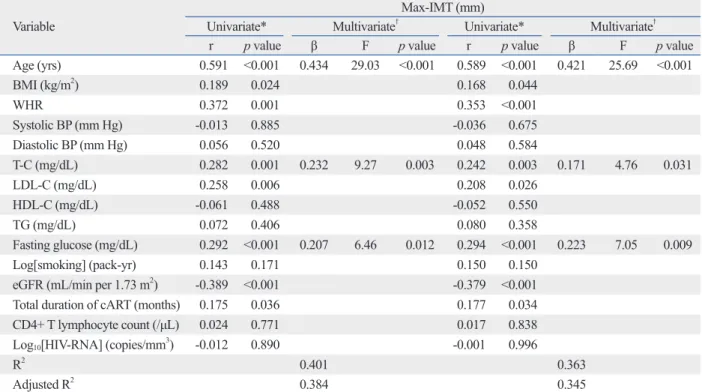
The levels of eGFR were inversely associated with Mean- IMT (r=-0.379, p<0.001) and Max-IMT (r=-0.389, p<0.001).
Correlations between cIMT and clinical and metabolic vari- ables are shown in Table 4. Max-IMT and Mean-IMT had a significantly positive correlation with age (r=0.591, p<0.001, and r=0.589, p<0.001, respectively), BMI (r=0.189, p<0.024, and r=0.168, p<0.044 respectively), WHR (r=0.372, p<0.001, and r=0.353, p<0.001, respectively), T-C (r=0.282, p=0.001, and r=0.242, p=0.003, respectively), LDL-C (r=0.258, p=
0.006, and r=0.208, p=0.026, respectively), and fasting glu- cose (r=0.292, p<0.001, and r=0.294, p<0.001). In addition, the total duration of cART was significantly positively asso- In the multivariate logistic regression model to identify
risk factors for carotid artery plaque in HIV-infected pa- tients receiving cART, older age (older than 40 years, OR 6.16, 95% CI 1.09-34.88, p=0.040), hypertension (OR 12.62, 95% CI 1.72-92.49, p=0.013), and higher LDL-C level (OR 1.08, 95% CI 1.01-1.16, p=0.039) were identified (Table 3).
The ability of Mean-IMT and Max-IMT to predict carotid artery plaque was further examined by ROC curve analyses.
The AUCs for Mean-IMT and Max-IMT were 0.74 (95% CI 0.65-0.84, p<0.001) and 0.76 (95% CI 0.67-0.85, p<0.001), respectively. The cut-off level for the greatest sensitivity and specificity for Mean-IMT was 0.62 mm (sensitivity=0.59 and specificity=0.82), and that for Max-IMT was 0.71 mm
Table 1. Characteristics of all Patients and Comparison of Clinical and Laboratory Parameters between the Carotid Plaque and Non-Plaque Group
Variable Total (n=145)
Common carotid artery
p value Plaque (-)
n=111 (76.6%) Plaque (+)
n=34 (23.4%)
Age, yrs 40.9±10.8 38.4±9.7 49.0±10.4 <0.001
≥40 yrs 74 (51.0) 46 (41.4) 28 (82.4) <0.001
Male 139 (95.9) 106 (95.5) 33 (97.1) 1.000
Medical history
Hypertension 20 (14.2) 8 (7.3) 12 (38.7) <0.001*
CVA 4 (2.8) 0 (0.0) 4 (12.9) 0.002*
DM 6 (4.3) 2 (1.8) 4 (12.9) 0.021*
Metabolic syndrome, yes 40 (27.6) 26 (23.4) 14 (41.2) 0.043
Body composition parameter
WHR 0.86±0.05 0.85±0.04 0.88±0.05 0.001
BMI (kg/m2) 23.2±2.9 23.0±2.8 23.9±3.2 0.148
Systolic BP (mm Hg) 129.5±14.3 129.1±13.4 130.9±17.0 0.532
Diastolic BP (mm Hg) 78.2±10.9 77.7±11.4 79.6±8.9 0.383
T-C (mg/dL) 171.8±31.7 168.8±29.6 181.6±36.7 0.039
LDL-C (mg/dL) 77.6±25.5 74.9±25.3 87.2±24.4 0.033
HDL-C (mg/dL) 48.1±12.4 48.9±12.9 45.3±9.8 0.157
TG (mg/dL) 253.9±161.7 246.8±155.3 277.7±182.3 0.352
Glucose (mg/dL) 99.9±15.9 97.7±10.8 106.9±25.6 0.003
Log[HOMA-IR] 1.30±1.02 1.38±1.00 1.04±1.06 0.118
Fasting insulin (μIU/mL) 24.4±29.5 26.2±32.2 18.6±17.7 0.228
Fasting GI ratio 9.55±9.68 8.41±7.63 13.09±13.87 0.023
Carotid IMT (mm)
Mean-IMT 0.59±0.13 0.56±0.09 0.68±0.17 <0.001
Max-IMT 0.70±0.16 0.66±0.11 0.82±0.22 <0.001
Smoking (pack-yrs) 9.7±10.2 9.2±9.9 11.8±10.8 0.214
Past or current smoker 97 (69.8) 75 (68.8) 22 (73.3) 0.633
eGFR (mL/min per 1.73 m2) 95.66±15.95 97.22±14.59 90.58±19.14 0.033
BMI, body mass index; BP, blood pressure; CVA, cerebro-vascular accident; DM, diabetes mellitus; eGFR, estimated glomerular filtration rate; GI ratio, glucose-insulin ratio; HDL-C, high-density lipoprotein cholesterol; HOMA-IR, homeostasis model assessment of insulin resistance; IMT, intima-media thick- ness; LDL-C, low-density lipoprotein cholesterol; T-C, total cholesterol; TG, triglycerides; WHR, waist-hip-ratio.
Data are expressed as mean±standard deviation or number (percent).
*Fisher’s Exact Test.
tively), and fasting glucose (p=0.012 and p=0.009, respec- tively) remained significant clinical factors independently associated with Max-IMT and Mean-IMT (adjusted R
2=0.384 and 0.345, respectively) (Table 4).
DISCUSSION
The present study revealed that older age (≥40 years), hy- pertension and higher LDL-C level are the independent clin- ical factors associated with the existence of carotid plaque in HIV-infected Koreans receiving cART. In addition, we con- firmed that Max-IMT and Mean-IMT are significantly as- sociated with the existence of carotid plaque and found that cIMT is correlated with traditional CVD risk factors in HIV-infected Koreans.
According to our multivariate analysis, the presence of documented hypertension and a 1 mg/dL increase in LDL- C were associated with 12.62 and 1.08 times higher risk of carotid plaque, respectively. In addition, older patients with HIV demonstrated a greater incidence of carotid plaque (es- pecially those over 40). It is generally well accepted that hypertension and dyslipidemia promote atherosclerosis and ciated with Max-IMT and Mean-IMT (r=0.175, p=0.036, and
r=0.177, p=0.034, respectively) in univariate analysis. In the multiple stepwise regression analyses, age (p<0.001 and p<0.001, respectively), T-C (p=0.003 and p=0.031, respec-
Table 2. Comparison of Variables of HIV Infection and cART between the Carotid Plaque and Non-Plaque Group
Variable Total (n=145) Common carotid artery
p value Plaque (-)
n=111 Plaque (+)
n=34
Known duration of HIV infection (month) 53.0±44.7 50.8±44.9 60.2±43.7 0.285
CD4+ T lymphocyte count (/μL) 349.1±176.2 354.1±174.6 332.9±183.3 0.540
Log10[HIV-RNA] (copies/mm3) 1.79±0.66 1.82±0.70 1.75±0.54 0.603
Total duration of cART (months) 36.7±29.5 35.2±29.1 41.8±30.8 0.256
PIs* 82 (56.6) 61 (55.0) 21 (61.8) 0.483
NNRTIs* 71 (49.0) 52 (46.8) 19 (55.9) 0.356
NRTI*
Stavudine 41 (28.3) 27 (24.3) 14 (41.2) 0.056
Didanosine 63 (43.4) 47 (42.3) 16 (47.1) 0.627
Zidovudine 99 (68.3) 79 (71.2) 20 (58.8) 0.176
cART, combined antiretroviral therapy; NNRTI, nonnucleoside analogue reverse transcriptase inhibitor; NRTI, nucleoside analogue reverse transcriptase inhibitor; PI, protease inhibitor; US, using ultrasound.
Data are expressed as mean±standard deviation or number (percent).
*These variables indicate continuous exposure history of PIs or NNRTIs or NRTI for more than six months before carotid US measurement.
Table 3. Multivariate Logistic Regression Model to Identify Clinical Factors Indicating the Existence of Carotid Artery Plaque in HIV-Infected Patients Receiving cART
Variable OR 95% CI p value
Old age (≥40 yrs old) 6.16 1.09-34.88 0.040
Hypertension 12.62 1.72-92.49 0.013
LDL-C (mg/dL) 1.08 1.01-1.16 0.039
cART, combined antiretroviral therapy; LDL-C, low-density lipoprotein cholesterol; OR, odds ratio; CI, confidence interval.
Fig. 1. ROC curves for Max-IMT and Mean-IMT for the prediction of carotid artery plaque. The area under the ROC curves for Mean-IMT and Max-IMT were 0.74 (95% CI 0.65-0.84, p<0.001) and 0.76 (95% CI 0.67-0.85, p<0.001), respectively. CI, confidence interval; IMT, intima-media thickness; ROC, re- ceiver operating characteristic.
0.0 0.2 0.4 0.6 0.8 1.0
Sensitivity
0.0 0.2 0.4 0.6 0.8 1.0
1-specificity
Mean-IMT Max-IMT Reference
Although the wide performance of cART has prolonged the life expectancy of individuals infected with HIV,
35the accelerated onset of CVD has emerged as a concerning complication of chronic HIV infection and long-term use of cART.
36Moreover, there is increasing evidence supporting the initiation of cART in asymptomatic HIV-infected pa- tients and a CD4+ T lymphocyte count >500 cells/mm
3.
37It is, therefore, increasingly more relevant to stratify patients for CVD risk when cART is being initiated or when treat- ment regimens are being adjusted.
38Arterial stiffness, a marker of CVD and an independent predictor of its corre- sponding risk, is associated with impaired endothelial func- tion.
39HIV may affect the vasculature directly via endotheli- al damage,
40and the virus-mediated inhibition of cholesterol efflux from macrophages with consequent reduced HDL-C levels,
41which promotes arterial stiffness and contributes to atherogenesis.
42Furthermore, HIV treatment, especially protease inhibitors may accelerate atherosclerosis especial- ly due to metabolic side effects including dyslipidemia and IR.
43,44However, we found that subclinical carotid athero- sclerosis was not associated with duration of HIV infection or cART regimen. Any association of HIV with atheroscle- consequently increase IMT in non-HIV-infected individu-
als.
28Prospective studies of large populations have reported a correlation between circulating concentration of total cho- lesterol and LDL-C with IMT in both non-HIV-infected Caucasian
28and Eskimos.
29Also, older age is known to be a major risk factor for the development of CVD.
30Endothe- lium-dependent dilation of vessels becomes impaired with age,
31,32and is thought to contribute to the age-associated increase in CVD risk.
30In our study, we observed similar associations between hypertension, LDL-C, age and carotid plaque in HIV-infected patients receiving cART.
The results of our study reveal that the presence of sub- clinical carotid plaque is a frequent occurrence among HIV- infected patient receiving cART (23.4%). Our present ob- servation, however, could be limited by the absence of age- matched HIV non-infected controls. Nevertheless, this high prevalence is in line with other previous observations,
33,34and only 6.7% of subclinical carotid lesions have been ob- served in an age-matched control group of 104 HIV-nega- tive subjects. Furthermore, 20.9% of subclinical carotid le- sions have been reported in HIV-infected patients naïve to cART.
18Table 4. Correlations between Max-IMT/Mean-IMT and Clinical and Metabolic Variables
VariableMax-IMT (mm)
Univariate* Multivariate† Univariate* Multivariate†
r p value β F p value r p value β F p value
Age (yrs) 0.591 <0.001 0.434 29.03 <0.001 0.589 <0.001 0.421 25.69 <0.001
BMI (kg/m2) 0.189 0.024 0.168 0.044
WHR 0.372 0.001 0.353 <0.001
Systolic BP (mm Hg) -0.013 0.885 -0.036 0.675
Diastolic BP (mm Hg) 0.056 0.520 0.048 0.584
T-C (mg/dL) 0.282 0.001 0.232 9.27 0.003 0.242 0.003 0.171 4.76 0.031
LDL-C (mg/dL) 0.258 0.006 0.208 0.026
HDL-C (mg/dL) -0.061 0.488 -0.052 0.550
TG (mg/dL) 0.072 0.406 0.080 0.358
Fasting glucose (mg/dL) 0.292 <0.001 0.207 6.46 0.012 0.294 <0.001 0.223 7.05 0.009
Log[smoking] (pack-yr) 0.143 0.171 0.150 0.150
eGFR (mL/min per 1.73 m2) -0.389 <0.001 -0.379 <0.001
Total duration of cART (months) 0.175 0.036 0.177 0.034
CD4+ T lymphocyte count (/μL) 0.024 0.771 0.017 0.838
Log10[HIV-RNA] (copies/mm3) -0.012 0.890 -0.001 0.996
R2 0.401 0.363
Adjusted R2 0.384 0.345
BMI, body mass index; BP, blood pressure; cART, combined active antiretroviral therapy; eGFR, estimated glomerular filtration rate; HDL-C, high-density lipoprotein cholesterol; IMT, intima-media thickness; LDL-C, low-density lipoprotein cholesterol; T-C, total cholesterol; TG, triglycerides; WHR, waist-hip- ratio.
β indicates regression coefficients.
*Univariate coefficients.
†Stepwise multivariate regression analysis.
tive control group for comparison.
In spite of these limitations, this study has clinical signifi- cance since it is the first report to evaluate the relationships between carotid atherosclerosis and metabolic risk factors in Asian patients with HIV. In conclusion, we demonstrated that the presence of hypertension, high LDL-C and old age are independent clinical factors of carotid plaque among HIV-infected Koreans. Future studies on the process of ath- erosclerosis in HIV-infected patients receiving cART are needed, including direct comparison between multiethnic HIV-infected patients and non-HIV-infected subjects.
REFERENCES
1. Palella FJ Jr, Delaney KM, Moorman AC, Loveless MO, Fuhrer J, Satten GA, et al. Declining morbidity and mortality among patients with advanced human immunodeficiency virus infection. HIV Outpatient Study Investigators. N Engl J Med 1998;338:853-60.
2. Mocroft A, Brettle R, Kirk O, Blaxhult A, Parkin JM, Antunes F, et al. Changes in the cause of death among HIV positive subjects across Europe: results from the EuroSIDA study. AIDS 2002;16:
1663-71.
3. Mochan A, Modi M, Modi G. Stroke in black South African HIV- positive patients: a prospective analysis. Stroke 2003;34:10-5.
4. Brannagan TH 3rd. Retroviral-associated vasculitis of the nervous system. Neurol Clin 1997;15:927-44.
5. Bonfanti P, De Socio GL, Marconi P, Franzetti M, Martinelli C, Vichi F, et al. Is metabolic syndrome associated to HIV infection per se? Results from the HERMES study. Curr HIV Res 2010;8:
165-71.
6. Carr A, Samaras K, Thorisdottir A, Kaufmann GR, Chisholm DJ, Cooper DA. Diagnosis, prediction, and natural course of HIV-1 protease-inhibitor-associated lipodystrophy, hyperlipidaemia, and diabetes mellitus: a cohort study. Lancet 1999;353:2093-9.
7. Alberti KG, Eckel RH, Grundy SM, Zimmet PZ, Cleeman JI, Do- nato KA, et al. Harmonizing the metabolic syndrome: a joint in- terim statement of the International Diabetes Federation Task Force on Epidemiology and Prevention; National Heart, Lung, and Blood Institute; American Heart Association; World Heart Federation; International Atherosclerosis Society; and Internation- al Association for the Study of Obesity. Circulation 2009;120:
1640-5.
8. Lang S, Mary-Krause M, Cotte L, Gilquin J, Partisani M, Simon A, et al. Increased risk of myocardial infarction in HIV-infected patients in France, relative to the general population. AIDS 2010;
24:1228-30.
9. Hodis HN, Mack WJ, LaBree L, Selzer RH, Liu CR, Liu CH, et al. The role of carotid arterial intima-media thickness in predicting clinical coronary events. Ann Intern Med 1998;128:262-9.
10. Stein JH, Korcarz CE, Post WS. Use of carotid ultrasound to identi- fy subclinical vascular disease and evaluate cardiovascular disease risk: summary and discussion of the American Society of Echocar- diography consensus statement. Prev Cardiol 2009;12:34-8.
11. O’Leary DH, Polak JF, Kronmal RA, Manolio TA, Burke GL, Wolfson SK Jr. Carotid-artery intima and media thickness as a risk
rosis remains vague because of discrepant findings among these studies and the likelihood of bias affecting some study results. cART induces not only metabolic effects including dyslipidemia, but also antimetabolic effects such as recovery from immunosuppression and HIV VL suppression. These effects might explain our results that HIV and cART were not associated with carotid atherosclerosis.
A non-dipping BP profile of abnormal diurnal BP rhythm and a reduced nocturnal BP fall was highly prevalent in cART-naïve HIV patients. And this pattern is currently re- garded as a risk factor in its own right for cardiovascular events and target organ damage.
45It has been suggested that the mechanism of a non-dipping pattern involves the associ- ation of non-dipping with salt-sensitive forms of hyperten- sion, renal function impairment and mineralocorticoid-in- duced forms of hypertension, but this is not yet clear.
46In our study, we could not check diurnal BP rhythm, and a BP pat- tern in HIV-infected patients receiving cART is warranted.
In the present study, we found that the cut-off levels of Max-IMT and Mean-IMT were 0.71 mm and 0.62 mm, re- spectively, for predicting the presence of carotid plaque. For the same BMI or waist circumference, Asians have a higher prevalence of hypertension and, a higher percentage of body fat, diabetes and dyslipidemia as well as clustering of these risk factors, compared with Caucasians.
47-50Although there are now ethnic-specified definitions for obesity,
47these cut- off points do not take into consideration the possible inter- ethnic differences in body build and body fat distribution among different Asian ethnic groups.
49,50Considering inter- ethnic differences of metabolic complications, the results of our study suggest that the cut-off values of Max-IMT and Mean-IMT might be useful for early detection of carotid atherosclerosis in Asian patients with HIV.
We also observed significant correlations between cIMT and other classical CVD risk factors such as age, T-C and fasting glucose. Increasing cIMT is known to be closely re- lated with systemic atherosclerosis, including CAD and CVA. Many prospective studies have shown that the devel- opment of cIMT progresses to cardiovascular events.
11,51,52Therefore, elevated T-C and fasting glucose may account for early atherosclerosis in HIV-infected patients.
There are several limitations to our study. The study de- sign was cross-sectional, which means that we cannot infer causality. Future prospective studies are required to evalu- ate the predictive power of risk factors on the future risk of CVD and all-cause mortality in a large multiethnic cohort.
Additional limitations include the lack of an HIV-seronega-
trations in man. Diabetologia 1985;28:412-9.
27. Levey AS, Bosch JP, Lewis JB, Greene T, Rogers N, Roth D. A more accurate method to estimate glomerular filtration rate from serum creatinine: a new prediction equation. Modification of Diet in Renal Disease Study Group. Ann Intern Med 1999;130:461-70.
28. Lorenz MW, Markus HS, Bots ML, Rosvall M, Sitzer M. Predic- tion of clinical cardiovascular events with carotid intima-media thickness: a systematic review and meta-analysis. Circulation 2007;115:459-67.
29. Masulli M, Patti L, Riccardi G, Vaccaro O, Annuzzi G, Ebbesson SO, et al. Relation among lipoprotein subfractions and carotid ath- erosclerosis in Alaskan Eskimos (from the GOCADAN Study).
Am J Cardiol 2009;104:1516-21.
30. Lakatta EG, Levy D. Arterial and cardiac aging: major sharehold- ers in cardiovascular disease enterprises: Part II: the aging heart in health: links to heart disease. Circulation 2003;107:346-54.
31. Celermajer DS, Sorensen KE, Spiegelhalter DJ, Georgakopoulos D, Robinson J, Deanfield JE. Aging is associated with endothelial dysfunction in healthy men years before the age-related decline in women. J Am Coll Cardiol 1994;24:471-6.
32. Eskurza I, Kahn ZD, Seals DR. Xanthine oxidase does not con- tribute to impaired peripheral conduit artery endothelium-depen- dent dilatation with ageing. J Physiol 2006;571(Pt 3):661-8.
33. Maggi P, Serio G, Epifani G, Fiorentino G, Saracino A, Fico C, et al. Premature lesions of the carotid vessels in HIV-1-infected pa- tients treated with protease inhibitors. AIDS 2000;14:F123-8.
34. Maggi P, Lillo A, Perilli F, Maserati R, Chirianni A; PREVALEAT Group. Colour-Doppler ultrasonography of carotid vessels in pa- tients treated with antiretroviral therapy: a comparative study.
AIDS 2004;18:1023-8.
35. Couzigou C, Semaille C, Le Strat Y, Pinget R, Pillonel J, Lot F, et al. Differential improvement in survival among patients with AIDS after the introduction of HAART. AIDS Care 2007;19:523-31.
36. Khunnawat C, Mukerji S, Havlichek D Jr, Touma R, Abela GS.
Cardiovascular manifestations in human immunodeficiency virus- infected patients. Am J Cardiol 2008;102:635-42.
37. Kitahata MM, Gange SJ, Abraham AG, Merriman B, Saag MS, Justice AC, et al. Effect of early versus deferred antiretroviral ther- apy for HIV on survival. N Engl J Med 2009;360:1815-26.
38. Calza L, Manfredi R, Pocaterra D, Chiodo F. Risk of premature atherosclerosis and ischemic heart disease associated with HIV in- fection and antiretroviral therapy. J Infect 2008;57:16-32.
39. Lakatta EG, Wang M, Najjar SS. Arterial aging and subclinical ar- terial disease are fundamentally intertwined at macroscopic and molecular levels. Med Clin North Am 2009;93:583-604.
40. Schillaci G, De Socio GV, Pirro M, Savarese G, Mannarino MR, Baldelli F, et al. Impact of treatment with protease inhibitors on aortic stiffness in adult patients with human immunodeficiency vi- rus infection. Arterioscler Thromb Vasc Biol 2005;25:2381-5.
41. Schillaci G, Pucci G, De Socio GV. HIV infection and antiretrovi- ral treatment: a “two-hit” model for arterial stiffness? Am J Hy- pertens 2009;22:817-8.
42. van Leuven SI, Sankatsing RR, Vermeulen JN, Kastelein JJ, Reiss P, Stroes ES. Atherosclerotic vascular disease in HIV: it is not just antiretroviral therapy that hurts the heart! Curr Opin HIV AIDS 2007;2:324-31.
43. Noor MA. The role of protease inhibitors in the pathogenesis of HIV-associated insulin resistance: cellular mechanisms and clini- cal implications. Curr HIV/AIDS Rep 2007;4:126-34.
44. DAD Study Group, Friis-Møller N, Reiss P, Sabin CA, Weber R, factor for myocardial infarction and stroke in older adults. Cardio-
vascular Health Study Collaborative Research Group. N Engl J Med 1999;340:14-22.
12. Chambless LE, Heiss G, Folsom AR, Rosamond W, Szklo M, Sharrett AR, et al. Association of coronary heart disease incidence with carotid arterial wall thickness and major risk factors: the Ath- erosclerosis Risk in Communities (ARIC) Study, 1987-1993. Am J Epidemiol 1997;146:483-94.
13. Lorenz MW, von Kegler S, Steinmetz H, Markus HS, Sitzer M.
Carotid intima-media thickening indicates a higher vascular risk across a wide age range: prospective data from the Carotid Ath- erosclerosis Progression Study (CAPS). Stroke 2006;37:87-92.
14. Kitamura A, Iso H, Imano H, Ohira T, Okada T, Sato S, et al. Ca- rotid intima-media thickness and plaque characteristics as a risk factor for stroke in Japanese elderly men. Stroke 2004;35:2788-94.
15. Rosvall M, Janzon L, Berglund G, Engström G, Hedblad B. Inci- dent coronary events and case fatality in relation to common ca- rotid intima-media thickness. J Intern Med 2005;257:430-7.
16. van der Meer IM, Bots ML, Hofman A, del Sol AI, van der Kuip DA, Witteman JC. Predictive value of noninvasive measures of atherosclerosis for incident myocardial infarction: the Rotterdam Study. Circulation 2004;109:1089-94.
17. De Socio GV, Martinelli C, Ricci E, Orofino G, Valsecchi L, Viti- ello P, et al. Relations between cardiovascular risk estimates and subclinical atherosclerosis in naive HIV patients: results from the HERMES study. Int J STD AIDS 2010;21:267-72.
18. Maggi P, Quirino T, Ricci E, De Socio GV, Gadaleta A, Ingrassia F, et al. Cardiovascular risk assessment in antiretroviral-naïve HIV patients. AIDS Patient Care STDS 2009;23:809-13.
19. National Kidney Foundation. K/DOQI clinical practice guidelines for chronic kidney disease: evaluation, classification, and stratifi- cation. Am J Kidney Dis 2002;39(2 Suppl 1):S1-266.
20. De Leeuw PW, Thijs L, Birkenhäger WH, Voyaki SM, Efstrato- poulos AD, Fagard RH, et al. Prognostic significance of renal function in elderly patients with isolated systolic hypertension: re- sults from the Syst-Eur trial. J Am Soc Nephrol 2002;13:2213-22.
21. Shlipak MG, Simon JA, Grady D, Lin F, Wenger NK, Furberg CD; Heart and Estrogen/progestin Replacement Study (HERS) Investigators. Renal insufficiency and cardiovascular events in postmenopausal women with coronary heart disease. J Am Coll Cardiol 2001;38:705-11.
22. Muntner P, He J, Hamm L, Loria C, Whelton PK. Renal insuffi- ciency and subsequent death resulting from cardiovascular disease in the United States. J Am Soc Nephrol 2002;13:745-53.
23. Pignoli P, Tremoli E, Poli A, Oreste P, Paoletti R. Intimal plus me- dial thickness of the arterial wall: a direct measurement with ultra- sound imaging. Circulation 1986;74:1399-406.
24. Yanase T, Nasu S, Mukuta Y, Shimizu Y, Nishihara T, Okabe T, et al. Evaluation of a new carotid intima-media thickness measure- ment by B-mode ultrasonography using an innovative measure- ment software, intimascope. Am J Hypertens 2006;19:1206-12.
25. Touboul PJ, Hennerici MG, Meairs S, Adams H, Amarenco P, Bornstein N, et al. Mannheim carotid intima-media thickness con- sensus (2004-2006). An update on behalf of the Advisory Board of the 3rd and 4th Watching the Risk Symposium, 13th and 15th European Stroke Conferences, Mannheim, Germany, 2004, and Brussels, Belgium, 2006. Cerebrovasc Dis 2007;23:75-80.
26. Matthews DR, Hosker JP, Rudenski AS, Naylor BA, Treacher DF, Turner RC. Homeostasis model assessment: insulin resistance and beta-cell function from fasting plasma glucose and insulin concen-
49. Deurenberg P, Yap M, van Staveren WA. Body mass index and percent body fat: a meta analysis among different ethnic groups.
Int J Obes Relat Metab Disord 1998;22:1164-71.
50. Tan CE, Ma S, Wai D, Chew SK, Tai ES. Can we apply the Na- tional Cholesterol Education Program Adult Treatment Panel defi- nition of the metabolic syndrome to Asians? Diabetes Care 2004;
27:1182-6.
51. Akosah KO, McHugh VL, Barnhart SI, Mathiason MA, Schaper AM, Perlock PA. Pilot Results of the Early Detection by Ultra- sound of Carotid Artery Intima-Media Thickness Evaluation (ED- UCATE) study. Am J Hypertens 2007;20:1183-8.
52. Salonen JT, Salonen R. Ultrasonographically assessed carotid morphology and the risk of coronary heart disease. Arterioscler Thromb 1991;11:1245-9.
Monforte Ad, et al. Class of antiretroviral drugs and the risk of myocardial infarction. N Engl J Med 2007;356:1723-35.
45. De Socio GV, Bonfanti P, Martinelli C, Ricci E, Pucci G, Marino- ni M, et al. Negative influence of HIV infection on day-night blood pressure variability. J Acquir Immune Defic Syndr 2010;55:
356-60.
46. Birkenhäger AM, van den Meiracker AH. Causes and conse- quences of a non-dipping blood pressure profile. Neth J Med 2007;65:127-31.
47. WHO Expert Consultation. Appropriate body-mass index for Asian populations and its implications for policy and intervention strategies. Lancet 2004;363:157-63.
48. Snehalatha C, Viswanathan V, Ramachandran A. Cutoff values for normal anthropometric variables in asian Indian adults. Diabetes Care 2003;26:1380-4.