Normative Values and Correlates of Mean Common Carotid Intima-Media Thickness in the Korean Rural Middle-aged Population: The Atherosclerosis RIsk of Rural Areas iN Korea General Population (ARIRANG) Study
Carotid intima-media thickness (CIMT) is considered as a surrogate marker for
cardiovascular disease (CVD). We determined the normative value of CIMT and correlates of CVD risk factors and Framingham risk score (FRS) in Korean rural middle-aged population. We measured CIMT with a B-mode ultrasonography in 1,759 subjects, aged 40 to 70 yr, in a population-based cohort in Korea. A healthy reference sample (n = 433) without CVD, normal weight and normal metabolic parameters was selected to establish normative CIMT values. Correlates between CIMT and conventional CVD risk factors were assessed in the entire population. Mean values of CIMT (in mm) for healthy reference sample aged 40-49, 50-59, and 60-70 yr were 0.55, 0.59, and 0.66 for men and 0.48, 0.55, and 0.63 for women, respectively. In multivariate regression analysis, CIMT was correlated with older age, higher BMI, male gender, higher LDL-cholesterol level and history of diabetes mellitus. The mean CIMT was also correlated with FRS in both gender (r2 = 0.043, P < 0.01 for men; r2 = 0.142, P < 0.01 for women). We identified normative value of CIMT for the healthy Korean rural middle-aged population. The CIMT is associated with age, obesity, gender, LDL-cholesterol, diabetes mellitus and FRS.
Key Words: Atherosclerosis; Intima-Media Thickness; Reference Values Young Jin Youn1, Nam Seok Lee1,
Jang-Young Kim1,2, Jun-Won Lee1, Joong-Kyung Sung1, Sung-Gyun Ahn1, Byung-Su You1, Seung-Hwan Lee1, Junghan Yoon1, Kyung-Hoon Choe1, Sang Baek Koh2,3, and Jong Ku Park3
1Division of Cardiology, Internal Medicine, Wonju College of Medicine, Yonsei University, Wonju;
2Institute of Genomic Cohort, Yonsei University, Wonju; 3Department of Preventive Medicine and Institute of Occupational Medicine, Wonju College of Medicine, Yonsei University, Wonju, Korea Received: 17 August 2010
Accepted: 6 December 2010 Address for Correspondence:
Jang-Young Kim, MD
Division of Cardiology, Department of Internal Medicine, Wonju College of Medicine, Yonsei University, 162 Ilsan-dong, Wonju 220-701, Korea
Tel: +82.33-741-0909, Fax: +82.33-741-1219 E-mail: [email protected]
This study was financially supported in part by the Project For Development of a Community Cohort for Health Management II (2005-present) of the Korea Centers for Disease Control and Prevention.
DOI: 10.3346/jkms.2011.26.3.365 • J Korean Med Sci 2011; 26: 365-371 Cardiovascular Disorders
INTRODUCTION
There is great deal of interest in identifying high-risk asymptom- atic patients in the general population to prevent mortality and morbidity due to cardiovascular disease (CVD) (1, 2). Measure- ment of carotid intima-media thickness (CIMT) with a B-mode ultrasonography is a valid approach for identifying and quanti- fying the presence of subclinical atherosclerosis. It is a noninva- sive, sensitive, and reproducible technique for identifying and quantifying atherosclerotic burden and CVD risk. It is also a well- validated research tool that has been translated into clinical prac- tice (2-4).
The American Heart Association Writing Group 3, National Cholesterol Education Program Adult Treatment Panel III (NCEP-ATP III), the American Society of Echocardiography, Screening of Heart Attack Prevention and Education (SHAPE) guideline, European Society of Hypertension recommend mea-
suring CIMT for refining CVD risk assessment in patients with subclinical atherosclerosis (5-8).
Normal CIMT values should be defined on the basis of age, gender and race/ethnicity within a general healthy population (2). Various CVD risk stratification schemes have been devel- oped using prospective data derived predominantly from Cau- casian populations. Given the ethnic diversity in the profile of CVD, varied risk associations and different levels of genetic-en- vironmental interactions in different populations, such studies performed in Caucasian populations cannot be directly applied to Korean populations. Currently, there are limited data for the normative values of CIMT in the general East Asian population.
The aim of this study was to determine the normative values of CIMT for healthy Korean subjects aged 40 to 70 yr, based on a cohort in Korea and assess the correlates of CVD risk factors and Framingham risk score (FRS) in entire population.
MATERIALS AND METHODS Study population
The Atherosclerosis RIsk of Rural Area iN Korea General popula- tion (ARIRANG) study is an ongoing cohort study of cardiovas- cular and metabolic risk factors conducted in a rural area in Ko- rea. We analyzed 1,716 subjects (male: 40.4%) aged from 40 to 70 who underwent CIMT measurements.
For the assessment of normative CIMT values, we selected a healthy reference sample by excluding subjects with any of the following conditions: 1) history of stroke including cerebral in- farction or transient ischemic attack, myocardial infarction, or heart failure; 2) hypertension (systolic blood pressure [SBP] ≥ 140 mmHg, diastolic blood pressure [DBP] ≥ 90 mmHg, or drug treat- ment for hypertension); 3) diabetes mellitus (fasting blood glu- cose ≥ 126 mg/dL or drug treatment for diabetes mellitus); 4) total cholesterol ≥ 220 mg/dL or pharmacologic therapy for dys- lipidemia; 5) current smoking; and 6) body mass index (BMI)
≥ 30 kg/m2.
Laboratory measurement
All subjects underwent a complete cardiovascular evaluation after 8 hr of fasting, including: 1) medical history for previous stroke, myocardial infarction, heart failure, hypertension, dia- betes mellitus, dyslipidemia or smoking; 2) anthropometric analysis including height, weight, waist circumference and hip circumference; 3) blood pressure measurement (obtained after 10 min of rest in the sitting position, expressed as the average of three consecutive measurements); 4) serum glucose levels; 5) plasma lipids profile including total cholesterol, triglyceride, high-density lipoprotein cholesterol (HDL-C), and low-density lipoprotein cholesterol (LDL-C) level; 6) serum high sensitive C-reactive protein (hs-CRP) level.
Carotid intima-media thickness measurement
The measurement was carried out according to a validated pro- cedure, using a high-resolution B-mode ultrasonography view of the far wall of the common carotid artery, with an ultrasonog- raphy system (Vivid-7; General Electric–Vingmed, Milwaukee, WI, USA) and a phased array 12-MHz transducer (9).
Patients were placed comfortably in the supine position with the head directed away from the side of interest and the neck extended slightly. Thereafter, the proximal, mid, and distal com- mon carotid artery (CCA), carotid bifurcation, and proximal por- tion of internal carotid artery were systematically interrogated along the long- and short-axis views. Still images of the CCA and carotid bifurcation were digitally acquired. The CIMT was deter- mined at the far wall of the CCA using the semi-automated edge- detection software. Using this software, a region of interest (about 2 cm in length and 1 cm away from bifurcation) was placed per- pendicular to the vessel wall. The software detects the lumen-
intima and the media-adventitia interface at the far wall of the vessel (Fig. 1). Because mean values are more reproducible, we use the mean CIMT (2).
Framingham risk score
Risk assessment for determining the 10-yr risk for developing CVD is carried out using Framingham risk score. The risk fac- tors included in the Framingham calculation of 10-yr risk are:
age, total cholesterol, HDL-C, SBP, treatment for hypertension, and cigarette smoking. The calculation was performed accord- ing to the ATP III guideline (6).
Statistical analysis
Data for continuous variables are presented as the mean ± stan- dard deviation and proportions are presented as frequencies and percentages. The CIMT data between the different age groups were assessed by one-way ANOVA and Post Hoc analysis was performed with Scheffe’s test. We evaluated the effect of tradi- tional risk factors on CIMT (as a continuous variable) using lin- ear regression both with and without adjustment for age and gender. Multivariate regression analysis was performed using the following variables: age, gender, SBP, DBP, triglycerides, HDL- C, LDL-C, hs-CRP which was log-transformed because of a pos- itive skew distribution, BMI, history of diabetes mellitus and smoking including current and ex-smoking. The correlate of Framingham risk score and CIMT was assessed by simple lin- ear regression analysis without adjustment of other factors. All tests were two-sided and P < 0.05 was considered to be statisti- cally significant. SPSS for Windows-version 15 (SPSS Inc., USA) was used for analyses.
Ethics statement
All subjects signed informed consent forms for participation in this study. This study was reviewed and approved by institution-
Fig. 1. Measuring Carotid Intima-Media Thickness Measurement using a high-resolu- tion B-mode ultrasonography view of the far wall of the common carotid artery, with an ultrasonography system. The software detects the lumen-intima and the media- adventitia interface at the far wall of the vessel.
al review board of Wonju Christian Hospital (Approval number:
CR105024).
RESULTS
Baseline characteristics of study population
The study population was consisted of 1,716 subjects (693 [40.4%]
men) aged 40 to 70 yr (mean age 55.1), of whom 433 (107 [24.7%]
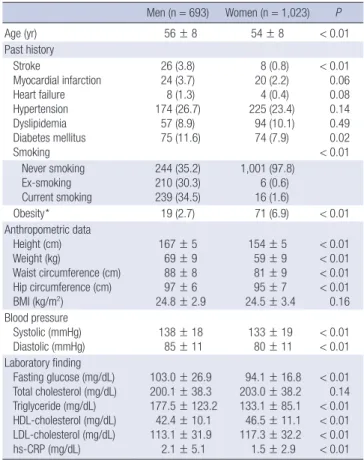
men) were found to be healthy (Fig. 2). In entire population, men were older and have more frequent history of stroke and diabe- tes mellitus. Smoking was also frequent in men. Men were taller and heavier than women, but mean BMI was not different be- tween two genders. SBP and DBP were higher in men. Total cholesterol level was similar but triglyceride level was higher in men. On contrary, HDL-C and LDL-C level was higher in wom- en. Higher hs-CRP level was observed in men. Demographic, clinical and laboratory characteristics of the study population
were presented in Table 1.
Normative value of CIMT in healthy reference sample In the healthy reference sample, mean CIMT was higher in men (0.60 ± 0.12 mm vs 0.53 ± 0.10 mm, P < 0.01). A significant cor- relation was observed between age and mean CIMT for both men (r2 = 0.144, P < 0.01) and women (r2 = 0.321, P < 0.01). Mean values of CIMT (in mm) in healthy subjects aged 40-49, 50-59, and 60-70 yr were: 0.55 ± 0.08, 0.59 ± 0.13, and 0.66 ± 0.13 mm for men and 0.48 ± 0.07, 0.55 ± 0.09, and 0.63 ± 0.12 mm for wom- Table 1. Baseline characteristics of study population
Men (n = 693) Women (n = 1,023) P
Age (yr) 56 ± 8 54 ± 8 < 0.01
Past history Stroke
Myocardial infarction Heart failure Hypertension Dyslipidemia Diabetes mellitus Smoking
26 (3.8) 24 (3.7) 8 (1.3) 174 (26.7)
57 (8.9) 75 (11.6)
8 (0.8) 20 (2.2) 4 (0.4) 225 (23.4) 94 (10.1) 74 (7.9)
< 0.01 0.06 0.08 0.14 0.49 0.02
< 0.01 Never smoking
Ex-smoking Current smoking
244 (35.2) 210 (30.3) 239 (34.5)
1,001 (97.8) 6 (0.6) 16 (1.6)
Obesity* 19 (2.7) 71 (6.9) < 0.01
Anthropometric data Height (cm) Weight (kg)
Waist circumference (cm) Hip circumference (cm) BMI (kg/m2)
167 ± 5 69 ± 9 88 ± 8 97 ± 6 24.8 ± 2.9
154 ± 5 59 ± 9 81 ± 9 95 ± 7 24.5 ± 3.4
< 0.01
< 0.01
< 0.01
< 0.01 0.16 Blood pressure
Systolic (mmHg) Diastolic (mmHg)
138 ± 18 85 ± 11
133 ± 19 80 ± 11
< 0.01
< 0.01 Laboratory finding
Fasting glucose (mg/dL) Total cholesterol (mg/dL) Triglyceride (mg/dL) HDL-cholesterol (mg/dL) LDL-cholesterol (mg/dL) hs-CRP (mg/dL)
103.0 ± 26.9 200.1 ± 38.3 177.5 ± 123.2
42.4 ± 10.1 113.1 ± 31.9 2.1 ± 5.1
94.1 ± 16.8 203.0 ± 38.2 133.1 ± 85.1 46.5 ± 11.1 117.3 ± 32.2 1.5 ± 2.9
< 0.01 0.14
< 0.01
< 0.01
< 0.01
< 0.01
*Defined BMI ≥ 30 kg/m2. BMI, body mass index; HDL, high-density lipoprotein; hs- CRP, high sensitive C-reactive protein; LDL, low-density lipoprotein.
Excluded (n = 1,283) (1) Past history Stroke: 34 (2.0%)
Myocardial infarction: 44 (2.8%) Heart failure: 12 (0.8%) (2) Hypertension
SBP ≥ 140 mmHg: 672 (39.2%) DBP ≥ 90 mmHg: 503 (29.4%) Medication: 399 (24.7%) (3) Diabetes mellitus
Fasting glucose ≥ 126 mg/dL: 117 (6.8%) Medication: 149 (9.4%)
(4) Dyslipidemia
Total cholesterol ≥ 220 mg/dL: 483 (28.1%) Medication: 151 (9.6%)
(5) Current smoking: 255 (14.9%) (6) Obesity (BMI ≥ 30 kg/m2): 90 (5.2%) 433 healthy subjects (men: 24.7%)
1,716 subjects (men: 40.4%) who underwent carotid ultrasound from
ARIRANG study
Fig. 2. Flow chart describing disposition of healthy subjects from the ARIRANG study.
Table 2. The mean value and 5th, 10th, 25th, 50th, 75th, 90th, and 95th percentiles value of carotid intima-media thickness among men and women according to age group
Age (yr) No. Mean Percentiles value of mean CIMT (mm) in men (n = 107)
5% 10% 25% 50% 75% 90% 95%
40-49 31 0.55 0.40 0.43 0.51 0.55 0.62 0.67 0.69
50-59 41 0.59 0.44 0.46 0.50 0.57 0.62 0.76 0.94
60-70 35 0.66 0.50 0.52 0.58 0.64 0.70 0.85 0.99
Total 107 0.60 0.44 0.48 0.52 0.57 0.65 0.75 0.89
Age (yr) No. Mean Percentiles value of mean CIMT (mm) in women (n = 326)
5% 10% 25% 50% 75% 90% 95%
40-49 165 0.48 0.39 0.41 0.44 0.47 0.52 0.57 0.61
50-59 106 0.55 0.43 0.45 0.48 0.54 0.60 0.67 0.75
60-70 55 0.63 0.46 0.51 0.55 0.62 0.69 0.80 0.95
Total 326 0.53 0.41 0.43 0.45 0.51 0.57 0.67 0.72
CIMT, carotid intima-media thickness.
en, respectively. Mean values of CIMT in men were higher at each age group but not in subjects aged 60-70 yr (0.66 ± 0.13 mm vs 0.63 ± 0.12 mm, P = 0.38). Mean CIMT values according to age groups were presented at Fig. 3. The mean value and 5th, 10th, 25th, 50th, 75th, 90th, and 95th percentiles value of CIMT among men and women according to age groups were present- ed in Table 2.
Correlates between CIMT and conventional CVD risk factors
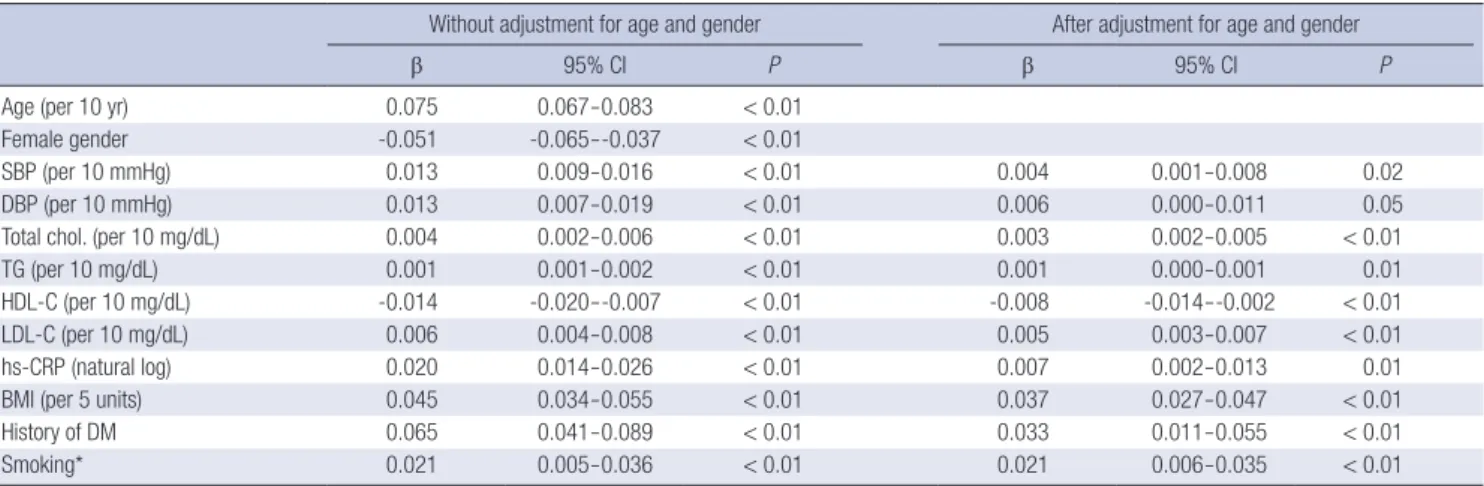
In the entire population, CIMT showed associations with age, gender, SBP, DBP, total cholesterol, triglyceride, HDL-C, LDL-C, BMI, history of diabetes and smoking by simple linear regres- sion. After adjustment for age and gender, these associations were persistent (Table 3). In multivariate regression analysis, in- dependent predictors of increasing CIMT were older age, high- er BMI, male gender, higher LDL-C level and history of diabetes mellitus (Table 4).
Correlates between CIMT and Framingham risk score Linear regression between increasing CIMT and Framingham risk score was performed in the entire population. A significant correlation was observed for both men (r2 = 0.043, P < 0.01) and women (r2 = 0.152, P < 0.01) but weak correlation in men (Fig. 4).
DISCUSSION
We present normative values of CIMT for healthy Korean rural adults aged 40-70 yr. We also report on the cross-sectional asso- ciations between increasing CIMT and conventional cardiovas- cular risk factors in entire sample. In addition, we present the correlation CIMT and Framingham risk score in this population.
The Oslo Ischemia Study showed that a significant number of participants remain asymptomatic despite significant coro- nary artery disease, but sudden cardiac death frequently occurs at the first presentation of coronary heart disease (10). Thus, it Table 3. Association of individual atherosclerotic risk factors with increasing CIMT in linear regression models with and without adjustment for age and gender (n = 1,716)
Without adjustment for age and gender After adjustment for age and gender
β 95% CI P β 95% CI P
Age (per 10 yr) 0.075 0.067-0.083 < 0.01
Female gender -0.051 -0.065--0.037 < 0.01
SBP (per 10 mmHg) 0.013 0.009-0.016 < 0.01 0.004 0.001-0.008 0.02
DBP (per 10 mmHg) 0.013 0.007-0.019 < 0.01 0.006 0.000-0.011 0.05
Total chol. (per 10 mg/dL) 0.004 0.002-0.006 < 0.01 0.003 0.002-0.005 < 0.01
TG (per 10 mg/dL) 0.001 0.001-0.002 < 0.01 0.001 0.000-0.001 0.01
HDL-C (per 10 mg/dL) -0.014 -0.020--0.007 < 0.01 -0.008 -0.014--0.002 < 0.01
LDL-C (per 10 mg/dL) 0.006 0.004-0.008 < 0.01 0.005 0.003-0.007 < 0.01
hs-CRP (natural log) 0.020 0.014-0.026 < 0.01 0.007 0.002-0.013 0.01
BMI (per 5 units) 0.045 0.034-0.055 < 0.01 0.037 0.027-0.047 < 0.01
History of DM 0.065 0.041-0.089 < 0.01 0.033 0.011-0.055 < 0.01
Smoking* 0.021 0.005-0.036 < 0.01 0.021 0.006-0.035 < 0.01
*Defined as current smoking or ex-smoking. BMI, body mass index; Chol., cholesterol; CI, confidence interval; DBP, diastolic blood pressure; DM, diabetes mellitus; HDL-C, high density lipoprotein cholesterol; hs-CRP; high sensitive C-reactive protein; LDL-C, low density lipoprotein cholesterol; SBP, systolic blood pressure; TG, triglyceride.
Table 4. Risk factors associated with increasing CIMT selected on stepwise linear regression (n = 1,716)
β 95% CI P
r2 = 0.235
Age (per 10 yr) 0.63 0.054-0.071 < 0.01
Female gender -0.46 -0.064--0.028 < 0.01
SBP (per 10 mmHg) 0.05 -0.001-0.001 0.08
DBP (per 10 mmHg) -0.05 -0.015-0.004 0.28
Triglycerides (per 10 mg/dL) 0.000 -0.001-0.001 0.76 HDL-cholesterol (per 10 mg/dL) -0.004 -0.010--0.003 0.26 LDL-cholesterol (per 10 mg/dL) 0.004 0.002-0.006 < 0.01 C-reactive protein (natural log) 0.002 -0.004-0.008 0.52
BMI (per 5 units) 0.026 0.015-0.036 < 0.01
History of diabetes mellitus 0.026 0.004-0.048 0.02
Smoking* -0.012 -0.032-0.007 0.213
*Defined as current smoking or ex-smoking. BMI, body mass index; CI, confidence interval; DBP, diastolic blood pressure; HDL-C, high density lipoprotein cholesterol;
LDL-C, low density lipoprotein cholesterol; SBP, systolic blood pressure.
Mean CIMT (mm)
P < 0.01 P = 0.04
P = 0.38
40-49 yr 50-59 yr 60-70 yr
Error Bars: +/- 2 SE Age group
Men Women
0.80
0.60
0.40
0.20
0.00
Fig. 3. Estimation of mean carotid intima-media thickness according to age groups and genders in healthy reference (men = 107; women = 326). CIMT, carotid intima- media thickness.
is very important to identify subjects who are in subclinical ath- erosclerosis and initiate primary prevention for CVD. The extent of carotid atherosclerosis positively correlates with the severity of coronary atherosclerosis and the severity of CIMT indepen- dently correlates with the risk of major cardiovascular disease such as transient cerebral ischemia, stroke and coronary events.
Therefore, measurement of CIMT with B-mode ultrasonography is a valid, noninvasive, sensitive and reproducible technique (2).
Although many committees and studies have shown the im- portance of CIMT measurements, there is not enough data re- garding normal CIMT values, especially in Koreans. Recent stud- ies including the Atherosclerosis Risk in Communities (ARIC) and Multi-Ethnic Study of Atherosclerosis (MESA) have showed different CIMT values according to age, gender and geographi- cal origin, and therefore normative CIMT values should be de- fined based on these factors (2, 11). The American Society of Echocardiography recommends population-specific normative data according to age, gender, and ethinicity (2). Since data from Caucasian populations cannot be directly applied to Korean because of difference of genetic and environmental factors, the normative data provided for CIMT in our study will allow the application of CIMT measurement in individual subjects from this ethnic group.
Our study is not the first report of normative CIMT values in Korean. Bae et al. (12) and Cho et al. (13) already reported nor- mative CIMT values in Korean. But, Cho et al. did not use the semi-automated edge-detection method for measuring CIMT and Bae et al. used subjects who had visited the general hospital and BMI was not considered in the criteria for healthy subjects (12, 13). The mean CIMT in our study was thinner than those of the two Korean studies, independent of age. Difference of mean CIMT could be explained that our study was based on a cohort and used very strict criteria for healthy subjects.
The statistical difference of mean CIMT between men and women was not observed in subjects aged 60-70 yr despite cor- relation of increasing CIMT and age in entire population. This
Fig. 4. Correlation between carotid intima-media thickness and Framingham risk score according to gender (men = 693; women = 1,023). CIMT, carotid intima-media thickness.
Mean CIMT for men (mm) Mean CIMT for women (mm)1.40
1.20 1.00 0.80 0.60 0.40 0.20
1.40 1.20 1.00 0.80 0.60 0.40
0 5 10 15 20 0 5 10 15 20 25
R Sq Linear = 0.43 R Sq Linear = 0.152
Framingham risk score Framingham risk score
phenomenon could be explained by menopause in females and this finding correlates well with a study of the effect of meno- pause on carotid artery remodeling (14).
Since the National Cholesterol Education Program (NCEP) Expert Panel (ATP III) recommends measuring CIMT because the finding of an elevated CIMT (e.g., ≥ 75th percentile for age and gender) could reclassify a person with multiple risk factors to a higher risk category, we also present the 5th, 10th, 25th, 50th, 75th, 90th, and 95th percentiles value of CIMT among men and women (5, 6). Further evaluation which percentiles of value should be used for cut-off value of abnormal CIMT is needed.
In our study, the mean CIMT was significantly correlated with age, gender and other cardiovascular risk factors including SBP, DBP, total cholesterol, triglyceride, HDL-C, LDL-C, hs-CRP, BMI, history of diabetes mellitus and smoking by simple linear regres- sion. But, in multivariate analysis using stepwise linear regres- sion, only age, BMI, gender, LDL-C and history of diabetes mel- litus were correlated with increasing CIMT in this population.
We could explain the reason for this result as following: First, there might be the potential ethnic differences regarding the role of classic versus novel risk factor as determinants of carotid atherosclerosis and cardiovascular risk. Second, because meta- bolic components clustered closely with each others, multiple collinearity should be considered to accept this result. To con- firm correlates with CIMT, further studies would be required.
We evaluated the relationship between CIMT and Framing- ham risk score because the Framingham risk score accurately estimates 10-yr CVD risk (2). In our study, CIMT was correlated well with Framingham risk score in both genders, but the CIMT of men showed weak correlation with Framingham risk score compared with the CIMT of women. Because relatively small number of men and lack of diabetes mellitus and obesity for calculating Framingham risk score may be the reasons that their CIMT values showed weak correlate with FRS. Another reason could be that since Framingham risk equations are derived from a North American population, consisting of mainly whites, it is
not clear if they can directly be extrapolated to the Korean pop- ulation and some concern has been raised over the fact that the original Framingham risk score underestimated risk (15). Wheth- er the estimating the vascular age by mean of measuring the CIMT could be a better approach for calculating CVD risk should be evaluated with the long-term follow-up data.
Our study is limited by its cross-sectional nature. In addition, our examination for CIMT was limited to measurement of either side of common carotid arteries and lack of data for presence of carotid plaque which is another important marker for athero- sclerosis. Although we exclude the subjects with CVD by history for previous stroke, myocardial infarction or heart failure, we did not exclude the subjects of peripheral artery disease because of lack of availability of the data. However, pending prospective data, our results for normative CIMT value provide important insights into the determinants of subclinical vascular disease in this population. A longitudinal study is needed for a better eval- uation of the relationships between cardiovascular risk factors, subclinical atherosclerosis and the risk of cardiovascular events in this population.
In conclusion, normative CIMT values were identified for the healthy Korean rural adults aged 40-70 yr using a B-mode ultra- sonography. The values are closely associated with age, obesity, gender, LDL-C and diabetes mellitus. Increasing CIMT is corre- lated with Framingham risk score in both genders.
REFERENCES
1. Taylor AJ, Merz CN, Udelson JE. 34th Bethesda Conference: executive summary–can atherosclerosis imaging techniques improve the detection of patients at risk for ischemic heart disease? J Am Coll Cardiol 2003; 41:
1860-2.
2. Stein JH, Korcarz CE, Hurst RT, Lonn E, Kendall CB, Mohler ER, Najjar SS, Rembold CM, Post WS; American Society of Echocardiography Ca- rotid Intima-Media Thickness Task Force. Use of carotid ultrasonogra- phy to identify subclinical vascular disease and evaluate cardiovascular disease risk: a consensus statement from the American Society of Echocar- diography Carotid Intima-Media Thickness Task Force. Endorsed by the Society for Vascular Medicine. J Am Soc Echocardiogr 2008; 21: 93-111.
3. Stein JH, Fraizer MC, Aeschlimann SE, Nelson-Worel J, McBride PE, Douglas PS. Vascular age: integrating carotid intima-media thickness measurements with global coronary risk assessment. Clin Cardiol 2004;
27: 388-92.
4. Gepner AD, Keevil JG, Wyman RA, Korcarz CE, Aeschlimann SE, Busse KL, Stein JH. Use of carotid intima-media thickness and vascular age to modify cardiovascular risk prediction. J Am Soc Echocardiogr 2006; 19:
1170-4.
5. Greenland P, Abrams J, Aurigemma GP, Bond MG, Clark LT, Criqui MH, Crouse JR 3rd, Friedman L, Fuster V, Herrington DM, Kuller LH, Ridker PM, Roberts WC, Stanford W, Stone N, Swan HJ, Taubert KA, Wexler L.
Prevention conference V: beyond secondary prevention; identifying the high-risk patient for primary prevention: noninvasive tests of atheroscle- rotic burden: Writing Group III. Circulation 2000; 101: E16-22.
6. National Cholesterol Education Program (NCEP) Expert Panel on De- tection, Evaluation, and Treatment of High Blood Cholesterol in Adults (Adult Treatment Panel III). Third report of the National Cholesterol Ed- ucation Program (NCEP) Expert Panel on Detection, Evaluation, and Treatment of High Blood Cholesterol in Adults (Adult Treatment Panel III) final report. Circulation 2002; 106: 3143-421.
7. Naghavi M, Falk E, Hecht HS, Jamieson MJ, Kaul S, Berman D, Fayad Z, Budoff MJ, Rumberger J, Naqvi TZ, Shaw LJ, Faergeman O, Cohn J, Bahr R, Koenig W, Demirovic J, Arking D, Herrera VL, Badimon J, Goldstein JA, Rudy Y, Airaksinen J, Schwartz RS, Riley WA, Mendes RA, Douglas P, Shah PK; SHAPE Task Force. From vulnerable plaque to vulnerable pa- tient--Part III: executive summary of the Screening for Heart Attack Pre- vention and Education (SHAPE) Task Force report. Am J Cardiol 2006;
98: 2H-15H.
8. Mancia G, De Backer G, Dominiczak A, Cifkova R, Fagard R, Germano G, Grassi G, Heagerty AM, Kjeldsen SE, Laurent S, Narkiewicz K, Ruilope L, Rynkiewicz A, Schmieder RE, Struijker Boudier HA, Zanchetti A, Va- hanian A, Camm J, De Caterina R, Dean V, Dickstein K, Filippatos G, Funck-Brentano C, Hellemans I, Kristensen SD, McGregor K, Sechtem U, Silber S, Tendera M, Widimsky P, Zamorano JL, Kjeldsen SE, Erdine S, Narkiewicz K, Kiowski W, Agabiti-Rosei E, Ambrosioni E, Cifkova R, Dominiczak A, Fagard R, Heagerty AM, Laurent S, Lindholm LH, Man- cia G, Manolis A, Nilsson PM, Redon J, Schmieder RE, Struijker-Boudi- er HA, Viigimaa M, Filippatos G, Adamopoulos S, Agabiti-Rosei E, Am- brosioni E, Bertomeu V, Clement D, Erdine S, Farsang C, Gaita D, Kio- wski W, Lip G, Mallion JM, Manolis AJ, Nilsson PM, O’Brien E, Poni- kowski P, Redon J, Ruschitzka F, Tamargo J, van Zwieten P, Viigimaa M, Waeber B, Williams B, Zamorano JL, The task force for the management of arterial hypertension of the European Society of Hypertension, The task force for the management of arterial hypertension of the European Society of Cardiology. 2007 Guideline for the management of arterial hypertension: The Task Force for the Management of Arterial Hyperten- sion of the European Society of Hypertension (ESH) and of the European Society of Cardiology (ESC). Eur Heart J 2007; 28: 1462-536.
9. O’Leary DH, Polak JF, Kronmal RA, Manolio TA, Burke GL, Wolfson SK Jr. Carotid-artery intima and media thickness as a risk factor for myocar- dial infarction and stroke in older adults. Cardiovascular Health Study Collaborative Research Group. N Engl J Med 1999; 340: 14-22.
10. Thaulow E, Erikssen J, Sandvik L, Erikssen G, Jorgensen L, Cohn PF. Ini- tial clinical presentation of cardiac disease in asymptomatic men with silent myocardial ischemia and angiographically documented coronary artery disease (the Oslo Ischemia Study). Am J Cardiol 1993; 72: 629-33.
11. Chambless LE, Heiss G, Folsom AR, Folsom AR, Rosamond W, Szklo M, Sharrett AR, Clegg LX. Association of coronary heart disease incidence with carotid arterial wall thickness and major risk factors: the Atheroscle- rosis Risk in Communities (ARIC) study, 1987-1993. Am J Epidemiol 1997;
146: 483-94.
12. Bae JH, Seung KB, Jung HO, Kim KY, Yoo KD, Kim CM, Cho SW, Cho SK, Kim YK, Rhee MY, Cho MC, Kim KS, Jin SW, Lee JM, Kim KS, Hyun DW, Cho YK, Seong IW, Jeong JO, Park SC, Jeong JY, Woo JT, Koh G, Lim SW. Analysis of Korean carotid intima-media thickness in Korean healthy subjects and patients with risk factors: Korea multi-center epidemiologi- cal study. Korean Circ J 2005; 35: 513-24.
13. Cho YL, Kim DJ, Kim HD, Choi SH, Kim SK, Kim HJ, Ahn CW, Cha BS, Lim SK, Kim KR, Lee HC, Huh KB. Reference values of carotid intima-me-
dia thickness and association with atherosclerotic risk factors in healthy subjects in Korea. Korean J Med 2003; 64: 275-83.
14. Muscelli E, Kozàkovà M, Flyvbjerg A, Kyriakopoulou K, Astiarraga BD, Glintborg D, Konrad T, Favuzzi A, Petrie J; RISC investigators. The effect of menopause on carotid artery remodeling, insulin sensitivity, and plas-
ma adiponectin in healthy women. Am J Hypertens 2009; 22: 364-70.
15. Brindle PM, McConnachie A, Upton MN, Hart CL, Davey Smith G, Watt GC. The accuracy of the Framingham risk-score in different socioeconom- ic groups: a prospective study. Br J Gen Pract 2005; 55: 838-45.
AUTHOR SUMMARY
Normative Values and Correlates of Mean Common Carotid Intima-Media
Thickness in the Korean Rural Middle-aged Population: The Atherosclerosis RIsk of Rural Areas iN Korea General Population (ARIRANG) Study
Young Jin Youn, Nam Seok Lee, Jang-Young Kim, Jun-Won Lee, Joong-Kyung Sung, Sung-Gyun Ahn, Byung-Su You, Seung-Hwan Lee, Junghan Yoon, Kyung-Hoon Choe, Sang Baek Koh, and Jong Ku Park
Carotid intima-media thickness (CIMT) is considered as a surrogate marker for cardiovascular disease (CVD). We determined the normative value of CIMT and correlates of CVD risk factors and Framingham risk score (FRS) in a community based cohort in Korea.
We measured CIMT with a B-mode ultrasonography in a consecutive 1,759 subjects, aged 40 to 70 yr. A healthy reference subject (n = 433) without CVD, normal weight and normal metabolic parameters was selected to establish normative CIMT values.
Correlates between CIMT and conventional CVD risk factors were assessed in the entire population. Mean normative values of CIMT aged 40-49, 50-59 and 60-70 were 0.55, 0.59 and 0.66 mm for men and 0.48, 0.55 and 0.63 mm for women, respectively. In multivariate regression analysis, CIMT was positively correlated with age, body mass index, male, LDL-cholesterol level and history of diabetes mellitus. The mean CIMT was also correlated with FRS in both gender (r2 = 0.043, P < 0.01 for men; r2 = 0.142, P <
0.01 for women).