Lab Anim Res 2017: 33(3), 209-215 https://doi.org/10.5625/lar.2017.33.3.209
ISSN 2233-7660 (Online)
Artemisia argyi attenuates airway inflammation in lipopolysaccharide induced acute lung injury model
Na-Rae Shin
1,#, Sung-Hyeuk Park
1,#, Je-Won Ko
1, Hyung-Won Ryu
2, Seong-Hun Jeong
3, Jong-Choon Kim
1, Dong-Ho Shin
1, Hoon-Sang Lee
4,*, In-Sik Shin
1,*
1
College of Veterinary Medicine (BK21 project team), Chonnam National University, Gwangju, Korea
2
Natural Medicine Research Center, Korea Research Institute of Bioscience & Biotechnology, Chungju, Korea
3
Namhae Garlic Research Institute, Namhae-gun, Korea
4
Korea Ginseng Corporation, Daejeon, Korea
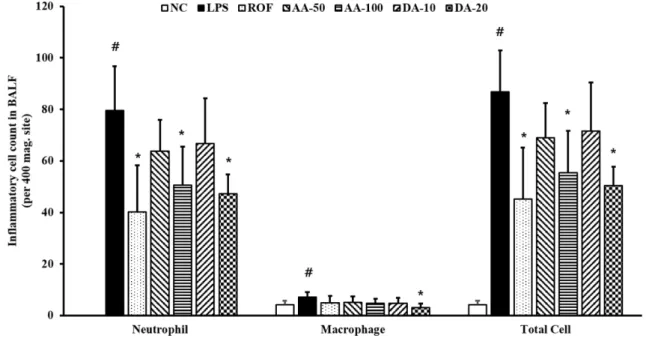
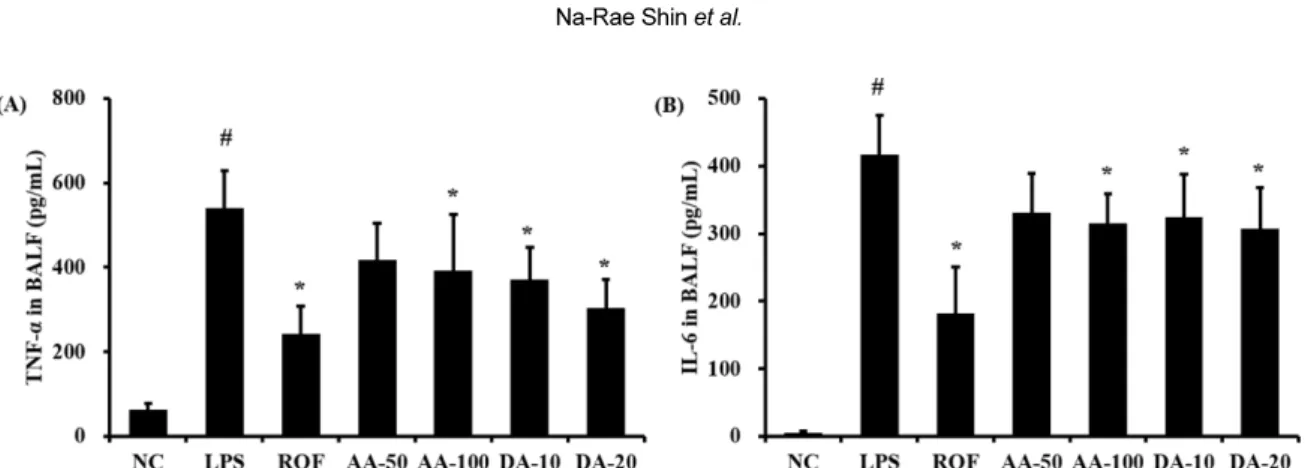
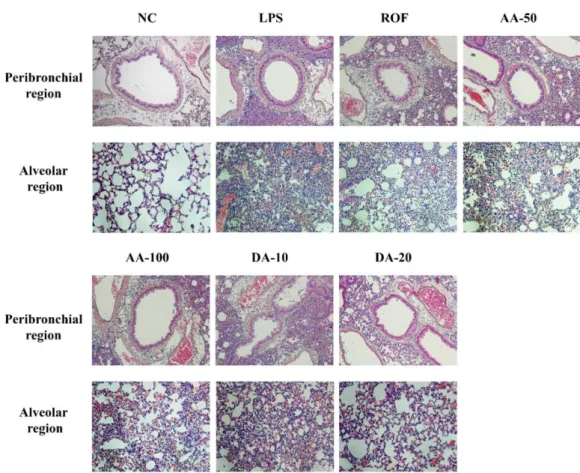
Artemisia argyi is used as a health supplement, tea, and food source in Korea. This study aimed to evaluate the effect of Artemisia argyi (AA) and its active compound, dehydromatricarin A (DA), on the attenuation of airway inflammation in a murine model of lipopolysaccharide (LPS)-induced acute lung injury (ALI). The C57BL/6 mice were administered AA (50 mg/kg or 100 mg/kg) and DA (10 mg/kg or 20 mg/kg) by oral gavage from day 0 to 7 days and LPS treated by intranasal instillation 48 hours before the sacrifice. The treatment of AA and DA markedly decreased inflammatory cells in the bronchoalveolar lavage fluid (BALF) compared with that in ALI-induced mice, which was accompanied by a significant reduction in the levels of tumor necrosis factor (TNF)-α and interleukin (IL)-6 in BALF. Furthermore, the administration of AA and DA clearly decreased inducible nitric oxide synthase (iNOS) expression and nuclear factor kappa B (NF-κB) phosphorylation in comparison with that in the ALI-induced mice. The histological examination of the lung tissue revealed that the administration of AA and DA suppressed the inflammatory cell infiltration into the peribronchial and alveolar lesions induced by LPS instillation.
Collectively, our results indicated that AA and DA effectively decreased the airway inflammatory response induced by LPS instillation. Therefore, AA and DA may offer a potential therapy for airway inflammatory disease.
Keywords: Artemisia argyi, dehydromatricarin A, acute lung injury, inducible nitric oxide synthase, nuclear factor kappa B
Received 12 June 2017; Revised version received 30 August 2017; Accepted 1 September 2017
The persistent occurrence of acute lung injury (ALI) is a major clinical problem that leads to increased morbidity and mortality. ALI is characterized by pulmonary edema and severe acute inflammatory response; in particular, neutrophil accumulation results in dyspnea and death [1]. In the pathogenesis of ALI, excess neutrophil accumulation is facilitated by the complex interaction of
inflammatory mediators [2]. Accumulated neutrophils can cause endothelial damage, enhance the permeability of the alveolar-capillary barrier, and release pro- inflammatory mediators, such as TNF- α and IL-6.
Because these mediators exacerbate inflammatory responses, they are regarded as crucial markers of the acute phase of ALI [3-6].
#