• 검색 결과가 없습니다.

The Effects of Nuclear Factor-κB Decoy Oligodeoxynucleotide on Lipopolysaccharide-Induced Direct Acute Lung Injury

N/A
N/A
Protected

Academic year: 2021

Share "The Effects of Nuclear Factor-κB Decoy Oligodeoxynucleotide on Lipopolysaccharide-Induced Direct Acute Lung Injury"

Copied!
10
0
0

로드 중.... (전체 텍스트 보기)

전체 글

(1)

This work was supported by the Korea Research Foundation Grant funded by the Korean Government (MOEHRD) (KRF-2006-331- E00122).

Address for correspondence: Kyung Ho Kang, M.D., Ph.D.

Division of Pulmonary, Allergy and Critical Care Medicine, Department of Internal Medicine, Korea University Guro Hospital, 80, Guro 2-dong, Guro-gu, Seoul 152-703, Korea

Phone: 82-2-2626-3028, Fax: 82-2-865-9670, E-mail: [email protected] Received: May. 20, 2009

Accepted: Jul. 2, 2009

ISSN: 1738-3536(Print)/2005-6184(Online) Tuberc Respir Dis 2009;67:95-104

CopyrightⒸ2009. The Korean Academy of Tuberculosis and Respiratory Diseases. All rights reserved.

The Effects of Nuclear Factor-κB Decoy Oligodeoxynucleotide on Lipopolysaccharide-Induced Direct Acute Lung Injury

1

Division of Pulmonary, Sleep and Critical Care Medicine, Department of Internal Medicine, Korea University Ansan Hospital, Ansan,

2

Division of Pulmonary, Allergy and Critical Care Medicine, Department of Internal Medicine, Korea University Guro Hospital,

3

Division of Respiratory and Critical Care Medicine, Department of Internal Medicine, Korea University Anam Hospital, Seoul, Korea

Je Hyeong Kim, M.D., Ph.D.

1

, Dae Wui Yoon, M.S.

1

, Ki Hwan Jung, M.D.

1

, Hye Ok Kim, M.D.

2

, Eun Sil Ha, M.D.

3

, Kyoung Ju Lee, M.D., Ph.D.

2

, Gyu Young Hur, M.D., Ph.D.

2

, Sung Yong Lee, M.D., Ph.D.

2

, Sang Yeub Lee, M.D., Ph.D.

3

, Chol Shin, M.D., Ph.D.

1

, Jae Jeong Shim, M.D., Ph.D.

2

, Kwang Ho In, M.D., Ph.D.

3

, Se Hwa Yoo, M.D., Ph.D.

3

, Kyung Ho Kang, M.D., Ph.D.

2

리포다당질로 인한 직접성 급성폐손상에서 Nuclear Factor-κB Decoy Oligodeoxynucleotide의 효과
김제형

1

, 윤대위

1

, 정기환

1

, 김혜옥

2

, 하은실

3

, 이경주

2

, 허규영

2

, 이승룡

2

, 이상엽

3

, 신 철

1

, 심재정

2

, 인광호

3

, 유세화

3

, 강경호

2

고려대학교 의과대학

1

안산병원,

2

구로병원,

3

안암병원 호흡기내과

Background: The pathophysiologic mechanisms of early acute lung injury (ALI) differ according to the type of primary insult. It is important to differentiate between direct and indirect pathophysiologic pathways, and this may influence the approach to treatment strategies. NF-κB decoy oligodeoxynucleotide (ODN) is a useful tool for the blockade of the expression of NF-κB-dependent proinflammatory mediators and has been reported to be effective in indirect ALI. The purpose of this study was to investigate the effect of NF-κB decoy ODN in the lipopolysac- charide (LPS)-induced direct ALI model.

Methods: Five-week-old specific pathogen-free male BALB/c mice were used for the experiment. In the preliminary studies, tumor necrosis factor (TNF)-α, interleukine (IL)-6 and NF-κB activity peaked at 6 hours after LPS ad- ministration. Myeloperoxidase (MPO) activity and ALI score were highest at 36 and 48 hours, respectively.

Therefore, it was decided to measure each parameter at the time of its highest level. The study mice were randomly divided into three experimental groups: (1) control group which was administered 50 μL of saline and treated with intratracheal administration of 200 μL DW containing only hemagglutinating virus of Japan (HVJ) vector (n=24);

(2) LPS group in which LPS-induced ALI mice were treated with intratracheal administration of 200 μL DW containing only HVJ vector (n=24); (3) LPS+ODN group in which LPS-induced ALI mice were treated with intratracheal administration of 200 μL DW containing 160 μg of NF-κB decoy ODN and HVJ vector (n=24). Each group was subdivided into four experimental subgroups: (1) tissue subgroup for histopathological examination for ALI at 48 hours (n=6); (2) 6-hour bronchoalveolar lavage (BAL) subgroup for measurement of TNF-α and IL-6 in BAL fluid (BALF) (n=6); (3) 36-hour BAL subgroup for MPO activity assays in BALF (n=6); and (4) tissue homogenate subgroup for measurement of NF-κB activity in lung tissue homogenates at 6 hours (n=6).

Original Article

(2)

Results: NF-κB decoy ODN treatment significantly decreased NF-κB activity in lung tissues. However, it failed to improve the parameters of LPS-induced direct ALI, including the concentrations of tumor necrosis factor-α and interleukin-6 in BALF, myeloperoxidase activity in BALF and histopathologic changes measured by the ALI score.

Conclusion: NF-κB decoy ODN, which has been proven to be effective in indirect models, had no effect in the direct ALI model.

Key Words: Acute lung injury, Lipopolysaccharides, Inflammation, Nuclear factor kappa B, Oligodeoxynucleotides

Introduction

Acute respiratory distress syndrome (ARDS) has a more severe manifestation of acute lung injury (ALI) in- duced by a variety of predisposing conditions com- posed of direct and indirect insults

1

. Despite recent ad- vances in the management of critically ill patients, the mortality rate of ARDS is persistently high

2

. Recently, the lung protective ventilation (LPV) strategy has been shown to improve the survival of ARDS patients by the prevention of ventilator-induced lung injury (VILI)

3

. The effectiveness of the LPV strategy may be limited because of severe spatial heterogeneity of lung involvement re- sulting in incomplete prevention of regional alveolar distension

4

. Therefore, alternative therapeutic strategies based on precise understanding of its pathophysiology are necessary to eliminate lung injury and improve the clinical consequences of ARDS patients.

During the pathogenesis of ALI and ARDS, the activa- tion of transcriptional factor nuclear factor-κB (NF-κB) has been reported to be a pivotal mechanism by which the synthesis of multiple proteins contributes to inflam- matory responses

5-9

. NF-κB is a ubiquitously expressed dimeric transcription factor involved in a wide range of biological processes that include inflammation, cell ad- hesion and cell survival

10

. Studies about the activation pathway of NF-κB led to the development of agents that block NF-κB transcriptional activity

11-13

. The decoy strategy

14

is considered a useful tool for analyzing the blockade of the expression of a wide variety of NF-κB- dependent proinflammatory mediators

15

. NF-κB decoy oligodeoxynucleotide (ODN) is synthetic double strand- ed ODN with an NF-κB specific consensus sequence

that binds to activated NF-κB. Thereby NF-κB decoy ODN competes for the binding of the activated NF-κB with consensus sequences in the promoter region of tar- get genes

16

. The effect and role of NF-κB decoy ODN have been reported in various inflammatory models which were known to be related with NF-κB activa- tion

17-21

. In particular, the NF-κB decoy ODN has been shown to be effective in the prevention of indirect ALI by intravenous lipopolysaccharide (LPS) administration

22

and cecal ligation and puncture (CLP)-induced sepsis

15

. The pathogenesis of ALI has been explained by the presence of a direct (primary or pulmonary) insult to the lung parenchyma such as pneumonia and aspiration of gastric contents, and/or indirect (secondary and ex- trapulmonary) insult, that results from an acute systemic inflammatory response such as sepsis and severe non- thoracic trauma with shock and multiple transfu- sions

1,23

. Various causes of ALI result in similar patholo- gies in the late stage

24-27

, but early pathophysiology, his- topathology, respiratory mechanics, and response to therapeutic intervention may differ significantly accord- ing to the type of the primary insult

28,29

. According to the studies of experimental models of direct and indirect ALI, there are discernible differences in the expression of NF-κB dependent proinflammatory cytokines in bronchoalveolar lavage fluid (BALF)

23

, suggesting dis- crepancies in NF-κB activation between the two types of ALI.

The aim of the present study was to elucidate and

examine the effects of NF-κB decoy ODN, which has

been reported to be effective in indirect ALI models

15,22

,

on proinflammatory cytokines, oxidative stress, and his-

topathology using the direct ALI model induced by LPS

(3)

intratracheal administration.

Materials and Methods 1. Animals and LPS-induced ALI model

The experimental methods were approved by the ani- mal research committee of Korea University and the eth- ics committee of Korea University Medical Center.

Five-week-old specific pathogen-free male BALB/c mice, each weighing 20 to 25 g, were used for the experiment. Each mouse was anesthetized by intra- peritoneal injection of 65 mg/kg of pentobarbital so- dium, and the trachea was exposed by mid-line cervical incision. LPS ( E. coli O55:B5, Sigma, St. Louis, MO, USA) 0.5 mg/kg/50 μL of saline was administered intra- tracheally with a microsyringe. To determine the time course of the parameters during ALI, tumor necrosis fac- tor (TNF)-α, interleukin (IL)-6, and myeloperoxidase (MPO) activity in bronchoalveolar lavage (BAL) fluid (BALF), histopathologic ALI score, and NF-κB activity in lung tissue homogenate were measured in BAL (n=6), tissue (n=6) and tissue homogenate (n=6) subgroups, respectively, at 6, 12, 24, 48, and 72 hours after LPS administration.

2. Tissue preparation and BAL

Under anesthesia, the mice of the tissue subgroup were tracheostomized and intubated. After rapid ex- sanguination by dissecting the abdominal aorta through an abdominal incision, the heart and lungs were removed en bloc through a midsternal incision. The lungs were immediately instilled with 4% paraformaldehyde through intubation at a hydrostatic pressure of 15 cmH

2

O and fixed in 4% paraformaldehyde for 48 hours. Paraffin blocks were prepared by dehydration of the lung tissues with ethanol and embedding in paraffin. For the mice in the BAL subgroup, after tracheostomy and intubation the thorax was opened following euthanasia by ex- sanguination, and three BAL procedures were per- formed, each with 1 mL of phosphate-buffered saline (PBS). The retrieval fluid was centrifuged (2,000× g at 4

o

C) for 10 minutes, and the supernatants were divided

into aliquots and stored at -70

o

C until analysis for TNF-α, IL-6 and MPO activity.

3. Evaluation of degree of ALI

The posterior portions of the right lower lobe were sectioned at a thickness of 5 μm, placed on glass slides, and stained with hematoxylin-eosin. A pathologist, who was blinded to the protocol and experimental groups, examined the degree of lung injury and graded the specimens with an ALI score based on: (1) alveolar ca- pillary congestion; (2) hemorrhage; (3) infiltration or ag- gregation of neutrophils in the airspace or the vessel wall; and (4) thickness of the alveolar wall/hyaline membrane formation. Each item was graded according to the following five-point scale: 0=minimal damage;

1=mild damage; 2=moderate damage; 3=severe damage;

and 4=maximal damage. The degree of ALI was as- sessed by the sum of item scores from 0 to 16 in five randomly selected high-power fields (HPF, ×400). The average of the sum of each field score was compared among the groups

30

.

4. BALF analysis and estimation of NF-κB activation in lung tissue homogenates

As an indicator of activated neutrophil accumulation, which is a major source of reactive oxygen species, the activity of MPO was determined directly in cell-free BALF according to the method described previously

31

, with minor modifications. Aliquots of 50 μL cell-free BALF were mixed in microtiter plates with 200 μL of O-dianisidine dihydrochloride (1.25 mg/mL in PBS) plus BSA (0.1% wt/vol) containing H

2

O

2

(0.05%, or 0.4 mM).

MPO activities are expressed as changes in absorbance

at 450 nm. TNF-α and IL-6 in BALF were measured by

enzyme-linked immunosorbent assay (ELISA) (R&D Sys-

tems, Minneapolis, MN, USA). Nuclear proteins from tis-

sue homogenate subgroup mice were prepared with a

Nuclear Extract Kit (Active Motif, Carlsbad, CA, USA) in

accordance with the manufacturer’s protocol. Activation

of the NF-κB p65 subunit in 5 μg of nuclear extracts

was measured using an NF-κB p65 ELISA-based tran-

scription factor assay kit (TransAM

TM

NF-κB p65 Trans-

(4)

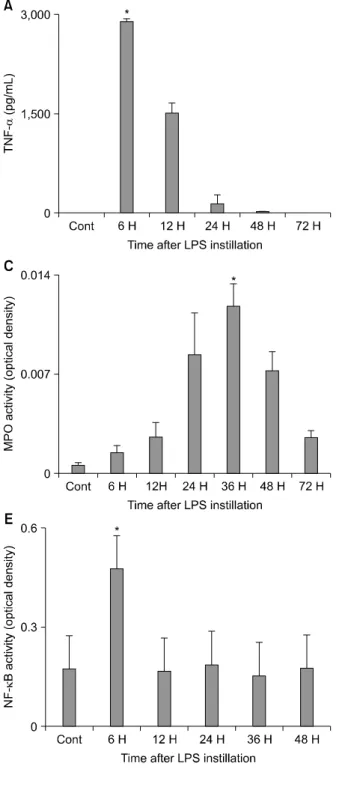
Figure 1. The time course of acute lung injury (ALI) para- meters. The concentrations of tumor necrosis factor (TNF)-α (A) and interleukin (IL)-6 (B) in bronchoalveolar lavage fluid (BALF) and nuclear factor (NF)-κB activity (E) in lung tis- sue homogenates showed peaks at 6 hours after lip- opolysaccharide (LPS) administration. Myeloperoxidase (MPO) activity (C) and ALI score (D) were highest at 36 and 48 hours, respectively (*p<0.05, compared with the control and other time points).

criptional Factor Assay Kit; Active Motif)

32,33

. 5. Time course of ALI parameters

In the preliminary studies aimed to determine the time course of the parameters, TNF-α (Figure 1A), IL-6 (Figure 1B) and NF-κB activity (Figure 1E) peaked at 6 hours after LPS administration compared to the control

group and other time points (p<0.05). MPO activity

(Figure 1C) and ALI score (Figure 1D) were the highest

at 36 and 48 hours, respectively (p<0.05). Therefore,

it was decided to measure each parameter at the time

of its highest level.

(5)

6. Synthesis and in vivo transfer of NF-κB decoy ODN and determination of administration route

The following sequences of phosphorothioate dou- ble-stranded ODN against the NF-κB binding site were used in this study, which were the same as reported previously

22,34

: 5’-CCTTGAAGGGATTTCCCTCC-3’ and 3’-GGAACTTCCCTAAAGGGAGG-5’ (consensus sequen- ces are underlined). For in vivo gene transfer, the he- magglutinating virus of Japan envelope vector system (HVJ Envelope Vector Kit GenomeOne-Neo; Ishihara Sangyo, Osaka, Japan) was used. This hemagglutinating virus of Japan envelope vector has been proven to be effective ODN delivery system both in vitro and in vivo

15,35

. To determine the effective treatment route and dose, NF-κB activity in lung tissue homogenate was measured after treatment with different routes and doses in the LPS-induced ALI model. The systemic route was tested with 200 μL of sterile distilled water (DW) con- taining different doses of NF-κB decoy ODN (4, 40, 80, and 160 μg/animal) infusion over 20 seconds through the tail vein, which was proven to be effective in sep- sis-induced ALI models

15,22

, 1 hour after induction of LPS-induced ALI. At 6 hours after LPS administration, NF-κB activity showed decreasing trends with an in- crease in the ODN dose, but did not differ significantly from LPS-induced ALI control mice. However, in the in- tratracheal route experiment, NF-κB activity was sig- nificantly decreased with treatment of 160 μg ODN.

Therefore, it was decided to treat with intratracheal ad- ministration of 160 μg of NF-κB decoy ODN.

7. Overall study protocol

The study mice were randomly divided into the fol- lowing three experimental groups: (1) control group which was administered 50 μL of saline and treated with intratracheal administration of 200 μL DW contain- ing only HVJ vector (n=24); (2) LPS group in which LPS-induced ALI mice were treated with intratracheal administration of 200 μL DW containing only HVJ vec- tor (n=24); (3) LPS+ODN group in which LPS-induced ALI mice were treated with intratracheal administration

of 200 μL DW containing 160 μg of NF-κB decoy ODN and HVJ vector (n=24). Each group was subdivided into four experimental subgroups: (1) tissue subgroup for histopathological examination for ALI at 48 hours (n=6);

(2) 6-hour BAL subgroup for measurement of TNF-α and IL-6 in BALF (n=6); (3) 36-hour BAL subgroup for MPO activity assays in BALF (n=6); and (4) tissue homo- genate subgroup for measurement of NF-κB activity in lung tissue homogenates at 6 hours (n=6).

8. Statistical analysis

All data are expressed as mean±standard deviation.

Statistical analysis was performed using SPSS for Win- dows

(Release 11.0.1; SPSS Inc., Chicago, IL, USA).

Intergroup differences were determined by non-para- metric Mann-Whitney U and Kruskal-Wallis tests. Statis- tical significance was defined as p<0.05.

Results

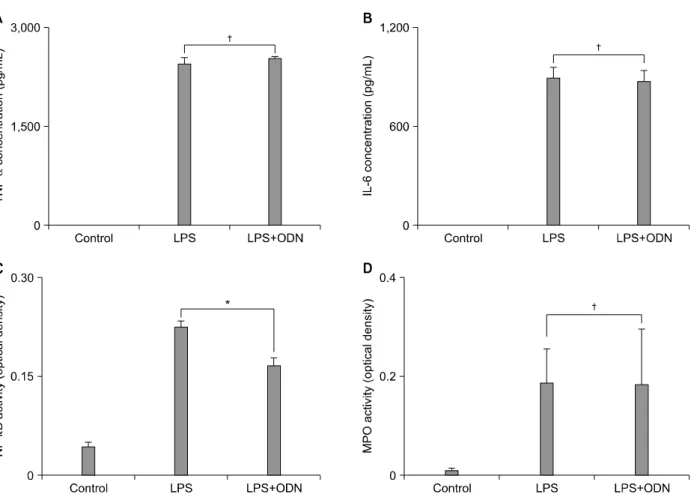
TNF-α and IL-6 were not detected in BALF of the control group. TNF-α concentration (Figure 2A) in the LPS group (2,445.7±103.72 pg/mL) was not different from that of the LPS+ODN group (2,529.67±32.86 pg/mL) (p=0.652). The concentration of IL-6 (Figure 2B) in the LPS and LPS+ODN groups (896.26±61.32 and 875.23±63.24 pg/mL, respectively) also did not show significant difference (p=0.723). Optical density (OD) of NF-κB activity in lung tissue homogenate (Figure 2C) was significantly different among the control, LPS, and LPS+ODN groups (0.043±0.07, 0.22±0.009 and 0.167

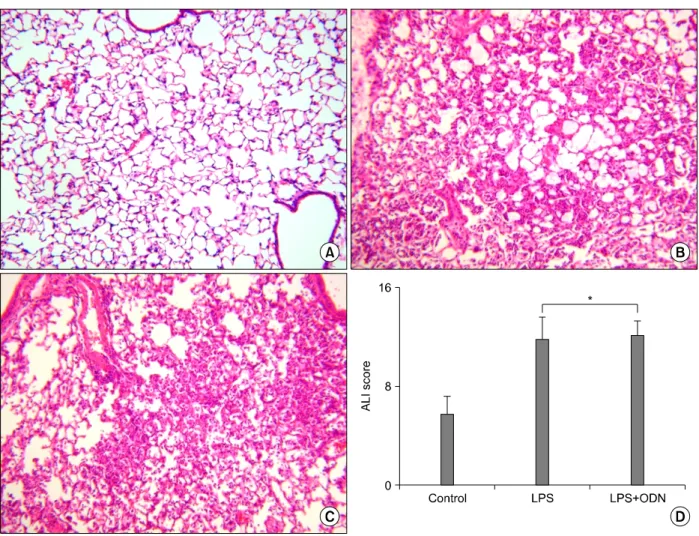
±0.012 OD, respectively) (p=0.000 by Kruskal-Wallis test). The LPS+ODN group showed significantly lower NF-κB activity than the LPS group (p=0.004). MPO activ- ity (Figure 2D) in the LPS+ODN group (0.183±0.114 OD) was not different from that of the LPS group (0.186±0.069 OD) (p=0.526). Histopathologic examina- tion of the LPS group (Figure 3B) indicated high levels of ALI parameters, including intra-alveolar exudates, hyaline membrane formation, inflammatory cell infiltra- tion, intra- alveolar hemorrhage, and interstitial edema.

These findings of ALI were similar in the LPS+ODN

(6)

Figure 2. The effects of nuclear factor (NF)-κB decoy oligodeoxynucleotide (ODN). The concentrations of tumor necrosis factor (TNF)-α (A) and interleukin (IL)-6 (B) and myeloperoxidase (MPO) activity (D) between the lipopolysaccharide (LPS) and LPS+ODN groups were not significantly different. NF-κB activity (C) in the lung tissue homogenates of the LPS+

ODN group was significantly lower than the LPS group (*p=0.004,

p>0.05).

group (Figure 3C). In the ALI score quantitative compar- ison (Figure 3D), the LPS+ODN group (12.1±1.2) showed an insignificant score in comparison to the LPS group (11.8±1.8) (p=0.453).

Discussion

In this study, although intratracheal administration of NF-κB decoy ODN significantly decreased NF-κB activ- ity in lung tissues, it failed to improve the parameters of LPS-induced direct ALI, including inflammatory cyto- kines, oxidant stress and histopathologic changes.

These results are different from other studies that used indirect ALI models induced by intravenous injection of LPS

22

and CLP

15

.

A vast majority of the results from the extensive ani-

mal studies demonstrated the complexity and multi-

plicity of the pathways in the pathologic processes of

ALI, and they indicated that differences in the initial in-

sult combined with underlying conditions can result in

the activation of different inflammatory mechanisms

29

.

Although various causes of ALI result in a uniform

pathologic condition in the late stage, evidence indic-

ates that the pathophysiology of early ALI may differ

according to the type of primary insult

23

. Therefore, it

is important to differentiate between direct and indirect

pathophysiologic pathways, and this may influence the

approach to treatment strategies, especially during the

early phase. The acute phase of ALI is characterized by

initiation and amplification of inflammatory response

with a complex network of cytokines and other proin-

flammatory compounds

36

. Although functional and mor-

(7)

Figure 3. Histopathologic examination (hematoxylin-eosin, ×100) and quantification by acute lung injury (ALI) score. The lipopolysaccharide (LPS) group (B) showed high levels of intra-alveolar exudates, hyaline membrane formation, in- flammatory cell infiltration, intra-alveolar hemorrhage, and interstitial edema. These findings were similar with the LPS+oli- godeoxynucleotide (ODN) group (C). The ALI score (D) of the LPS+ODN group was not different from the LPS group (*p=0.453).

phologic changes were similar, direct insult yielded more pronounced inflammatory responses independent of the cause; for example, pulmonary ALI showed a threefold increase in IL-8 and IL-10 in relation to ex- trapulmonary ALI, whereas IL-6 was two times greater in pulmonary ALI

37

, suggesting the importance of differ- entiation between direct and indirect pathophysiologic pathways.

NF-κB has been reported to be a critical transcription factor required for the maximal expression of many cy- tokines involved in the pathogenesis of ALI. Several studies on the NF-κB activation pathway led to the dis- covery of new agents capable of blocking NF-κB tran-

scriptional activity

11-13

. The decoy strategy has recently

been developed

14

and is considered a useful tool for the

blockade of the expression of a wide variety of NF-κB-

dependent proinflammatory mediators. Inhibition of NF-

κB activation with the use of a decoy ODN has been

shown to be effective in myocardial infarction

34

, ab-

dominal aortic aneurysm

18

, carotid artery intimal hyper-

plasia

38

, endotoxin-induced fatal liver failure

19

, and au-

toimmune myocarditis

21

models. Also in the indirect

murine ALI models using intravenous LPS injection

15

and CLP

22

, this strategy has been effective in the in-

hibition of lung vascular permeability and sepsis-in-

duced gene overexpression.

(8)

However, the present study with an LPS-induced di- rect ALI model showed that NF-κB decoy ODN had no effect on concentrations of TNF-α and IL-6, MPO activ- ity and histopathologic lung injury in spite of a statisti- cally significant decrease of NF-κB activity in lung tissues. The most plausible reason for these results that differ with those of indirect ALI models is the difference of NF-κB decoy ODN effectiveness depending on the time course of NF-κB activation. In the LPS- and CLP-in- duced indirect ALI models, it was reported that NF-κB activity was markedly increased in the lung tissues from 10 hours after insult

15,22

, but intratracheal LPS admin- istration showed peak NF-κB activity at 6 hours and rapid decline down to the level of the control at 12 hours, indicating earlier activation of NF-κB by direct insult. Another issue is the action time of NF-κB decoy ODN. Although precise time courses of the effectiveness of NF-κB decoy ODN in different models have not been elucidated, Matsuda et al. reported that the tail vein in- jection of 80 μg NF-κB decoy ODN produced a con- stant reduction >70% in the activation of NF-κB in lung tissues at 9 hours after injection in LPS- or CLP-in- duced indirect ALI models

15,22

. However, in our prelimi- nary studies for the determination of treatment route, tail vein injection of NF-κB decoy ODN up to 160 μg had no significant effect in the reduction of NF-κB activity in lung tissues in the LPS-induced direct ALI model. The absence of the effect of systemic treatment with NF-κB decoy ODN in the direct ALI model is suspected to be due to the different compartmentalization of inflamma- tory response

39

compared with indirect ALI models and the possibility of inactivation of HVJ envelope by ad- sorption to blood cells (by manufacture’s guide). There- fore, the intratracheal treatment route was adopted. In spite of the significant decrease of NF-κB activity by in- tratracheal treatment with 160 μg of NF-κB decoy ODN, the degree of inhibition was about 24% compared with the LPS group which was considerably lower than those of the studies using indirect ALI models. These results may be caused by the fact that in the direct ALI model acute inflammatory response is earlier and more intense than the indirect models; also, the maximal ac-

tion time of NF-κB decoy ODN is later than the time of NF-κB activation in the direct ALI model. In order to answer this question, proper studies about the time course of the effectiveness of NF-κB decoy ODN and studies with more than 160 μg ODN would be neces- sary. Taking into consideration the maximal effect time of 9 hours after ODN injection in direct ALI models, pre- treatment with ODN prior to LPS administration may be essential to be effective in the inhibition of NF-κB acti- vation in the direct ALI model which shows an earlier NF-κB activation than the indirect model. However, pretreatment strategy has no clinical relevance in inves- tigating the treatment modalities for ALI and ARDS patients. Studies using more than 160 μg of the ODN in intratracheal treatment are almost impossible because of the solubility limitation of ODN and the vector system and a possibility of drowning the mice due to an increase in the administration volume of treatment solution. There were several limitations in this study. First, the experi- ments using a group treated with scrambled decoy ODN were absent. Because treatment with NF-κB decoy ODN did not show any effect on the parameters of ALI, the experiments with scrambled decoy ODN were not performed. Second, the experiment with control group treated by NF-κB decoy ODN without HVJ vector sys- tem was omitted. Therefore, possible detrimental effects of NF-κB decoy ODN such as an insult for ALI were not examined. Third, treatment with NF-κB decoy ODN using intratracheal administration route could not guar- antee even distribution of the ODN. Although intra- tracheal treatment with 160 μg of NF-κB decoy ODN decreased significantly NF-κB activity, limitation of in- hibitory effect due to uneven distribution of the ODN could not be ruled out.

In order to discover new therapeutic strategies for ALI

and ARDS, it is essential to detail cellular and molecular

mechanisms that modulate inflammation and protect the

lung from biomechanical stress injury

40

. According to

the results of this study, NF-κB decoy ODN, which has

been proven to be effective in indirect models, had no

effect in the direct ALI model.

(9)

References

1. Bernard GR, Artigas A, Brigham KL, Carlet J, Falke K, Hudson L, et al. The American-European Consensus Conference on ARDS. Definitions, mechanisms, rele- vant outcomes, and clinical trial coordination. Am J Respir Crit Care Med 1994;149:818-24.

2. Rubenfeld GD, Caldwell E, Peabody E, Weaver J, Martin DP, Neff M, et al. Incidence and outcomes of acute lung injury. N Engl J Med 2005;353:1685-93.

3. The Acute Respiratory Distress Syndrome Network.

Ventilation with lower tidal volumes as compared with traditional tidal volumes for acute lung injury and the acute respiratory distress syndrome. N Engl J Med 2000;

342:1301-8.

4. Gattinoni L, Caironi P, Pelosi P, Goodman LR. What has computed tomography taught us about the acute respiratory distress syndrome? Am J Respir Crit Care Med 2001;164:1701-11.

5. Leeper-Woodford SK, Detmer K. Acute hypoxia incre- ases alveolar macrophage tumor necrosis factor activity and alters NF-kappaB expression. Am J Physiol 1999;

276:L909-16.

6. Moine P, McIntyre R, Schwartz MD, Kaneko D, Shenkar R, Le Tulzo Y, et al. NF-kappaB regulatory mechanisms in alveolar macrophages from patients with acute respi- ratory distress syndrome. Shock 2000;13:85-91.

7. Pepperl S, Dörger M, Ringel F, Kupatt C, Krombach F.

Hyperoxia upregulates the NO pathway in alveolar macrophages in vitro: role of AP-1 and NF-kappaB. Am J Physiol Lung Cell Mol Physiol 2001;280:L905-13.

8. Pugin J, Dunn I, Jolliet P, Tassaux D, Magnenat JL, Nicod LP, et al. Activation of human macrophages by mechanical ventilation in vitro. Am J Physiol 1998;275:

L1040-50.

9. Shenkar R, Yum HK, Arcaroli J, Kupfner J, Abraham E. Interactions between CBP, NF-kappaB, and CREB in the lungs after hemorrhage and endotoxemia. Am J Physiol Lung Cell Mol Physiol 2001;281:L418-26.

10. Karin M. The beginning of the end: IkappaB kinase (IKK) and NF-kappaB activation. J Biol Chem 1999;274:

27339-42.

11. Nathens AB, Bitar R, Davreux C, Bujard M, Marshall JC, Dackiw AP, et al. Pyrrolidine dithiocarbamate attenu- ates endotoxin-induced acute lung injury. Am J Respir Cell Mol Biol 1997;17:608-16.

12. Pierce JW, Schoenleber R, Jesmok G, Best J, Moore SA, Collins T, et al. Novel inhibitors of cytokine-induced IkappaBalpha phosphorylation and endothelial cell ad- hesion molecule expression show anti-inflammatory ef-

fects in vivo. J Biol Chem 1997;272:21096-103.

13. Sheehan M, Wong HR, Hake PW, Malhotra V, O'Con- nor M, Zingarelli B. Parthenolide, an inhibitor of the nuclear factor-kappaB pathway, ameliorates cardiovas- cular derangement and outcome in endotoxic shock in rodents. Mol Pharmacol 2002;61:953-63.

14. Bielinska A, Shivdasani RA, Zhang LQ, Nabel GJ. Regu- lation of gene expression with double-stranded phosphor- othioate oligonucleotides. Science 1990;250:997-1000.

15. Matsuda N, Hattori Y, Jesmin S, Gando S. Nuclear fac- tor-kappaB decoy oligodeoxynucleotides prevent acute lung injury in mice with cecal ligation and puncture-in- duced sepsis. Mol Pharmacol 2005;67:1018-25.

16. Morishita R, Higaki J, Tomita N, Ogihara T. Application of transcription factor "decoy" strategy as means of gene therapy and study of gene expression in car- diovascular disease. Circ Res 1998;82:1023-8.

17. Igwe OJ. Modulation of peripheral inflammation in sen- sory ganglia by nuclear factor (kappa)B decoy oligo- deoxynucleotide: involvement of SRC kinase pathway.

Neurosci Lett 2005;381:114-9.

18. Nakashima H, Aoki M, Miyake T, Kawasaki T, Iwai M, Jo N, et al. Inhibition of experimental abdominal aortic aneurysm in the rat by use of decoy oligodeoxynucleo- tides suppressing activity of nuclear factor kappaB and ets transcription factors. Circulation 2004;109:132-8.

19. Ogushi I, Iimuro Y, Seki E, Son G, Hirano T, Hada T, et al. Nuclear factor kappa B decoy oligodeoxynucleo- tides prevent endotoxin-induced fatal liver failure in a murine model. Hepatology 2003;38:335-44.

20. Xu MQ, Shuai XR, Yan ML, Zhang MM, Yan LN.

Nuclear factor-kappaB decoy oligodeoxynucleotides at- tenuates ischemia/reperfusion injury in rat liver graft.

World J Gastroenterol 2005;11:6960-7.

21. Yokoseki O, Suzuki J, Kitabayashi H, Watanabe N, Wada Y, Aoki M, et al. cis Element decoy against nu- clear factor-kappaB attenuates development of experi- mental autoimmune myocarditis in rats. Circ Res 2001;

89:899-906.

22. Matsuda N, Hattori Y, Takahashi Y, Nishihira J, Jesmin S, Kobayashi M, et al. Therapeutic effect of in vivo transfection of transcription factor decoy to NF-kappaB on septic lung in mice. Am J Physiol Lung Cell Mol Physiol 2004;287:L1248-55.

23. Pelosi P, D'Onofrio D, Chiumello D, Paolo S, Chiara G, Capelozzi VL, et al. Pulmonary and extrapulmonary acute respiratory distress syndrome are different. Eur Respir J Suppl 2003;42:48s-56s.

24. Bachofen M, Weibel ER. Alterations of the gas ex-

change apparatus in adult respiratory insufficiency as-

(10)

sociated with septicemia. Am Rev Respir Dis 1977;

116:589-615.

25. Blaisdell FW. Pathophysiology of the respiratory dis- tress syndrome. Arch Surg 1974;108:44-9.

26. Lamy ML, Fallat RJ, Koeniger EL, Dietrich HP, Kamm B, Hill JD. Pathophysiology of adult respiratory distress syndrome. Acta Anaesthesiol Belg 1975;23 Suppl:64-77.

27. Nash G, Foley FD, Langlinais PC. Pulmonary interstitial edema and hyaline membranes in adult burn patients.

Electron microscopic observations. Hum Pathol 1974;

5:149-60.

28. Callister ME, Evans TW. Pulmonary versus extrapul- monary acute respiratory distress syndrome: different diseases or just a useful concept? Curr Opin Crit Care 2002;8:21-5.

29. Rocco PR, Zin WA. Pulmonary and extrapulmonary acute respiratory distress syndrome: are they different?

Curr Opin Crit Care 2005;11:10-7.

30. Kim JH, Suk MH, Yoon DW, Lee SH, Hur GY, Jung KH, et al. Inhibition of matrix metalloproteinase-9 pre- vents neutrophilic inflammation in ventilator-induced lung injury. Am J Physiol Lung Cell Mol Physiol 2006;

291:L580-7.

31. Hirano S. Migratory responses of PMN after intra- peritoneal and intratracheal administration of lipopoly- saccharide. Am J Physiol 1996;270:L836-45.

32. Harada K, Ohira S, Isse K, Ozaki S, Zen Y, Sato Y, et al. Lipopolysaccharide activates nuclear factor-kappaB through toll-like receptors and related molecules in cul- tured biliary epithelial cells. Lab Invest 2003;83:1657- 67.

33. Renard P, Ernest I, Houbion A, Art M, Le Calvez H,

Raes M, et al. Development of a sensitive multi-well colorimetric assay for active NFkappaB. Nucleic Acids Res 2001;29:E21.

34. Morishita R, Sugimoto T, Aoki M, Kida I, Tomita N, Moriguchi A, et al. In vivo transfection of cis element

"decoy" against nuclear factor-kappaB binding site pre- vents myocardial infarction. Nat Med 1997;3:894-9.

35. Kaneda Y, Nakajima T, Nishikawa T, Yamamoto S, Ikegami H, Suzuki N, et al. Hemagglutinating virus of Japan (HVJ) envelope vector as a versatile gene deliv- ery system. Mol Ther 2002;6:219-26.

36. Ware LB, Matthay MA. The acute respiratory distress syndrome. N Engl J Med 2000;342:1334-49.

37. Menezes SL, Bozza PT, Neto HC, Laranjeira AP, Negri EM, Capelozzi VL, et al. Pulmonary and extrapulmon- ary acute lung injury: inflammatory and ultrastructural analyses. J Appl Physiol 2005;98:1777-83.

38. Yoshimura S, Morishita R, Hayashi K, Yamamoto K, Nakagami H, Kaneda Y, et al. Inhibition of intimal hy- perplasia after balloon injury in rat carotid artery model using cis-element 'decoy' of nuclear factor-kappaB binding site as a novel molecular strategy. Gene Ther 2001;8:1635-42.

39. Cavaillon JM, Annane D. Compartmentalization of the inflammatory response in sepsis and SIRS. J Endotoxin Res 2006;12:151-70.

40. Matthay MA, Zimmerman GA, Esmon C, Bhattacharya

J, Coller B, Doerschuk CM, et al. Future research direc-

tions in acute lung injury: summary of a National Heart,

Lung, and Blood Institute working group. Am J Respir

Crit Care Med 2003;167:1027-35.

수치

Figure  1.  The  time  course  of  acute  lung  injury  (ALI)  para- para-meters. The concentrations of tumor necrosis factor (TNF)-α (A) and interleukin (IL)-6 (B) in bronchoalveolar lavage fluid (BALF)  and  nuclear  factor (NF)-κB activity  (E)  in  lun
Figure 2. The effects of nuclear factor (NF)-κB decoy oligodeoxynucleotide (ODN). The concentrations of tumor necrosis factor (TNF)-α (A) and interleukin (IL)-6 (B) and myeloperoxidase (MPO) activity (D) between the lipopolysaccharide (LPS) and LPS+ODN gro
Figure 3. Histopathologic examination (hematoxylin-eosin, ×100) and quantification by acute lung injury (ALI) score

참조

관련 문서

tor cells are reported to restore function of damaged tissue in various preclinical disease models.13,14 Based on our previously study by Li, et al.6 intravenous injection of

Effects of Silibinin and Resveratrol on Degradation of I κB and Translocation of NF-κB p65 Induced by Tumor Necrosis Factor- α in Cultured Airway Epithelial Cells.. Su Hyun Park*

[r]

24 hours after LPS intratracheal instillation, bronchoalveolar lavege fluids(BALF) was obtained to measure protein and proinflammatory cytokines(TNF-α, IL-1β, IL-6). Protein