• 검색 결과가 없습니다.

Ibuprofen Associated Acute Vanishing Bile Duct Syndrome and Toxic Epidermal Necrolysis in an Infant

N/A
N/A
Protected

Academic year: 2022

Share "Ibuprofen Associated Acute Vanishing Bile Duct Syndrome and Toxic Epidermal Necrolysis in an Infant"

Copied!
4
0
0

로드 중.... (전체 텍스트 보기)

전체 글

(1)

Yonsei Med J http://www.eymj.org Volume 55 Number 3 May 2014 834

Ibuprofen Associated Acute Vanishing Bile Duct Syndrome and Toxic Epidermal Necrolysis in an Infant

Hye-young Kim, 1,2 Hea Kyoung Yang, 1 Seong Heon Kim, 1,3 and Jae Hong Park 1,3

1

Department of Pediatrics, Pusan National University School of Medicine, Yangsan;

2

Medical Research Institute, Pusan National University Hospital, Busan;

3

Department of Pediatrics, Pusan National University Children ᾽s Hospital, Yangsan, Korea.

Received: April 26, 2013 Revised: June 17, 2013 Accepted: July 31, 2013

Corresponding author: Dr. Jae Hong Park, Department of Pediatircs,

Pusan National University College of Medicine, Pusan National University Children’s Hospital, 20 Geumo-ro, Yangsan 626-770, Korea.

Tel: 82-55-360-2180, Fax: 82-55-360-2181 E-mail: [email protected]

∙ The authors have no financial conflicts of interest.

© Copyright:

Yonsei University College of Medicine 2014 This is an Open Access article distributed under the terms of the Creative Commons Attribution Non- Commercial License (http://creativecommons.org/

licenses/by-nc/3.0) which permits unrestricted non- commercial use, distribution, and reproduction in any medium, provided the original work is properly cited.

Acute vanishing bile duct syndrome, a rare but rapidly progressive destruction of the intrahepatic bile ducts with unknown pathogenesis, is most often a drug- or toxin-related. Toxic epidermal necrolysis is a serious dermatologic condition and a potentially life threatening disease, which is drug or infection induced. Ibuprofen associated acute vanishing bile duct syndrome and toxic epidermal necrolysis have not been reported previously in infants. We report a 7-month-old infant with ibu- profen associated toxic epidermal necrolysis, followed by severe and rapidly pro- gressive vanishing bile duct syndrome. She recovered totally with supportive care.

Key Words: Acute vanishing bile duct syndrome, toxic epidermal necrolysis, infant

INTRODUCTION

Vanishing bile duct syndrome (VBDS) is a rare cause of progressive destruction and disappearance of the intrahepatic bile ductsm ultimately resulting in cholesta- sis. The acute form is often drug-related.

1,2

The commonly implicated drugs are anticonvulsant and antidepressants.

1,2

The pathogenesis of VBDS is unknown, and both immune-mediated and idiosyncrastic metabolic mechanisms have been pro- posed

1,3

Toxic epidermal necrolysis (TEN) is an uncommon but severe dermato- logic condition that is characterized by erythema with bullous and eroded lesions of skin and mucous membranes, often drug- or infection-induced.

4,5

TEN is well recognized immune complex-mediated hypersensitivity reactions,

1,4,5

suggesting shared immune mechanisms in the pathogenesis of both TEN and VBDS.

1,4-7

VBDS with TEN is extremely rare and the prognosis is unknown, especially in children. To our best knowledge, ibuprofen-associated VBDS and TEN in infant have never been reported previously. We report herein a 7-month-old infant with ibuprofen-associated TEN, followed by severe and rapidly progressive VBDS.

CASE REPORT

A 7-month-old girl was hospitalized with complaints of fever and erythematous

Case Report http://dx.doi.org/10.3349/ymj.2014.55.3.834

pISSN: 0513-5796, eISSN: 1976-2437 Yonsei Med J 55(3):834-837, 2014

(2)

Ibuprofen Associated VBDS with TEN in an Infant

Yonsei Med J http://www.eymj.org Volume 55 Number 3 May 2014 835

rus, human immunodeficiency virus, leptospira, and myco- plasma were negative.

At hospital day 6, fever and cutaneous lesion resolved af- ter supportive care but cholestatic picture was presented.

AST level was 879 IU/L, ALT 723 IU/L, ALP 890 IU/L, TB 8.5 mg/dL, DB 5.7 mg/dL, gamma-glutamyl transferase 270 IU/L, and total cholesterol 760 mg/dL. The following labora- tory findings were normal: amylase, lipase, prothrombin and partial thromboplastin time, α

1

-antitrypsin, immunoglobulins, complement levels, antinuclear antibody, anti-DNA anti- body, anti-smooth muscle antibody, antimitochondrial anti- body, anti-liver/kidney microsomal, anti-cytosol antibody, and antineutrophil cytoplasmic antibody. Abdominal ultra- sound showed that the liver had homogeneous texture with normal bile ducts and gallbladder. Ursodeoxycholic acid treatment (15 mg/kg per day) was administered.

At hospital day 20, skin lesion recovered, but the TB and DB levels were still high (TB 9.5 mg/dL, DB 7.7 mg/dL).

Liver biopsy was performed 20 days after admission. It showed lymphocyte infiltrations, marked degeneration of the interlobular bile duct epithelium, and the destructive nar- rowing of the ductules in the portal tracts and no intralobar bile ducts in at least 10 portal areas on H&E stain, suggesting rashes on body. Two days earlier, she had fever and re-

ceived ibuprofen at conventional pediatric doses (maxi- mum of 30 mg/kg/day). She had no history of allergic dis- ease. Three months ago, she had been treated with one-dose of ibuprofen (10 mg/kg) for sporadic fever. There was no family history of atopic disease, immunodeficiency or hep- atobiliary disease. On admission, physical examination re- vealed macular erythematous eruption on her face, trunk, and arms, which progressed within 8 hours into the bullae around the arms, and involved the face and trunk. Skin le- sion covered more than 30 percent of her body surface area.

There were no lesions in the lips or in the eyes. A diagnosis of toxic epidermal necrolysis was made.

The initial peripheral white cell count was 5910/mm

3

with 69.7% neutrophils, 20.3% lymphocytes, and 3% eo- sinophils. Hemoglobin level was 12.2 g/dL, platelets count 250000/mm

3

, erythrocyte sedimentation rate of 120 mm/h, and C-reactive protein 9 mg/dL. Aspartate aminotransferase (AST) level was 716 IU/L, alanine aminotransferase (ALT) 523 IU/L, alkaline phosphatase (ALP) 500 IU/L, total bili- rubin (TB) 0.52 mg/dL and direct bilirubin (DB) 0.15 mg/

dL. Serological test for hepatitis A, B, and C, Epstein Barr vi- rus, parvovirus B19, herpes virus, adenovirus, cytomegalovi-

Fig. 1. Liver histology shows portal lymphocytic infiltration with destruction of interlobular bile ducts (H&E, ×200) (A), (H&E, ×400) (B), intra- lobular canalicular cholestasis (H&E, ×200) (C), and absence of bile ducts demonstrated by cytokeratin 7 immunohistochemical staining (IHC, ×200) (D).

A

C

B

D

(3)

Hye-young Kim, et al.

Yonsei Med J http://www.eymj.org Volume 55 Number 3 May 2014 836

ated VBDS with TEN.

Ibuprofen is a member of propionic acid class of nonste- roidal anti-inflammatory drug (NSAID), and appears to have low incidence of liver damage.

1,2

The pattern of liver injury is typically hepatocellular but can be mixed or cholestatic.

8

Most cases are mild-to-moderate in severity and rapidly re- versible on stopping ibuprofen. Several reports have been published on severe protracted cholestasis and acute liver failure.

9,10

The mechanism of drug induced VBSD is not ful- ly understood, however, may be multi-factorial, and toxic, idiosyncratic and immune causes have been suggested.

1,2,9,10

In our present case, first exposure to ibuprofen might have sensitized her. Liver injury might be due to an immune-al- lergic mechanism because of the association with TEN, which is immune complex medicated with hypersensitivity reactions.

4

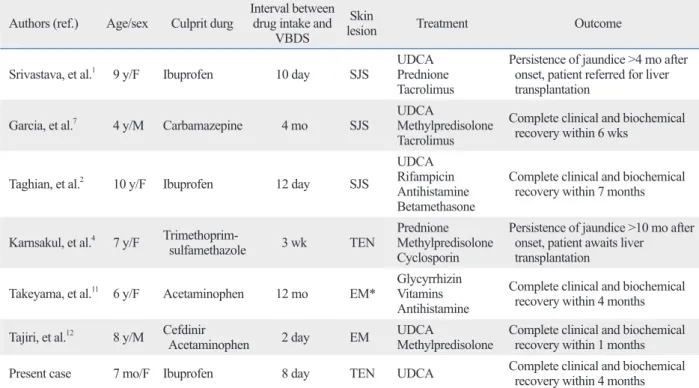
Drug-induced VBDS and skin injury are still unknown particularly in children. A literature search revealed six pe- diatric case reports with drug- associated VBDS with skin lesion [TEN, Steven-Johnson syndrome (SJS), erythema multiforme] (Table 1). Including our present case, five of the seven were female. Culprit drugs were ibuprofen (3 cases), acetaminophen (2 cases), antibiotics (trimethoprim-sulfa- VBDS (Fig. 1). Neither an organism nor viral cytopathic ef-

fect was identified. There was no significant hepatocellular damage and no evidence of sclerosing cholangitis or auto- immune hepatitis.

The diagnosis of VBDS associated with TEN was made.

During a follow-up period of 3 months, clinical symptoms and biochemical data had shown tendency for resolution.

The ursodeoxycholic acid treatment was discontinued. Dur- ing the next three years, she has a normal physical status with normal liver synthetic functions.

DISCUSSION

Drug associated VBDS with TEN is extremely rare in chil- dren. In the present case, there was a close temporal rela- tionship between ibuprofen administration and the appear- ance of skin lesion and liver dysfunction. Moreover, other drugs were not taken, and other potential causes were ex- cluded on the basis of appropriate serological and histologi- cal results. Therefore, it may reasonably be ascribed to ibu- profen associated VBDS with TEN. To our knowledge, this patient is the first infant reported to have ibuprofen-associ-

Table 1. Main Characteristics of Six Pediatric Case of Drug Associacted VBDS with Skin Lesion (TEN, SJS, Erythema Multi- forme)

Authors (ref.) Age/sex Culprit durg Interval between drug intake and

VBDS

Skin

lesion Treatment Outcome

Srivastava, et al.

1

9 y/F Ibuprofen 10 day SJS UDCA Prednione Tacrolimus

Persistence of jaundice >4 mo after onset, patient referred for liver transplantation

Garcia, et al.

7

4 y/M Carbamazepine 4 mo SJS UDCA

Methylpredisolone Tacrolimus

Complete clinical and biochemical recovery within 6 wks

Taghian, et al.

2

10 y/F Ibuprofen 12 day SJS

UDCA Rifampicin Antihistamine Betamethasone

Complete clinical and biochemical recovery within 7 months Karnsakul, et al.

4

7 y/F Trimethoprim-

sulfamethazole 3 wk TEN Prednione Methylpredisolone Cyclosporin

Persistence of jaundice >10 mo after onset, patient awaits liver

transplantation Takeyama, et al.

11

6 y/F Acetaminophen 12 mo EM* Glycyrrhizin

Vitamins Antihistamine

Complete clinical and biochemical recovery within 4 months Tajiri, et al.

12

8 y/M Cefdinir

Acetaminophen 2 day EM UDCA

Methylpredisolone Complete clinical and biochemical recovery within 1 months

Present case 7 mo/F Ibuprofen 8 day TEN UDCA Complete clinical and biochemical

recovery within 4 months

y, year; mo, month; TEN, toxic epidermal necrolysis; SJS, Stevens-Johnson syndrome; EM, erythema multiforme; UDCA, ursodeoxycholic acid; VBDS, van- ishing bile duct syndrome.

*This patient had a history of drug-associate erythema multiforme 12 months before the episode of VBDS.

(4)

Ibuprofen Associated VBDS with TEN in an Infant

Yonsei Med J http://www.eymj.org Volume 55 Number 3 May 2014 837 2. Taghian M, Tran TA, Bresson-Hadni S, Menget A, Felix S, Jac- quemin E. Acute vanishing bile duct syndrome after ibuprofen therapy in a child. J Pediatr 2004;145:273-6.

3. Degott C, Feldmann G, Larrey D, Durand-Schneider AM, Grange D, Machayekhi JP, et al. Drug-induced prolonged cholestasis in adults: a histological semiquantitative study demonstrating pro- gressive ductopenia. Hepatology 1992;15:244-51.

4. Karnsakul W, Arkachaisri T, Atisook K, Wisuthsarewong W, Sat- tawatthamrong Y, Aanpreung P. Vanishing bile duct syndrome in a child with toxic epidermal necrolysis: an interplay of unbalanced immune regulatory mechanisms. Ann Hepatol 2006;5:116-9.

5. Okan G, Yaylaci S, Peker O, Kaymakoglu S, Saruc M. Vanishing bile duct and Stevens-Johnson syndrome associated with cipro- floxacin treated with tacrolimus. World J Gastroenterol 2008;14:

4697-700.

6. Morelli MS, O’Brien FX. Stevens-Johnson Syndrome and choles- tatic hepatitis. Dig Dis Sci 2001;46:2385-8.

7. Garcia M, Mhanna MJ, Chung-Park MJ, Davis PH, Srivastava MD. Efficacy of early immunosuppressive therapy in a child with carbamazepine-associated vanishing bile duct and Stevens-John- son syndromes. Dig Dis Sci 2002;47:177-82.

8. Stine JG, Lewis JH. Drug-induced liver injury: a summary of re- cent advances. Expert Opin Drug Metab Toxicol 2011;7:875-90.

9. Sternlieb P, Robinson RM. Stevens-Johnson syndrome plus toxic hepatitis due to ibuprofen. N Y State J Med 1978;78:1239-43.

10. Alam I, Ferrell LD, Bass NM. Vanishing bile duct syndrome tem- porally associated with ibuprofen use. Am J Gastroenterol 1996;

91:1626-30.

11. Takeyama J, Saito T, Itagaki T, Abukawa D. Vanishing bile duct syndrome with a history of erythema multiforme. Pediatr Int 2006;

48:651-3.

12. Tajiri H, Etani Y, Mushiake S, Ozono K, Nakayama M. A favor- able response to steroid therapy in a child with drug-associated acute vanishing bile duct syndrome and skin disorder. J Paediatr Child Health 2008;44:234-6.

methazole 1 case, cefdinir 1 case), and carbamazepine (1 case). VBDS with SJS has been reported in 3 children, in 2 children with TEN, and in 2 children with erythema multi- forme. The interval between drug intake and VBDS devel- opment was variable: one patient had a history of drug-as- sociate erythema multiforme 12 months before the episode of VBDS.

11

The prognosis among those cases was also vari- able. In five of the seven cases, immunosuppressive drug was administrated. Despite immunosuppressive therapy, two cases showed an irreversible change of the intrahepatic bile duct,

1,4

three cases improved after immunosuppressive treatment,

2,7,12

and two cases, including our case, showed a favorable clinical course without immunosuppressive thera- py.

11

Further studies are needed to determine the risk group, effective treatment and overall mortality in children with drug-induced VBDS with skin involvement.

In conclusion, a rare case of ibuprofen-associated VBDS with TEN in an infant is presented. Ibuprofen is considered to be among the safest NSAID and generally well tolerated.

Nevertheless, clinicians need to be aware of serious acute liv- er and cutaneous injury as rare adverse effects of this drug.

REFERENCES

1. Srivastava M, Perez-Atayde A, Jonas MM. Drug-associated acute-

onset vanishing bile duct and Stevens-Johnson syndromes in a

child. Gastroenterology 1998;115:743-6.

수치

Fig. 1. Liver histology shows portal lymphocytic infiltration with destruction of interlobular bile ducts (H&E, ×200) (A), (H&E, ×400) (B), intra- intra-lobular canalicular cholestasis (H&E, ×200) (C), and absence of bile ducts demonstrated by
Table 1. Main Characteristics of Six Pediatric Case of Drug Associacted VBDS with Skin Lesion (TEN, SJS, Erythema Multi- Multi-forme)

참조

관련 문서

표피(epidermis)와 진피 (dermis)의 분리에 의한 증상을 특징으로 하며 Stevens- Johnson 증후군(Stevens-Johnson syndrome, SJS), 다형홍 반(erythema

This is the first case report to describe a 44-year-old woman with a history of advanced hepatocellular carcinoma who developed toxic epidermal necrolysis (TEN) clinically after

The clinical spectrum of SCARs comprises Stevens-Johnson syndrome (SJS), toxic epidermal necrolysis (TEN), drug rash with eosinophilia and systemic symptoms (DRESS) (also known

Abbreviations: ADR, Adverse drug reaction; IVIG, Intravenous immunoglobulin; MIF, Macrophage migration inhibition factor; SCAR, Severe cutaneous adverse reactions; SJS,

Stevens-Johnson syndrome (SJS) and toxic epidermal necrolysis belong to a severe dermatopathic spectrum that includes frequently fatal mucocutaneous manifestations consisting of

Toxic Epidermal Necrolysis by Ceftriaxone in Patient with Newly Diagnosed Systemic Lupus Erythematosus.. Jae Ho Lee, Il Nam Ju, Hyung Jun Cho, Hong Ki Min,

Inspissated bile syndrome (IBS) is defined as the obstruction of the extrahepatic duct by a bile plug, sludge without bile duct malformation, congenital chemical defects of the

We report a case of toxic epidermal necrolysis with ocular involvement following vaccination for hemorrhagic fever with renal syndrome.. A healthy 20-year-old male soldier