Yonsei Med J http://www.eymj.org Volume 53 Number 1 January 2012 228
Case Report
http://dx.doi.org/10.3349/ymj.2012.53.1.228pISSN: 0513-5796, eISSN: 1976-2437 Yonsei Med J 53(1):228-230, 2012
Toxic Epidermal Necrolysis with Ocular Involvement Following Vaccination for Hemorrhagic Fever with Renal Syndrome
Young Hoon Hwang,
1Myung Seung Kang,
2Kyung O Lim,
3and Sang Mok Lee
1Departments of 1Ophthalmology and 2Dermatology, Armed Forces Capital Hospital, Seongnam;
3Department of Ophthalmology, Seoul Paik Hospital, Inje University College of Medicine, Seoul, Korea.
Received: February 25, 2011 Revised: April 25, 2011 Accepted: April 29, 2011
Corresponding author: Dr. Sang Mok Lee, Department of Ophthalmology, Armed Forces Capital Hospital, San 13-4 Yul-dong, Seongnam 463-040, Korea.
Tel: 82-31-725-6271, Fax: 82-31-706-0987 E-mail: [email protected]
∙ The authors have no financial conflicts of interest.
© Copyright:
Yonsei University College of Medicine 2012 This is an Open Access article distributed under the terms of the Creative Commons Attribution Non- Commercial License (http://creativecommons.org/
licenses/by-nc/3.0) which permits unrestricted non- commercial use, distribution, and reproduction in any medium, provided the original work is properly cited.
We report a case of toxic epidermal necrolysis with ocular involvement following vaccination for hemorrhagic fever with renal syndrome. A healthy 20-year-old male soldier presented with confluent purpuric and erythematous dusky red mac- ules evolving to flaccid blister and epidermal detachment on the whole body with conjunctival injection. The patient had no antecedent medical or surgical condi- tions except for two doses of hemorrhagic fever with renal syndrome vaccination.
With supportive care, skin lesions were improved. Ophthalmic examinations re- vealed conjunctival injection with epithelial defects in both eyes. Ocular complica- tions were resolved after amniotic membrane transplantation. Toxic epidermal necrolysis may be considered as a possible complication of hemorrhagic fever with renal syndrome vaccination.
Key Words: Hemorrhagic fever with renal syndrome, toxic epidermal necrolysis, vaccination
INTRODUCTION
Toxic epidermal necrolysis (TEN) is an acute and severe skin reaction character- ized by widespread erythema, blisters, and sheet-like skin loss, often associated with a systemic toxic condition and mucous membrane involvement including the ocular tissues.1-6 TEN is assumed to be related to hypersensitivity reactions to drugs and infections.1-6 Vaccination has been reported as a rare triggering factor for erythema multiforme (EM), Stevens-Johnson syndrome (SJS), and TEN.7-10 To date, there is no report of EM/SJS/TEN related to hemorrhagic fever with renal syndrome (HFRS) vaccination. We report herein a case of TEN with ocular in- volvement following vaccination for HFRS.
CASE REPORT
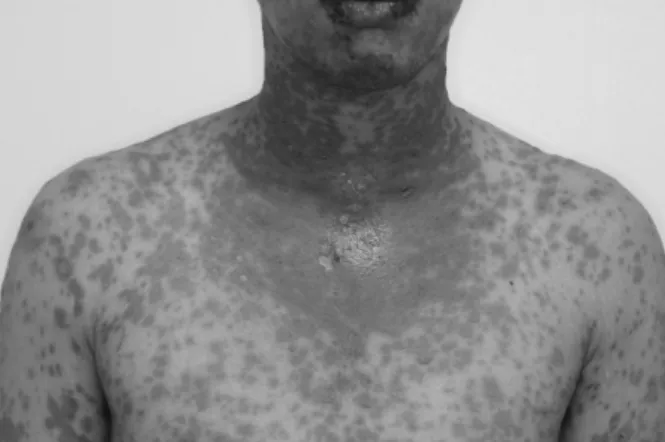
A healthy 20-year-old male soldier presented with confluent purpuric and ery- thematous dusky red macules evolving to flaccid blister and epidermal detach- ment on the whole body with extensive erosions and necroses of the oral mucosa
TEN after HFRS Vaccination
Yonsei Med J http://www.eymj.org Volume 53 Number 1 January 2012 229
bilateral amniotic membrane transplantation (AMT) was performed covering whole ocular surface including cornea, lid margins, bulbar and tarsal conjunctivas 5 days after ad- mission. After the surgery, symblepharon rings and thera- peutic contact lenses were applied in both eyes. Three weeks after the operation, the ocular complications disappeared, and visual acuity was 20/20 in both eyes without any sym- blepharon formation.
DISCUSSION
Various factors have been reported to be associated with TEN. Among them, the most frequent causes were drugs and infections.1-6 Vaccination for human papillomavirus, hepatitis B, smallpox, anthrax, tetanus, mumps, measles, ru- bella, and influenza has been reported as a rare cause of EM/
SJS/TEN.7-10 To date, there has been no published case of TEN related to HFRS vaccination.
HFRS is a life-threatening disease presented by sudden fever, chills, nausea, petechiae, headache, and backache;
the most serious aspect of the disease is vascular leakage, acute shock, and renal failure.11-13 Mortality ranges of HFRS have been to be estimated up to 15%.11-13 Approximately 150,000 to 200,000 patients with HFRS are hospitalized each year throughout the world and many of the patients are solders and farmers because HFRS is transmitted by rat.12 In Asia, Hantaan virus and Seoul virus have been identified and known as important causative agents for HFRS in Ko- rea and China.13
The first Hantaan virus vaccine (Hantavax®) was devel- oped from suckling mouse brain and inactivated with 0.05%
formalin.12 The recommended immunization schedule of (Fig. 1). Nikolsky sign was positive on erythematous
zones. The patient had no antecedent medical or surgical conditions or medications including NSAID except for two doses of HFRS vaccination (Hantavax®; Korea Green Cross, Seoul, Korea) at one month interval. The first symp- tom of bilateral conjunctival injection and tearing devel- oped one day after second vaccination. And then, other symptoms such as swelling of lips, malaise, headache, pha- ryngeal irritation, and conjunctival itching sense developed.
However, there were no symptoms such as fever, myalgia, nausea, diarrhea, and arthralgia. Skin vesicles and papules quickly developed and became widespread involving oral mucosa, neck, and upper extremities followed by dissemi- nation to the trunk and legs. The palms and soles were un- affected. Laboratory findings including complete blood cell count, electrolyte/BUN/Cr analysis, liver function test, urine analysis, and tests for autoimmune diseases (anti-nu- clear antibody, anti-Smith antibody, anti-neutrophil cyto- plasmic antibody, and smooth muscle antibody) were with- in normal range. Because the total area of epidermis detachment was greater than 30% of total body surface, the patient was diagnosed as TEN and high dose systemic cor- ticosteroid and prophylactic antibiotics with supportive treatment were administered. Skin lesions improved slowly with these methods.
Ophthalmic examinations revealed visual acuity of 20/40 and conjunctival injection with medial, inferior, and tempo- ral conjunctival epithelial defects in both eyes at presenta- tion (Fig. 2). Topical steroid (PredForte®; Allergan, Irvine, CA, USA), antibiotics (Vigamox®; Alcon, Fort Worth, TX, USA), and lubricant ointment (Duratears®; Alcon, Fort Worth, TX, USA) were applied in both eyes. To minimize ocular complication associated with ocular surface inflammation,
Fig. 1. Photograph of the patient at the first visit. Confluent purpuric and er- ythematous dusky macules evolving to flaccid blister and epidermal de- tachment on the whole body predominating the trunk and upper limbs with extensive erosions and necroses of the lower lip were shown.
Fig. 2. Slit-lamp biomicroscopic finding of the right eye at the first visit.
Conjunctival injection with widespread epithelial defects (area between arrows) was revealed.
Young Hoon Hwang, et al.
Yonsei Med J http://www.eymj.org Volume 53 Number 1 January 2012 230
Research Project from the ROK Defense Ministry. The funding sources had no role in study design, data collection and analysis, manuscript preparation, or the decision to submit the manuscript for publication.
REFERENCES
1. Power WJ, Ghoraishi M, Merayo-Lloves J, Neves RA, Foster CS.
Analysis of the acute ophthalmic manifestations of the erythema multiforme/Stevens-Johnson syndrome/toxic epidermal necrolysis disease spectrum. Ophthalmology 1995;102:1669-76.
2. Revuz J, Penso D, Roujeau JC, Guillaume JC, Payne CR, Wechsler J, et al. Toxic epidermal necrolysis. Clinical findings and progno- sis factors in 87 patients. Arch Dermatol 1987;123:1160-5.
3. Chang YS, Huang FC, Tseng SH, Hsu CK, Ho CL, Sheu HM. Er- ythema multiforme, Stevens-Johnson syndrome, and toxic epider- mal necrolysis: acute ocular manifestations, causes, and manage- ment. Cornea 2007;26:123-9.
4. López-García JS, Rivas Jara L, García-Lozano CI, Conesa E, de Juan IE, Murube del Castillo J. Ocular features and histopatholog- ic changes during follow-up of toxic epidermal necrolysis. Oph- thalmology 2011;118:265-71.
5. Sotozono C, Ueta M, Koizumi N, Inatomi T, Shirakata Y, Ikezawa Z, et al. Diagnosis and treatment of Stevens-Johnson syndrome and toxic epidermal necrolysis with ocular complications. Oph- thalmology 2009;116:685-90.
6. Gueudry J, Roujeau JC, Binaghi M, Soubrane G, Muraine M.
Risk factors for the development of ocular complications of Ste- vens-Johnson syndrome and toxic epidermal necrolysis. Arch Dermatol 2009;145:157-62.
7. Katoulis AC, Liakou A, Bozi E, Theodorakis M, Alevizou A, Zaf- eiraki A, et al. Erythema multiforme following vaccination for hu- man papillomavirus. Dermatology 2010;220:60-2.
8. Chopra A, Drage LA, Hanson EM, Touchet NL. Stevens-Johnson syndrome after immunization with smallpox, anthrax, and tetanus vaccines. Mayo Clin Proc 2004;79:1193-6.
9. Kaur S, Handa S. Erythema multiforme following vaccination in an infant. Indian J Dermatol Venereol Leprol 2008;74:251-3.
10. Ball R, Ball LK, Wise RP, Braun MM, Beeler JA, Salive ME. Ste- vens-Johnson syndrome and toxic epidermal necrolysis after vac- cination: reports to the vaccine adverse event reporting system.
Pediatr Infect Dis J 2001;20:219-23.
11. Schmaljohn C. Vaccines for hantaviruses. Vaccine 2009;27 Suppl 4:D61-4.
12. Sohn YM, Rho HO, Park MS, Kim JS, Summers PL. Primary hu- moral immune responses to formalin inactivated hemorrhagic fe- ver with renal syndrome vaccine (Hantavax): consideration of ac- tive immunization in South Korea. Yonsei Med J 2001;42:278-84.
13. Bi Z, Formenty PB, Roth CE. Hantavirus infection: a review and global update. J Infect Dev Ctries 2008;2:3-23.
14. Shay E, Kheirkhah A, Liang L, Sheha H, Gregory DG, Tseng SC.
Amniotic membrane transplantation as a new therapy for the acute ocular manifestations of Stevens-Johnson syndrome and toxic epi- dermal necrolysis. Surv Ophthalmol 2009;54:686-96.
Hantavax® is a series of two doses one month apart with one booster 12 months later.12 From 1990 to 1998, 5,690,000 doses of Hantavax® were used in Korea (1,162,000 doses to soldiers, 20.4%).12 However, little is known about the com- plications related to Hantavax® vaccination.
Verification of causes of TEN is difficult. Therefore, tem- poral relationship and absence of other known causal events have been considered as proofs of causal relationship in the previous studies.1-10 Considering the temporal relationship between the development of TEN and vaccination, the HFRS vaccination was the most possible cause in the present case, without any other known causes of TEN including infec- tions and drugs. Bilateral conjunctival injection and tearing developed as the first symptom one day after the second HFRS vaccination followed by whole body skin eruptions in our case, in good accord with the previous studies. Time interval between the administration of the vaccine and EM/
SJS/TEN development varied between 1 day and 3 weeks,7-10 and acute conjunctivitis occurred several hours to 4 days before skin eruptions in many cases.5
The mechanism of TEN following HFRS vaccination is not clear. It has been hypothesized that the protein compo- nents of vaccine act like keratinocyte-expressed antigens, thus triggering immune reactions.7,12
Ocular involvement of TEN occurs in 50% to 88% of cas- es and can cause severe complications.1-6 Ocular manage- ment includes application of lubricant ointment, antibiotics to prevent infection, steroids to control inflammation, and periodic lysis of symblepharon.14 AMT is known as a re- cent strategy to suppress inflammation, prevent ulcer for- mation, and promote healing during the acute stage of TEN, thus preventing sight-threatening cicatrical complications.14 In the present case, ocular complications were recovered after AMT with supportive care with eye drops. The AMT in acute stage of TEN would be an effective strategy to fa- cilitate epithelial healing and reduce inflammation as re- ported previously.14
In conclusion, we experienced the first case of TEN with ocular involvement developed after HFRS vaccination. TEN may be considered as a possible complication of HFRS vac- cination.
ACKNOWLEDGEMENTS
The study was supported by the Korean Military Medical