J O U R N A L O F
Veterinary Science
pISSN 1229-845X, eISSN 1976-555X J. Vet. Sci. (2014), 15(3), 423-426 http://dx.doi.org/10.4142/jvs.2014.15.3.423
Received: 6 Jan. 2013, Revised: 13 Mar. 2014, Accepted: 1 Apr. 2014
Original Article
*Corresponding authors: Tel: +86-931-8342771; Fax: +86-931-8340977; E-mails: [email protected], [email protected]
ⓒ 2014 The Korean Society of Veterinary Science.
This is an Open Access article distributed under the terms of the Creative Commons Attribution Non-Commercial License (http://creativecommons.org/licenses/by-nc/3.0) which permits unrestricted non-commercial use, distribution, and reproduction in any medium, provided the original work is properly cited.
A reverse transcription loop-mediated isothermal amplification assay to rapidly diagnose foot-and-mouth disease virus C
Yao-zhong Ding
1,2, Jian-hua Zhou
1, Li-na Ma
1, Yan-ni Qi
1, Gang Wei
3, Jie Zhang
1,2,*, Yong-guang Zhang
1,2,*
1
State Key Laboratory of Veterinary Etiological Biology, OIE/National Foot and Mouth Disease Reference Laboratory, Lanzhou Veterinary Research Institute, Chinese Academy of Agricultural Sciences, Lanzhou 730046, China
2
Jiangsu Co-Innovation Center for Prevention and Control of Important Animal Infectious Diseases and Zoonoses, Yangzhou, Jiangsu 225009, China
3
Lanzhou Jiaotong Univesity Bowen College, Lanzhou 730101, China
A reverse transcription loop-mediated isothermal amplification (RT-LAMP) assay was developed to rapidly detect foot-and-mouth disease virus serotype C (FMDV C).
By testing 10-fold serial dilutions of FMDV C samples, sensitivity of the FMDV C RT-LAMP was found to be 10 times higher than that of conventional reverse transcription- PCR (RT-PCR). No cross-reactivity with A, Asia 1, or O FMDV or swine vesicular disease virus (SVDV) indicated that FMDV C RT-LAMP may be an exciting novel method for detecting FMDV C.
Keywords: foot-and-mouth disease, foot-and-mouth disease virus serotype C, reverse transcription loop-mediated isothermal amplification, reverse transcription-PCR, sensitivity
Introduction
Foot-and-mouth disease virus (FMDV) is a member of the genus Aphthovirus of the family Picornaviridae, and includes seven different serotypes [2]. FMDV serotypes O and A are widely distributed worldwide. In contrast, FMDV serotypes SAT 1, SAT 2, and SAT 3 are normally restricted to Africa while FMDV serotype Asia 1 is limited to Asia [4,6]. Historically, FMDV serotype C (FMDV C) has had a narrow geographic distribution compared to both type O and type A. This virus had not been identified in Southeast Asia until it was introduced into the Philippines in 1976 [7]. No more case was confirmed after Kenya in 2005 and the Amazon region of Brazil in 2004 [5,10]. It has been assumed that FMDV C is disappearing from Africa [9]. However, an investigation by Tekleghiorghis et al. [11]
and similar research in Uganda [1] indicated that FMDV C may still exist in Eritrea. These findings suggest that FMDV C might be circulating without being detected.
Generally, virus isolation is considered to be the “gold standard” for diagnosing diseases. Other assays including antigen detection by enzyme-linked immunosorbent assay (ELISA), conventional reverse transcription-PCR (RT- PCR), and real-time RT-PCR are recommended as primary diagnostic techniques by the Office International Des Epizooties or World Organization for Animal Health (OIE) World Reference Laboratory (WRL). All of these current methods are relatively time-consuming and laborious. To overcome these problems, a rapid, simple, and practical assay called reverse transcription loop-mediated isothermal amplification (RT-LAMP) was first reported by Notomi et al. [8]. However, the capability of RT-LAMP to detect FMDV C RNA has not been evaluated. This is of particular interest because the ability to make a simple, rapid preclinical diagnosis would be extremely useful for controlling FMDV. In the current study, we compared the sensitivity and specificity of the RT-LAMP assay for detecting FMDV C in clinical samples to that of conventional RT-PCR.
Materials and Methods Viral strains and samples
Clinical samples of FMDV O/CHA/1999, A/CHA/2009, and Asia 1/CHA/2005 as well as swine vesicular disease virus (SVDV) were provided from the OIE and China National Foot-and-Mouth Disease Reference Laboratory.
FMDV C that was introduced from a laboratory in the
424 Yao-zhong Ding et al.
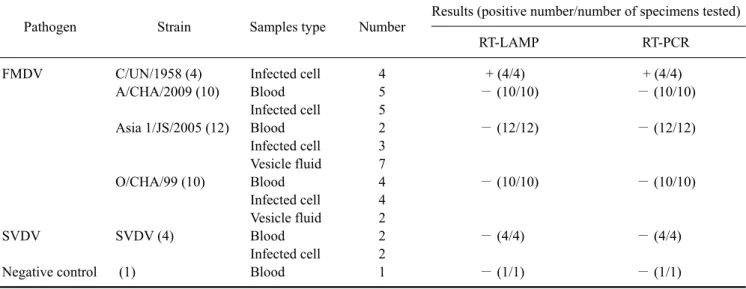
Table 1. Results of the reverse transcription loop-mediated isothermal amplification (RT-LAMP) analysis of 41 clinical samples
Pathogen Strain Samples type Number Results (positive number/number of specimens tested)
RT-LAMP RT-PCR
FMDV
SVDV
Negative control
C/UN/1958 (4) A/CHA/2009 (10) Asia 1/JS/2005 (12)
O/CHA/99 (10)
SVDV (4) (1)
Infected cell Blood Infected cell Blood Infected cell Vesicle fluid Blood Infected cell Vesicle fluid Blood Infected cell Blood
4 5 5 2 3 7 4 4 2 2 2 1
+ (4/4)
− (10/10)
− (12/12)
− (10/10)
− (4/4)
− (1/1)
+ (4/4)
− (10/10)
− (12/12)
− (10/10)
− (4/4)
− (1/1)
+, positive reaction; −, negative control. FMDV: foot-and-mouth disease virus, SVDV: swine vesicular disease virus.Table 2. Sequences of the RT-PCR and RT-LAMP primers designed to detect the VP1 gene of FMDV C
Assay Primer name Sequence
RT-LAMP
RT-PCR F B FIP BIP Upstream Downstream
ACACTGGGAAGCTGACGT GTTGACCCAGGTCTCCTCT CGGGTCAGCGGTCTCTTGTG+T TTT+GCACCGGTTTCTGCACTT CTCTCCCATACACCGCACCAC+T TTT+CGGGTAGTGGCGTAAGTTG GCGAGACGCAAGTCCACCGC GCGCGCCCACGATACCATCT former Union of Soviet Socialist Republics (USSR) was
incubated on Baby Hamster Syrian Kindey Cell (BHK-21), which is a subclone (clone 13) of the parental line established from the kidneys of five unsexed mice, provided by the OIE and China National Foot-and-Mouth Disease Reference Laboratory. Identities of all viruses in the 41 samples (Table 1) were confirmed by RT-PCR, and the procedure is as follows, 50
oC for 30 min, 95
oC for 8 min, 35 cycles of 94
oC for 1 min, 58
oC for 1 min and 72
oC for 1 min, extension at 72
oC for 10 min.
RNA extraction
RNA was extracted from the positive samples which are FMDV O/CHA/1999, A/CHA/2009, and Asia 1/CHA/2005 as well as SVDV provided by China National Foot-and- Mouth Disease Reference Laboratory and blood of healthy pig which was negatively detected by RT-PCR or ELISA for FMDV assay, with a TaKaRa MiniBEST Viral RNA/DNA Extraction Kit (ver. 4.0; Takara Bio, Japan) according to the manufacturer’s instructions. After extraction, the RNA was eluted in 30 μL of elution buffer and stored at −70
oC until further use.
Conventional RT-PCR and RT-LAMP
The detection of FMDV by RT-PCR was performed with previously described primers [3]. A conserved sequence in the VP1 region of FMDV C genome was selected as the target sequence for RT-PCR (Table 1) for VP1 can discriminate FMDV C from FMDV O, A and Asia 1 as well as other viruses, such as SVDV. RT-PCR was performed in a 25- μL reaction containing PrimeScript 1 step Enzyme Mix 1 μL (Takara Bio), 2×1 step buffer (Takara Bio) 12.5 μL , RNase Free dH
2O (Takara Bio) 8.9
μL, 0.8 μL of each upstream and downstream primer, template RNA 1 μL.
A set of four RT-LAMP primers including two outer
primers and two inner primers that recognize six distinct
regions in the conserved target sequence of all topotypes of
the virus were designed based on FMDV C genome
sequence alignment in National Center for Biotechnology
Information (GenBank Accession No. M90368.1; Table
2). RT-LAMP was carried out in a conventional water bath
(Beijing Changan Scientific instrument, China) in a 25- μL
reaction containing 2.0 μM each of FIP and BIP primer, 0.2
μM each of F and B primer, 1.0 mM of each
deoxyribonucleoside triphosphate (dNTP), 8 U of Bst
DNA polymerase (New England Biolabs, USA), and 1 U
of THERMO-X reverse transcriptase (Invitrogen, USA),
2.5- μL 10× buffer (containing 4 mM of MgSO
4and 0.8 M
betaine), and 1 μL of extracted template RNA in a 0.2-mL
Eppendorf tube (Axygen Scientific, USA). Amplification
A transcription loop-mediated isothermal amplification assay to rapidly diagnose foot-and-mouth disease virus C 425
Fig. 1. Comparing the sensitivity of RT-LAMP and RT-PCR for the detection of C-type FMDV using agarose gel electrophoresis.
(A) Lane M1, DNA marker DL-100 (1500, 1000, 900, 800, 700, 600, 500, 400, 300, 200 and 100 bp; Takara Bio,Japan). Lanes 1∼
7, different dilutions (3.25 × 10
5ng/mL to 3.25 × 10
−1ng/mL) of FMDV C subjected to the RT-LAMP assay. (B) Lane M2, DNA marker DL-2000 (2000, 1000, 750, 500, 250 and 100 bp; Takara Bio). Lanes 1∼5, different dilutions (3.25 × 10
4ng/mL to 3.25 × 10
0ng/mL) of FMDV C subjected to RT-PCR. RT-PCR products corresponded to specific amplification of the FMDV C VP1 gene with a detection limit of 3.25 × 10
0ng/mL. In contrast, the
detection limit for RT-LAMP was 3.25 × 10
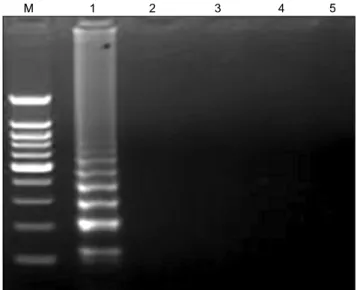
-1ng/mL. Fig. 2. Analysis of RT-LAMP specificity for FMDV C. The ability of the assay to distinguish FMDV C from FMDV A, O, and Asia 1 as well as SVDV was evaluated. Lane M, DNA marker DL-100 (1500, 1000, 900, 800, 700, 600, 500, 400, 300, 200 and 100 bp; Takara Bio); Lane 1, FMDV C; Lane 2, FMDV A; Lane 3, FMDV Asia 1; Lane 4, FMDV O; and Lane 5, SVDV.
was performed at 60
oC for 45 min and then terminated by heating the reactions at 80
oC for 10 min. The RT-LAMP and RT-PCR products were separated by 2.5% agarose gel electrophoresis for analysis.
Measurement of RT-LAMP sensitivity and specificity
To compare the detection limits of RT-LAMP and RT-PCR, 10-fold serial dilutions of all samples [3.25 × 10
5ng/mL to 3.25 × 10
−1ng/mL, measured by DU Series 700 (Beckman Coulter, Germany)] were prepared to analyze the sensitivities of the two techniques. To assess the specificity of RT-LAMP, 41 clinical samples including 4 FMDV C, 10 FMDV A, 12 FMDV Asia 1, 10 FMDV O, 4 PRRSV, and one negative control (Table 1) were analyzed.
Results
Comparison of RT-LAMP and RT-PCR sensitivity A positive RT-LAMP result was associated with the appearance of many bands of different sizes viewed by agarose electrophoresis. Amplification by RT-LAMP produced different bands with a ladder-like pattern (Fig. 1).
To compare the sensitivity and detection limits of RT-LAMP and RT-PCR, we used both techniques to evaluate the same FMDV C samples. As shown in Fig. 1, the detection limit of RT-PCR was 3.25 × 10
0ng/mL. In contrast, the detection limit of RT-LAMP was about 3.25 × 10
-1ng/mL which was 10 times higher than the limit of conventional RT-PCR.
Evaluation of FMDV RT-LAMP specificity
Agarose gel electrophoresis analysis indicated that only
FMDV C RNA produced a specific positive reaction with RT-LAMP. No cross-reactivity was observed with the SVDV, FMDV O, FMDV A, or FMDV Asia 1 samples.
The healthy tissues produced a negative reaction (Fig. 2).
Discussion
FMDV is an important veterinary pathogen that can cause widespread epidemics. Early detection of FMD is essential for effective disease control. Simple, rapid, and noninvasive diagnostic tests are critical for FMD diagnosis.
Previous studies [1,11] indicated that FMDV C may circulate without being detected. Therefore, the development of a highly sensitive assay for detecting FMDV C is critical for preventing and controlling FMDV C epidemics. The four samples containing FMDV C were identified as positive while the one negative control and 36 samples containing other viruses were identified as negative (Table 1). The assay can be completed within 1 h.
Due to its rapidity, sensitivity, and specificity, the RT-LAMP assay is suitable for making clinical diagnoses and FMDV C surveillance. Results from this study indicated that RT-LAMP was 10 times more sensitive than traditional RT-PCR. The detection limit of RT-LAMP demonstrated that this assay would increase the likelihood of recognizing FMDV C in animals or animal products.
Furthermore, RT-LAMP might be developed for
confirming virus serotypes.
426 Yao-zhong Ding et al.